

EN 17948:2024
(Main)Maintenance management and functions
- Abstract
This document specifies the main content of maintenance management and the main activities for which maintenance management is responsible.
This document is applicable to maintenance managers and asset managers in the industry sector and for infrastructure and buildings in order to achieve the success factors of the organization.
- Status
- Published
- Publication Date
- 05-Nov-2024
- Technical Committee
- CEN/TC 319 - Maintenance
- Drafting Committee
- CEN/TC 319/WG 8 - Maintenance management
- Current Stage
- 6060 - Definitive text made available (DAV) - Publishing
- Start Date
- 06-Nov-2024
- Due Date
- 22-Apr-2024
- Completion Date
- 06-Nov-2024

EN 17948:2024 - Maintenance management and functions (CEN)
Overview
EN 17948:2024, published by CEN/TC 319, defines the main content of maintenance management and the core activities for which maintenance management is responsible. Applicable to the industry sector and to infrastructure and buildings, the standard guides maintenance and asset managers in designing a maintenance management process that supports organizational success factors - safety, availability, cost control, environmental protection and asset life‑cycle performance.
Key Topics
The standard covers a structured maintenance framework and management requirements without prescribing specific technical solutions. Major topics include:
- Maintenance framework: contributions, challenges, types of maintenance, the maintenance process and life‑cycle requirements for physical assets.
- Maintenance management fundamentals: objectives, policy and strategy, including choices between corrective, preventive and condition‑based approaches.
- Organizational structure: maintenance functions, job profiles, maintenance levels and echelons (first‑line/field, workshop, manufacturer), and allocation of responsibilities.
- Maintenance process and control: planning, scheduling, control, performance monitoring and continuous improvement.
- Influencing factors: operating conditions, safety, environmental and economic drivers that shape maintenance decisions.
- Support processes: documentation, contracts, personnel competence and qualification, logistics and spare parts management.
- Performance measurement: indicators and scorecards to monitor availability, reliability, costs, safety and environmental performance.
- Annexes: a map of related CEN/TC 319 maintenance standards (management, methodologies, resources) and examples of maintenance levels.
Normative references cited include EN 13306:2017 (maintenance terminology) and EN 17007:2017 (maintenance process and associated indicators).
Applications
EN 17948:2024 is intended for:
- Maintenance managers and asset managers in manufacturing, utilities, transport, infrastructure and facilities management.
- Facility and building managers seeking to align maintenance with organizational objectives and regulatory/compliance needs.
- Operational leaders and procurement teams defining internal vs. outsourced maintenance strategies and contracts.
- Consultants and systems integrators implementing maintenance processes, CMMS/EAM configurations, KPI dashboards, and competence frameworks.
Practical uses:
- Developing maintenance policy and strategy aligned with business goals.
- Defining maintenance organization, roles, and maintenance levels/echelons.
- Establishing KPIs and scorecards to measure reliability, availability and cost effectiveness.
- Aligning maintenance with asset life‑cycle planning, safety and sustainability objectives.
Related Standards
- EN 13306:2017 - Maintenance terminology
- EN 17007:2017 - Maintenance process and associated indicators
- CEN/TC 319 suite - additional standards on maintenance methodologies, resources and management (mapped in Annex A of EN 17948)
Keywords: maintenance management, asset management, maintenance policy, maintenance strategy, maintenance process, CEN, EN 17948:2024, maintenance functions, facilities management, maintenance KPIs.
Relations
- Effective Date
- 28-Jan-2026
- Effective Date
- 28-Jan-2026
- Referred By
EN ISO 18369-2:2017 - Ophthalmic optics - Contact lenses - Part 2: Tolerances (ISO 18369-2:2017) - Effective Date
- 28-Jan-2026
Get Certified
Connect with accredited certification bodies for this standard

Great Wall Tianjin Quality Assurance Center
Established 1993, first batch to receive national accreditation with IAF recognition.
Hong Kong Quality Assurance Agency (HKQAA)
Hong Kong's leading certification body.

Innovative Quality Certifications Pvt. Ltd. (IQCPL)
Known for integrity, providing ethical & impartial Assessment & Certification. CMMI Institute Partner.
Sponsored listings
Frequently Asked Questions
EN 17948:2024 is a standard published by the European Committee for Standardization (CEN). Its full title is "Maintenance management and functions". This standard covers: This document specifies the main content of maintenance management and the main activities for which maintenance management is responsible. This document is applicable to maintenance managers and asset managers in the industry sector and for infrastructure and buildings in order to achieve the success factors of the organization.
This document specifies the main content of maintenance management and the main activities for which maintenance management is responsible. This document is applicable to maintenance managers and asset managers in the industry sector and for infrastructure and buildings in order to achieve the success factors of the organization.
EN 17948:2024 is classified under the following ICS (International Classification for Standards) categories: 03.080.10 - Maintenance services. Facilities management. The ICS classification helps identify the subject area and facilitates finding related standards.
EN 17948:2024 has the following relationships with other standards: It is inter standard links to EN 13306:2017, EN 17007:2017, EN ISO 18369-2:2017. Understanding these relationships helps ensure you are using the most current and applicable version of the standard.
EN 17948:2024 is available in PDF format for immediate download after purchase. The document can be added to your cart and obtained through the secure checkout process. Digital delivery ensures instant access to the complete standard document.
Standards Content (Sample)
SLOVENSKI STANDARD
01-januar-2025
Vodenje vzdrževanja in funkcije
Maintenance management and functions
Instandhaltungsfunktion und -management
Fonction maintenance et management de la maintenance
Ta slovenski standard je istoveten z: EN 17948:2024
ICS:
03.080.10 Vzdrževalne storitve. Maintenance services.
Upravljanje objektov Facilities management
2003-01.Slovenski inštitut za standardizacijo. Razmnoževanje celote ali delov tega standarda ni dovoljeno.
EN 17948
EUROPEAN STANDARD
NORME EUROPÉENNE
November 2024
EUROPÄISCHE NORM
ICS 03.080.10
English Version
Maintenance management and functions
Management de la maintenance et fonctions Instandhaltungsmanagement und -funktionen
This European Standard was approved by CEN on 30 September 2024.
CEN members are bound to comply with the CEN/CENELEC Internal Regulations which stipulate the conditions for giving this
European Standard the status of a national standard without any alteration. Up-to-date lists and bibliographical references
concerning such national standards may be obtained on application to the CEN-CENELEC Management Centre or to any CEN
member.
This European Standard exists in three official versions (English, French, German). A version in any other language made by
translation under the responsibility of a CEN member into its own language and notified to the CEN-CENELEC Management
Centre has the same status as the official versions.
CEN members are the national standards bodies of Austria, Belgium, Bulgaria, Croatia, Cyprus, Czech Republic, Denmark, Estonia,
Finland, France, Germany, Greece, Hungary, Iceland, Ireland, Italy, Latvia, Lithuania, Luxembourg, Malta, Netherlands, Norway,
Poland, Portugal, Republic of North Macedonia, Romania, Serbia, Slovakia, Slovenia, Spain, Sweden, Switzerland, Türkiye and
United Kingdom.
EUROPEAN COMMITTEE FOR STANDARDIZATION
COMITÉ EUROPÉEN DE NORMALISATION
EUROPÄISCHES KOMITEE FÜR NORMUNG
CEN-CENELEC Management Centre: Rue de la Science 23, B-1040 Brussels
© 2024 CEN All rights of exploitation in any form and by any means reserved Ref. No. EN 17948:2024 E
worldwide for CEN national Members.
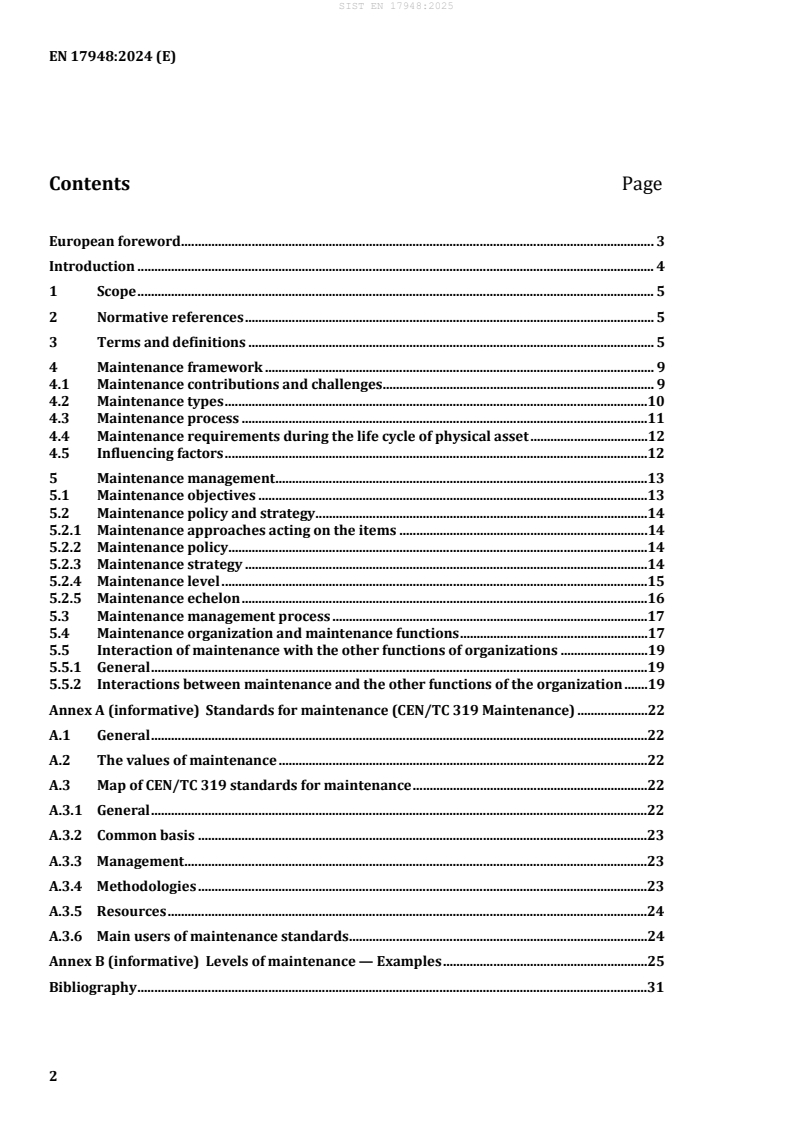
Contents Page
European foreword . 3
Introduction . 4
1 Scope . 5
2 Normative references . 5
3 Terms and definitions . 5
4 Maintenance framework . 9
4.1 Maintenance contributions and challenges . 9
4.2 Maintenance types .10
4.3 Maintenance process .11
4.4 Maintenance requirements during the life cycle of physical asset .12
4.5 Influencing factors .12
5 Maintenance management .13
5.1 Maintenance objectives .13
5.2 Maintenance policy and strategy .14
5.2.1 Maintenance approaches acting on the items .14
5.2.2 Maintenance policy .14
5.2.3 Maintenance strategy .14
5.2.4 Maintenance level .15
5.2.5 Maintenance echelon .16
5.3 Maintenance management process .17
5.4 Maintenance organization and maintenance functions .17
5.5 Interaction of maintenance with the other functions of organizations .19
5.5.1 General .19
5.5.2 Interactions between maintenance and the other functions of the organization .19
Annex A (informative) Standards for maintenance (CEN/TC 319 Maintenance) .22
A.1 General .22
A.2 The values of maintenance .22
A.3 Map of CEN/TC 319 standards for maintenance .22
A.3.1 General .22
A.3.2 Common basis .23
A.3.3 Management .23
A.3.4 Methodologies .23
A.3.5 Resources .24
A.3.6 Main users of maintenance standards .24
Annex B (informative) Levels of maintenance — Examples .25
Bibliography .31
European foreword
This document (EN 17948:2024) has been prepared by Technical Committee CEN/TC 319
“Maintenance”, the secretariat of which is held by UNI.
This European Standard shall be given the status of a national standard, either by publication of an
identical text or by endorsement, at the latest by May 2025, and conflicting national standards shall be
withdrawn at the latest by May 2025.
Attention is drawn to the possibility that some of the elements of this document may be the subject of
patent rights. CEN shall not be held responsible for identifying any or all such patent rights.
Any feedback and questions on this document should be directed to the users’ national standards body.
A complete listing of these bodies can be found on the CEN website.
According to the CEN-CENELEC Internal Regulations, the national standards organisations of the
following countries are bound to implement this European Standard: Austria, Belgium, Bulgaria, Croatia,
Cyprus, Czech Republic, Denmark, Estonia, Finland, France, Germany, Greece, Hungary, Iceland, Ireland,
Italy, Latvia, Lithuania, Luxembourg, Malta, Netherlands, Norway, Poland, Portugal, Republic of North
Macedonia, Romania, Serbia, Slovakia, Slovenia, Spain, Sweden, Switzerland, Türkiye and the United
Kingdom.
Introduction
This document is part of a set of maintenance standards produced by CEN/TC 319 where it holds a central
place because it introduces maintenance, its organization and management and establishes close links
with the other standards of CEN/TC 319. Annex A presents the framework and an overview of the
available CEN/TC 319 maintenance standards divided into four groups: Common basis, Management,
Methodologies, and Resources. This document belongs to the Management group.
Maintenance is a set of activities that requires effective management able to anticipate, react quickly to
events, and adapt to business changes. It has an essential role in controlling plant safety and occupational
and environmental risks as well as ensuring the competitiveness and the durability of organisations and
companies.
Therefore, the importance of effective maintenance management is major, and this document gives
guidelines for maintenance managers to develop a process contributing to the success factors defined by
the managing board. It is based on the existing European standards, and particularly those which describe
the role of maintenance within asset management, the maintenance processes and their inter-
relationships, the maintenance of buildings and infrastructures, maintenance key performance
indicators, maintenance support processes such as documentation, contracts, qualification of
maintenance personnel, etc.
This document is intended to help maintenance managers develop the maintenance management process
in its various aspects (maintenance policy, maintenance objectives, maintenance strategy, internal/
outsourced activities, organization of functions, job profiles and responsibilities, budgets, supervision of
maintenance activities, communication, and continuous improvement).
Annex A presents a summary of other standards for maintenance which have been prepared by
CEN/TC 319
Annex B describes examples of levels of maintenance.
1 Scope
This document specifies the main content of maintenance management and the main activities for which
maintenance management is responsible.
This document is applicable to maintenance managers and asset managers in the industry sector and for
infrastructure and buildings in order to achieve the success factors of the organization.
2 Normative references
The following documents are referred to in the text in such a way that some or all of their content
constitutes requirements of this document. For dated references, only the edition cited applies. For
undated references, the latest edition of the referenced document (including any amendments) applies.
EN 13306:2017, Maintenance - Maintenance terminology
EN 17007:2017, Maintenance process and associated indicators
3 Terms and definitions
For the purposes of this document, the following terms and definitions apply.
ISO and IEC maintain terminology databases for use in standardization at the following addresses:
— ISO Online browsing platform: available at https://www.iso.org/obp/
— IEC Electropedia: available at https://www.electropedia.org/
3.1
item
part, component, device, subsystem, functional unit, equipment or system that can be individually
described and considered
Note 1 to entry: A number of items e.g. a population of items, or a sample, may itself be considered as an item.
Note 2 to entry: An item may consist of hardware, software or both.
Note 3 to entry: Software consists of programs, procedures, rules, documentation, and data of an information
processing system.
[SOURCE: EN 13306:2017, definition 3.1]
3.2
physical asset
item that has potential or actual value to an organization
Note 1 to entry: Examples of physical assets are components, machines, plants, buildings, infrastructures, etc.
[SOURCE: EN 13306:2017, definition 3.2]
3.3
maintenance
combination of all technical, administrative and managerial actions during the life cycle of an item
intended to retain it in, or restore it to, a state in which it can perform the required function
Note 1 to entry: Technical maintenance actions include observation and analyses of the item state (e.g. inspection,
monitoring, testing, diagnosis, prognosis, etc.) and active maintenance actions (e.g. repair, refurbishment).
Note 2 to entry: See also the definitions of improvement and modification.
[SOURCE: EN 13306:2017, definition 2.1]
3.4
maintenance management
all activities of the management that determine the maintenance requirements, objectives, strategies and
responsibilities, and implementation of them by such means as maintenance planning, maintenance
control, and the improvement of maintenance activities and economics
[SOURCE: EN 13306:2017, definition 2.2]
3.5
process
set of interrelated or interacting activities that use inputs to deliver an intended result
[SOURCE: EN ISO 9000:2015, definition 3.4.1, modified]
3.6
maintenance function
role and responsibility entrusted to entities within an organization for achieving maintenance objectives
3.7
maintenance policy
general approach to the provision of maintenance and maintenance support based on the objectives and
policies of owners, users and customers
Note 1 to entry: The maintenance policy entails establishing the direction (method, programme, budget, etc.) based
on the goals and objectives set by the company's Management.
The management focus in the policy statement can be:
— availability and useful life of the item;
— safety of the items and individuals, product quality, environmental protection;
— optimization of maintenance costs, etc.
In particular, the maintenance policy give guidance to maintenance strategy that leads to choices being made
between:
— planning corrective and/or preventive, predetermined or condition-based maintenance;
— internal or external service provision.
[SOURCE: EN 17007:2017, definition 3.8]
3.8
maintenance strategy
management method used in order to achieve the maintenance objectives
EXAMPLE Outsourcing of maintenance, allocation of resources, etc.
[SOURCE: EN 13306:2017, definition 2.4]
3.9
life cycle
series of stages through which an item goes, from its conception to disposal
EXAMPLE A typical system life cycle consists of acquisition, operation, maintenance, modernization,
decommissioning and/or disposal.
Note 1 to entry: The stages identified will vary with the application.
[SOURCE: EN 13306:2017, definition 4.18]
3.10
sustainable development
development that meets the needs of the present without compromising the ability of future generations
to meet their own needs
[SOURCE: UN Brundtland Commission report, 1987]
3.11
indenture level
level of sub-division within an item hierarchy
EXAMPLE System, subsystem and component.
Note 1 to entry: From the maintenance perspective, the indenture level depends on the complexity of the item's
construction, the accessibility to sub-items, skill level of maintenance personnel, test equipment facilities, safety
considerations, etc.
[SOURCE: EN 13306:2017, definition 3.7]
3.12
line of maintenance
maintenance echelon
position in an organization where specified levels of maintenance are to be carried out on an item
EXAMPLE Field (first line maintenance), workshop (second line maintenance) and manufacturer (third line
maintenance).
Note 1 to entry: The lines of maintenance are characterized by the skill required of the personnel, the facilities
available, the location, the complexity of the maintenance task, etc.
[SOURCE: EN 13306:2017, definition 10.3]
3.13
maintenance level
maintenance task categorization by complexity
EXAMPLES
— Level 1 is characterized by simple actions carried out with minimal training.
— Level 2 is characterized by basic actions which have to be carried out by qualified personnel using detailed
procedures.
— Level 3 is characterized by complex actions carried out by qualified technical personnel using detailed
procedures.
— Level 4 is characterized by actions which imply the know-how of a technique or a technology and carried out
by specialized technical personnel.
— Level 5 is characterized by actions which imply a knowledge held by the manufacturer or a specialized
company with industrial logistic support equipment.
Note 1 to entry: The maintenance level may be related to the indenture level.
[SOURCE: EN 13306:2017, definition 7.18]
3.14
competence
proven ability to use knowledge, skills, and personal, social and/or methodological abilities, in work or
study situations and in professional and personal development
Note 1 to entry: Competence is described in terms of responsibility and autonomy.
[SOURCE: EN 15628:2014, definition 3.1]
3.15
indicator
quantitative or qualitative measure of a characteristic or a set of characteristics of a phenomenon or
performance of activities, according to defined criteria or a given formula or questionnaire
Note 1 to entry: The indicator is a tool for development and implementation of a strategy for monitoring progress
towards the goals outlined in the strategy.
[SOURCE: EN 15341:2019+A1:2022, definition 3.3]
3.16
scorecard
set of associated, consistent, and complementary indicators providing synthetic and global information
Note 1 to entry: It is a tool for the development and implementation of a strategy and for monitoring progress
towards the goals outlined in the strategy.
3.17
maintenance objectives
targets assigned and accepted for the maintenance activities
Note 1 to entry: These targets may include for example availability, cost reduction, product quality, environment
preservation, safety, useful life, asset value preservation.
[SOURCE: EN 13306:2017, definition 2.3]
3.18
intrinsic reliability
inherent reliability
reliability of an item determined by design and manufacture under expected conditions of operation
assuming that no preventive maintenance task is carried out, excepting routine maintenance
[SOURCE: EN 13306:2017, definition 4.2, modified, note to entry deleted]
3.19
operational reliability
actual reliability of an item considering operating modes, operating conditions and possible preventive
maintenance actions carried out
[SOURCE: EN 13306:2017, definition 4.4]
4 Maintenance framework
4.1 Maintenance contributions and challenges
Maintenance is a shield to defend against undesirable events and, as such, maintenance implements
defensive tasks and contributes to risk management and dependability as indicated in EN 60300-3-1.
Maintenance is also a crucial way to optimize the performance of an organization and, as such, it strongly
contributes to Asset Management, introduced in the ISO 55000 standard, aiming to translate into
decisions and actions the strategic objectives of companies and organisations. This is achieved by acting
on the processes of design, acquisition and sale, renovation, production, and maintenance. Maintenance
is indeed an essential area to ensure efficient and profitable management of assets. Coordinated with the
other processes, maintenance optimizes the value created and plays a key role in asset management (see
EN 16646:2014 and EN 17485:2021).
Maintenance is as well a basic pillar of sustainable development. There are four intertwined dimensions
to sustainable development: society, environment, culture and economy. In 2015, the United Nations
adopted its Agenda 2030 with 17 sustainable development goals. Designing a physical asset by planning
and facilitating its maintenance and then constantly maintaining it in good condition during its life cycle
is to ensure a longer life. This therefore helps to reduce raw materials and energy to rebuild it, which is a
benefit for the environment and for economic efficiency. It is also giving work locally because
maintenance is a set of local activities, which is social benefit. Three characteristics of sustainable
development are thus met by maintenance.
Maintenance brings together many technical, administrative and managerial professions and which is
directly concerned by the rise of digitization. In the context of “enabling technologies” there will be
considerable developments, both in the techniques of fault diagnosis and prognosis and in the
implementation of new maintenance strategies.
4.2 Maintenance types
Maintenance consists of managerial, administrative and technical activities to be performed on the
physical assets to enable them carrying out the required function and upstream and downstream
maintenance activities as described in EN 17007:2017 and Annex A.
The various types of maintenance have different characteristics that make them very complementary. A
maintenance strategy is built by choosing the types of tasks to be privileged according to the physical
assets, the operational context, and the strategic objectives of the company.
Maintenance is distinguished in three main types:
a) Corrective maintenance which is carried out after a fault detection and consists in restoring the item
in a condition to perform its required function. It will be the more effective when maintainability of
the item is high, and the logistic support is adequate. This corrective maintenance can also be chosen
when it is decided that it is better to run to failure than to perform tasks to avoid it. This can be the
case when the failure has no direct effect on functions immediately required and corrective
maintenance can be postponed and scheduled for a chosen date.
b) Preventive maintenance is used to prevent failures and therefore shall be performed before
acceptable performance of the required function is lost. It may increase the operational reliability
and/or the availability of items. There are several types of preventive maintenance which are
described below.
c) Improvement of technical characteristics of items which consists of improving their intrinsic
reliability, maintainability, or safety by modifying their design or manufacture. When possible, the
result can be more efficient and sustainable than using preventive maintenance, which does not
change the intrinsic reliability of assets but only their operational reliability.
Preventive maintenance in turn distinguishes several types:
d) Predetermined maintenance which consists of performing preventive action on an item at given
instants according to a determined number of units of use. This maintenance consists of replacing
components, adjusting, lubricating, cleaning, preventively repairing all, or parts of, an item.
Therefore, it is active preventive maintenance carried out without observing at first the state of the
item. It is fully justified when a failure mechanism is known (wear, aging, for example) and the date
of the failure can be established based on units of use.
e) Condition based maintenance which contains tasks to observe the state of an item and active
preventive maintenance tasks which are performed, or not, depending on the actual item state.
Observations can consist of physical measurements with sensors (vibrations, temperatures,
intensities, images, etc.) or sense-based observations (visual, noise, etc.). Two types of condition-
based maintenance can be discerned:
1) non-predictive condition-based maintenance when the active preventive maintenance action to
restore the item is triggered by exceeding a given threshold, but there is no possibility to predict
the date of the failure;
2) predictive maintenance when advanced methods and techniques of observation and analysis
make it possible to optimally forecast the date to perform the active preventive maintenance
task.
Predictive maintenance is now the subject of much promising research thanks to the very fast progress
of digital technology. It is based on the development of multiple techniques that make it possible to
diagnose the state of items and forecast their evolution.
4.3 Maintenance process
Maintenance consists of a set of organized and coordinated activities, using resources and carried out by
various actors to achieve a given result. According to EN ISO 9001 definition, maintenance is a process
which itself consists of many sub-processes described in detail in EN 17007:2017. The sub-processes that
comprise it are classified into three distinct categories:
a) The management process, which is the subject of this document. It determines maintenance
objectives, policy and strategy. It establishes the organization of maintenance within the company,
allocates the necessary resources, ensures consistency between actions, allows communication and
measures results to continuously improve performances.
b) The realization processes, which are the fundamental purpose of maintenance. They contain
maintenance tasks belonging to the different types presented above (corrective, preventive,
improvement), but also the actions defining, preparing, scheduling, launching and closing these tasks.
c) The support processes, which provide the resources and services necessary for the entire
maintenance process.
The maintenance requires different kind of resources such as documents, tools, test equipment, people,
spare parts, facilities, etc. The provision of those resources requires maintenance activities which are
implemented by maintenance processes described in EN 17007:2017.
They lead to maintenance activities to:
1) Ensure personal health and safety to individuals and preserve environment.
2) Budget maintenance of items.
3) Deliver the operational documentation.
4) Manage data.
5) Provide the needed infrastructures.
6) Deliver maintenance requirements during items design and modification.
7) Provide internal human resources.
8) Provide external maintenance services.
9) Deliver spare parts.
10) Deliver the tools, support equipment and information system.
11) Improve the results.
4.4 Maintenance requirements during the life cycle of physical asset
Maintenance shall be considered over the entire life cycle of a physical asset and not just during the
operating phase. Indeed, many specific tasks shall be carried out from the initial design and during all the
following phases (manufacturing, installation/commissioning, operation and maintenance,
modernization/renovation/life cycle extension, disposal). More especially, it is during the first phases of
the life cycle that the intrinsic reliability, maintainability and safety of the physical assets are determined,
and these characteristics are critical to the life cycle cost and economic performance.
Therefore, maintenance management covers all the asset life cycle and maintenance activities.
Maintenance engineering is generally responsible for intervening during the design phase so that
maintenance requirements are considered. This is especially the subject of the RAMS (Reliabilty,
Availability, Maintainability and Safety) and ILS (Integrated Logistic Support) studies that should be
considered during this phase to establish preliminary maintenance plan and logistic support.
Maintenance requirements result mainly from availability, safety, and cost objectives, and are defined in
terms of reliability and maintainability of items and the logistic support required. Intrinsic
maintainability and reliability requirements are defined during the design phase and usually verified
before commissioning. Operational maintainability and reliability requirements are achieved by
implementing preventive maintenance plans and performing corrective maintenance tasks with the
logistic support defined by the organization.
4.5 Influencing factors
Management intervenes at many levels and each employee of a company manage its part, but the
management of maintenance referred to in this document concerns more particularly maintenance
managers, assets managers, directors in charge of supervision and strategic decisions.
The maintenance management is closely linked to the strategic plan of the organization which depends
on various internal or external influencing factors affecting the performance of the organization and
introducing uncertainties with economic consequences. These factors should be regularly reviewed and
their effects on critical success factors should be analysed to determine and continuously improve
maintenance objectives, policy and strategy consistent with Strategic asset management plan. These
factors include the following:
External influencing factors (main examples):
1) Locations.
2) Society, culture.
3) Laws, regulations, national labour policies.
4) Markets.
5) Sectors/branches.
6) Economy.
7) Stakeholders.
8) Technologies and processes.
9) Environmental conditions.
Internal influencing factors (main examples):
1) Company culture.
2) Maintenance competence.
3) Economic.
4) Company size and structure.
5) Processes severity and criticality of physical assets.
6) Processes and technologies complexity.
7) Nature, size, complexity, age, integrity, status and utilization rate of physical assets.
8) Products/services mix.
5 Maintenance management
5.1 Maintenance objectives
Maintenance objectives shall be clearly and rigorously aligned with the key success factors of the
company/organization. These are defined by company management and may relate to different aspects
such as production volume or operating rate, quality of products or services, cost control, investments,
image and reputation of the company, environmental and societal commitments (sustainability,
occupational safety, social responsibility, and risk management), market shares, technological leadership,
etc. Standards, including ISO 55000, the ISO 14000 series, EN ISO 26000, and the ISO 45000 series can be
useful to manage these success factors.
These objectives are common to all the processes of the company/organization and maintenance shall
define its own objectives by coordinating with the other processes (design /acquisition, sale, operation,
renovation, disposal, human resources, etc.). Indeed, silo behaviour can only lead to poor overall
performance and shall be avoided. The main role of maintenance management is therefore to establish
strong relationships with all the actors responsible for the various other processes (see EN 16646 and
EN 17485:2021) to determine the contribution of each one in the achievement of the success factors and
to deduce specific objectives.
The specific objectives of maintenance are as follows:
a) Guarantee the safety of the item (plant, system, installation, building, infrastructure, etc.), i.e. control
the risks to populations and assets and avoid environmental disasters (fires, explosions,
contamination, etc.).
b) Guarantee the health and safety of workers, especially maintenance personnel during performance
of maintenance tasks.
c) Preserve environment against nuisances or harmful wastes.
d) Ensure the production or service availability of the item.
e) Control and optimize the maintenance costs.
f) Ensure the durability of the item until its planned end of operation or expected life.
g) Preserve the asset value in anticipation of possible sale.
h) Ensure the quality of products and services.
Depending on their contribution to the success factors, the various objectives shall be prioritized, and
requirements can be allocated (e.g. availability: 95 %, no entry into safety procedure, etc.).
5.2 Maintenance policy and strategy
5.2.1 Maintenance approaches acting on the items
Maintenance plans can be established based on criticality analysis.
The maintenance process acts on the different objectives with the following different approaches:
a) Preventive maintenance to control the operational reliability of the items.
b) Corrective maintenance to make items available after failure within time limits and at costs which
depend on their operational maintainability.
c) Item’s improvements to increase their intrinsic reliability and maintainability.
In addition to these three maintenance types, maintenance support is used to bring the organization a
better effectiveness to maintain the item.
Through these approaches the maintenance process acts on the operational reliability and
maintainability of the equipment, and therefore on their availability. This makes it possible to achieve
satisfactory levels for the various objectives potentially concerned.
It should be noted that some of these objectives are antagonistic and they cannot meet their maximum
level all together (for example: safety can lead to unavailability and costs). This is where the equipment
reliability and maintainability levels come into play and shall be adjusted to obtain the best compromise.
It should be underlined that reliability is not always an objective. Indeed, in some cases, a high objective
of operational reliability could lead to unacceptable levels of unavailability and costs.
To summarize what has just been said, maintenance management shall set the objectives in line with the
success factors and then find the right compromise between them. Next, the appropriate approaches shall
be selected to achieve the levels of reliability and maintainability of the items required to reach the
expected results. This translates into the maintenance policy and strategy.
5.2.2 Maintenance policy
Maintenance policy is defined by the company management.
Maintenance policy determines framework for maintenance management. It defines the maintenance
objectives and sets the basis for maintenance planning, maintenance support, maintenance budget, etc.,
considering the external environment (laws, decrees, codes, regulations, standards, etc.). This implies
making choices between the maintenance types to be preferred (corrective, preventive, predetermined,
condition-based or predictive maintenance) or the other levers (improvement of items, logistic support).
The maintenance policy also sets the indenture levels where maintenance shall be carried out, the
maintenance levels and maintenance echelons, and then make choices between insourced and/or
outsourced maintenance.
5.2.3 Maintenance strategy
Maintenance strategy is proposed by the maintenance management.
The maintenance strategy results from the maintenance policy and make more detailed choices to
achieve, the objectives set. It gives guidelines to:
1) develop, adapt, or implement maintenance methods;
2) draw up and optimize the maintenance instructions;
3) organize the maintenance teams;
4) insource and/or outsource the maintenance tasks partially or totally;
5) define, manage, and optimize the stock of spare parts and consumables, the documentation, the tools,
etc.;
6) decide on the modernization or the improvement of the items on the basis of the analysis of their
economic impact (payback period).
The maintenance strategy involves implementing a maintenance plan with quantified objectives and
measurable indicators (see EN 17007:2017, 6.3, PRV process: Prevent undesirable events by avoiding
failures and faults process) and to compare the measured results with the objectives (see – Improve the
Results - process).
The choice between internal or outsourced services is also an important part of the maintenance strategy
(see – Provide Internal Human Resource – and - Provide external maintenance services - processes)
which is concerned by:
1) selection, assessment, and recruitment of maintenance personnel;
2) staff training and information;
3) management of skills and authorizations;
4) communication, etc.
5.2.4 Maintenance level
5.2.4.1 General
The maintenance policy and strategy shall specify the different levels of maintenance as well as the
entities to which they are entrusted. This is particularly important when contracts are made with external
companies so that there is no ambiguity about the responsibilities. The persons in charge of the tasks can
be:
a) the users of the items (or the occupants of the buildings);
b) the maintenance personnel, taking into account their qualification;
c) the personnel of the user company or of an external company;
d) a combination of the three.
Five levels are proposed to classify the tasks depending on their complexity (according to
EN 13306:2017). Examples are given in Annex B to illustrate these levels in industrial and building cases.
5.2.4.2 Level 1 of maintenance
Simple actions required for operation, taken on readily accessible parts in complete safety using support
equipment integrated in the item.
This type of action can be performed by the user of the item with, where appropriate, the support
equipment integrated in the item and with the help of the instructions for use or maintenance (see
example in Annex B).
5.2.4.3 Level 2 of maintenance
Actions requiring simple instructions and/or support equipment that is easy to use or implement.
This type of maintenance action is taken by qualified and/or authorized personnel, with detailed
instructions and the support equipment defined in the instructions for maintenance.
Personnel is qualified and/or authorized when they have followed training that enables them to work
safely on items presenting certain potential risks and are recognized as being fit to perform the assigned
work, in view of their skills (see example in Annex B).
5.2.4.4 Level 3 of maintenance
Actions requiring complex instructions and/or portable support equipment that is complex to use or
implement.
This type of maintenance action is taken by qualified and/or authorized technicians, with detailed
instructions and the support equipment defined in the instructions for maintenance (see example in
Annex B).
5.2.4.5 Level 4 maintenance
Actions with instructions requiring mastery of a particular technique or technology and/or the use of
specialized support equipment.
This type of maintenance action is taken by a specialized and/or authorized technician or team, with the
help of any general or special instructions for maintenance (see example in Annex B).
5.2.4.6 Level 5 maintenance
Actions with instructions requiring know-how, calling on techniques or technologies, processes and/or
industrial support equipment.
This type of maintenance action (renovations, rebuilds, etc.) is taken by the manufacturer or by a
specialized and/or authorized department or company, with the support equipment defined by the
manufacturer and, therefore, close to the manufacture of the item concerned (see example in Annex B).
5.2.5 Maintenance echelon
The maintenance echelon specifies the place where the actions are performed. Three echelons are usually
defined:
1) on-site maintenance: the action is performed directly on the item on the spot (on-site maintenance
can be performed remotely);
2) maintenance workshop: the item is taken to an appropriate place on site to be maintained;
3) maintenance at the manufacturer or maintenance by a specialized and/or authorized company: the
item is transported for actions requiring specific tools.
Maintenance task should be carried out at echelon 1, either when they are simple to carry out without
tools which are specific or difficult to transport, either when the item is difficult to disconnect and/or
transport. Echelon 2 should be chosen when maintenance task requires tools that are difficult to
transport and/or the item can be easily replaced to limit unavailability. Echelon 3 should be chosen when
the maintenance task to be carried out requires specific tools or skills available from the manufacturer.
5.3 Maintenance management process
The maintenance management process consists of different sub-processes and actions described in
EN 17007:2017. More especially, it contains the following activities (acronyms in brackets refer to
EN 17007:2017 processes):
a) Define the maintenance objectives in coordination with the other processes of the company and
consistent with its success factors (MAN.1). This approach and the generic objectives of maintenance
are described in 5.2;
b) Establish the maintenance policy and strategy (MAN.1);
c) Identify the internal or external activities (MAN.2) which is a part of the maintenance strategy based
on the maintenance levels;
d) Determine the organization, job profiles and responsibilities (MAN.3). Each company shall define its
own organization based on its context, its culture and its industrial or building sector;
e) Prepare and negotiate the budgets (MAN.4) especially including manpower, spare parts and
consumables, any outsourced services, miscellaneous costs (depreciation, operating costs, etc.).
Budgets are controlled so that any gap detected is analysed and explained to take remedial measures;
f) Oversee the actions (MAN.5), which means to supervise and coordinate, harmonize, and handle the
maintenance processes for which the maintenance functions are responsible. Reviews are made with
those responsible for the actions (internal and external) and monitoring indicators are put in place
to ensure that all processes are well controlled and there is no risk of delay or additional costs or
poor maintenance qualities;
g) Define, select, analyse, and communicate the information (MAN.6). Maintenance management uses
KPI and scorecards to monitor the performances and to inform stakeholders of the results and
perspectives. That contribute to develop the maintenance culture. Communication is particularly
essential to show the role of maintenance, which is not always well understood, and to motivate
maintenance personnel (see MAN.6);
h) Define policy and strategy areas of improvement (MAN.7). This continuous improvement activity is
essential to optimize the performances. It is carried out at all levels of the organization and the
maintenance management mission is to organize this process and anchor it in the company culture.
5.4 Maintenance organization and maintenance functions
Based on the maintenance policy and the choices made by the company management, maintenance
management determines the structural organization to be put in place. It is about determining who does
what, defining job profiles and assigning responsibilities. The choices made between internal activities
and outsourced activities are very important in establishing the internal organization of the company and
the competences required. Indeed, the decision of outsourcing actions leads to activities of supervision
and evaluation while the choice of in-house requires resources and skills to carry out the tasks.
Each company
...