

EN 12972:2018+A1:2024
(Main + Amendment)Tanks for the transport of dangerous goods - Testing, inspection and marking of metallic tanks
- Abstract
This document specifies testing, inspection and marking for the type approval, initial inspection, periodic inspection, intermediate inspection and exceptional check of metallic tanks (shell and equipment) of fixed tanks (tank vehicles), demountable tanks, tank-wagons, portable tanks and tank containers for the transport of dangerous goods.
This document is not applicable to battery-vehicles and battery-wagons comprising cylinders, tubes, pressure drums, bundles of cylinders, and multiple element gas containers (MEGCs), independent of whether the elements are receptacles or tanks.
- Status
- Published
- Publication Date
- 07-May-2024
- Technical Committee
- CEN/TC 296 - Tanks for transport of dangerous goods
- Drafting Committee
- CEN/TC 296/WG 5 - Testing, inspection and marking
- Current Stage
- 6060 - Definitive text made available (DAV) - Publishing
- Start Date
- 08-May-2024
- Due Date
- 03-Jan-2024
- Completion Date
- 08-May-2024

Overview
EN 12972:2018+A1:2024 is the European standard (adopted by SIST) that sets out requirements for the testing, inspection and marking of metallic tanks used in the transport of dangerous goods. It covers type approval, initial, periodic, intermediate and exceptional inspections for a wide range of tank types including fixed tanks (tank vehicles), demountable tanks, tank‑wagons, portable tanks and tank containers. The standard incorporates Amendment A1 (2024) and is intended for use across CEN member states.
Note: this standard explicitly excludes battery‑vehicles and battery‑wagons made up of cylinders, tubes, pressure drums, bundles of cylinders and MEGCs.
Key topics and technical requirements
EN 12972:2018+A1:2024 organizes requirements and procedures into clear technical areas:
- Scope and definitions - terms, symbols and applicable tank types.
- Inspections and tests - requirements for type approval, modification checks, initial, periodic, intermediate and exceptional inspections.
- Non‑destructive testing (NDT) of welds and other critical joints.
- Mechanical tests and dynamic longitudinal impact tests (where applicable to portable tanks and tank‑wagons).
- Pressure and leak testing: hydraulic pressure tests, vacuum tests and leakproofness checks, including test fluids, pressurization and evaluation criteria.
- Inspection of shell interior and exterior - condition of shell, protective linings/coatings, fastenings and earth connections.
- Service equipment and structural components - inspection of fittings, frames and mounting arrangements.
- Documentation, certificates and marking - test reports, inspection certificates and tank plates (marking content is specified; annexes provide templates).
- Annexes - survey tables, technical data sheet for type approval, certificate formats, tank plate details and manufacturing tolerances (references EN 13445‑4 in Annex F).
Practical applications and users
This standard is essential for organizations involved in the lifecycle of tanks for dangerous goods transport:
- Tank manufacturers and designers - to demonstrate compliance during type approval.
- Inspection and certification bodies - to perform initial, periodic and exceptional inspections and issue certificates.
- Transport companies, fleet owners and operators - to ensure tanks remain compliant and safe in service.
- Maintenance and repair workshops - for guidance on post‑repair inspections and marking.
- Regulators and safety managers - for setting operational and compliance requirements.
Using SIST EN 12972 helps reduce leakage and rupture risk, ensures consistent inspection and testing practices, and supports legal and commercial acceptance across European markets.
Related standards
- EN 12972 references other normative documents (see annexes), including EN 13445‑4 for manufacturing tolerances; users should consult referenced standards for complementary technical details.
Keywords: SIST EN 12972, metallic tanks, transport of dangerous goods, testing, inspection, marking, type approval, tank containers, tank‑wagons, portable tanks, NDT, hydraulic pressure test, leakproofness.
Relations
- Effective Date
- 31-Jan-2024
- Effective Date
- 31-Jan-2024
- Effective Date
- 28-Jan-2026
- Effective Date
- 28-Jan-2026
- Effective Date
- 28-Jan-2026
- Effective Date
- 28-Jan-2026
- Effective Date
- 28-Jan-2026
- Effective Date
- 28-Jan-2026
- Effective Date
- 28-Jan-2026
- Effective Date
- 28-Jan-2026
- Effective Date
- 28-Jan-2026
- Effective Date
- 28-Jan-2026
- Effective Date
- 28-Jan-2026
- Effective Date
- 28-Jan-2026
- Effective Date
- 28-Jan-2026
Get Certified
Connect with accredited certification bodies for this standard

CIS Institut d.o.o.
Personal Protective Equipment (PPE) certification body. Notified Body NB-2890 for EU Regulation 2016/425 PPE.
Institut za varilstvo d.o.o. (Welding Institute)
Slovenia's leading welding institute since 1952. ISO 3834, EN 1090, pressure equipment certification, NDT personnel, welder qualification. Only IIW Au

Kiwa BDA Testing
Building and construction product certification.
Sponsored listings
Frequently Asked Questions
EN 12972:2018+A1:2024 is a standard published by the European Committee for Standardization (CEN). Its full title is "Tanks for the transport of dangerous goods - Testing, inspection and marking of metallic tanks". This standard covers: This document specifies testing, inspection and marking for the type approval, initial inspection, periodic inspection, intermediate inspection and exceptional check of metallic tanks (shell and equipment) of fixed tanks (tank vehicles), demountable tanks, tank-wagons, portable tanks and tank containers for the transport of dangerous goods. This document is not applicable to battery-vehicles and battery-wagons comprising cylinders, tubes, pressure drums, bundles of cylinders, and multiple element gas containers (MEGCs), independent of whether the elements are receptacles or tanks.
This document specifies testing, inspection and marking for the type approval, initial inspection, periodic inspection, intermediate inspection and exceptional check of metallic tanks (shell and equipment) of fixed tanks (tank vehicles), demountable tanks, tank-wagons, portable tanks and tank containers for the transport of dangerous goods. This document is not applicable to battery-vehicles and battery-wagons comprising cylinders, tubes, pressure drums, bundles of cylinders, and multiple element gas containers (MEGCs), independent of whether the elements are receptacles or tanks.
EN 12972:2018+A1:2024 is classified under the following ICS (International Classification for Standards) categories: 13.300 - Protection against dangerous goods; 23.020.20 - Vessels and containers mounted on vehicles. The ICS classification helps identify the subject area and facilitates finding related standards.
EN 12972:2018+A1:2024 has the following relationships with other standards: It is inter standard links to EN 12972:2018/FprA1, EN 12972:2018, EN ISO 5817:2023, EN 12663-2:2010+A1:2023, EN ISO 17637:2016, EN ISO 9606-3:1999, EN ISO 15626:2018, EN ISO 10855-1:2024, EN ISO 11666:2018, EN ISO 15614-2:2025, EN ISO 9606-1:2017, EN ISO 9016:2012, EN ISO 6520-1:2007, EN 837-3:1996, EN ISO 15608:2025. Understanding these relationships helps ensure you are using the most current and applicable version of the standard.
EN 12972:2018+A1:2024 is associated with the following European legislation: EU Directives/Regulations: 2008/68/EC; Standardization Mandates: M/TDG. When a standard is cited in the Official Journal of the European Union, products manufactured in conformity with it benefit from a presumption of conformity with the essential requirements of the corresponding EU directive or regulation.
EN 12972:2018+A1:2024 is available in PDF format for immediate download after purchase. The document can be added to your cart and obtained through the secure checkout process. Digital delivery ensures instant access to the complete standard document.
Standards Content (Sample)
SLOVENSKI STANDARD
01-september-2024
Nadomešča:
SIST EN 12972:2018
Cisterne za prevoz nevarnega blaga - Preskušanje, pregled in označevanje
kovinskih cistern
Tanks for the transport of dangerous goods - Testing, inspection and marking of metallic
tanks
Tanks für die Beförderung gefährlicher Güter - Prüfung, Inspektion und Kennzeichnung
von Metalltanks
Citernes destinées au transport des matières dangereuses - Épreuve, contrôle et
marquage des citernes métalliques
Ta slovenski standard je istoveten z: EN 12972:2018+A1:2024
ICS:
13.300 Varstvo pred nevarnimi Protection against dangerous
izdelki goods
23.020.20 Posode in vsebniki, montirani Vessels and containers
na vozila mounted on vehicles
2003-01.Slovenski inštitut za standardizacijo. Razmnoževanje celote ali delov tega standarda ni dovoljeno.
EN 12972:2018+A1
EUROPEAN STANDARD
NORME EUROPÉENNE
May 2024
EUROPÄISCHE NORM
ICS 13.300; 23.020.20 Supersedes EN 12972:2018
English Version
Tanks for the transport of dangerous goods - Testing,
inspection and marking of metallic tanks
Citernes destinées au transport des matières Tanks für die Beförderung gefährlicher Güter -
dangereuses - Épreuve, contrôle et marquage des Prüfung, Inspektion und Kennzeichnung von
citernes métalliques Metalltanks
This European Standard was approved by CEN on 20 May 2018 and includes Amendment 1 approved by CEN on 19 February
2024.
CEN members are bound to comply with the CEN/CENELEC Internal Regulations which stipulate the conditions for giving this
European Standard the status of a national standard without any alteration. Up-to-date lists and bibliographical references
concerning such national standards may be obtained on application to the CEN-CENELEC Management Centre or to any CEN
member.
This European Standard exists in three official versions (English, French, German). A version in any other language made by
translation under the responsibility of a CEN member into its own language and notified to the CEN-CENELEC Management
Centre has the same status as the official versions.
CEN members are the national standards bodies of Austria, Belgium, Bulgaria, Croatia, Cyprus, Czech Republic, Denmark, Estonia,
Finland, France, Germany, Greece, Hungary, Iceland, Ireland, Italy, Latvia, Lithuania, Luxembourg, Malta, Netherlands, Norway,
Poland, Portugal, Republic of North Macedonia, Romania, Serbia, Slovakia, Slovenia, Spain, Sweden, Switzerland, Türkiye and
United Kingdom.
EUROPEAN COMMITTEE FOR STANDARDIZATION
COMITÉ EUROPÉEN DE NORMALISATION
EUROPÄISCHES KOMITEE FÜR NORMUNG
CEN-CENELEC Management Centre: Rue de la Science 23, B-1040 Brussels
© 2024 CEN All rights of exploitation in any form and by any means reserved Ref. No. EN 12972:2018+A1:2024 E
worldwide for CEN national Members.
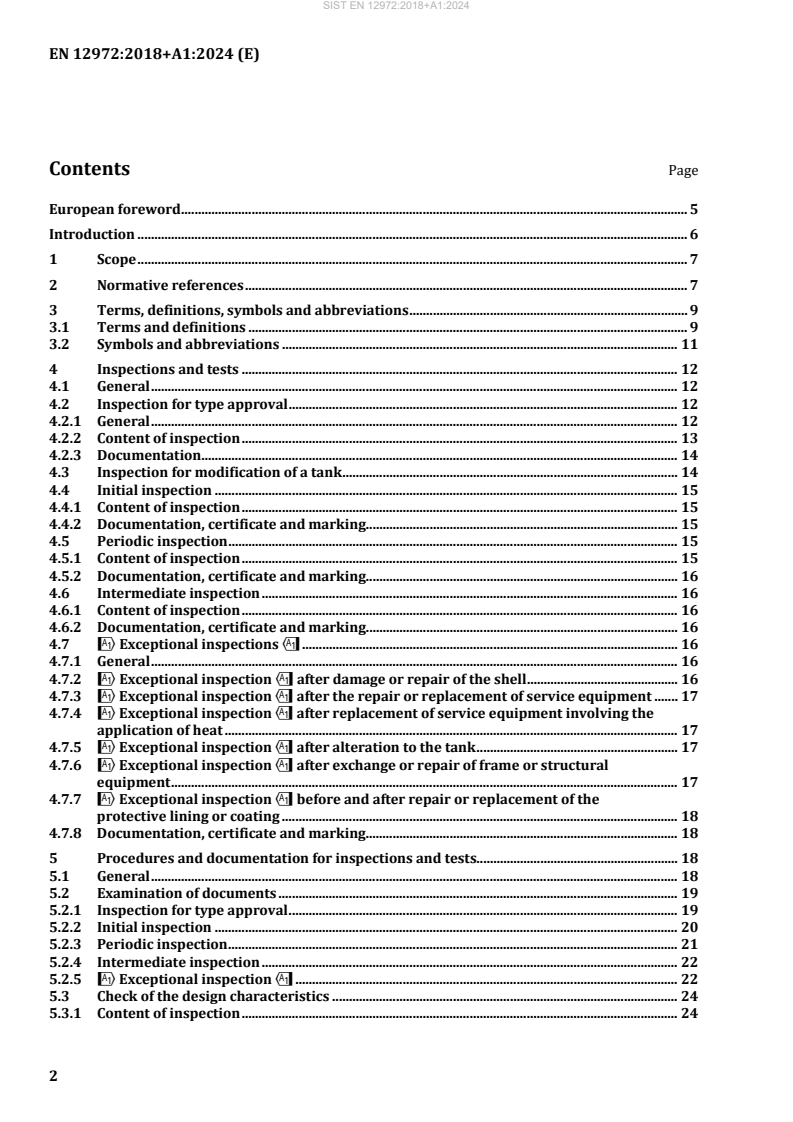
Contents Page
European foreword . 5
Introduction . 6
1 Scope . 7
2 Normative references . 7
3 Terms, definitions, symbols and abbreviations . 9
3.1 Terms and definitions . 9
3.2 Symbols and abbreviations . 11
4 Inspections and tests . 12
4.1 General . 12
4.2 Inspection for type approval . 12
4.2.1 General . 12
4.2.2 Content of inspection . 13
4.2.3 Documentation . 14
4.3 Inspection for modification of a tank . 14
4.4 Initial inspection . 15
4.4.1 Content of inspection . 15
4.4.2 Documentation, certificate and marking. 15
4.5 Periodic inspection . 15
4.5.1 Content of inspection . 15
4.5.2 Documentation, certificate and marking. 16
4.6 Intermediate inspection . 16
4.6.1 Content of inspection . 16
4.6.2 Documentation, certificate and marking. 16
4.7 !Exceptional inspections" . 16
4.7.1 General . 16
4.7.2 !Exceptional inspection" after damage or repair of the shell . 16
4.7.3 !Exceptional inspection" after the repair or replacement of service equipment . 17
4.7.4 !Exceptional inspection" after replacement of service equipment involving the
application of heat . 17
4.7.5 !Exceptional inspection" after alteration to the tank . 17
4.7.6 !Exceptional inspection" after exchange or repair of frame or structural
equipment . 17
4.7.7 !Exceptional inspection" before and after repair or replacement of the
protective lining or coating . 18
4.7.8 Documentation, certificate and marking. 18
5 Procedures and documentation for inspections and tests. 18
5.1 General . 18
5.2 Examination of documents . 19
5.2.1 Inspection for type approval . 19
5.2.2 Initial inspection . 20
5.2.3 Periodic inspection . 21
5.2.4 Intermediate inspection . 22
5.2.5 !Exceptional inspection" . 22
5.3 Check of the design characteristics . 24
5.3.1 Content of inspection . 24
5.3.2 Examination of the manufacturing conditions . 24
5.3.3 Inspection of the materials and wall thicknesses . 24
5.3.4 Examination of the manufacturing methods . 24
5.3.5 Inspection of main dimensions. 25
5.3.6 NDT of the welds . 25
5.3.7 Mechanical tests . 32
5.4 Inspection of the shell interior . 35
5.4.1 Inspection of the condition of the shell . 35
5.4.2 Inspection of protective lining or coating . 35
5.5 Inspection of the tank exterior . 35
5.5.1 Inspection of the condition of the tank . 35
5.5.2 Inspection of the fastenings of the tank and its structural equipment . 36
5.5.3 Inspection of marking . 36
5.5.4 Inspection of earth connection . 36
5.6 Hydraulic pressure test . 36
5.6.1 General . 36
5.6.2 Extent of test . 36
5.6.3 Test pressure. 37
5.6.4 Test liquid. 38
5.6.5 Gas as test fluid . 38
5.6.6 Pressurization . 38
5.6.7 Test duration . 38
5.6.8 Measurement . 38
5.6.9 Evaluation of the test . 39
5.7 Vacuum testing . 39
5.7.1 Test procedure . 39
5.7.2 Measurement . 39
5.7.3 Evaluation of the test . 39
5.8 Leakproofness test . 39
5.8.1 General . 39
5.8.2 Extent of test . 40
5.8.3 Leakproofness test pressure . 40
5.8.4 Leakproofness test fluid . 41
5.8.5 Pressurization . 41
5.8.6 Test duration . 41
5.8.7 Special leakproofness test of the mounting of certain items of equipment . 42
5.8.8 Evaluation of the test . 42
5.9 Determination of water capacity . 42
5.10 Inspection of service equipment . 43
5.10.1 General . 43
5.10.2 Inspection of service equipment for type approval of the tank . 43
5.10.3 Inspection of service equipment for other inspections . 43
5.10.4 Check of satisfactory operation of service equipment . 43
5.11 Inspection of frame or other structural equipment of portable tanks and tank
containers . 44
5.11.1 Inspection of frame or other structural equipment for type approval . 44
5.11.2 Initial, periodic, !intermediate and exceptional inspection" of the frame or
other structural equipment of portable tanks and tank containers . 45
5.12 Dynamic longitudinal impact test . 45
5.12.1 Portable tanks . 45
5.12.2 Tank-wagons . 45
5.13 Test report, certificate and marking . 45
5.13.1 Test report for type approval . 45
5.13.2 Certificate of initial, periodic !, intermediate and exceptional inspection" . 45
5.13.3 Marking . 45
Annex A (informative) Applicable items of tank inspection — Survey Table . 47
Annex B (normative) Technical data sheet for type approval . 49
Annex C (informative) Certificate of initial, periodic !, intermediate and exceptional
inspection" . 53
Annex D (informative) Tank plates for fixed tanks (tank vehicles) and demountable tanks
for the transport of dangerous goods . 55
D.1 Tank plate . 55
D.2 Content of the marking of the tank plate . 56
Annex E (normative) Tank plates for tank containers intended for the transport of
dangerous goods. 57
Annex F (normative) Manufacturing tolerances (based on EN 13445-4 [19]) . 59
F.1 Surface geometry of welds . 59
F.2 Middle line alignment . 59
F.3 Surface alignment . 59
F.3.1 Surface linear misalignment between parts . 59
F.3.2 Joining of parts of different thickness . 60
F.4 Tolerances for tanks . 60
F.4.1 External diameter . 60
F.4.2 Out of roundness . 60
F.4.3 Deviation from the longitudinal axis . 60
F.4.4 Irregularities in profile . 60
F.4.5 Middle line angular misalignment . 62
F.4.6 Dished ends . 62
Bibliography . 63
European foreword
This document (EN 12972:2018+A1:2024) has been prepared by Technical Committee CEN/TC 296
“Tanks for the transport of dangerous goods”, the secretariat of which is held by AFNOR.
This European Standard shall be given the status of a national standard, either by publication of an
identical text or by endorsement, at the latest by November 2024, and conflicting national standards
shall be withdrawn at the latest by November 2024.
Attention is drawn to the possibility that some of the elements of this document may be the subject of
patent rights. CEN shall not be held responsible for identifying any or all such patent rights.
This document includes Amendment 1 approved by CEN on 19 February 2024.
This document supersedes !EN 12972:2018".
The start and finish of text introduced or altered by amendment is indicated in the text by tags !".
!deleted text"
In comparison with EN 12972:2015, the following fundamental changes have been made:
a) alignment with RID [1] and ADR [2] as known at publication of this document;
b) update of the normative references;
c) addition of requirements for NDT and manufacturing tolerances;
d) amendment of hydraulic pressure test and leakproofness test;
e) deletion of Subclauses 5.6.4 “Test fluid” and 5.6.5 “Precautions for gas as a test fluid”;
f) deletion of Annex C “Hydraulic pressure testing with gases – hazards and precautions”.
Any feedback and questions on this document should be directed to the users’ national standards body.
A complete listing of these bodies can be found on the CEN website.
According to the CEN-CENELEC Internal Regulations, the national standards organizations of the
following countries are bound to implement this European Standard: Austria, Belgium, Bulgaria,
Croatia, Cyprus, Czech Republic, Denmark, Estonia, Finland, France, Germany, Greece, Hungary, Iceland,
Ireland, Italy, Latvia, Lithuania, Luxembourg, Malta, Netherlands, Norway, Poland, Portugal, Republic of
North Macedonia, Romania, Serbia, Slovakia, Slovenia, Spain, Sweden, Switzerland, Türkiye and the
United Kingdom.
Introduction
The types and frequencies of the inspections and tests as well as the responsibilities are given by the
relevant regulations concerning the transport of dangerous goods. This document becomes mandatory
if declared as such in the relevant regulation concerning the transport of dangerous goods. In all the
other cases, it will remain voluntary like any European Standard, and aim at being used as a guidance
for the testing, inspection and marking of metallic tanks.
1 Scope
This document specifies testing, inspection and marking for the type approval, initial inspection,
periodic inspection, intermediate inspection and !exceptional inspection" of metallic tanks (shell
and equipment) of fixed tanks (tank vehicles), demountable tanks, tank-wagons, portable tanks and
tank containers for the transport of dangerous goods.
This document is not applicable to battery-vehicles and battery-wagons comprising cylinders, tubes,
pressure drums, bundles of cylinders, and multiple element gas containers (MEGCs), independent of
whether the elements are receptacles or tanks.
2 Normative references
The following documents are referred to in the text in such a way that some or all of their content
constitutes requirements of this document. For dated references, only the edition cited applies. For
undated references, the latest edition of the referenced document (including any amendments) applies.
EN 590, Automotive fuels – Diesel - Requirements and test methods
EN 837-1, Pressure gauges – Part 1: Bourdon tube pressure gauges - Dimensions, metrology, requirements
and testing
EN 837-2, Pressure gauges – Part 2: Selection and installation recommendations for pressure gauges
EN 837-3, Pressure gauges – Part 3: Diaphragm and capsule pressure gauges - Dimensions, metrology,
requirements and testing
EN 12079-1, Offshore containers and associated lifting sets – Part 1: Offshore container - Design,
manufacture and marking
EN 12663-2, Railway applications - Structural requirements of railway vehicle bodies – Part 2: Freight
wagons
EN 13094:2015, Tanks for the transport of dangerous goods - Metallic tanks with a working pressure not
exceeding 0,5 bar - Design and construction
EN ISO 148-1, Metallic materials - Charpy pendulum impact test – Part 1: Test method (ISO 148-1)
EN ISO 3452-1, Non-destructive testing - Penetrant testing – Part 1: General principles (ISO 3452-1)
EN ISO 3834-2, Quality requirements for fusion welding of metallic materials – Part 2: Comprehensive
quality requirements (ISO 3834-2)
EN ISO 4136, Destructive tests on welds in metallic materials - Transverse tensile test (ISO 4136)
EN ISO 5173, Destructive tests on welds in metallic materials - Bend tests (ISO 5173)
!EN ISO 5817, Welding - Fusion-welded joints in steel, nickel, titanium and their alloys (beam welding
excluded) - Quality levels for imperfections (ISO 5817)"
EN ISO 6520-1:2007, Welding and allied processes - Classification of geometric imperfections in metallic
materials – Part 1: Fusion welding (ISO 6520-1:2007)
EN ISO 9015-1:2011, Destructive tests on welds in metallic materials - Hardness testing – Part 1: Hardness
test on arc welded joints (ISO 9015-1:2001)
EN ISO 9016:2012, Destructive tests on welds in metallic materials - Impact tests - Test specimen location,
notch orientation and examination (ISO 9016:2012)
EN ISO 9606-1, Qualification testing of welders - Fusion welding – Part 1: Steels (ISO 9606-1)
EN ISO 9606-2, Qualification test of welders - Fusion welding – Part 2: Aluminium and aluminium alloys
(ISO 9606-2)
EN ISO 9606-3, Approval testing of welders - Fusion welding – Part 3: Copper and copper alloys (ISO 9606-
3)
EN ISO 9606-4, Approval testing of welders - Fusion welding – Part 4: Nickel and nickel alloys (ISO 9606-
4)
EN ISO 9712, Non-destructive testing - Qualification and certification of NDT personnel (ISO 9712)
!EN ISO 10042, Welding - Arc-welded joints in aluminium and its alloys - Quality levels for
imperfections (ISO 10042)
EN ISO 10863, Non-destructive testing of welds - Ultrasonic testing - Use of time-of-flight diffraction
technique (TOFD) (ISO 10863)"
EN ISO 11666, Non-destructive testing of welds - Ultrasonic testing - Acceptance levels (ISO 11666)
!EN ISO 13588, Non-destructive testing of welds - Ultrasonic testing - Use of automated phased array
technology (ISO 13588)"
EN ISO 14731, Welding coordination - Tasks and responsibilities (ISO 14731)
EN ISO 14732, Welding personnel - Qualification testing of welding operators and weld setters for
mechanized and automatic welding of metallic materials (ISO 14732)
EN ISO 15607, Specification and qualification of welding procedures for metallic materials - General rules
(ISO 15607)
!EN ISO 15626, Non-destructive testing of welds - Time-of-flight diffraction technique (TOFD) -
Acceptance levels (ISO 15626)"
CEN ISO/TR 15608, Welding - Guidelines for a metallic materials grouping system (ISO/TR 15608)
EN ISO 15609-1, Specification and qualification of welding procedures for metallic materials - Welding
procedure specification – Part 1: Arc welding (ISO 15609-1)
EN ISO 15614-1, Specification and qualification of welding procedures for metallic materials -Welding
procedure test – Part 1: Arc and gas welding of steels and arc welding of nickel and nickel alloys
(ISO 15614-1)
EN ISO 15614-2, Specification and qualification of welding procedures for metallic materials - Welding
procedure test – Part 2: Arc welding of aluminium and its alloys (ISO 15614-2)
EN ISO 17636-1, Non-destructive testing of welds - Radiographic testing – Part 1: X- and gamma-ray
techniques with film (ISO 17636-1)
EN ISO 17636-2, Non-destructive testing of welds - Radiographic testing - Part 2: X- and gamma-ray
techniques with digital detectors (ISO 17636-2)
EN ISO 17637, Non-destructive testing of welds - Visual testing of fusion-welded joints (ISO 17637)
EN ISO 17638, Non-destructive testing of welds - Magnetic particle testing (ISO 17638)
EN ISO 17639:2013, Destructive tests on welds in metallic materials - Macroscopic and microscopic
examination of welds (ISO 17639:2003)
EN ISO 17640, Non-destructive testing of welds - Ultrasonic testing - Techniques, testing levels, and
assessment (ISO 17640)
EN ISO 17643:2015, Non-destructive testing of welds - Eddy current examination of welds by complex
plane analysis (ISO 17643:2015)
!EN ISO 19285, Non-destructive testing of welds - Phased array ultrasonic testing (PAUT) - Acceptance
levels (ISO 19285)"
EN ISO 23277:2015, Non-destructive testing of welds - Penetrant testing - Acceptance levels
(ISO 23277:2015)
EN ISO 23278:2015, Non-destructive testing of welds - Magnetic particle testing - Acceptance levels
(ISO 23278:2015)
IMO MSC/Circ. 860, Guidelines for the approval of offshore containers handled in open seas
UN Manual of Tests and Criteria, Part IV
3 Terms, definitions, symbols and abbreviations
3.1 Terms and definitions
For the purposes of this document, the following terms and definitions apply.
ISO and IEC maintain terminology databases for use in standardization at the following addresses:
• IEC Electropedia: available at http://www.electropedia.org/
• ISO Online browsing platform: available at http://www.iso.org/obp
NOTE 1 The definitions of terms used in this document are taken as those given by the applicable regulations
concerning the transport of dangerous goods unless otherwise stated.
NOTE 2 Additional terms and definitions can be found in EN 14564 [4].
May be purchased from the International Maritime Organization (IMO), 4 Albert Embankment, Lambeth,
London SE1 7SR, United Kingdom.
May be purchased from the United Nations Economic Commission for Europe (UNECE), 8 Avenue de la Paix,
1202 Geneva, Switzerland.
3.1.1
expert
dependent on national law, individual person approved by the competent authority, or national body
approved by the competent authority, or inspection body approved by the competent authority, to
perform designated inspections and tests in accordance with the scope of their approval
Note 1 to entry: According to RID/ADR testing and inspection duties are allocated to either the competent
authority or to inspection bodies or individual experts approved by the competent authority. RID and ADR include
detailed requirements on the qualification, obligations, accreditation and approval of these inspection bodies.
3.1.2
protective lining or coating
lining or coating protecting the metallic tank material against corrosion or reaction with the substances
to be transported
Note 1 to entry: This does not apply to lining or coating used only to protect the substance to be carried.
3.1.3
repair
correction of a defect
Note 1 to entry: It does not include normal service and servicing operations of the shell or service equipment or
replacement of gaskets or service equipment to the same specification.
3.1.4
technical code
code or standard(s) according to which the tank has been designed and constructed
Note 1 to entry: RID/ADR use this term in context with tanks which are NOT designed, constructed and tested
according to referenced standards. For the purpose of this standard, EN 14025 [5] and EN 13094 are considered
to be technical codes.
3.1.5
modification
work on an existing tank with a valid, or expired, or
withdrawn type approval which causes a non-conformity with the type approval mentioned above
3.1.6
alteration
work on an existing tank with a valid, or expired, or
withdrawn type approval leaving the tank inside the scope of the type approval provided the original
type approval is in conformity with the relevant regulation on the transport of dangerous goods at the
time of the work
3.2 Symbols and abbreviations
For the purpose of this document, the following symbols and abbreviations apply.
3.2.1 General symbols and abbreviations:
e nominal shell thickness
D internal tube diameter
i
NDT non-destructive testing
λ joint coefficient
3.2.2 NDT symbols (used in Tables 1 and 2):
VT Visual testing
UT Ultrasonic testing
PT Penetrant testing
MT Magnetic particle testing
RT Radiographic testing
ET Eddy current testing
3.2.3 Weld position symbols (see Figure 1, used in Table 1):
N “Tee”-junction (weld node)
C Circular (or transverse) joints of the same cylindrical or conical part and of a rotating or ring-
shaped part
NC Longitudinal joints or joints that do not belong to the C type
The weld of a hemispherical end is similar to a longitudinal weld (NC) when it is located beyond the
cylindrical part of the end.
Figure 1 — Weld position symbols
3.2.4 !Welding imperfection symbols (used in Table 3, Table 6 and Table 7)":
a nominal fillet weld throat thickness
b width of weld reinforcement (width of excess weld)
d diameter of pore
h height of imperfection
l length of imperfection
t wall or plate thickness
w width of imperfection
3.2.5 Material property symbols (used in Annex B):
A elongation at break
R yield strength
e
R tensile strength
m
3.2.6 Manufacturing tolerance symbols (used in Annex F):
d1 middle line alignment
D internal shell diameter
O out of roundness
P peaking
4 Inspections and tests
4.1 General
In accordance with the relevant regulations concerning the transport of dangerous goods, shells and
their equipment shall undergo inspections for issuing the type approval certificate, inspection for
modification of a tank and initial, intermediate and periodic inspections and !exceptional
inspections", if needed, as indicated in the survey table in Annex A and as given in this standard.
All inspections and tests carried out according to this document shall state the condition of the tank at
the time of inspection or testing.
4.2 Inspection for type approval
4.2.1 General
The inspection for type approval shall be carried out on a prototype tank of either a single tank or a
range of tanks. A type approval which includes a limited variation of the design will allow the following
variations to the design without requiring a new approval, if there are no other conflicting technical or
legal requirements:
— a decrease in the initial design temperature range;
— a decrease in the maximum gross mass;
— a reduction in volume only resulting from variations in diameter (not applicable to cross sections
with recesses or protrusions) and length, providing related calculation and drawings include each
proposed diameter, length and number of compartments of the shell under the most unfavourable
conditions, i.e.:
— greatest density of goods;
— greatest shell length and diameter;
— greatest water capacity of front compartment;
— greatest water capacity of rear compartment. For non-cylindrical shells according to
EN 13094:2015, 6.3, only the height may be reduced.
NOTE Attention is drawn to the permitted design variations with regard to reduction of volume of portable
tanks, specified in the UN Manual of Tests and Criteria, Part IV, Section 41;
— a variation in the grade of the material used may be allowed with the following reserves:
— the same qualified welding procedures according to EN ISO 15614-1 or EN ISO 15614-2 are
applicable;
— calculation is carried out in the most unfavourable case, in particular the mechanical
characteristics selected are for each element the lowest values of the grades used;
— movement or modification of nozzles and manholes provided that the same level of protection is
afforded and the strength calculation takes into account the most unfavourable case;
— a decrease in the number of nozzles;
— an increase of the number of surge plates and baffles;
— an increase of the shell thickness(es) provided the same welding procedures are used;
— for pressure tanks, a decrease of the maximum working pressure;
— an increase in the thickness of the insulation used for additional protection;
— an increase in the effectiveness of the thermal insulation of the tank;
— the use of alternative service equipment if there is no change in the technical specification of the
equipment and it is placed in the same location.
4.2.2 Content of inspection
4.2.2.1 Inspection for initial type approval
The inspection for initial type approval shall be carried out in accordance with the following subclauses:
— examination of documents (see 5.2.1);
— check of the design characteristics (see 5.3);
— inspection of the shell interior (see 5.4);
— inspection of the tank exterior (see 5.5);
— hydraulic pressure test (see 5.6);
— vacuum test (see 5.7, only if required and if no calculation or finite element analysis has been
provided);
— leakproofness test (see 5.8);
— determination of water capacity (see 5.9);
— inspection of service equipment (see 5.10);
— inspection of frame or other structural equipment of portable tanks and tank containers (see 5.11);
— dynamic longitudinal impact test of portable tanks (see 5.12);
— check the marking on the tank (see 5.13.3).
4.2.2.2 Inspection for modifications to a type approval
Where a modification to the type approval is proposed, the applicable units of the inspection for initial
type approval shall be reappraised. The inspection for type approval in the case of a modification shall
be carried out on the parts that have been modified.
4.2.3 Documentation
The results of the inspection for type approval shall be recorded by the expert in a type examination
report. The possible variations of the design which have been inspected as being in conformity with the
legislation must be stated in the type examination report.
NOTE A preliminary report can be issued after examination of the documents.
!In the case of tank vehicles, a data sheet containing the information in Annex B shall be prepared in
addition to the type examination report. In the case of other tanks, it is recommended that a data sheet
containing the information in Annex B is prepared to assist the issuing of type approval in addition to
the type examination report. Annex B shall cover the limits of the permitted variations of type approval
according to 4.2.1."
4.3 Inspection for modification of a tank
In case of a modification of a tank already in service taking it outside the scope of the type approval, the
inspection shall be carried out:
— to the parts to be modified, and
— with the applicable units of the inspection for type approval and of the initial inspection.
In this case, an approval certificate for modification of the tank shall be issued.
!NOTE The certificate for modification meets the requirements of the certificate referred to in 6.8.2.3.4 of
RID [1] and ADR [2]."
4.4 Initial inspection
4.4.1 Content of inspection
The initial inspection shall be carried out in accordance with the following subclauses:
— examination of documents (see 5.2.2);
— check of the design characteristics (see 5.3);
— inspection of the shell interior (see 5.4);
— inspection of the tank exterior (see 5.5);
— hydraulic pressure test (see 5.6);
— leakproofness test (see 5.8);
— determination of water capacity (see 5.9; only where required by regulation for individual tanks);
— inspection of service equipment (see 5.10);
— inspection of frame or other structural equipment of portable tanks and tank containers (see 5.11);
— check of the marking of the tank plate (see 5.13.3).
For vacuum insulated tanks, a satisfactory vacuum in accordance with the manufacturer's specification
shall be confirmed by measurement.
4.4.2 Documentation, certificate and marking
The results of the initial inspection shall be recorded by the expert on a certificate. An individual tank
that has been tested and passed for type approval shall be issued with an initial inspection certificate.
Certificate and marking shall be in accordance with 5.13.
4.5 Periodic inspection
4.5.1 Content of inspection
The periodic inspection shall be carried out in accordance with the following subclauses:
— examination of documents (see 5.2.3);
— inspection of the shell interior (see 5.4);
— inspection of the tank exterior (see 5.5);
— hydraulic pressure test (see 5.6);
— leakproofness test (see 5.8);
— inspection of service equipment (see 5.10);
— inspection of frame or other structural equipment of portable tanks and tank containers (see 5.11).
For vacuum insulated tanks, the inspection of the shell interior and the hydraulic pressure test are not
required provided that a satisfactory vacuum in accordance with the manufacturer's specification is
confirmed by measurement and simultaneously a leakproofness test is carried out.
If openings have been made in shells intended for the carriage of refrigerated liquefied gases, the
method by which they are hermetically closed before the shells are returned to service shall be
inspected according to 4.7.5.
In the case of tanks intended for the carriage of powdery or granular substances, the hydraulic pressure
test may be omitted and replaced by the leakproofness test (see 5.8).
4.5.2 Documentation, certificate and marking
The results of the periodic inspection shall be recorded by the expert on a certificate. Any defect found
which can impair the safety of the tank or the equipment and any related repairs carried
...