

EN 1550:1997+A1:2008
(Main + Amendment)Machine-tools safety - Safety requirements for the design and construction of work holding chucks
- Abstract
This European Standard sets out the requirements and/or measures to remove the hazards and limit the risk on work holding chucks which are defined in 3.1.
This European standard covers all the hazards relevant to this component.
These hazards are listed in clause 4.
The requirements of this standard concern designers, manufacturers, suppliers and importers of work holding chucks.
This standard also includes information which the manufacturer shall provide to the user.
This standard is primarily directed to components which are manufactured after the date of issue of this standard.
- Status
- Published
- Publication Date
- 29-Jul-2008
- Technical Committee
- CEN/TC 143 - Machine tools - Safety
- Drafting Committee
- CEN/TC 143/WG 3 - Turning machines - Safety
- Current Stage
- 9060 - Closure of 2 Year Review Enquiry - Review Enquiry
- Start Date
- 02-Sep-2025
- Completion Date
- 02-Sep-2025
- Directive
- 2006/42/EC - Directive 2006/42/EC of the European Parliament and of the Council of 17 May 2006 on machinery, and amending Directive 95/16/EC (recast)OJ Ref: C, C 214 OJ Date: 08-Sep-2009
98/37/EC - MachineryOJ Ref: C, C 22 OJ Date: 28-Jan-2009



Overview
EN 1550:1997+A1:2008 - Machine-tools safety: Safety requirements for the design and construction of work holding chucks - is a CEN European Standard that specifies safety requirements and information for work holding chucks (clamping devices with movable jaws). It covers hazards relevant to chucks, prescribes design and marking requirements, and sets out the information manufacturers must supply to users. The standard supports conformity with the EU Machinery Directives (98/37/EC and 2006/42/EC).
Key topics and technical requirements
- Scope and users: Applies to designers, manufacturers, suppliers and importers of work holding chucks and to components produced after the standard’s issue.
- List of hazards (clause 4): crushing, entanglement, drawing-in/trapping, impact, ejection of parts.
- Design safety measures:
- Compatibility between chuck and its actuating equipment (cylinders).
- Provision of balance quality factor G (per ISO 1940-1).
- Prevention of base jaws being flung out by centrifugal forces (e.g., locking pins).
- Handling provisions for chucks with mass > 20 kg (e.g., lifting holes).
- Operational limits:
- Manufacturer must state maximum rotational speed (nmax). For non‑compensated chucks, nmax is limited by loss of clamping force criteria (see standard).
- Static and dynamic clamping force definitions and requirements; methods for determining clamping forces must be provided.
- Power and manual operation:
- Power‑operated chucks: devices to ensure clamping force is effectively applied; pressure retention measures on energy loss (EN 982/EN 983 referenced).
- Manual tools (wrenches): designed so they cannot remain in a rotating chuck (spring‑loaded removal or spindle interlock).
- Special features:
- Safety for chucks with grooves/slots (pins or retainers to prevent ejection).
- Requirements for centrifugally compensated chucks and limits on jaw mass/radius.
- Information & marking:
- Instruction handbook must include safety, handling, maintenance, clamping force methods, nmax, jaw mass limits, interchangeability references, and interface conditions.
- Marking: manufacturer name, type/serial number, max input force/torque, maximum measured static clamping force, and nmax.
Applications and who uses it
- Manufacturers and designers of power and manually operated chucks for machine tools.
- Machine-tool integrators, safety engineers, CE compliance assessors and technical buyers assessing chuck suitability.
- Maintenance teams and operators using the instruction handbook for safe operation, checking static clamping forces, and setting permissible machining speeds.
- Useful in risk assessments, procurement specifications, installation and maintenance procedures.
Related standards
- EN 982, EN 983 (fluid power safety)
- EN ISO 12100‑1 / 12100‑2 (machine safety principles)
- ISO 1940‑1, ISO 3089, ISO 3442, ISO 9401 (balance, chuck geometry, interchangeability)
- prEN 1005‑2 (manual handling guidance)
EN 1550:1997+A1:2008 is essential for ensuring safe chuck design, proper user information, and conformity with EU machinery safety requirements.
Relations
- Effective Date
- 18-Jan-2023
- Effective Date
- 25-Aug-2026
- Effective Date
- 25-Aug-2026
- Effective Date
- 25-Aug-2026
- Effective Date
- 09-Feb-2026
- Effective Date
- 28-Jan-2026
- Effective Date
- 28-Jan-2026
- Effective Date
- 28-Jan-2026
- Effective Date
- 28-Jan-2026
- Effective Date
- 28-Jan-2026
- Effective Date
- 28-Jan-2026
- Effective Date
- 28-Jan-2026
- Effective Date
- 28-Jan-2026
Get Certified
Connect with accredited certification bodies for this standard

DVS-ZERT GmbH
German welding certification society.
CARES (UK Certification Authority for Reinforcing Steels)
UK certification for reinforcing steels and construction.
EWF/IIW (European/International Welding Federation)
International welding personnel certification.
Sponsored listings
Frequently Asked Questions
EN 1550:1997+A1:2008 is a standard published by the European Committee for Standardization (CEN). Its full title is "Machine-tools safety - Safety requirements for the design and construction of work holding chucks". This standard covers: This European Standard sets out the requirements and/or measures to remove the hazards and limit the risk on work holding chucks which are defined in 3.1. This European standard covers all the hazards relevant to this component. These hazards are listed in clause 4. The requirements of this standard concern designers, manufacturers, suppliers and importers of work holding chucks. This standard also includes information which the manufacturer shall provide to the user. This standard is primarily directed to components which are manufactured after the date of issue of this standard.
This European Standard sets out the requirements and/or measures to remove the hazards and limit the risk on work holding chucks which are defined in 3.1. This European standard covers all the hazards relevant to this component. These hazards are listed in clause 4. The requirements of this standard concern designers, manufacturers, suppliers and importers of work holding chucks. This standard also includes information which the manufacturer shall provide to the user. This standard is primarily directed to components which are manufactured after the date of issue of this standard.
EN 1550:1997+A1:2008 is classified under the following ICS (International Classification for Standards) categories: 25.060.20 - Dividing and tool-workpiece holding devices. The ICS classification helps identify the subject area and facilitates finding related standards.
EN 1550:1997+A1:2008 has the following relationships with other standards: It is inter standard links to EN 1550:1997, ISO 3442:1991, ISO 3089:1991, ISO 1940-1:1986, ISO 9401:1991, EN 12259-3:2000, EN ISO 12100-1:2003, EN 983:1996, EN 1005-2:2003, EN 982:1996, EN ISO 12100-2:2003, EN 393:1993, EN ISO 3506-1:1997. Understanding these relationships helps ensure you are using the most current and applicable version of the standard.
EN 1550:1997+A1:2008 is associated with the following European legislation: EU Directives/Regulations: 2006/42/EC, 98/37/EC; Standardization Mandates: M/079, M/396. When a standard is cited in the Official Journal of the European Union, products manufactured in conformity with it benefit from a presumption of conformity with the essential requirements of the corresponding EU directive or regulation.
EN 1550:1997+A1:2008 is available in PDF format for immediate download after purchase. The document can be added to your cart and obtained through the secure checkout process. Digital delivery ensures instant access to the complete standard document.
Standards Content (Sample)
2003-01.Slovenski inštitut za standardizacijo. Razmnoževanje celote ali delov tega standarda ni dovoljeno.Sicherheit von Werkzeugmaschinen - Sicherheitsanforderungen für die
Gestaltung und Konstruktion von Spannfuttern für die WerkstückaufnahmeSécurité des machines-outils - Spécifications de sécurité pour la conception et la construction des mandrins porte-piècesMachine-tools safety - Safety requirements for the design and construction of work holding chucks25.060.20Delilniki in vpenjala za orodja in obdelovanceDividing and tool-workpiece holding devicesICS:Ta slovenski standard je istoveten z:EN 1550:1997+A1:2008SIST EN 1550:2000+A1:2008en,fr,de01-oktober-2008SIST EN 1550:2000+A1:2008SLOVENSKI
STANDARD
EUROPEAN STANDARD NORME EUROPÉENNE EUROPÄISCHE NORM
EN 1550:1997+A1
July 2008 ICS 25.060.20 Supersedes EN 1550:1997 English Version
Machine-tools safety - Safety requirements for the design and construction of work holding chucks
Sécurité des machines-outils - Spécifications de sécurité pour la conception et la construction des mandrins porte-pièces
Sicherheit von Werkzeugmaschinen - Sicherheitsanforderungen für die
Gestaltung und Konstruktion von Spannfuttern für die WerkstückaufnahmeThis European Standard was approved by CEN on 9 February 1997 and includes Amendment 1 approved by CEN on 29 June 2008.
CEN members are bound to comply with the CEN/CENELEC Internal Regulations which stipulate the conditions for giving this European Standard the status of a national standard without any alteration. Up-to-date lists and bibliographical references concerning such national standards may be obtained on application to the CEN Management Centre or to any CEN member.
This European Standard exists in three official versions (English, French, German). A version in any other language made by translation under the responsibility of a CEN member into its own language and notified to the CEN Management Centre has the same status as the official versions.
CEN members are the national standards bodies of Austria, Belgium, Bulgaria, Cyprus, Czech Republic, Denmark, Estonia, Finland, France, Germany, Greece, Hungary, Iceland, Ireland, Italy, Latvia, Lithuania, Luxembourg, Malta, Netherlands, Norway, Poland, Portugal, Romania, Slovakia, Slovenia, Spain, Sweden, Switzerland and United Kingdom.
EUROPEAN COMMITTEE FOR STANDARDIZATION
COMITÉ EUROPÉEN DE NORMALISATION EUROPÄISCHES KOMITEE FÜR NORMUNG
Management Centre: rue de Stassart, 36
B-1050 Brussels © 2008 CEN All rights of exploitation in any form and by any means reserved worldwide for CEN national Members. Ref. No. EN 1550:1997+A1:2008: ESIST EN 1550:2000+A1:2008
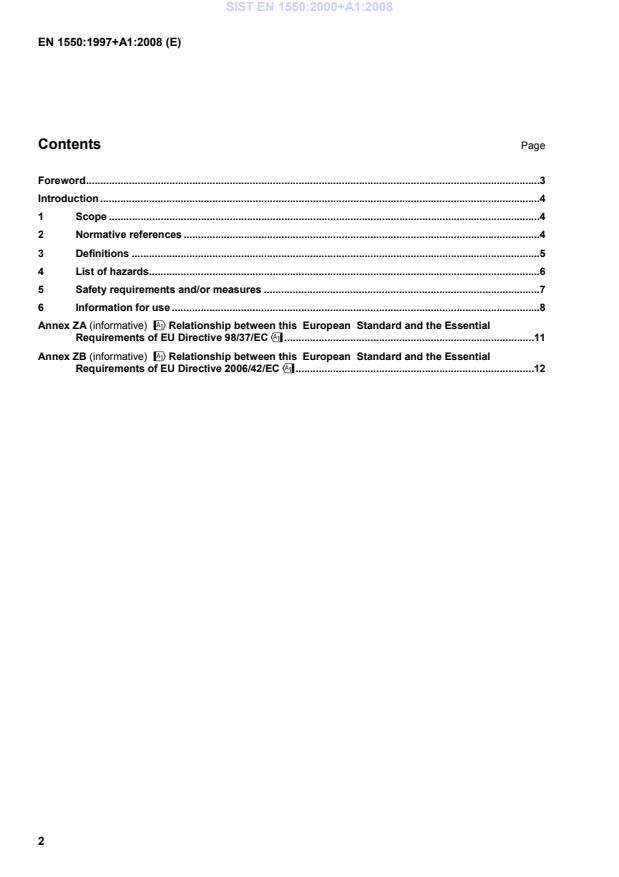
!Relationship between this
European
Standard and the Essential Requirements of EU Directive 98/37/EC".11 Annex ZB (informative)
!Relationship between this
European
Standard and the Essential Requirements of EU Directive 2006/42/EC".12
...