

EN 13245-2:2008
(Main)Plastics - Unplasticized poly(vinyl chloride) (PVC-U) profiles for building applications - Part 2: PVC-U profiles and PVC-UE profiles for internal and external wall and ceiling finishes
- Abstract
This European Standard specifies the health and safety requirements for unplasticized poly(vinyl chloride) (PVC-U) profiles and cellular unplasticized poly(vinyl chloride) (PVC-UE) profiles for interior and exterior wall and ceiling finishes. It also specifies methods for the evaluation of conformity of the products to the requirements, and includes requirements for their marking.
The products are intended for use as wall and ceiling finishes for internal and external applications according to the manufacturer's specifications, which may include specifications for the fixings.
Profiles for the management of electrical power cables, communication cables and power track systems used for the distribution of electrical power, roofline products (fascia and soffit) including guttering, internal trim profiles including window boards and profiles for windows or doors are not covered by this European Standard.
- Status
- Published
- Publication Date
- 16-Sep-2008
- Technical Committee
- CEN/TC 249 - Plastics
- Drafting Committee
- CEN/TC 249/WG 5 - Thermoplastic profiles for building applications
- Current Stage
- 9093 - Decision to confirm - Review Enquiry
- Start Date
- 19-Jun-2022
- Completion Date
- 07-Oct-2026
- Directive
- 305/2011 - Regulation (eu) No 305/2011 of the European Parliament and of the Council of 9 march 2011 laying down harmonised conditions for the marketing of construction products and repealing council directive 89/106/eecOJ Ref: C, C 259 OJ Date: 08-Aug-2014
89/106/EEC - Construction productsOJ Ref: C, C 167 OJ Date: 25-Jun-2010


Overview
EN 13245-2:2008 (CEN) specifies health and safety requirements for unplasticized poly(vinyl chloride) (PVC‑U) and cellular unplasticized PVC (PVC‑UE) profiles used as internal and external wall and ceiling finishes. The standard defines required performance areas, test methods, rules for evaluation of conformity and marking. It applies to profiles intended to form continuous plane panels for protection and/or decoration, used according to the manufacturer’s installation and fixing instructions. Several product types are explicitly excluded (e.g., cable management profiles, roofline products, internal trim such as window boards, and window/door profiles).
Key Topics and technical requirements
- Scope and definitions - Clear terminology for PVC‑U and PVC‑UE profiles, coatings and intended end‑use (internal/external wall and ceiling finishes).
- Reaction to fire - Products shall be tested and classified according to EN 13501‑1; reaction-to-fire testing procedures (e.g., EN 13823 and EN ISO 11925‑2) and mounting/fixing conditions are specified (see Annex A).
- Mechanical resistance - Impact resistance testing requirements differ for PVC‑U and PVC‑UE profiles:
- PVC‑U: impact testing referenced to EN 13245‑1 Annex A and EN 477.
- PVC‑UE: impact resistance assessed per Annex B of this part; ageing and Charpy procedures covered in Annexes C and D.
- Durability - Requirements and ageing tests (artificial UV or natural ageing) to assess loss of impact resistance or mechanical properties for external use.
- Resistance to fixings - Manufacturers must declare methods of fixing and provide relevant guidance.
- Evaluation of conformity - Includes initial type testing, factory production control (FPC) requirements, provisions for one‑off or low‑quantity products and marking rules (including CE marking guidance in Annex ZA).
- Documentation and marking - Mandatory declaration of declared performance, classification and mounting/fixing details to support safe installation.
Applications
- Exterior and interior cladding, siding and ceiling panel systems made from PVC‑U or PVC‑UE profiles.
- Situations where builders, specifiers or regulators require documented reaction to fire, impact resistance and durability data for wall and ceiling finishes.
- Useful for manufacturers preparing technical files and CE marking evidence.
Who should use this standard
- PVC profile manufacturers and converters
- Building product specifiers, architects and façade engineers
- Test laboratories performing reaction-to-fire, impact and ageing tests
- Authorities and certification bodies assessing conformity and CE marking
Related standards
- EN 13245‑1 (designation of light coloured profiles)
- EN 13501‑1, EN 13823 (reaction to fire)
- EN 477, EN ISO 179‑1, EN ISO 8256, EN ISO 4892‑3 (impact and ageing tests)
- EN 12608, EN 14351‑1 (related PVC and building product standards)
Keywords: EN 13245-2:2008, PVC‑U profiles, PVC‑UE profiles, wall and ceiling finishes, reaction to fire, impact resistance, durability, CE marking, CEN.
Relations
- Effective Date
- 01-Apr-2026
- Effective Date
- 28-Jan-2026
- Effective Date
- 28-Jan-2026
- Effective Date
- 28-Jan-2026
- Effective Date
- 28-Jan-2026
- Effective Date
- 28-Jan-2026
- Effective Date
- 28-Jan-2026
- Effective Date
- 28-Jan-2026
- Effective Date
- 28-Jan-2026
- Effective Date
- 28-Jan-2026
- Effective Date
- 24-Oct-2009
- Effective Date
- 22-Dec-2008
Get Certified
Connect with accredited certification bodies for this standard

DIN CERTCO
DIN Group product certification.

Smithers Quality Assessments
US management systems and product certification.
Sponsored listings
Frequently Asked Questions
EN 13245-2:2008 is a standard published by the European Committee for Standardization (CEN). Its full title is "Plastics - Unplasticized poly(vinyl chloride) (PVC-U) profiles for building applications - Part 2: PVC-U profiles and PVC-UE profiles for internal and external wall and ceiling finishes". This standard covers: This European Standard specifies the health and safety requirements for unplasticized poly(vinyl chloride) (PVC-U) profiles and cellular unplasticized poly(vinyl chloride) (PVC-UE) profiles for interior and exterior wall and ceiling finishes. It also specifies methods for the evaluation of conformity of the products to the requirements, and includes requirements for their marking. The products are intended for use as wall and ceiling finishes for internal and external applications according to the manufacturer's specifications, which may include specifications for the fixings. Profiles for the management of electrical power cables, communication cables and power track systems used for the distribution of electrical power, roofline products (fascia and soffit) including guttering, internal trim profiles including window boards and profiles for windows or doors are not covered by this European Standard.
This European Standard specifies the health and safety requirements for unplasticized poly(vinyl chloride) (PVC-U) profiles and cellular unplasticized poly(vinyl chloride) (PVC-UE) profiles for interior and exterior wall and ceiling finishes. It also specifies methods for the evaluation of conformity of the products to the requirements, and includes requirements for their marking. The products are intended for use as wall and ceiling finishes for internal and external applications according to the manufacturer's specifications, which may include specifications for the fixings. Profiles for the management of electrical power cables, communication cables and power track systems used for the distribution of electrical power, roofline products (fascia and soffit) including guttering, internal trim profiles including window boards and profiles for windows or doors are not covered by this European Standard.
EN 13245-2:2008 is classified under the following ICS (International Classification for Standards) categories: 83.140.99 - Other rubber and plastics products. The ICS classification helps identify the subject area and facilitates finding related standards.
EN 13245-2:2008 has the following relationships with other standards: It is inter standard links to EN ISO 179-1:2026, EN 13501-1:2018, EN 477:1995, EN ISO 179-1:2023, EN ISO 8256:2023, EN ISO 9001:2000, EN ISO 11925-2:2002, EN 13823:2020+A1:2022, EN ISO 4892-3:2024, EN 13964:2014, EN 13245-2:2008/AC:2009; is excused to EN 13245-1:2004. Understanding these relationships helps ensure you are using the most current and applicable version of the standard.
EN 13245-2:2008 is associated with the following European legislation: EU Directives/Regulations: 305/2011, 89/106/EEC; Standardization Mandates: M/121. When a standard is cited in the Official Journal of the European Union, products manufactured in conformity with it benefit from a presumption of conformity with the essential requirements of the corresponding EU directive or regulation.
EN 13245-2:2008 is available in PDF format for immediate download after purchase. The document can be added to your cart and obtained through the secure checkout process. Digital delivery ensures instant access to the complete standard document.
Standards Content (Sample)
2003-01.Slovenski inštitut za standardizacijo. Razmnoževanje celote ali delov tega standarda ni dovoljeno.Kunststoffe - Profile aus weichmacherfreiem Polyvinylchlorid (PVC-U) für die Anwendung im Bauwesen - Teil 2: Profile aus PVC-U und Profile aus PVC-UE für Wand- und Deckenbekleidungen für Innen- und AußenanwendungenPlastiques - Profilés en poly(chlorure de vinyle) non plastifié (PVC-U) pour applications dans le bâtiment - Partie 2: Profilés en PVC-U et profilés en PVC-UE pour finitions des murs et plafonds intérieurs et extérieursPlastics - Unplasticized poly(vinyl chloride) (PVC-U) profiles for building applications - Part 2: PVC-U profiles and PVC-UE profiles for internal and external wall and ceiling finishes83.140.99Drugi izdelki iz gume in polimernih materialovOther rubber and plastics productsICS:Ta slovenski standard je istoveten z:EN 13245-2:2008SIST EN 13245-2:2008en,fr,de01-december-2008SIST EN 13245-2:2008SLOVENSKI
STANDARD
EUROPEAN STANDARDNORME EUROPÉENNEEUROPÄISCHE NORMEN 13245-2September 2008ICS 83.140.99 English VersionPlastics - Unplasticized poly(vinyl chloride) (PVC-U) profiles forbuilding applications - Part 2: PVC-U profiles and PVC-UEprofiles for internal and external wall and ceiling finishesPlastiques - Profilés en poly(chlorure de vinyle) non plastifié(PVC-U) pour applications dans le bâtiment - Partie 2:Profilés en PVC-U et profilés en PVC-UE pour finitions desmurs et plafonds intérieurs et extérieursKunststoffe - Profile aus weichmacherfreiemPolyvinylchlorid (PVC-U) für die Anwendung im Bauwesen -Teil 2: Profile aus PVC-U und Profile aus PVC-UE fürWand- und Deckenbekleidungen für Innen- undAußenanwendungenThis European Standard was approved by CEN on 25 July 2008.CEN members are bound to comply with the CEN/CENELEC Internal Regulations which stipulate the conditions for giving this EuropeanStandard the status of a national standard without any alteration. Up-to-date lists and bibliographical references concerning such nationalstandards may be obtained on application to the CEN Management Centre or to any CEN member.This European Standard exists in three official versions (English, French, German). A version in any other language made by translationunder the responsibility of a CEN member into its own language and notified to the CEN Management Centre has the same status as theofficial versions.CEN members are the national standards bodies of Austria, Belgium, Bulgaria, Cyprus, Czech Republic, Denmark, Estonia, Finland,France, Germany, Greece, Hungary, Iceland, Ireland, Italy, Latvia, Lithuania, Luxembourg, Malta, Netherlands, Norway, Poland, Portugal,Romania, Slovakia, Slovenia, Spain, Sweden, Switzerland and United Kingdom.EUROPEAN COMMITTEE FOR STANDARDIZATIONCOMITÉ EUROPÉEN DE NORMALISATIONEUROPÄISCHES KOMITEE FÜR NORMUNGManagement Centre: rue de Stassart, 36
B-1050 Brussels© 2008 CENAll rights of exploitation in any form and by any means reservedworldwide for CEN national Members.Ref. No. EN 13245-2:2008: ESIST EN 13245-2:2008
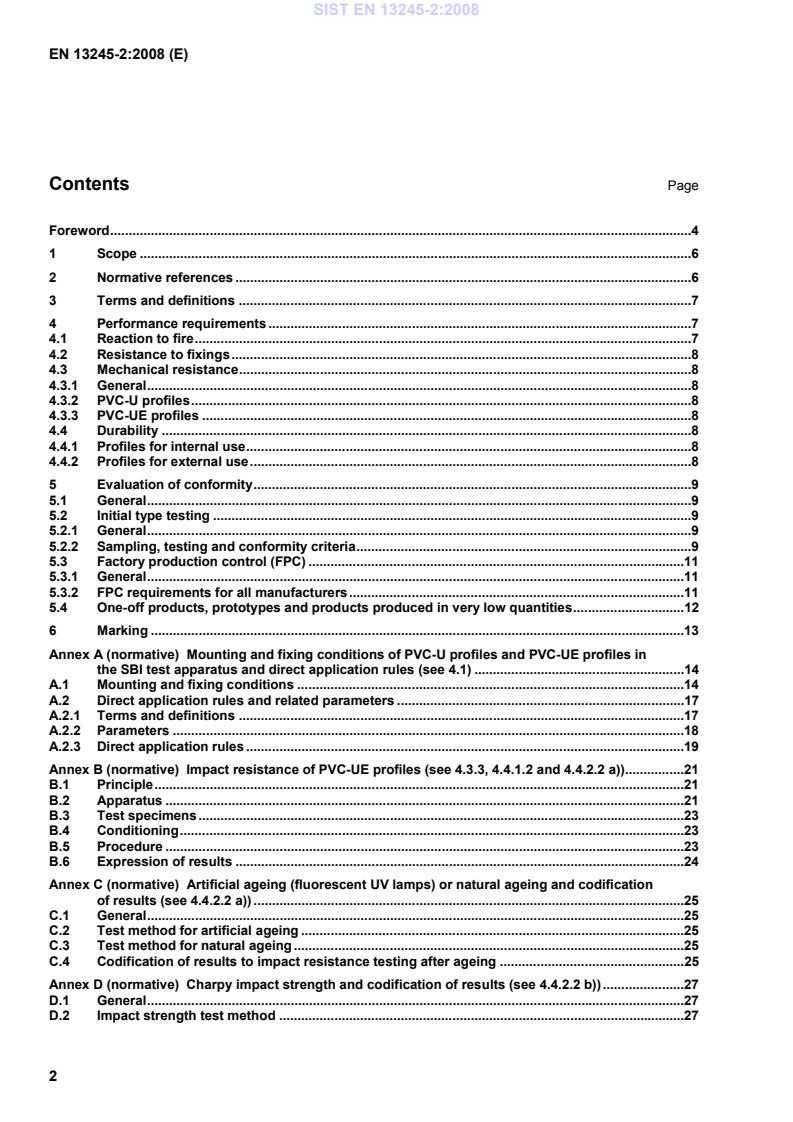
Mounting and fixing conditions of PVC-U profiles and PVC-UE profiles in the SBI test apparatus and direct application rules (see 4.1).14 A.1 Mounting and fixing conditions.14 A.2 Direct application rules and related parameters.17 A.2.1 Terms and definitions.17 A.2.2 Parameters.18 A.2.3 Direct application rules.19 Annex B (normative)
Impact resistance of PVC-UE profiles (see 4.3.3, 4.4.1.2 and 4.4.2.2 a)).21 B.1 Principle.21 B.2 Apparatus.21 B.3 Test specimens.23 B.4 Conditioning.23 B.5 Procedure.23 B.6 Expression of results.24 Annex C (normative)
Artificial ageing (fluorescent UV lamps) or natural ageing and codification of results (see 4.4.2.2 a)).25 C.1 General.25 C.2 Test method for artificial ageing.25 C.3 Test method for natural ageing.25 C.4 Codification of results to impact resistance testing after ageing.25 Annex D (normative)
Charpy impact strength and codification of results (see 4.4.2.2 b)).27 D.1 General.27 D.2 Impact strength test method.27 SIST EN 13245-2:2008
Clauses of this European Standard addressing the provisions of the EU Construction Products Directive.28 ZA.1 Scope and relevant characteristics.28 ZA.2 Procedure for attestation of conformity of PVC-U profiles and PVC-UE profiles for internal and external wall and ceiling finishes.31 ZA.3 CE marking and labelling.34 Bibliography.41
Designation standards for PVC-U profiles
prEN 13245-3, Designation of coated/coloured PVC-UE profiles (in preparation) EN 13245-2, Plastics — Unplasticized poly(vinyl chloride) (PVC-U) profiles for building applications — Part 2: PVC-U profiles and PVC-UE profiles for internal and external wall and ceiling finishes (standard prepared by CEN/TC 249) EN 13659, Shutters — Performance requirements including safety (standard prepared by CEN/TC 33)
Product standards a EN 14351-1, Windows and doors — Product standard, performance characteristics - Part 1: Windows and external pedestrian doorsets without resistance to fire and/or smoke leakage characteristics (standard prepared by CEN/TC 33) Semi-products standard
EN 12608, Unplasticized polyvinylchloride (PVC-U) profiles for the fabrication of windows and doors — Classification, requirements and test methods (standard prepared by CEN/TC 33) a
Standards to provide possibility for the CE marking.
According to the CEN/CENELEC Internal Regulations, the national standards organizations of the following countries are bound to implement this European Standard: Austria, Belgium, Bulgaria, Cyprus, Czech Republic, Denmark, Estonia, Finland, France, Germany, Greece, Hungary, Iceland, Ireland, Italy, Latvia, Lithuania, Luxembourg, Malta, Netherlands, Norway, Poland, Portugal, Romania, Slovakia, Slovenia, Spain, Sweden, Switzerland and the United Kingdom. SIST EN 13245-2:2008
1 Scope This European Standard specifies the health and safety requirements for unplasticized poly(vinyl chloride) (PVC-U) profiles and cellular unplasticized poly(vinyl chloride) (PVC-UE) profiles for interior and exterior wall and ceiling finishes. It also specifies methods for the evaluation of conformity of the products to the requirements, and includes requirements for their marking.
The products are intended for use as wall and ceiling finishes for internal and external applications according to the manufacturer's specifications, which may include specifications for the fixings. Profiles for the management of electrical power cables, communication cables and power track systems used for the distribution of electrical power, roofline products (fascia and soffit) including guttering, internal trim profiles including window boards and profiles for windows or doors are not covered by this European Standard.1)
2 Normative references The following referenced documents are indispensable for the application of this document. For dated references, only the edition cited applies. For undated references, the latest edition of the referenced document (including any amendments) applies. EN 477:1995, Unplasticized polyvinylchloride (PVC-U) profiles for the fabrication of windows and doors — Determination of the resistance to impact of main profiles by falling mass EN 13245-1:2004, Plastics — Unplasticized poly(vinyl chloride) (PVC-U) profiles for building applications — Part 1: Designation of light coloured profiles EN 13501-1, Fire classification of construction products and building elements — Part 1: Classification using data from reaction to fire tests EN 13823, Reaction to fire tests for building products — Building products excluding floorings exposed to the thermal attack by a single burning item EN ISO 179-1, Plastics — Determination of Charpy impact properties — Part 1: Non-instrumented impact test (ISO 179-1:2000) EN ISO 4892-3, Plastics — Methods of exposure to laboratory light sources — Part 3: Fluorescent UV lamps (ISO 4892-3:2006) EN ISO 8256, Plastics — Determination of tensile-impact strength (ISO 8256:2004) EN ISO 9001:2000, Quality management systems — Requirements (ISO 9001:2000) EN ISO 11925-2, Reaction to fire tests — Ignitability of building products subjected to direct impingement of flame — Part 2: Single-flame source test (ISO 11925-2:2002)
1) Products that are excluded are in the scopes of standards prepared by CEN/TC 33 or CENELEC/TC 213. Further works in CEN/TC 249 will develop specifications for internal trim profiles including window boards and roofline products.
coloured or clear covering layer on the sight surface of a profile with a good bonding strength to the profile, e.g. a co-extruded layer, a lacquer-coating or a laminated foil 3.3 non-cellular unplasticized poly(vinyl chloride)
PVC-U unplasticized poly(vinyl chloride) the density of which is not reduced by the presence of numerous small cavities (cells), interconnecting or not, dispersed throughout the mass
3.4 cellular unplasticized poly(vinyl chloride)
PVC-UE unplasticized poly(vinyl chloride) the density of which is reduced by the presence of numerous small cavities (cells), interconnecting or not, dispersed throughout the mass
[EN ISO 472:2001]
3.5 PVC-U profile profile made of unplasticized poly(vinyl chloride) (PVC-U) material NOTE It applies to profiles made of non-cellular material rather than cellular material.
3.6 PVC-UE profile profile made of cellular unplasticized poly(vinyl chloride) (PVC-UE) material 4 Performance requirements 4.1 Reaction to fire Reaction to fire performance applies only for PVC-U profiles and PVC-UE profiles intended for end uses on interior/exterior wall/ceiling finishes subject to reaction to fire regulations. Nevertheless, even when this use is not subject to such regulations, the reaction to fire performance of these profiles may be declared. The PVC-U profile or PVC-UE profile shall be tested and classified according to EN 13501-1 and the resulting class and sub-class shall be declared. When tested in accordance with EN 13823, the mounting and fixing of the PVC-U profile or PVC-UE profile shall conform to Annex A and the indication on this method, as given therein, shall also be declared. NOTE For exterior wall finishes (claddings, sidings) a façade fire scenario may be developed. This new scenario may in the future replace the scenario according to EN 13501-1. Classification of the product can still be based on the current Euroclass system (EN 13501-1) unless and until regulatory requirements provisions demand otherwise. SIST EN 13245-2:2008
a) impact resistance according to Annex B after an artificial ageing (exposure to fluorescent UV lamps) or a natural ageing according to Annex C and declaring the method of assessment and the result according to Table C.1; or SIST EN 13245-2:2008
5 Evaluation of conformity 5.1 General The conformity of PVC-U profiles and PVC-UE profiles with the requirements of this standard and with the declared values (including classes) shall be demonstrated by: − initial type testing; − factory production control by the manufacturer, including product assessment. For the purposes of initial type testing, PVC-U profiles and PVC-UE profiles may be grouped into families, where it is considered that the result, for the selected characteristic(s), from testing any one product within the family is representative for all other products within that family.
Products produced as one-offs, prototypes and products produced in very low quantities shall be covered by 5.4. 5.2 Initial type testing 5.2.1 General The initial type testing of PVC-U profiles and PVC-UE profiles shall be performed to show conformity with this standard. Tests previously performed in accordance with the provisions of this standard (same product, characteristic(s), test method, sampling procedure, system of attestation of conformity, etc.) may be taken into account. In addition, initial type testing shall be performed at the beginning of the production of a new type of PVC-U profiles and PVC-UE profiles (unless a member of the same family) or at the beginning of a new method of production (where this may affect the stated characteristics). All characteristics of PVC-U profiles and PVC-UE profiles in Clause 4 for which declared values are given shall be subject to initial type testing. Whenever a change occurs in the PVC-U profiles and PVC-UE profiles, the compound or supplier of the components, or the production process (subject to the definition of a family), which would change significantly one or more of the characteristics, the initial type testing shall be repeated for the appropriate characteristic(s). 5.2.2 Sampling, testing and conformity criteria PVC-U profiles and PVC-UE profiles shall be selected at random from normal production in such a manner that they are representative of normal production. For a new PVC-U profile or PVC-UE profile or a new method of their production it shall be as in 5.4.
The number of specimens to be tested (or assessed) shall be in accordance with Table 2 or Table 3, as applicable. SIST EN 13245-2:2008
Table 2 — Number of specimens and conformity criteria for ITT applicable to PVC-U profiles Charac-teristic Intended use a Requirement clause Assessment method Number of testsNumber of specimens/ test Conformity criteriaReaction to fire i + e 4.1 Tests referred to from EN 13501-1
1 See
EN 13501-1 See classification in EN 13501-1 + indica-tion on mounting/ fixing method Mechanical resistance
e 4.3.2 EN 13245-1:2004, Annex A 1 10 EN 13245-1:2004, Table 2 Durability
i 4.4.1.1 EN 13245-1:2004, Annex A 1 10 EN 13245-1:2004, Table 2 Durability
e 4.4.2.1 EN ISO 8256, Method A - type 5
and EN 13245-1:2004,5.6.2 (ageing) 1 10 EN 13245-1:2004, 5.6.4 a
PVC-U profiles for internal (i) and/or external (e) use.
Table 3 — Number of specimens and conformity criteria for ITT applicable to PVC-UE profiles Charac-teristic Intended use a Requirement clause Assessment method Number of testsNumber of specimens/ test Conformity criteria Reaction to fire i + e 4.1 Tests referred to from EN 13501-1 1 See
EN 13501-1 See classification in EN 13501-1 + indica-tion on mounting/ fixing method Mechanical resistance
e 4.3.3 Annex B 1 10 Table B.1 Durability
i 4.4.1.2 Annex B 1 10 Table B.1 Durability
e 4.4.2.2 a) or 4.4.2.2 b) Annex B and Annex C (ageing) Annex D and EN 13245-1:2004
- 5.6.2 (ageing) 1 10 Table C.1
Table D.1 a
PVC-UE profiles for internal (i) and/or external (e) use.
The results of all initial type testing shall be recorded and held by the manufacturer for at least 10 years after the date of last production of the profiles to which they relate. SIST EN 13245-2:2008
5.3.2.1 Product specific requirements The FPC system shall: address this European Standard; and ensure that the products placed on the market conform with the stated performance characteristics. The results of inspections, tests or assessments requiring action shall be recorded, as shall any action taken. The action to be taken when control values or criteria are not met shall be recorded and retained for the period specified in the manufacturer’s FPC procedures. SIST EN 13245-2:2008
This also applies where the manufacturer of the profiles is also the producer of the raw materials.
5.3.2.3 Product testing and evaluation
The procedures shall be established to ensure that the declared values of all of the characteristics are maintained. The product characteristics, and the means of control, shall be:
a) reaction to fire: routine control of reaction to fire classification shall be on the basis of checks on compound to ensure that it remains within the requirements of Table 4 and tests on the finished product of a type and a frequency to be defined and documented, to ensure that the finished product itself remains the same as that subjected to initial type testing; b) mechanical resistance for external products only: once/production batch and at least once/48 h of production time, test according to 4.3.2 or 4.3.3 shall be performed; c) durability:
1) of products for internal use: once/production batch and at least once/48 h of production time, test according to 4.4.1.1 or 4.4.1.2 shall be performed; 2) of products for external use: each compound shall be checked in accordance with Table 4 once/delivery and the manufacturing process of the product shall be checked once/production batch and at least once/48 h of production time.
If the compound changes or goes beyond the manufacturer’s specification, such that one or more of the declared characteristics may change, it shall either be rejected or considered that a new product is being produced, in which case ITT shall be performed for those characteristics affected by the change. Any other sampling frequency may be used, if conformity of the characteristics at the confidence level of 95 % can be demonstrated by statistical control.
For the FPC impact resistance testing, five specimens shall be tested with no failure. In case of one failure, five additional specimens shall be tested from the same batch. Maximum one failure out of ten shall be allowed.
For FPC, the specimens should be conditioned at (23 ± 2) °C. If this is not the case, the conditioning temperature shall be recorded. 5.4 One-off products, prototypes and products produced in very low quantities Products produced as a one-off, prototypes assessed before full production is established, and products produced in very low quantities (for which the minimum sampling frequencies as specified in 5.3.2.3 are not applicable) shall be assessed as follows. SIST EN 13245-2:2008
Mounting and fixing conditions of PVC-U profiles and PVC-UE profiles in the SBI test apparatus and direct application rules (see 4.1) A.1 Mounting and fixing conditions To represent normal mounting and fixing conditions of PVC-U profiles and PVC-UE profiles for wall and ceiling finishes, eight types of mounting and fixing can be considered for the SBI test, as described in Table A.1. The different mounting and fixing conditions are shown in Figures A.1 to A.4. Table A.1 — Mounting and fixing conditions in the SBI test Method of fixing Position Type of fixing a Code Mechanical fixing b
DVM Vertical Glued DVG Mechanical fixing b DHM Directly on the wall Other orientation Glued DHG Mechanical fixing b AVM Vertical Glued AVG Mechanical fixing b AHM On spacers with an air gap Other orientation Glued AHG a
The edges of specimens shall be closed to obtain an unventilated air gap.
b
Fixing by screws, nails or staples.
Any other method of fixing than those given above may be used but, in this case, the results apply only to that method. No direct application rules exist in this case.
a) by screws
b) by staples Figure A.1 — Examples of fixing directly on wall using mechanical fixings (screws or staples) SIST EN 13245-2:2008
Figure A.2 — Example of fixing directly on a wall using glue
a) by screws
b) by staples Figure A.3 — Example of fixing on spacer using mechanical fixings (screws or staples)
a) application of glue
b) fixing of profile
Figure A.4 — Example of fixing on spacer using glue SIST EN 13245-2:2008
On spacers Spacer raw material (wood,…) Dimensions of the spacer sections (depth gives the air gap value) Distance between spacers and from spacers to the edge of the wall Type of fixing (screw, nail, staple, glue) If the profiles are glued on spacers, the type of glue Number and orientation of fixing points on spacers Perimeter (finishing profile or aluminium tape), if relevant
Corner (finishing profile or other kind of finishing), if relevant Fixing of the finishing profiles
Directly on the SBI support wall with screws, nails, staples, glue Type of fixing (screw, nail, staple, glue) Number and orientation of fixing points on the wall Perimeter (finishing profile or aluminium tape), if relevant
Corner (finishing profile or other kind of finishing), if relevant Fixing of the finishing profiles If the profiles are glued, the type and the quantity of glue in g per m²
Figures A.5 and A.6 give examples of the overall mounting of PVC-U profile specimens in the SBI apparatus.
Figure A.5 — Example SBI mounting with PVC-U profiles of width 250 mm in vertical position SIST EN 13245-2:2008
Figure A.6 — Example SBI mounting with PVC-U profiles of width 250 mm in horizontal position
Following testing and classification, the results shall be shown as the reaction to fire class(es) followed by the mounting code(s) from Table A.1, as shown below. When several mounting conditions result in the same class, each different mounting condition shall follow the class, whereas different classes shall be presented separately. EXAMPLE
B-d0, s3/AVG/DVM for a profile in Class B-d0, s3 mounted vertically, glued on spacers or mechanically fixed directly to the wall. C-d1, s2/DVG for a profile in Class C-d1, s2 mounted vertically, glued directly to the wall. A.2 Direct application rules and related parameters A.2.1 Terms and definitions For the purpose of this clause the following terms and definitions apply.
A.2.1.1 direct field of application of test results outcome of a process (involving the application of defined rules) whereby a test result is deemed to be equally valid for variations in one or more of the product characteristics and/or intended end use applications A.2.1.2 product
material, element or component, about which information is required
Yes Composition (amount of inorganic fillers) Yes Mass per unit area
Yes
A.2.2.2 End-use application parameters Table A.4 gives the parameters which have an influence on determining the reaction to fire performance of the product in its end-use application when tested according to EN 13823 (single burning item test). Table A.4 — End-use application parameters when tested according to EN 13823 End-use application parameter Method of fixing Position Type of fixing
Code Influence on SBI test results Mechanical fixing a
DVM Yes Vertical Glued DVG Yes Mechanical fixing a
DHM Yes Directly on the wall Other orientation Glued DHG Yes Mechanical fixing a
AVM Yes Vertical Glued AVG Yes Mechanical fixing a
AHM Yes On spacers with an air gap Other orientation Glued AHG Yes a
Fixing by screws, nails or staples.
Mass per unit area
For a family the maximum and the minimum mass per unit area of the profile shall be tested and the lowest classification shall be declared. a
Coating
No direct application rule exists. a A range of products may be divided into more than one family.
A.2.3.2 Direct application rules for the end-use application parameters Tables A.6 and A.7 give direct applications rules for the end-use application parameters. Table A.6 — Validity of the test results for profiles directly fixed on wall End use application parameter Position Type of fixing Influence on SBI test results Mechanical fixing a
Rules I, II and III. Vertical Glued Rules III and IV.
Mechanical fixing a
Rules I and II. Other orientation Glued Rule IV. a
Fixing by screws, nails or staples. Rule I: The test result (classification) with a distance between two consecutive fixings, d, is valid, without additional test, for the same type of PVC-U profiles or PVC-UE profiles mounted with a distance between two consecutive fixings less than d, all other mounting parameters being identical.
Rule II: The results from any product with one type of mechanical fixing (i.e. screws) are applicable to the same product fixed with any other mechanical system (i.e. staples or nails), all other mounting parameters being identical.
Rule III: The results from vertical orientation are applicable to the same product used in any other orientation. Rule IV: The results from any product tested with mechanical fixings are applicable to the same product glued.
Rules III, V, VI, VII and VIII. Vertical Glued Rules III, IV, VI and VII. Mechanical fixing a
Rules V, VI, VII and VIII. Other orientation Glued Rules IV, VI and VII. a
Fixing by screws, nails or staples. Rule III: The results from vertical orientation are applicable to the same product used in any other orientation.
Rule IV: The results from any product tested with mechanical fixings are applicable to the same product glued.
Rule V: The test result (classification) with a distance between two consecutive fixings, d, shall be valid, without test, for the same type of PVC-U profiles or PVC-UE profiles mounted with a distance between two consecutive fixings less than d, all other parameters and orientation being identical.
Rule VI: The test result (classification) with an air gap, e, shall be valid, without test, for the same type of PVC-U profiles or PVC-UE profiles mounted with an air gap less than e or without air gap (directly on the wall), all other parameters and orientation being identical.
Rule VII: The results on wood spacers are valid for the product on spacers of equal or higher reaction to fire class than that of the wood. Rule VIII: The results from any product with one type of mechanical fixing (i.e. screws) are applicable to the same product fixed with any mechanical system.
Impact resistance of PVC-UE profiles (see 4.3.3, 4.4.1.2 and 4.4.2.2 a)) B.1 Principle The impact resistance of PVC-UE profiles shall be measured at 23 °C by striking the profile, completely supported by a plate, with a mass falling vertically from a known height onto the exposed surface. The energy levels shall be classified according to the results of a series of impact tests with a striker of specified mass. B.2 Apparatus The impact resistance test shall be carried out with an impact testing machine, as described in EN 477:1995, Clause 4, incorporating the following equipment: a) main frame, rigidly fixed in the vertical position; b) guide rails or a guiding tube, rigidly fixed to the main frame to guide the striker and release it to fall vertically and freely; c) rigid specimen support, comprising two rounded off steel supports (200 ± 1) mm apart according to EN 477:1995, rigidly fixed to a solid foundation or to a table having a mass of more than 50 kg; d) release mechanism such that the striker can fall from a height which can be adjusted up to 1 500 mm, as measured from the top surface of the specimen; e) striker, with a smooth hemispherical striking surface of (25 ± 0,5) mm radius; the total mass of the striker shall be:
1) either adjustable with relevant additional masses to the following masses: (100 ± 1) g, (200 ± 1) g, (300 ± 2) g, (400 ± 2) g, (500 ± 2) g, (600 ± 2) g, (1 000 ± 5) g, (1 500 ± 5) g, (2 000 ± 5) g
or
(m x 100 ± 5) g where m is an integer,
2) or static at (1 000 ± 5) g; f) flat wooden plate (e.g. plywood of a minimum 32 mm thickness) adjusted to the geometry of the profile to support it completely when tested. Possible voids between back side of the profile and the support plate can be filled up with a soft material such as cellular rubber filler. Figure B.1 gives examples of profiles and corresponding plates.
a)
b)
c)
d) Figure B.1 — Examples of profiles and corresponding plates
Cut ten specimens (300 ± 10) mm long from profiles selected at random from a batch. In the case of profiles with webs, choose the impact point approximately at the mid point between the supporting webs on the surface of the profile normally exposed, if applicable. If the geometry of the profile does not allow determining clearly the impact point, the impact
...