

EN 415-3:2021
(Main)Safety of packaging machines - Part 3: Form, fill and seal machines; fill and seal machines
- Abstract
This document establishes safety requirements for the main types of form, fill and seal machines, fill and seal machines and the filling machines which are frequently fitted to these machines.
Form fill and seal machines within the scope of this document are:
- flow wrapping machine;
- vertical form, fill and seal machine;
- horizontal sachet form, fill and seal machine;
- thermoform, fill and seal machine;
- tubular bag form, fill and seal machine;
- mandrel form, fill and seal machine.
Fill and seal machines within the scope of this document are:
- pre-made bag, erect, fill and seal machine;
- cup or tub fill and seal machine;
- sack fill and seal machine.
Filling machines commonly fitted to form, fill and seal machines and fill and seal machines within the scope of this document are:
- auger filler;
- volumetric cup filler;
- nett weigher;
- multi-head weigher.
Other types of form, fill and seal machine which are described in 3.3 have similar hazards to these machines and Clause 4 indicates which clauses of this document are applicable to these machines.
This document covers the safety requirements for machine design, construction and all phases of life of the machines including installation, commissioning, operation, adjustment, maintenance and cleaning.
This document applies to machines manufactured after the date of publication of this document.
This document does not apply to:
- blow mould fill and seal machines;
- bulk container fill and seal machines;
- cartoning machines;
- food depositors, including volumetric piston depositors in the scope of EN 15180;
- thermoforming machines in the scope of EN 12409.
This document does not consider:
- hazards due to the products packed in these machines, but does consider the hazards caused by dusts, modified atmosphere gases, and flammable products;
- hazards resulting from the operation of the machines in a potentially explosive atmosphere.
- Status
- Published
- Publication Date
- 12-Oct-2021
- Withdrawal Date
- 29-Apr-2022
- Technical Committee
- CEN/TC 146 - Packaging machines - Safety
- Current Stage
- 6060 - Definitive text made available (DAV) - Publishing
- Start Date
- 13-Oct-2021
- Due Date
- 05-Jun-2020
- Completion Date
- 13-Oct-2021
- Directive
- 2006/42/EC - Directive 2006/42/EC of the European Parliament and of the Council of 17 May 2006 on machinery, and amending Directive 95/16/EC (recast)OJ Ref: OJ L 194 OJ Date: 02-Aug-2023

Overview
EN 415-3:2021 - Safety of Packaging Machines, Part 3: Form, Fill and Seal Machines; Fill and Seal Machines - is a European Standard developed by CEN. This document establishes comprehensive safety requirements for form, fill and seal machines, fill and seal machines, and the filling equipment typically integrated into these systems. Packaging machinery plays a core role in a wide range of industries, and ensuring operator safety and minimizing risks is key for manufacturers, machine users, and maintenance providers.
This standard applies to machines manufactured after its publication date, and addresses all lifecycle stages including machine design, installation, commissioning, operation, adjustment, and maintenance. It aims to harmonize safety practices across the EU, supporting compliance with the Essential Requirements of the EU Machinery Directive (2006/42/EC).
Key Topics
EN 415-3:2021 covers:
Types of Machines Included:
- Flow wrapping machines
- Vertical and horizontal form, fill and seal machines (including sachet, tubular bag, and mandrel types)
- Thermoform, fill and seal machines
- Pre-made bag, cup or tub, and sack fill and seal machines
Frequently Fitted Filling Machines:
- Auger fillers
- Volumetric cup fillers
- Nett weighers
- Multi-head weighers
Scope Exclusions:
- Blow mould fill and seal machines
- Bulk container fill and seal machines
- Cartoning machines
- Food depositors covered by EN 15180
- Thermoforming machines under EN 12409
Safety Requirements:
- Inherently safe design to minimize mechanical hazards
- Guard design, interlocking devices, and proper placement of safety barriers
- Risk assessment for hazards from dusts, modified atmosphere gases, and flammable products
- Verification protocols and guidance on safe installation, operation, cleaning, and maintenance
- Marking, instructions, and warning of residual risks
Lifecycle Approach:
- Emphasis on safety from manufacture through decommissioning
Applications
Packaging machines governed by EN 415-3:2021 are deployed across sectors such as food and beverage, pharmaceuticals, personal care, and many other industries requiring efficient, automated packaging processes. Implementation offers:
- Improved Worker Safety: Standardized safety practices help prevent injuries associated with moving mechanical parts, sharp edges, and hazardous emissions.
- Regulatory Compliance: Assists manufacturers and machine users to fulfill requirements under the EU Machinery Directive, market surveillance, and occupational health obligations.
- Operational Efficiency: Clearly defined safety requirements and verification steps reduce downtime by minimizing accidents and facilitating effective maintenance.
- Risk Reduction: Systematic guidance for risk assessment, emergency stops, and protective devices minimizes exposure to potentially hazardous operations.
- International Consistency: Facilitates easier trade and equipment acceptance within EU member states due to harmonized safety requirements.
Related Standards
EN 415-3:2021 is part of the EN 415 series for packaging machinery safety, which includes:
- EN 415-1: Terminology and classification of packaging machines and associated equipment
- EN 415-9: Noise measurement methods for packaging machines, packaging lines and auxiliary equipment
- EN 415-10: General requirements
- EN ISO 12100: Safety of machinery - General principles for design and risk assessment
- EN ISO 14120: General requirements for guards on machinery
Referencing these related standards provides a comprehensive framework for safety, hygiene, ergonomics, and operational excellence in packaging automation.
Keywords: EN 415-3:2021, packaging machinery safety, form fill and seal machine, fill and seal machine, CEN, packaging machine safety requirements, EU Machinery Directive, automated packaging safety, flow wrapping, auger filler, multi-head weigher.
Relations
- Effective Date
- 28-May-2014
- Effective Date
- 09-Feb-2026
- Effective Date
- 09-Feb-2026
- Effective Date
- 09-Feb-2026
- Effective Date
- 09-Feb-2026
- Effective Date
- 09-Feb-2026
- Effective Date
- 09-Feb-2026
- Effective Date
- 09-Feb-2026
- Effective Date
- 09-Feb-2026
- Effective Date
- 09-Feb-2026
- Effective Date
- 28-Jan-2026
- Effective Date
- 28-Jan-2026
- Effective Date
- 28-Jan-2026
- Effective Date
- 28-Jan-2026
- Effective Date
- 28-Jan-2026
Get Certified
Connect with accredited certification bodies for this standard

BRCGS (Brand Reputation Compliance Global Standards)
Global food safety and quality standards owner.
Sponsored listings
Frequently Asked Questions
EN 415-3:2021 is a standard published by the European Committee for Standardization (CEN). Its full title is "Safety of packaging machines - Part 3: Form, fill and seal machines; fill and seal machines". This standard covers: This document establishes safety requirements for the main types of form, fill and seal machines, fill and seal machines and the filling machines which are frequently fitted to these machines. Form fill and seal machines within the scope of this document are: - flow wrapping machine; - vertical form, fill and seal machine; - horizontal sachet form, fill and seal machine; - thermoform, fill and seal machine; - tubular bag form, fill and seal machine; - mandrel form, fill and seal machine. Fill and seal machines within the scope of this document are: - pre-made bag, erect, fill and seal machine; - cup or tub fill and seal machine; - sack fill and seal machine. Filling machines commonly fitted to form, fill and seal machines and fill and seal machines within the scope of this document are: - auger filler; - volumetric cup filler; - nett weigher; - multi-head weigher. Other types of form, fill and seal machine which are described in 3.3 have similar hazards to these machines and Clause 4 indicates which clauses of this document are applicable to these machines. This document covers the safety requirements for machine design, construction and all phases of life of the machines including installation, commissioning, operation, adjustment, maintenance and cleaning. This document applies to machines manufactured after the date of publication of this document. This document does not apply to: - blow mould fill and seal machines; - bulk container fill and seal machines; - cartoning machines; - food depositors, including volumetric piston depositors in the scope of EN 15180; - thermoforming machines in the scope of EN 12409. This document does not consider: - hazards due to the products packed in these machines, but does consider the hazards caused by dusts, modified atmosphere gases, and flammable products; - hazards resulting from the operation of the machines in a potentially explosive atmosphere.
This document establishes safety requirements for the main types of form, fill and seal machines, fill and seal machines and the filling machines which are frequently fitted to these machines. Form fill and seal machines within the scope of this document are: - flow wrapping machine; - vertical form, fill and seal machine; - horizontal sachet form, fill and seal machine; - thermoform, fill and seal machine; - tubular bag form, fill and seal machine; - mandrel form, fill and seal machine. Fill and seal machines within the scope of this document are: - pre-made bag, erect, fill and seal machine; - cup or tub fill and seal machine; - sack fill and seal machine. Filling machines commonly fitted to form, fill and seal machines and fill and seal machines within the scope of this document are: - auger filler; - volumetric cup filler; - nett weigher; - multi-head weigher. Other types of form, fill and seal machine which are described in 3.3 have similar hazards to these machines and Clause 4 indicates which clauses of this document are applicable to these machines. This document covers the safety requirements for machine design, construction and all phases of life of the machines including installation, commissioning, operation, adjustment, maintenance and cleaning. This document applies to machines manufactured after the date of publication of this document. This document does not apply to: - blow mould fill and seal machines; - bulk container fill and seal machines; - cartoning machines; - food depositors, including volumetric piston depositors in the scope of EN 15180; - thermoforming machines in the scope of EN 12409. This document does not consider: - hazards due to the products packed in these machines, but does consider the hazards caused by dusts, modified atmosphere gases, and flammable products; - hazards resulting from the operation of the machines in a potentially explosive atmosphere.
EN 415-3:2021 is classified under the following ICS (International Classification for Standards) categories: 55.200 - Packaging machinery. The ICS classification helps identify the subject area and facilitates finding related standards.
EN 415-3:2021 has the following relationships with other standards: It is inter standard links to EN 415-3:1999+A1:2009, EN 60204-1:2018, EN 61496-2:2013, ISO 3864-3:2012, EN 60079-14:2014, ISO 3864-2:2016, EN IEC 61496-3:2019, ISO 3864-1:2011, EN 61496-1:2013, EN 60825-4:2006, EN ISO 13855:2010, EN ISO 14159:2008, EN ISO 13850:2015, EN ISO 4414:2010, EN 620:2002+A1:2010. Understanding these relationships helps ensure you are using the most current and applicable version of the standard.
EN 415-3:2021 is associated with the following European legislation: EU Directives/Regulations: 2006/42/EC; Standardization Mandates: M/396. When a standard is cited in the Official Journal of the European Union, products manufactured in conformity with it benefit from a presumption of conformity with the essential requirements of the corresponding EU directive or regulation.
EN 415-3:2021 is available in PDF format for immediate download after purchase. The document can be added to your cart and obtained through the secure checkout process. Digital delivery ensures instant access to the complete standard document.
Standards Content (Sample)
SLOVENSKI STANDARD
01-december-2021
Nadomešča:
SIST EN 415-3:2001+A1:2010
Varnost pakirnih naprav - 3. del: Oblikovalne, polnilne in zapiralne naprave;
polnilne in zapiralne naprave
Safety of packaging machines - Part 3: Form, fill and seal machines; fill and seal
machines
Sicherheit von Verpackungsmaschinen - Teil 3: Form-, Füll- und Verschließmaschinen;
Füll- und Verschließmaschinen
Sécurité des machines d'emballage - Partie 3 : Machines d'emballage à former, remplir
et sceller ; machines d'emballage à remplir et sceller
Ta slovenski standard je istoveten z: EN 415-3:2021
ICS:
55.200 Pakirni stroji Packaging machinery
2003-01.Slovenski inštitut za standardizacijo. Razmnoževanje celote ali delov tega standarda ni dovoljeno.
EN 415-3
EUROPEAN STANDARD
NORME EUROPÉENNE
October 2021
EUROPÄISCHE NORM
ICS 55.200 Supersedes EN 415-3:1999+A1:2009
English Version
Safety of packaging machines - Part 3: Form, fill and seal
machines; fill and seal machines
Sécurité des machines d'emballage - Partie 3 : Sicherheit von Verpackungsmaschinen - Teil 3: Form-,
Machines d'emballage à former, remplir et sceller ; Füll- und Verschließmaschinen; Füll- und
machines d'emballage à remplir et sceller Verschließmaschinen
This European Standard was approved by CEN on 6 September 2021.
CEN members are bound to comply with the CEN/CENELEC Internal Regulations which stipulate the conditions for giving this
European Standard the status of a national standard without any alteration. Up-to-date lists and bibliographical references
concerning such national standards may be obtained on application to the CEN-CENELEC Management Centre or to any CEN
member.
This European Standard exists in three official versions (English, French, German). A version in any other language made by
translation under the responsibility of a CEN member into its own language and notified to the CEN-CENELEC Management
Centre has the same status as the official versions.
CEN members are the national standards bodies of Austria, Belgium, Bulgaria, Croatia, Cyprus, Czech Republic, Denmark, Estonia,
Finland, France, Germany, Greece, Hungary, Iceland, Ireland, Italy, Latvia, Lithuania, Luxembourg, Malta, Netherlands, Norway,
Poland, Portugal, Republic of North Macedonia, Romania, Serbia, Slovakia, Slovenia, Spain, Sweden, Switzerland, Turkey and
United Kingdom.
EUROPEAN COMMITTEE FOR STANDARDIZATION
COMITÉ EUROPÉEN DE NORMALISATION
EUROPÄISCHES KOMITEE FÜR NORMUNG
CEN-CENELEC Management Centre: Rue de la Science 23, B-1040 Brussels
© 2021 CEN All rights of exploitation in any form and by any means reserved Ref. No. EN 415-3:2021 E
worldwide for CEN national Members.
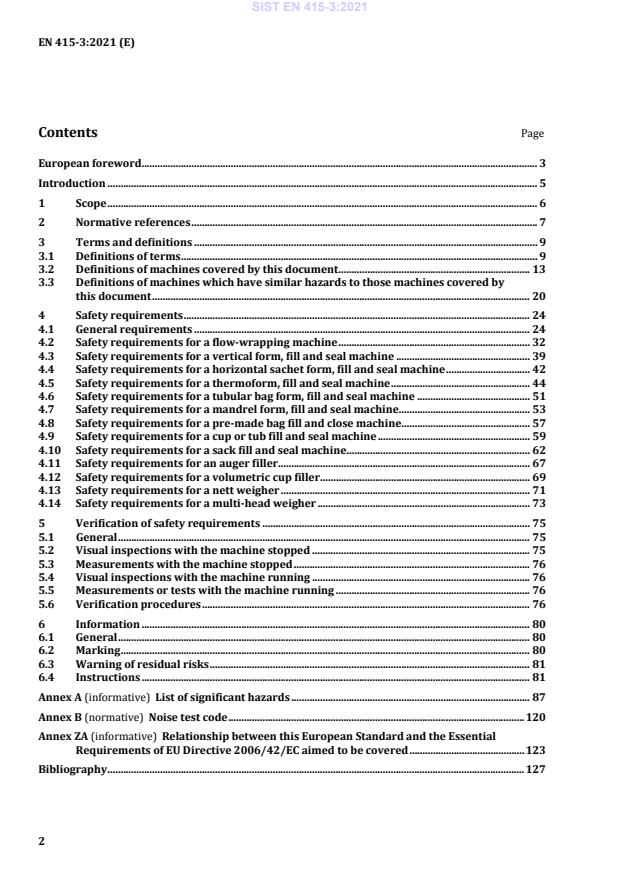
Contents Page
European foreword . 3
Introduction . 5
1 Scope . 6
2 Normative references . 7
3 Terms and definitions . 9
3.1 Definitions of terms . 9
3.2 Definitions of machines covered by this document . 13
3.3 Definitions of machines which have similar hazards to those machines covered by
this document . 20
4 Safety requirements . 24
4.1 General requirements . 24
4.2 Safety requirements for a flow-wrapping machine . 32
4.3 Safety requirements for a vertical form, fill and seal machine . 39
4.4 Safety requirements for a horizontal sachet form, fill and seal machine . 42
4.5 Safety requirements for a thermoform, fill and seal machine . 44
4.6 Safety requirements for a tubular bag form, fill and seal machine . 51
4.7 Safety requirements for a mandrel form, fill and seal machine . 53
4.8 Safety requirements for a pre-made bag fill and close machine . 57
4.9 Safety requirements for a cup or tub fill and seal machine . 59
4.10 Safety requirements for a sack fill and seal machine. 62
4.11 Safety requirements for an auger filler . 67
4.12 Safety requirements for a volumetric cup filler . 69
4.13 Safety requirements for a nett weigher . 71
4.14 Safety requirements for a multi-head weigher . 73
5 Verification of safety requirements . 75
5.1 General . 75
5.2 Visual inspections with the machine stopped . 75
5.3 Measurements with the machine stopped . 76
5.4 Visual inspections with the machine running . 76
5.5 Measurements or tests with the machine running . 76
5.6 Verification procedures . 76
6 Information . 80
6.1 General . 80
6.2 Marking . 80
6.3 Warning of residual risks . 81
6.4 Instructions . 81
Annex A (informative) List of significant hazards . 87
Annex B (normative) Noise test code . 120
Annex ZA (informative) Relationship between this European Standard and the Essential
Requirements of EU Directive 2006/42/EC aimed to be covered . 123
Bibliography . 127
European foreword
This document (EN 415-3:2021) has been prepared by Technical Committee CEN/TC 146 “Packaging
machines – Safety”, the secretariat of which is held by UNI.
This European Standard shall be given the status of a national standard, either by publication of an
identical text or by endorsement, at the latest by April 2022, and conflicting national standards shall be
withdrawn at the latest by April 2022.
Attention is drawn to the possibility that some of the elements of this document may be the subject of
patent rights. CEN shall not be held responsible for identifying any or all such patent rights.
This document has been prepared under a Standardization Request given to CEN by the European
Commission and the European Free Trade Association, and supports essential requirements of EU
Directive(s).
For relationship with EU Directive(s), see informative Annex ZA, which is an integral part of this
document.
This document supersedes EN 415-3:1999+A1:2009.
The following significant changes have been made:
— Scope now includes fill and seal machines and multi-head weighers;
— Cartoning machines have been removed from the scope;
— Safety requirements have been rewritten so they are in line with EN 415-10:2014;
— Normative references have been changed to reflect the many changes that have been made to B1 and
B2 standards.
EN 415, Safety of packaging machines consists of the following parts:
— Part 1: Terminology and classification of packaging machines and associated equipment;
— Part 2: Pre-formed rigid container packaging machines;
— Part 4: Palletizers and depalletizers;
— Part 5: Wrapping machines;
— Part 6: Pallet wrapping machines;
— Part 7: Cartoning and case-packing machines;
— Part 8: Strapping machines;
— Part 9: Noise measurement methods for packaging machines, packaging lines and auxiliary equipment,
grade of accuracy 2 and 3;
— Part 10: General requirements.
Any feedback and questions on this document should be directed to the users’ national standards body.
A complete listing of these bodies can be found on the CEN website.
According to the CEN-CENELEC Internal Regulations, the national standards organisations of the
following countries are bound to implement this European Standard: Austria, Belgium, Bulgaria, Croatia,
Cyprus, Czech Republic, Denmark, Estonia, Finland, France, Germany, Greece, Hungary, Iceland, Ireland,
Italy, Latvia, Lithuania, Luxembourg, Malta, Netherlands, Norway, Poland, Portugal, Republic of North
Macedonia, Romania, Serbia, Slovakia, Slovenia, Spain, Sweden, Switzerland, Turkey and the United
Kingdom.
Introduction
Form, fill and seal machines and fill and seal machines are used extensively in Europe, in an increasingly
wide range of industries. They contain many hazards and have the potential to cause serious injury.
This document is a type-C standard as stated in EN ISO 12100.
This document is of relevance, in particular, for the following stakeholder groups representing the market
players with regard to machinery safety:
— machine manufacturers (small, medium and large enterprises);
— health and safety bodies (regulators, accident prevention organizations, market surveillance, etc.).
Others can be affected by the level of machinery safety achieved with the means of the document by the
above-mentioned stakeholder groups:
— machine users/employers (small, medium and large enterprises);
— machine users/employees (e.g. trade unions, organizations for people with special needs);
— service providers, e.g. for maintenance (small, medium and large enterprises);
The above-mentioned stakeholder groups have been given the possibility to participate at the drafting
process of this document. The machinery concerned and the extent to which hazards, hazardous
situations or hazardous events are covered are indicated in the Scope of this document.
When requirements of this type-C standard are different from those which are stated in type-A or type-B
standards, the requirements of this type-C standard take precedence over the requirements of the other
standards for machines that have been designed and built according to the requirements of this type-C
standard.
1 Scope
This document establishes safety requirements for the main types of form, fill and seal machines, fill and
seal machines and the filling machines which are frequently fitted to these machines.
Form fill and seal machines within the scope of this document are:
— flow wrapping machine;
— vertical form, fill and seal machine;
— horizontal sachet form, fill and seal machine;
— thermoform, fill and seal machine;
— tubular bag form, fill and seal machine;
— mandrel form, fill and seal machine.
Fill and seal machines within the scope of this document are:
— pre-made bag, erect, fill and seal machine;
— cup or tub fill and seal machine;
— sack fill and seal machine.
Filling machines commonly fitted to form, fill and seal machines and fill and seal machines within the
scope of this document are:
— auger filler;
— volumetric cup filler;
— nett weigher;
— multi-head weigher.
Other types of form, fill and seal machine which are described in 3.3 have similar hazards to these
machines and Clause 4 indicates which clauses of this document are applicable to these machines.
This document covers the safety requirements for machine design, construction and all phases of life of
the machines including installation, commissioning, operation, adjustment, maintenance and cleaning.
This document applies to machines manufactured after the date of publication of this document.
This document does not apply to:
— blow mould fill and seal machines;
— bulk container fill and seal machines;
— cartoning machines;
— food depositors, including volumetric piston depositors in the scope of EN 15180;
— thermoforming machines in the scope of EN 12409.
This document does not consider:
— hazards due to the products packed in these machines, but does consider the hazards caused by
dusts, modified atmosphere gases, and flammable products;
— hazards resulting from the operation of the machines in a potentially explosive atmosphere.
2 Normative references
The following documents are referred to in the text in such a way that some or all of their content
constitutes requirements of this document. For dated references, only the edition cited applies. For
undated references, the latest edition of the referenced document (including any amendments) applies.
EN 415-1:2014, Safety of packaging machines — Part 1: Terminology and classification of packaging
machines and associated equipment
EN 415-9:2009, Safety of packaging machines — Part 9: Noise measurement methods for packaging
machines, packaging lines and associated equipment, grade of accuracy 2 and 3
EN 415-10:2014, Safety of packaging machines — Part 10: General Requirements
EN 618:2002+A1:2010, Continuous handling equipment and systems — Safety and EMC requirements for
equipment for mechanical handling of bulk materials except fixed belt conveyors
EN 620:2002+A1:2010, Continuous handling equipment and systems — Safety and EMC requirements for
fixed belt conveyors for bulk materials
EN 1005-2:2003+A1:2008, Safety of machinery — Human physical performance — Part 2: Manual
handling of machinery and component parts of machinery
EN 1127-1:2019, Explosive atmospheres — Explosion prevention and protection — Part 1: Basic concepts
and methodology
EN 1672-2:2020, Food processing machinery — Basic concepts — Part 2: Hygiene and cleanability
requirements
EN 15180:2014, Food processing machinery — Food depositors — Safety and hygiene requirements
EN 60079-14:2014, Explosive atmospheres — Part 14: Electrical installations design, selection and erection
(IEC 60079-14:2013)
EN 60204-1:2018, Safety of machinery — Electrical equipment of machines — Part 1: General requirements
(IEC 60204-1:2018)
EN 60825-4:2006, Safety of laser products — Part 4: Laser guards
EN 61496-1:2013, Safety of machinery — Electro-sensitive protective equipment — Part 1: General
requirements and tests
EN 61496-2:2013, Safety of machinery — Electro-sensitive protective equipment — Part 2: Particular
requirements for equipment using active opto-electronic protective devices (AOPDs) (IEC 61496-2:2013)
EN IEC 61496-3:2019, Safety of machinery — Electro-sensitive protective equipment — Part 3: Particular
requirements for active opto-electronic protective devices responsive to diffuse Reflection (AOPDDR)
(IEC 61496-3:2018)
EN ISO 4413:2010, Hydraulic fluid power — General rules and safety requirements for systems and their
components (ISO 4413:2010)
EN ISO 4414:2010, Pneumatic fluid power — General rules and safety requirements for systems and their
components (ISO 4414:2010)
EN ISO 7010:2020, Graphical symbols — Safety colours and safety signs — Registered safety signs
(ISO 7010:2019, Corrected version 2020-06)
EN ISO 11688-1:2009, Acoustics — Recommended practice for the design of low-noise machinery and
equipment — Part 1: Planning (ISO/TR 11688-1:1995)
EN ISO 12100:2010, Safety of machinery — General principles for design — Risk assessment and risk
reduction (ISO 12100:2010)
EN ISO 13732-1:2008, Ergonomics of the thermal environment — Methods for the assessment of human
responses to contact with surfaces — Part 1: Hot surfaces (ISO 13732-1:2006)
EN ISO 13849-1:2015, Safety of machinery — Safety-related parts of control systems — Part 1: General
principles for design (ISO 13849-1:2015)
EN ISO 13850:2015, Safety of machinery — Emergency stop function — Principles for design
(ISO 13850:2015)
EN ISO 13851:2019, Safety of machinery — Two-hand control devices, principles for design and selection.
(ISO 13851:2019)
EN ISO 13854:2019, Safety of machinery — Minimum gaps to avoid crushing of parts of the human body
(ISO 13854:2017)
EN ISO 13855:2010, Safety of machinery — Positioning of safeguards with respect to the approach speeds
of parts of the human body (ISO 13855:2010)
EN ISO 13856-2:2013, Safety of machinery — Pressure-sensitive protective devices — Part 2: General
principles for design and testing of pressure-sensitive edges and pressure-sensitive bars (ISO 13856-2:2013)
EN ISO 13857:2019, Safety of machinery — Safety distances to prevent hazard zones being reached by
upper and lower limbs (ISO 13857:2019)
EN ISO 14119:2013, Safety of machinery — Interlocking devices associated with guards — Principles for
design and selection (ISO 14119:2013)
EN ISO 14120:2015, Safety of machinery — Guards — General requirements for the design and construction
of fixed and movable guards (ISO 14120:2015)
EN ISO 14122-2:2016, Safety of machinery — Permanent means of access to machinery — Part 2: Working
platforms and walkways (ISO 14122-2:2016)
EN ISO 14122-3:2016, Safety of machinery — Permanent means of access to machinery — Part 3: Stairs,
stepladders and guard-rails (ISO 14122-3:2016)
EN ISO 14122-4:2016, Safety of machinery — Permanent means of access to machinery — Part 4: Fixed
ladders (ISO 14122-4:2016)
EN ISO 14123-1:2015, Safety of machinery — Reduction of risks to health resulting from hazardous
substances emitted by machinery — Part 1: Principles and specifications for machinery manufacturers
(ISO 14123-1:2015)
EN ISO 14123-2:2015, Safety of machinery — Reduction of risks to health resulting from hazardous
substances emitted by machinery — Part 2: Methodology leading to verification procedures (ISO 14123-
2:2015)
EN ISO 14159:2008, Safety of machinery — Hygiene requirements for the design of machinery
(ISO 14159:2002)
ISO 3864-1:2011, Graphical symbols — Safety colours and safety signs — Part 1: Design principles for safety
signs and safety markings
ISO 3864-2:2016, Graphical symbols — Safety colours and safety signs — Part 2: Design principles for
product safety labels
ISO 3864-3:2012, Graphical symbols — Safety colours and safety signs — Part 3: Design principles for
graphical symbols for use in safety signs
3 Terms and definitions
For the purposes of this document, the terms and definitions given in EN ISO 12100:2010,
EN 415-1:2014, EN 415-10:2014 and the following apply.
ISO and IEC maintain terminological databases for use in standardization at the following addresses:
— IEC Electropedia: available at https://www.electropedia.org/
— ISO Online browsing platform: available at https://www.iso.org/obp
3.1 Definitions of terms
3.1.1
automatically adjustable guard
movable guard attached to a moveable machine element (e.g. moving side of a pre-made bag magazine)
and a fixed machine element (e.g. machine frame) which moves automatically when the moveable
element is adjusted
Note 1 to entry: An automatically adjustable guard does not comply with this definition unless it has been
dimensioned and positioned using relevant tables of EN ISO 13857:2019.
3.1.2
bag
flat or gusseted flexible container longitudinally seamed and closed at one or both ends made from paper,
plastic film, foil, laminate, etc.
Note 1 to entry: Bags produced on form, fill and seal machines will typically have a seal at both ends and a
longitudinal seal running down the centre of the rear face of the bag.
3.1.3
change parts
machine parts designed to handle a specific product, packaging material or pack size that need to be
changed when the machine is set up to handle a different product, packaging material or pack size
3.1.4
change part guard
fixed or interlocking guard which has been made to suit one product or pack size and must be changed
every time the product or pack size is changed
Note 1 to entry: A change part guard does not comply with this definition unless it has been dimensioned and
positioned using relevant tables of EN ISO 13857:2019.
3.1.5
cup
tub
thin walled tapered container
3.1.6
deformable material
material which can be formed by the application of pressure alone
3.1.7
food depositor
machine that dispenses a food product in a predetermined volume or shape
3.1.8
film reel
packaging material reel
continuous sheet of paper, carton board, plastic film, metal foil or flexible laminate wound on a cylindrical
core
3.1.9
film web
continuous sheet of paper, plastic film, metal foil or laminate
3.1.10
fixed guard
guard affixed in such a manner (for example, by screws, nuts, and welding) that it can only be opened or
removed by the use of tools or by destruction of the means by which the guard is affixed
Note 1 to entry: A fixed guard does not comply with this definition unless it complies with subclause 4.1.2.2 of
this document.
3.1.11
hot melt adhesive
adhesive that is solid at room temperature and which is melted and applied at elevated temperature
3.1.12
interlocking guard
guard associated with an interlocking device so that, together with the control system of the machine, the
following functions are performed:
— the hazardous machine functions “covered” by the guard cannot operate until the guard is closed;
— if the guard is opened while hazardous machine functions are operating, a stop command is given;
— when the guard is closed, the hazardous machine functions “covered” by the guard can operate (the
closure of the guard does not, by itself, start the hazardous machine functions)
Note 1 to entry: An interlocking guard does not comply with this definition unless it complies with subclause
4.1.2.2 of this document.
3.1.13
longitudinal seal
seal made on a package in line with the direction of material travel in the machine
3.1.14
magazine
mechanical assembly designed to hold stacks of cartons, carton blanks, pre-made bags, pre-made sacks,
leaflets, labels, lids or stackable containers
3.1.15
mandrel
mechanical assembly around which a flexible package or carton is formed
3.1.16
manually adjustable guard
adjustable guard where the adjustment is made manually and the adjustment remains fixed during a
particular operation
Note 1 to entry: A manually adjustable guard does not comply with this definition unless it complies with
subclause 4.1.2.2 of this document.
3.1.17
modified atmosphere
atmosphere where the normal atmosphere within a package is completely or partially replaced by one or
more selected gases
Note 1 to entry: Usually the objective is to extend shelf or storage life of the packaged products.
3.1.18
pack
package
assembly of product and packaging materials produced by a packaging machine
3.1.19
packaging material
material used to make a package
EXAMPLEs Film laminate, carton board, paper.
3.1.20
packaging material transport mechanism
mechanical assembly which transports packaging material through the packaging machine
3.1.21
pre-made bag
pre-formed flat or gusseted flexible package longitudinally seamed and closed at one end made from
paper, plastic film, foil, laminate or a woven material
3.1.22
pre-made sack
pre-formed flat or gusseted sack longitudinally seamed and closed at one or both ends made from paper,
plastic film, laminate, or a woven material
3.1.23
product
substance, article pack or package that is handled in the packaging machine
3.1.24
reclosing feature applicator
mechanism which applies a zip or self-adhesive packaging component to a package on a packaging
machine
3.1.25
sachet
flat package which when formed from two webs of flexible material is sealed on four sides and when
formed from one web is sealed on three or four sides
3.1.26
sack placer
mechanism which places an empty pre-made sack onto a filling spout
3.1.27
sack transfer mechanism
mechanism which takes empty sacks from a sack magazine and transfers them to a sack placer
3.1.28
soil
any unwanted matter, including product residues, micro-organisms, residual detergent or disinfecting
agents
3.1.29
transverse seal
seal made on a package at right angles to the direction of material travel in the machine
3.1.30
trip guard
interlocking guard which is designed to move easily when touched by someone and which stops the
machine before a hazard zone can be reached
3.1.31
tubular bag
flexible package closed at both ends and made from a flat film tube
3.2 Definitions of machines covered by this document
3.2.1 Form, fill and seal machines
3.2.1.1
flow-wrapping machine
horizontally operating form, fill and seal machine with material reel mounted above the operating level,
the product loaded horizontally and a longitudinal seal formed below the pack
Figure 1 — Principle of operation of a typical flow-wrapping machine
3.2.1.2
vertical form, fill and seal machine
machine which uses flexible packaging material to form a tube, which is then filled vertically with product
and sealed in a sequence of operations whilst the packaging material is transported vertically downwards
Note 1 to entry: There are several variants of this typical design, including one where the bag is formed vertically
and then transferred to a horizontal mechanism for filling and sealing.
Figure 2 — Principle of operation of a typical vertical form, fill and seal machine
3.2.1.3
horizontal sachet form, fill and seal machine
horizontally operating form, fill and seal machine in which packs are formed, sealed on 2 or 3 sides, filled
vertically with product and sealed on the remaining side whilst the film web is moved horizontally with
the pack vertical
Figure 3 — Principle of operation of a typical horizontal sachet form, fill and seal machine
3.2.1.4
thermoform, fill and seal machine
machine in which a web of thermoformable material is heated and formed with pressure and/or vacuum,
before being filled vertically with product, sealed with a top film or pre-formed lid and finally cut to
produce individual packs
Note 1 to entry: Machines can produce one or more lanes of packs and some machines incorporate equipment to
evacuate packages before they are sealed.
Figure 4 — Principle of operation of a typical thermoform, fill and seal machine
3.2.1.5
tubular bag form, fill and seal machine
machine which forms a bag or sack from a reel of lay flat tubular flexible packaging film, before it is filled
with product and sealed
Figure 5 — Principle of operation of a typical tubular bag form, fill and seal machine
3.2.1.6
mandrel form, fill and seal machine
machine which forms packs from a reel of flexible material or carton blanks, on one or more mandrels,
before filling the packs with product and sealing their tops within the machine
Note 1 to entry: On some machines the mandrels are mounted vertically and on others horizontally as shown in
Figure 6.
Figure 6 — Principle of operation of a typical mandrel form, fill and seal machine
3.2.2 Fill and seal machines
3.2.2.1
pre-made bag fill and seal machine
machine in which a pre-made bag is taken from a magazine, opened, filled with product and then sealed
Figure 7 — Principle of operation of a typical pre-made bag fill and seal machine
3.2.2.2
sack fill and seal machine
machine in which a pre-made sack is filled with product and sealed
Note 1 to entry: The operation of the machine is rotary on some machines and linear on others.
Note 2 to entry: On some machines the pre-made sack is opened and placed in the machine manually, but on
others it is taken automatically from a magazine, before being opened ready for filling.
Figure 8 —Principle of operation of a typical in-line sack fill and seal machine
3.2.2.3
cup or tub fill and seal machine
machine in which a pre-made cup or tub is taken from a magazine, filled and then closed with a heat
sealed foil or a pre-formed lid
Note 1 to entry: The operation of the machine shown in Figure 9 is linear, but some machines of this type are
rotary.
Figure 9 — Principle of operation of a typical cup/tub fill and seal machine
3.2.3 Filling machines
3.2.3.1
auger filling machine
filling machine which measures out a product, usually a powder, using an auger which rotates for a
predetermined number of revolutions
3.2.3.2
volumetric cup filling machine
filling machine which measures out a product, usually free-flowing solids or powder, in a cup of
predetermined volume
3.2.3.3
nett weigher
filling machine which measures out a predetermined mass of product, usually free-flowing solids, before
dispensing it as a fill
3.2.3.4
multi-head weigher
selective combination weigher
nett weighing machine with multiple weighing units, which computes an appropriate combination of
loads to achieve the predetermined mass and discharges them together as a fill
3.3 Definitions of machines which have similar hazards to those machines covered by
this document
NOTE The following machines have similar hazards to those on the machines covered by this document.
3.3.1
lower reel flow-wrapping machine
horizontally operating form, fill and seal machine, with film reel mounted below the operating level, the
product placed on to the film web and a longitudinal seal formed above the pack
Figure 10 — Principle of operation of a typical lower reel flow-wrapping machine
3.3.2
stick packing machine
vertical form, fill and seal machine which produces small cross-section stick shaped packs
Note 1 to entry: Machines typically produce several lanes of packages at the same time.
3.3.3
edge sealing machine
horizontally operating form, fill and seal machine in which product is placed on a horizontal web of film
before being sealed on 3 or 4 sides to an upper web of film
Note 1 to entry: Machines can have one or two reels of film and can produce one or more lanes of packs.
Figure 11 — Principle of operation of a typical edge sealing machine
3.3.4
vertical sachet form, fill and seal machine
vertically operating form, fill and seal machine which uses one or two webs of film which are formed
vertically, filled with product and sealed to produce a 3 or 4 side sealed sachet
Note 1 to entry: Machines can have one or two reels of film and can produce one or more lanes of packs.
Figure 12 — Principle of operation of a typical vertical sachet form, fill and seal machine
3.3.5
strip packing machine
vertically operating sachet form, fill and seal machine which produces strips of individually sealed packs
joined together in predetermined lengths
3.3.6
vertical form, fill and seal machine for carton board
vertically operating form fill and seal machine which uses a carton board laminate, which is formed, filled
with product and sealed to produce a pack resembling a carton
Note 1 to entry: The pack is usually filled with a liquid.
Figure 13 — Principle of operation of a typical vertical form, fill and seal machine for carton
board
3.3.7
deep draw fill and seal machine
machine in which a web of deformable material is formed under pressure in a die press, before being
filled vertically with product, sealed with a top film or pre-formed lid, and finally cut to produce individual
packs
Note 1 to entry: Machines can produce one or more lanes of packs.
Note 2 to entry: The operation of the machine in Figure 14 is linear, but some machines of this type are rotary.
Figure 14 — Principle of operation of a typical deep draw fill and seal machine
3.3.8
count filling machine
filling machine which measures out solids according to a predetermined count
4 Safety requirements
4.1 General requirements
4.1.1 General
All the machines in the scope of this document shall comply with the safety requirements and protective
or risk reduction measures in 4.1 and the relevant machine specific measures 4.2 to 4.14 where the
equivalent hazard exists. In addition, machines shall comply with clauses of EN 415-10:2014 where they
are specifically referenced in this document.
Where a machine has hazards, which are not on a typical machine and so are not described in Annex A,
the machine shall be designed according to EN 415-10:2014.
4.1.2 Requirements to minimize mechanical risks
4.1.2.1 Inherently safe design
Inherently safe design measures shall be applied as far as possible to eliminate or reduce risks and shall
comply with the requirements of EN 415-10:2014, 5.2.1.1. Subclauses 4.2 to 4.14 identify some of the
mechanisms where inherently safe design measures can typically be applied, for example by limiting the
forces applied by the mechanisms.
With the exception of cutting mechanisms, accessible parts of the machine shall have no sharp edges, no
sharp angles and no rough surfaces likely to cause injury.
4.1.2.2 Design of safeguards
Safeguards shall comply with 4.1.2.2, 4.1.2.4 and EN 415-10:2014, 5.2.1.4. Interlocking guards shall
comply with EN 415-10:2014, 5.2.1.5 and 5.16.2.3 and EN ISO 14120:2015, 5.2.3.
Where the smallest dimension of a rectangular opening or diameter of a circular opening in a guard is
less than or equal to 120 mm, the safety distances in Tables 3, 4 and 6 of EN ISO 13857:2019 shall apply.
Where the opening is larger than 120 mm, the safety distances shown in EN 415-10:2014, 5.2.1.3 shall
apply.
When an interlocking guard is opened, it shall not be possible to reach a hazard zone before the hazardous
movement has stopped. Where this objective is not achieved, a guard locking device or internal baffle
which prevents direct access to the hazard zone shall be fitted. Where a baffle is used it shall be
dimensioned and positioned so that the person’s movement will be impeded or slowed down sufficiently
for the hazardous movement to stop before the hazard zone can be reached.
Where guards are made of a transparent material and there is a risk of someone walking into the open
guard, the guard shall be marked or fitted with features which make the guard clearly visible when it is
open.
Where there is a risk that someone could be shut inside a guarded area, the interlocking guard that gives
access to this area shall be fitted with an interlocking device that minimises the risk of the guard being
closed accidentally and EN 415-10:2014, 5.16.2.3 shall apply.
Where a good view to zones inside the machine is necessary and the design of the guards causes shadows
that prevent good visibility of the process within the machine, the machine shall be equipped with
interior lighting.
The design of the guards shall ensure that it is not possible to reach hazard zones in the machine by
reaching over guards when standing on a means of access described in this document. Where guards are
open at the top the safety distance in Table 2 of EN ISO 13857:2019 shall apply.
Where electro-sensitive protective equipment (ESPE) is used instead of a guard it shall comply with
EN 61496-1:2013 and shall be positioned in accordance with EN ISO 13855:2010.
4.1.2.3 Pneumatic and hydraulic equipment
4.1.2.3.1 General
The machine shall be equipped with an isolation device for each supply for fluid power which shall be
located outside hazard zones and shall be readily accessible, clearly labelled, and have features to allow
them to be locked in the off position.
The machine shall have a facility to release stored energy in a safe manner.
The control system shall be designed to prevent unexpected start-up following the requirements of
EN 415-10:2014, 5.1.6.
4.1.2.3.2 Pneumatic
Pneumatic components and piping shall comply with the requirements of EN ISO 4414:2010.
An air service unit shall be provided with an isolation valve complying with EN ISO 4414:2010, 5.2.8; a
pressure build-up valve, pressure regulator, pressure gauge and condensate discharge valve shall also be
provided.
4.1.2.3.3 Hydraulic
Hydraulic components and piping shall comply with the requirements of EN ISO 4413:2010.
Hydraulic isolation valves shall comply with EN ISO 4413:2010, 5.4.7.2.1.
4.1.2.4 Size or product changing
4.1.2.4.1 Design of guards
The design of the machine and its guards shall ensure that danger zones on the machine are safeguarded
without the need for adjustment of safeguards, for all the product and pack sizes for which the machine
has been specified.
Where this is not possible adjustable guards or change part guards shall be used.
Adjustable guards shall be either:
a) adjusted in a positive mode by adjusting the functional parts either manually or under power, or
b) fitted with interlocking devices which ensure that the machine cannot be started or operated unless
the guards are adjusted correctly.
Change part guards shall be either:
a) connected to the functional parts so that the machine cannot function without the appropriate
guarding being fitted, or
b) fitted with interlocking devices so that the machine cannot be started or operated without the
required guard in place.
4.1.2.4.2 Size or product changing under power
Where parts of the machine are adjusted under power, the risks presented by these powered movements
shall be eliminated using the following hierarchy of measures:
a) ensuring that the movements are not hazardous by following the safety by design principles
described in 4.1.2.1, or
b) if a) is not possible by ensuring that movements can only take place when the machine’s interlocking
movable guards are closed or;
c) where it is not possible to fulfil the requirements of a) or b), the movement can only take place using
a hold-to-run control device complying with EN 415-10:2014, 5.16.3.
4.1.2.5 Drive mechanisms
Drive mechanisms shall be enclosed with fixed or interlocking guards.
4.1.2.6 Hand-wheels
Where handles or hand-wheels are provided to operate mechanisms manually, they shall preferably be
disconnected when the machine runs automatically.
If the hand-wheel is designed to rotate under power during automatic operation it shall comply with
EN 415-10:2014, 5.20.5.
4.1.2.7 Measures to minimize slip, trip and fall risks
The measures described in EN 415-10:2014, 5.2.2 shall apply.
4.1.2.8 Tasks requiring guards to be open while mechanisms are moved under power
The design of the machine shall avoid the need to carry out any task where it is necessary to move
machine mechanisms while a guard is open. If mechanisms need to be moved in manual mode, this shall
only be possible with all the interlocking guards in the closed position.
Where for technical reasons this is not practicable, movement of the machine parts shall only be possible
if all of the requirements of EN 415-10:2014, 5.16.3 have been satisfied.
4.1.3 Electrical equipment
4.1.3.1 General requirements
Electrical equipment fitted to machines in the scope of this document shall comply with EN 415-10:2014,
5.3, 5.5 and 5.6 and 5.14.
4.1.3.2 Emergency stop devices
All machines in the scope of this document shall be fitted with at least one emergency stop device that
complies with EN ISO 13850:2015 and shall be positioned according to EN 415-10:2014, 5.14.
4.1.3.3 Electrostatic phenomena
On machines where hazards may arise from the generation of static electricity, sufficient earth bonding
or static elimination equipment shall be provided to ensure that hazardous levels of static electricity do
not occur. This equipment shall ensure that electrostatic discharge shall lead neither to any injury nor to
the ignition of potentially explosive atmospheres or combustible substances.
Electrostatic discharge elimination devices shall be protected using interlocking guards and the control
system shall ensure that the static elimination devices are turned off when the interlocking guard is open.
4.1.4 Thermal hazards
The external temperature of exposed parts
...