

FprEN 13454-1
(Main)Binders for floor screeds based on calcium sulphate - Part 1: Definitions and requirements
General Information
- Abstract
This document applies to binders made of calcium sulphate used for the manufacture of floor screeds for interior use in buildings. This document does not cover the application of floor screeds. Floor screeds made with products covered by this document can contribute to thermal and sound insulation and fire protection of the floor.
This document specifies binders where the principal active constituent is calcium sulphate.
Factory made mixtures are covered by EN 13813 and are therefore not part of this document.
- Status
- Not Published
- Publication Date
- 20-Jan-2019
- Withdrawal Date
- 21-Jul-2019
- Technical Committee
- CEN/TC 241 - Gypsum and gypsum based products
- Drafting Committee
- CEN/TC 241/WG 1 - Powders
- Current Stage
- 5098 - Decision to abandon - Formal Approval
- Start Date
- 15-May-2019
- Completion Date
- 30-Sep-2026

Overview
FprEN 13454-1 - "Binders for floor screeds based on calcium sulphate - Part 1: Definitions and requirements" (CEN) defines terminology and sets requirements for calcium sulphate binders used in interior floor screeds. The standard focuses on binders whose principal active constituent is calcium sulphate and clarifies product types (e.g., CAB, CAB‑F, CAC, CAC‑F) and factory-made mixtures. It does not cover the on‑site application or laying of screeds. Test methods are provided in Part 2 (prEN 13454‑2).
Keywords: FprEN 13454-1, calcium sulphate binders, floor screeds, CEN, definitions and requirements, EN 13813.
Key topics
- Scope and terminology: precise definitions for calcium sulphate constituents, additives, admixtures, aggregates and screed types.
- Types of binders: classification such as calcium sulphate binders for stiff and flowing mixtures (CAB, CAB‑F) and composite variants (CAC, CAC‑F).
- Technical requirements:
- Chemical composition (content of CaSO4)
- pH value
- Setting time and working time
- Mechanical properties: compressive and flexural strength classes
- Dimensional stability: shrinkage and swelling limits
- Reaction to fire and management of dangerous substances
- Durability-related properties for factory‑made mixtures: water vapour permeability, impact sound insulation, thermal resistance, chemical resistance, consistency classes (flowing, highly plastic, stiff)
- Assessment and conformity:
- Type testing, factory production control (FPC), and AVCP (Assessment and Verification of Constancy of Performance) procedures
- Marking, labelling and designation requirements
- Relationship to other standards: cross‑references to EN 13813 (screed materials), EN 13501‑1 (reaction to fire), and test standards like EN 13892 and EN ISO 10140.
Applications
- Ensures consistent quality of binders for interior floor screeds in residential, commercial and institutional buildings.
- Supports products that contribute to thermal insulation, sound insulation, and fire protection of floors.
- Useful for manufacturers specifying binder formulations, product certification bodies, testing laboratories, and specifiers selecting screed materials.
Who should use this standard
- Binder and screed manufacturers producing calcium sulphate–based products
- Quality managers and R&D teams developing formulations
- Certification bodies and testing laboratories conducting AVCP and type testing
- Architects, specifiers and contractors assessing material compliance and performance claims
Related standards
- EN 13813 - Screed material and floor screeds (factory‑made mixtures)
- prEN 13454‑2 - Test methods for calcium sulphate binders and mixtures
- EN 13501‑1 - Fire classification of construction products
- EN 13892, EN ISO 10140 - Relevant test methods for strength and acoustics
This standard provides the regulatory and technical framework to specify, test and certify calcium sulphate binders for reliable, code‑compliant floor screed products.
Relations
- Effective Date
- 18-Jan-2023
Get Certified
Connect with accredited certification bodies for this standard

DIBt (Deutsches Institut für Bautechnik)
German Institute for Building Technology.
DIN CERTCO
DIN Group product certification.

Aboma Certification B.V.
Specialized in construction, metal, and transport sectors.
Sponsored listings
Frequently Asked Questions
FprEN 13454-1 is a draft published by the European Committee for Standardization (CEN). Its full title is "Binders for floor screeds based on calcium sulphate - Part 1: Definitions and requirements". This standard covers: This document applies to binders made of calcium sulphate used for the manufacture of floor screeds for interior use in buildings. This document does not cover the application of floor screeds. Floor screeds made with products covered by this document can contribute to thermal and sound insulation and fire protection of the floor. This document specifies binders where the principal active constituent is calcium sulphate. Factory made mixtures are covered by EN 13813 and are therefore not part of this document.
This document applies to binders made of calcium sulphate used for the manufacture of floor screeds for interior use in buildings. This document does not cover the application of floor screeds. Floor screeds made with products covered by this document can contribute to thermal and sound insulation and fire protection of the floor. This document specifies binders where the principal active constituent is calcium sulphate. Factory made mixtures are covered by EN 13813 and are therefore not part of this document.
FprEN 13454-1 is classified under the following ICS (International Classification for Standards) categories: 01.040.91 - Construction materials and building (Vocabularies); 91.100.10 - Cement. Gypsum. Lime. Mortar; 91.100.50 - Binders. Sealing materials. The ICS classification helps identify the subject area and facilitates finding related standards.
FprEN 13454-1 has the following relationships with other standards: It is inter standard links to EN 13454-1:2004. Understanding these relationships helps ensure you are using the most current and applicable version of the standard.
FprEN 13454-1 is associated with the following European legislation: EU Directives/Regulations: 305/2011; Standardization Mandates: M/132. When a standard is cited in the Official Journal of the European Union, products manufactured in conformity with it benefit from a presumption of conformity with the essential requirements of the corresponding EU directive or regulation.
FprEN 13454-1 is available in PDF format for immediate download after purchase. The document can be added to your cart and obtained through the secure checkout process. Digital delivery ensures instant access to the complete standard document.
Standards Content (Sample)
SLOVENSKI STANDARD
01-september-2017
Veziva in industrijsko pripravljene mešanice za estrihe na osnovi kalcijevega
sulfata - 1. del: Definicije in zahteve
Binders and factory made mixtures for floor screeds based on calcium sulphate - Part 1:
Definitions and requirements
Calciumsulfat-Binder und Werkmörtel für Estriche - Teil 1: Begriffe und Anforderungen
Liants et mélanges fabriqués en usine à base de sulfate de calcium pour chapes de sol -
Partie 1 : Définitions et exigences
Ta slovenski standard je istoveten z: prEN 13454-1
ICS:
01.040.91 Gradbeni materiali in gradnja Construction materials and
(Slovarji) building (Vocabularies)
91.100.10 Cement. Mavec. Apno. Malta Cement. Gypsum. Lime.
Mortar
91.100.50 Veziva. Tesnilni materiali Binders. Sealing materials
2003-01.Slovenski inštitut za standardizacijo. Razmnoževanje celote ali delov tega standarda ni dovoljeno.
DRAFT
EUROPEAN STANDARD
prEN 13454-1
NORME EUROPÉENNE
EUROPÄISCHE NORM
July 2017
ICS 01.040.91; 91.100.10; 91.100.50 Will supersede EN 13454-1:2004
English Version
Binders and factory made mixtures for floor screeds based
on calcium sulphate - Part 1: Definitions and requirements
Liants et mélanges fabriqués en usine à base de sulfate Calciumsulfat-Binder und Werkmörtel für Estriche -
de calcium pour chapes de sol - Partie 1 : Définitions et Teil 1: Begriffe und Anforderungen
exigences
This draft European Standard is submitted to CEN members for enquiry. It has been drawn up by the Technical Committee
CEN/TC 241.
If this draft becomes a European Standard, CEN members are bound to comply with the CEN/CENELEC Internal Regulations
which stipulate the conditions for giving this European Standard the status of a national standard without any alteration.
This draft European Standard was established by CEN in three official versions (English, French, German). A version in any other
language made by translation under the responsibility of a CEN member into its own language and notified to the CEN-CENELEC
Management Centre has the same status as the official versions.
CEN members are the national standards bodies of Austria, Belgium, Bulgaria, Croatia, Cyprus, Czech Republic, Denmark, Estonia,
Finland, Former Yugoslav Republic of Macedonia, France, Germany, Greece, Hungary, Iceland, Ireland, Italy, Latvia, Lithuania,
Luxembourg, Malta, Netherlands, Norway, Poland, Portugal, Romania, Serbia, Slovakia, Slovenia, Spain, Sweden, Switzerland,
Turkey and United Kingdom.
Recipients of this draft are invited to submit, with their comments, notification of any relevant patent rights of which they are
aware and to provide supporting documentation.
Warning : This document is not a European Standard. It is distributed for review and comments. It is subject to change without
notice and shall not be referred to as a European Standard.
EUROPEAN COMMITTEE FOR STANDARDIZATION
COMITÉ EUROPÉEN DE NORMALISATION
EUROPÄISCHES KOMITEE FÜR NORMUNG
CEN-CENELEC Management Centre: Avenue Marnix 17, B-1000 Brussels
© 2017 CEN All rights of exploitation in any form and by any means reserved Ref. No. prEN 13454-1:2017 E
worldwide for CEN national Members.
prEN 13454-1:2017 (E)
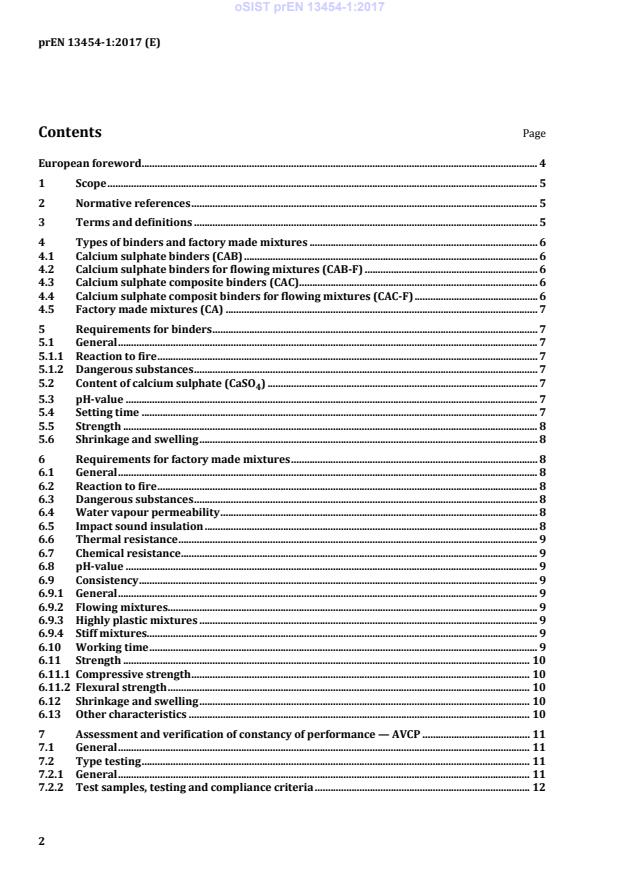
Contents Page
European foreword . 4
1 Scope . 5
2 Normative references . 5
3 Terms and definitions . 5
4 Types of binders and factory made mixtures . 6
4.1 Calcium sulphate binders (CAB) . 6
4.2 Calcium sulphate binders for flowing mixtures (CAB-F) . 6
4.3 Calcium sulphate composite binders (CAC). 6
4.4 Calcium sulphate composit binders for flowing mixtures (CAC-F) . 6
4.5 Factory made mixtures (CA) . 7
5 Requirements for binders . 7
5.1 General . 7
5.1.1 Reaction to fire . 7
5.1.2 Dangerous substances . 7
5.2 Content of calcium sulphate (CaSO ) . 7
5.3 pH-value . 7
5.4 Setting time . 7
5.5 Strength . 8
5.6 Shrinkage and swelling . 8
6 Requirements for factory made mixtures . 8
6.1 General . 8
6.2 Reaction to fire . 8
6.3 Dangerous substances . 8
6.4 Water vapour permeability . 8
6.5 Impact sound insulation . 8
6.6 Thermal resistance . 9
6.7 Chemical resistance . 9
6.8 pH-value . 9
6.9 Consistency . 9
6.9.1 General . 9
6.9.2 Flowing mixtures . 9
6.9.3 Highly plastic mixtures . 9
6.9.4 Stiff mixtures. 9
6.10 Working time . 9
6.11 Strength . 10
6.11.1 Compressive strength . 10
6.11.2 Flexural strength . 10
6.12 Shrinkage and swelling . 10
6.13 Other characteristics . 10
7 Assessment and verification of constancy of performance — AVCP . 11
7.1 General . 11
7.2 Type testing . 11
7.2.1 General . 11
7.2.2 Test samples, testing and compliance criteria . 12
prEN 13454-1:2017 (E)
7.2.3 Test reports . 12
7.2.4 Shared other party results . 12
7.2.5 Cascading determination of the product type results . 13
7.3 Factory production control (FPC) . 14
7.3.1 General . 14
7.3.2 Requirements . 15
7.3.3 Product specific requirements . 17
7.3.4 Initial inspection of factory and of FPC . 18
7.3.5 Continuous surveillance of FPC (only for products covered by AVCP system 1+, 1 and
2+) . 18
7.3.6 Procedure for modifications . 18
7.3.7 One-off products, pre-production products (e.g. prototypes) and products produced
in very low quantity . 19
8 Designation . 19
9 Marking, labelling and packaging . 20
9.1 Binders . 20
9.2 Factory made mixtures . 21
10 Conformity criteria and assessment procedure . 22
10.1 General . 22
10.2 Statistical conformity criteria . 22
10.2.1 General . 22
10.2.2 Inspection by variables . 23
10.2.3 Inspection by attributes . 24
10.3 Assessment based on individual results for factory made mixtures . 25
10.4 Conformity requirements . 25
Annex ZA (informative) Relationship of this European Standard with Regulation
(EU) No. 305/2011 . 27
ZA.1 Scope and relevant characteristics . 27
ZA.2 System of Assessment and Verification of Constancy of Performance (AVCP) . 28
ZA.3 Assignment of AVCP tasks . 28
Bibliography . 31
prEN 13454-1:2017 (E)
European foreword
This document (prEN 13454-1:2017) has been prepared by Technical Committee CEN/TC 241 “Gypsum
and gypsum based products”, the secretariat of which is held by AFNOR.
This document is currently submitted to the CEN Enquiry.
This document will supersede EN 13454-1:2004.
This document has been prepared under a mandate given to CEN by the European Commission and the
European Free Trade Association, and supports essential requirements of Regulation
(EU) No. 305/2011.
For relationship with Regulation (EU) No. 305/2011, see informative Annex ZA, which is an integral
part of this document.
Compared with the previous version the following changes have been made:
a) differentiation between binders for stiff and flowing mixtures;
b) modification of the strength classes for binders;
c) Clause 7 and Annex ZA updated in line with the CPR.
This document specifies binders and factory made mixtures where the principal active constituent is
calcium sulphate.
The requirements in EN 13454-1 on binders are based on the results of tests according to EN 13454-2.
The requirements on factory made mixtures for floor screeds based on calcium sulphate are in
accordance with EN 13813.
This document for binders and factory made mixtures for floor screeds based on calcium sulphate
consists of two parts:
— Part 1: Definitions and requirements
— Part 2: Test methods
prEN 13454-1:2017 (E)
1 Scope
This document applies to binders made of calcium sulphate used for the manufacture of floor screeds
for interior use in buildings. It also includes requirements for factory made mixtures made of calcium
sulphate used for the manufacture of floor screeds which are given in EN 13813. This document does
not cover the application of floor screeds. Floor screeds made with products covered by this document
can contribute to thermal and sound insulation and fire protection of the floor.
2 Normative references
The following documents, in whole or in part, are normatively referenced in this document and are
indispensable for its application. For dated references, only the edition cited applies. For undated
references, the latest edition of the referenced document (including any amendments) applies.
EN 12086:2013, Thermal insulating products for building applications - Determination of water vapour
transmission properties
prEN 13454-2:2017, Binders, composite binders and factory made mixtures for floor screeds based on
calcium sulphate — Part 2: Test methods
EN 13501-1:2007+A1:2009, Fire classification of construction products and building elements — Part 1:
Classification using test data from reaction to fire tests
EN 13813:2002, Screed material and floor screeds - Screed material - Properties and requirements
EN 13892-2:2002, Methods of test for screed materials - Part 2: Determination of flexural and compressive
strength
EN ISO 10140 (all parts), Acoustics - Laboratory measurement of sound insulation of building elements -
(ISO 10140-1)
3 Terms and definitions
For the purposes of this document, the following terms and definitions apply.
3.1
calcium sulphate constituent
calcium sulphate in its various dehydration phases
EXAMPLE hemihydrate and anhydrite
3.2
additive
material added to calcium sulphate binder or mixture by the manufacturer to influence the chemical
and/or the physical properties
Note 1 to entry: Additives are, for example, fillers, pozzolans, pigments and artificial resins
3.3
admixture
material added to the binder or mixture in small quantities and which, by chemical or physical action or
both, change the properties of the calcium sulphate constituent like its workability, hardening or setting
Note 1 to entry: Admixtures are, for example accelerators, retarders and plasticizers.
prEN 13454-1:2017 (E)
3.4
aggregate
material consisting of uncrushed and/or crushed mineral material with particle sizes and shapes
suitable for the production of floor screeds
3.5
screed
layer of screed material laid in situ, directly onto a base, bonded or unbonded, or onto an intermediate
layer or insulating layer, to obtain one or more of the following purposes:
— to obtain a defined level;
— to carry the final flooring;
— to provide a wearing surface.
3.6
binder
material used for the purpose of holding solid particles together in a coherent mass
3.7
consistency
fluidity of fresh screed material which characterises its ease of use
3.8
flow diameter
dimension for consistency of stiff factory made mixtures
3.9
spread
dimension for consistency of flowing and highly plastic mixtures
4 Types of binders and factory made mixtures
4.1 Calcium sulphate binders (CAB)
Calcium sulphate binders (CAB) consist of calcium sulphate constituents binding by hydration and may
contain admixtures and additives (see 5.2 a).
4.2 Calcium sulphate binders for flowing mixtures (CAB-F)
Calcium sulphate binders (CAB-F) consist of calcium sulphate constituents binding by hydration and
contain admixtures and/or additives (see 5.2 a). CAB-F is exclusively used for the manufacture of self-
levelling floor screeds.
4.3 Calcium sulphate composite binders (CAC)
Calcium sulphate composite binders (CAC) consist of calcium sulphate binders (CAB) and contain
additional additives (see 5.2 b).
4.4 Calcium sulphate composit binders for flowing mixtures (CAC-F)
Calcium sulphate composite binders (CAC-F) consist of calcium sulphate constituents binding by
hydration and contain admixtures and/or additives (see 5.2 a). CAC-F is exclusively used for the
manufacture of self-levelling floor screeds.
prEN 13454-1:2017 (E)
4.5 Factory made mixtures (CA)
Factory made mixtures consist of binders and aggregates and may contain admixtures and additives
with or with-out water. The means of determining the suitability of the aggregates for use in factory
made mixtures shall be recorded in the manufacturer’s documentation of the factory production
control.
With respect to the manufacturing methods, factory made mixtures shall be suitable for application in
one of the three consistencies: stiff, highly plastic or flowing (see 6.9).
If calcium sulphate binders or calcium sulphate composite binders, as specified in this document, are
used for the manufacture of factory made mixtures, the tests specified in prEN 13454-2 for
determination of the pH-value and for determination of shrinkage and swelling need not to be carried
out.
Factory made mixtures can be produced and delivered as:
a) prebatched (dry) in a factory and mixed on the construction site in factory specified proportions
and conditions;
b) premixed (dry) in a factory and mixed on the construction site by adding water;
c) ready mixed (wet) which is supplied to the construction site in a pre-mixed and gauged condition.
5 Requirements for binders
5.1 General
5.1.1 Reaction to fire
Binders are reaction to fire Class A1 without testing according to Commission Decision 96/603/EC as
fl
amended, provided that they contain ≤ 1 % by mass or volume of organic material, whichever is the
more onerous. For products which contain > 1 % of organic material, the product shall be tested and
classified in accordance with EN 13501-1.
5.1.2 Dangerous substances
Where required the release of dangerous substances shall be declared.
5.2 Content of calcium sulphate (CaSO )
The content of calcium sulphate in the following materials shall be:
a) calcium sulphate binders (CAB, CAB-F): ≥ 85 % calcium sulphate by mass;
b) calcium sulphate composite binders (CAC, CAC-F): ≥ 50 % and < 85 % calcium sulphate by mass.
The content of calcium sulphate shall be determined as specified in prEN 13454-2:2017.
5.3 pH-value
The pH-value of binders shall be ≥ 7,0.
The pH-value shall be determined as specified in prEN 13454-2.
5.4 Setting time
The initial setting time shall be ≥ 30 min.
The initial setting time for CAB and CAC shall be determined as specified in prEN 13454-2:2017, 4.3.1.
prEN 13454-1:2017 (E)
The initial setting time for CAB-F and CAC-F shall be determined as specified in prEN 13454-2:2017,
4.3.2.
5.5 Strength
The strength of binders shall comply with the requirements of Table 1.
Table 1 — Strengths of binders defined as characteristics values
Minimum flexural strength Minimum compressive strength
2 2
N/mm N/mm
Binder
Tested after
3 days 28 days 3 days 28 days
CAB/CAC 2,0 5,0 12,0 30,0
CAB-F/CAC-F 2,0 5,0 10,0 25,0
The strength of Cab and CAC shall be determined as specified in prEN 13454-2:2017, 4.5.1.
The strength of CAB-F and CAC-F shall be determined as specified in prEN 13454-2:2017, 4.5.2.
5.6 Shrinkage and swelling
The values for shrinkage and swelling shall not exceed 0,2 mm/m.
Shrinkage and swelling shall be determined as specified in prEN 13454-2.
6 Requirements for factory made mixtures
6.1 General
NOTE Factory made mixtures placed on the market of the European Economic Area, and therefore subject to
conformity with the Construction Products Regulation, are covered by EN 13813; tests performed to
prEN 13454-2 can, however, be taken into account to demonstrate conformity to EN 13813. Factory made
mixtures are, though, marked in accordance with EN 13813.
6.2 Reaction to fire
Factory made mixtures (CA) are reaction to fire Class A1 without testing according to Commission
fl
Decision 96/603/EC as amended, provided that they contain ≤ 1 % by mass or volume of organic
material, whichever is the more onerous. Products which contain > 1 % of organic material shall be
tested and classified in accordance with EN 13501-1.
6.3 Dangerous substances
Where required the release of dangerous substances shall be declared.
6.4 Water vapour permeability
Where the intended use of a factory made mixture is for moisture diffusion control, the permeability to
water vapour of the factory made mixture shall be determined in accordance with EN 12086.
6.5 Impact sound insulation
Impact sound insulation is a property of the assembled system and not of the product itself.
prEN 13454-1:2017 (E)
When relevant, the impact sound insulation of a system including factory made mixtures shall be
determined in accordance with the EN ISO 10140 series.
6.6 Thermal resistance
This requirement is defined in EN 13813.
6.7 Chemical resistance
This requirement is defined in EN 13813.
NOTE Floor screeds based on calcium sulphate are not used as wearing surfaces and, consequently, they are
not ex-posed to chemical influences. A chemical resistance test is, therefore, not necessary.
6.8 pH-value
For factory made mixtures based on calcium sulphate the pH-value shall be ≥ 7 when determined in
accordance with prEN 13454-2.
NOTE The test is not necessary for factory made mixtures produced exclusively from binder as defined in 4.1
to 4.4 and aggregates as defined in 3.4 and controlled as specified in 4.3.
6.9 Consistency
6.9.1 General
A manufacturer of screed materials may declare the consistency in mm determined in accordance with
EN 13454-2. Where the consistency value is greater than 300 mm, it may be determined in accordance
with EN 12706.
For premixed and prebatched mixtures the consistency is determined with a given water to solid ratio
as specified by the supplier.
6.9.2 Flowing mixtures
The spread shall be ≥ 220 mm.
The spread shall be determined as specified in prEN 13454-2.
With this consistency the mixtures shall not segregate (no visual sedimentation, no visual development
of layers).
6.9.3 Highly plastic mixtures
The spread shall be between 150 mm and less than 220 mm and determined as specified in
prEN 13454-2.
6.9.4 Stiff mixtures
The flow diameter shall be 110 mm to 140 mm.
The flow diameter shall be determined as specified in prEN 13454-2.
6.10 Working time
The minimum working time for flowing, highly plastic and stiff mixtures shall be ≥ 30 min.
The working time shall be determined as specified in prEN 13454-2.
The working time for ready mixed products begins when the product is loaded (including water).
NOTE In EN 13813 the term “setting time” is used for “working time”.
prEN 13454-1:2017 (E)
6.11 Strength
6.11.1 Compressive strength
The compressive strength of factory made mixtures (CA) shall be designated by a “C” (for Compression)
followed by the compressive strength class in N/mm , given in Table 2 in accordance with EN 13813.
Table 2 — Compressive strength of factory made mixtures (CA) defined as characteristic values
a
C5 C7 C12 C16 C20 C25 C30 C35 C40 C50 C60 C80
Class
Compressive strength in
5 7 12 16 20 25 30 35 40 50 60 80
N/mm
a
For calcium sulphate the classes C12 to C60 are recommended.
The compressive strength shall be determined as specified in EN 13892-2.
NOTE A description of the test is given in prEN 13454-2.
6.11.2 Flexural strength
The flexural strength is designated with “F” (for Flexural) followed by the flexural strength in N/mm
given in Table 3 (in accordance with EN 13813).
Table 3 — Flexural strength of factory made mixtures (CA) defined as characteristic values
a
Class F1 F2 F3 F4 F5 F6 F7 F10 F15 F20 F30 F40 F50
Flexural strength in
1 2 3 4 5 6 7 10 15 20 30 40 50
N/mm
a
For calcium sulphate the classes F3 to F20 are recommended.
The flexural strength shall be determined as specified in EN 13892-2.
NOTE A description of the test is given in prEN 13454-2.
6.12 Shrinkage and swelling
A manufacturer of screed materials may declare the shrinkage value and swelling value of the screed
material in mm/m, determined in accordance with prEN 13454-2 or in accordance with EN 13872
where the product is intended to be applied at a thickness less than 10 mm.
The values for shrinkage and swelling shall not exceed 0,2 mm/m.
NOTE This requirement is not applicable for factory made mixtures produced exclusively from binder as
defined in 4.1 to 4.4 and aggregates as defined in 3.4 and controlled as specified in 4.3.
6.13 Other characteristics
For other characteristics (i.e. surface hardness, resistance to rolling wheel, water permeability, bond
strength, sound absorption, modulus of elasticity in flexure and electrical resistance) see EN 13813.
prEN 13454-1:2017 (E)
7 Assessment and verification of constancy of performance — AVCP
7.1 General
The compliance of binders and factory made mixtures for floor screeds with the requirements of this
standard and with the performances declared by the manufacturer in the DoP shall be demonstrated
by:
— determination of the product type;
— factory production control by the manufacturer, including product assessment.
The manufacturer shall always retain the overall control and shall have the necessary means to take
responsibility for the conformity of the product with its declared performance(s).
7.2 Type testing
7.2.1 General
All performances related to characteristics included in this standard shall be determined when the
manufacturer intends to declare the respective performances unless the standard gives provisions for
declaring them without performing tests (e.g. use of previously existing data, CWFT and conventionally
accepted performance).
Assessment previously performed in accordance with the provisions of this standard, may be taken into
account provided that they were made to the same or a more rigorous test method, under the same
AVCP system on the same product or products of similar design, construction and functionality, such
that the results are applicable to the product in question.
NOTE 1 Same AVCP system means testing by an independent third party (applies only for products covered by
system 1+, 1 and 3), under the responsibility of a notified product certification body (applies only for products
covered by system 1+ and 1).
For the purposes of assessment, the manufacturer's products may be grouped into families, where it is
considered that the results for one or more characteristics from any one product within the family are
representative for that same characteristics for all products within that same family.
NOTE 2 Products can be grouped in different families for different characteristics.
NOTE 3 Reference to the assessment method standards should be made to allow the selection of a suitable
representative sample.
In addition, the determination of the product type shall be performed for all characteristics included in
the standard for which the manufacturer declares the performance:
— at the beginning of the production of a new or modified binders and factory made mixtures for floor
screeds (unless a member of the same product range), or
— at the beginning of a new or modified method of production (where this may affect the stated
properties); or
they shall be repeated for the appropriate characteristic(s), whenever a change occurs in the binders
and factory made mixtures for floor screeds design, in the raw material or in the supplier of the
components, or in the method of production (subject to the definition of a family), which would affect
significantly one or more of the characteristics.
prEN 13454-1:2017 (E)
Where components are used whose characteristics have already been determined, by the component
manufacturer, on the basis of assessment methods of other product standards, these characteristics
need not be re-assessed. The specifications of these components shall be documented.
Products bearing regulatory marking in accordance with appropriate harmonized European
specifications may be presumed to have the performances declared in the DoP, although this does not
replace the responsibility on the binders and factory made mixtures for floor screeds manufacturer to
ensure that the binders and factory made mixtures for floor screeds as a whole is correctly
manufactured and its component products have the declared performance values.
7.2.2 Test samples, testing and compliance criteria
The number of samples of binders and factory made mixtures for floor screeds to be tested/assessed
shall be in accordance with Table 4.
Table 4 — Number of samples to be tested and compliance criteria
Assessment Compliance
Characteristic Requirement No. of samples
method criteria
Reaction to fire
5.1.1 5.1.1 5.1.1
(for exposed situations)
Release of corrosive
5.4 5.4 5.4
substances
Mechanical resistance 5.5 5.5 5.5
Durability
5.2 5.2 5.2
Calcium sulphate content
5.5 5.5 5.5
Mechanical resistance
5.6 5.6 5.6
Shrinkage and swelling
a a a
Dangerous substances 5.1.2 5.1.2 5.1.2
a
No test method available at the moment. The number of samples and the compliance criteria shall be in
accordance to the corresponding test method.
7.2.3 Test reports
The results of the determination of the product type shall be documented in test reports. All test reports
shall be retained by the manufacturer for at least 10 years after the last date of production of the
binders and factory made mixtures for floor screeds to which they relate.
7.2.4 Shared other party results
A manufacturer may use the results of the product type determination obtained by someone else (e.g.
by another manufacturer, as a common service to manufacturers, or by a product developer), to justify
his own declaration of performance regarding a product that is manufactured according to the same
design (e.g. dimensions) and with raw materials, constituents and manufacturing methods of the same
kind, provided that:
— the results are known to be valid for products with the same essential characteristics relevant for
the product performance;
prEN 13454-1:2017 (E)
— in addition to any information essential for confirming that the product has such same
performances related to specific essential characteristics, the other party who has carried out the
1)
determination of the product type concerned or has had it carried out, has expressly accepted to
transmit to the manufacturer the results and the test report to be used for the latter’s product type
determination, as well as information regarding production facilities and the production control
process that can be taken into account for FPC;
— the manufacturer using other party results accepts to remain responsible for the product having
the declared performances and he also:
a) ensures that the product has the same characteristics relevant for performance as the one that
has been subjected to the determination of the product type, and that there are no significant
differences with regard to production facilities and the production control process compared
to that used for the product that was subjected to the determination of the product type; and
b) keeps available a copy of the determination of the product type report that also contains the
information needed for verifying that the product is manufactured according to the same
design and with raw materials, constituents and manufacturing methods of the same kind.
7.2.5 Cascading determination of the product type results
For some construction products, there are companies (often called “system houses”) which supply or
2)
ensure the supply of, on the basis of an agreement, some or all of the components (e.g. in case of
3)
windows: profiles, gaskets, weather strips) to an assembler who then manufactures the finished
product (referred to below as the “assembler”) in his factory.
Provided that the activities for which such a system house is legally established include
manufacturing/assembling of products as the assembled one, the system house may take the
responsibility for the determination of the product type regarding one or several essential
characteristics of an end product which is subsequently manufactured and/or assembled by other firms
in their own factory.
When doing so, the system house shall submit an “assembled product” using components manufactured
by it or by others, to the determination of the product type and then make the determination of the
product type report available to the assemblers, i.e. the actual manufacturer of the product placed on
the market.
To take into account such a situation, the concept of cascading determination of the product type might
be taken into consideration in the technical specification, provided that this concerns characteristics for
which either a notified product certification body or a notified test laboratory intervene, as presented
below.
The determination of the product type report that the system house has obtained with regard to tests
carried out by a notified body, and which is supplied to the assemblers, may be used for the regulatory
marking purposes without the assembler having to involve again a notified body to undertake the
determination of the product type of the essential characteristic(s) that were already tested, provided
that:
1) The formulation of such an agreement can be done by licence, contract, or any other type of written consent.
2)
This can be, for instance, a contract, license or whatever kind of written agreement, which should also contain
clear provisions with regard to responsibility and liability of the component producer (system house, on the one
hand, and the assembler of the finished product, on the other hand.
3)
These companies may produce components but they are not required to do so.
prEN 13454-1:2017 (E)
— the assembler manufactures a product which uses the same combination of components
(components with the same characteristics), and in the same way, as that for which the system
house has obtained the determination of the product type report. If this report is based on a
combination of components not representing the final product as to be placed on the market,
and/or is not assembled in accordance with the system house’s instruction for assembling the
components, the assembler needs to submit his finished product to the determination of the
product type;
— the system house has notified to the manufacturer the instructions for manufacturing/assembling
the product and installation guidance;
— the assembler (manufacturer) assumes the responsibility for the correct assembly of the product in
accordance with the instructions for manufacturing/assembling the product and installation
guidance notified to him by the system house;
— the instructions for manufacturing/assembling the product and installation guidance notified to the
assembler (manufacturer) by the system house are an integral part of the assembler’s Factory
Production Control system and are referred to in the determination of the product type report;
— the assembler is able to provide documented evidence that the combination of components he is
using, and his way of manufacturing, correspond to the one for which the system house has
obtained the determination of the product type report (he needs to keep a copy of the system
house’s determination of the product type report);
— regardless the possibility of referring, on the basis of the agreement signed with the system house,
to the latter’s responsibility and liability under private law, the assembler remains responsible for
the product being in compliance with the declared performances, including both the design and the
manufacture of the product, which is given when he affixes the regulatory marking on his product
7.3 Factory production control (FPC)
7.3.1 General
The manufacturer shall establish, document and maintain an FPC system to ensure that the products
placed on the market comply with the declared performance of the essential characteristics.
The FPC system shall consist of procedures, regular inspections and tests and/or assessments and the
use of the results to control raw and other incoming materials or components, equipment, the
production process and the product.
All the elements, requirements and provisions adopted by the manufacturer shall be documented in a
systematic manner in the form of written policies and procedures.
This factory production control system documentation shall ensure a common understanding of the
evaluation of the constancy of performance and enable the achievement of the required product
performances and the effective operation of the production control system to be checked. Factory
production control therefore brings together operational techniques and all measures allowing
maintenance and control of the compliance of the product with the declared performances of the
essential characteristics.
In case the manufacturer has used shared or cascading product type results, the FPC shall also include
the appropriate documentation as foreseen in 7.2.4 and 7.2.5.
prEN 13454-1:2017 (E)
7.3.2 Requirements
7.3.2.1 General
The manufacturer is responsible for organizing the effective implementation of the FPC system in line
with the content of this product standard. Tasks and responsibilities in the production control
organization shall be documented and this documentation shall be kept up-to-date.
The responsibility, authority and the relationship between personnel that manages, performs or verifies
work affecting product constancy, shall be defined. This applies in particular to personnel that need to
initiate actions preventing product non-constancies from occurring, actions in case of non-constancies
and to identify and register product constancy problems.
Personnel performing work affecting the constancy of performance of the product shall be competent
on the basis of appropriate education, training, skills and experience for which records shall be
maintained.
In each factory the manufacturer may delegate the action to a person having the necessary authority to:
— identify procedures to demonstrate constancy of performance of the product at appropriate stages;
— identify and record any instance of non-constancy;
— identify procedures to correct instances of non-constancy.
The manufacturer shall draw up and keep up-to-date documents defining the factory production
control. The manufacturer's documentation and procedures should be appropriate to the product and
manufacturing process. The FPC system should achieve an appropriate level of confidence in the
constancy of performance of the product. This involves:
a) the preparation of documented procedures and instructions relating to factory production control
operations, in accordance with the requirements of the technical specification to which reference is
made;
b) the effective implementation of these procedures and instructions;
c) the recording of
...