

EN 16931-1:2017+A1:2019/prA2
(Amendment)Electronic invoicing - Part 1: Semantic data model of the core elements of an electronic invoice
- Abstract
This European Standard establishes a semantic data model of the core elements of an electronic invoice. The semantic model includes only the essential information elements that an electronic invoice needs to ensure legal (including fiscal) compliance and to enable interoperability for cross-border, cross sector and for domestic trade. The semantic model may be used by organizations in the private and the public sector for public procurement invoicing. It may also be used for invoicing between private sector enterprises. It has not been specifically designed for invoicing consumers.
This European Standard complies at least with the following criteria:
- it is technologically neutral;
- it is compatible with relevant international standards on electronic invoicing;
- the application of this standard should comply with the requirements for the protection of personal data of Directive 95/46/EC, having due regard to the principles of privacy and data protection by-design, data minimization, purpose limitation, necessity and proportionality;
- it is consistent with the relevant provisions of Directive 2006/112/EC [2];
- it allows for the establishment of practical, user-friendly, flexible and cost-efficient electronic invoicing systems;
- it takes into account the special needs of small and medium-sized enterprises as well as of sub-central contracting authorities and contracting entities;
- it is suitable for use in commercial transactions between enterprises.
- Status
- Not Published
- Publication Date
- 25-Apr-2023
- Technical Committee
- CEN/TC 434 - Project Committee - Electronic Invoicing
- Drafting Committee
- CEN/TC 434/WG 1 - Definition
- Current Stage
- 4098 - Decision to abandon - Enquiry
- Start Date
- 06-May-2024
- Completion Date
- 07-Oct-2026

Overview
EN 16931-1:2017+A1:2019/prA2 (CEN) defines a semantic data model of the core elements of an electronic invoice. The standard specifies the essential information elements necessary to ensure legal and fiscal compliance and to enable interoperability across borders, sectors and domestic trade. It is technology‑neutral, aligned with relevant international e‑invoicing standards, and intended for public procurement and B2B invoicing (not specifically designed for consumer invoicing).
Key topics and requirements
- Semantic data model (core invoice model): a minimal, interoperable set of invoice data elements required for legal/fiscal compliance and automated processing.
- Essential information elements only: focuses on the core fields needed for VAT/tax and transactional traceability; excludes many sector- or country‑specific extensions.
- Interoperability and syntax neutrality: the model is independent of specific file formats; syntax bindings and compliant syntaxes are covered in companion technical specifications.
- Compliance and privacy: application should respect EU data protection principles (privacy‑by‑design, data minimization, purpose limitation) and be consistent with Directive 2006/112/EC on VAT.
- Extensibility: sector or national extensions are supported via a described methodology (see CEN/TR 16931-5).
- Practical design criteria: aimed at cost‑efficient, user‑friendly electronic invoicing systems and takes into account SME and sub‑central contracting authority needs.
Practical applications and users
Who benefits and how:
- Public authorities implementing e‑procurement and e‑invoicing to meet EU regulatory requirements.
- ERP, accounting and invoicing software vendors who need a standardized semantic model to enable automated invoice exchange and processing.
- B2B platforms, integrators and service providers deploying cross‑border invoice transmission and validation.
- Tax authorities and auditors for consistent VAT/tax reporting and audit trails.
- Organizations seeking to harmonize invoice exchanges across sectors and national borders while keeping systems technology neutral.
Typical use cases:
- Automating invoice validation and payment workflows.
- Exchanging invoices between heterogenous systems (ERP ↔ e‑invoicing networks).
- Implementing public procurement invoicing mandates with guaranteed interoperability.
Related standards
Part of an EN 16931 series and supporting documents:
- EN 16931-1 (this semantic model)
- CEN/TS 16931-2 (List of syntaxes complying with EN 16931-1)
- CEN/TS 16931-3-x (Methodology and specific syntax bindings, e.g. UBL, UN/CEFACT, UN/EDIFACT)
- CEN/TR 16931-4, -5, -6 (guidelines on transmission, use of extensions, testing)
EN 16931-1 is a foundational reference for anyone implementing compliant, interoperable electronic invoicing in Europe and across international trading systems.
Relations
- Effective Date
- 22-Jul-2020
Get Certified
Connect with accredited certification bodies for this standard

BSI Group
BSI (British Standards Institution) is the business standards company that helps organizations make excellence a habit.

NYCE
Mexican standards and certification body.
Sponsored listings
Frequently Asked Questions
EN 16931-1:2017+A1:2019/prA2 is a draft published by the European Committee for Standardization (CEN). Its full title is "Electronic invoicing - Part 1: Semantic data model of the core elements of an electronic invoice". This standard covers: This European Standard establishes a semantic data model of the core elements of an electronic invoice. The semantic model includes only the essential information elements that an electronic invoice needs to ensure legal (including fiscal) compliance and to enable interoperability for cross-border, cross sector and for domestic trade. The semantic model may be used by organizations in the private and the public sector for public procurement invoicing. It may also be used for invoicing between private sector enterprises. It has not been specifically designed for invoicing consumers. This European Standard complies at least with the following criteria: - it is technologically neutral; - it is compatible with relevant international standards on electronic invoicing; - the application of this standard should comply with the requirements for the protection of personal data of Directive 95/46/EC, having due regard to the principles of privacy and data protection by-design, data minimization, purpose limitation, necessity and proportionality; - it is consistent with the relevant provisions of Directive 2006/112/EC [2]; - it allows for the establishment of practical, user-friendly, flexible and cost-efficient electronic invoicing systems; - it takes into account the special needs of small and medium-sized enterprises as well as of sub-central contracting authorities and contracting entities; - it is suitable for use in commercial transactions between enterprises.
This European Standard establishes a semantic data model of the core elements of an electronic invoice. The semantic model includes only the essential information elements that an electronic invoice needs to ensure legal (including fiscal) compliance and to enable interoperability for cross-border, cross sector and for domestic trade. The semantic model may be used by organizations in the private and the public sector for public procurement invoicing. It may also be used for invoicing between private sector enterprises. It has not been specifically designed for invoicing consumers. This European Standard complies at least with the following criteria: - it is technologically neutral; - it is compatible with relevant international standards on electronic invoicing; - the application of this standard should comply with the requirements for the protection of personal data of Directive 95/46/EC, having due regard to the principles of privacy and data protection by-design, data minimization, purpose limitation, necessity and proportionality; - it is consistent with the relevant provisions of Directive 2006/112/EC [2]; - it allows for the establishment of practical, user-friendly, flexible and cost-efficient electronic invoicing systems; - it takes into account the special needs of small and medium-sized enterprises as well as of sub-central contracting authorities and contracting entities; - it is suitable for use in commercial transactions between enterprises.
EN 16931-1:2017+A1:2019/prA2 is classified under the following ICS (International Classification for Standards) categories: 35.240.20 - IT applications in office work; 35.240.63 - IT applications in trade. The ICS classification helps identify the subject area and facilitates finding related standards.
EN 16931-1:2017+A1:2019/prA2 has the following relationships with other standards: It is inter standard links to EN 16931-1:2017+A1:2019. Understanding these relationships helps ensure you are using the most current and applicable version of the standard.
EN 16931-1:2017+A1:2019/prA2 is associated with the following European legislation: EU Directives/Regulations: 2014/55/EU. When a standard is cited in the Official Journal of the European Union, products manufactured in conformity with it benefit from a presumption of conformity with the essential requirements of the corresponding EU directive or regulation.
EN 16931-1:2017+A1:2019/prA2 is available in PDF format for immediate download after purchase. The document can be added to your cart and obtained through the secure checkout process. Digital delivery ensures instant access to the complete standard document.
Standards Content (Sample)
SLOVENSKI STANDARD
01-marec-2022
Elektronsko izdajanje računov - 1. del: Semantični podatkovni model osrednjih
elementov za elektronski račun - Dopolnilo A2
Electronic invoicing - Part 1: Semantic data model of the core elements of an electronic
invoice
Elektronische Rechnungsstellung - Teil 1: Semantisches Datenmodell der Kernelemente
einer elektronischen Rechnung
Facturation électronique - Partie 1 : modèle sémantique de données des éléments
essentiels d'une facture électronique
Ta slovenski standard je istoveten z: EN 16931-1:2017+A1:2019/prA2
ICS:
03.100.20 Trgovina. Komercialna Trade. Commercial function.
dejavnost. Trženje Marketing
35.240.63 Uporabniške rešitve IT v IT applications in trade
trgovini
SIST EN 16931- en,fr,de
1:2017+A1:2020/oprA2:2022
2003-01.Slovenski inštitut za standardizacijo. Razmnoževanje celote ali delov tega standarda ni dovoljeno.
DRAFT
EUROPEAN STANDARD
EN 16931-
NORME EUROPÉENNE
1:2017+A1:2019
EUROPÄISCHE NORM
prA2
January 2022
ICS 35.240.20; 35.240.63
English Version
Electronic invoicing - Part 1: Semantic data model of the
core elements of an electronic invoice
Facturation électronique - Partie 1 : modèle Elektronische Rechnungsstellung - Teil 1:
sémantique de données des éléments essentiels d'une Semantisches Datenmodell der Kernelemente einer
facture électronique elektronischen Rechnung
This draft amendment is submitted to CEN members for enquiry. It has been drawn up by the Technical Committee CEN/TC 434.
This draft amendment A2, if approved, will modify the European Standard EN 16931-1:2017+A1:2019. If this draft becomes an
amendment, CEN members are bound to comply with the CEN/CENELEC Internal Regulations which stipulate the conditions for
inclusion of this amendment into the relevant national standard without any alteration.
This draft amendment was established by CEN in three official versions (English, French, German). A version in any other
language made by translation under the responsibility of a CEN member into its own language and notified to the CEN-CENELEC
Management Centre has the same status as the official versions.
CEN members are the national standards bodies of Austria, Belgium, Bulgaria, Croatia, Cyprus, Czech Republic, Denmark, Estonia,
Finland, France, Germany, Greece, Hungary, Iceland, Ireland, Italy, Latvia, Lithuania, Luxembourg, Malta, Netherlands, Norway,
Poland, Portugal, Republic of North Macedonia, Romania, Serbia, Slovakia, Slovenia, Spain, Sweden, Switzerland, Turkey and
United Kingdom.
Recipients of this draft are invited to submit, with their comments, notification of any relevant patent rights of which they are
aware and to provide supporting documentation.
Warning : This document is not a European Standard. It is distributed for review and comments. It is subject to change without
notice and shall not be referred to as a European Standard.
EUROPEAN COMMITTEE FOR STANDARDIZATION
COMITÉ EUROPÉEN DE NORMALISATION
EUROPÄISCHES KOMITEE FÜR NORMUNG
CEN-CENELEC Management Centre: Rue de la Science 23, B-1040 Brussels
© 2022 CEN All rights of exploitation in any form and by any means reserved Ref. No. EN 16931-1:2017+A1:2019/prA2:2022
worldwide for CEN national Members. E
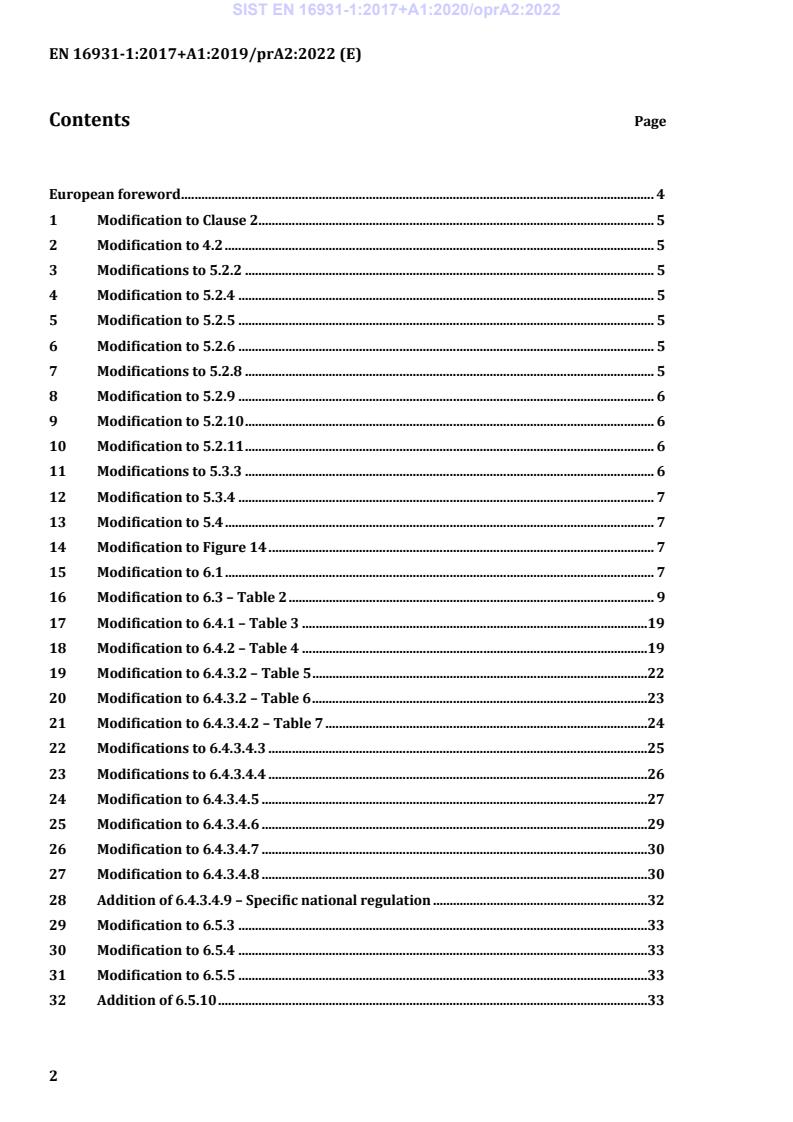
Contents Page
European foreword . 4
1 Modification to Clause 2. 5
2 Modification to 4.2 . 5
3 Modifications to 5.2.2 . 5
4 Modification to 5.2.4 . 5
5 Modification to 5.2.5 . 5
6 Modification to 5.2.6 . 5
7 Modifications to 5.2.8 . 5
8 Modification to 5.2.9 . 6
9 Modification to 5.2.10 . 6
10 Modification to 5.2.11 . 6
11 Modifications to 5.3.3 . 6
12 Modification to 5.3.4 . 7
13 Modification to 5.4 . 7
14 Modification to Figure 14 . 7
15 Modification to 6.1 . 7
16 Modification to 6.3 – Table 2 . 9
17 Modification to 6.4.1 – Table 3 .19
18 Modification to 6.4.2 – Table 4 .19
19 Modification to 6.4.3.2 – Table 5 .22
20 Modification to 6.4.3.2 – Table 6 .23
21 Modification to 6.4.3.4.2 – Table 7 .24
22 Modifications to 6.4.3.4.3 .25
23 Modifications to 6.4.3.4.4 .26
24 Modification to 6.4.3.4.5 .27
25 Modification to 6.4.3.4.6 .29
26 Modification to 6.4.3.4.7 .30
27 Modification to 6.4.3.4.8 .30
28 Addition of 6.4.3.4.9 – Specific national regulation .32
29 Modification to 6.5.3 .33
30 Modification to 6.5.4 .33
31 Modification to 6.5.5 .33
32 Addition of 6.5.10 .33
33 Modification to 6.5.12 . 34
34 Modification to 6.5.13 – Decimals . 34
35 Modification to 6.5.14 – Rounding . 35
36 Modification to Table C.1 . 36
European foreword
This document (EN 16931-1:2017+A1:2019/prA2:2022) has been prepared by Technical Committee
CEN/TC 434 “Electronic Invoicing”, the secretariat of which is held by NEN.
This document is currently submitted to Enquiry.
This document has been prepared under a Standardization Request given to CEN by the European
Commission and the European Free Trade Association, and supports essential requirements of EU
Directive(s) / Regulation(s).
For relationship with EU Directive(s) / Regulation(s), see informative Annex B which is an integral part
of EN 16931-1:2017+A1:2019.
This document is part of a set of documents, consisting of:
— EN 16931-1:2017, Electronic invoicing – Part 1: Semantic data model of the core elements of an
electronic invoice
— CEN/TS 16931-2:2017, Electronic invoicing – Part 2: List of syntaxes that comply with EN 16931-1
— CEN/TS 16931-3-1:2017, Electronic invoicing – Part 3-1: Methodology for syntax bindings of the core
elements of an electronic invoice
— CEN/TS 16931-3-2:2017, Electronic invoicing – Part 3-2: Syntax binding for ISO/IEC 19845 (UBL 2.1)
invoice and credit note
— CEN/TS 16931-3-3:2017, Electronic invoicing – Part 3-3: Syntax binding for UN/CEFACT XML Cross
Industry Invoice D16B
— CEN/TS 16931-3-4:2017, Electronic invoicing – Part 3-4: Syntax binding for UN/EDIFACT
INVOICE D16B
— CEN/TR 16931-4:2017, Electronic invoicing – Part 4: Guidelines on interoperability of electronic
invoices at the transmission level
— CEN/TR 16931-5:2017, Electronic invoicing – Part 5: Guidelines on the use of sector or country
extensions in conjunction with EN 16931-1, methodology to be applied in the real environment
— CEN/TR 16931-6 , Electronic invoicing – Part 6: Result of the test of EN 16931-1 with respect to its
practical application for an end user – Testing methodology
In preparation.
1 Modification to Clause 2
Remove:
IEEE/ISO/IEC 60559-2020 – ISO/IEC/IEEE International Standard – Floating-point arithmetic
2 Modification to 4.2
Add in the last paragraph:
The methodology to create extensions is described in CEN/TR 16931-5.
3 Modifications to 5.2.2
Replace the last two sentences of the 1st paragraph by
This delivery or deliveries is/are then invoiced by the Seller to the Buyer. Finally, the Buyer pays the
Payee.
Replace the last two sentences of the 2nd paragraph by:
Deliveries result in an invoice. An invoice may refer to multiple deliveries and multiple purchase orders.
Replace the 1st sentence of the 3rd paragraph by:
A delivery may include the pick-up and return of returnable packaging from previous deliveries and, for
which a payment (deposit) had previously been made by the Buyer and had been received by the Seller.
4 Modification to 5.2.4
Replace the last two sentences of the last paragraph by:
A purchase order serves as a contract and triggers the deliveries. A purchase order may be confirmed by
the Seller (not shown in the diagram).
5 Modification to 5.2.5
Delete the last sentence:
Each delivery … one purchase order.
6 Modification to 5.2.6
Delete the last sentence:
An invoice … to one delivery.
7 Modifications to 5.2.8
Replace – paragraph with:
After receipt of the purchase order the Seller sends a despatch advice in advance of the deliveries. In the
invoice a reference is made to the relevant despatch advice(s). The invoice content should reflect the
content of despatch advices which it refers to. An invoice may refer to multiple purchase order and
multiple despatch advices.
8 Modification to 5.2.9
Replace the paragraph with:
After delivery and before the invoice is issued, the Seller waits for a receiving advice from the Receiver,
in which the Receiver acknowledges that the goods and services have been received and if there are any
issues with the delivery. The Seller bases the invoice on information contained in the receiving advices.
The invoice may refer to multiple despatch advices, multiple receiving advices and may also refer to
multiple purchase orders.
9 Modification to 5.2.10
Replace the last sentence by:
The invoice or credit note may refer to multiple preceding invoices.
10 Modification to 5.2.11
Delete the last sentence
See Annex A … mechanisms.
11 Modifications to 5.3.3
In the “In scope for the core invoice model” replace R5, R7, R9 and R10 by:
R5 information to trace to related purchase orders from the document and line level (all processes,
except P2 and P5);
R7 information to trace to a single contract and the underlying call for tenders from the document
or line level (all processes, except P3 and P5);
R9 information to trace to multiple despatch advices from the document and line level (processes
P7 and P8);
R10 information to trace to multiple receiving advices from the document and line level (process P8);
Replace the list in “Out of scope for the core invoice model” by:
— reference to one or more related purchase order lines on header level;
— reference to multiple related purchase order lines on line level;
— reference to multiple contracts;
— reference to one or more price lists;
— reference to the exact time of delivery;
— reference to more than one receiving advice;
— reference to one or more receiving advice lines at invoice line level;
— reference to supporting documents at invoice line level;
— reference to one or more consumption reports or performance records;
— reference to one or more invoices for payment in advance;
— reference to multiple sales orders (issued by the Seller);
— sub-lines of allowances and charges;
— delivered quantities of goods and services if different from invoiced quantities;
— ordered quantities of goods and services if different from invoiced quantities;
— back-ordered quantities of goods and services if different from invoiced quantities;
— coded attributes of goods and services;
— specific coded quality information of goods or services;
— structured metered values;
— lot numbers of goods and services (except in free text);
— serial numbers or other identification numbers (e.g. of the person rendering the services) (except
in free text);
12 Modification to 5.3.4
In “In scope for the core invoice model” replace R55 by:
R55 codes for exemption and out of scope reasons at document and invoice line level.
13 Modification to 5.4
Replace the 1st paragraph with:
An invoice, compliant with the core invoice model may reference multiple purchase orders and multiple
deliveries explicitly. For automatic processing of invoices, usually explicit, qualified references are
needed.
14 Modification to Figure 14
Add the title of the figure
Figure 14 — Invoice relations
15 Modification to 6.1
Replace Figure 15 by:
16 Modification to 6.3 – Table 2
Semanti
Cardinalit Business Req.
c data
ID Level Description Usage Note
y Term ID
type
The time of the day
BT- Invoice issue
+ 0.1 when the Invoice was R56 Time
188 time
issued.
Identifies the Seller's
electronic address to
Seller R13
BT- which the application Identifie
++ 0.1 electronic ,
34 level response to the r
address R57
invoice may be
delivered.
The identification The scheme identifier shall be
Scheme scheme identifier of the chosen from the EAS
1.1
identifier Seller electronic (Electronic Address Scheme)
address. list.
Identifies the Buyer's
Buyer R13
BT- electronic address to Identifie
++ 0.1 electronic ,
49 which the invoice is r
address R57
delivered.
The identification The scheme identifier shall be
Scheme scheme identifier of the chosen from the EAS
1.1
identifier Buyer electronic (Electronic Address Scheme)
address. list.
A group of business In the case of pick-up, the
terms providing deliver to address is the pick-
BG- DELIVER TO information about the up address. Sufficient
++ 0.1 R32
address to which goods components of the address
15 ADDRESS
and services invoiced are to be filled to comply with
were or are delivered. legal requirements.
A group of business
PAYMENT
BG- terms providing
+ 0.n INSTRUCTIO R58
16 information about the
NS
payment.
The amount to be paid In case of a split payment.
BT- Amount to
++ 0.1 according this payment May be the amount to be Amount
166 be paid
instruction withheld.
The suffix ".Type" has been deleted for readability.
Semanti
Cardinalit Business Req.
c data
ID Level Description Usage Note
y Term ID
type
A group of business
BG- CREDIT
++ 0.1 terms to specify credit R58
17 TRANSFER
transfer payments.
Document
R15
BT- level The amount of an
++ 1.1 , Amount
92 allowance allowance, without VAT.
R19
amount
The base amount that
may be used, in
Document
conjunction with the R15
BT- level
++ 0.1 document level , Amount
93 allowance
allowance percentage, to R42
base amount
calculate the document
level allowance amount.
Semanti
Cardinalit Business Req.
c data
ID Level Description Usage Note
y Term ID
type
The following entries of
UNTDID 5305 [6] are used
(further clarification between
brackets):
- Standard rate (Liable for
VAT in a standard way)
- Zero rated goods (Liable for
VAT with a percentage rate of
zero)
- Exempt from tax
(VAT/IGIC/IPSI)
- VAT Reverse Charge
(Reverse charge
VAT/IGIC/IPSI rules apply)
- VAT exempt for intra
R15
community supply of goods
Document
,
(VAT/IGIC/IPSI not levied
level A coded identification of
R16
due to Intra-community
BT- allowance what VAT category
++ 1.1 , Code
supply rules)
95 VAT applies to the document
R45
category level allowance.
- Free export item, tax not
,
code
charged (VAT/IGIC/IPSI not
R48
levied due to export outside
of the EU)
- Services outside scope of tax
(Sale is not subject to
VAT/IGIC/IPSI)
- Canary Islands General
Indirect Tax (Liable for IGIC
tax)
- Liable for IPSI
(Ceuta/Melilla tax)
- Transferred (VAT) for
Italian split payment
- Specific national regulation
(to be detailed in the
Exemption reason)
Document
A textual statement of R48
Level
the reason why the ,
BT- Allowance Articles 226 items 11 to 15
0.1
+++ amount is exempted R49 Text
167 VAT Directive 2006/112/EC [2].
from VAT or why no ,
exemption
VAT is being charged R51
reason text
Semanti
Cardinalit Business Req.
c data
ID Level Description Usage Note
y Term ID
type
R48
Document
,
Level A coded statement of the
R49
BT- Allowance reason for why the VATEX (VAT Exemption
+++ 0.1 Code
,
168 VAT amount is exempted Reasons) code list.
R51
exemption from VAT.
reason code
R55
Document
Indicator that shows
level
BT- that the allowance
++ 0.1 allowance Yes or no R38 Text
169 amount is subject to tax
tax withheld
withholding process
indicator
R15
Document ,
BT- The amount of a charge,
++ 1.1 level charge R16 Amount
99 without VAT.
amount ,
R19
The base amount that
may be used, in R15
Document conjunction with the ,
BT-
++ 0.1 level charge document level charge R16 Amount
base amount percentage, to calculate ,
the document level R19
charge amount.
Semanti
Cardinalit Business Req.
c data
ID Level Description Usage Note
y Term ID
type
The following entries of
UNTDID 5305 [6] are used
(further clarification between
brackets):
- Standard rate (Liable for
VAT in a standard way)
- Zero rated goods (Liable for
VAT with a percentage rate of
zero)
- Exempt from tax
(VAT/IGIC/IPSI)
- VAT Reverse Charge
(Reverse charge
VAT/IGIC/IPSI rules apply)
- VAT exempt for intra
community supply of goods
(VAT/IGIC/IPSI not levied
Document R15
A coded identification of
due to Intra-community
level charge ,
BT- what VAT category
supply rules)
1.1
++ VAT R45 Code
102 applies to the document
category - Free export item, tax not ,
level charge.
code charged (VAT/IGIC/IPSI not R48
levied due to export outside
of the EU)
- Services outside scope of tax
(Sale is not subject to
VAT/IGIC/IPSI)
- Canary Islands General
Indirect Tax (Liable for IGIC
tax)
- Liable for IPSI
(Ceuta/Melilla tax)
- Transferred (VAT) for
Italian split payment
- Specific national regulation
(to be detailed in the
Exemption reason)
Document A textual statement of R48
Level Charge the reason why the ,
BT- Articles 226 items 11 to 15
+++ 0.1 VAT amount is exempted R49 Text
170 Directive 2006/112/EC [2].
exemption from VAT or why no ,
reason text VAT is being charged R51
R48
Document
,
A coded statement of the
Level Charge
R49
BT- reason for why the VATEX (VAT Exemption
+++ 0.1 VAT Code
,
amount is exempted
171 Reasons) code list.
exemption
R51
from VAT.
reason code
R55
Semanti
Cardinalit Business Req.
c data
ID Level Description Usage Note
y Term ID
type
Document Indicator that shows
BT- level charge that the charge amount
++ 0.1 Yes or no R38 Text
172 tax withheld is subject to tax
indicator withholding process
The Invoice total amount
without VAT is the Sum of
Invoice line net amount (BT-
Invoice total
BT- The total amount of the 109) minus Sum of
++ 1.1 amount R40 Amount
109 Invoice without VAT. allowances on document
without VAT
level (BT-92) plus Sum of
charges on document level
(BT-99).
The sum of amount
which have been paid in
This amount is subtracted
advance or shall not be R40
BT- from the invoice total amount
+++ 0.1 Paid amount calculated into the , Amount
113 with VAT to calculate the
amount due for payment R66
amount due for payment.
(e.g. split payment
amount).
Part of the tax or social
BG- securities amount that is
+ 0.n Tax withheld R38
33 not to be paid to the
Seller.
BT- Amount Amount that is not to be
++ 1.1 R38 Amount
172 withheld paid to the Seller.
Base of the amount that
BT- Withheld
++ 0.1 is not to be paid to the R38 Amount
173 base amount
Seller.
Percentage of the base
BT- Withheld Percent
0.1 amount that is not to be
++ R38
174 percentage age
paid to the Seller.
BT- Tax withheld Description/Reason of
++ 0.1 R38 Text
175 reason text tax withholding process
Semanti
Cardinalit Business Req.
c data
ID Level Description Usage Note
y Term ID
type
The following entries of
UNTDID 5305 [6] are used
(further clarification between
brackets):
- Standard rate (Liable for
VAT in a standard way)
- Zero rated goods (Liable for
VAT with a percentage rate of
zero)
- Exempt from tax
(VAT/IGIC/IPSI)
- VAT Reverse Charge
(Reverse charge
VAT/IGIC/IPSI rules apply)
- VAT exempt for intra
community supply of goods
R38
(VAT/IGIC/IPSI not levied
VAT ,
due to Intra-community
BT- Coded identification of a
++ 1.1 category R45 Code
supply rules)
118 VAT category.
code ,
- Free export item, tax not
R49
charged (VAT/IGIC/IPSI not
levied due to export outside
of the EU)
- Services outside scope of tax
(Sale is not subject to
VAT/IGIC/IPSI)
- Canary Islands General
Indirect Tax (Liable for IGIC
tax)
- Liable for IPSI
(Ceuta/Melilla tax)
- Transferred (VAT) for
Italian split payment
- Specific national regulation
(to be detailed in the
Exemption reason)
R48
,
A coded statement of the
VAT
R49
BT- reason for why the VATEX (VAT Exemption
++ 0.1 exemption Code
,
121 amount is exempted Reasons) code list.
reason code
R51
from VAT.
R55
Semanti
Cardinalit Business Req.
c data
ID Level Description Usage Note
y Term ID
type
Attached document is used
when documentation shall be
stored with the Invoice for
future reference or audit
purposes.
A Receiver of an Invoice,
compliant to the core invoice
An attached document
Binary
model may accept and
BT- Attached embedded as binary
object
++ 0.1 process the following types of R35
125 document object or sent together
attachments with a warning.
with the invoice.
A warning is given because
the processing of a structured
attachment requires the
knowledge of its semantics,
which have to be given via a
bilateral agreement,.
Allowed mime codes:
- application/pdf
- image/png
- image/jpeg
- text/csv
-
Attached
The mime code of the
application/vnd.openxmlfor
1.1 document
attached document.
mats-
Mime code
officedocument.spreadsheet
ml.sheet
-
application/vnd.oasis.opendo
cument. spreadsheet
— application/xml (.xml).
It may be a subscription
number, telephone number,
An identifier for an
Invoice line meter point etc., as
BT- object on which the Identifie
++ 0.n object applicable. It is possible to R33
128 invoice line is based, r
identifier reference multiple types of
given by the Seller.
reference (not multiple
references of the same type).
If it may be not clear for the
receiver what scheme is used
The identification for the identifier, a
Scheme scheme identifier of the conditional scheme identifier
0.1
identifier Invoice line object should be used that shall be
identifier. chosen from the
UNTDID 1153 code list [6]
entries.
Semanti
Cardinalit Business Req.
c data
ID Level Description Usage Note
y Term ID
type
Indicator that shows
Invoice line
BT- that the Invoice line
++ 0.1 tax withheld Yes or no R37 Text
176 amount is subject to tax
indicator
withholding process
Invoice line An identifier for a
BT- purchase referenced purchase
++ 0.1 R5 Text
177 order order, issued by the
reference Buyer.
Invoice line An identifier for a
BT-
++ 0.1 project referenced project, R44 Text
reference issued by the Buyer.
Invoice line
BT- An identifier for a
++ 0.1 tender or lot R7 Text
186 referenced tender or lot
reference
Invoice line
BT- An identifier for a
++ 0.1 contract R7 Text
187 referenced contract
reference
Invoice line An identifier for a
BT-
++ 0.1 sales order referenced sales order, R5 Text
reference issued by the Seller.
Invoice line An identifier for a
BT- despatch referenced despatch
++ 0.1 R9 Text
179 advice advice, issued by the
reference Seller.
Invoice line An identifier for a
BT- receiving referenced receiving
++ 0.1 R10 Text
180 advice advice, issued by the
reference Buyer.
Invoice line An identifier for a Docume
The purchase order identifier
BT- purchase referenced line within a nt
++ 0.1 may be referenced on R6
132 order line purchase order, issued referenc
document level.
reference by the Buyer. e
Invoice line R15
BT- The amount of an
+++ 1.1 allowance , Amount
136 allowance, without VAT.
amount R19
The base amount that
may be used, in
Invoice line conjunction with the R15
BT-
+++ 0.1 allowance Invoice line allowance , Amount
base amount percentage, to calculate R42
the Invoice line
allowance amount.
Invoice line
BT- The amount of a charge,
+++ 1.1 charge R19 Amount
141 without VAT.
amount
Semanti
Cardinalit Business Req.
c data
ID Level Description Usage Note
y Term ID
type
The base amount that
may be used, in
Invoice line conjunction with the
BT-
+++ 0.1 charge base Invoice line charge R42 Amount
amount percentage, to calculate
the Invoice line charge
amount.
Item VAT The price of an item per Unit
BT-
+++ 0.1 inclusive base quantity, inclusive price
price of VAT. amount
Item price The number of item
BT-
The Item price base quantity
0.1 base units to which the price
+++ R14 Quantity
149 shall not be negative.
quantity applies.
The following entries of
UNTDID 5305 [6] are used
(further clarification between
brackets):
- Standard rate (Liable for
VAT in a standard way)
- Zero rated goods (Liable for
VAT with a percentage rate of
zero)
- Exempt from tax
(VAT/IGIC/IPSI)
- VAT Reverse Charge
(Reverse charge
VAT/IGIC/IPSI rules apply)
- VAT exempt for intra
R37
community supply of goods
,
(VAT/IGIC/IPSI not levied
Invoiced
R45
due to Intra-community
BT- item VAT The VAT category code
+++ 1.1 , Code
supply rules)
151 category for the invoiced item.
R48
code
- Free export item, tax not
,
charged (VAT/IGIC/IPSI not
R55
levied due to export outside
of the EU)
- Services outside scope of tax
(Sale is not subject to
VAT/IGIC/IPSI)
- Canary Islands General
Indirect Tax (Liable for IGIC
tax)
- Liable for IPSI
(Ceuta/Melilla tax)
- Transferred (VAT) for
Italian split payment
- Specific national regulation
(to be detailed in the
Exemption reason)
Semanti
Cardinalit Business Req.
c data
ID Level Description Usage Note
y Term ID
type
Invoiced The VAT amount that
BT-
+++ 0.1 item VAT applies to the invoiced Amount
amount item
Invoiced A textual statement of R48
item VAT the reason why the ,
BT- Articles 226 items 11 to 15
+++ 0.1 exemption / amount is exempted R49 Text
183 Directive 2006/112/EC [2].
out of scope from VAT or why no ,
reason text VAT is being charged R51
R48
Invoiced A coded statement of the
,
item VAT reason for why the
R49
BT- VATEX (VAT Exemption
+++ 0.1 exemption / amount is exempted Code
,
184 Reasons) code list.
out of scope from VAT or why no
R51
reason code VAT is being charged.
R55
17 Modification to 6.4.1 – Table 3
Replace BR-50, BR-66 and BR-67 by:
A Payment account identifier (BT-84) shall be present if Account
BR-50 BT-84
Payment Type Code (BT-81) means “Credit Transfer”. information
If the invoice has one or more attachments, the attachment Attached
BR-66 BT-125
details shall be specified in Attached documents (BT-125). documents
If Invoice line net amount (BT-131) is negative EITHER the
Invoiced quantity (BT-129) shall be negative OR Invoice line
allowances (BG-27) shall be greater than Invoice line charges Invoice line net
BR-67 BT-131
(BG-28) plus line price (Item net price BT-146/ Item price amount
base quantity BT-149* x Invoiced quantity BT-129).|Invoice
line |BT-131.
18 Modification to 6.4.2 – Table 4
Replace the table by:
Business
ID Description Target / context term /
group
Value added tax point date (BT-7) and Value added tax point BT-7, BT-
BR-CO-3 Invoice
date code (BT-8) are mutually exclusive. 8
Each Invoice line (BG-25) shall be categorized with an
BR-CO-4 Invoice Line BT-151
Invoiced item VAT category code (BT-151).
Document level allowance reason code (BT-98) and
Document level BT-97,
BR-CO-5 Document level allowance reason (BT-97) shall indicate the
Allowances BT-98
same type of allowance.
Business
ID Description Target / context term /
group
Document level charge reason code (BT-105) and Document
Document level BT-104,
BR-CO-6 level charge reason (BT-104) shall indicate the same type of
Charges BT-105
charge.
Invoice line allowance reason code (BT-140) and Invoice line
Invoice line BT-139,
BR-CO-7 allowance reason (BT-139) shall indicate the same type of
Allowances BT-140
allowance reason.
Invoice line charge reason code (BT-145) and Invoice line
Invoice line BT-144,
charge reason (BT144) shall indicate the same type of charge
BR-CO-8
Charges BT-145
reason.
The Seller VAT identifier (BT-31), the Seller tax
representative VAT identifier (BT-63) and the Buyer VAT BT-31,
BR-CO-9 identifier (BT-48) shall have a prefix in accordance with ISO VAT identifiers BT-48,
code ISO 3166-1 alpha-2 by which the country of issue may BT-63
be identified. Nevertheless, Greece may use the prefix ‘EL’.
Sum of Invoice line net amount (BT-106) shall be the sum of
BR-CO-10 Document totals BT-106
Invoice line net amount (BT-131) with a tolerance of 0,01.
Sum of allowances on document level (BT-107) shall be the
BR-CO-11 sum of Document level allowance amount (BT-92) with a Document totals BT-107
tolerance of 0,01.
Sum of charges on document level (BT-108) shall be the sum
BR-CO-12 of Document level charge amount (BT-99) with a tolerance of Document totals BT-108
0,01.
The VAT category taxable amount (BT-116) in a VAT
breakdown (BG-23) shall be equal to the sum of Invoice line
net amounts (BT-131) plus the sum of document level charge
amounts (BT-99) minus the sum of document level allowance
amounts (BT-92) where the VAT category code (BT-151, BT-
102, BT-95) and the VAT rate (BT-152, BT-103, BT-96) equals
BR-CO-26 the VAT category code (BT-118) and the VAT category rate
(BT-119), and where applicable the exemption / out of scope
reason code (BT-168, BT-171 and BT-184) and the exemption
reason text (BT-167, BT-170 and BT-183) are identical with
the VAT category exemption / out of scope reason code (BT-
120) and VAT category exemption / out of scope reason text
(BT-121), rounded to 2 decimals with a tolerance of 0,01.
Invoice total amount without VAT (BT-109) shall be equal to
BR-CO-28 Document totals BT-109
the sum of VAT category taxable amounts (BT-116)
Invoice total VAT amount (BT-110) = ∑ VAT category tax
BR-CO-14 Document totals BT-110
amount (BT-117).
Invoice total amount with VAT (BT-112) = Invoice total
BR-CO-15 amount without VAT (BT-109) + Invoice total VAT amount Document totals BT-112
(BT-110)
Amount due for payment (BT-115) = Invoice total amount
BR-CO-16 with VAT (BT-112) - ∑ Paid amount (BT-113 – ∑ Amount Document totals BT-115
withheld (BT-172).+ Rounding amount (BT-114).
Business
ID Description Target / context term /
group
VAT category tax amount (BT-117) = VAT category taxable
BR-CO-17 amount (BT-116) x (VAT category rate (BT-119) / 100), VAT breakdown BT-117
rounded to two decimals.
An Invoice shall at least have one VAT breakdown group (BG-
BR-CO-18 VAT breakdown BG-23
23).
If Invoicing period (BG-14) is used, the Invoicing period start
Delivery or invoice BT-73,
BR-CO-19 date (BT-73) or the Invoicing period end date (BT-74) shall
period BT-74
be filled, or both.
BR-CO-20 If Invoice line period (BG-26) is used, the Invoice line period Invoice line period BT-134,
start date (BT-134) or the Invoice line period end date (BT- BT-135
135) shall be filled, or both.
BR-CO-21 Each Document level allowance (BG-20) shall contain a Document level BT-97,
Document level allowance reason (BT-97) or a Document allowance BT-98
level allowance reason code (BT-98), or both.
BR-CO-22 Each Document level charge (BG-21) shall contain a Document level BT-104,
Document level charge reason (BT-104) or a Document level charge BT-105
charge reason code (BT-105), or both.
BR-CO-23 Each Invoice line allowance (BG-27) shall contain an Invoice Invoice line BT-139,
line allowance reason (BT-139) or an Invoice line allowance allowance BT-140
reason code (BT-140), or both.
BR-CO-24 Each Invoice line charge (BG-28) shall contain an Invoice line Invoice line charge BT-144,
charge reason (BT-144) or an Invoice line charge reason code BT-145
(BT-145), or both.
BR-CO-25 In case the Amount due for payment (BT-115) is positive, Invoice BT-9, BT-
either the Payment due date (BT-9) or the Payment terms 20
(BT-20) shall be present.
BR-CO-26 In order for the buyer to automatically identify a supplier, the Seller BT-29,
Seller identifier (BT-29), the Seller legal registration identifier BT-30,
(BT-30) and/or the Seller VAT identifier (BT-31) shall be BT-31
present.
BR-CO-29 The Item price base quantity (BT-149) shall NOT be negative. Price details BT-149
BR-CO-30 Invoice line net amount (BT-131) shall be equal to ((Item net Invoice line net BT-131
price (BT-146) ÷ Item price base quantity (BT-149)) x amount
Invoiced quantity (BT-129) + ∑ Invoice line charge amount
(BT-141) – ∑ Invoice line allowance amount (BT-136) with a
tolerance of 0,01.
If Tax withheld indicator is equal to “Yes” at Document
BR-CO-32
Allowance level (BT-XXX) or Document Charge level (BT-XXX)
or Line level (BT-XXX) at least one Tax withheld (BG-XX) shall
be present.
19 Modification to 6.4.3.2 – Table 5
Replace the table by:
Definition of category Category
Standard VAT calculation
Item is liable for VAT that is calculated in a standard way of applying the VAT
Standard rate
percentage to the relevant taxable amount.
Item is liable for VAT that is calculated in a standard way of applying the VAT
percentage to the relevant taxable amount, but the VAT percentage rate is 0 Zero rated
(zero).
VAT is not levied due to trade circumstances
Item is exempt from VAT. Exempt
The VAT tax is not levied to an item that is liable for VAT due to trade
Reverse charge
circumstances where the Reverse charge VAT rules apply.
The VAT is not levied to an item that is liable for VAT due to trade Intra-community
circumstances where the rules on Intra-community supply apply. supply
The VAT is not levied to an item that is liable for VAT due to trade
Export
circumstances where the rules on export outside of the EU apply.
Other VAT taxes apply
Sale is subject to Canary Island (IGIC) tax. IGIC
Sale is subject to Ceuta and Melilla (IPSI) tax. IPSI
Sale is subject to a specific national regulation where normal VAT calculation
XX
does not apply
Not subject to VAT
Sale is not subject to VAT. Not subject to VAT
Transferred VAT
VAT not to be paid to the issuer of the invoice but directly to relevant tax
Transferred
authority (for Italian split payment)
20 Modification to 6.4.3.2 – Table 6
Replace the Table by:
ID Description
An Invoice that contains an Invoice line (BG-25), a Document level allowance (BG-20) or
a Document level charge (BG-21) where the VAT category code (BT-151, BT-95 or BT-
BR-S-1
102) is “Standard rated” shall contain in the VAT breakdown (BG-23) at least one VAT
category code (BT-118) equal with “Standard rated”.
An Invoice that contains an Invoice line (BG-25) where the Invoiced item VAT category
code (BT-151) is “Standard rated” shall contain the Seller VAT Identifier (BT-31), the
BR-S-2
Seller tax registration identifier (BT-32) and/or the Seller tax representative VAT
identifier (BT-63).
An Invoice that contains a Document level allowance (BG-20) where the Document level
allowance VAT category code (BT-95) is “Standard rated” shall contain the Seller VAT
BR-S-3
Identifier (BT-31), the Seller tax registration identifier (BT-32) and/or the Seller tax
representative VAT identifier (BT-63).
An Invoice that contains a Document level charge (BG-21) where the Document level
charge VAT category code (BT-102) is “Standard rated” shall contain the Seller VAT
BR-S-4
Identifier (BT-31), the Seller tax registration identifier (BT-32) and/or the Seller tax
representative VAT identifier (BT-63).
In an Invoice line (BG-25) where the Invoiced item VAT category code (BT-151) is
BR-S-5
“Standard rated” the Invoiced item VAT rate (BT-152) shall be greater than zero.
In a Document level allowance (BG-20) where the Document level allowance VAT
BR-S-6 category code (BT-95) is “Standard rated” the Document level allowance VAT rate (BT-
96) shall be greater than zero.
In a Document level charge (BG-21) where the Document level charge VAT category
BR-S-7 code (BT-102) is “Standard rated” the Document level charge VAT rate (BT-103) shall
be greater than zero.
The VAT category tax amount (BT-117) in a VAT breakdown (BG-23) where VAT
BR-S-9 category code (BT-118) is “Standard rated” shall be equal to the VAT category taxable
amount (BT-116) multiplied by the VAT category rate (BT-119), with a tolerance of 1.
The VAT category tax amount (BT-117) in a VAT breakdown (BG-23) where VAT
BR-S-X category code (BT-118) is “Standard rated” should be equal to the VAT category taxable
amount (BT-116) multiplied by the VAT category rate (BT-119).
A VAT Breakdown (BG-23) with VAT Category code (BT-118) “Standard rate” shall not
BR-S-10 have a VAT exemption / out of scope reason code (BT-121) or VAT exemption / out of
scope reason text (BT-120).
Invoice line (BG-25) where the Invoiced item VAT category code (BT-151) is “Standard
BR-S-11 rated” shall not have a Invoiced item VAT exemption / out of scope reason text (BT-183)
or Invoiced item VAT exemption / out of scope reason code (BT-184)
21 Modification to 6.4.3.4.2 – Table 7
Replace the table by:
ID Description
An Invoice that contains an Invoice line (BG-25), a Document level allowance (BG-20) or
a Document level charge (BG-21) where the VAT category code (BT-151, BT-95 or BT-
BR-S-1
102) is “Standard rated” shall contain in the VAT breakdown (BG-23) at least one VAT
category code (BT-118) equal with “Standard rated”.
An Invoice that contains an Invoice line (BG-25) where the Invoiced item VAT category
code (BT-151) is “Standard rated” shall contain the Seller VAT Identifi
...