

EN 15759-1:2011
(Main)Conservation of cultural property - Indoor climate - Part 1: Guidelines for heating churches, chapels and other places of worship
- Abstract
This European Standard provides guidelines for the selection of heating strategies and heating systems in churches, chapels and other places of worship such as mosques and synagogues, in order to prevent damage to cultural property while at the same time creating an indoor climate that allows for a sustainable use of these buildings. It applies to most kinds of places of worship regardless of size and construction. This European Standard applies not only to the introduction of new heating systems but also to the replacement of old ones.
This European Standard applies to buildings that are part of cultural heritage or that house cultural heritage objects. This European Standard deals with indoor climate conditions, heating strategies and technical solutions for their implementation but not with the technical equipment itself.
- Status
- Published
- Publication Date
- 22-Nov-2011
- Withdrawal Date
- 30-May-2012
- Technical Committee
- CEN/TC 346 - Conservation of cultural property
- Drafting Committee
- CEN/TC 346/WG 7 - Specifying and measuring Indoor/outdoor climate
- Current Stage
- 9093 - Decision to confirm - Review Enquiry
- Start Date
- 23-May-2023
- Completion Date
- 07-Oct-2026

Overview
EN 15759-1:2011 - published by CEN - provides guidance on heating churches, chapels and other places of worship to protect building fabric and cultural property while enabling sustainable use. The standard focuses on indoor climate management for heritage buildings (including mosques and synagogues), and applies to both installation of new heating systems and replacement of existing ones. It addresses indoor climate conditions, heating strategies and technical approaches for implementation, but does not specify technical equipment.
Key Topics
- Scope and purpose
- Conservation of cultural property through appropriate indoor climate control in places of worship.
- Applicable to buildings that are part of cultural heritage or that house cultural heritage objects.
- Assessment
- Evaluate building structure, interiors, contents, patterns of use and air exchange before intervention.
- Indoor climate specification
- Define climate targets for conservation and for thermal comfort, including relative humidity, temperature and air movement considerations.
- Consider historic indoor climate and establish appropriate compromise when conservation and comfort conflict.
- Heating strategies
- Options such as no heating, conservation heating, and heating for thermal comfort.
- Spatial strategies: general (whole building) vs local heating (e.g., pew or localized systems).
- Temporal strategies: continuous, intermittent and mixed-mode heating.
- Technical solutions & application
- Guidance on warm-air, infrared, radiators, wall and underfloor heating, pew heating and distribution approaches.
- Advice on distribution in space and time to minimize risk to heritage materials.
- Implementation & evaluation
- Steps for design, installation, commissioning and post-installation evaluation against conservation and comfort specifications.
- Sustainability
- Energy efficiency, environmental impact and long-term maintenance considerations are integral to decision-making.
Applications
Who uses EN 15759-1:2011:
- Conservation professionals, heritage managers and museum advisers
- Architects and engineers specifying HVAC for historic buildings
- Facility managers and church authorities planning heating upgrades
- Contractors bidding on retrofits in heritage contexts
Practical uses:
- Choosing a heating strategy that prevents material damage (e.g., mold, salt migration, cracking)
- Preparing specifications for refurbishment or replacement of heating systems
- Balancing visitor and worshipper comfort with preservation goals
- Informing monitoring plans and performance evaluation after installation
Related Standards
- EN 15759-2 (Part 2) - ventilation considerations for indoor climate in cultural heritage buildings (referenced as the companion document)
- Standards and guidance developed by CEN/TC 346 (Conservation of cultural property)
Keywords: EN 15759-1:2011, conservation of cultural property, indoor climate, heating churches, places of worship, heating strategies, conservation heating, thermal comfort, heritage buildings, CEN.
Relations
- Effective Date
- 28-Jan-2026
- Effective Date
- 28-Jan-2026
- Effective Date
- 28-Jan-2026
- Effective Date
- 28-Jan-2026
- Effective Date
- 28-Jan-2026
- Effective Date
- 28-Jan-2026
- Effective Date
- 28-Jan-2026
- Effective Date
- 28-Jan-2026
Frequently Asked Questions
EN 15759-1:2011 is a standard published by the European Committee for Standardization (CEN). Its full title is "Conservation of cultural property - Indoor climate - Part 1: Guidelines for heating churches, chapels and other places of worship". This standard covers: This European Standard provides guidelines for the selection of heating strategies and heating systems in churches, chapels and other places of worship such as mosques and synagogues, in order to prevent damage to cultural property while at the same time creating an indoor climate that allows for a sustainable use of these buildings. It applies to most kinds of places of worship regardless of size and construction. This European Standard applies not only to the introduction of new heating systems but also to the replacement of old ones. This European Standard applies to buildings that are part of cultural heritage or that house cultural heritage objects. This European Standard deals with indoor climate conditions, heating strategies and technical solutions for their implementation but not with the technical equipment itself.
This European Standard provides guidelines for the selection of heating strategies and heating systems in churches, chapels and other places of worship such as mosques and synagogues, in order to prevent damage to cultural property while at the same time creating an indoor climate that allows for a sustainable use of these buildings. It applies to most kinds of places of worship regardless of size and construction. This European Standard applies not only to the introduction of new heating systems but also to the replacement of old ones. This European Standard applies to buildings that are part of cultural heritage or that house cultural heritage objects. This European Standard deals with indoor climate conditions, heating strategies and technical solutions for their implementation but not with the technical equipment itself.
EN 15759-1:2011 is classified under the following ICS (International Classification for Standards) categories: 97.195 - Items of art and handicrafts. Cultural property and heritage. The ICS classification helps identify the subject area and facilitates finding related standards.
EN 15759-1:2011 has the following relationships with other standards: It is inter standard links to EN 16096:2012, EN 15757:2010, EN ISO 11079:2007, EN 16095:2012, EN ISO 7730:2025, EN 15758:2010, EN 16242:2012, EN 15759-2:2018. Understanding these relationships helps ensure you are using the most current and applicable version of the standard.
EN 15759-1:2011 is available in PDF format for immediate download after purchase. The document can be added to your cart and obtained through the secure checkout process. Digital delivery ensures instant access to the complete standard document.
Standards Content (Sample)
2003-01.Slovenski inštitut za standardizacijo. Razmnoževanje celote ali delov tega standarda ni dovoljeno.Erhaltung des kulturellen Erbes - Raumklima - Teil 1: Leitfäden für die Beheizung von AndachtsstättenConservation des biens culturels - Environnement intérieur - Partie 1 : Recommandations pour le chauffage des églises, chapelles et autres édifices cultuelsConservation of cultural property - Indoor climate - Part 1: Guidelines for heating churches, chapels and other places of worship97.195Umetniški in obrtniški izdelkiItems of art and handicraftsICS:Ta slovenski standard je istoveten z:EN 15759-1:2011SIST EN 15759-1:2012en,fr,de01-januar-2012SIST EN 15759-1:2012SLOVENSKI
STANDARD
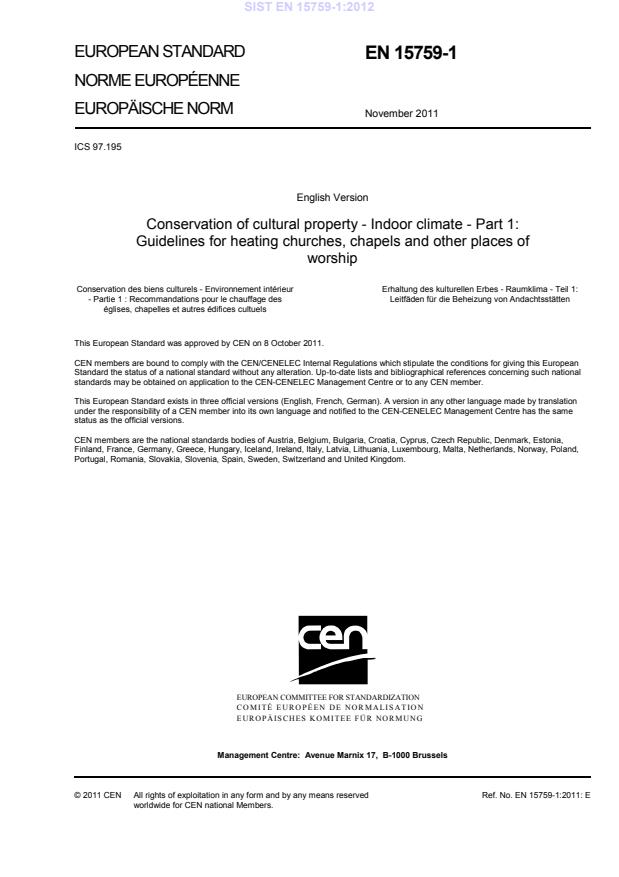
EUROPEAN STANDARD NORME EUROPÉENNE EUROPÄISCHE NORM
EN 15759-1
November 2011 ICS 97.195 English Version
Conservation of cultural property - Indoor climate - Part 1: Guidelines for heating churches, chapels and other places of worship
Conservation des biens culturels - Environnement intérieur - Partie 1 : Recommandations pour le chauffage des églises, chapelles et autres édifices cultuels
Erhaltung des kulturellen Erbes - Raumklima - Teil 1: Leitfäden für die Beheizung von Andachtsstätten This European Standard was approved by CEN on 8 October 2011.
CEN members are bound to comply with the CEN/CENELEC Internal Regulations which stipulate the conditions for giving this European Standard the status of a national standard without any alteration. Up-to-date lists and bibliographical references concerning such national standards may be obtained on application to the CEN-CENELEC Management Centre or to any CEN member.
This European Standard exists in three official versions (English, French, German). A version in any other language made by translation under the responsibility of a CEN member into its own language and notified to the CEN-CENELEC Management Centre has the same status as the official versions.
CEN members are the national standards bodies of Austria, Belgium, Bulgaria, Croatia, Cyprus, Czech Republic, Denmark, Estonia, Finland, France, Germany, Greece, Hungary, Iceland, Ireland, Italy, Latvia, Lithuania, Luxembourg, Malta, Netherlands, Norway, Poland, Portugal, Romania, Slovakia, Slovenia, Spain, Sweden, Switzerland and United Kingdom.
EUROPEAN COMMITTEE FOR STANDARDIZATION
COMITÉ EUROPÉEN DE NORMALISATION EUROPÄISCHES KOMITEE FÜR NORMUNG
Management Centre:
Avenue Marnix 17,
B-1000 Brussels © 2011 CEN All rights of exploitation in any form and by any means reserved worldwide for CEN national Members. Ref. No. EN 15759-1:2011: ESIST EN 15759-1:2012
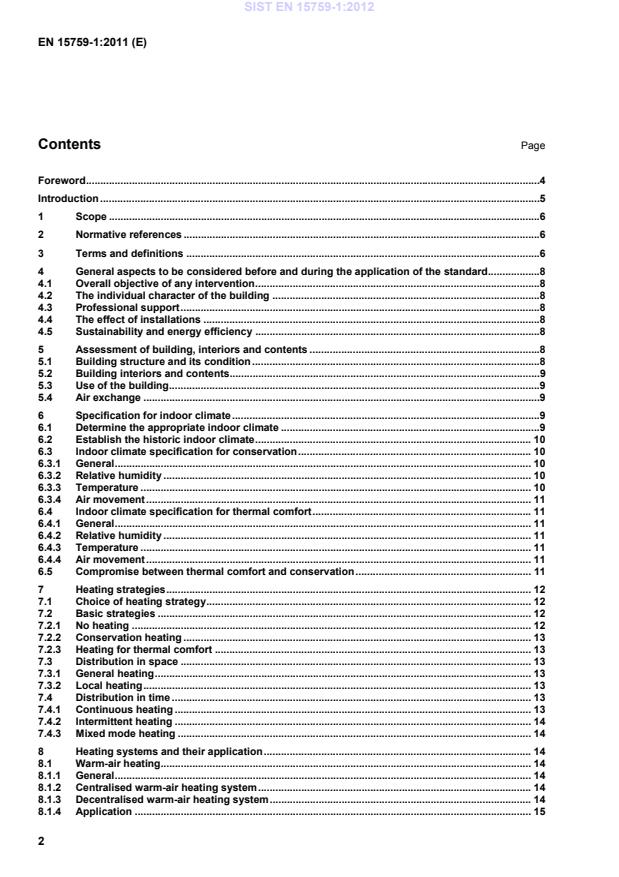
Flow chart giving an overview of the standard . 21Bibliography . 22 SIST EN 15759-1:2012
a) assessment of the building, its interior and contents; b) determine an indoor climate specification with respect to conservation and thermal comfort; c) determine an appropriate heating strategy; d) select and design an appropriate heating system; e) implement the proposed changes; f) evaluate the effectiveness of the heating system with respect to the specification. This is the first standard in a series of standards on indoor climate and climate control in cultural heritage buildings. The air exchange of a building has a fundamental influence on its indoor climate and climate control; general considerations are given in Clause 5. Ventilation will be dealt with fully in the second part of the series of standards on indoor climate in cultural heritage buildings, prEN 15759-2, Conservation of cultural property — Indoor climate — Part 2: Ventilation. SIST EN 15759-1:2012
1) Under publication. SIST EN 15759-1:2012
3.11 microclimate climate in part of a building or a room where the climate differs from the surrounding climate 3.12 mixed mode heating combination of continuous and intermittent heating, where the building is continually kept at a low temperature and heated to a higher temperature only when it is used 3.13 natural indoor climate indoor climate of a building without heating, forced ventilation or any other kind of active climate control 3.14 outdoor climate climate outside of a building 3.15 target range of RH variations range of RH variations that must be maintained to avoid climate induced damages 3.16 thermal comfort state of mind that expresses satisfaction with the surrounding environment
3.17 thermal stratification vertical layering of air temperatures in a building SIST EN 15759-1:2012
parts of the building would be at risk if the heating strategy or heating system was altered. For these purposes, a condition survey of the building is required. The European Standard prEN 16096 provides guidelines for condition survey of immovable cultural heritage objects. In the survey, special attention shall be paid to the building envelope: moisture transport, air tightness and thermal insulation. The survey shall also include the condition and functionality of existing heating installations. 5.2 Building interiors and contents The condition of the surface decoration and significant contents shall be surveyed. The European Standard prEN 16095 provides guidelines on condition report, visual inspection and description of movable cultural heritage. In the survey, special attention shall be paid to the condition of wall paintings, some of which may be hidden under layers of plaster or paint, and to that of stone monuments, stained glass, painted and unpainted woodwork, canvas paintings, textiles (e.g. banners), metalwork (e.g. lecterns and brasses) and objects of mixed materials such as organs. 5.3 Use of the building The initial assessment shall include a description of the heating demand in relation to the present and planned use of the building, and is to take into account patterns of worship and visiting; liturgical arrangements, performances and secular activities. 5.4 Air exchange The air exchange of a building, whether it is due to mechanical ventilation, natural ventilation or infiltration, (leakage) can have a significant influence on the indoor climate and hence on climate control decision-making. Although this standard is limited to heating, it is essential to consider the two in tandem. When choosing a heating strategy and designing a heating system, the following aspects of air exchange shall be taken into account: unnecessary air exchange will increase both energy and power demand in order to counteract its effects on temperature and/or humidity; depending on outdoor climate conditions in relation to indoor conditions, air exchange can sometimes reduce humidity levels, sometimes having the reverse effect; therefore it has to be considered in parallel with heating strategies designed to control internal humidity; controlled ventilation can be an alternative to heating when high humidity is a problem; air exchange creates air motions that may affect conditions both for thermal comfort and for conservation. 6 Specification for indoor climate 6.1 Determine the appropriate indoor climate In order to determine the appropriate indoor climate with respect to conservation and thermal comfort, the following steps shall be taken: a) establish the historic indoor climate; b) determine an indoor climate specification for conservation; c) determine an indoor climate specification for thermal comfort; SIST EN 15759-1:2012
b) For materials other than those covered in EN 15757 such as metals and glass and in the event of salt crystallisation, an expert shall be consulted to adjust the target range. c) The allowable rate of change in RH shall be determined by an expert. Rapid changes in RH lead to gradients of moisture contents across materials and corresponding differential dimensional response resulting in stress. Slow changes in RH bring about a more uniform moisture distribution within the materials but still cause an overall dimensional response which may lead to stress development in objects and design layers restrained in their movement. d) Determine an u
...