

CEN/TR 14245:2020
(Main)Cement - Guidelines for the application of EN 197-2: Assessment and verification of constancy of performance
- Abstract
This document specifies the scheme for the assessment and verification of constancy of performance (AVCP) of cements, including certification of constancy of performance.
The document provides technical rules for factory production control, further testing of samples taken at the manufacturing plant (autocontrol testing) and assessment of the performance of the cement, initial inspection of the manufacturing plant and of factory production control, continuing surveillance, assessment and evaluation of factory production control and audit-testing of samples. It also provides rules for actions to be followed in the event of non-conformity and requirements for depots.
In this document, the word “cement” is used to refer both to common cements as defined in EN 197 1 and to other cements and binders for which the relevant product specification standard makes reference to this document and which are submitted for certification. Such a cement is produced at a given factory and belongs to a particular type and a particular strength class, as defined and specified in the relevant product specification standard.
The guidelines given in the Technical Report CEN/TR 14245 contain information for the application of this document.
This document is linked with Annexes ZA of European Standards covering cements and binders, i.e. EN 197 1, EN 14216, EN 14647, EN 413 1 and EN 15743.
NOTE The reason for having drafted this separate document is that the provisions it includes are applicable to different products covered by different European Standards.
Guidance
EN 197 2 deals with the assessment and verification of constancy of performance (AVCP) of cements and binders that are submitted for certification. It deals in particular with cases where “further testing” of the product is undertaken, as is the case for attestation system 1+ under the Construction Products Regulation. The products for which EN 197 2 is applicable are: the common cement products and the low heat cements and the sulfate resisting cements, refer to EN 197 1, the very low heat special cements, refer to EN 14216, the supersulfated cements, refer to EN 15743, the calcium aluminate cements, refer to EN 14647, and the masonry cements, refer to EN 413 1.
- Status
- Published
- Publication Date
- 10-Mar-2020
- Technical Committee
- CEN/TC 51 - Cement and building limes
- Drafting Committee
- CEN/TC 51/WG 13 - Assessment of conformity
- Current Stage
- 6060 - Definitive text made available (DAV) - Publishing
- Start Date
- 11-Mar-2020
- Due Date
- 10-Dec-2019
- Completion Date
- 11-Mar-2020



Overview - CEN/TR 14245:2020 (Cement AVCP guidance)
CEN/TR 14245:2020 is a Technical Report by CEN that provides practical guidelines for the application of EN 197-2 - the scheme for the assessment and verification of constancy of performance (AVCP) of cements. It clarifies certification procedures, factory production control (FPC), further testing (autocontrol), initial and ongoing inspections, audit‑testing, depot requirements and actions to be taken in cases of non‑conformity. The document supports uniform application of EN 197-2 across cement and binder product standards and aligns with the Construction Products Regulation (CPR) attestation systems (notably system 1+ where “further testing” is required).
Key topics and technical requirements
- Factory production control (FPC): structure, documentation, quality management, process control, handling, storage and packaging requirements for continuous mass production of cement.
- Autocontrol testing: sampling and testing procedures for samples taken at the manufacturing plant, measurement equipment, record‑keeping and corrective actions.
- Initial inspection and certification tasks: requirements for initial assessment of the manufacturing plant, production equipment and laboratories prior to issuing a certificate of constancy of performance.
- Continuing surveillance and audit‑testing: ongoing inspections, evaluation of autocontrol test results, independent audit sampling/testing and evaluation criteria.
- Non‑conformity management: procedural rules for actions after detected non‑conformities from inspections or audit tests, including reporting and corrective measures.
- Depot requirements: guidance on storage/dispatch locations and responsibilities for conformity when product is held in depots.
- Annexes: methods for evaluating representativeness and accuracy of 28‑day strength test results and a certification procedure flow (informative).
Practical applications - who uses this standard
- Cement manufacturers and factory quality managers - to design and document compliant factory production control and autocontrol programs.
- Product certification bodies and notified bodies - to perform initial and continuing inspections, audit‑testing and issue certificates of constancy of performance under EN 197-2 and the CPR.
- Testing laboratories and technical auditors - to apply sampling/testing rules and evaluate test accuracy and representativeness.
- Importers, distributors and depot operators - to understand responsibilities for AVCP, storage and release of cement products.
- Regulatory and compliance teams - to align company processes with European cement standards and CPR attestation systems.
Related standards and links
- EN 197-2 (AVCP of cement)
- EN 197-1, EN 14216, EN 14647, EN 413-1, EN 15743 (product standards linked by Annex ZA)
- EN 196-7 (sampling/preparation of cement)
- Construction Products Regulation (Regulation (EU) No 305/2011)
Keywords: CEN/TR 14245, EN 197-2, AVCP, cement certification, factory production control, autocontrol testing, audit-testing, Construction Products Regulation, cement standards, product conformity.
Relations
- Replaces
CEN/TR 14245:2014 - Cement - Guidelines for the application of EN 197-2 Conformity Evaluation - Effective Date
- 24-Mar-2020
- Effective Date
- 28-Jan-2026
- Effective Date
- 28-Jan-2026
- Refers
EN 15743:2010+A1:2015 - Supersulfated cement - Composition, specifications and conformity criteria - Effective Date
- 28-Jan-2026
- Effective Date
- 28-Jan-2026
- Refers
EN 14647:2005 - Calcium aluminate cement - Composition, specifications and conformity criteria - Effective Date
- 28-Jan-2026
- Effective Date
- 28-Jan-2026
Get Certified
Connect with accredited certification bodies for this standard

DIBt (Deutsches Institut für Bautechnik)
German Institute for Building Technology.
DIN CERTCO
DIN Group product certification.

Aboma Certification B.V.
Specialized in construction, metal, and transport sectors.
Sponsored listings
Frequently Asked Questions
CEN/TR 14245:2020 is a technical report published by the European Committee for Standardization (CEN). Its full title is "Cement - Guidelines for the application of EN 197-2: Assessment and verification of constancy of performance". This standard covers: This document specifies the scheme for the assessment and verification of constancy of performance (AVCP) of cements, including certification of constancy of performance. The document provides technical rules for factory production control, further testing of samples taken at the manufacturing plant (autocontrol testing) and assessment of the performance of the cement, initial inspection of the manufacturing plant and of factory production control, continuing surveillance, assessment and evaluation of factory production control and audit-testing of samples. It also provides rules for actions to be followed in the event of non-conformity and requirements for depots. In this document, the word “cement” is used to refer both to common cements as defined in EN 197 1 and to other cements and binders for which the relevant product specification standard makes reference to this document and which are submitted for certification. Such a cement is produced at a given factory and belongs to a particular type and a particular strength class, as defined and specified in the relevant product specification standard. The guidelines given in the Technical Report CEN/TR 14245 contain information for the application of this document. This document is linked with Annexes ZA of European Standards covering cements and binders, i.e. EN 197 1, EN 14216, EN 14647, EN 413 1 and EN 15743. NOTE The reason for having drafted this separate document is that the provisions it includes are applicable to different products covered by different European Standards. Guidance EN 197 2 deals with the assessment and verification of constancy of performance (AVCP) of cements and binders that are submitted for certification. It deals in particular with cases where “further testing” of the product is undertaken, as is the case for attestation system 1+ under the Construction Products Regulation. The products for which EN 197 2 is applicable are: the common cement products and the low heat cements and the sulfate resisting cements, refer to EN 197 1, the very low heat special cements, refer to EN 14216, the supersulfated cements, refer to EN 15743, the calcium aluminate cements, refer to EN 14647, and the masonry cements, refer to EN 413 1.
This document specifies the scheme for the assessment and verification of constancy of performance (AVCP) of cements, including certification of constancy of performance. The document provides technical rules for factory production control, further testing of samples taken at the manufacturing plant (autocontrol testing) and assessment of the performance of the cement, initial inspection of the manufacturing plant and of factory production control, continuing surveillance, assessment and evaluation of factory production control and audit-testing of samples. It also provides rules for actions to be followed in the event of non-conformity and requirements for depots. In this document, the word “cement” is used to refer both to common cements as defined in EN 197 1 and to other cements and binders for which the relevant product specification standard makes reference to this document and which are submitted for certification. Such a cement is produced at a given factory and belongs to a particular type and a particular strength class, as defined and specified in the relevant product specification standard. The guidelines given in the Technical Report CEN/TR 14245 contain information for the application of this document. This document is linked with Annexes ZA of European Standards covering cements and binders, i.e. EN 197 1, EN 14216, EN 14647, EN 413 1 and EN 15743. NOTE The reason for having drafted this separate document is that the provisions it includes are applicable to different products covered by different European Standards. Guidance EN 197 2 deals with the assessment and verification of constancy of performance (AVCP) of cements and binders that are submitted for certification. It deals in particular with cases where “further testing” of the product is undertaken, as is the case for attestation system 1+ under the Construction Products Regulation. The products for which EN 197 2 is applicable are: the common cement products and the low heat cements and the sulfate resisting cements, refer to EN 197 1, the very low heat special cements, refer to EN 14216, the supersulfated cements, refer to EN 15743, the calcium aluminate cements, refer to EN 14647, and the masonry cements, refer to EN 413 1.
CEN/TR 14245:2020 is classified under the following ICS (International Classification for Standards) categories: 91.100.10 - Cement. Gypsum. Lime. Mortar. The ICS classification helps identify the subject area and facilitates finding related standards.
CEN/TR 14245:2020 has the following relationships with other standards: It is inter standard links to CEN/TR 14245:2014, EN 413-1:2011, EN 196-7:2007, EN 15743:2010+A1:2015, EN 197-1:2011, EN 14647:2005, EN ISO 717-1:2020. Understanding these relationships helps ensure you are using the most current and applicable version of the standard.
CEN/TR 14245:2020 is available in PDF format for immediate download after purchase. The document can be added to your cart and obtained through the secure checkout process. Digital delivery ensures instant access to the complete standard document.
Standards Content (Sample)
SLOVENSKI STANDARD
01-maj-2020
Nadomešča:
SIST-TP CEN/TR 14245:2014
Cement - Smernice za uporabo EN 197-2: Ocenjevanje in preverjanje
nespremenljivosti lastnosti
Cement - Guidelines for the application of EN 197-2: Assessment and verification of
constancy of performance
Zement - Richtlinien für die Anwendung der EN 197-2: Bewertung und Überprüfung der
Leistungsbeständigkeit
Ciment - Lignes directrices pour l'application de l'EN 197-2: Evaluation et vérification de
la constance de la performance
Ta slovenski standard je istoveten z: CEN/TR 14245:2020
ICS:
91.100.10 Cement. Mavec. Apno. Malta Cement. Gypsum. Lime.
Mortar
2003-01.Slovenski inštitut za standardizacijo. Razmnoževanje celote ali delov tega standarda ni dovoljeno.
CEN/TR 14245
TECHNICAL REPORT
RAPPORT TECHNIQUE
March 2020
TECHNISCHER BERICHT
ICS 91.100.10 Supersedes CEN/TR 14245:2014
English Version
Cement - Guidelines for the application of EN 197-2:
Assessment and verification of constancy of performance
Ciment - Lignes directrices pour l'application de l'EN Zement - Richtlinien für die Anwendung der EN 197-2:
197-2 - Evaluation de la conformité Bewertung und Überprüfung der
Leistungsbeständigkeit
This Technical Report was approved by CEN on 8 December 2019. It has been drawn up by the Technical Committee CEN/TC 51.
CEN members are the national standards bodies of Austria, Belgium, Bulgaria, Croatia, Cyprus, Czech Republic, Denmark, Estonia,
Finland, France, Germany, Greece, Hungary, Iceland, Ireland, Italy, Latvia, Lithuania, Luxembourg, Malta, Netherlands, Norway,
Poland, Portugal, Republic of North Macedonia, Romania, Serbia, Slovakia, Slovenia, Spain, Sweden, Switzerland, Turkey and
United Kingdom.
EUROPEAN COMMITTEE FOR STANDARDIZATION
COMITÉ EUROPÉEN DE NORMALISATION
EUROPÄISCHES KOMITEE FÜR NORMUNG
CEN-CENELEC Management Centre: Rue de la Science 23, B-1040 Brussels
© 2020 CEN All rights of exploitation in any form and by any means reserved Ref. No. CEN/TR 14245:2020 E
worldwide for CEN national Members.
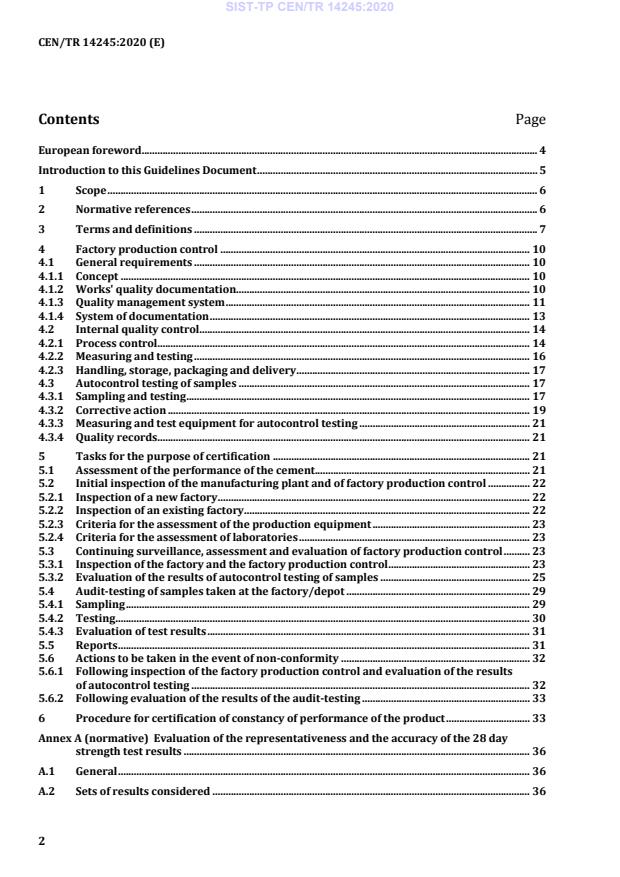
Contents Page
European foreword . 4
Introduction to this Guidelines Document . 5
1 Scope . 6
2 Normative references . 6
3 Terms and definitions . 7
4 Factory production control . 10
4.1 General requirements . 10
4.1.1 Concept . 10
4.1.2 Works' quality documentation. 10
4.1.3 Quality management system . 11
4.1.4 System of documentation . 13
4.2 Internal quality control. 14
4.2.1 Process control. 14
4.2.2 Measuring and testing . 16
4.2.3 Handling, storage, packaging and delivery . 17
4.3 Autocontrol testing of samples . 17
4.3.1 Sampling and testing . 17
4.3.2 Corrective action . 19
4.3.3 Measuring and test equipment for autocontrol testing . 21
4.3.4 Quality records . 21
5 Tasks for the purpose of certification . 21
5.1 Assessment of the performance of the cement. 21
5.2 Initial inspection of the manufacturing plant and of factory production control . 22
5.2.1 Inspection of a new factory . 22
5.2.2 Inspection of an existing factory . 22
5.2.3 Criteria for the assessment of the production equipment . 23
5.2.4 Criteria for the assessment of laboratories . 23
5.3 Continuing surveillance, assessment and evaluation of factory production control . 23
5.3.1 Inspection of the factory and the factory production control . 23
5.3.2 Evaluation of the results of autocontrol testing of samples . 25
5.4 Audit-testing of samples taken at the factory/depot . 29
5.4.1 Sampling . 29
5.4.2 Testing . 30
5.4.3 Evaluation of test results . 31
5.5 Reports . 31
5.6 Actions to be taken in the event of non-conformity . 32
5.6.1 Following inspection of the factory production control and evaluation of the results
of autocontrol testing . 32
5.6.2 Following evaluation of the results of the audit-testing . 33
6 Procedure for certification of constancy of performance of the product . 33
Annex A (normative) Evaluation of the representativeness and the accuracy of the 28 day
strength test results . 36
A.1 General . 36
A.2 Sets of results considered . 36
A.3 Evaluation procedure . 36
A.3.1 Introduction. 36
A.3.2 Symbols . 36
A.3.3 Evaluation of whether set A and set B belong to the same population (sampling error
check) . 37
A.3.4 Comparison between set B and set C in order to check the accuracy of the
autocontrol testing (testing error check) . 38
A.3.5 Masonry cement . 38
A.3.6 Calcium aluminate cement . 38
Annex B (informative) Procedure for certification of constancy of performance of cement . 39
Bibliography . 40
European foreword
This document (CEN/TR 14245:2020) has been prepared by Technical Committee CEN/TC 51 “Cement
and building limes”, the secretariat of which is held by NBN.
Attention is drawn to the possibility that some of the elements of this document may be the subject of
patent rights. CEN shall not be held responsible for identifying any or all such patent rights.
This document supersedes CEN/TR 14245:2014.
Compared with CEN/TR 14245:2014, the following changes have been made:
— The Guidelines Document follows the changes made in EN 197-2;
— Guidance relating to AVCP for distributors and importers has been inserted in the Guidelines
Document.
Introduction to this Guidelines Document
Purpose
The purpose of this document is to provide explanatory detail on points not fully elaborated in
EN 197-2. It is intended for use by all parties involved in the certification of cement following EN 197-2.
It is an objective of this Guidelines Document that its use will assist in the establishment of equivalent
procedures for certification of cement. It is expected that, following this document, traditional good
procedures and practices that can be different can continue to be used, provided that they are not in
contradiction with EN 197-2 and the relevant product specification standard. Such existing good
procedures and practices, applied in conjunction with these Guidelines, are not considered to be an
impediment to the achievement of the uniform level of certification throughout Europe, and by different
product certification bodies.
This document is based on existing situations for production, assessment and verification of constancy
of performance of cements. In case of situations different to those included in this document, specific
procedures should be elaborated on a case by case decision and be fully recorded and approved. These
specific procedures should always fulfil the specifications given in EN 197-1 and EN 197-2 and lead to
the same level of confidence in product that would be achieved by application of this document.
Arrangement
The clause numbering system of EN 197-2 is followed. The text of each of the clauses of the European
Standard is reproduced in full and is followed by guidance, which is provided only for those clauses
where clarification or elaboration is needed.
Clauses of EN 197-2
1 Scope
2 Normative references
3 Terms and definitions
4 Factory production control
5 Tasks for the purpose of certification
6 Procedure for certification of constancy of performance of the product
Table 1
Annexes A and B
1 Scope
This document specifies the scheme for the assessment and verification of constancy of performance
(AVCP) of cements, including certification of constancy of performance.
The document provides technical rules for factory production control, further testing of samples taken
at the manufacturing plant (autocontrol testing) and assessment of the performance of the cement,
initial inspection of the manufacturing plant and of factory production control, continuing surveillance,
assessment and evaluation of factory production control and audit-testing of samples. It also provides
rules for actions to be followed in the event of non-conformity and requirements for depots.
In this document, the word “cement” is used to refer both to common cements as defined in EN 197-1
and to other cements and binders for which the relevant product specification standard makes
reference to this document and which are submitted for certification. Such a cement is produced at a
given factory and belongs to a particular type and a particular strength class, as defined and specified in
the relevant product specification standard.
The guidelines given in the Technical Report CEN/TR 14245 contain information for the application of
this document.
This document is linked with Annexes ZA of European Standards covering cements and binders, i.e.
EN 197-1, EN 14216, EN 14647, EN 413-1 and EN 15743.
NOTE The reason for having drafted this separate document is that the provisions it includes are applicable
to different products covered by different European Standards.
Guidance
EN 197-2 deals with the assessment and verification of constancy of performance (AVCP) of
cements and binders that are submitted for certification. It deals in particular with cases where
“further testing” of the product is undertaken, as is the case for attestation system 1+ under the
Construction Products Regulation. The products for which EN 197-2 is applicable are: the common
cement products and the low heat cements and the sulfate resisting cements, refer to EN 197-1, the
very low heat special cements, refer to EN 14216, the supersulfated cements, refer to EN 15743, the
calcium aluminate cements, refer to EN 14647, and the masonry cements, refer to EN 413-1.
2 Normative references
The following documents are referred to in the text in such a way that some or all of their content
constitutes requirements of this document. For dated references, only the edition cited applies. For
undated references, the latest edition of the referenced document (including any amendments) applies.
EN 196-7, Methods of testing cement — Part 7: Methods of taking and preparing samples of cement
EN 197-1, Cement — Part 1: Composition, specifications and conformity criteria for common cements
EN 413-1, Masonry cement — Part 1: Composition, specifications and conformity criteria
EN 14647, Calcium aluminate cement — Composition, specifications and conformity criteria
EN 15743, Supersulfated cement — Composition, specifications and conformity criteria
3 Terms and definitions
For the purposes of this document, the following terms and definitions apply.
ISO and IEC maintain terminological databases for use in standardization at the following addresses:
— IEC Electropedia: available at http://www.electropedia.org/
— ISO Online browsing platform: available at http://www.iso.org/obp
NOTE In the context of this document the term “construction product” refers to cement.
3.1
AVCP
abbreviation for assessment and verification of constancy of performance
3.2
certificate of constancy of performance of the product
document issued under the rules of the scheme for the AVCP indicating that adequate confidence is
provided that the cement conforms to the performance(s) declared in accordance with the relevant
product standard
Guidance
The term “certificate of constancy of performance of the product” refers to certificates of constancy
of performance of the product issued by a product certification body under the rules of the
Construction Products Regulation and EN 197-2.
3.3
initial period
immediate period starting after the first issuing of the certificate of constancy of performance of the
product for a cement and at the latest from the first dispatching of cement
3.4
factory production control
documented, permanent and internal control of production in a factory, in accordance with the relevant
harmonized technical specifications
[SOURCE: Regulation (EU) No 305/2011, Article 2 (Construction Product Regulation)[3]]
3.5
factory
facility used by a manufacturer for the production of cement using equipment which is suitable for
continuous mass production of cement including, in particular, equipment for adequate grinding and
homogenization and the necessary silo capacity for the storage and dispatch of each cement produced
Note 1 to entry: This equipment and the production control applied allow the control of production with
sufficient accuracy.
Guidance
According to EN 197-1, common cements (CEM cements) consist of different materials and are
statistically homogeneous in composition resulting from quality assured production and material
handling processes. A high degree of uniformity in all cement characteristics is obtained through
continuous mass production processes, in particular, adequate grinding and homogenization
processes. Similar considerations apply for other cements.
Three categories of “factory” are recognized:
— traditional full cement factories, where clinker and cement are produced on the same site;
— grinding plants, where cement is produced by grinding supplied cement constituents;
— blending plants, where ground cement constituents, which may be received already combined
as cement, are blended to produce finished cement.
The following operating steps, which apply for all of these types of factory, are essential in the
manufacturing process. These steps are needed to ensure the necessary uniformity, continuity and
suitability of the cement properties as well as the ability to meet the other requirements of the
relevant product specification standard:
— use of separate and adequate storage for the cement constituents;
— Controlling the cement constituents – including, where relevant, their fineness and particle size
distribution, and therefore their grinding – to achieve a performance of the cement compatible
with the requirements of the product specification standard;
— proportioning the cement constituents in order to achieve the target composition of the
cement;
— homogenization of the cement constituents by grinding, or by mixing where relevant;
— storage of finished product, in silos of adequate capacity, allowing proper identification of mass
quantities of product and giving the possibility of taking spot samples at any time without prior
notice.
Factories can only be operated by manufacturers which have personnel with sufficient experience
and knowledge in all operating steps important for cement quality and which have the people, test
procedures and test equipment to test, evaluate and correct the cement being produced. The
definition of factory in EN 197-2 takes it, therefore, for granted that all operating steps listed above
are carried out in effect under the same quality responsibility.
3.6
new factory
factory which is not already producing cement(s) certified using EN 197-2
3.7
existing factory
factory which is already producing cement(s) certified using EN 197-2
3.8
depot
bulk cement handling facility not located at the factory used for the dispatch of cement, whether in bulk
or bagged, after transfer or storage where the manufacturer has full responsibility for all aspects of the
quality of the cement
Guidance
In the case of a depot the facility is strictly linked to the factory and is included in the factory
Works’ quality documentation. The manufacturer has full responsibility for the quality of the
cement released from the depot. Depots are included in the Works’ quality documentation. An
entity other than the manufacturer may own and operate the depot but it does this on behalf of and
under the strict quality management responsibility of the manufacturer.
3.9
distributor
natural or legal person in the supply chain, other than the manufacturer or the importer, who makes a
construction product available on the market
[SOURCE: Regulation (EU) No 305/2011, Article 2 (Construction Product Regulation)]
3.10
importer
natural or legal person established within the European Union, who places a construction product from
a third country on the European Union market
[SOURCE: Regulation (EU) No 305/2011, Article 2 (Construction Product Regulation)]
3.11
assessment of the performance
determination of the essential characteristics of a construction product, on the basis of testing
(including sampling), calculation, tabulated values or descriptive documentation of the product
3.12
product certification body
body notified in accordance with Chapter VII of Regulation (EU) No 305/2011 to carry out constancy of
performance certification
3.13
works’ quality documentation
documentation that provides information on the factory production control which is applied by a
manufacturer at a particular factory to ensure constancy of performance of the cement
4 Factory production control
4.1 General requirements
4.1.1 Concept
Factory production control means the permanent internal control of cement production and consists of
internal quality control (see 4.2) complemented by autocontrol testing of samples of cement taken at
the point of release (see 4.3).
NOTE 1 The requirements of this document as regards factory production control apply to factories and their
depots.
NOTE 2 The requirements of this document in regards to factory production control take into account the
clauses of EN ISO 9001 [1] which are relevant to the production, process control and testing of cement.
Guidance
The purpose of factory production control is to ensure that the cement is manufactured in a
controlled way to meet all of the requirements of the relevant product specification standard. In
order for a product certification body to verify such a system, it has to be documented in a
structured way. This is carried out in a Works’ quality documentation, supported and cross-
referenced by a series of procedures, work instructions and other associated and relevant
documents. These need to be clear, concise and adopt recommended good practices where
applicable. The factory production control system may form part of a wider, integrated
management system provided it can be demonstrated that all applicable EN 197-2 requirements
are addressed. See also Clause 4.1.2 of the document.
4.1.2 Works' quality documentation
The manufacturer's documentation and procedures for factory production control shall be described in
a Works' quality documentation, which shall adequately describe, amongst other things, for each
factory and depot:
a) the quality aims and the organizational structure, responsibilities and powers of the management
with regard to product quality and the means to monitor the achievement of the required product
quality and the effective operation of the internal quality control (see 4.1.3 and 4.2);
b) the manufacturing and quality control techniques, processes and systematic actions that will be
used (see 4.2.1, 4.2.3 and 4.3.2);
c) the inspections and tests that will be carried out before, during and after manufacture, and the
frequency with which they will be carried out (see 4.2.2, 4.3.1 and 4.3.3).
The Works' quality documentation shall address and document the procedures operated to ensure that
the manufactured cement conforms to the performance(s) declared in accordance with the relevant
product standard. The documentation may reference associated documents which provide further
details of the autocontrol testing of samples and the internal quality control. For the purpose of this
scheme, the term Works' quality documentation shall be considered to include these associated
documents.
1 This testing corresponds also to the “further testing of samples taken at the manufacturing plant” mentioned in
Delegated Regulation (EU) No 568/2014 amending Annex V to Regulation (EU) No 305/2011 (Construction Products
Regulation) .
[4]
In the case of an existing quality management system according to EN ISO 9001, the corresponding
quality documentation may also be applied for product certification if it meets all the requirements of
this document which are relevant to the factory production control of cement.
Guidance
Illustrative example of responsibilities – For information only
The producer has three overall responsibilities:
— To have an approach for production control and testing (to ensure that adequate quality
procedures exist);
— To ensure that the procedures are carried out;
— To ensure that the approach and application are giving the expected results.
Responsibility and authority for personal responsible for the quality of the product and FPC
system should be clear, communicated and understood within the organization.
Examples of responsibilities that should be defined are:
— The co-ordination, monitoring and updating of the Works’ quality documentation procedures;
— Ensuring all personnel at every level is kept informed of working methods, procedures,
specifications and quality targets;
— Setting the requirements for process control and supervising their written transmission to the
appropriate personnel;
— The system of management of corrective actions for the entire scope of the FPC system;
— Assessing the conformity of raw materials to the relevant specifications;
— Controlling of off-specification constituents and non-conforming cements;
— The identification and resolution of non-conformities in the FPC system;
— Supervising the recording and processing of relevant data and consequent approval;
— Provide the organization with periodic reports on the compliance status of the cement.
There needs to be a quality plan for the production of conforming cement and whilst it shall be
recognized that the plan can take on one of many forms and include such things as process flow
charts and control tables, it shall show how each of the parts of the process are connected. There
shall be a clear indication of where samples are taken and at what frequency, together with the
tests to be applied. Targets and acceptability criteria should also be documented.
In the case of an existing quality management system in accordance with EN ISO 9001, it should be
clearly stated in the Works’ quality documentation that the system is also used for factory
production control according to EN 197-2 and the relevant product specification standard.
4.1.3 Quality management system
4.1.3.1 Quality policy statement
The Works' quality documentation shall include a statement by management defining its quality policy,
objectives and commitments to the attainment of product quality.
Guidance
The quality policy statement is a document signed normally by the managing director of the
company or by the manager of the factory, depending on the organization of the company, or by
both. It should include the quality aims and its commitment to meeting the requirements of
standards and/or of its customers and to ongoing improvement, both internally and externally. It
should indicate approval of the factory production control system as outlined in the Works’ quality
documentation and that it is mandatory.
The system by which all personnel are informed of the quality policy should be documented. A
route for feedback should be established to aid understanding of the policy.
In the case of an existing quality management system in accordance with EN ISO 9001, the quality
policy statement should include a commitment to the attainment of cement quality in relation to
the relevant product specification standard.
The Quality Policy should be reviewed periodically to ensure changes in aims are incorporated.
4.1.3.2 Quality manager
A quality manager shall be appointed who, irrespective of other responsibilities, shall have defined and
adequate authority and responsibility for ensuring that the requirements of this document for the AVCP
are implemented and maintained.
Guidance
The quality manager should be clearly shown to have the necessary dedication, time and authority
to ensure that cement continues to conform to the relevant product specification standard by the
adoption of the requirements of the documented factory production control system. As he has the
ultimate responsibility for the effective operation of factory production control his responsibilities
should at least include maintenance of the Works’ quality documentation, the operation of process
and autocontrol and the evaluation of the cement data to the relevant product specification
standard requirements. Effective and unrestricted communication channels to other affected
departments shall be open to the quality manager to discuss possible problems.
The authority and responsibility for the factory production control system and the quality
assurance of cement are not necessarily held by the same person.
The Works’ quality documentation should state to whom the responsibility is transferred in the
absence of the quality manager.
4.1.3.3 Internal audits and management review
In order to ensure the continuing suitability and effectiveness of the Work’s quality documentation to
meet the requirements of this document:
a) internal audits covering the scope of this Clause 4;
b) a management review of the functioning and the results of the factory production control, taking
into account records of the internal audits;
shall be performed at least once a year.
Guidance
For audits to be of value, there needs to be evidence that non-conformities raised are progressed to
a satisfactory conclusion and this shall be assessed by management during the review. Reviews
should be conducted to an established formal agenda by a management team and a record made of
the findings, showing actions to be taken and relevant responsibilities. Reviews will need to take
account of not only the internal audits but also of customer complaints.
Audits need to be carried out at an established frequency, procedures and plan, by trained
personnel independent of the area to be audited.
It is essential that internal audits cover all aspects dealt with in the Works’ quality documentation,
not forgetting the characteristics of cement constituents and cements and in-process specifications.
4.1.3.4 Training
The Works' quality documentation shall describe the measures taken to ensure that all the personnel
involved in operations that can affect internal quality control and product quality have appropriate
experience or training. Appropriate records shall be retained.
Guidance
The adequate training of all personnel engaged in quality related matters and forming part of the
factory production control system is of prime importance. It ensures that the exact skills and level
of understanding are achieved to allow tasks to be carried out correctly and efficiently.
A training plan, covering all the relevant personnel should be available, listing the essential skills
and education required for each element of the task/responsibility to be covered. These need to
cover both technical skills and an understanding of the function and operation of quality systems.
The training plan shall be supported by management and be continuous. It should indicate the
minimum educational level required for each role. Training can be external, as well as internal –
details of these should be recorded.
A separate training plan for new starters will be required to cover induction training.
4.1.4 System of documentation
4.1.4.1 Document control
All documents and data related to factory production control and to this scheme for the AVCP shall be
controlled.
This control shall ensure that the appropriate issues of all documents are available at essential
locations, that obsolete documents are withdrawn and that changes or modifications to any document
are effectively introduced.
A system shall be established to identify the current version of documents in order to prevent the use of
non-applicable documents.
Guidance
The effectiveness of the factory production control system relies on the availability and use of
correctly updated documents and data which include the Works’ quality documentation,
procedures, operating instructions, technical specifications, plans, flowcharts, test methods and
data records; this list is not exhaustive. A procedure shall be available covering the issuing of
amendments and updated documents. All documents should be listed, giving proper identification,
issue status and approval, holders and locations and mode of disposal of previous issues. If
previous issues are to be retained they shall be suitably marked to indicate that they are
obsolescent and withdrawn.
The principles of the document control are the same as those of EN ISO 9001, which can therefore
be used as guidelines.
4.1.4.2 Quality records
Records shall be retained to provide evidence of factory production control for at least the period
required.
Guidance
All factory production control records should be kept for a minimum period of three years and the
Works’ quality documentation will identify retention periods and location of all records. Factory
production control records that relate directly to the finished cement should be retained for at least
the period necessary to satisfy product liability legislation and for at least a period of ten years.
All records shall be legible, identifiable, retrievable and protected from damage, deterioration or
loss. Where records have been transferred to electronic or optical storage media, suitable back-up
copies should be taken.
4.2 Internal quality control
4.2.1 Process control
4.2.1.1 General
The Works' quality documentation shall describe the parameters for process planning, process control
and testing, inspection, corrective action, verification, dispatch and the associated records for each
factory and depot.
Guidance
Process control should be designed to prevent non-conformities arising. This cannot be achieved by
testing only. To ensure that cement complies with the relevant specifications, planning of the
production process is required and should address the following:
— A process flow description/diagram to illustrate the important production elements and show
how each stage is interrelated. This should include all stages covered by the selected scope of
the factory production control. It should also indicate measurement points, sampling points for
the relevant tests and storage areas;
— Targets and control limits (and subsequent actions if these are not met) for each process stage,
including parameters that are not included in the product specification standard, for example,
specific surface area;
— Method and frequency of data collecting and processing;
— Procedures to cover 4.2.1 to 4.3.4 with particular reference to those in the cases of changing
conditions such as start/stop operations, cement and silo changeovers;
— Prevention of contamination of cement, cement constituents (including clinker) and all
materials covered by the selected scope of the factory production control, during production,
handling and dispatch.
In following the requirements of EN 197-2, all categories of factory (see guidance under 3.5) should
have, in particular, the following equipment and procedures:
— Separate storage for incoming materials, normally silos for powdered materials and adequate
other forms of storage for granular materials;
— Testing and control of all cement constituents, the degree of which being adapted to the level of
influence of the constituent to the ultimate quality of the product;
— Adequate blending and homogenization equipment and procedures;
— Silo(s) for each product awaiting dispatch;
— Adequate testing and control of intermediate products.
For grinding plants and full factories there should also be:
— Adequate grinding equipment and procedures.
In the case of blending plants, because the grinding facilities are located at a site that is remote from
the plant, special consideration has to be given, on a case by case basis, to the equipment and to the
factory production control to verify their suitability for producing cement in accordance with the
requirements of the relevant product specification standard. For this purpose, the effectiveness of
mixing and homogenization equipment should also be periodically assessed and verified. For
blending plants, in addition to the equipment and procedure items listed above for all types of
factory, there should also be:
— Arrangements to ensure that cement constituents are produced, supplied and received in
accordance with the requirements of the relevant product specification standard and of the
blending plant for the purpose of designing the cement and controlling its properties; when the
constituents are received already combined as cement, the CE marking of the cement should be
required as a possibility to prove compliance with the requirements; the composition of any
incoming pre-mixed constituents including cement should be documented by the supplier;
— Documented procedures showing full traceability and control of the cement constituents
whether received separately or in a combined form, for instance as cement; the quality
documentation should list all the relevant parameters for the control of the cement
constituents, e.g. their fineness.
4.2.1.2 Constituents and composition of cement
Documented procedures and appropriate test methods shall be established to ensure that the
constituents meet the specifications in the relevant product specification standard and are suitable to
enable cement to be produced meeting the targets and control limits.
The Works' quality documentation shall describe the methods used by the manufacturer to ensure that
the composition of the cement produced conforms to the performance(s) declared in accordance with
the relevant product standard, including appropriate test methods.
Guidance
Incoming supply should be assessed against a previously agreed specification and will generally
involve sampling and testing. Procedures may include those to establish suitability of different
sources of all constituents including additives.
Adequate stocks shall be maintained and discrete, suitable storage should be available for each
constituent. If any material is unsatisfactory, there shall be an adequate procedure for disposal and
possible controlled use. This is particularly important for off-specification clinker or clinker and
blastfurnace slag that have been stored outside.
Determination of cement composition also includes the amount of minor additional constituents.
The target level values and the allowed variation of all constituents should be specified and
recorded.
Feeding equipment shall be adequately checked and, where relevant, calibrated, to ensure
constituent additions/percentages meet the requirements of the product specification standard.
4.2.1.3 Control of off-specification production
The Works' quality documentation shall contain procedures for the review and adjustment of the
factory production control in case of off-specification production or non-conformity.
The actions taken in the event of non-conformity shall be recorded in a report subject to inspection
during the management review.
Guidance
It is necessary to make a distinction between the off-specification material within the production
process that has to meet internal specifications fixed by the cement manufacturer (e.g. kiln feed,
clinker, milled cement, ground cement constituents), and off-specifications related to the final
cement. The former can be dealt by internal processing e.g. separate storage and controlled re-use,
blending, which is designed to bring them back into specification. This may not be possible in the
latter case. 4.3.2 will then be invoked.
Procedures should clearly indicate the measure to take, case by case, the identification of the off-
specification products and where they are stored. The responsibility for the control release and re-
use of these materials should be clearly defined and documented.
4.2.2 Measuring and testing
4.2.2.1 Inspection, measuring and test equipment
The equipment for in-process inspection and testing shall be regularly checked and calibrated in
accordance with the procedures and frequencies laid down in the Works' quality documentation.
Guidance
All equipment should be uniquely identified and verified to a programme prescribed in the Works’
quality documentation. Equipment used to control and monitor essential characteristics should be
checked and calibrated. Verification and calibration records should enable verification of the
calibration status of the equipment and that out of specification or calibration should be marked
“not for use” and isolated. Verification and calibration procedures should be documented.
4.2.2.2 Inspection and test status
Procedures for the inspection and test status through the stages of manufacture shall be detailed in the
Works' quality documentation. These shall include procedures for the control of off-specification
intermediate materials.
Guidance
The quality system and procedures should ensure that all required inspections and tests are carried
out. The system needs to provide a way of showing these have been done and the particular status
of materials at each stage of the process. This is probably best achieved by the signing-off of results
in the operating logbooks by the quality manager or his appointee, supported by designated storage
areas for the various materials.
Off-spe
...