

EN 15910:2014
(Main)Water quality - Guidance on the estimation of fish abundance with mobile hydroacoustic methods
- Abstract
This European Standard specifies a standardized method for data sampling and procedures for data evaluation of fish populations in large rivers, lakes and reservoirs, using hydroacoustic equipment deployed on mobile platforms (boats and vessels).
This standard covers fish population abundance estimates of pelagic and profundal waters > 15 m mean depth with the acoustic beam oriented vertically, and the inshore and surface waters of water bodies > 2 m depth with the beam oriented horizontally. The size structure of fish populations can only be determined to a relatively low degree of precision and accuracy, particularly from horizontally-deployed echosounders. As acoustic techniques are presently unable to identify species directly, other direct fish catching methods should always be used in combination.
This standard provides recommendations and requirements on equipment, survey design, data acquisition, post-processing of data and results and reporting. A selected literature with references in support of this standard is given in the Bibliography.
- Status
- Published
- Publication Date
- 21-Jan-2014
- Withdrawal Date
- 30-Jul-2014
- Technical Committee
- CEN/TC 230 - Water analysis
- Drafting Committee
- CEN/TC 230 - Water analysis
- Current Stage
- 9093 - Decision to confirm - Review Enquiry
- Start Date
- 09-Feb-2022
- Completion Date
- 21-Oct-2026



Overview
EN 15910:2014 - Water quality: Guidance on the estimation of fish abundance with mobile hydroacoustic methods (CEN) defines a standardized approach for using hydroacoustic (echosounder) systems deployed on mobile platforms (boats/vessels) to estimate fish abundance in large rivers, lakes and reservoirs. The standard covers vertical-beam surveys for pelagic/profundal zones (mean depth > 15 m) and horizontal-beam surveys for inshore/surface waters (> 2 m). It sets out requirements for equipment, calibration, survey design, data acquisition, post‑processing, calculation of results and reporting, and highlights limitations of acoustic methods (e.g., species ID and precise size-structure estimation).
Key topics and requirements
- Scope and field of application
- Mobile hydroacoustic surveys for lakes, reservoirs and wide lowland rivers.
- Vertical orientation for deep (mean > 15 m) pelagic/profundal waters; horizontal orientation for inshore/surface waters > 2 m.
- Equipment & performance
- Use of calibrated echosounders and modern multi/dual/split-beam systems; minimum and optimum performance levels are specified.
- Calibration procedures and routine checks are required.
- Survey design
- Pre-planning, timing, transducer orientation/positioning, and determination of Elementary Distance Sampling Unit (EDSU).
- Considerations for resolution, detection range (MUR), and stratification.
- Data acquisition
- Recommended echosounder settings, logging of environmental and GPS track data, and complementary gear (nets, electrofishing) for species identification.
- Post-processing & analysis
- Bottom detection, discrimination of biological and non-biological echoes, Single Echo Detection (SED/ST) handling, and methods for abundance/biomass estimates.
- Interpretation of Target Strength (TS) into fish length/weight (noting inherent uncertainty).
- Quality assurance
- Procedures for QC/QA, inter-comparisons, precision and variance estimation, and standardized reporting templates.
Practical applications
- Rapid, non-destructive mapping of fish distribution and density across large water bodies.
- Monitoring fish population trends, biomass estimation for fisheries management, habitat assessment, and supporting environmental impact studies.
- Complementary use with gillnets, electrofishing or other direct sampling for species composition and age/size validation.
Who should use this standard
- Fisheries biologists, aquatic ecologists, environmental consultants, water resource managers and monitoring agencies conducting mobile hydroacoustic surveys.
- Developers of monitoring programs needing standardized protocols for comparability across sites and time.
Related standards and resources
- EN 14962 (Guidance on the scope and selection of fish sampling methods) is referenced for combined sampling strategies.
- Annexes in EN 15910 provide supplementary methods (EDSU, variance estimates, TS interpretation) and a bibliography for further reading.
Using EN 15910:2014 ensures consistent, reproducible hydroacoustic assessments of fish abundance and supports scientifically robust fisheries and water‑quality monitoring programs.
Relations
- Effective Date
- 28-Jan-2026
- Effective Date
- 30-Jan-2010
Get Certified
Connect with accredited certification bodies for this standard

CIS Institut d.o.o.
Personal Protective Equipment (PPE) certification body. Notified Body NB-2890 for EU Regulation 2016/425 PPE.

Kiwa BDA Testing
Building and construction product certification.
Kmetijski inštitut Slovenije
Agricultural Institute of Slovenia. Soil testing, plant health, agricultural product analysis.
Sponsored listings
Frequently Asked Questions
EN 15910:2014 is a standard published by the European Committee for Standardization (CEN). Its full title is "Water quality - Guidance on the estimation of fish abundance with mobile hydroacoustic methods". This standard covers: This European Standard specifies a standardized method for data sampling and procedures for data evaluation of fish populations in large rivers, lakes and reservoirs, using hydroacoustic equipment deployed on mobile platforms (boats and vessels). This standard covers fish population abundance estimates of pelagic and profundal waters > 15 m mean depth with the acoustic beam oriented vertically, and the inshore and surface waters of water bodies > 2 m depth with the beam oriented horizontally. The size structure of fish populations can only be determined to a relatively low degree of precision and accuracy, particularly from horizontally-deployed echosounders. As acoustic techniques are presently unable to identify species directly, other direct fish catching methods should always be used in combination. This standard provides recommendations and requirements on equipment, survey design, data acquisition, post-processing of data and results and reporting. A selected literature with references in support of this standard is given in the Bibliography.
This European Standard specifies a standardized method for data sampling and procedures for data evaluation of fish populations in large rivers, lakes and reservoirs, using hydroacoustic equipment deployed on mobile platforms (boats and vessels). This standard covers fish population abundance estimates of pelagic and profundal waters > 15 m mean depth with the acoustic beam oriented vertically, and the inshore and surface waters of water bodies > 2 m depth with the beam oriented horizontally. The size structure of fish populations can only be determined to a relatively low degree of precision and accuracy, particularly from horizontally-deployed echosounders. As acoustic techniques are presently unable to identify species directly, other direct fish catching methods should always be used in combination. This standard provides recommendations and requirements on equipment, survey design, data acquisition, post-processing of data and results and reporting. A selected literature with references in support of this standard is given in the Bibliography.
EN 15910:2014 is classified under the following ICS (International Classification for Standards) categories: 13.060.70 - Examination of biological properties of water. The ICS classification helps identify the subject area and facilitates finding related standards.
EN 15910:2014 has the following relationships with other standards: It is inter standard links to EN 14962:2006, prEN 15910. Understanding these relationships helps ensure you are using the most current and applicable version of the standard.
EN 15910:2014 is associated with the following European legislation: EU Directives/Regulations: 2000/60/EC; Standardization Mandates: M/424. When a standard is cited in the Official Journal of the European Union, products manufactured in conformity with it benefit from a presumption of conformity with the essential requirements of the corresponding EU directive or regulation.
EN 15910:2014 is available in PDF format for immediate download after purchase. The document can be added to your cart and obtained through the secure checkout process. Digital delivery ensures instant access to the complete standard document.
Standards Content (Sample)
2003-01.Slovenski inštitut za standardizacijo. Razmnoževanje celote ali delov tega standarda ni dovoljeno.LPLWasserbeschaffenheit - Anleitung zur Abschätzung der Fischabundanz mit mobilen hydroakustischen VerfahrenQualité de l'eau - Guide sur l'estimation de l'abondance des poissons par des méthodes hydroacoustiques mobilesWater quality - Guidance on the estimation of fish abundance with mobile hydroacoustic methods13.060.70Preiskava bioloških lastnosti vodeExamination of biological properties of waterICS:Ta slovenski standard je istoveten z:EN 15910:2014SIST EN 15910:2014en,fr,de01-marec-2014SIST EN 15910:2014SLOVENSKI
STANDARD
EUROPEAN STANDARD NORME EUROPÉENNE EUROPÄISCHE NORM
EN 15910
January 2014 ICS 13.060.70 English Version
Water quality - Guidance on the estimation of fish abundance with mobile hydroacoustic methods
Qualité de l'eau - Guide sur l'estimation de l'abondance des poissons par des méthodes hydroacoustiques mobiles
Wasserbeschaffenheit - Anleitung zur Abschätzung der Fischabundanz mit mobilen hydroakustischen Verfahren This European Standard was approved by CEN on 17 November 2013.
CEN members are bound to comply with the CEN/CENELEC Internal Regulations which stipulate the conditions for giving this European Standard the status of a national standard without any alteration. Up-to-date lists and bibliographical references concerning such national standards may be obtained on application to the CEN-CENELEC Management Centre or to any CEN member.
This European Standard exists in three official versions (English, French, German). A version in any other language made by translation under the responsibility of a CEN member into its own language and notified to the CEN-CENELEC Management Centre has the same status as the official versions.
CEN members are the national standards bodies of Austria, Belgium, Bulgaria, Croatia, Cyprus, Czech Republic, Denmark, Estonia, Finland, Former Yugoslav Republic of Macedonia, France, Germany, Greece, Hungary, Iceland, Ireland, Italy, Latvia, Lithuania, Luxembourg, Malta, Netherlands, Norway, Poland, Portugal, Romania, Slovakia, Slovenia, Spain, Sweden, Switzerland, Turkey and United Kingdom.
EUROPEAN COMMITTEE FOR STANDARDIZATION
COMITÉ EUROPÉEN DE NORMALISATION EUROPÄISCHES KOMITEE FÜR NORMUNG
CEN-CENELEC Management Centre:
Avenue Marnix 17,
B-1000 Brussels © 2014 CEN All rights of exploitation in any form and by any means reserved worldwide for CEN national Members. Ref. No. EN 15910:2014 ESIST EN 15910:2014
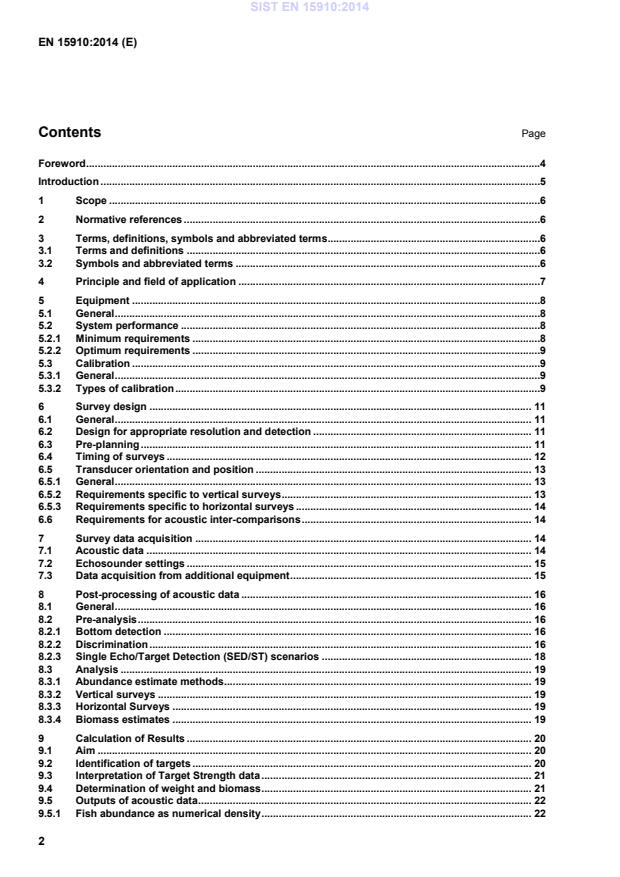
Supplementary data . 29 Annex B (informative)
Methods for estimates of fish abundance . 31 Annex C (informative)
Interpretation of TS into fish length and weight . 32 Annex D (informative)
Deconvolution procedure . 37 Annex E (informative)
Determination of the Elementary Distance Sampling Unit (EDSU). 39 Annex F (informative)
Estimates of sampling variance and precision . 40 Annex G (informative)
Published inter-comparison studies . 41 Bibliography . 43
m-2); — Sv Volume Backscattering Strength; Unit: decibel, dB re 1 m-1; — SED Single Echo Detection; — SNR Signal to Noise Ratio; — ST Single Target; — TS Target Strength; Units = dB re 1m2; — TVG Time Varied Gain; — YOY Young of the year. SIST EN 15910:2014
(1) where D is cruise track length; A is the area being surveyed. Then: 0,5()−=CVaΛ (2) where a is a variable between 0,4 and 0,8, depending on fish distribution; higher values of a are appropriate when fish are concentrated in a few large schools, low values when the fish are more uniformly distributed [35]. g) Working time. The working time available for the collection of acoustic data should be calculated. For both water bodies (lakes and rivers), time may have to be factored in for stationary measurements for specific purposes, e.g. aspect identification for sizing Target Strength (TS) in horizontal surveys, hydrographic sampling, etc. h) Preparation of the survey track data for GPS. The survey plan (i.e. waypoints and transects) should be in a format suitable for transfer to GPS. i) Appropriate vessel. The selection of an appropriate vessel is important. This should be stable and low noise (with a preference for 4 stroke over 2 stroke motors, or electric if feasible). Cruise speed should be a maximum of 10 km/h Actual speed selection should be appropriate for the ping rate and water depth, aiming for a minimum of 3 hits on a fish of interest when target-tracking / trace-counting. 6.4 Timing of surveys The timing of acoustic surveys should consider the following factors. Surveys should be conducted during the period when the target fish are in open water and most dispersed. The following seasonal factors should be considered when planning an acoustic survey [38]: SIST EN 15910:2014
Horizontal surveys Vertical surveys Signal-to-noise ratio Low High Aspect of fish relative to the transducer Often unknown Dorsal Weather conditions Highly susceptible to adverse weather (wind, waves, heavy rain) Less susceptible to adverse weather Vessel stability High influence on measurements Low influence on measurements Boat traffic Susceptible to acoustic interference from other vessels Less susceptible to acoustic interference from other vessels 6.5.2 Requirements specific to vertical surveys The maximum pulse repetition rate shall be calculated according to the maximum depth sampled. The transducer depth should be as shallow as possible, but greater than depths that generate micro-bubbles. SIST EN 15910:2014
1) Sonar5-Pro® (Lindem Data Acquisition, Oslo, Norway), Echoview® (Myriax, Tasmania, Australia), EchoScape® (HTI, Seattle, USA) and Visual Analyzer® (BioSonics, Seattle, USA) are examples of suitable products available commercially. This information is given for the convenience of users of this European Standard and does not constitute an endorsement by CEN of these products. SIST EN 15910:2014
...