

prEN 12477
(Main)Protective gloves for welders
- Abstract
This document specifies requirements and test methods for protective gloves for use in manual metal welding, cutting and allied processes.
Protective gloves for welders protect the hands and the wrists during the process of welding and related tasks.
Protective gloves for welders protect against small splashes of molten metal, short contact exposure to limited flame, convective heat and contact heat and U.V. radiation from the arc. The glove’s material provides minimum electrical resistance up to 100 V (DC) for arc welding. Besides, they protect against mechanical aggressions.
WARNING - It is not meant to bring any protection in case of defective or wrong use of the welding equipment. It does not qualify the glove for protection against electrical shock where protective gloves designed according to EN 60903 shall be used.
According to their performance, protective gloves for welders are classified into two types:
- Type A: lower dexterity (with higher other performance);
- Type B: higher dexterity (with lower other performance).
Protective gloves for special welding processes are outside the scope of this document.
- Status
- Not Published
- Publication Date
- 02-Apr-2023
- Technical Committee
- CEN/TC 162 - Protective clothing including hand and arm protection and lifejackets
- Drafting Committee
- CEN/TC 162/WG 8 - Protective gloves
- Current Stage
- 4060 - Closure of enquiry - Enquiry
- Start Date
- 29-Jul-2021
- Due Date
- 06-Sep-2021
- Completion Date
- 29-Jul-2021

Overview
prEN 12477 - "Protective gloves for welders" (CEN draft) specifies performance requirements and test methods for gloves used in manual metal welding, cutting and allied processes. It defines protective objectives (hands and wrist protection from molten metal splashes, short flame contact, convective and contact heat, UV from the arc and mechanical hazards) and classifies gloves by intended performance into Type A (lower dexterity, higher protection) and Type B (higher dexterity, lower protection). The standard also sets marking, sizing and conditioning rules and includes optional electrical-resistance requirements for arc welding use.
Key topics and technical requirements
- Scope of protection
- Resistance to small splashes of molten metal, limited flame contact, convective and contact heat, mechanical hazards and UV radiation from the arc.
- Minimum electrical resistance for arc welding materials (note: not a substitute for electrical-shock gloves per EN 60903).
- Classification
- Type A: higher protective performance, reduced dexterity - recommended for general welding processes.
- Type B: improved dexterity - recommended for tasks requiring fine manipulation (e.g., TIG welding).
- Defined tests and performance levels
- Mechanical: abrasion, blade cut, TDM cut method, tear and puncture (EN 388 family).
- Thermal: burning behaviour, contact heat (tested at 100 °C), convective heat and resistance to small splashes of molten metal (EN 407).
- Electrical: vertical resistance test (EN 1149‑2) under conditioned humidity/temperature; optional requirement to avoid conductive paths between inner and outer parts.
- Dexterity: per EN ISO 21420 (smallest diameters specified).
- Sizing, length and marking
- Minimum glove lengths by hand size are specified.
- Marking must include the standard number and Type A or B, plus the welding-protection pictogram.
- Conditioning and cleaning
- Tests are conducted on conditioned samples; performance after recommended cleaning cycles must be reported (lowest level used for marking).
Applications and who uses this standard
- Manufacturers of welding gloves and PPE designers - to design and certify products for welding hazards.
- Test laboratories and conformity assessors - to verify performance and marking.
- Safety managers, procurement and welding supervisors - to select appropriate gloves (Type A vs Type B) for specific welding tasks.
- Regulators and certification bodies - to align PPE with EU Regulation 2016/425 when this standard is referenced.
Related standards
- EN 388 (mechanical risks)
- EN 407 (thermal risks)
- EN ISO 21420 (general glove requirements)
- EN 1149‑2 (electrical vertical resistance)
- EN 60903 (insulating gloves for electrical work - not covered by prEN 12477)
- ISO/TR 25901‑3 (welding process vocabulary)
Keywords: prEN 12477, protective gloves for welders, welding gloves, welding PPE, arc welding gloves, EN 12477, EN 388, EN 407, EN ISO 21420.
Relations
- Effective Date
- 03-Feb-2021
Get Certified
Connect with accredited certification bodies for this standard

CIS Institut d.o.o.
Personal Protective Equipment (PPE) certification body. Notified Body NB-2890 for EU Regulation 2016/425 PPE.

Kiwa BDA Testing
Building and construction product certification.
Kmetijski inštitut Slovenije
Agricultural Institute of Slovenia. Soil testing, plant health, agricultural product analysis.
Sponsored listings
Frequently Asked Questions
prEN 12477 is a draft published by the European Committee for Standardization (CEN). Its full title is "Protective gloves for welders". This standard covers: This document specifies requirements and test methods for protective gloves for use in manual metal welding, cutting and allied processes. Protective gloves for welders protect the hands and the wrists during the process of welding and related tasks. Protective gloves for welders protect against small splashes of molten metal, short contact exposure to limited flame, convective heat and contact heat and U.V. radiation from the arc. The glove’s material provides minimum electrical resistance up to 100 V (DC) for arc welding. Besides, they protect against mechanical aggressions. WARNING - It is not meant to bring any protection in case of defective or wrong use of the welding equipment. It does not qualify the glove for protection against electrical shock where protective gloves designed according to EN 60903 shall be used. According to their performance, protective gloves for welders are classified into two types: - Type A: lower dexterity (with higher other performance); - Type B: higher dexterity (with lower other performance). Protective gloves for special welding processes are outside the scope of this document.
This document specifies requirements and test methods for protective gloves for use in manual metal welding, cutting and allied processes. Protective gloves for welders protect the hands and the wrists during the process of welding and related tasks. Protective gloves for welders protect against small splashes of molten metal, short contact exposure to limited flame, convective heat and contact heat and U.V. radiation from the arc. The glove’s material provides minimum electrical resistance up to 100 V (DC) for arc welding. Besides, they protect against mechanical aggressions. WARNING - It is not meant to bring any protection in case of defective or wrong use of the welding equipment. It does not qualify the glove for protection against electrical shock where protective gloves designed according to EN 60903 shall be used. According to their performance, protective gloves for welders are classified into two types: - Type A: lower dexterity (with higher other performance); - Type B: higher dexterity (with lower other performance). Protective gloves for special welding processes are outside the scope of this document.
prEN 12477 is classified under the following ICS (International Classification for Standards) categories: 13.340.40 - Hand and arm protection. The ICS classification helps identify the subject area and facilitates finding related standards.
prEN 12477 has the following relationships with other standards: It is inter standard links to EN 12477:2001. Understanding these relationships helps ensure you are using the most current and applicable version of the standard.
prEN 12477 is associated with the following European legislation: EU Directives/Regulations: 2016/425; Standardization Mandates: M/031, M/571, M/571 Amd 1. When a standard is cited in the Official Journal of the European Union, products manufactured in conformity with it benefit from a presumption of conformity with the essential requirements of the corresponding EU directive or regulation.
prEN 12477 is available in PDF format for immediate download after purchase. The document can be added to your cart and obtained through the secure checkout process. Digital delivery ensures instant access to the complete standard document.
Standards Content (Sample)
SLOVENSKI STANDARD
01-julij-2021
Varovalne rokavice za varilce
Protective gloves for welders
Schutzhandschuhe für Schweißer
Gants de protection pour soudeurs
Ta slovenski standard je istoveten z: prEN 12477
ICS:
13.340.40 Varovanje dlani in rok Hand and arm protection
25.160.01 Varjenje, trdo in mehko Welding, brazing and
spajkanje na splošno soldering in general
2003-01.Slovenski inštitut za standardizacijo. Razmnoževanje celote ali delov tega standarda ni dovoljeno.
DRAFT
EUROPEAN STANDARD
NORME EUROPÉENNE
EUROPÄISCHE NORM
May 2021
ICS 13.340.40 Will supersede EN 12477:2001
English Version
Protective gloves for welders
Gants de protection pour soudeurs Schutzhandschuhe für Schweißer
This draft European Standard is submitted to CEN members for enquiry. It has been drawn up by the Technical Committee
CEN/TC 162.
If this draft becomes a European Standard, CEN members are bound to comply with the CEN/CENELEC Internal Regulations
which stipulate the conditions for giving this European Standard the status of a national standard without any alteration.
This draft European Standard was established by CEN in three official versions (English, French, German). A version in any other
language made by translation under the responsibility of a CEN member into its own language and notified to the CEN-CENELEC
Management Centre has the same status as the official versions.
CEN members are the national standards bodies of Austria, Belgium, Bulgaria, Croatia, Cyprus, Czech Republic, Denmark, Estonia,
Finland, France, Germany, Greece, Hungary, Iceland, Ireland, Italy, Latvia, Lithuania, Luxembourg, Malta, Netherlands, Norway,
Poland, Portugal, Republic of North Macedonia, Romania, Serbia, Slovakia, Slovenia, Spain, Sweden, Switzerland, Turkey and
United Kingdom.
Recipients of this draft are invited to submit, with their comments, notification of any relevant patent rights of which they are
aware and to provide supporting documentation.
Warning : This document is not a European Standard. It is distributed for review and comments. It is subject to change without
notice and shall not be referred to as a European Standard.
EUROPEAN COMMITTEE FOR STANDARDIZATION
COMITÉ EUROPÉEN DE NORMALISATION
EUROPÄISCHES KOMITEE FÜR NORMUNG
CEN-CENELEC Management Centre: Rue de la Science 23, B-1040 Brussels
© 2021 CEN All rights of exploitation in any form and by any means reserved Ref. No. prEN 12477:2021 E
worldwide for CEN national Members.
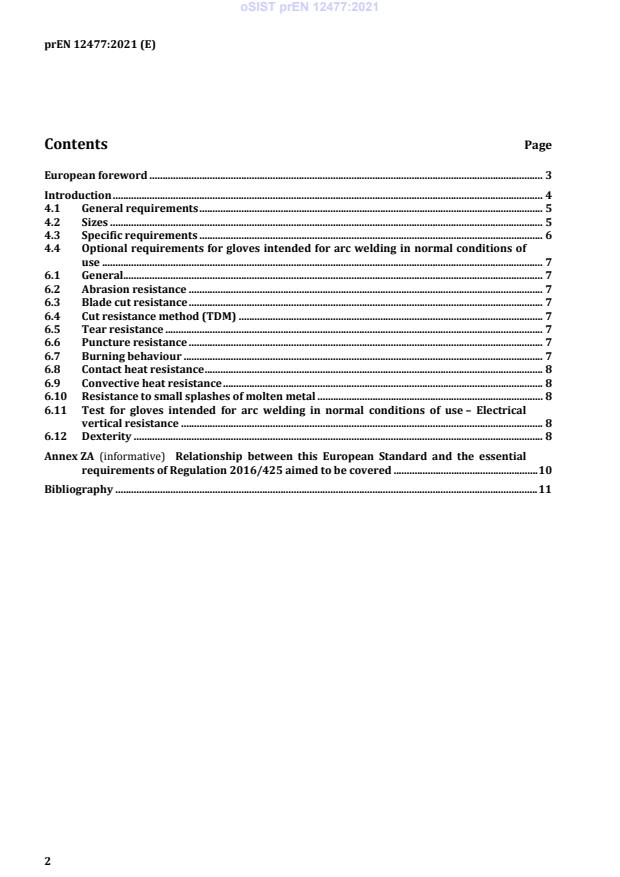
Contents Page
European foreword . 3
Introduction . 4
4.1 General requirements . 5
4.2 Sizes . 5
4.3 Specific requirements . 6
4.4 Optional requirements for gloves intended for arc welding in normal conditions of
use . 7
6.1 General. 7
6.2 Abrasion resistance . 7
6.3 Blade cut resistance . 7
6.4 Cut resistance method (TDM) . 7
6.5 Tear resistance . 7
6.6 Puncture resistance . 7
6.7 Burning behaviour . 7
6.8 Contact heat resistance . 8
6.9 Convective heat resistance . 8
6.10 Resistance to small splashes of molten metal . 8
6.11 Test for gloves intended for arc welding in normal conditions of use – Electrical
vertical resistance . 8
6.12 Dexterity . 8
Annex ZA (informative) Relationship between this European Standard and the essential
requirements of Regulation 2016/425 aimed to be covered . 10
Bibliography . 11
European foreword
This document (prEN 12477:2021) has been prepared by Technical Committee CEN/TC 162 “Protective
clothing including hand and arm protection and lifejackets”, the secretariat of which is held by DIN.
This document is currently submitted to the CEN Enquiry.
This document will supersede EN 12477:2001 and EN 12477:2001/A1:2005.
In comparison with the previous edition, the following technical modifications have been made:
— reference to new standard EN 388, EN 407, EN ISO 21420, etc.;
— new TDM test coming from EN 388;
— new gloves length, Table 1;
— new pictogram.
This document has been prepared under a mandate given to CEN by the European Commission and the
European Free Trade Association, and supports essential requirements of EU Directive(s).
For relationship with EU Directive(s), see informative Annex ZA, which is an integral part of this
document.
Introduction
There are various manual welding processes, which are defined in ISO/TR 25901-3:2016, “Welding and
allied processes — Vocabulary — Part 3: Welding processes”.
The nature and the severity of the risks for welders' hands vary according to the various welding
processes. The performance (protection and dexterity) required for protective gloves can therefore
differ depending on their intended use.
1 Scope
This document specifies requirements and test methods for protective gloves for use in manual metal
welding, cutting and allied processes.
Protective gloves for welders protect the hands and the wrists during the process of welding and
related tasks.
Protective gloves for welders protect against small splashes of molten metal, short contact exposure to
limited flame, convective heat and contact heat and U.V. radiation from the arc. The glove’s material
provides minimum electrical resistance up to 100 V (DC) for arc welding. Besides, they protect against
mechanical aggressions.
WARNING — It is not meant to bring any protection in case of defective or wrong use of the welding
equipment. It does not qualify the glove for protection against electrical shock where protective gloves
designed according to EN 60903 shall be used.
According to their performance, protective gloves for welders are classified into two types:
— Type A: lower dexterity (with higher other performance);
— Type B: higher dexterity (with lower other performance).
Protective gloves for special welding processes are outside the scope of this document.
2 Normative references
The following documents are referred to in the text in such a way that some or all of their content
constitutes requirements of this document. For dated references, only the edition cited applies. For
undated references, the latest edition of the referenced document (including any amendments) applies.
EN 388:2016+A1:2018, Protective gloves against mechanical risks
EN 407:2020, Protective gloves and other hand protective equipments against thermal risks (heat and/or
fire)
EN 1149-2, Protective clothing — Electrostatic properties — Part 2: Test method for measurement of the
electrical resistance through a material (vertical resistance)
EN ISO 21420:2020, Protective gloves — General requirements and test methods (ISO 21420:2020)
3 Terms and definitions
No terms and definitions are listed in this document.
4 Requirements
4.1 General requirements
Protective gloves for welders shall comply with all the general requirements of EN ISO 21420:2020,
except the lengths which are defined in 4.2.
4.2 Sizes
The sizes shall correspond to the requirements established in EN ISO 21420:2020, 5.1.
When measured according to EN ISO 21420:2020, 6.1, the minimum length shall be in accordance with
Table 1.
Table 1 — Minimum length for gloves for welder
Hand size 6 7 8 9 10 11 12 13
Higher than
Minimum length of glove (mm) 300 310 320 330 340 350
4.3 Specific requirements
Protective gloves for welders shall be tested and, according to the test results, be classified as type A
a
...