

EN 15768:2015
(Main)Influence of materials on water intended for human consumption - GC-MS identification of water leachable organic substances
- Abstract
This European Standard describes a method for detecting and identifying organic chemicals that are amenable to GC-MS analysis using the procedures described and which can migrate from a product into water intended for human consumption. This European Standard does not provide all the necessary tools to completely identify all the substances that are detected. A method of semi-quantitatively estimating the concentrations of the organic substances detected is also provided, however, concentrations should only be seen as indicative.
NOTE The method to be used for the preparation of migration waters is specified by separate EN's, as noted below.
- Status
- Published
- Publication Date
- 27-Jan-2015
- Withdrawal Date
- 30-Jul-2015
- Technical Committee
- CEN/TC 164 - Water supply
- Drafting Committee
- CEN/TC 164/WG 3 - Effects of materials in contact with drinking water
- Current Stage
- 9020 - Submission to 2 Year Review Enquiry - Review Enquiry
- Start Date
- 15-Jul-2026
- Completion Date
- 15-Jul-2026



Overview
EN 15768:2015 (CEN) specifies a GC‑MS screening method for the identification of water‑leachable organic substances that can migrate from materials into water intended for human consumption. It describes procedures to extract, detect and tentatively identify organic chemicals amenable to gas chromatography–mass spectrometry (GC‑MS). This standard is a screening and identification method - it provides semi‑quantitative concentration estimates and identification guidance but is not intended as a definitive quantitative specification.
Key topics and requirements
- Scope and purpose: Detect and identify organic migrants from finished products (e.g., pipes, coatings, membranes, resins) that contact drinking water.
- Analytical technique: GC‑MS general survey analysis, typically using electron‑impact ionization and wide m/z scan modes for non‑target screening.
- Sample types: Migration waters produced according to the separate EN migration test methods (see Related Standards).
- Quality controls:
- Use of internal standards (ideally isotopically labelled) added to migration waters.
- Injection standards added to solvent extracts.
- Routine laboratory blanks and procedural blanks to identify contamination sources.
- Mass calibration, instrument performance checks, and analyst performance verification.
- Data handling: Procedures for library searching, background subtraction, and guidance on confidence levels for tentative identifications (informative annexes provide identification strategy).
- Reporting: Semi‑quantitative concentration estimates should be reported as indicative only; comprehensive reporting requirements and test report content are specified.
- Limitations: EN 15768:2015 does not guarantee complete identification of all detected compounds and is not a replacement for targeted quantitative methods when accurate concentrations are required.
Applications and users
- Who uses it:
- Accredited analytical laboratories performing compliance or pre‑approval screening.
- Water utilities and regulators assessing material suitability and potential health risks.
- Manufacturers of plumbing materials, coatings and water treatment components for product assessment and approval dossiers.
- Auditors conducting approval or surveillance testing.
- Practical applications:
- Screening migration waters for unknown organic migrants.
- Prioritizing substances for follow‑up targeted quantitative analysis.
- Supporting product approval, risk assessment and quality assurance for materials in contact with drinking water.
Related standards
- EN 12873‑1 / EN 12873‑2 / EN 12873‑3 / EN 12873‑4 - methods to prepare migration waters for different material types.
- EN ISO 3696 - water for analytical laboratory use (reagent water quality).
- Note: EN 15768:2015 is an identification method only and should be cited as such in regulatory or technical documents.
Keywords: EN 15768:2015, GC‑MS, water leachable organic substances, migration waters, drinking water, screening method, semi‑quantitative, CEN, migration testing, internal standard.
Relations
- Effective Date
- 28-Jan-2026
- Effective Date
- 28-Jan-2026
- Effective Date
- 28-Jan-2026
- Effective Date
- 28-Jan-2026
- Effective Date
- 28-Jan-2026
Get Certified
Connect with accredited certification bodies for this standard

BSI Group
BSI (British Standards Institution) is the business standards company that helps organizations make excellence a habit.

Bureau Veritas
Bureau Veritas is a world leader in laboratory testing, inspection and certification services.

DNV
DNV is an independent assurance and risk management provider.
Sponsored listings
Frequently Asked Questions
EN 15768:2015 is a standard published by the European Committee for Standardization (CEN). Its full title is "Influence of materials on water intended for human consumption - GC-MS identification of water leachable organic substances". This standard covers: This European Standard describes a method for detecting and identifying organic chemicals that are amenable to GC-MS analysis using the procedures described and which can migrate from a product into water intended for human consumption. This European Standard does not provide all the necessary tools to completely identify all the substances that are detected. A method of semi-quantitatively estimating the concentrations of the organic substances detected is also provided, however, concentrations should only be seen as indicative. NOTE The method to be used for the preparation of migration waters is specified by separate EN's, as noted below.
This European Standard describes a method for detecting and identifying organic chemicals that are amenable to GC-MS analysis using the procedures described and which can migrate from a product into water intended for human consumption. This European Standard does not provide all the necessary tools to completely identify all the substances that are detected. A method of semi-quantitatively estimating the concentrations of the organic substances detected is also provided, however, concentrations should only be seen as indicative. NOTE The method to be used for the preparation of migration waters is specified by separate EN's, as noted below.
EN 15768:2015 is classified under the following ICS (International Classification for Standards) categories: 13.060.20 - Drinking water; 67.250 - Materials and articles in contact with foodstuffs; 71.040.50 - Physicochemical methods of analysis. The ICS classification helps identify the subject area and facilitates finding related standards.
EN 15768:2015 has the following relationships with other standards: It is inter standard links to EN 12873-1:2014, EN ISO 3696:1995, EN 12873-2:2021, EN 12873-4:2021, EN 12873-3:2019. Understanding these relationships helps ensure you are using the most current and applicable version of the standard.
EN 15768:2015 is associated with the following European legislation: EU Directives/Regulations: 98/83/EC; Standardization Mandates: M/136 rev2. When a standard is cited in the Official Journal of the European Union, products manufactured in conformity with it benefit from a presumption of conformity with the essential requirements of the corresponding EU directive or regulation.
EN 15768:2015 is available in PDF format for immediate download after purchase. The document can be added to your cart and obtained through the secure checkout process. Digital delivery ensures instant access to the complete standard document.
Standards Content (Sample)
2003-01.Slovenski inštitut za standardizacijo. Razmnoževanje celote ali delov tega standarda ni dovoljeno.Vpliv materialov na pitno vodo - Identifikacija GC-MS vodno lužljivih organskih snoviIdentifizierung mittels GC-MS von durch Wasser auslaugbaren organischen Substanzen aus Materialien für den Kontakt mit TrinkwasserInfluence sur l'eau des matériaux en contact avec l'eau destinée à la consommation humaine - Identification par CG-SM de substances organiques lixiviables à l’eauInfluence of materials on water intended for human consumption - GC-MS identification of water leachable organic substances71.040.50Fizikalnokemijske analitske metodePhysicochemical methods of analysis67.250Materiali in predmeti v stiku z živiliMaterials and articles in contact with foodstuffs13.060.20Pitna vodaDrinking waterICS:Ta slovenski standard je istoveten z:EN 15768:2015SIST EN 15768:2015en,de01-april-2015SIST EN 15768:2015SLOVENSKI
STANDARD
EUROPEAN STANDARD NORME EUROPÉENNE EUROPÄISCHE NORM
EN 15768
January 2015 ICS 13.060.20; 67.250; 71.040.50 English Version
Influence of materials on water intended for human consumption - GC-MS identification of water leachable organic substances
Influence sur l'eau des matériaux en contact avec l'eau destinée à la consommation humaine - Identification par CG-SM de substances organiques lixiviables à l'eau
Identifizierung mittels GC-MS von durch Wasser auslaugbaren organischen Substanzen aus Materialien für den Kontakt mit Trinkwasser This European Standard was approved by CEN on 29 November 2014.
CEN members are bound to comply with the CEN/CENELEC Internal Regulations which stipulate the conditions for giving this European Standard the status of a national standard without any alteration. Up-to-date lists and bibliographical references concerning such national standards may be obtained on application to the CEN-CENELEC Management Centre or to any CEN member.
This European Standard exists in three official versions (English, French, German). A version in any other language made by translation under the responsibility of a CEN member into its own language and notified to the CEN-CENELEC Management Centre has the same status as the official versions.
CEN members are the national standards bodies of Austria, Belgium, Bulgaria, Croatia, Cyprus, Czech Republic, Denmark, Estonia, Finland, Former Yugoslav Republic of Macedonia, France, Germany, Greece, Hungary, Iceland, Ireland, Italy, Latvia, Lithuania, Luxembourg, Malta, Netherlands, Norway, Poland, Portugal, Romania, Slovakia, Slovenia, Spain, Sweden, Switzerland, Turkey and United Kingdom.
EUROPEAN COMMITTEE FOR STANDARDIZATION
COMITÉ EUROPÉEN DE NORMALISATION EUROPÄISCHES KOMITEE FÜR NORMUNG
CEN-CENELEC Management Centre:
Avenue Marnix 17,
B-1000 Brussels © 2015 CEN All rights of exploitation in any form and by any means reserved worldwide for CEN national Members. Ref. No. EN 15768:2015 ESIST EN 15768:2015
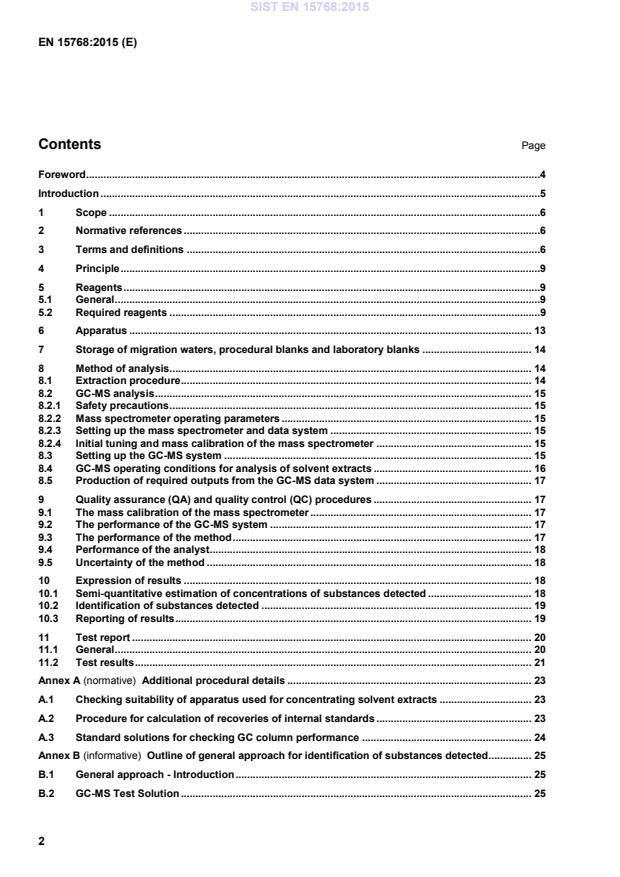
Additional procedural details . 23 A.1 Checking suitability of apparatus used for concentrating solvent extracts . 23 A.2 Procedure for calculation of recoveries of internal standards . 23 A.3 Standard solutions for checking GC column performance . 24 Annex B (informative)
Outline of general approach for identification of substances detected. 25 B.1 General approach - Introduction . 25 B.2 GC-MS Test Solution . 25 SIST EN 15768:2015
Guidance on the interpretation of results . 28 C.1 Introduction . 28 C.2 Initial assessment of test report . 28 C.3 Assessment of results of analysis . 28 Annex D (informative)
Guidance on the identification of substances . 30 D.1 A suggested strategy to assist in identifying substances in extracted leachates . 30 D.2 Resolution of co-eluting peaks . 30 D.3 Proceeding when background subtraction does not help . 31 D.4 Tentatively identifying a substance using boiling points and retention indices . 31 D.5 Library search results and identifying “unknown” substances . 32 D.6 Interpretation of the mass spectrum . 32 D.7 Reporting confidence in a substance identification . 33 D.8 How to report alternative identifications and when this is appropriate . 33 D.9 What to do if library search fails to assign a reasonable identification . 34
3 Terms and definitions For the purposes of this document, the following terms and definitions apply. 3.1 u atomic mass unit, defined as 1/12 of the mass of a single atom of carbon-12 in the gas phase (i.e. unbound), at rest and in its ground state 3.2 asymmetry factor
As measure of the absorption of a compound during gas chromatographic analysis Note 1 to entry: The asymmetry factor (As) can be derived from Formula (1). +=(ab)Abs2 (1) where a is the distance from the leading edge of the peak at the point on the baseline where the perpendicular dropped from the peak maximum crosses it; b is the corresponding distance from the trailing edge of the peak. Locate the apex of the peaks that require their asymmetry values calculated. For each peak, drop a perpendicular line down at a right-angle to the baseline. SIST EN 15768:2015
Note 2 to entry: Some manufacturer's GC-MS software packages allow the calculation of peak asymmetries to be produced automatically. Check the criteria used for the measurement, as some packages perform the calculation at 5 % of the peak height. 3.3 electron impact ionization ionization by a beam of electrons 3.4 GC-MS analytical instrument comprising a gas chromatograph (GC) linked to a mass spectrometer (MS) 3.5 GC-MS general survey analysis acquisition of a series of mass spectra (up to several thousand) during the course of a gas chromatographic run, by operating the mass spectrometer in a continuous cyclic scanning mode over a wide m/z range 3.6 injection standard organic substance added to the final solvent extract prior to analysis Note 1 to entry: An injection standard is added to allow the recoveries of the internal standards to be calculated, by providing a means of normalizing the GC-MS responses for solvent extracts and GC-MS standards. 3.7 internal standard organic substance added to the migration water at a known concentration prior to the commencement of the analysis Note 1 to entry: Internal standards are added for the following reasons (a) to demonstrate that the analysis has been undertaken successfully, and (b) to provide a reference to allow other substances detected to be quantified. Ideally, the internal standards should not be present in the migration waters being analysed; for this reason, isotopically labelled standards are used. 3.8 test water water used to prepare the migration water, as specified in EN 12873-1, EN 12873-2, EN 12873-3 or EN 12873-4 depending on the material being tested 3.9 laboratory blank water, as specified in EN ISO 3696, known to contain negligible levels of contamination, to which internal standards (3.7) have been added and which is then analysed in the same way as the migration water Note 1 to entry: Laboratory blanks are used to check for potential contamination of either migration waters or solvent extracts which may occur within the laboratory during the course of the analysis. 3.10 migration water aqueous solution that results from leaving test water in contact with the test material under the specified test conditions 3.11 procedural blank aqueous solution that results from leaving test water in contact with tanks or containers identical to those used to prepare the migration water in the absence of the test material SIST EN 15768:2015
TIC sum of all the separate ion currents carried by the individual ions contributing to a single mass spectrum 3.16 TIC chromatogram graphical representation of the TIC versus time 3.17 Linear Retention Index Linear Retention Index −−×+×=+)()(100100)(n1nnxRTRTRTRTn (2) where n is the number of carbon atoms in n-alkane prior to substance of interest; RTn
is the retention time (min) of n-alkane; RTn + 1 is the retention time (min) of next n-alkane; RTx is the retention time (min) of substance of interest SIST EN 15768:2015
5.2.8 Acetone, glass distilled grade, batches should not be used until they have been verified as free from significant contamination, see Note 2. NOTE 1 Other grades can be suitable but it is necessary to demonstrate that any impurities present do not interfere with the detection of substances of interest or the internal standards, or introduce unacceptable contamination, see Note 2. NOTE 2 Generally any peak in the solvent after the acetone has been diluted 5 times with dichloromethane with an estimated concentration greater than 1
5.2.9 Ascorbic acid solution, prepared as follows: — dissolve (4,0 ± 0,1) g of ascorbic acid in reagent water (5.2.1) and make up to 1 l. Before use, extract the ascorbic acid solution with two 100 ml aliquots of dichloromethane, discarding the solvent afterwards. Transfer the ascorbic acid solution to a suitable screw-capped bottle. The solution is stable for use for one month after preparation. 5.2.10 Sodium sulphate (anhydrous), prepared as follows: — remove any organic contaminants by heating at (500 ± 50) °C for ≥ 4 h, and store so that rehydration is minimized and re-contamination cannot occur. 5.2.11 Internal standards Use the following isotopically-labelled (≥98 atom % a) substances: — d6-benzene; — d21-2,6-di-t-butyl-4-methylphenol (d21-BHT); — d5-chlorobenzene; — d34-hexadecane; — d8-naphthalene; — d10-phenanthrene; — d5-phenol; SIST EN 15768:2015
°C for 4 min, linearly programmed at 8 °C/min to a final temperature of 300 °C and maintaining this for 20 min. Other columns and/or conditions can also be suitable. Ensure that: a) the temperature programming rate does not exceed 12 °C/min at any time; b) all of the internal standards are detected on the TIC chromatogram; c) d6-benzene is separated from the solvent peak and that the retention time of d62-squalane is between 35 min and 45 min; d) the asymmetry factors, As, (3.2) for the peaks obtained for d5-phenol and d8-naphthalene are within the range 0,65 to 2,0. In the event that this requirement is not met, investigate the cause and correct before continuing with the analysis. If necessary, install a new GC column; e) the sensitivity of the mass spectrometer is set so that acceptable spectra are obtained for those internal standards, which are present at the threshold concentration (2 µg/l) and the mass spectra obtained for the internal standards present at the highest level (16 µg/l) are not saturated by, if necessary, adjusting the sensitivity of the mass spectrometer. The TIC peak areas for the internal standards should be noted; f) the mass spectra obtained from the GC-MS system performance test correspond closely to mass spectra previously acquired for these internal standards on the same GC-MS system under identical operating conditions; g) the m/z value of the base peak is consistent, and that the intensities of 6 to 10 peaks having an intensity > 10 % of the base peak do not vary by more than 30 % of their intensity when compared to previously acquired spectra; h) the high mass ions (>300 u) in the mass spectra for d62-squalane are correctly mass measured after the mass spectrometer mass calibration. If this is not the case, recalibrate the mass spectrometer before continuing with the analysis. 8.4 GC-MS operating conditions for analysis of solvent extracts Analyse concentrated solvent extracts using identical conditions to those used for checking the performance of the GC-MS system using the internal standards GC column test solution (5.2.18) (see Note 1). The “fitness for purpose” of the GC-MS system (with reference to items a to h of 8.3) should be checked prior to using the system for this analysis. Check the performance of the GC-MS system before every batch of concentrated solvent extracts run, using the internal standards GC column test solution (5.2.18), and regularly during the batch if batch sizes are greater than six. For example, analyse the internal standards GC test column solution (5.2.18) after every sixth concentrated solvent extract and check the criteria given in 8.3 (items a to h) to ensure that the performance of the system has not deteriorated. If the performance of the system has deteriorated stop the analysis; investigate, and correct the cause of the failure before continuing with the analysis. SIST EN 15768:2015
...