

EN 4886:2024
(Main)Aerospace series - Rotorcraft life raft - Requirements, testing and marking
- Abstract
This document specifies minimum requirements for life rafts carried on helicopters operating in a hostile sea area or over very rough sea conditions. Life rafts covered by this document are for use by helicopter crew members and passengers in the event of a ditching or water impact.
They are intended either for integration into the helicopter, or stowed in the cabin before being manhandled out of the helicopter. This document does not cover air-drop life rafts.
- Status
- Published
- Publication Date
- 16-Jul-2024
- Technical Committee
- ASD-STAN - Aerospace
- Drafting Committee
- ASD-STAN/D 12/WG 2 - Ditching Equipment
- Current Stage
- 6060 - Definitive text made available (DAV) - Publishing
- Start Date
- 17-Jul-2024
- Completion Date
- 17-Jul-2024

Overview
EN 4886:2024 - "Aerospace series - Rotorcraft life raft - Requirements, testing and marking" is a CEN European Standard that defines the minimum requirements for life rafts carried on helicopters operating in hostile sea areas or over very rough sea conditions. It covers life rafts intended for crew members and passengers after a ditching or water impact, whether integrated into the helicopter or stowed in the cabin for manual deployment. The standard explicitly excludes air-drop life rafts.
Key topics and technical requirements
EN 4886:2024 addresses the full lifecycle of rotorcraft life rafts, including design, materials, performance, testing and marking. Major technical areas include:
- Design & occupancy: required design features and occupancy ratings for different raft sizes and configurations.
- Performance categories: distinguishes performance levels (notably Category A and Category B) to match operational environments.
- Buoyancy, canopy and floor: essential stability, freeboard and protective canopy specifications.
- Materials & durability: resistance to temperature, fuels, fluids, UV, salt spray, fungal growth, tear/puncture and seam strength.
- Inflation & pressure systems: inflation reliability, pressure retention, proof/ultimate pressure testing and overpressure protection.
- Seaworthiness & stability: requirements for sea-anchor, stabilizing systems and boarding facilities.
- Attached equipment: life lines, grab lines, rescue lines/quoit, lights, knives and survival ELT and survival equipment kit.
- Ergonomics & deployment: human factors testing for deployment and boarding in realistic conditions.
- Valise/container requirements: packaging and stowage for both Category A and B life rafts.
- Marking & conspicuity: colour, retroreflective materials and labelling for identification and search-and-rescue.
- Testing procedures: visual inspection, material tests (puncture, tensile, fluids), functional tests (inflation, canopy, drop, freeboard) and attachment strength tests.
Applications and users
EN 4886:2024 is intended for organizations involved in rotorcraft safety and survival equipment, including:
- Helicopter manufacturers and OEMs integrating life rafts into rotorcraft.
- Aviation equipment designers and life-raft manufacturers certifying products for offshore, SAR and hostile-sea operations.
- Maintenance organisations, certification bodies and airworthiness authorities evaluating compliance.
- Offshore operators, SAR providers and flight safety managers specifying equipment for crew/passenger evacuation.
Keywords: rotorcraft life raft, helicopter life raft, EN 4886:2024, CEN standard, ditching survival, life raft testing, helicopter safety.
Related standards (if applicable)
Consider cross-referencing other aviation and marine life‑saving standards and industry guidance on life‑raft design, material testing and survival equipment to ensure harmonised compliance with airworthiness and maritime rescue requirements.
Relations
- Effective Date
- 25-Aug-2026
- Effective Date
- 28-Jan-2026
- Effective Date
- 28-Jan-2026
- Refers
EN ISO 9227:2022 - Corrosion tests in artificial atmospheres - Salt spray tests (ISO 9227:2022) - Effective Date
- 28-Jan-2026
- Effective Date
- 28-Jan-2026
- Effective Date
- 28-Jan-2026
- Effective Date
- 28-Jan-2026
- Effective Date
- 28-Jan-2026
- Effective Date
- 28-Jan-2026
- Refers
EN 4863:2023 - Aerospace series - Rotorcraft immersion suits - Requirements, testing and marking - Effective Date
- 28-Jan-2026
- Effective Date
- 28-Jan-2026
- Effective Date
- 28-Jan-2026
Get Certified
Connect with accredited certification bodies for this standard

BSI Group
BSI (British Standards Institution) is the business standards company that helps organizations make excellence a habit.

Bureau Veritas
Bureau Veritas is a world leader in laboratory testing, inspection and certification services.

DNV
DNV is an independent assurance and risk management provider.
Sponsored listings
Frequently Asked Questions
EN 4886:2024 is a standard published by the European Committee for Standardization (CEN). Its full title is "Aerospace series - Rotorcraft life raft - Requirements, testing and marking". This standard covers: This document specifies minimum requirements for life rafts carried on helicopters operating in a hostile sea area or over very rough sea conditions. Life rafts covered by this document are for use by helicopter crew members and passengers in the event of a ditching or water impact. They are intended either for integration into the helicopter, or stowed in the cabin before being manhandled out of the helicopter. This document does not cover air-drop life rafts.
This document specifies minimum requirements for life rafts carried on helicopters operating in a hostile sea area or over very rough sea conditions. Life rafts covered by this document are for use by helicopter crew members and passengers in the event of a ditching or water impact. They are intended either for integration into the helicopter, or stowed in the cabin before being manhandled out of the helicopter. This document does not cover air-drop life rafts.
EN 4886:2024 is classified under the following ICS (International Classification for Standards) categories: 13.200 - Accident and disaster control; 49.020 - Aircraft and space vehicles in general. The ICS classification helps identify the subject area and facilitates finding related standards.
EN 4886:2024 has the following relationships with other standards: It is inter standard links to ISO 105-A02:1993, EN ISO 105-E02:2013, EN ISO 105-X12:2016, EN ISO 9227:2022, EN 4862:2023, EN 1875-3:2023, EN 772-19:2000, EN ISO 12947-2:2016, EN 4856:2023, EN 4863:2023, EN ISO 1421:2016, EN ISO 811:2018. Understanding these relationships helps ensure you are using the most current and applicable version of the standard.
EN 4886:2024 is available in PDF format for immediate download after purchase. The document can be added to your cart and obtained through the secure checkout process. Digital delivery ensures instant access to the complete standard document.
Standards Content (Sample)
SLOVENSKI STANDARD
01-september-2024
Aeronavtika - Reševalni splav za rotoplane - Zahteve, preskušanje in označevanje
Aerospace series - Rotorcraft life raft - Requirements, testing and marking
Luft- und Raumfahrt - Drehflüglerrettungsinsel - Anforderungen, Prüfung und
Kennzeichnung
Série aérospatiale - Radeaux de sauvetage de giravion - Exigences, essais et marquage
Ta slovenski standard je istoveten z: EN 4886:2024
ICS:
13.200 Preprečevanje nesreč in Accident and disaster control
katastrof
49.020 Letala in vesoljska vozila na Aircraft and space vehicles in
splošno general
2003-01.Slovenski inštitut za standardizacijo. Razmnoževanje celote ali delov tega standarda ni dovoljeno.
EN 4886
EUROPEAN STANDARD
NORME EUROPÉENNE
July 2024
EUROPÄISCHE NORM
ICS 13.200; 49.020
English Version
Aerospace series - Rotorcraft life raft - Requirements,
testing and marking
Série aérospatiale - Radeaux de sauvetage de giravion - Luft- und Raumfahrt - Drehflügler-Rettungsinsel -
Exigences, essais et marquage Anforderungen, Prüfung und Kennzeichnung
This European Standard was approved by CEN on 26 May 2024.
CEN members are bound to comply with the CEN/CENELEC Internal Regulations which stipulate the conditions for giving this
European Standard the status of a national standard without any alteration. Up-to-date lists and bibliographical references
concerning such national standards may be obtained on application to the CEN-CENELEC Management Centre or to any CEN
member.
This European Standard exists in three official versions (English, French, German). A version in any other language made by
translation under the responsibility of a CEN member into its own language and notified to the CEN-CENELEC Management
Centre has the same status as the official versions.
CEN members are the national standards bodies of Austria, Belgium, Bulgaria, Croatia, Cyprus, Czech Republic, Denmark, Estonia,
Finland, France, Germany, Greece, Hungary, Iceland, Ireland, Italy, Latvia, Lithuania, Luxembourg, Malta, Netherlands, Norway,
Poland, Portugal, Republic of North Macedonia, Romania, Serbia, Slovakia, Slovenia, Spain, Sweden, Switzerland, Türkiye and
United Kingdom.
EUROPEAN COMMITTEE FOR STANDARDIZATION
COMITÉ EUROPÉEN DE NORMALISATION
EUROPÄISCHES KOMITEE FÜR NORMUNG
CEN-CENELEC Management Centre: Rue de la Science 23, B-1040 Brussels
© 2024 CEN All rights of exploitation in any form and by any means reserved Ref. No. EN 4886:2024 E
worldwide for CEN national Members.
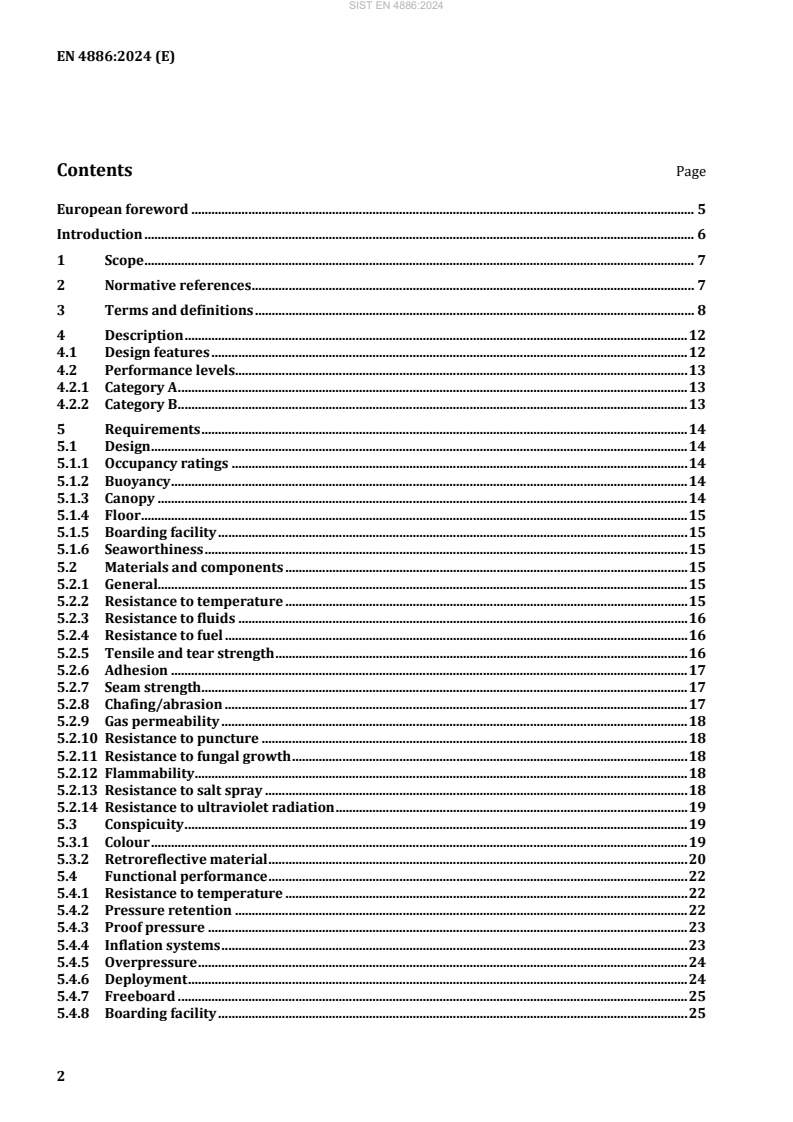
Contents Page
European foreword . 5
Introduction . 6
1 Scope . 7
2 Normative references . 7
3 Terms and definitions . 8
4 Description . 12
4.1 Design features . 12
4.2 Performance levels . 13
4.2.1 Category A . 13
4.2.2 Category B . 13
5 Requirements . 14
5.1 Design . 14
5.1.1 Occupancy ratings . 14
5.1.2 Buoyancy . 14
5.1.3 Canopy . 14
5.1.4 Floor . 15
5.1.5 Boarding facility . 15
5.1.6 Seaworthiness . 15
5.2 Materials and components . 15
5.2.1 General. 15
5.2.2 Resistance to temperature . 15
5.2.3 Resistance to fluids . 16
5.2.4 Resistance to fuel . 16
5.2.5 Tensile and tear strength . 16
5.2.6 Adhesion . 17
5.2.7 Seam strength . 17
5.2.8 Chafing/abrasion . 17
5.2.9 Gas permeability . 18
5.2.10 Resistance to puncture . 18
5.2.11 Resistance to fungal growth . 18
5.2.12 Flammability . 18
5.2.13 Resistance to salt spray . 18
5.2.14 Resistance to ultraviolet radiation . 19
5.3 Conspicuity . 19
5.3.1 Colour . 19
5.3.2 Retroreflective material . 20
5.4 Functional performance . 22
5.4.1 Resistance to temperature . 22
5.4.2 Pressure retention . 22
5.4.3 Proof pressure . 23
5.4.4 Inflation systems . 23
5.4.5 Overpressure . 24
5.4.6 Deployment . 24
5.4.7 Freeboard . 25
5.4.8 Boarding facility . 25
5.4.9 Canopy . 26
5.4.10 Drop . 26
5.4.11 Packed buoyancy . 26
5.5 Attached equipment . 26
5.5.1 General . 26
5.5.2 Life lines and grab lines . 26
5.5.3 Retaining lines . 27
5.5.4 Sea anchor . 28
5.5.5 Rescue line and quoit . 28
5.5.6 Stabilizing system . 28
5.5.7 Survivor locator lights . 29
5.5.8 Knife/belt cutter . 30
5.5.9 Survival ELT . 31
5.5.10 Survival equipment kit . 31
5.6 Ergonomic performance . 31
5.7 Seaworthiness . 33
5.8 Valise or container . 33
5.8.1 Category A life rafts . 33
5.8.2 Category B life rafts . 33
6 Testing . 34
6.1 Visual inspection . 34
6.2 Nominal values and tolerances . 34
6.3 Materials and components . 34
6.3.1 Fluids (Category B life raft valise or container) . 34
6.3.2 Fuel . 34
6.3.3 Resistance to puncture . 35
6.3.4 Resistance to fungal growth . 36
6.3.5 Relief valve . 36
6.3.6 Strength of lacing cord . 36
6.4 Functional performance . 36
6.4.1 General . 36
6.4.2 Retroreflective material . 36
6.4.3 Resistance to temperature . 37
6.4.4 Proof and ultimate pressure . 39
6.4.5 Inflation system and deployment . 39
6.4.6 Overpressure. 40
6.4.7 Canopy inflation . 40
6.4.8 Deployment. 40
6.4.9 Freeboard . 41
6.4.10 Strength of boarding facility . 41
6.4.11 Drop . 41
6.4.12 Packed buoyancy . 41
6.5 Attached equipment . 42
6.5.1 Strength of attachment points . 42
6.5.2 Life lines and grab lines . 42
6.5.3 Retaining line . 42
6.5.4 Sea anchor . 42
6.5.5 Rescue line and quoit . 42
6.5.6 Stabilizing system . 42
6.5.7 Knife/belt cutter . 43
6.5.8 Lights . 43
6.6 Ergonomic performance . 44
6.6.1 General. 44
6.6.2 Test subjects . 44
6.6.3 Category A life raft deployment . 45
6.6.4 Category B life raft deployment . 45
6.6.5 Boarding . 45
6.6.6 Use of attached equipment . 46
6.6.7 Canopy use . 47
6.6.8 Propulsion . 47
6.6.9 Jump resistance . 47
6.6.10 Carbon dioxide build-up . 48
6.7 Seaworthiness . 48
6.8 Reporting . 48
7 Marking . 49
8 Information supplied by the manufacturer . 50
Annex A (informative) Instruction card and survival manual . 51
A.1 Instruction card . 51
A.1.1 General. 51
A.1.2 Immediate actions . 51
A.1.3 Instructions for longer exposures . 51
A.1.4 Instructions on arrival of rescue services . 52
A.2 Survival manual . 52
Bibliography . 54
European foreword
This document (EN 4886:2024) has been prepared by ASD-STAN.
After enquiries and votes carried out in accordance with the rules of this Association, this document has
received the approval of the National Associations and the Official Services of the member countries of
ASD-STAN, prior to its presentation to CEN.
This European Standard shall be given the status of a national standard, either by publication of an
identical text or by endorsement, at the latest by January 2025, and conflicting national standards shall
be withdrawn at the latest by January 2025.
Attention is drawn to the possibility that some of the elements of this document may be the subject of
patent rights. CEN shall not be held responsible for identifying any or all such patent rights.
Any feedback and questions on this document should be directed to the users’ national standards body.
A complete listing of these bodies can be found on the CEN website.
According to the CEN-CENELEC Internal Regulations, the national standards organizations of the
following countries are bound to implement this European Standard: Austria, Belgium, Bulgaria,
Croatia, Cyprus, Czech Republic, Denmark, Estonia, Finland, France, Germany, Greece, Hungary, Iceland,
Ireland, Italy, Latvia, Lithuania, Luxembourg, Malta, Netherlands, Norway, Poland, Portugal, Republic of
North Macedonia, Romania, Serbia, Slovakia, Slovenia, Spain, Sweden, Switzerland, Türkiye and the
United Kingdom.
Introduction
This document prescribes the minimum standards of design and performance for rotorcraft life rafts,
carried on rotorcraft operating in a hostile sea area or over very rough sea conditions. Life rafts are
designed to provide protection following ditching or water impact, after escape from the rotorcraft and
while awaiting rescue.
The document aims to ensure that the equipment user is able to carry out the necessary emergency
procedures whilst being provided with an appropriate level of protection under foreseeable conditions
of use. It aims to ensure that the equipment has no detrimental effect on the health and safety of the
user or on the performance of other equipment.
This document is applicable to all rotorcraft. Rotorcraft include helicopters, tilt rotor/wing and
gyroplanes. For the purpose of this document the term helicopter is used generically hereinafter.
1 Scope
This document specifies minimum requirements for life rafts carried on helicopters operating in a
hostile sea area or over very rough sea conditions. Life rafts covered by this document are for use by
helicopter crew members and passengers in the event of a ditching or water impact.
They are intended either for integration into the helicopter, or stowed in the cabin before being
manhandled out of the helicopter. This document does not cover air-drop life rafts.
2 Normative references
The following documents are referred to in the text in such a way that some or all of their content
constitutes requirements of this document. For dated references, only the edition cited applies. For
undated references, the latest edition of the referenced document (including any amendments) applies.
EN 1875-3, Rubber- or plastics-coated fabrics — Determination of tear strength — Part 3: Trapezoidal
method (five-highest-peak calculation)
EN 4856, Aerospace series — Rotorcraft Emergency Breathing Systems (EBS) — Requirements, testing
and marking
EN 4862, Aerospace series — Rotorcraft constant wear lifejackets — Requirements, testing and marking
EN 4863, Aerospace series — Rotorcraft immersion suits — Requirements, testing and marking
EN ISO 105-E02, Textiles — Tests for colour fastness — Part E02: Colour fastness to sea water
(ISO 105-E02)
EN ISO 105-X12, Textiles — Tests for colour fastness — Part X12: Colour fastness to rubbing
(ISO 105-X12)
EN ISO 811, Textiles — Determination of resistance to water penetration — Hydrostatic pressure test
(ISO 811)
EN ISO 1421, Rubber- or plastics-coated fabrics — Determination of tensile strength and elongation at
break (ISO 1421)
EN ISO 9227, Corrosion tests in artificial atmospheres — Salt spray tests (ISO 9227)
EN ISO 12947-2, Textiles — Determination of the abrasion resistance of fabrics by the Martindale
method — Part 2: Determination of specimen breakdown (ISO 12947-2)
ISO 105-A02, Textiles — Tests for colour fastness — Part A02: Grey scale for assessing change in colour
AATCC Test Method 183, Test Method for Transmittance or Blocking of Erythemally Weighted Ultraviolet
Radiation through Fabrics
ASTM D1434-82, Standard Test Method for Determining Gas Permeability Characteristics of Plastic Film
and Sheeting
ASTM D1655, Standard Specification for Aviation Turbine Fuels
ASTM D3389-21, Standard Test Method for Coated Fabrics Abrasion Resistance (Rotary Platform
Abrader)
ASTM D4060, Standard Test Method for Abrasion Resistance of Organic Coatings by the Taber Abraser
CIE publication No. 15, Colorimetry
DEF STAN 91-091, Turbine Fuel, Kerosene Type, JET A-1; NATO Code: F-35; JSD: AVTUR
EASA, Certification Specifications for Large Aeroplanes, CS-25, Book 1 — Appendix F
EUROCAE, ED-14G, Environmental conditions and test procedures for airborne equipment; Section 11,
Fluids susceptibility
EUROCAE, ED-14G, Environmental conditions and test procedures for airborne equipment; Section 13,
Fungus resistance
FTMS (Federal Standard) 191A, Textile test methods
IATA Guidance material (Kerosene Type), NATO Code F-35
IMO, Resolution MSC.481(102), Revised recommendation on the use and fitting of retro-reflective
materials on life-saving appliances
MIL-STD-3009, Lighting, aircraft, night vision imaging system (NVIS) compatible
SAE ARP5825, Design Requirements and Test Procedures for Dual Mode Exterior Lights
3 Terms and definitions
For the purposes of this document, the following terms and definitions apply.
ISO and IEC maintain terminology databases for use in standardization at the following addresses:
— ISO Online browsing platform: available at https://www.iso.org/obp/
— IEC Electropedia: available at https://www.electropedia.org/
3.1
life raft
flexible water craft which, when inflated, floats stably in the water and provides protection to the user
in the event of a ditching or water impact
3.2
reversible life raft
life raft that, when inflated, is fully functional when either-side-up
3.3
rotorcraft
heavier-than-air aircraft that depends principally for its support in flight on the lift generated by one or
more rotors
3.4
helicopter
rotorcraft that, for its horizontal motion, depends principally on its engine-driven rotors
3.5
ditching
controlled emergency landing on water, deliberately executed in accordance with Rotorcraft Flight
Manual procedures, with the intent of abandoning the rotorcraft as soon as practical
3.6
water impact
helicopter contact with water that is unintentional or exceeds the ditching capability of the helicopter
for water entry
3.7
hostile sea area
open sea area north of 45 N and south of 45 S
Note 1 to entry: For a full definition of ‘hostile environment’ see Air Operations Rule definition in Commission
Regulation (EU) No 965/2012 amended by 2016/1199, Annex (1)(a).
3.8
very rough sea
) of 4 m to 6 m and wind speeds of 51,9 km/h to 87,0 km/h
sea areas with a significant wave height (Hs
3.9
significant wave height
H
s
average value of the height (vertical distance between trough and crest) of the highest third of the
waves present
3.10
deployment
sequence of events resulting in inflation of the life raft
3.11
actuation
action which makes a device start to work, in this case initiating inflation of the life raft
3.12
primary inflation system
means to inflate a combination of the primary buoyancy chamber, boarding facility if inflatable and
canopy if inflatable, which inflate from the main gas cylinder following actuation of a single device
3.13
primary buoyancy chamber
one of the inflatable compartments necessary to meet the minimum buoyancy requirements of this
document
3.14
minimum operating pressure
pressure required to meet the minimum buoyancy requirements of this document
3.15
boarding facility
device attached to the life raft designed to assist users to enter the life raft
3.16
canopy
device which protects the occupants of a life raft from the external environment
3.17
stabilising system
means of improving stability achieved by the use of a water pocket(s) or water scoop(s)
Note 1 to entry: Other means may be used that provide equivalent performance.
3.18
aspirator
device that uses the Venturi effect to draw ambient air into the life raft buoyancy chambers during
inflation
3.19
life line
line around the external periphery of the primary buoyancy chambers which can be reached and
grasped by a person in the water
3.20
grab line
line around the internal periphery of the primary buoyancy chambers, for use by the occupants while
manoeuvring and when seated within the life raft
3.21
retaining line
cord that is attached between the life raft and the helicopter, designed to release the life raft without
damage should the helicopter sink
3.22
short retaining line
retaining line provided to position the life raft during occupant transfer from the helicopter into the life
raft, thereby easing boarding
3.23
long retaining line
retaining line provided to allow the life raft to drift away from the helicopter but remain attached to it
at a safe distance, thus facilitating survivor(s) location by rescuers
3.24
inflation line
long retaining line that is used to inflate a life raft (Category B)
3.25
sea anchor
device which when deployed is used to create drag and reduce leeway/drift
3.26
rescue line
throw line used to haul a person in the water to the life raft/boarding facility, attached to the life raft at
one end and to a quoit at the other end
3.27
quoit
inherently buoyant ring designed to be thrown to a person in the water, to assist the person in reaching
the life raft
Note 1 to entry: The quoit is attached to a rescue line.
3.28
survivor locator light
device which emits light intended to aid in the location of the user in an emergency
3.29
radar reflector
means to reflect radar waves to improve the visibility of the life raft on radar screens and hence
increase the likelihood of detection
3.30
visual signalling device
device designed to help in the location of the life raft and occupants, which provides a visible sign
Note 1 to entry: For example, a high intensity strobe light, orange smoke signal or hand-held flare.
3.31
emergency locator transmitter
ELT
equipment which broadcasts distinctive signals on designated emergency frequencies
3.32
survival ELT
ELT that is tethered to a life raft and manually deployed by a life raft occupant, activated either
manually or automatically (e.g. by water activation)
3.33
personal locator device
PLD
device carried on the body that is able to transmit a signal to enable electronic detection and location of
a person in the water
Note 1 to entry: In the maritime environment a PLD may be known as an Autonomous Maritime Rescue Device
(AMRD).
3.34
survival equipment kit
equipment that is attached to a life raft to aid and sustain occupants whilst awaiting rescue
Note 1 to entry: For example, bailing bucket, first aid kit, sea sickness tablets and other life-saving equipment
including means to sustain life, as listed in Commission Regulation (EU) 965/2012, AMC1 CAT.IDE.H.300.
3.35
lifejacket
garment or device which, when correctly worn and used in water will provide the user with buoyancy
positioned to provide protection from drowning and increase the likelihood of survival and rescue
3.36
helicopter constant wear lifejacket
lifejacket worn on the body throughout a helicopter flight, provided to protect the user in the event of a
ditching or water impact
3.37
immersion suit
garment designed to protect the user’s body from the cooling effects of immersion in water
Note 1 to entry: Cooling effects include cold shock and hypothermia.
Note 2 to entry: An immersion suit may be integrated or worn with a separate constant wear lifejacket.
3.38
integrated immersion suit
immersion suit that incorporates the functionality of a lifejacket
3.39
buoyancy element
inflatable chamber incorporated into an integrated immersion suit that, when inflated, provides the suit
with the functionality of a lifejacket
3.40
helicopter immersion suit
immersion suit worn on the body throughout a helicopter flight, provided to protect the user in the
event of a ditching or water impact
3.41
immersion suit system
helicopter immersion suit (with or without thermal insulation) and its components and accessories
including either a constant wear lifejacket or buoyancy element and/or emergency breathing system, as
applicable
3.42
sprayhood
cover fitted to a lifejacket or integrated immersion suit that can be brought in front of the face,
incorporating an area of transparent material, used to protect the airways from water and wave splash
and intended to increase the likelihood of survival in rough water conditions
3.43
declared absolute life
maximum period of time that the life raft may remain in service from the date of manufacture
4 Description
4.1 Design features
The main features of a life raft designed to this document, herein referred to as a life raft, are:
— buoyancy chambers;
— floor;
— canopy and the means to support the canopy;
— boarding facility;
— inflation system(s).
The following items of attached equipment are mandatory features of a life raft:
— life line(s);
— grab line(s);
— long and short retaining lines;
— sea anchor;
— stabilizing system;
— rescue line and quoit;
— internal and external survivor locator lights;
— buoyant knife/belt cutter;
— radar reflector;
— visual signalling device;
— survival ELT;
— survival equipment kit;
— valise or container (Category B life rafts only).
The manufacturer may make provision for the installation of a survival ELT to be fitted post-
manufacture by a third party. A representative survival ELT or a dummy with weight and size
representing a survival ELT may be used for testing.
Optional accessories include but are not limited to:
— means of life raft containment.
4.2 Performance levels
4.2.1 Category A
Category A life rafts are designed to be integrated with the helicopter structure and are provided with
an interface that allows remote deployment and activation.
4.2.2 Category B
Category B life rafts are designed to be manhandled out of the helicopter, manually deployed and
activated by the helicopter occupants.
5 Requirements
5.1 Design
5.1.1 Occupancy ratings
5.1.1.1 An average occupant weight of 98 kg shall be used when determining the capacity of the
life raft, taking into account the weight of the occupant’s clothing and personal equipment.
5.1.1.2 The normal rated capacity of the life raft shall be taken as the number of occupants that can
be accommodated when each occupant is provided with a minimum width of back support of 460 mm, a
.
minimum height of back support of 200 mm and a minimum floor area of 0,33 m
5.1.1.3 The minimum overload rating for the life raft shall be rounded up to the nearest whole
number of occupants to the normal rated capacity times 1,5 with a minimum floor area of 0,22 m for
each occupant.
5.1.1.4 Testing shall be carried out in accordance with 6.1.
5.1.2 Buoyancy
5.1.2.1 The life raft shall incorporate a minimum of two independent primary buoyancy chambers.
The life raft may incorporate secondary buoyancy chambers to improve performance.
5.1.2.2 The life raft shall have a high level of tolerance to such accidental damage that may be
incurred from contact with the exterior of the helicopter while the life raft is on the water adjacent to
the helicopter. This may be achieved by providing adequate redundancy or protection of the floor and
primary buoyancy chambers.
5.1.2.3 Any additional inflatable compartments, e.g. canopy supports, boarding facilities and floor,
shall be so designed and arranged that damage to them will not significantly affect the primary
buoyancy of the life raft. In particular, puncture of additional inflatable compartments such as canopy
supports, boarding facilities and floor shall not affect the buoyancy of the primary buoyancy chambers.
5.1.2.4 Testing shall be carried out in accordance with 6.1.
5.1.3 Canopy
5.1.3.1 A canopy(s) shall be provided covering the total area of the life raft, capable of being
occupied and supported above the heads of seated occupants when either side up. The canopy(s) shall
be permanently attached to the life raft.
5.1.3.2 The canopy(s) fitted to life rafts with a normal rated occupancy of greater than 6 persons
shall include a minimum of two entry points. Life rafts with a normal occupancy rating of 6 persons or
less need only be provided with one entry point. Where two entry facilities are provided they shall be
positioned 180° apart.
5.1.3.3 Testing shall be carried out in accordance with 6.1.
Value from CAA FOD 27/2005 for a male helicopter occupant.
5.1.4 Floor
Provision shall be made to insulate those areas of the floor that are in contact with the occupants of the
life raft. The insulation shall be at least equal to that given by a 25 mm thick air cushion. Testing shall be
carried out in accordance with 6.1.
NOTE Where the insulation is provided by inflation of the floor diaphragm this document takes no account of
its buoyancy.
5.1.5 Boarding facility
5.1.5.1 Boarding facility(s) shall be designed to assist entry from the water and shall have sufficient
hand-holds to aid boarding (see also 5.4.8.3). Testing shall be carried out in accordance with 6.1.
5.1.5.2 Life rafts with a normal rated occupancy of greater than 6 persons shall include a minimum
of two life raft boarding facilities. Life rafts with a normal occupancy rating of 6 persons or less need
only be provided with one boarding facility. Where two boarding facilities are provided they shall be
positioned 180° apart. Testing shall be carried out in accordance with 6.1.
5.1.5.3 There shall be means inside the life raft to assist persons to pull themselves into the life raft
from the boarding facility. Testing shall be carried out in accordance with 6.1.
5.1.5.4 The design of the boarding facility(s) shall be such that a clothed user, wearing an
immersion suit system with the lifejacket or buoyancy element fully inflated, can board the life raft
without assistance (see also 5.4.8 and 5.6.4). Testing shall be carried out in accordance with 6.1.
NOTE Helicopter immersion suits are hereinafter referred to as immersion suits. Helicopter constant wear
lifejackets are hereinafter referred to as lifejackets.
5.1.6 Seaworthiness
The life raft and its associated equipment shall be designed to be seaworthy and maximize occupant
survivability in all operating conditions, meeting the requirements specified at 5.7.
5.2 Materials and components
5.2.1 General
All materials used shall be suitable for their intended application and compatible with other materials
used in the life raft’s construction. Testing shall be carried out in accordance with 6.1.
The choice and combination of materials and protective treatments shall be such that, during the period
between inspections, any deterioration of the life raft will not render the life raft unserviceable. Testing
shall be carried out in accordance with 6.1.
The tests required in 5.2.5, 5.2.6, 5.2.7, 5.2.8, 5.2.9 and 5.2.10 shall be undertaken on material samples
both before and after conditioning at a temperature of (70 ± 3) °C for at least 168 h, in accordance with
FTMS 191A, Method 5850. After temperature exposure, samples shall be allowed to cool to (21 ± 1) °C
for a period of 16 h to 96 h. Following conditioning materials shall retain at least 90 % of their original
strength, adhesion and air holding properties, and they shall not fall below the minimum values
specified in 5.2.5, 5.2.6, 5.2.7, 5.2.9 and 5.2.10.
5.2.2 Resistance to temperature
The materials used shall be resistant to changes caused by the effects of temperature. Due consideration
shall be taken of the possible temperature variations during stowage.
When tested in accordance with 6.4.3 there shall be no degradation of the materials or functionality of
the life raft (see 5.4.1).
5.2.3 Resistance to fluids
5.2.3.1 Material used in the construction of buoyancy chambers and floors shall resist the
detrimental effects of helicopter oils and hydraulic fluids, when tested in accordance with
EUROCAE ED-14G, section 11 (as amended). The material shall display no visible signs of cracking,
flaking, swelling or separation.
5.2.3.2 Fabric, including seams, used in the construction of buoyancy chamb
...