

EN 1247:2004+A1:2010
(Main + Amendment)Foundry machinery - Safety requirements for ladles, pouring equipment, centrifugal casting machines, continuous and semi continuous casting machines
- Abstract
This document specifies requirements to be met by the manufacturer for the foreseeable significant hazards due to design, construction and installation, during commissioning, operation, maintenance, and decommissioning of the following machines and equipment which are used directly and indirectly for the manufacture of castings:
- Ladles;
- Pouring equipment;
- Centrifugal casting machines for production of tubes (only machines with horizontal or oblique axis of rotation);
- Continuous and semi continuous casting machines for non-ferrous metals.
This document specifies the safety requirements in addressing the following items:
- controls;
- protection against:
- mechanical hazards, movement of machines and material, ejection of parts, material, liquids and gases, implosion, structural instability;
- electric hazards;
- explosion, fire, scalds, contact with hot parts (burns), gases and flames;
- noise and vibration;
- thermal radiation;
- harmful by-products, poisoning, pollution of operators air;
- impact;
- deterioration of worker’s health;
- shearing;
- crushing;
- maintenance, provision for warning systems.
It is assumed that
- normal operation of equipment falling within this scope may involve the intervention of personnel;
- machines are operated by skilled and adequately trained persons;
- machines are used with adequate workplace lighting conforming to local regulations, or to EN 12464-1.
- Status
- Published
- Publication Date
- 13-Jul-2010
- Withdrawal Date
- 30-Jan-2011
- Technical Committee
- CEN/TC 202 - Foundry machinery
- Drafting Committee
- CEN/TC 202/WG 3 - Other pouring and casting processes
- Current Stage
- 9060 - Closure of 2 Year Review Enquiry - Review Enquiry
- Start Date
- 02-Dec-2017
- Completion Date
- 02-Dec-2017
- Directive
- 2006/42/EC - Directive 2006/42/EC of the European Parliament and of the Council of 17 May 2006 on machinery, and amending Directive 95/16/EC (recast)OJ Ref: C, C 110 OJ Date: 08-Apr-2011



EN 1247:2004+A1:2010 - Overview
EN 1247:2004+A1:2010 (CEN) is the European type C standard that sets safety requirements for foundry machinery used in the manufacture of castings. It applies to ladles, pouring equipment, centrifugal casting machines (horizontal or oblique axis for tube production) and continuous / semi-continuous casting machines for non‑ferrous metals. The standard covers manufacturer responsibilities for foreseeable significant hazards during design, construction, installation, commissioning, operation, maintenance and decommissioning and includes Amendment A1 (2010).
Key topics and technical requirements
The standard specifies safety measures and verification requirements focused on:
- Controls and safety‑related control systems (design and verification)
- Mechanical protections against movement, ejection, implosion, shearing and crushing
- Structural stability and prevention of material ejection
- Electrical safety for machine electrical equipment
- Fire, explosion, scalding and thermal hazards including contact with hot parts and thermal radiation
- Noise and vibration measurement and declaration (ref. EN 1265)
- Harmful by‑products (fumes, gases, poisoning and operator air pollution)
- Maintenance provisions including lockout, prevention of unexpected start‑up and warning systems
- Marking, warning devices and information for use (labelling, manuals and safety signs)
- Verification and testing procedures, plus informative annexes (e.g., flammability testing for hydraulic fluids and example designs).
Assumptions: machines are operated by trained personnel, may require operator intervention and are used with adequate workplace lighting (EN 12464‑1).
Practical applications and who uses this standard
EN 1247 is intended for:
- Foundry machinery manufacturers designing ladles, pouring systems and casting machines
- Machine designers and safety engineers implementing risk reduction measures and safety controls
- Plant managers and maintenance teams ensuring safe operation, servicing and decommissioning
- Notified bodies and conformity assessors verifying compliance with Machinery Directive requirements (see Annex ZA)
- Health & safety officers preparing operating instructions, marking and workplace controls
Use cases include new machine design, CE conformity assessment, procurement specifications, risk assessments and safety upgrades in non‑ferrous foundries.
Related standards
EN 1247 references and works alongside key machinery and safety standards such as:
- EN ISO 12100 (general machine safety principles)
- EN 60204‑1 (electrical equipment of machines)
- EN ISO 13849‑1 (safety‑related control systems)
- EN 1265 (noise test code for foundry machines)
- Additional standards for guards, signalling and fluid power safety.
For manufacturers and safety professionals in the foundry sector, EN 1247:2004+A1:2010 is the primary reference for designing and verifying safe ladles, pouring equipment and casting machines.
Relations
- Effective Date
- 24-Apr-2010
- Effective Date
- 24-Apr-2010
- Effective Date
- 25-Aug-2026
- Effective Date
- 25-Aug-2026
- Effective Date
- 25-Aug-2026
- Effective Date
- 09-Feb-2026
- Effective Date
- 09-Feb-2026
- Effective Date
- 09-Feb-2026
- Effective Date
- 09-Feb-2026
- Effective Date
- 09-Feb-2026
- Effective Date
- 09-Feb-2026
- Effective Date
- 28-Jan-2026
- Effective Date
- 28-Jan-2026
- Effective Date
- 28-Jan-2026
- Refers
EN 1265:1999+A1:2008 - Safety of machinery - Noise test code for foundry machines and equipment - Effective Date
- 28-Jan-2026
Get Certified
Connect with accredited certification bodies for this standard

DVS-ZERT GmbH
German welding certification society.
CARES (UK Certification Authority for Reinforcing Steels)
UK certification for reinforcing steels and construction.
EWF/IIW (European/International Welding Federation)
International welding personnel certification.
Sponsored listings
Frequently Asked Questions
EN 1247:2004+A1:2010 is a standard published by the European Committee for Standardization (CEN). Its full title is "Foundry machinery - Safety requirements for ladles, pouring equipment, centrifugal casting machines, continuous and semi continuous casting machines". This standard covers: This document specifies requirements to be met by the manufacturer for the foreseeable significant hazards due to design, construction and installation, during commissioning, operation, maintenance, and decommissioning of the following machines and equipment which are used directly and indirectly for the manufacture of castings: - Ladles; - Pouring equipment; - Centrifugal casting machines for production of tubes (only machines with horizontal or oblique axis of rotation); - Continuous and semi continuous casting machines for non-ferrous metals. This document specifies the safety requirements in addressing the following items: - controls; - protection against: - mechanical hazards, movement of machines and material, ejection of parts, material, liquids and gases, implosion, structural instability; - electric hazards; - explosion, fire, scalds, contact with hot parts (burns), gases and flames; - noise and vibration; - thermal radiation; - harmful by-products, poisoning, pollution of operators air; - impact; - deterioration of worker’s health; - shearing; - crushing; - maintenance, provision for warning systems. It is assumed that - normal operation of equipment falling within this scope may involve the intervention of personnel; - machines are operated by skilled and adequately trained persons; - machines are used with adequate workplace lighting conforming to local regulations, or to EN 12464-1.
This document specifies requirements to be met by the manufacturer for the foreseeable significant hazards due to design, construction and installation, during commissioning, operation, maintenance, and decommissioning of the following machines and equipment which are used directly and indirectly for the manufacture of castings: - Ladles; - Pouring equipment; - Centrifugal casting machines for production of tubes (only machines with horizontal or oblique axis of rotation); - Continuous and semi continuous casting machines for non-ferrous metals. This document specifies the safety requirements in addressing the following items: - controls; - protection against: - mechanical hazards, movement of machines and material, ejection of parts, material, liquids and gases, implosion, structural instability; - electric hazards; - explosion, fire, scalds, contact with hot parts (burns), gases and flames; - noise and vibration; - thermal radiation; - harmful by-products, poisoning, pollution of operators air; - impact; - deterioration of worker’s health; - shearing; - crushing; - maintenance, provision for warning systems. It is assumed that - normal operation of equipment falling within this scope may involve the intervention of personnel; - machines are operated by skilled and adequately trained persons; - machines are used with adequate workplace lighting conforming to local regulations, or to EN 12464-1.
EN 1247:2004+A1:2010 is classified under the following ICS (International Classification for Standards) categories: 25.120.30 - Moulding equipment. The ICS classification helps identify the subject area and facilitates finding related standards.
EN 1247:2004+A1:2010 has the following relationships with other standards: It is inter standard links to EN 1247:2004/FprA1, EN 1247:2004, ISO 7000:2004, ISO 8598:1996, ISO 7745:1989, EN 60529:1991, EN 61310-1:2008, EN 61310-2:2008, CLC/TR 60079-32-1:2018, EN 60519-1:2003, ISO 3864-1:2002, EN ISO 4414:2010, EN ISO 14123-2:2015, EN 2286:1989, EN 1265:1999+A1:2008. Understanding these relationships helps ensure you are using the most current and applicable version of the standard.
EN 1247:2004+A1:2010 is associated with the following European legislation: EU Directives/Regulations: 2006/42/EC, 98/37/EC; Standardization Mandates: M/396. When a standard is cited in the Official Journal of the European Union, products manufactured in conformity with it benefit from a presumption of conformity with the essential requirements of the corresponding EU directive or regulation.
EN 1247:2004+A1:2010 is available in PDF format for immediate download after purchase. The document can be added to your cart and obtained through the secure checkout process. Digital delivery ensures instant access to the complete standard document.
Standards Content (Sample)
2003-01.Slovenski inštitut za standardizacijo. Razmnoževanje celote ali delov tega standarda ni dovoljeno.Livarski stroji
- Varnostne zahteve za livne ponve, opremo za vlivanje, stroje za centrifugalno vlivanje ter stroje za kontinuirno in polkontinuirno vlivanjeGießereimaschinen - Sicherheitsanforderungen für Pfannen, Gießeinrichtungen, Schleudergießmaschinen kontinuierliche und halbkontinuierliche StranggießmaschinenMachines de fonderie - Prescriptions de sécurité concernant les poches, les matériels de coulée, les machines à couler par centrifugation, les machines à couler en continu ou en semi-continuFoundry machinery - Safety requirements for ladles, pouring equipment, centrifugal casting machines, continuous and semi continuous casting machines25.120.30Livarska opremaMoulding equipmentICS:Ta slovenski standard je istoveten z:EN 1247:2004+A1:2010SIST EN 1247:2004+A1:2010en,fr01-september-2010SIST EN 1247:2004+A1:2010SLOVENSKI
STANDARD
EUROPEAN STANDARD NORME EUROPÉENNE EUROPÄISCHE NORM
EN 1247:2004+A1
July 2010 ICS 25.120.30 Supersedes EN 1247:2004English Version
Foundry machinery - Safety requirements for ladles, pouring equipment, centrifugal casting machines, continuous and semi continuous casting machines
Machines de fonderie - Prescriptions de sécurité concernant les poches, les matériels de coulée, les machines à couler par centrifugation, les machines à couler en continu ou en semi-continu
Gießereimaschinen - Sicherheitsanforderungen für Pfannen, Gießeinrichtungen, Schleudergießmaschinen kontinuierliche und halbkontinuierliche Stranggießmaschinen This European Standard was approved by CEN on 17 December 2003 and includes Amendment 1 approved by CEN on 20 May 2010.
CEN members are bound to comply with the CEN/CENELEC Internal Regulations which stipulate the conditions for giving this European Standard the status of a national standard without any alteration. Up-to-date lists and bibliographical references concerning such national standards may be obtained on application to the CEN Management Centre or to any CEN member.
This European Standard exists in three official versions (English, French, German). A version in any other language made by translation under the responsibility of a CEN member into its own language and notified to the CEN Management Centre has the same status as the official versions.
CEN members are the national standards bodies of Austria, Belgium, Bulgaria, Croatia, Cyprus, Czech Republic, Denmark, Estonia, Finland, France, Germany, Greece, Hungary, Iceland, Ireland, Italy, Latvia, Lithuania, Luxembourg, Malta, Netherlands, Norway, Poland, Portugal, Romania, Slovakia, Slovenia, Spain, Sweden, Switzerland and United Kingdom.
EUROPEAN COMMITTEE FOR STANDARDIZATION
COMITÉ EUROPÉEN DE NORMALISATION EUROPÄISCHES KOMITEE FÜR NORMUNG
Management Centre:
Avenue Marnix 17,
B-1000 Brussels © 2010 CEN All rights of exploitation in any form and by any means reserved worldwide for CEN national Members. Ref. No. EN 1247:2004+A1:2010: ESIST EN 1247:2004+A1:2010
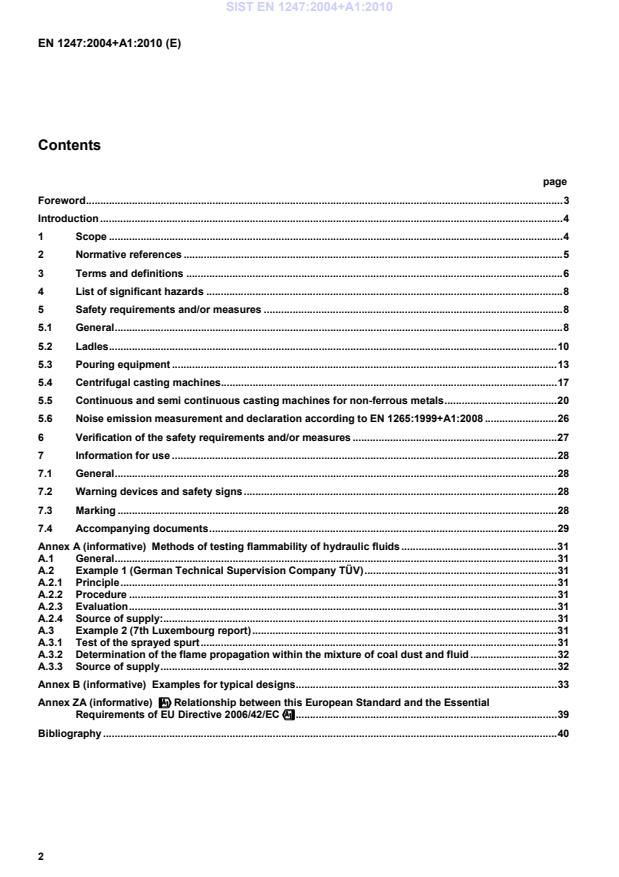
Methods of testing flammability of hydraulic fluids . 31A.1General . 31A.2Example 1 (German Technical Supervision Company TÜV) . 31A.2.1Principle . 31A.2.2Procedure . 31A.2.3Evaluation . 31A.2.4Source of supply:. 31A.3Example 2 (7th Luxembourg report) . 31A.3.1Test of the sprayed spurt . 31A.3.2Determination of the flame propagation within the mixture of coal dust and fluid . 32A.3.3Source of supply . 32Annex B (informative)
Examples for typical designs . 33Annex ZA (informative)
!!!!Relationship between this European Standard and the Essential Requirements of EU Directive 2006/42/EC"""" . 39Bibliography . 40
!". This document has been prepared under a mandate given to CEN by the European Commission and the European Free Trade Association, and supports essential requirements of EU Directive(s). For relationship with EU Directives, see informative Annex ZA, which is an integral part of this document. According to the CEN/CENELEC Internal Regulations, the national standards organizations of the following countries are bound to implement this European Standard: Austria, Belgium, Bulgaria, Croatia, Cyprus, Czech Republic, Denmark, Estonia, Finland, France, Germany, Greece, Hungary, Iceland, Ireland, Italy, Latvia, Lithuania, Luxembourg, Malta, Netherlands, Norway, Poland, Portugal, Romania, Slovakia, Slovenia, Spain, Sweden, Switzerland and United Kingdom.
protection against: mechanical hazards, movement of machines and material, ejection of parts, material, liquids and gases, implosion, structural instability; electric hazards; explosion, fire, scalds, contact with hot parts (burns), gases and flames;
noise and vibration; thermal radiation; harmful by-products, poisoning, pollution of operators air; impact; deterioration of worker’s health; shearing; SIST EN 1247:2004+A1:2010
CLC/TR 50404, Electrostatics — Code of practice for the avoidance of hazards due to static electricity"
3 Terms and definitions !For the purposes of this document, the terms and definitions given in EN ISO 12100-1:2003 and the following apply. NOTE Definitions used in EN and ISO standards referred to in this European Standard are also valid for this European Standard." SIST EN 1247:2004+A1:2010
NOTE This equipment consists of a vessel, heated or unheated, with or without a metering device, for delivery of molten metal to the mould by gravity, or by applying air or inert gas pressure or vacuum onto the surface of the molten metal in the vessel. Heated vessels are also called furnaces. 3.4 centrifugal casting machine machine to manufacture tubes by centrifugal means. The axis of the tube coincides with the axis of rotation and where the thickness of the tube is determined by the dimensions of the mould and the amount of metal cast (see Annex B, Figure B.7). The said axis may be horizontal or oblique (vertical axis of rotation is excluded, see Clause 1) 3.5 continuous and semi continuous casting machine machine which provides a regular or intermittent supply of liquid metal (for this document: non-ferrous metal only, see Clause 1) to a mould, from where the solidified product leaves under gravity or by powered means
Depending upon the direction in which the bar leaves the tundish distinction is made between vertical and horizontal casting. Additionally, distinction is made between continuous and semi continuous casting as to whether the bar is cast without interruption and cut with a flying saw or is stopped after reaching a determined length and is then completely removed from the equipment. In the non-ferrous metals sector the semi continuous casting process is mainly used. 3.6 metering monitoring the amount of liquid metal 3.7 breakthrough refractory lining of the pouring equipment is penetrated by molten metal 3.8 stripping/ejection of castings removal of the centrifugal casting from the mould after solidification ! 3.9 dynamically self-locking a gearbox meets the requirements for dynamically self-locking, if the geared motor drive stops immediately or after a short time after switch-off even if a torque is acting at the output side of the gearbox NOTE Dynamic automatic locking is only possible at very high transmissions ratios and in low drive speed ranges." SIST EN 1247:2004+A1:2010
Column 1 Column 2 Column 3 Column 4 !!!!Significant hazard"""" Hazardous situation Safety measures according to the mentioned standards AND/OR specific measures Verifi-cation !!!!5.2 Ladles 5.2.1 Fire, burns Discharge of molten metal or slag due to unexpected tilting in case of:
manual tilting A locking device shall be provided for ladles tilted by hand. D, F
A dynamically self-locking gear (see 3.9) shall be installed by the manufacturer which is fitted to the forces under operation. D, F
motorised tilting The tilting movement shall be activated only when energised through a hold-to-run control device placed where its operator has a full and unrestricted view of the ladle and the receiver vessel/container. F
centre of gravity above trunnion axis, e. g., by modification of nominal capacity by the user (e. g., use of smaller linings) For steel pouring ladles with ancillary lifting facility only: the manufacturer shall ensure by design that the centre of gravity is always below the trunnion axis at all operating conditions. the manufacturer shall advise the user in the Information for use that any modification shall maintain this condition V, D
Loss of self-locking of gear in case of gear ladles that are tilted by hand. For worm gear units only: Lubricants shall not prevent the self-locking of ladle gears. V, D
For all gear units: information for use shall include advice that the gear function shall be checked before every shift (see 7.4.2) and to secure dynamically self-locking, the output torque and the braking torque shall be measured at regular intervals (as a general rule every two years) at a test stand and the results shall be documented. V, D
Insufficient connection between
trunnion and ladle (centre band) Ladle trunnions shall be inserted con-centrically into the centre band and positively fixed by welding with the centre band and the inner surface of the ladle. V, D SIST EN 1247:2004+A1:2010
vessel and bottom Ladle bottoms shall be designed as flat head or (circular) blank if necessary with reinforcing ribs (see Annex B, Figures B.3, and B.4). V, D
Qualified welders and certificated procedures shall be used (see EN 287-1, EN ISO 14731, EN ISO 3834-1). V, D
Breakage of gear parts. Ladle gearing shall be designed to withstand the calculated and foreseen dynamic loads during lifting and transportation. V, D
Information for use shall include advice that impacts to the gear shall be prevented (see 7.4.2). V
Breakthrough of the ladle and unexpected discharge of molten metal. Information for use shall include advice that the ladle shall only be used after refractory material has been applied in accordance with the refractory manufacturer’s instruc-tions. V
Unexpected discharge from a bottom pouring ladle caused by unintended actuation of the stopper rod equipment. The stopper rod equipment (see Annex B, Figure B.2) shall be designed to prevent unintended or accidental actuation, e.g., by a mechanical locking device. D, F
Information for use shall include advice about the need to inspect and renew the stopper at necessary intervals. V, D 5.2.2 Explosion, burns Moisture existing in the lining of the ladle. Vents shall be provided for certain types of linings. V, D
Information for use shall include a note that the lining shall be heated and the moisture shall be removed in accordance with the refractory manufacturer's instructions (see 7.4.2). V, D
Bottom pouring ladles Information for use should advise the user that pouring zones and ladle filling areas in which bottom pouring ladles are used should have provisions to accommodate molten metal leakage (e. g., sand pits, pit moulds). V, D 5.2.3 Impact, burns Unexpected upset of hanger or ladle. Ladles shall be provided with devices to prevent ladle turning e.g., by a locking pin or mechanical latch. Such a device shall only be unlocked immediate before pouring. V, D SIST EN 1247:2004+A1:2010
Hoisted ladle falling caused by break, tear out and wear of parts of the ladle and hanger. The manufacturer shall draw-up a static calculation for every ladle. The maximum operating load shall be calculated with a safety factor of at least 2. Dh
Protection of hanger against radiant heat shall be provided, e. g., by a heat shield (see Annex B, Figure B.1). V, D
The manufacturer and welders shall be certified for welding conditions on this equipment (see EN 287-1, EN ISO 14731, EN ISO 3834-1). V
Welding that requires special treatment shall be done prior to the final heat treatment if appropriate. V
Information for use shall provide instructions that
before each use there shall be visual inspections for apparent deficiencies such as missing parts, corrosion, deformation and points of visible overheating of the material and in particular the self-locking of the gear and V, D
at regular intervals (as a general rule every two years) there shall be inspections of all stressed components of the assembly by qualified personnel for
cracks, wear, corrosion, deformation, distortion, missing parts, points of visible overheating and loss of self-locking of the gear.
Stressed components are:
hangers and hanger connections, supporting arms of hanger, tilt gear parts and supporting parts of the ladle exposed to radiation or direct heat;
hanger connections and gear fittings stressed by mechanical vibrations during transport;
strengthening bands of ladle walls and bottom that may be weakened by corrosion and
trunnions.
Detection for cracks shall be performed by a proven non-destructive test method, e.g., magnetic particle inspection process, ultrasonic or equivalent methods. The results of the tests shall be recorded. M, D 5.2.4 Burns, impact Transport by fork-lift truck (not on public highway). Ladles slipping from the forks of a fork-lift truck. If the ladle is intended to be transported by a fork-lift truck it shall be fitted with means for lifting and a mechanical locking device between ladle and fork-lift truck. V, D 5.2.5 Burns, fumes If liquid metal is treated with magnesium there is a risk of spattering and/or delayed reactions. The space for treatment ladles shall be enclosed during treatment to prevent spattering of liquid metal. V, D
Information for use shall include information to provide means to remove toxic or reaction fumes and how to protect area open to personnel against spattering of liquid metal, e. g., by shields and to provide PPE. V, D 5.2.6 Noise Only for empty ladles re-tilted by compressed air motor Information for use shall include information to wear PPE. V, D" 5.3
Pouring equipment !deleted text" 5.3.1 Lack of stability Unintended tilting during tilting or in a tilt stop position due to any cause. Provide by design: hold-to-run control device. The tilting movement shall be activated only when energised through a hold-to-run control device, placed where its operator has a full and unrestricted view of the ladle and the receiver vessel/container and
V, D
controlled non-return valves or direc-tional valves (directly attached at the hydraulic cylinder) which turn off inde-pendently in case of pressure drop or V, D
mechanically operated jacks (by hand, hydraulics, spring or gravity) and V, D SIST EN 1247:2004+A1:2010
device for manual re-tilting and V, D
control system to provide means due to malfunction (see 5.3.12) V, D 5.3.2 Crushing, shearing During tilting or movement of equipment. Design safety distances, grids, guards, trip devices V, D 5.3.3 Burns Metal eruptions caused by:
excess pressure in the vessel or metal level below the minimum heel level required to maintain the siphon effect or Pressure limitation and display for minimum heel level of the vessel (see Annex B, !Figure B.5") V, D Fixed guards (see EN 953) V, D
damaged siphon refractories losing the siphon effect or Covers or lids on filling gate and pouring spout and V, D
cracks in the refractories. Protective walls and roofing over operators desk. V, D
Information for use shall provide information about PPE, warning signs (see EN 61310-1; -2) and fault alarms. instructions that equipment shall only be used in accordance with the refractory manufacturers' instructions (see !7.4.3"). V, D
cooling water coming into contact with liquid metal; leakage of liquid metal into moist furnace pit; use of equipment with refractory lining not fully dried. Monitoring (preferably automatic) of refractory lining in case of electric heated pouring equipment; D
Protection of cooling pipes and hoses and V, D
Where applicable, any furnace pit has to be designed such that water can flow off freely in case of damaged pipes and hoses and that no ground water can enter (see !7.4.3"); V, D
Information for use shall include a note that the lining shall be heated and the moisture shall be removed in accordance with the refractory manufacturer's instructions (see !7.4.3"). V, D
Information for use shall indicate the need for PPE (see !7.4.3"). V, D SIST EN 1247:2004+A1:2010
Overfilling of the pouring equipment causes flow out of molten metal. Provide means such as automatic pressure relief if maximum permissible level in the pouring spout or pressure limit value inside or the pouring equipment has been exceeded. V, D Design to include provisions to re-tilt the pouring equipment to the neutral position, if necessary by manual means or auxiliary means. V, D 5.3.4 Fire or explo-sions or burns If burner flame extinguishes the fuel may enter the vessel and suddenly ignite. See 5.2.6, 5.3.6 and 5.4.6 of
!EN 746-2:2010". V Ejection of molten material from the vessel. Design of equipment to prevent uncon-trolled release of treatment gases. D
Information for use shall contain instructions on training of personnel (see !7.4.3") and shall indicate the need for personal protective clothing (see !7.4.2"). V, D
When producing spheroidal graphite cast iron, magnesium vapour ignites in air when it discharges. Guard close to the pipes and valves where flammable gases could escape from the equipment. V, D
Uncontrolled release and igni-tion of hydraulic fluids. Pipework and hoses for hydraulic fluids shall be protected against mechanical and thermal damage by the use of covers, shielding etc. and fixing means such as ducts and channels and V, D
Hydraulic equipment shall be suitable for use with fire resistant hydraulic fluids (see ISO 7745 and Annex A). V, D
Information for use shall include advice, that hydraulic fluids which contain poly-chlorinated bi phenyls (P.C.B.) and poly-chlorinated tri phenyls (P.C.T.) shall not be used (see !7.4.2"). V, D 5.3.5 Burns and scalds When there is cooling water failure, formation of vapour in cooling pipes and hoses can cause explosion danger. Provide standby emergency cooling in case there is cooling water failure. NOTE This provision should be made by agreement between the manufacturer and the user. D 5.3.6 Explosions When there is a generation of explosive dusts or gases in a confined space, heat caused by, e. g., welding or hot gases can create an explosion when escaping, or a furnace door is opened. Design of equipment to prevent these generations. D SIST EN 1247:2004+A1:2010
Provide explosion reliefs where applicable. D Information for use shall indicate the need for a control procedure to prevent this situation, e. g., work permits for danger zones for preventative maintenance (see !7.4.4") or repairs. V, D 5.3.7 Thermal radiation Burns by contact or close proximity to hot parts during, e. g., deslagging; changing the stopper rod, or metal level control electrode; pouring spout replace-ment; maintenance; opening the slag door; opening the cover; inductor replacement. Information for use shall indicate the need for: Protective screens; Warning signs (see EN 60310-1; -2); Wearing personal protective clothing when potentially exposed and
Protection of operators work place, if applicable. V, D 5.3.8 Light radiation Glare causing: disorientation; defective vision. Design of equipment to prevent this condition. V Information for use shall indicate the need for: Warning notices in danger zones (see EN 60310-1; -2); Using antiglare glasses where appli-cable (see !7.4.3"). V, D 5.3.9 Inhalation, ingestion of harmful dusts and fumes Deliberate or accidental use of potentially harmful operational process materials, e. g., chloride, fluoride, cadmium, lead, nickel. Adequate exhaust ventilation shall be provided, or operating manual shall include the need for its provision and maintenance (see !7.4.3", !EN 626-1" and EN 626-2). V, D 5.3.10 Crushing, shearing, cutting or severing, en-tanglement, drawing, trapping, impact, friction, or burns Intended or unintended ac-tuation of machine move-ments. Unexpected movements or failure of the normal retaining or drive system whether mechanical, electrical, hydraulic or pneumatic. Cooling water failure According to EN 1037 and
!EN ISO 13849-1" the control system shall ensure that automatic restart is prevented and re-actuation of the start control is always required to initiate powered movement following, e. g., any change of mode, selection of optional function, a system re-set, guard interlock interruption, restoration of adequate pressure or voltage or correction of a system failing. D SIST EN 1247:2004+A1:2010
Heat radiation or excessive temperature causes failure of electric isolation. Inadequate connections and conductors. Adjacent metallic parts under the effect of induced currents See 13 of !EN 60519-1:2003" V 5.3.12 Malfunction Impossibility of stopping the tilting in the best possible condition Emergency stop device(s) in accordance with !EN ISO 13850". V, D Stop category 1 (9.2.2 of
!EN 60204-1:2006") shall be provided for the tilting movement of a pouring vessel to prevent flow-out of molten metal in tilting position. V, D Emergency switching off device: Push-button operated switches shall be used (see 10.8.2 of
!EN 60204-1:2006"). V, D 5.3.13 Electrical shock, fire Electrostatic discharge !According to CLC/TR 50404" V 5.4
Centrifugal casting machines 5.4.1 Crushing, impact Stripping/ejection of castings. Design of the machine:
Control panel shall be remote from danger zone; D Provision of interlocking guards with guard locking conforming to EN 1088 (see Annex B, Figure B.7). V, D
Disintegration of parts of the die due to centrifugal force, e. g., die-lockings. Strength of the die and die-locking. D Information for use shall provide instructions of intended use, e.g., speed limits (rpm) corresponding to the strength of the die and pressure limits. V, D
Uncontrolled over-speed of the drive (electronic controlled) Limiting of the speed (rpm) by proximity switches. D
Mechanical rail guided cross transport of castings. Design equipment to prevent trapping of persons so that movements of the equip-ment do not cause danger. D SIST EN 1247:2004+A1:2010
Dies moving along pouring spouts and approaching end stops. Provide safety distances by location of parts, according to EN 349. V, D, M
Ejection or falling of the die from the bearing rollers. Design to prevent ejection or falling of die (see Annex B, Figure B.8), e. g. fixed guides; restraining pieces. D 5.4.2 Burns, impact, crushing Machine integrated controlled tilting of the ladle, manually initiated. The tilting movement shall be activated only when energised through a hold-to-run control device, placed where its operator has a full and unrestricted view of the ladle and the receiver vessel/container. D 5.4.3 Burns Discharge of molten metal due to disintegration of parts (see also 5.4.1); unintended loosening of die-lockings during rotation of the die; unintended machine stop Centrifugally applied die-lockings shall be designed to prevent them loosening during casting operation. Die-lockings that are actuated pneumatically, hydraulically or electro-mechanically shall be designed in such a way that unlocking cannot occur before the solidification of the liquid metal. D
The emergency stop device for the die rotation movement (see 5.4.9) shall correspond to 9.2.2 of
!EN 60204-1:2006", !stop category 1", and !EN ISO 13850". D, F
Shifting of movable and slew-able pouring spouts. It shall be possible to fix pouring spouts positively prior to start of casting operation, e. g., by locking clamps. V, D, F
Ejecting metal during rotation of the die. Coverings to protect against burns caused by ejection of molten metal shall be included and conformed to fixed guard (see 5.3.2.1 of EN ISO 12100-2:2003 and EN 953) with an inserted movable guard (see 5.3.2.3 of EN ISO 12100-2:2003, EN 953 and EN 1088). V, D 5.4.4 Fire, burns Uncontrolled release and igni-tion of hydraulic fluids Pipework and hoses for hydraulic fluids shall be protected against mechanical and thermal damage by the use of covers, shielding etc. and fixing means such as ducts and channels and V, D
Hydraulic equipment shall be suitable for use with fire resistant hydraulic fluids (see ISO 7745 and Annex A) and V, D SIST EN 1247:2004+A1:2010
Information for use shall include advice, that hydraulic fluids which contain poly-chlorinated bi phenyls (P.C.B.) and poly-chlorinated tri phenyls (P.C.T.) shall not be used (see !7.4.2"). V, D 5.4.5 Noise Noise during operation. Noise reduction by design
...