

EN 14044:2014
(Main)High rise aerial appliances for fire and rescue service use - Turntable ladders with sequential movements - Safety and performance requirements and test methods
General Information
- Abstract
1.1 This European Standard specifies the safety and performance requirements and test methods applicable to turntable ladders with sequential movements of classes 18, 24, 30 and > 30 to 56, as defined in 3.13, under the control of fire-fighters and intended for fire fighting and rescuing people.
NOTE This European Standard is intended to be used in conjunction with EN 1846–1, EN 1846–2 and EN 1846–3.
Turntable ladder vehicles comprise a chassis, bodywork and a powered extending structure unit in the form of a ladder with or without a rescue cage.
Turntable ladder vehicles covered by this European Standard have a self-propelled chassis, the motor of which supplies the power necessary for the operation of the ladder. They do not permit operational movements to be made simultaneously.
1.2 This European Standard deals with the technical safety requirements to minimize the hazards listed in Clause 4 which can arise during commissioning, operational use, routine checking and maintenance of turntable ladders when carried out in accordance with the specifications given by the manufacturer or the manufacturer's authorized representative.
1.3 This European Standard deals with the use of turntable ladder vehicles within an ambient temperature range from −15 °C to +35 °C and with a wind velocity on the ladder set ≤ 12,5 m/s. Additional measures can be necessary for use outside this range. Special designs for use under special climatic conditions should be agreed between the manufacturer and the purchaser. Any additional requirements are outside the scope of the standard.
1.4 This European Standard does not deal with the design of a standard automotive chassis with regard to hazards resulting from or due to use as a road vehicle.
1.5 This European Standard is not applicable to turntable ladder vehicles with sequential movements which are manufactured before the date of publication of this European Standard by CEN.
- Status
- Published
- Publication Date
- 14-Jan-2014
- Withdrawal Date
- 30-Jul-2014
- Technical Committee
- CEN/TC 192 - Fire service equipment
- Drafting Committee
- CEN/TC 192/WG 4 - High rise aerial appliances
- Current Stage
- 9060 - Closure of 2 Year Review Enquiry - Review Enquiry
- Start Date
- 02-Sep-2019
- Completion Date
- 02-Sep-2019
- Directive
- 2006/42/EC - Directive 2006/42/EC of the European Parliament and of the Council of 17 May 2006 on machinery, and amending Directive 95/16/EC (recast)OJ Ref: C, C 220 OJ Date: 11-Jul-2014

Overview - EN 14044:2014 (Turntable ladders with sequential movements)
EN 14044:2014 is the European standard that specifies safety and performance requirements and test methods for high‑rise aerial appliances used by fire and rescue services - specifically turntable ladders with sequential (semi‑automatic) movements. It covers ladder classes 18, 24, 30 and >30 up to 56 and applies to self‑propelled turntable ladder vehicles where the vehicle engine supplies ladder power and operational movements are not permitted simultaneously. The standard addresses commissioning, operational use, routine checks and maintenance performed according to manufacturer instructions, within ambient conditions of −15 °C to +35 °C and wind velocity on the ladder set ≤ 12.5 m/s.
Key topics and technical requirements
- Scope and applicability: Classes, vehicle configuration (self‑propelled chassis), exclusions (not applicable to automotive chassis design or units manufactured before publication).
- Safety hazards & risk minimization: Identification of significant hazards and required technical measures during use, commissioning and maintenance.
- Stability and strength: Static and dynamic stability requirements related to jacking width, supported boundaries and residual forces; strength and fatigue analysis of ladder and structural components.
- Functional requirements & controls: Control console requirements, safety‑related control systems compliant with EN ISO 13849‑1 (performance levels), indicators for ladder length/extension/elevation, audible low‑battery alarm and emergency stop logic for rescue cage controls.
- Rescue cage & access: Design, load limits, anchoring points for fall‑protection equipment, guard‑rail and door locking requirements, and limits on number of persons.
- Verification & test methods: Stability tests, strength tests, operating time, functional tests and acceptance/verification procedures (Annexes with test tables and examples).
- Information for use: Required instruction handbook content, marking, maintenance schedules and commissioning guidance.
- Operational limits: Nominal reach tables, overall dimensions, maximum gross laden mass and environmental use conditions.
Practical applications - who uses this standard
- Manufacturers and designers: to design turntable ladders meeting defined safety/performance and to prepare technical documentation and tests.
- Fire and rescue procurement teams: to specify requirements and compare vendor compliance.
- Testing laboratories and certification bodies: to perform stability, strength and functional tests and verification.
- Fleet managers / maintenance personnel: for commissioning, inspection, routine checks and maintenance schedules.
- Regulators and safety officers: to assess conformity with EU machinery requirements and safe operational limits.
Related standards and references
- Intended to be used in conjunction with EN 1846‑1, EN 1846‑2, EN 1846‑3 (fire service vehicle standards).
- References functional safety standards such as EN ISO 13849‑1 and other EN/ISO machinery and electrical standards cited in the normative references.
Keywords: EN 14044:2014, turntable ladders, aerial appliances, fire service, safety and performance requirements, test methods, jacking width, rescue cage, stability tests, EN 1846.
Relations
- Effective Date
- 22-Jan-2014
- Effective Date
- 25-Aug-2026
- Effective Date
- 09-Feb-2026
- Effective Date
- 09-Feb-2026
- Effective Date
- 28-Jan-2026
- Effective Date
- 28-Jan-2026
- Effective Date
- 28-Jan-2026
- Effective Date
- 28-Jan-2026
- Effective Date
- 28-Jan-2026
- Refers
EN 1846-1:2011 - Firefighting and rescue service vehicles - Part 1: Nomenclature and designation - Effective Date
- 28-Jan-2026
- Effective Date
- 28-Jan-2026
- Effective Date
- 28-Jan-2026
- Effective Date
- 28-Jan-2026
- Effective Date
- 28-Jan-2026
Get Certified
Connect with accredited certification bodies for this standard

CIS Institut d.o.o.
Personal Protective Equipment (PPE) certification body. Notified Body NB-2890 for EU Regulation 2016/425 PPE.

Kiwa BDA Testing
Building and construction product certification.
Kmetijski inštitut Slovenije
Agricultural Institute of Slovenia. Soil testing, plant health, agricultural product analysis.
Sponsored listings
Frequently Asked Questions
EN 14044:2014 is a standard published by the European Committee for Standardization (CEN). Its full title is "High rise aerial appliances for fire and rescue service use - Turntable ladders with sequential movements - Safety and performance requirements and test methods". This standard covers: 1.1 This European Standard specifies the safety and performance requirements and test methods applicable to turntable ladders with sequential movements of classes 18, 24, 30 and > 30 to 56, as defined in 3.13, under the control of fire-fighters and intended for fire fighting and rescuing people. NOTE This European Standard is intended to be used in conjunction with EN 1846–1, EN 1846–2 and EN 1846–3. Turntable ladder vehicles comprise a chassis, bodywork and a powered extending structure unit in the form of a ladder with or without a rescue cage. Turntable ladder vehicles covered by this European Standard have a self-propelled chassis, the motor of which supplies the power necessary for the operation of the ladder. They do not permit operational movements to be made simultaneously. 1.2 This European Standard deals with the technical safety requirements to minimize the hazards listed in Clause 4 which can arise during commissioning, operational use, routine checking and maintenance of turntable ladders when carried out in accordance with the specifications given by the manufacturer or the manufacturer's authorized representative. 1.3 This European Standard deals with the use of turntable ladder vehicles within an ambient temperature range from −15 °C to +35 °C and with a wind velocity on the ladder set ≤ 12,5 m/s. Additional measures can be necessary for use outside this range. Special designs for use under special climatic conditions should be agreed between the manufacturer and the purchaser. Any additional requirements are outside the scope of the standard. 1.4 This European Standard does not deal with the design of a standard automotive chassis with regard to hazards resulting from or due to use as a road vehicle. 1.5 This European Standard is not applicable to turntable ladder vehicles with sequential movements which are manufactured before the date of publication of this European Standard by CEN.
1.1 This European Standard specifies the safety and performance requirements and test methods applicable to turntable ladders with sequential movements of classes 18, 24, 30 and > 30 to 56, as defined in 3.13, under the control of fire-fighters and intended for fire fighting and rescuing people. NOTE This European Standard is intended to be used in conjunction with EN 1846–1, EN 1846–2 and EN 1846–3. Turntable ladder vehicles comprise a chassis, bodywork and a powered extending structure unit in the form of a ladder with or without a rescue cage. Turntable ladder vehicles covered by this European Standard have a self-propelled chassis, the motor of which supplies the power necessary for the operation of the ladder. They do not permit operational movements to be made simultaneously. 1.2 This European Standard deals with the technical safety requirements to minimize the hazards listed in Clause 4 which can arise during commissioning, operational use, routine checking and maintenance of turntable ladders when carried out in accordance with the specifications given by the manufacturer or the manufacturer's authorized representative. 1.3 This European Standard deals with the use of turntable ladder vehicles within an ambient temperature range from −15 °C to +35 °C and with a wind velocity on the ladder set ≤ 12,5 m/s. Additional measures can be necessary for use outside this range. Special designs for use under special climatic conditions should be agreed between the manufacturer and the purchaser. Any additional requirements are outside the scope of the standard. 1.4 This European Standard does not deal with the design of a standard automotive chassis with regard to hazards resulting from or due to use as a road vehicle. 1.5 This European Standard is not applicable to turntable ladder vehicles with sequential movements which are manufactured before the date of publication of this European Standard by CEN.
EN 14044:2014 is classified under the following ICS (International Classification for Standards) categories: 13.220.10 - Fire-fighting. The ICS classification helps identify the subject area and facilitates finding related standards.
EN 14044:2014 has the following relationships with other standards: It is inter standard links to EN 14044:2005+A1:2009, ISO 8598:1996, EN 60529:1991, EN 61310-1:2008, EN 1846-3:2013, EN ISO 13849-1:2023, CEN/TS 15989:2015, EN ISO 12100:2010, EN ISO 4413:2010, EN 1846-1:2011, EN 1846-2:2009+A1:2013, EN ISO 7731:2008, EN ISO 13850:2015, EN 2286:1989. Understanding these relationships helps ensure you are using the most current and applicable version of the standard.
EN 14044:2014 is associated with the following European legislation: EU Directives/Regulations: 2006/42/EC; Standardization Mandates: M/396. When a standard is cited in the Official Journal of the European Union, products manufactured in conformity with it benefit from a presumption of conformity with the essential requirements of the corresponding EU directive or regulation.
EN 14044:2014 is available in PDF format for immediate download after purchase. The document can be added to your cart and obtained through the secure checkout process. Digital delivery ensures instant access to the complete standard document.
Standards Content (Sample)
2003-01.Slovenski inštitut za standardizacijo. Razmnoževanje celote ali delov tega standarda ni dovoljeno.Hubrettungsfahrzeuge für die Feuerwehr - Drehleitern mit aufeinander folgenden (sequenziellen) Bewegungen (Halbautomatik-Drehleitern) - Sicherheits- und Leistungsanforderungen sowie PrüfverfahrenMoyens élévateurs aériens pour la lutte contre l'incendie - Echelles pivotantes à mouvements séquentiels - Prescriptions de sécurité et des performances et méthodes d'essaisHigh rise aerial appliances for fire service use - Turntable ladders with sequential movements - Safety and performance requirements and test methods97.145LestveLadders13.220.10Gašenje požaraFire-fightingICS:Ta slovenski standard je istoveten z:EN 14044:2014SIST EN 14044:2014en,fr,de01-marec-2014SIST EN 14044:2014SLOVENSKI
STANDARDSIST EN 14044:2005+A1:20091DGRPHãþD
EUROPEAN STANDARD NORME EUROPÉENNE EUROPÄISCHE NORM
EN 14044
January 2014 ICS 13.220.10 Supersedes EN 14044:2005+A1:2009English Version
High rise aerial appliances for fire and rescue service use - Turntable ladders with sequential movements - Safety and performance requirements and test methods
Moyens élévateurs aériens à l'usage des services de secours et de lutte contre l'incendie - Échelles pivotantes à mouvements séquentiels - Prescriptions de sécurité et de performances et méthodes d'essais
Hubrettungsfahrzeuge für die Feuerwehr - Drehleitern mit aufeinander folgenden (sequenziellen) Bewegungen (Halbautomatik-Drehleitern) - Sicherheits- und Leistungsanforderungen sowie Prüfverfahren This European Standard was approved by CEN on 26 October 2013.
CEN members are bound to comply with the CEN/CENELEC Internal Regulations which stipulate the conditions for giving this European Standard the status of a national standard without any alteration. Up-to-date lists and bibliographical references concerning such national standards may be obtained on application to the CEN-CENELEC Management Centre or to any CEN member.
This European Standard exists in three official versions (English, French, German). A version in any other language made by translation under the responsibility of a CEN member into its own language and notified to the CEN-CENELEC Management Centre has the same status as the official versions.
CEN members are the national standards bodies of Austria, Belgium, Bulgaria, Croatia, Cyprus, Czech Republic, Denmark, Estonia, Finland, Former Yugoslav Republic of Macedonia, France, Germany, Greece, Hungary, Iceland, Ireland, Italy, Latvia, Lithuania, Luxembourg, Malta, Netherlands, Norway, Poland, Portugal, Romania, Slovakia, Slovenia, Spain, Sweden, Switzerland, Turkey and United Kingdom.
EUROPEAN COMMITTEE FOR STANDARDIZATION
COMITÉ EUROPÉEN DE NORMALISATION EUROPÄISCHES KOMITEE FÜR NORMUNG
CEN-CENELEC Management Centre:
Avenue Marnix 17,
B-1000 Brussels © 2014 CEN All rights of exploitation in any form and by any means reserved worldwide for CEN national Members. Ref. No. EN 14044:2014 ESIST EN 14044:2014
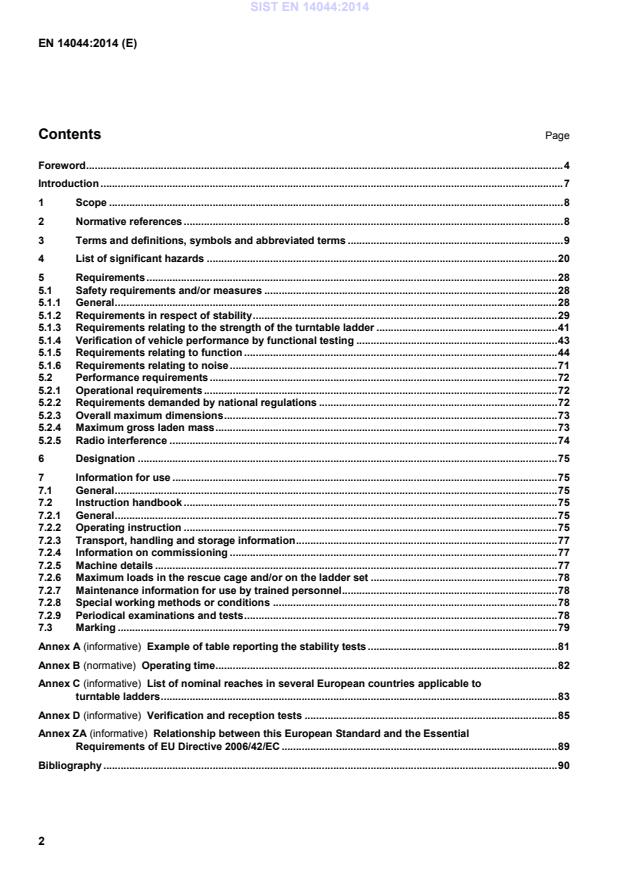
Foreword . 4 Introduction . 7 1 Scope . 8 2 Normative references . 8 3 Terms and definitions, symbols and abbreviated terms . 9 4 List of significant hazards . 20 5 Requirements . 28 5.1 Safety requirements and/or measures . 28 5.1.1 General . 28 5.1.2 Requirements in respect of stability . 29 5.1.3 Requirements relating to the strength of the turntable ladder . 41 5.1.4 Verification of vehicle performance by functional testing . 43 5.1.5 Requirements relating to function . 44 5.1.6 Requirements relating to noise . 71 5.2 Performance requirements . 72 5.2.1 Operational requirements . 72 5.2.2 Requirements demanded by national regulations . 72 5.2.3 Overall maximum dimensions . 73 5.2.4 Maximum gross laden mass . 73 5.2.5 Radio interference . 74 6 Designation . 75 7 Information for use . 75 7.1 General . 75 7.2 Instruction handbook . 75 7.2.1 General . 75 7.2.2 Operating instruction . 75 7.2.3 Transport, handling and storage information . 77 7.2.4 Information on commissioning . 77 7.2.5 Machine details . 77 7.2.6 Maximum loads in the rescue cage and/or on the ladder set . 78 7.2.7 Maintenance information for use by trained personnel . 78 7.2.8 Special working methods or conditions . 78 7.2.9 Periodical examinations and tests . 78 7.3 Marking . 79 Annex A (informative)
Example of table reporting the stability tests . 81 Annex B (normative)
Operating time . 82 Annex C (informative)
List of nominal reaches in several European countries applicable to turntable ladders . 83 Annex D (informative)
Verification and reception tests . 85 Annex ZA (informative)
Relationship between this European Standard and the Essential Requirements of EU Directive 2006/42/EC . 89 Bibliography . 90 SIST EN 14044:2014
f) verification of static stability and dynamic stability revised; g) functional requirements revised; h) requirement for audible alarm at low battery voltage added; i) verification relating to the strength of the turntable ladder at the boundary of free-standing use with .max revised; j) verification relating to the strength of the turntable ladder at the boundary of free-standing use (without or with rescue cage) deleted; k) verification relating to turntable ladders constructed to be operated only with the rear axle suspension fully or partially locked revised; l) requirement that loaded ladder shall maintain its position for 10 min with a variation less than 150 mm added; m) at least 100 mm difference at relative positions for the suspension locking device added; n) static tilt angle added; SIST EN 14044:2014
3.1 turntable ladder with sequential movements machine with an extending structure in the form of a ladder set mounted on a self-propelled chassis with no restriction on the angle of the slewing movement, where the chassis engine supplies the power necessary for operation and where there are no provisions for simultaneous operation of the different movements 3.2 turntable ladder equipment entire assembly of the mobile components mounted on the chassis which can carry at its upper extent, fixed or removable rescue equipment Note 1 to entry: The jacking system is part of the turntable ladder equipment. [SOURCE: EN 14043:2014, 3.2] 3.3 ladder set part of turntable ladder comprising several ladder sections which are connected together so as to extend telescopically [SOURCE: EN 14043:2014, 3.3] 3.4 extended ladder set length L distance between the extreme points of the extended ladder Note 1 to entry: The length is expressed in metres. [SOURCE: EN 14043:2014, 3.4] 3.5 rescue cage fixed or removable complementary device principally used for firefighting, rescuing people and other operational services [SOURCE: EN 14043:2014, 3.5] SIST EN 14044:2014
angle in the transverse direction to the longitudinal axis of the vehicle between the horizontal and the ground surface Note 1 to entry: The angle is expressed in degrees. [SOURCE: EN 14043:2014, 3.7] 3.8 gradient angle
angle in the longitudinal axis of the vehicle between the horizontal and the ground surface Note 1 to entry: The angle is expressed in degrees. [SOURCE: EN 14043:2014, 3.8] 3.9 slewing angle
angle determined cIockwise from the straight ahead position between the longitudinal axis of the vehicle and the longitudinal axis of the last ladder section projection Note 1 to entry: The angle is expressed in degrees. Note 2 to entry: The zero degrees position corresponds to the longitudinal axis of the vehicle facing towards the driver's cab. [SOURCE: EN 14043:2014, 3.9] 3.10 rescue height h vertical height from the horizontal ground surface to the base floor of the rescue cage without loading and in the case of turntable ladders without rescue cage the height of the topmost ladder rung
Note 1 to entry: The length is expressed in metres. [SOURCE: EN 14043:2014, 3.10] SIST EN 14044:2014
l distance from the outer edge of the vehicle to the perpendicular dropped from the outer edge of the base of the rescue cage or the working platform or the projection from the outer edge of the vehicle to perpendicular from the topmost rung Note 1 to entry: The distance is expressed in metres. Note 2 to entry: The measurement is taken at right angles to the longitudinal axis of the vehicle on horizontal terrain without loading. Note 3 to entry: If the jacks extend beyond the maximum width of the vehicle, the distance is measured from the outer edge of the most extended jack. [SOURCE: EN 14043:2014, 3.14] 3.15 nominal rescue projection lN specified horizontal projection at nominal rescue height Note 1 to entry: The projection is expressed in metres and measured in accordance with nominal rescue height (see 3.11). [SOURCE: EN 14043:2014, 3.15] SIST EN 14044:2014
Key l horizontal projection h rescue height 1 to 3 free standing boundary (1 to 3 persons, with rescue cage) 4 supported boundary of use, with rescue cage and without load 5 free standing boundary with 1 person, without rescue cage 6 supported boundary of use, without load and without rescue cage Figure 1 — Example of boundary 3.24 jacking width b distance at right angles between two imaginary parallel lines to be drawn on either side of the central axis of the vehicle at the outer edges of the furthest extended and lowered jacks including base plates
Note 1 to entry: See Figure 2. SIST EN 14044:2014
a)
b) Key b jacking width Figure 2 — Jacking width
[SOURCE: EN 14043:2014, 3.24] 3.25 operating time tR time to reach, from the travel position, the maximum rescue height (at 90° to the longitudinal axis of the chassis) Note 1 to entry: If appropriate the operating time tR includes the time for attaching the rescue cage and making it ready for use with the ladder stabilized at maximum jacking width by the vehicle. [SOURCE: EN 14043:2014, 3.25] 3.26 static stability test verification of a turntable ladder’s ability to resist tipping or rolling over with the ladder set not being permitted to move under load Note 1 to entry: The static stability test is not an overload test. [SOURCE: EN 14043:2014, 3.26] SIST EN 14044:2014
[SOURCE: EN 14043:2014, 3.30.3] SIST EN 14044:2014
Key 1 to X+1 section number A first (upper) section B intermediate sections (second section, third section, etc) C last (lower) section Figure 3 — Designation of ladder set sections 3.37 dead man's device hold to run control device that requires continuous actuation to maintain movement EXAMPLE Foot pedal. [SOURCE: EN 14043:2014, 3.37] 3.38 working position condition of the vehicle after successful jacking and/or levelling when the rescue cage is operational and when it is possible to move/use the ladder set under normal operation [SOURCE: EN 14043:2014, 3.38] 3.39 stabilizing the vehicle stabilization procedure in the area of the under-carriage by extending and lowering of the jacking system left and right with the jacking plates firmly on the ground, according to manufacturer’s instructions, and activation of the ready-to-operate signal for the upper-carriage [SOURCE: EN 14043:2014, 3.39] 3.40 under-carriage components under the slewing ring like subframe, bodywork, jacking system, chassis
[SOURCE: EN 14043:2014, 3.40] SIST EN 14044:2014
upper-carriage components above the subframe like slewing ring, turntable, main control stand and the ladder set [SOURCE: EN 14043:2014, 3.41] 4 List of significant hazards Table 1 describes all the significant hazards, hazardous situations and events, as far as they are dealt with in this European Standard, identified by risk assessment as significant for this type of machinery and which necessitates action to eliminate or reduce the risk. The significant hazards are based on the principles of EN ISO 12100:2010, Annex B. Also shown are the subclause references to the safety requirements and/or protective measures in this document. Table 1 — List of significant hazards No. Hazard Assembly Process/function/ cause Clause/subclause in this European Standard/reference to applicable standards 1 Mechanical hazards 1.1 Crushing hazard Jacks Moving the jacks • 5.1.5.2.11 • 5.1.5.2.15 • 5.1.5.5.2 • Clause 7 Pressure of the jacks on the ground • 5.1.5.5.2 • 5.1.5.2.12 • 5.1.5.2.13 • 5.1.5.2.14 • Clause 7 Uncontrolled movement (lifting of the base plate) • 5.1.5.2.14 Suspensions locking device Re-establishing ground contact with the tyres during return to travel position • 5.1.5.2.15 Defect in the suspension locking device on activation • 5.1.5.2.1 • Clause7 Cradle/turret Crushing by the slewing drive mechanism • 5.1.5.7.1 Crushing by the turret in motion • 5.1.5.7.1 • 5.1.5.7.2 Crushing by the cradle in motion • 5.1.5.7.1 SIST EN 14044:2014
Rescue cage Crushing by mobile parts during levelling correction • 5.1.5.4.8 Impact against an obstacle • 5.1.5.4.3 • 5.1.5.4.12 • 5.1.5.4.14 • 5.1.5.5.3 • 5.1.5.5.5 • 5.1.5.8.4 • Clause 7 Fitting/removal of the rescue cage • 5.1.5.4.6 Movement in the rescue cage
• 5.1.5.4.13 Crushing a person outside the rescue cage • 5.1.5.4.12 • 5.1.5.5.3 • 5.1.5.5.4 • 5.1.5.8.1 • Clause 7 1.2 Shearing hazard Cradle/turret Crushing by the cradle in motion • 5.1.5.7.1 Ladder set Crushing between the rungs during extending and housing • 5.1.5.5.3 • 5.1.5.8.1 Rescue cage Crushing by mobile parts during levelling correction • 5.1.5.4.8 Impact against an obstacle • 5.1.5.4.12 • 5.1.5.5.3 • 5.1.5.5.5 1.3 Cutting or severing hazard General
• EN 1846–2 Ladder set Damaged wire ropes • 5.1.5.8.2 1.4 Entanglement hazard General All moving parts • 5.1.5.7.1 • 5.1.5.8.2 • Clause 7 SIST EN 14044:2014
• 5.1.5.5.6 1.6 Impact hazard Jacks Movement of the jacks • 5.1.5.5.2 • 5.1.5.2.14 • Clause 7 Put pressure on the ground • 5.1.5.5.2 • 5.1.5.2.14 • Clause 7 Neutralization suspension Re-establishing ground contact with the tyres during return to travel position • 5.1.5.2.15 Cradle/turret Crushing by the turret in motion • 5.1.5.5.3 • 5.1.5.7.1 • 5.1.5.7.2 • Clause 7 Rescue cage Impact against an obstacle • 5.1.5.4.3 • 5.1.5.4.12 • 5.1.5.4.14 • 5.1.5.5.3 • 5.1.5.5.5 • 5.1.5.8.4 • Clause 7 1.8 Friction or abrasion hazard General Moving parts • 5.1.5.7.3 Couplings, etc. • 5.1.5.9 SIST EN 14044:2014
Contact of persons with live parts (direct contact) Overall design General measures • EN 60204–1 2.2 Contact of persons with parts which have become live under faulty conditions (indirect contact) Overall design General measures • EN 60204–1 2.3 Approach to live parts under high voltage Ladder set Contact with overhead electrical conductors • 5.1.5.2.10 • Clause 7 2.4 Electrostatic hazard General
• 5.1.5.2.10 4 Hazard generated by noise 4.1 Interference with speech communication, acoustic signals, hearing loss, tinnitus, etc. Communications
• 5.1.5.8.4 Ladder Normal operation • 5.1.5.8.4 • 5.1.6 • EN 1846–2:2009+A1:2013, Annexes E and F 6 Hazards generated by radiation 6.1 Low frequency, radio frequency radiation, micro waves General Normal operation • 5.1.5.16 8 Hazards generated by neglecting ergonomic principles in turntable ladder with sequential movement design 8.1 Unhealthy postures or excessive effort Ladder set Rescue • access ladder/chassis deck • access ladder/ground level • emergency operating system
• 5.1.5.8.3
• 5.1.5.11.2
• 5.1.2.3.4 Rescue cage Fitting/removal • 5.1.5.4.6 SIST EN 14044:2014
General
• Clause 7 8.4 Inadequate local lighting Control consoles Use of consoles • 5.1.5.5.1 Access to the main control console Use of consoles • 5.1.5.5.3 8.5 Mental overload and underload, stress All movements Use of controls without error • 5.1.5.5.1 • 5.1.5.5.2 • 5.1.5.5.3 • 5.1.5.5.5 8.6 Human error, human behaviour
Control consoles
Operating controls/reading of information • 5.1.5.5 • Clause 7 10 Unexpected start-up, unexpected overrun/overspeed (or any similar malfunction)
The whole ladder General operation • 5.1.5 Intentional stop or failure of the main power supply • 5.1.2.3.4 • 5.1.2.3.5 10.3 External influences on electrical equipment
Electrical circuits and components General measures • 5.1.5.10 10.5 Errors in the software Software
• 5.1.5.12 13 Failure
...