

EN 12649:2008+A1:2011
(Main)Concrete compactors and smoothing machines - Safety
- Abstract
1.1 This document applies to concrete compactors and smoothing machines as defined in Clause 3 and illustrated in Annex A and Annex B.
This standard also applies for hand-held motor-operated concrete vibrators as defined in EN 60745-2-12:2003, but with the additional safety requirements for electronically controlled systems as defined in this standard (see 5.2.1.2).
1.2 This document does not deal with auxiliary equipment which provides the energy for internal and external vibrators, e.g. air compressors, hydraulic power sources and voltage transformers. This document does not apply to remote-controlled or portable smoothing machines and self-acting (robotic) smoothing machines.
1.3 This document deals with all significant hazards, hazardous situations and events relevant to concrete com-pactors and smoothing machines, when they are used as intended and under the conditions foreseen by the manu-facturer (see Clause 4). This document specifies the appropriate technical measures to eliminate or reduce risks aris-ing from the significant hazards.
This standard also includes measures to consider reasonably foreseeable misuse.
1.4 This document is not applicable to machines which are manufactured before the date of publication of this document by CEN.
- Status
- Published
- Publication Date
- 12-Jul-2011
- Withdrawal Date
- 30-Jan-2012
- Technical Committee
- CEN/TC 151 - Construction equipment and building material machines - Safety
- Drafting Committee
- CEN/TC 151/WG 8 - Concrete preparation and handling equipment - Safety
- Current Stage
- 9093 - Decision to confirm - Review Enquiry
- Start Date
- 24-Jun-2015
- Completion Date
- 30-Sep-2026
- Directive
- 2006/42/EC - Directive 2006/42/EC of the European Parliament and of the Council of 17 May 2006 on machinery, and amending Directive 95/16/EC (recast)OJ Ref: C, C 338 OJ Date: 18-Nov-2011

Overview
EN 12649:2008+A1:2011 is a CEN safety standard for concrete compactors and smoothing machines. It defines the scope, hazard analysis and technical safety measures for internal and external vibrators, vibrating beams and smoothing machines when used as intended (including reasonably foreseeable misuse). The standard also applies to hand‑held motor‑operated concrete vibrators referenced in EN 60745-2-12, with added requirements for electronically controlled systems. EN 12649 supports compliance with the EU Machinery Directive (2006/42/EC) and includes illustrations and dimensional guidance in annexes.
Key topics and technical requirements
The standard focuses on eliminating or reducing significant hazards through design, verification and documentation. Key topics include:
- Risk assessment and scope: Coverage of significant hazards, hazardous situations and events relevant to concrete compactors and smoothing machines; Type C standard precedence over more general (A/B) standards.
- Machine categories: Definitions for internal vibrators, external vibrators, vibrating beams, smoothing machines and portable units; exclusions (e.g., auxiliary power sources, remote‑controlled or robotic smoothing machines).
- Safety measures:
- Mechanical safeguards - prevention of drawing‑in and guarding of rotating or transmission parts.
- Electrical safety and EMC - protection against direct/indirect contact, durability against dust/wetness and requirements for electronically controlled systems.
- Noise and vibration - measures addressing hearing risk and hand‑arm vibration exposure.
- Hydraulic/pneumatic risks - high‑pressure fluid injection hazards.
- Fire protection and thermal hazards - hot parts and combustion engine risks.
- Stability and mounting - fixation, lifting and towing points for external vibrators and beams.
- Verification and testing: Procedures to verify that safety requirements and protective measures are effective.
- Information for use: Required marking, warning signs, and comprehensive operation and maintenance manuals for safe use.
- Annexes: Illustrations (Annex A) and dimensions of smoothing machines (Annex B); Annex ZA links to the Machinery Directive.
Applications and who uses this standard
EN 12649 is used by:
- Manufacturers and designers of concrete compactors, smoothing machines and vibrators to design compliant, safe equipment.
- Safety engineers and risk assessors to evaluate machine hazards and specify protective measures.
- Test laboratories and conformity assessors for verification and CE marking.
- Purchasers, rental companies and site managers to ensure supplied machines meet safety requirements.
- Regulators and inspectors for compliance checks on construction equipment safety.
Practical applications include machine design, guarding specification, EMC and electrical design, noise/vibration control, user documentation and conformity assessment for CE marking.
Related standards
Relevant references cited in EN 12649 include:
- EN ISO 12100 (general machine safety principles)
- EN 60204-1 (electrical equipment of machines)
- EN 60745-2-12 (hand‑held concrete vibrators)
- EN ISO standards on noise and vibration, EMC and safety components
Keywords: EN 12649, concrete compactors safety, smoothing machines safety, CEN standard, hand‑held concrete vibrators, construction equipment safety, machinery risk assessment.
Relations
- Effective Date
- 19-Jan-2023
- Effective Date
- 18-Jan-2023
- Effective Date
- 25-Aug-2026
- Effective Date
- 25-Aug-2026
- Effective Date
- 25-Aug-2026
- Effective Date
- 09-Feb-2026
- Effective Date
- 09-Feb-2026
- Effective Date
- 09-Feb-2026
- Effective Date
- 09-Feb-2026
- Effective Date
- 09-Feb-2026
- Effective Date
- 09-Feb-2026
- Effective Date
- 28-Jan-2026
- Effective Date
- 28-Jan-2026
- Effective Date
- 28-Jan-2026
- Effective Date
- 28-Jan-2026
Get Certified
Connect with accredited certification bodies for this standard

DIBt (Deutsches Institut für Bautechnik)
German Institute for Building Technology.
DIN CERTCO
DIN Group product certification.

Aboma Certification B.V.
Specialized in construction, metal, and transport sectors.
Sponsored listings
Frequently Asked Questions
EN 12649:2008+A1:2011 is a standard published by the European Committee for Standardization (CEN). Its full title is "Concrete compactors and smoothing machines - Safety". This standard covers: 1.1 This document applies to concrete compactors and smoothing machines as defined in Clause 3 and illustrated in Annex A and Annex B. This standard also applies for hand-held motor-operated concrete vibrators as defined in EN 60745-2-12:2003, but with the additional safety requirements for electronically controlled systems as defined in this standard (see 5.2.1.2). 1.2 This document does not deal with auxiliary equipment which provides the energy for internal and external vibrators, e.g. air compressors, hydraulic power sources and voltage transformers. This document does not apply to remote-controlled or portable smoothing machines and self-acting (robotic) smoothing machines. 1.3 This document deals with all significant hazards, hazardous situations and events relevant to concrete com-pactors and smoothing machines, when they are used as intended and under the conditions foreseen by the manu-facturer (see Clause 4). This document specifies the appropriate technical measures to eliminate or reduce risks aris-ing from the significant hazards. This standard also includes measures to consider reasonably foreseeable misuse. 1.4 This document is not applicable to machines which are manufactured before the date of publication of this document by CEN.
1.1 This document applies to concrete compactors and smoothing machines as defined in Clause 3 and illustrated in Annex A and Annex B. This standard also applies for hand-held motor-operated concrete vibrators as defined in EN 60745-2-12:2003, but with the additional safety requirements for electronically controlled systems as defined in this standard (see 5.2.1.2). 1.2 This document does not deal with auxiliary equipment which provides the energy for internal and external vibrators, e.g. air compressors, hydraulic power sources and voltage transformers. This document does not apply to remote-controlled or portable smoothing machines and self-acting (robotic) smoothing machines. 1.3 This document deals with all significant hazards, hazardous situations and events relevant to concrete com-pactors and smoothing machines, when they are used as intended and under the conditions foreseen by the manu-facturer (see Clause 4). This document specifies the appropriate technical measures to eliminate or reduce risks aris-ing from the significant hazards. This standard also includes measures to consider reasonably foreseeable misuse. 1.4 This document is not applicable to machines which are manufactured before the date of publication of this document by CEN.
EN 12649:2008+A1:2011 is classified under the following ICS (International Classification for Standards) categories: 91.220 - Construction equipment. The ICS classification helps identify the subject area and facilitates finding related standards.
EN 12649:2008+A1:2011 has the following relationships with other standards: It is inter standard links to EN 12649:2008, EN 12649:2008/FprA1, ISO 6405-1:2004, ISO 3795:1989, ISO 8598:1996, HD 22.4 S4:2004, EN 60745-2-12:2003, EN 60529:1991, EN 60309-2:1999, HD 60364-4-41:2007, EN 60309-1:1999, EN 982:1996, EN ISO 3744:2010, EN 2286:1989, EN 574:1996. Understanding these relationships helps ensure you are using the most current and applicable version of the standard.
EN 12649:2008+A1:2011 is associated with the following European legislation: EU Directives/Regulations: 2006/42/EC; Standardization Mandates: M/396. When a standard is cited in the Official Journal of the European Union, products manufactured in conformity with it benefit from a presumption of conformity with the essential requirements of the corresponding EU directive or regulation.
EN 12649:2008+A1:2011 is available in PDF format for immediate download after purchase. The document can be added to your cart and obtained through the secure checkout process. Digital delivery ensures instant access to the complete standard document.
Standards Content (Sample)
2003-01.Slovenski inštitut za standardizacijo. Razmnoževanje celote ali delov tega standarda ni dovoljeno.Stroji za komprimiranje in glajenje betona - VarnostMaschinen zum Verdichten und Glätten von Beton - SicherheitsanforderungenCompacteurs à béton et talocheuses - Prescriptions de sécuritéConcrete compactors and smoothing machines - Safety91.220Gradbena opremaConstruction equipmentICS:Ta slovenski standard je istoveten z:EN 12649:2008+A1:2011SIST EN 12649:2008+A1:2011en,fr,de01-september-2011SIST EN 12649:2008+A1:2011SLOVENSKI
STANDARD
EUROPEAN STANDARD NORME EUROPÉENNE EUROPÄISCHE NORM
EN 12649:2008+A1
July 2011 ICS 91.220 Supersedes EN 12649:2008English Version
Concrete compactors and smoothing machines - Safety
Compacteurs à béton et talocheuses - Prescriptions de sécurité
Maschinen zum Verdichten und Glätten von Beton - Sicherheitsanforderungen This European Standard was approved by CEN on 21 March 2008 and includes Amendment 1 approved by CEN on 19 May 2011.
CEN members are bound to comply with the CEN/CENELEC Internal Regulations which stipulate the conditions for giving this European Standard the status of a national standard without any alteration. Up-to-date lists and bibliographical references concerning such national standards may be obtained on application to the CEN-CENELEC Management Centre or to any CEN member.
This European Standard exists in three official versions (English, French, German). A version in any other language made by translation under the responsibility of a CEN member into its own language and notified to the CEN-CENELEC Management Centre has the same status as the official versions.
CEN members are the national standards bodies of Austria, Belgium, Bulgaria, Croatia, Cyprus, Czech Republic, Denmark, Estonia, Finland, France, Germany, Greece, Hungary, Iceland, Ireland, Italy, Latvia, Lithuania, Luxembourg, Malta, Netherlands, Norway, Poland, Portugal, Romania, Slovakia, Slovenia, Spain, Sweden, Switzerland and United Kingdom.
EUROPEAN COMMITTEE FOR STANDARDIZATION
COMITÉ EUROPÉEN DE NORMALISATION EUROPÄISCHES KOMITEE FÜR NORMUNG
Management Centre:
Avenue Marnix 17,
B-1000 Brussels © 2011 CEN All rights of exploitation in any form and by any means reserved worldwide for CEN national Members. Ref. No. EN 12649:2008+A1:2011: ESIST EN 12649:2008+A1:2011
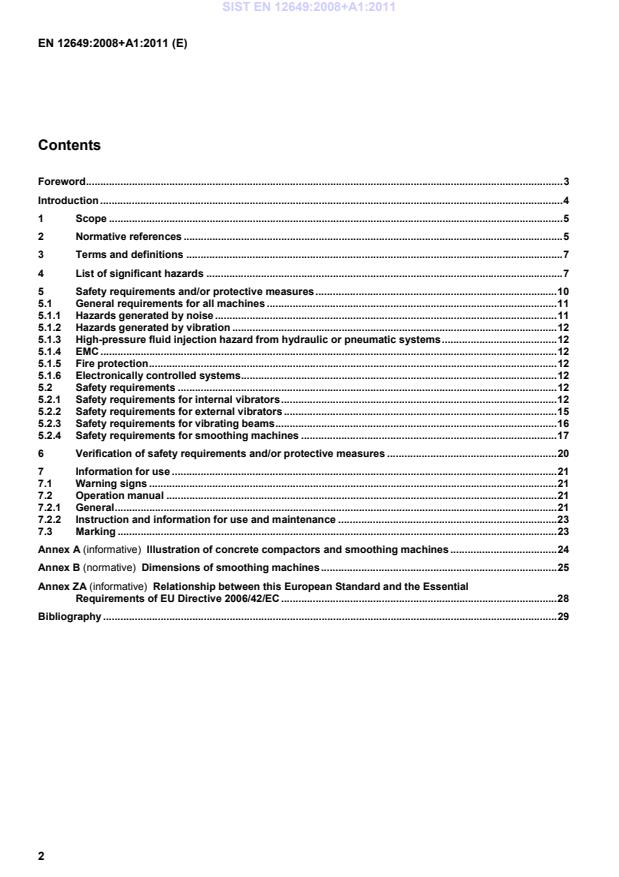
Illustration of concrete compactors and smoothing machines . 24Annex B (normative)
Dimensions of smoothing machines . 25Annex ZA (informative)
Relationship between this European Standard and the Essential
Requirements of EU Directive 2006/42/EC . 28Bibliography . 29 SIST EN 12649:2008+A1:2011
1 Scope 1.1 This document applies to concrete compactors and smoothing machines as defined in Clause 3 and illus-trated in Annex A and Annex B. This standard also applies for hand-held motor-operated concrete vibrators as defined in EN 60745-2-12:2003, but with the additional safety requirements for electronically controlled systems as defined in this standard (see 5.2.1.2). 1.2 This document does not deal with auxiliary equipment which provides the energy for internal and external vibrators, e.g. air compressors, hydraulic power sources and voltage transformers. This document does not apply to remote-controlled or portable smoothing machines and self-acting (robotic) smoothing machines. 1.3 This document deals with all significant hazards, hazardous situations and events relevant to concrete com-pactors and smoothing machines, when they are used as intended and under the conditions foreseen by the manu-facturer (see Clause 4). This document specifies the appropriate technical measures to eliminate or reduce risks arising from the significant hazards. This standard also includes measures to consider reasonably foreseeable misuse. 1.4 This document is not applicable to machines which are manufactured before the date of publication of this document by CEN. 2 Normative references The following referenced documents are indispensable for the application of this document. For dated references, only the edition cited applies. For undated references, the latest edition of the referenced document (including any amendments) applies. !deleted text" EN 500-1:2006, Mobile road construction machinery — Safety — Part 1: Common requirements EN 574:1996, Safety of machinery — Two-hand control devices — Functional aspects — Principles for design EN 614-1:2006, Safety of machinery — Ergonomic design principles — Part 1: Terminology and general principles !deleted text" EN 953:1997, Safety of machinery — Guards — General requirements for the design and construction of fixed and movable guards EN 982:1996, Safety of machinery — Safety requirements for fluid power systems and their components — Hy-draulics EN 983:1996, Safety of machinery — Safety requirements for fluid power systems and their components — Pneu-matics EN 1032:2003, Mechanical vibration — Testing of mobile machinery in order to determine the vibration emission value EN 1050:1996, Safety of machinery — Principles for risk assessment EN 13309:2000, Construction machinery — Electromagnetic compatibility of machines with internal electrical power supply SIST EN 12649:2008+A1:2011
(ISO 3744:2010)" !EN ISO 4871:2009", Acoustics — Declaration and verification of noise emission values of machinery and equipment (ISO 4871:1996) !EN ISO 11201:2010, Acoustics — Noise emitted by machinery and equipment — Determination of emission sound pressure levels at a work station and at other specified positions in an essentially free field over a reflecting plane with negligible environmental corrections (ISO 11201:2010)" !EN ISO 11688-1:2009", Acoustics — Recommended practice for the design of low-noise machinery and equipment — Part 1: Planning (ISO/TR 11688-1:1995) EN ISO 12100-1:2003, Safety of machinery — Basic concepts, general principles for design — Part 1: Basic termi-nology, methodology (ISO 12100-1:2003) EN ISO 12100-2:2003, Safety of machinery — Basic concepts, general principles for design — Part 2: Technical principles (ISO 12100-2:2003) EN ISO 13732-1:2006, Ergonomics of the thermal environment — Methods for the assessment of human re-sponses to contact with surfaces — Part 1: Hot surfaces (ISO 13732:2006) EN ISO 13849-1:2006, Safety of machinery — Safety-related parts of control systems — Part 1: General principles for design (ISO 13849-1:2006) !EN ISO 13857:2008, Safety of machinery — Safety distances to prevent hazard zones being reached by upper and lower limbs (ISO 13857:2008)" EN ISO 20643:2005, Mechanical vibration — Hand-held and hand-guided machinery — Principles for evaluation of vibration emission (ISO 20643:2005) ISO 3795:1989, Road vehicles, and tractors and machinery for agriculture and forestry — Determination of burning behaviour of interior materials ISO 6405-1:2004, Earth-moving machinery — Symbols for operator controls and other displays — Part 1: Common symbols CR 1030-1:1995, Hand-arm vibration — Guidelines for vibration hazards reduction — Part 1: Engineering methods by design of machinery HD 22.4 S4:2004, Cables of rated voltages up to and including 450/750 V and having crosslinked insulation — Part 4: Cords and flexible cables !HD 60364-4-41:2007, Low-voltage electrical installations — Part 4-41: Protection for safety — Protection against electric shock (IEC 60364-4-41:2005, modified)" SIST EN 12649:2008+A1:2011
3 Terms and definitions For the purposes of this document, the definitions given in EN ISO 12100-1:2003 together with the following apply. 3.1 concrete compactor machine which compacts concrete by transmitting vibration for the compaction process, the vibration is produced by internal and/or external vibrators NOTE Internal vibrators, external vibrators and vibrating beams are concrete compactors. 3.2 internal vibrator equipment to produce mechanical vibrations, the vibrators powered by electrical, pneumatic or hydraulic energy transmit vibrations while immersed in the concrete in order to compact it NOTE Internal vibrators include eccentric weight, rotating mass and an internal power source transmitter to turn the eccentric weight shaft. 3.3 external vibrator equipment to produce mechanical vibrations, it transmits the vibration to the form area and into the concrete in or-der to compact the concrete NOTE The external vibrators can be fixed on tables, grates, forms, plates or beams. 3.4 vibrating beam equipment to produce mechanical vibrations, the frame is placed on the concrete and transmits the vibrations into the concrete NOTE The vibrating beams that are described in this standard include frames, vibrators and pull equipment for continuous working. 3.5 smoothing machine motor-powered equipment with rotating tools in order to smooth the unhardened concrete, the machine is pedes-trian-controlled or ride-on-operated NOTE Cabins are not included in the equipment of smoothing machines. 3.6 portable smoothing machine motor-powered smaller equipment with rotating tools in order to smooth unhardened mortar especially on vertical surface, they are hand-held during operation 3.7 self-acting (robotic) smoothing machine smoothing machine that is adjusted for specific operation before starting to work, afterwards it operates automati-cally without control by a person 4 List of significant hazards This clause contains all the significant hazards, hazardous situations and events, as far as they are dealt with in this standard, identified by risk assessment as significant for this type of machinery and which require action to eliminate or reduce the risk. SIST EN 12649:2008+A1:2011
Hazards Locations/circumstances/ consequences See Clause 4.1 List of hazards for internal vibra-tors
4.1.1 Mechanical hazards
4.1.1.1 Drawing-in hazard Unguarded transmission parts Other rotating parts 5.2.1.1 4.1.2 Electrical hazards
4.1.2.1 Electrical contact of persons with lifeparts Direct contact Indirect contact 5.2.1.2 4.1.2.2 External influences on electrical equipment Damage to electrical equipment Dust/wetness 5.2.1.2 4.1.3 Thermal hazards
4.1.3.1 Burns by possible contact with hot parts Combustion engine, hot parts 5.2.1.3 4.1.4 Hazards generated by noise
4.1.4.1 Hearing loss, interference with speech communications and acoustic signals Noise of the engines Noise by vibrating parts 5.1.1 4.1.5 Hazards generated by hand-arm-vibration Eccentric vibrations of the rotating mass 5.1.2 4.1.6 Hazards caused by missing and/or incorrectly positioned safety related measures/ means
4.1.6.1 Safety related devices Holds, lifting and tie-down devices and towing eyes 5.2.1.7 4.2 List of hazards for external vi-brators
4.2.1 Mechanical hazards
5.2.2.1 4.2.1.1 Drawing-in hazard Uncovered power source 5.2.2.1 4.2.1.2 Loss of stability Loosening of the vibrator
5.2.2.1 4.2.2 Electrical hazards
4.2.2.1 Electrical contact of persons with lifeparts Direct contact Indirect contact 5.2.2.2 4.2.2.2 External influences on electrical equipment Damage to electrical equipment Dust/wetness 5.2.2.2 4.2.3 Hazards generated by noise
5.1.2 4.2.3.1 Hearing loss, interference with speech communications and acoustic signals Noise by vibrating parts 5.1.2 4.2.4 Hazards caused by missing and/or incorrectly positioned safety related measures/ means
5.2.2.4 4.2.4.1 Safety related devices Holds, lifting and tie-down devices and towing eyes 5.2.2.4 SIST EN 12649:2008+A1:2011
Hazards Locations/circumstances/ consequences See Clause 4.3 List of hazards for vibrating beams
4.3.1 Mechanical hazards
5.2.3.1 4.3.1.1 Drawing-in hazard Unguarded transmission parts Rotating parts 5.2.3.1 4.3.1.2 Loss of stability Loosening of the vibrator 4.2.1.2 4.3.2 Electrical hazards
4.3.2.1 Electrical contact of persons with lifeparts Direct contact Indirect contact 5.2.3.2 4.3.2.2 External influences on electrical equipment Damage to electrical equipment Dust/wetness 5.2.3.2 4.3.3 Thermal hazard
4.3.3.1 Burns by possible contact with hot parts Combustion engine, hot parts 5.2.3.3 4.3.4 Hazards generated by noise
5.1.1 4.3.4.1 Hearing loss, interference with speech communications and acoustic signals Noise of the engines Noise by vibrating beams 5.1.1 4.3.5 Hazards generated by hand-arm vibration Eccentric vibrations of the rotating mass 5.1.2 4.3.6 Hazards generated by material and substances processed or used by machinery.
4.3.6.1 Hazards from inhalation of harmful gases Inhalation of harmful exhausted gases from combustion engines 5.2.3.6 4.3.7 Hazards caused by missing and/or incorrectly positioned safety related measures/ means
4.3.7.1 Safety related devices Holds, lifting and tie-down devices and towing eyes 5.2.3.7 4.4 List of hazards for smoothing machines
4.4.1 Mechanical hazard
5.2.4.1 4.4.1.1 Cutting or severing hazard Rotating smoothing blades 5.2.4.1 4.4.1.2 Drawing-in hazard Unguarded transmission parts Other rotating parts 5.2.4.1 4.4.1.3 Impact hazard Rotation of the pole after becoming loose 5.2.4.1 4.4.1.4 Loss of stability Collapse of machinery parts during transportation Loosening of the pole or parts of the pole 5.2.4.1 SIST EN 12649:2008+A1:2011
Hazards Locations/circumstances/ consequences See Clause 4.4.1.5 Slip, trip and fall Hazard related to the rotating smoothing blades running into firm objects Running into other persons Smoothing machine with driving seat gets out of control of the driver Unintentional starting of the smooth-ing tools on smoothing machines with driving seats 5.2.4.1 4.4.2 Electrical hazards
4.4.2.1 Electrical contact of persons with lifeparts Direct contact Indirect contact 5.2.4.2 4.4.2.2 External influences on electrical equipment Damage to electrical equipment Dust/wetness 5.2.4.2 4.4.3 Thermal hazards
4.4.3.1 Burns by possible contact with hot parts Combustion engine, hot parts 5.2.4.3 4.4.4 Hazards generated by noise
5.1.1 4.4.4.1 Hearing loss, interference with speech communications and acoustic signals Noise of the engine(s) 5.1.1 4.4.5 Hazards generated by whole-body and hand-arm vibration Vibrations from the engine(s) and smoothing blades 5.1.2 4.4.6 Hazards generated by material and substances processed or used by machinery.
5.2.4.6 4.4.6.1 Hazards from inhalation of harmful gases Inhalation of harmful exhausted gases from combustion engines 5.2.4.6 4.4.7 Hazards caused by missing and/or incorrectly positioned safety related measures/ means
4.4.7.1 Safety related devices Holds, lifting and tie-down devices and towing eyes 5.2.4.7 4.4.7.2 Starting devices Backswing of the hand-starting de-vice of combustion engines Side-slip of the rope during pull-starting Uncontrolled movement of the ma-chine 5.2.4.8 4.4.8 Hazards caused by failure of en-ergy supply
4.4.8.1 Failure of energy supply Unintentional starting by switching-on after interruption of energy supply 5.2.4.1 5 Safety requirements and/or protective measures Machinery shall comply with the safety requirements and/or protective measures of this standard. SIST EN 12649:2008+A1:2011
!EN ISO 13857:2008", EN 614-1:2006, EN 60204-1:2006 and EN 60745-2-12:2003, the manufacturer shall carry out a risk assessment to establish the requirements of these standards which are to be applied. This specific risk assessment according to EN 1050:1996 is part of the general risk assessment of the machine. Where the means reduce the risk is by a safe operation of the machine, the manufacturer shall include in the infor-mation for use details of the safe operation and the elements of training required by the operating personnel. 5.1 General requirements for all machines 5.1.1 Hazards generated by noise 5.1.1.1 Noise reduction at source at the design stage Main noise sources are the main drive and through its vibrating parts. When designing the machinery, the available information and technical measures to control noise at the source shall be taken into account, see for example !EN ISO 11688-1:2009". NOTE EN ISO 11688-2:2000 [1] gives useful information on noise generation mechanism in machinery. 5.1.1.2 Noise reduction by protective devices Noise can be reduced for example by the following means: the use of machinery components with low-noise emis-sion encapsulation. 5.1.1.3 Noise reduction by information Information on residual risk, after technical measures to control noise emission have been implemented, shall be given by the manufacturer, see Clause 7. 5.1.1.4 Operation conditions during test Operation conditions that are typical of nominal operation of concrete compactors and smoothing machines defined in the scope of this standard and providing the highest level shall be chosen. 5.1.1.5 Determination of the A-weighted emission sound pressure level at the control station A-weighted sound pressure levels shall be measured according to !EN ISO 11201:2010" at the control sta-tion(s) at or on the machines. The measurement points shall be at a height of 1,55 m plus/minus 0,075 m. If there is a seat at the control station, the measurement point is at a height of 0,80 m plus/minus 0,05 m above the seat. Positions of the measurement points (control station(s)) and detailed information on the operating conditions during the noise measurement shall be recorded and reported. If the sound pressure level is higher than 70 dB(A), the sound pressure level shall be given in the operating man-ual. If the sound pressure level is lower than 70 dB(A), this fact shall be indicated in the operating manual. Detailed information on operating conditions during the measurement of noise shall be recorded and reported. 5.1.1.6 Determination of the A-weighted sound power level The manufacturer shall give information on noise emission. In the absence of a noise-test code, the following ap-plies: SIST EN 12649:2008+A1:2011
other rotating parts
Enclosing guards shall be designed in accor-dance with EN 953:1997 considering the safety distanc
...