

EN 15650:2010
(Main)Ventilation for buildings - Fire dampers
- Abstract
This European Standard applies to fire dampers that are to be used in conjunction with fire separating elements to maintain fire compartments. This standard specifies requirements and gives reference to the test methods defined for fire dampers, which are intended to be installed in Heating, Ventilating and Air Conditioning (HVAC) installations in buildings. All fire dampers close automatically in response to raised temperatures indicating fire. Details are given for the provision of evaluation of conformity and marking of fire dampers.
To avoid duplication reference is made to a variety of other standards. To this end it is advised to read this standard in conjunction with EN 1366-2 and EN 1363-1 for details of the fire resistance testing and
EN 13501-3 for classification.
Fire dampers meeting requirements of this standard may be considered suitable for both ducted and unducted applications.
This standard has not considered in detail the detrimental and/or corrosive effects that may be caused by chemical processes present in the atmosphere, which are drawn through the system intentionally or inadvertently and therefore does not apply to fire dampers used in such applications. An indication of salt spray corrosion may be determined using the method described in Annex B.
- Status
- Published
- Publication Date
- 06-Apr-2010
- Withdrawal Date
- 30-Oct-2010
- Technical Committee
- CEN/TC 156 - Ventilation for buildings
- Current Stage
- 6060 - Definitive text made available (DAV) - Publishing
- Start Date
- 07-Apr-2010
- Due Date
- 09-May-2010
- Completion Date
- 07-Apr-2010
- Directive
- 305/2011 - Regulation (eu) No 305/2011 of the European Parliament and of the Council of 9 march 2011 laying down harmonised conditions for the marketing of construction products and repealing council directive 89/106/eecOJ Ref: C, C 259 OJ Date: 08-Aug-2014
89/106/EEC - Construction productsOJ Ref: C, C 246 OJ Date: 24-Aug-2011

Overview
EN 15650:2010 - Ventilation for buildings: Fire dampers specifies performance, testing references and conformity requirements for fire dampers used to maintain fire compartmentation in building HVAC systems. The standard covers fire dampers that close automatically in response to elevated temperature (thermal release) and that may also be actuated by an external input. It applies to both ducted and unducted installations and sets out requirements for fire resistance, leakage, durability, marking and documentation.
Key topics and technical requirements
- Fire resistance performance - Fire dampers are evaluated for integrity (E), insulation (I) and leakage (S); classification is to be declared in accordance with EN 13501-3.
- Automatic operation - Dampers must close automatically on receipt of a thermal signal and be capable of maintaining a fully closed safety position to preserve compartmentation.
- Construction and components - Requirements cover construction, actuating mechanisms, sensing/thermal release devices and corrosion protection. Multi-section and insulated variants are addressed.
- Testing methods (referenced) - EN 15650 references fire resistance testing and procedures in standards such as EN 1366‑2 and EN 1363‑1, aerodynamic testing per EN 1751, and thermal release tests (e.g., ISO 10294‑4).
- Durability and cycling - Pre-fire and long-term cycling tests are specified (see Annex C) to demonstrate operational reliability and durability.
- Corrosion considerations - The standard does not fully address aggressive/corrosive atmospheres; Annex B provides a salt-spray exposure test as an indication of corrosion resistance.
- Evaluation of conformity & factory control - Initial type testing, factory production control (FPC), continuous surveillance and test reporting requirements are described for conformity assessment.
- Marking & documentation - Requirements for product marking, installation and maintenance information are specified to support correct selection, installation and lifecycle management.
Applications and typical users
- Applications: Commercial buildings, shopping centres, hospitals, multi-residential buildings and other premises where HVAC penetrations cross fire-separating elements.
- Who uses this standard:
- Manufacturers of fire dampers and HVAC components
- Test houses performing fire resistance and leakage testing
- Building services engineers and consultants specifying fire protection systems
- Installers and maintenance teams responsible for fire compartmentation
- Regulatory authorities and conformity assessors
Related standards (read in conjunction)
- EN 1366-2 (fire damper fire resistance testing)
- EN 1363-1 (general fire resistance test methods)
- EN 13501-3 (classification of fire resistance data)
- EN 1751 (aerodynamic testing of dampers)
- ISO 10294-4 (thermal release tests)
- EN 60068-2-52 (salt mist testing) and EN 60529 (IP code)
- EN ISO 13943 (fire safety vocabulary)
EN 15650:2010 provides the practical framework to select, test and certify fire dampers that reliably protect building compartmentation within HVAC systems. Keywords: EN 15650:2010, fire dampers, ventilation for buildings, HVAC fire protection, fire resistance, leakage classification, thermal release, conformity assessment.
Relations
- Effective Date
- 25-Aug-2026
- Effective Date
- 09-Feb-2026
- Effective Date
- 09-Feb-2026
- Effective Date
- 28-Jan-2026
- Effective Date
- 28-Jan-2026
- Effective Date
- 28-Jan-2026
- Effective Date
- 28-Jan-2026
- Effective Date
- 28-Jan-2026
- Effective Date
- 28-Jan-2026
- Effective Date
- 28-Jan-2026
- Effective Date
- 08-Jun-2022
Get Certified
Connect with accredited certification bodies for this standard

DIBt (Deutsches Institut für Bautechnik)
German Institute for Building Technology.
DIN CERTCO
DIN Group product certification.

Aboma Certification B.V.
Specialized in construction, metal, and transport sectors.
Sponsored listings
Frequently Asked Questions
EN 15650:2010 is a standard published by the European Committee for Standardization (CEN). Its full title is "Ventilation for buildings - Fire dampers". This standard covers: This European Standard applies to fire dampers that are to be used in conjunction with fire separating elements to maintain fire compartments. This standard specifies requirements and gives reference to the test methods defined for fire dampers, which are intended to be installed in Heating, Ventilating and Air Conditioning (HVAC) installations in buildings. All fire dampers close automatically in response to raised temperatures indicating fire. Details are given for the provision of evaluation of conformity and marking of fire dampers. To avoid duplication reference is made to a variety of other standards. To this end it is advised to read this standard in conjunction with EN 1366-2 and EN 1363-1 for details of the fire resistance testing and EN 13501-3 for classification. Fire dampers meeting requirements of this standard may be considered suitable for both ducted and unducted applications. This standard has not considered in detail the detrimental and/or corrosive effects that may be caused by chemical processes present in the atmosphere, which are drawn through the system intentionally or inadvertently and therefore does not apply to fire dampers used in such applications. An indication of salt spray corrosion may be determined using the method described in Annex B.
This European Standard applies to fire dampers that are to be used in conjunction with fire separating elements to maintain fire compartments. This standard specifies requirements and gives reference to the test methods defined for fire dampers, which are intended to be installed in Heating, Ventilating and Air Conditioning (HVAC) installations in buildings. All fire dampers close automatically in response to raised temperatures indicating fire. Details are given for the provision of evaluation of conformity and marking of fire dampers. To avoid duplication reference is made to a variety of other standards. To this end it is advised to read this standard in conjunction with EN 1366-2 and EN 1363-1 for details of the fire resistance testing and EN 13501-3 for classification. Fire dampers meeting requirements of this standard may be considered suitable for both ducted and unducted applications. This standard has not considered in detail the detrimental and/or corrosive effects that may be caused by chemical processes present in the atmosphere, which are drawn through the system intentionally or inadvertently and therefore does not apply to fire dampers used in such applications. An indication of salt spray corrosion may be determined using the method described in Annex B.
EN 15650:2010 is classified under the following ICS (International Classification for Standards) categories: 91.140.30 - Ventilation and air-conditioning systems. The ICS classification helps identify the subject area and facilitates finding related standards.
EN 15650:2010 has the following relationships with other standards: It is inter standard links to ISO 10294-4:2001, EN 60529:1991, EN 60068-2-52:1996, EN 1751:2024, EN 13501-3:2005, EN ISO 5135:2020, EN ISO 13943:2000, EN 1366-2:1999, EN 15882-2:2022, EN 13501-3:2025, prEN 15650. Understanding these relationships helps ensure you are using the most current and applicable version of the standard.
EN 15650:2010 is associated with the following European legislation: EU Directives/Regulations: 305/2011, 89/106/EEC; Standardization Mandates: M/109. When a standard is cited in the Official Journal of the European Union, products manufactured in conformity with it benefit from a presumption of conformity with the essential requirements of the corresponding EU directive or regulation.
EN 15650:2010 is available in PDF format for immediate download after purchase. The document can be added to your cart and obtained through the secure checkout process. Digital delivery ensures instant access to the complete standard document.
Standards Content (Sample)
2003-01.Slovenski inštitut za standardizacijo. Razmnoževanje celote ali delov tega standarda ni dovoljeno.Lüftung von Gebäuden - Brandschutzklappen in LuftleitungenLüftung von Gebäuden - BrandschutzklappenVentilation for buildings - Duct mounted fire dampers91.140.30VLVWHPLVentilation and air-conditioning13.220.01Varstvo pred požarom na splošnoProtection against fire in generalICS:Ta slovenski standard je istoveten z:EN 15650:2010SIST EN 15650:2010en,fr,de01-september-2010SIST EN 15650:2010SLOVENSKI
STANDARD
EUROPEAN STANDARD NORME EUROPÉENNE EUROPÄISCHE NORM
EN 15650
April 2010 ICS 91.140.30 English Version
Ventilation for buildings - Fire dampers
Ventilation dans les bâtiments - Clapets coupe-feu
Lüftung von Gebäuden - Brandschutzklappen This European Standard was approved by CEN on 27 February 2010.
CEN members are bound to comply with the CEN/CENELEC Internal Regulations which stipulate the conditions for giving this European Standard the status of a national standard without any alteration. Up-to-date lists and bibliographical references concerning such national standards may be obtained on application to the CEN Management Centre or to any CEN member.
This European Standard exists in three official versions (English, French, German). A version in any other language made by translation under the responsibility of a CEN member into its own language and notified to the CEN Management Centre has the same status as the official versions.
CEN members are the national standards bodies of Austria, Belgium, Bulgaria, Croatia, Cyprus, Czech Republic, Denmark, Estonia, Finland, France, Germany, Greece, Hungary, Iceland, Ireland, Italy, Latvia, Lithuania, Luxembourg, Malta, Netherlands, Norway, Poland, Portugal, Romania, Slovakia, Slovenia, Spain, Sweden, Switzerland and United Kingdom.
EUROPEAN COMMITTEE FOR STANDARDIZATION
COMITÉ EUROPÉEN DE NORMALISATION EUROPÄISCHES KOMITEE FÜR NORMUNG
Management Centre:
Avenue Marnix 17,
B-1000 Brussels © 2010 CEN All rights of exploitation in any form and by any means reserved worldwide for CEN national Members. Ref. No. EN 15650:2010: ESIST EN 15650:2010
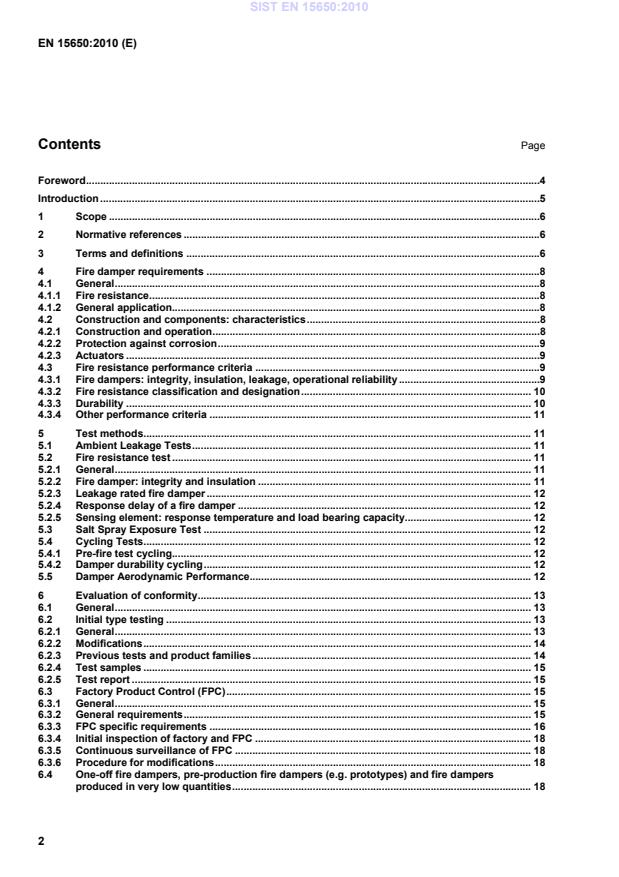
Typical fire damper descriptions . 21Annex B (normative)
Salt spray exposure test . 22Annex C (normative)
Cycling Tests . 23Annex D (informative)
Example of inspection and maintenance procedure . 25Annex E (normative)
Factory Production Control – TEST PLAN . 26Annex ZA (informative)
Relationship between this European Standard and the Essential Requirements of EU Directive (Construction products Directive 89/106/EEC). 27Bibliography . 33 SIST EN 15650:2010
Particular reference should be made to EN 1366-2, which defines the furnace testing associated with these products and EN 13501-3, which provides details on their fire resistance classification. Consideration of any caution notices within any fire testing standards (e.g. health and safety) should be considered before undertaking any fire testing. In addition, the aerodynamic performance of fire dampers should be tested to EN 1751, if such information is to be presented by a manufacturer. The areas for which products supplied to this standard are considered applicable include, but are not limited to: a) commercial premises; b) shopping and retail centres; c) hospitals; d) multi-residential buildings.
To avoid duplication reference is made to a variety of other standards. To this end it is advised to read this standard in conjunction with EN 1366-2 and EN 1363-1 for details of the fire resistance testing and
EN 13501-3 for classification. Fire dampers meeting requirements of this standard may be considered suitable for both ducted and unducted applications. This standard has not considered in detail the detrimental and/or corrosive effects that may be caused by chemical processes present in the atmosphere, which are drawn through the system intentionally or inadvertently and therefore does not apply to fire dampers used in such applications. An indication of salt spray corrosion may be determined using the method described in Annex B. 2 Normative references The following referenced documents are indispensable for the application of this document. For dated references, only the edition cited applies. For undated references, the latest edition of the referenced document (including any amendments) applies. EN 1366-2:1999, Fire resistance tests for service installations — Part 2: Fire dampers EN 1751, Ventilation for buildings — Air terminal devices — Aerodynamic testing of dampers and valves EN 13501-3:2005, Fire classification of construction products and building elements — Part 3: Classification using data from fire resistance tests on products and elements used in building service installations: fire resisting ducts and fire dampers EN 60068-2-52:1996, Environmental testing — Part 2: Tests — Test Kb: Salt mist, cyclic (sodium chloride solution) (IEC 60068-2-52:1996) EN 60529:1991, Degrees of protection provided by enclosures (IP code) (IEC 60529:1989) EN ISO 5135, Acoustics — Determination of sound power levels of noise from air-terminal devices, air-terminal units, dampers and valves by measurement in a reverberation room (ISO 5135:1997) EN ISO 13943:2000, Fire safety — Vocabulary (ISO 13943:2000) ISO 10294-4:2001, Fire resistance tests — Fire dampers for air distribution systems — Part 4: Test of thermal release mechanism 3 Terms and definitions For the purpose of this document, the terms and definitions given in EN ISO 13943:2000 and the following apply. SIST EN 15650:2010
3.2 insulated fire damper fire damper of any type that shows classifiable insulation characteristics when tested 3.3 leakage rated fire damper fire damper of any type that shows classifiable reduced leakage characteristics when tested 3.4 multi-section fire dampers fire damper of any type constructed from smaller units 3.5
fire compartment enclosed space, comprising one or more separate spaces, bounded by elements of construction having a specified fire resistance and intended to prevent the spread of fire (in either direction) for a given period of time NOTE Fire compartment often has regulatory definitions and requirements. The term should not be confused with "room of origin" or "fire cell". 3.6 triggering device device such as a fire detector system, smoke detector or pushbutton, which sends an activating signal to the initiation device 3.7 horizontal mounting position of the damper mounted horizontally when installed in a floor or a ceiling 3.8 vertical mounting position of the damper mounted vertically when installed in a wall 3.9 actuating mechanism mechanism, integral or directly associated with the fire damper which, when initiated by the fire damper release device, which causes the movable component of the damper to change from the "open" to the "closed" position 3.10 thermal release mechanism mechanism, containing/linked to the sensing element, that causes the open damper to release and close in response to elevated temperature 3.11 sensing element device that senses temperature, that causes the thermal release mechanism to activate at a defined elevated temperature SIST EN 15650:2010
4.2.1.2 Nominal activation conditions / Sensitivity 4.2.1.2.1 General The units may be open as part of a heating and ventilating system and shall close only on the receipt of: an elevated temperature; or an external input. Consequently, fire dampers shall: a) move to and maintain their closed position; b) have known leakage characteristics; c) include a thermal release mechanism that causes the damper to close (this may be function of their design), where the thermal release mechanism uses a sensing element which shall be tested in accordance with 5.2.5; d) be fire resisting to maintain compartmentation in closed position. NOTE A facility for manual override to open and close the damper for inspection purposes may be useful and may be included in the product design. This would be of use during commissioning should no power be available. SIST EN 15650:2010
4.2.2 Protection against corrosion Where a manufacturer intends to demonstrate an enhanced salt spray corrosion resistant performance of a fire damper to give a guide on its durability, the test detailed in Annex B shall be performed and the result of these tests declared (i.e. pass/fail). Alternatively, this performance may be made by using of known-corrosion-resistance products, components and treatments and this shall be declared. NOTE Except for products used in a corrosive/contaminated environment, there are no corrosion resistance requirements on products for other uses. 4.2.3 Actuators Actuators shall be constructed and assembled to have the strength and rigidity necessary to perform the design operations to which it may be subjected, without the loosening or displacement of parts, or other serious defects when subjected to the tests referred to in Annex C. Actuators shall be assessed by an IP42 test as a minimum according to EN 60529:1991. Actuator construction shall be such that it does not cause a fire damper to fail the test by flaming outside of the furnace and outside the duct. Where modulating actuators allowing fire dampers to give variable volume control are to be supplied, these shall be subjected to more extensive cycle testing according to Annex C. As smoke is seen as being as, if not more, dangerous than fire, closing actuators may be used that close the unit early as the result of, for instance, a fire alarm. These shall form a part of the tested construction if the actuator is seen as being the prime mover of the unit. If an actuator is associated with a fire damper for everyday use, it should be tested at the same time as the fire damper to ensure that it does not cause the fire damper to fail in any way that may have not been foreseen. 4.3 Fire resistance performance criteria 4.3.1 Fire dampers: integrity, insulation, leakage, operational reliability The assessment of integrity (E) of fire dampers, as one of the fire resistance performance characteristics, shall be made on the basis of: SIST EN 15650:2010
The operational reliability shall be satisfied by the 0 or 50 cycle test at ambient temperature; b) Largest size − leakage (measured continuously) through the damper when closed after 5 min from the start of the fire test; c) Cracks or openings in excess of given dimensions and ignition of a cotton pad and sustained flaming on the non-exposed side at the perimeter of the damper junction with the wall or floor or duct (the penetration). When insulation characteristics (I) are proven for fire dampers, this shall be classified and declared, together with integrity. A smoke leakage performance requirement is described in EN 1366-2 to allow the (S) classification, and this shall be applied, if the damper is intended for the end uses where this performance is required (largest and smallest sizes at ambient and largest size (measured continuously) after 5 min from the start of the fire test). 4.3.2 Fire resistance classification and designation Having achieved the performance criteria in 4.3.1, the fire damper shall be classified and designated in accordance with EN 13501-3. The following shall be declared for each fire damper: a) integrity class "E", integrity and insulation class "EI" (in accordance with EN 13501-3:2005); b) indication(s) of suitability for vertical and/or horizontal use, together with mounting in, or on to, a wall or in a duct passing through a wall or in, or on to, a floor, or in a duct passing through a floor, or both, respectively: as ve and/or ho. The classification is completed by "(i Æ o)", "(o Æ i)", or (i ÅÆ o)" to indicate whether the element has been tested and fulfils the requirements from the inside of outside only or both. In addition, the symbols "ve" and/or "ho" indicate the suitability for vertical and/or horizontal use. The addition of the symbol "S" indicates the satisfaction of an extra restriction on leakage. NOTE
ve or ho should not be taken to imply the direction of operation, nor the orientation of the axis of the damper blade.
EXAMPLE EI 60 (ve) S. 4.3.3 Durability
4.3.3.1 Durability of response delay Following the test described in 5.2.5 demonstrates the durability of response delay by testing the sensing element for response temperature and load bearing capacity. 4.3.3.2 Durability of operational reliability To ensure requirements on this durability aspect, the following proxy characteristics shall be taken in account: The ability of the fire damper to demonstrate its operational reliability over the life of the system shall be determined by the open and closing cycle tests shown in Annex C. SIST EN 15650:2010
5 Test methods 5.1 Ambient Leakage Tests The test method shall be in accordance with EN 1366-2 and/or EN 1751. 5.2 Fire resistance test 5.2.1 General In addition to other requirements in this standard, the fire damper shall be subjected to a furnace mounted fire resistance test. The purpose of the test is to evaluate the ability of a fire damper to prevent fire and smoke spreading from one fire compartment to another through the air ductwork system which may penetrate fire separating walls and floors. The fire damper is attached (directly or remotely via a section of ducting), in/to a supporting construction using a method described in the test standard (EN 1366-2) in a manner generally representative of practice. Fire dampers may be situated within the construction of the wall/floor, attached to the face of the wall/floor, or mounted remotely from it via a section of fire resistant ducting. NOTE Test results are only valid for the tested method of mounting, together with any direct or extended field of application that may be applicable. Tests shall be performed starting with the fire damper in the open position to expose the thermal release mechanism of the fire damper to furnace conditions. Temperature and integrity measurements shall be carried out in various parts of the test construction during the test. The impermeability of the fire damper system shall be measured by direct flow measurements whilst maintaining a constant pressure differential across the closed fire damper of 300 Pa. The leakage rate of dampers requiring an S classification shall be measured at ambient temperature.
It may be necessary to test fire dampers not mounted directly within the centre of the supporting construction, both inside and outside the supporting construction for it to be universally acceptable for that method of installation. 5.2.2 Fire damper: integrity and insulation Equipment and method as fully described in EN 1366-2, the largest size to be manufactured shall be subjected to the closure test, followed by the fire resistance test (EN 1366-2). Units shall be fire tested in the SIST EN 15650:2010
Products may be grouped into families where the results for one or more characteristics from any one product in the family are representative for all other products within that family. NOTE 1 Products may be in different families for different characteristics. NOTE 2 Reference to the test standards should be made to allow the selection of a suitable representative sample. In addition, Type Tests or Initial Type Testing shall be performed for all characteristics included in the standard for which the manufacturer declares performances: at the beginning of the production of a new or modified fire damper design, the raw material or supplier of the components; at the beginning of a new or modified method of production (where this may affect the stated properties); or they shall be repeated for the appropriate characteristic(s), whenever a change occurs in the fire damper design, in the raw material or in the supplier of the components, or in the production process (subject to the definition of a family), which would affect significantly one or more of the characteristics. Where kit components are used whose characteristics have already been determined, by the component manufacturer, on the basis of compliance with other technical specifications, these characteristics need not be reassessed. The specifications of these components shall be documented, as shall the inspection scheme for ensuring their compliance. Products CE marked in accordance with appropriate harmonised European specifications may be presumed to have the performances stated with the CE marking, although this does not replace the responsibility of the fire damper designer to ensure that the fire damper as a whole is correctly designed and its components have the necessary performance values to meet the design. SIST EN 15650:2010
If the manufacturer has the product designed, manufactured, assembled, packed, processed and labelled by subcontracting, FPC of the original manufacturer may be taken into account. However, where subcontracting takes place, the manufacturer shall retain the overall control of the products and ensure that he receives all the information that is necessary to fulfil his responsibilities according to this European Standard. The manufacturer, who subcontracts all of his activities, may in no circumstances pass his responsibilities on to a subcontractor. All the elements, requirements and provisions adopted by the manufacturer shall be documented in a systematic manner in the form of written policies and procedures. This production control system documentation shall ensure a common understanding of conformity evaluation and enable the achievement of the required fire damper characteristics and the effective operation of the production control system to be checked. In each factory the manufacturer may delegate the action to a person having the necessary authority to: a) identify procedures to demonstrate conformity of the product at appropriate stages; b) identify and record any instance of non-conformity; c) identify procedures to correct instances of non conformity. Factory production control, therefore, brings together operational techniques and all measures allowing maintenance and control of the conformity of the product with this European Standard. Its implementation may be achieved by controls and tests on measuring equipment, raw materials and constituents, processes, machines and manufacturing equipment and finished products, including material properties in products, and by making use of the results thus obtained. 6.3.2 General requirements Manufacturers having an FPC system which complies with EN ISO 9001:2008 and/or EN ISO 9002:1994 and which addresses the requirements of this harmonised standard are recognised as satisfying the FPC requirements of the Council Directive 89/106/EEC. Where a manufacturer operates different production lines or units in the same factory, or production lines or units in different factories, and these are covered by a single, overall FPC system, the manufacturer still has to keep control records for each separate production line or unit (and this shall be made a requirement of the technical specification). However, when performing FPC inspections, although the product specific aspects SIST EN 15650:2010
the effective implementation of these procedures and instructions; c) the recording of these operations and their results; d) the use of these results to correct any deviations, repair the effects of such deviations, treat any resulting instances of non-conformity and, if necessary, revise the FPC to rectify the cause of non-conformity. Production control operations include some or all of the following operations: e) the specification and verification of raw materials and constituents; f) the controls and tests to be carried out during manufacture according to a frequency laid down in the prescribed test plan; g) the verifications and tests to be carried out on finished products according to a frequency in accordance with Annex E and adapted to the product and its conditions of manufacture. NOTE Depending on the specific case, it may be necessary to carry out: 1) the operations referred to under b) and c); 2) only the operations under b); or
3) only those under c). The operations under b) centre as much on the intermediate states of the product as on manufacturing machines and their adjustment, and equipment, etc. These controls and tests and their frequency are chosen based on product type and composition, the manufacturing process and its complexity, the sensitivity of product features to variations in manufacturing parameters, etc. With regard to operations under c), where there is no control of finished products at the time that they are placed on the market, the manufacturer shall ensure that packaging, and reasonable conditions of handling and storage, do not damage products and that the product remains in conformity with the technical specification. The appropriate calibrations shall be carried out on defined measuring and test instruments. SIST EN 15650:2010
The equipment shall be used in conformity with the specification or the test reference system to which the specification refers. 6.3.3.2.2 Monitoring of conformity If necessary, monitoring shall be carried out of the conformity of intermediate states of the product and at the main stages of its production. NOTE This monitoring of conformity focuses where necessary on the product throughout the process of manufacture, so that only products having passed the scheduled intermediate controls and tests are dispatched. 6.3.3.2.3 Prescribed test plan Tests shall be in accordance with the test plan in Annex E. 6.3.3.2.4 Test Records The manufacturer should establish and maintain records which provide evidence that the product has been tested. These records should show clearly whether the product has satisfied the defined acceptance criteria. Where the product fails to satisfy the acceptance measures, the provisions for non-conforming products should apply. 6.3.3.2.5 Treatment of products which do not conform If control or test results show that the product does not meet the requirements, for example if the statistical variation of test results exceeds the limits allowed by the technical specification (see Annex E), the necessary corrective action shall immediately be taken. Products or batches not conforming shall be isolated and properly identified. Once the fault has been corrected, the test or verification in question shall be repeated. If products have been delivered before the re
...