

EN 16811-1:2016
(Main)Winter service equipment and products - De-icing agents - Part 1: Sodium chloride - Requirements and test methods
- Abstract
This European Standard specifies the essential requirements of sodium chloride (salt) for spreading on roads for winter maintenance and includes tests of these requirements. The requirements are specified for salt in crystallized form and for salt in solution (brine), which is delivered to the customer.
- Status
- Published
- Publication Date
- 09-Aug-2016
- Withdrawal Date
- 27-Feb-2017
- Technical Committee
- CEN/TC 337 - Winter maintenance and road service area maintenance equipment
- Drafting Committee
- CEN/TC 337/WG 1 - Winter maintenance equipment
- Current Stage
- 9093 - Decision to confirm - Review Enquiry
- Start Date
- 08-Jun-2022
- Completion Date
- 21-Oct-2026

Overview
EN 16811-1:2016 - Winter service equipment and products - De-icing agents - Part 1: Sodium chloride - specifies essential requirements and test methods for sodium chloride used for road winter maintenance. The standard covers both crystallized salt (spreadable solid salt) and sodium chloride solutions (brine) delivered to end users. It is a CEN (European) standard intended to standardize product quality, testing and product descriptions for procurement and operational use across Member States.
Key Topics and Requirements
- Scope and purpose: Defines required properties of sodium chloride for spreading and spraying on roads, facilitating clear product specifications for tenders and purchasing.
- Chemical requirements: Limits and analytical determination methods for NaCl and contaminants (sulfate, heavy metals, etc.).
- Physical properties: Requirements and tests for moisture, sieve analysis (particle size distribution), bulk density, water insoluble matter, and density for brine.
- Additives and safety: Determination of anti-caking agents, and checks for hydrocarbons, total organic carbon (TOC) and pH.
- Sampling and labelling: Normative annexes detail sampling procedures for both packaged and bulk shipments, labelling and distribution of samples, and sampling reports.
- Test methods: Includes validated analytical procedures in Annex C, such as:
- Potentiometric determination of sodium chloride
- Inductively coupled plasma optical emission spectrometry (ICP/OES) for metals and sulfate
- Cold vapour atomic absorption spectrometry for total mercury
- Molecular absorption spectrometry for anti-caking agents
- Product descriptions: Annex A provides standardized product descriptions for sodium chloride and brine to be used in contracts and specifications.
Applications and Who Uses It
- Road authorities and municipalities: Specify compliant salt/brine in procurement and tenders for winter maintenance contracts.
- Salt producers and suppliers: Ensure product conformity for supply contracts and labelling.
- Testing laboratories: Apply the standard’s sampling and analytical methods to verify compliance.
- Winter service contractors & equipment manufacturers: Use product specifications to match application methods (spreading vs. spraying) and storage requirements.
- Environmental and regulatory bodies: Assess contaminants and environmental impact related to de-icing salt use.
Related Standards
EN 16811-1 is part of the EN 16811 series (Part 2: calcium/magnesium chlorides; Part 3: other de-icing agents). Normative references include standards such as EN 932-1 (sampling of aggregates), EN 1235/1236 (sieving and bulk density), EN 1484 (TOC), EN ISO 3696 (laboratory water) and EN ISO 10523 (pH). Compliance supports consistent, quality-controlled winter road maintenance across Europe.
Keywords: EN 16811-1:2016, sodium chloride, de-icing agents, brine, road salt, winter service, test methods, sampling, ICP/OES, mercury analysis, anti-caking agent, sieve analysis.
Relations
- Effective Date
- 25-Aug-2026
- Effective Date
- 25-Aug-2026
- Effective Date
- 25-Aug-2026
- Effective Date
- 25-Aug-2026
- Effective Date
- 25-Aug-2026
- Effective Date
- 25-Aug-2026
- Effective Date
- 25-Aug-2026
- Effective Date
- 25-Aug-2026
- Effective Date
- 25-Aug-2026
- Effective Date
- 28-Jan-2026
- Refers
EN 818-5:1999 - Short link chain for lifting purposes - Safety - Part 5: Chain slings - Grade 4 - Effective Date
- 28-Jan-2026
- Effective Date
- 28-Jan-2026
- Effective Date
- 28-Jan-2026
- Effective Date
- 28-Jan-2026
- Effective Date
- 28-Jan-2026
Get Certified
Connect with accredited certification bodies for this standard

ECOCERT
Organic and sustainability certification.

CIS Institut d.o.o.
Personal Protective Equipment (PPE) certification body. Notified Body NB-2890 for EU Regulation 2016/425 PPE.

Eurofins Food Testing Global
Global leader in food, environment, and pharmaceutical product testing.
Sponsored listings
Frequently Asked Questions
EN 16811-1:2016 is a standard published by the European Committee for Standardization (CEN). Its full title is "Winter service equipment and products - De-icing agents - Part 1: Sodium chloride - Requirements and test methods". This standard covers: This European Standard specifies the essential requirements of sodium chloride (salt) for spreading on roads for winter maintenance and includes tests of these requirements. The requirements are specified for salt in crystallized form and for salt in solution (brine), which is delivered to the customer.
This European Standard specifies the essential requirements of sodium chloride (salt) for spreading on roads for winter maintenance and includes tests of these requirements. The requirements are specified for salt in crystallized form and for salt in solution (brine), which is delivered to the customer.
EN 16811-1:2016 is classified under the following ICS (International Classification for Standards) categories: 13.030.40 - Installations and equipment for waste disposal and treatment; 71.100.45 - Refrigerants and antifreezes. The ICS classification helps identify the subject area and facilitates finding related standards.
EN 16811-1:2016 has the following relationships with other standards: It is inter standard links to ISO 2482:1973, ISO 2483:1973, ISO 649-2:1981, ISO 6227:1982, ISO 758:1976, ISO 2480:1972, ISO 2479:1972, ISO 565:1990, ISO 2591-1:1988, EN ISO 2811-3:2001, EN 818-5:1999, EN 12503-2:2001, EN 1235:1995, EN 15144:2007, EN 1236:1995. Understanding these relationships helps ensure you are using the most current and applicable version of the standard.
EN 16811-1:2016 is available in PDF format for immediate download after purchase. The document can be added to your cart and obtained through the secure checkout process. Digital delivery ensures instant access to the complete standard document.
Standards Content (Sample)
SLOVENSKI STANDARD
01-oktober-2016
Oprema za zimska vzdrževalna dela - Sredstva za odtajanje - 1. del: Natrijev klorid -
Zahteve in preskusne metode
Winter service equipment - De-icing agents - Part 1: Sodium chloride - Requirements
and test methods
Winterdienstausrüstung - Enteisungsmittel - Teil 1: Natriumchlorid - Anforderungen und
Prüfmethoden
Ta slovenski standard je istoveten z: EN 16811-1:2016
ICS:
13.030.40 Naprave in oprema za Installations and equipment
odstranjevanje in obdelavo for waste disposal and
odpadkov treatment
71.100.45 Hladiva in antifrizi Refrigerants and antifreezes
2003-01.Slovenski inštitut za standardizacijo. Razmnoževanje celote ali delov tega standarda ni dovoljeno.
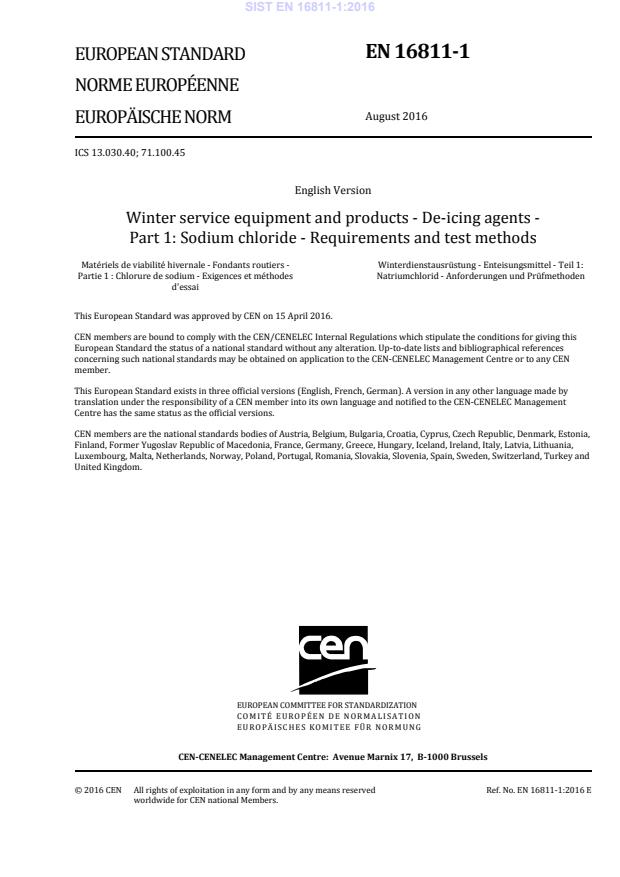
EN 16811-1
EUROPEAN STANDARD
NORME EUROPÉENNE
August 2016
EUROPÄISCHE NORM
ICS 13.030.40; 71.100.45
English Version
Winter service equipment and products - De-icing agents -
Part 1: Sodium chloride - Requirements and test methods
Matériels de viabilité hivernale - Fondants routiers - Winterdienstausrüstung - Enteisungsmittel - Teil 1:
Partie 1 : Chlorure de sodium - Exigences et méthodes Natriumchlorid - Anforderungen und Prüfmethoden
d'essai
This European Standard was approved by CEN on 15 April 2016.
CEN members are bound to comply with the CEN/CENELEC Internal Regulations which stipulate the conditions for giving this
European Standard the status of a national standard without any alteration. Up-to-date lists and bibliographical references
concerning such national standards may be obtained on application to the CEN-CENELEC Management Centre or to any CEN
member.
This European Standard exists in three official versions (English, French, German). A version in any other language made by
translation under the responsibility of a CEN member into its own language and notified to the CEN-CENELEC Management
Centre has the same status as the official versions.
CEN members are the national standards bodies of Austria, Belgium, Bulgaria, Croatia, Cyprus, Czech Republic, Denmark, Estonia,
Finland, Former Yugoslav Republic of Macedonia, France, Germany, Greece, Hungary, Iceland, Ireland, Italy, Latvia, Lithuania,
Luxembourg, Malta, Netherlands, Norway, Poland, Portugal, Romania, Slovakia, Slovenia, Spain, Sweden, Switzerland, Turkey and
United Kingdom.
EUROPEAN COMMITTEE FOR STANDARDIZATION
COMITÉ EUROPÉEN DE NORMALISATION
EUROPÄISCHES KOMITEE FÜR NORMUNG
CEN-CENELEC Management Centre: Avenue Marnix 17, B-1000 Brussels
© 2016 CEN All rights of exploitation in any form and by any means reserved Ref. No. EN 16811-1:2016 E
worldwide for CEN national Members.
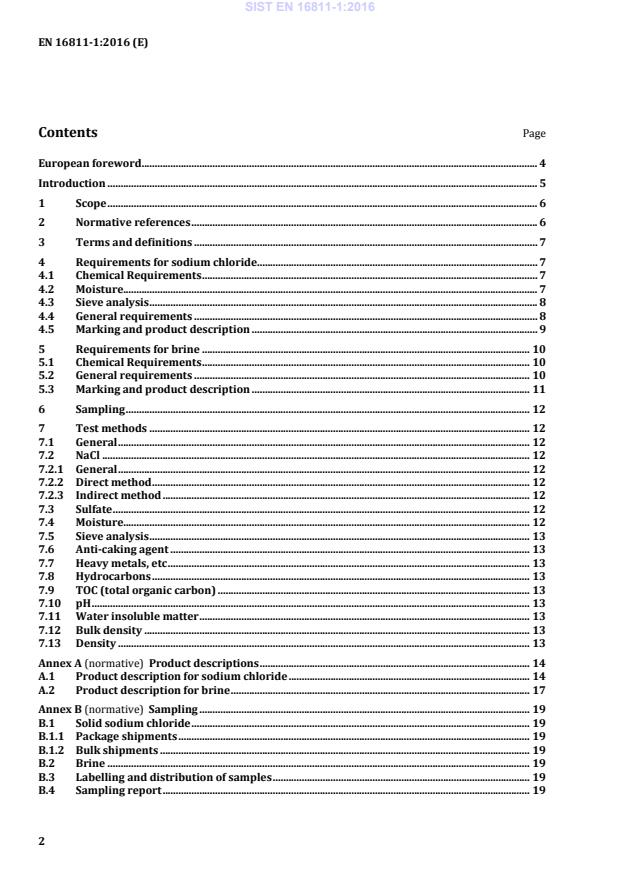
Contents Page
European foreword . 4
Introduction . 5
1 Scope . 6
2 Normative references . 6
3 Terms and definitions . 7
4 Requirements for sodium chloride. 7
4.1 Chemical Requirements . 7
4.2 Moisture. 7
4.3 Sieve analysis . 8
4.4 General requirements . 8
4.5 Marking and product description . 9
5 Requirements for brine . 10
5.1 Chemical Requirements . 10
5.2 General requirements . 10
5.3 Marking and product description . 11
6 Sampling . 12
7 Test methods . 12
7.1 General . 12
7.2 NaCl . 12
7.2.1 General . 12
7.2.2 Direct method . 12
7.2.3 Indirect method . 12
7.3 Sulfate . 12
7.4 Moisture. 12
7.5 Sieve analysis . 13
7.6 Anti-caking agent . 13
7.7 Heavy metals, etc . 13
7.8 Hydrocarbons . 13
7.9 TOC (total organic carbon) . 13
7.10 pH . 13
7.11 Water insoluble matter . 13
7.12 Bulk density . 13
7.13 Density . 13
Annex A (normative) Product descriptions . 14
A.1 Product description for sodium chloride . 14
A.2 Product description for brine . 17
Annex B (normative) Sampling . 19
B.1 Solid sodium chloride . 19
B.1.1 Package shipments . 19
B.1.2 Bulk shipments . 19
B.2 Brine . 19
B.3 Labelling and distribution of samples . 19
B.4 Sampling report . 19
Annex C (normative) Analytical methods . 21
C.1 Determination of sodium chloride (potentiometric method) . 21
C.1.1 Scope and field of application . 21
C.1.2 Principle . 21
C.1.3 Reagents . 21
C.1.4 Apparatus . 22
C.1.5 Sampling and samples . 22
C.1.6 Procedure . 22
C.1.7 Expression of results . 23
C.2 Determination of aluminium, arsenic, cadmium, calcium, chromium, cobalt, copper,
lead, magnesium, nickel, sulfate, zinc (inductively coupled plasma optical emission
spectrometry (ICP/OES)) . 24
C.2.1 General . 24
C.2.2 Principle . 25
C.2.3 Reagents . 25
C.2.4 Apparatus (informative) . 25
C.2.5 Sampling and samples . 26
C.2.6 Procedure . 26
C.2.7 Expression of results . 29
C.2.8 Remarks . 32
C.3 Determination of total mercury (cold vapour atomic absorption spectrometry) . 32
C.3.1 General . 32
C.3.2 Principle . 33
C.3.3 Reagents . 33
C.3.4 Apparatus (informative) . 34
C.3.5 Procedure . 35
C.3.6 Expression of results . 36
C.4 Determination of anti-caking agent (molecular absorption spectrometry) . 38
C.4.1 General . 38
C.4.2 Principle . 39
C.4.3 Reagents . 39
C.4.4 Apparatus . 39
C.4.5 Sampling and samples . 40
C.4.6 Procedure . 40
C.4.7 Expression of results . 41
Bibliography . 43
European foreword
This document (EN 16811-1:2016) has been prepared by Technical Committee CEN/TC 337 “Road
operation equipment and products”, the secretariat of which is held by AFNOR.
This European Standard shall be given the status of a national standard, either by publication of an
identical text or by endorsement, at the latest by February 2017, and conflicting national standards
shall be withdrawn at the latest by February 2017.
Attention is drawn to the possibility that some of the elements of this document may be the subject of
patent rights. CEN [and/or CENELEC] shall not be held responsible for identifying any or all such patent
rights.
EN 16811, Winter service equipment and products — De-icing agents, is currently composed with the
following parts:
— Part 1: Sodium chloride — Requirements and test methods;
— Part 2: Calcium chloride and Magnesium chloride — Requirements and test methods;
— Part 3: Other solid and liquid de-icing agents — Requirements and test methods [CEN/TS].
According to the CEN-CENELEC Internal Regulations, the national standards organisations of the
following countries are bound to implement this European Standard: Austria, Belgium, Bulgaria,
Croatia, Cyprus, Czech Republic, Denmark, Estonia, Finland, Former Yugoslav Republic of Macedonia,
France, Germany, Greece, Hungary, Iceland, Ireland, Italy, Latvia, Lithuania, Luxembourg, Malta,
Netherlands, Norway, Poland, Portugal, Romania, Slovakia, Slovenia, Spain, Sweden, Switzerland,
Turkey and the United Kingdom.
Introduction
De-icing agents are important for the winter maintenance of roads. They can prevent and, in addition to
it, eliminate slippery conditions.
The standard describes the requirements for de-icing salt and their testing methods. The requirements
are different for using, storage and type of distribution (spreading and spraying). These need different
properties.
The aim of this standard is an easy description of the product specifications for tenders and other
purchasing procedures.
1 Scope
This European Standard specifies the essential requirements of sodium chloride (salt) for spreading on
roads for winter maintenance and includes tests of these requirements. The requirements are specified
for salt in crystallized form and for salt in solution (brine), which is delivered to the customer.
2 Normative references
The following documents, in whole or in part, are normatively referenced in this document and are
indispensable for its application. For dated references, only the edition cited applies. For undated
references, the latest edition of the referenced document (including any amendments) applies.
EN 932-1, Tests for general properties of aggregates — Part 1: Methods for sampling
EN 1235, Solid fertilizers — Test sieving (ISO 8397:1988 modified)
EN 1236, Fertilizers — Determination of bulk density (loose) (ISO 3944:1992 modified)
EN 1484, Water analysis — Guidelines for the determination of total organic carbon (TOC) and dissolved
organic carbon (DOC)
EN 15144, Winter maintenance equipment — Terminology — Terms for winter maintenance
EN ISO 3696, Water for analytical laboratory use — Specification and test methods (ISO 3696)
EN ISO 9377-2, Water quality — Determination of hydrocarbon oil index — Part 2: Method using solvent
extraction and gas chromatography (ISO 9377-2)
EN ISO 10523, Water quality — Determination of pH (ISO 10523)
ISO 565, Test sieves — Metal wire cloth, perforated metal plate and electroformed sheet — Nominal sizes
of openings
ISO 649-2, Laboratory glassware — Density hydrometers for general purposes — Part 2: Test methods
and use
ISO 758, Liquid chemical products for industrial use — Determination of density at 20 degrees C
ISO 2479, Sodium chloride for industrial use — Determination of matter insoluble in water or in acid and
preparation of principal solutions for other determinations
ISO 2480, Sodium chloride for industrial use — Determination of sulphate content — Barium sulphate
gravimetric method
ISO 2482, Sodium chloride for industrial use — Determination of calcium and magnesium contents —
EDTA complexometric methods
ISO 2483, Sodium chloride for industrial use — Determination of the loss of mass at 110 degrees C
ISO 2591-1, Test sieving — Part 1: Methods using test sieves of woven wire cloth and perforated metal
plate
ISO 6227, Chemical products for industrial use — General method for determination of chloride ions —
Potentiometric method
3 Terms and definitions
For the purposes of this document, the terms and definitions given in EN 15144 and the following apply.
3.1
sodium chloride
salt
NaCl,
substance which is produced as rock salt, as solar salt and as vacuum salt
Note 1 to entry: Rock salt is extracted by mechanical mining of natural salt beds. Solar salt is produced by solar
evaporation of sea water or brine from salt deposits and by extraction from salt lakes. Solar salt from sea water is
named as sea salt. Vacuum salt is prepared by the evaporation of water from brine. Used salt (waste salt) comes
from secondary aluminium smelters, from fishery industry, from leather industry, etc. REACH [4] registered
synthetic by-product salts derive from chemical reactions (e.g. from gas cleaning in waste incinerators).
3.2
brine
solution of sodium chloride in water
Note 1 to entry: Brine is available as natural brine from underground deposits and from solar salt/sea salt
production, and as solution of rock salt, solar salt/sea salt or vacuum salt in water. Further sources are used salts
and by-product salts.
4 Requirements for sodium chloride
4.1 Chemical Requirements
The sodium chloride shall conform to the requirements specified in Table 1:
Table 1 — Chemical requirements for sodium chloride
Parameter Limit
Weight %
NaCl a
min. 90
a
Sulfate
max. 3
NOTE 1 NaCl is determined as total chloride content and expressed as NaCl (weight % in the dry product).
NOTE 2 Sulfate is determined as water soluble sulfate and expressed as SO (weight % in the dry product).
a
The NaCI and sulfate content of salt can be specified within these limits by the purchaser depending on his individual
needs. It can also be specified within these limits at the national level (National Annexes to this European Standard).
4.2 Moisture
The sodium chloride shall conform to the requirements specified in Table 2.
Table 2 — Moisture limits for sodium chloride
Limit
Weight %
Dry salt Semi-dry salt Wet salt
Moisture max. 0,6 max. 2,0 max. 6,0
For storage in silos dry salt is recommended.
For rock salt a minimum moisture content of 0,2 weight % is recommended (to avoid dust
during stocking and salt usage).
NOTE 1 For undried vacuum salt the limit is max. 3,5 weight %.
NOTE 2 The moisture contents are expressed as H2O in the delivered undried salts.
4.3 Sieve analysis
The sodium chloride shall conform to the requirements specified in Table 3.
Table 3 — Sieve analysis for sodium chloride
Weight % passing test sieve
Grade EF Grade F Grade M Grade C
(extra fine salt) (fine salt) (medium salt) (coarse salt)
0,125 mm max. 5 0,125 mm max. 5 0,125 mm max. 7 0,8 mm max. 35
0,8 mm 25 to 100 0,8 mm 10 to 40 0,8 mm 5 to 35 3,15 mm 30 to 80
2,0 mm 100 (2 weight 1,6 mm 30 to 80 1,6 mm 10 to 60 6,3 mm 75 to 95
% production related
3,15 mm 90 to 100 3,15 mm 45 to 90 10 mm 100 (2 weight
tolerance with max.
% production related
5,0 mm 100 (2 weight 6,3 mm 100 (2 weight
3 mm grain size)
tolerance with max.
% production related % production related
12 mm grain size)
tolerance with max. tolerance with max.
8 mm grain size) 8 mm grain size)
4.4 General requirements
The sodium chloride shall arrive at purchaser’s delivery point in a free-flowing and usable condition
and shall conform to the requirements specified in Table 4.
Table 4 — General requirements for sodium chloride
Parameter Limit Unit
Anti-caking agent (sodium-, min. 3 to max. 125 (expressed mg/kg
potassium-, or calcium as Fe(CN) -anion)
ferrocyanide)
pH of 10 weight % solution between 5 and 10
Al (Aluminium) ≤ 50 mg/kg
As (Arsenic) ≤ 2,5 mg/kg
Cd (Cadmium) ≤ 2 mg/kg
Co (Cobalt) ≤ 2 mg/kg
Cr (Chromium) ≤ 5 mg/kg
Cu (Copper) ≤ 5 mg/kg
Hg (Mercury) ≤ 0,5 mg/kg
Ni (Nickel) ≤ 5 mg/kg
Pb (Lead) ≤ 5 mg/kg
Zn (Zinc) ≤ 20 mg/kg
Hydrocarbons ≤ 100 mg/kg
NOTE 1 Other anti-caking agents are allowed if they have the same performance as the ferrocyanides.
NOTE 2 The limits for Al (Aluminium) and hydrocarbons are foreseen for by-product salts and waste salts. There is
no need to determine these parameters in natural based salts (rock salt, solar salt, vacuum salt).
NOTE 3 The determination of heavy metals is performed in a solution with pH 4 (except mercury).
NOTE 4 The parameters stated as mg/kg of dry product.
For salt which is not of natural origin the supplier shall supply the content of total organic carbon (TOC)
for the evaluation of the environmental impact.
4.5 Marking and product description
The sodium chloride shall be delivered in bulk lots, or in bags or other containers acceptable to the
purchaser. The following information shall be marked on the salt packaging or on associated
documents:
a) the name and address of the producer or supplier;
b) the words “Salt for winter maintenance”;
c) sieve analysis grade (extra fine, fine, medium or coarse salt);
d) moisture class (dry, semi-dry or wet salt);
e) the origin of salt (rock salt, solar salt/sea salt, vacuum salt, used salt or by-product salt);
f) the net weight;
g) the number of this European Standard.
In tendering processes the offers shall include a product description which is dated not longer than
12 months before the date of the offer. The supplier shall supply the bulk density (loose) for
information purposes (see A.1).
All information shall be given in the languages of the countries of destination.
5 Requirements for brine
5.1 Chemical Requirements
The brine shall conform to the requirements specified in Table 5.
Table 5 — Chemical requirements for brine
Limit
Parameter
Weight %
NaCl 18 to 26
Sulfate a
max. 0,6
Water insoluble matter b
max. 0,03
The concentration of brine shall be specified by the purchaser. Typical concentrations vary
from 18 weight % to 26 weight %.
NOTE 1 NaCl is determined as total chloride content and expressed as NaCl.
NOTE 2 Sulfate expressed as SO4 and measured in a 10 weight % brine.
a
For sulfate a lower limit can be defined at the national level.
b
10 l of brine shall pass a test sieve (size 0,5 mm) without water insoluble residues after washing with water on
the sieve.
5.2 General requirements
The brine shall conform to the requirements in Table 6.
Table 6 — General requirements for brine
Parameter Limit Unit
pH of 10 weight % between 5 and 10
solution
Al (Aluminium) ≤ 50 mg/kg
As (Arsenic) ≤ 2,5 mg/kg
Cd (Cadmium) ≤ 2 mg/kg
Co (Cobalt) ≤ 2 mg/kg
Cr (Chromium) ≤ 5 mg/kg
Cu (Copper) ≤ 5 mg/kg
Hg (Mercury) ≤ 0,5 mg/kg
Ni (Nickel) ≤ 5 mg/kg
Pb (Lead) ≤ 5 mg/kg
Zinc (Zn) ≤ 20 mg/kg
Hydrocarbons ≤ 100 mg/kg
NOTE 1 The limits for Al (Aluminium) and hydrocarbons are foreseen for brine which is not of natural origin.
There is no need to determine these parameters in brines which are based on natural salts (rock salt, solar salt,
vacuum salt).
NOTE 2 The determination of heavy metals is performed in brine with pH 4 (except mercury).
NOTE 3 The parameters stated as mg/kg of dry product.
For brine which is derived from chemical reactions or made from used salts and by-products salts the
supplier shall supply the content of total organic carbon (TOC) for the evaluation of the environmental
impact.
5.3 Marking and product description
The brine shall be delivered in containers acceptable to the purchaser. The following information shall
be marked on delivery documents:
a) the name and address of the producer or supplier;
b) the words “Brine for winter maintenance”;
c) the NaCl concentration (weight %);
d) the net weight;
e) the number of this European Standard.
In tendering processes the offers shall include a product description which is dated not longer than
12 months before the date of the offer. The supplier shall supply the density (20 °C) for information
purposes (see A.2).
All information shall be given in the languages of the countries of destination.
6 Sampling
The sampling of solid and liquid forms of sodium chloride shall be according the procedures described
in Annex B.
7 Test methods
7.1 General
The test for compliance with the requirements shall be in accordance with the following methods or in
accordance with validated methods.
7.2 NaCl
7.2.1 General
The determination of the NaCl content in commercial salts can be carried out either by the direct
method or by the indirect method:
7.2.2 Direct method
The NaCl shall be determined by potentiometric titration in accordance with the analytical method
given in C.1. It is possible to carry out this determination without an automatic titrator.
7.2.3 Indirect method
This method allows the calculation of sodium chloride content on the basis of the results of the
determination of sulfate (see 7.3), calcium and magnesium, water insoluble matter (see 7.11) und loss
of mass on drying (see 7.4). Convert sulfate to calcium sulfate and unused sulfate first to magnesium
sulfate and any remaining sulfate to sodium sulfate.
Calcium and magnesium shall be determined in accordance with the test method given in C.2. For salts
with high concentrations of calcium and magnesium the contents of these elements shall be determined
by complexometric titration with ethylendiaminetetraacetate (EDTA) solution in accordance with the
test method in ISO 2482.
The percentage mass fraction of NaCl of commercial salt shall be determined by calculation:
Percentage NaCl on a dry matter basis = (100 - percentage non-chloride impurities) × 100/100 -
percentage loss of mass on drying
For rock salt and solar/sea salt pulverize the sample before dissolving; after dissolving filtrate the test
solution.
For the determination of the NaCl content in used salts, by-product salts and brines the direct method
shall be used.
7.3 Sulfate
The sulfate shall be determined in accordance with the test method in ISO 2480 (gravimetric method)
or with the analytical method given in C.2. To catch the soluble sulfate completely it is necessary to
dissolve the product sample with hot water.
7.4 Moisture
The loss of mass at 110 °C shall be determined in accordance with the test method in ISO 2483,
modified as follows:
— with 100 g test sample (instead of 10 g as in ISO 2483);
— stir up the samples of wet salts in the course of drying delicately;
— stop the test with obtaining constant mass (delta of 10 mg on the weighing), normally a duration of
90 min is necessary.
7.5 Sieve analysis
The particle size distribution shall be determined by dry sieving in accordance with the test method in
ISO 2591-1 (test sieves according ISO 565) or in accordance with the test method in EN 1235. The salt
shall be dried (see 7.4) before sieving. For sieves with a diameter up to 200 mm use test portions with
100 g, for bigger sieves use test portions of 1 000 g.
7.6 Anti-caking agent
The content of anti-caking agent (ferrocyanide) shall be determined by molecular absorption
spectrometry (see C.4).
7.7 Heavy metals, etc
The contents of heavy metals, etc., except for mercury, shall be determined by inductively coupled
plasma optical emission spectrometry (ICP-OES) (see C.2).
NOTE Alternatively, the determination of contents of heavy metals, etc. can be carried out by atomic
absorption spectrometry (AAS), in accordance with EN ISO 15586.
The content of mercury shall be determined by cold vapour atomic absorption spectrometry (see C.3).
7.8 Hydrocarbons
The content of hydrocarbons shall be determined in accordance with the test method in EN ISO 9377-2
(modified: procedure for test samples).
7.9 TOC (total organic carbon)
The content of total organic carbon shall be determined on the basis of the test method in EN 1484
(modified: the presence of chloride requires an appropriate pre-treatment).
7.10 pH
The pH of salt and brine shall be determined in accordance with the test method in EN ISO 10523
(modified: determination in 10 weight % salt solution; brine samples are diluted to a concentration of
10 weight %.).
7.11 Water insoluble matter
The matter insoluble in water shall be determined in accordance with the test method in ISO 2479. To
dissolve the soluble components completely it is necessary to use hot water. With brine, start with
filtration of the undiluted test sample (min. 350 ml).
7.12 Bulk density
The bulk density of loose salt shall be determined in accordance with the test method in EN 1236. On
the basis of the same method the bulk density of salts which contain more than 20 weight % of particles
exceeding 5 mm in diameter shall be determined.
7.13 Density
The density of brine at 20 °C shall be determined in accordance with the test method in ISO 758 or in
accordance with the test method in ISO 649-2.
Annex A
(normative)
Product descriptions
A.1 Product description for sodium chloride
Product
Trade name ………………………………………………………………………………………………………………………………
Natural origin
Other origin
Synthetic by-product salt
(salt from chemical reactions) REACH registration no.: ……………………
Used salt (waste salt)
Supplier
………………………………………………………………………………………………………………………………
………………………………………………………………………………………………………………………………
Product specification (results of supplier tests; requirements in brackets)
- NaCl: ……………………………. Weight % (min. 90)
- Sulphate: ……………………… Weight % (max. 3)
- Moisture: …………………………Weight % (dry salt max. 0,6, semi-dry salt max. 2,0,
wet salt max. 6,0/max. 3,5 % for undried vacuum salt)
- Anti-caking agent
Chemical substance: …………………………………………………………………….
CAS no.: ………………………………………………………………………………….
Content: …………………………………mg/kg (min. 3 to max. 125, expressed as Fe(CN) -anion)
- pH: ………………………………………(5 – 10, in 10 weight % solution)
- Sieve analysis
Weight % passing test sieve:
Grade EF (extra fine salt) Grade F (fine salt)
0,125 mm ………………… (max. 5) 0,125 mm ………………… (max. 5)
0,8 mm ………………… (25 to 100) 0,8 mm ………………… (10 to 40)
2,0 mm …………………. (100*) 1,6 mm ………………… (30 to 80)
3,15 mm ………………… (90 to 100)
5,0 mm ………………… (100**)
Grade M (medium salt) Grade C (coarse salt)
0,125 mm ………………… (max. 7) 0,8 mm ………………… (max. 35)
0,8 mm ………………… (5 to 35) 3,15 mm ………………… (30 to 80)
1,6 mm ………………… (10 to 60) 6,3 mm …………………… (75 to 95)
3,15 mm ………………… (45 to 90) 10 mm …………………… (100***)
6,3 mm ………………. (100**)
* 2 weight % production related tolerance with max. 3 mm grain size
** 2 weight % production related tolerance with max. 8 mm grain size
*** 2 weight % production related tolerance with max. 12 mm grain size
- Heavy metals, hydrocarbons, etc.:
Al (Aluminium)* …………………………. mg/kg (≤ 50)
As (Arsenic) …………………………. mg/kg (≤ 2,5)
Cd (Cadmium) …………………………. mg/kg (≤ 2)
Co (Cobalt) …………………………. mg/kg (≤ 2)
Cr (Chromium) …………………………. mg/kg (≤ 5)
Cu (Copper) …………………………. mg/kg (≤ 5)
Hg (Mercury) …………………………. mg/kg (≤ 0,5)
Ni (Nickel) …………………………. mg/kg (≤ 5)
Pb (Lead) …………………………. mg/kg (≤ 5)
Zn (Zinc) …………………………. mg/kg (≤ 20)
Hydrocarbons* …………………………. mg/kg (≤ 100)
TOC* …………………………. mg/kg
*data necessary if the salt is not of natural origin
- Bulk density (loose): . kg/m
Other information (added colours, etc.):
……………………………………………………………………………………………………………………
……………………………………………………………………………………………………………………
……………………………………………………………………………………………………………………
……………………………………………………………………………………………………………………
Date, signature and stamp of supplier
A.2 Product description for brine
Product
Trade name …………………………………………………………………………………………………………………….
Natural origin
Other origin
- Brine derived from chemical reactions or
from synthetic by-product salts
REACH registration no.: .……………………….
- Brine from used salt
Supplier
……………………………………………………………………………………………………………………
……………………………………………………………………………………………………………………
Product specification (results of supplier tests; requirements in brackets)
- NaCl: ………………………………………… Weight % (18 to 26)
- Sulphate: …………………………………… Weight % (max. 0,6, in 10 weight %
solution)
- Water insoluble matter: …………………… Weight % (max. 0,03)
- pH: …………………………………………… (5 – 10, in 10 weight % solution)
- Heavy metals, hydrocarbons, etc.:
Al (Aluminium)** …………………. mg/kg* (≤ 50)
As (Arsenic) ………………… mg/kg* (≤ 2.5)
Cd (Cadmium) ………………… mg/kg* (≤ 2)
Co (Cobalt) ………………… mg/kg* (≤ 2)
Cr (Chromium) …………………. mg/kg* (≤ 5)
Cu (Copper) …………………. mg/kg* (≤ 5)
Hg (Mercury) …………………. mg/kg* (≤ 0,5)
Ni (Nickel) …………………. mg/kg* (≤ 5)
Pb (Lead) …………………. mg/kg* (≤ 5)
Zn (Zinc) …………………. mg/kg* (≤ 20)
Hydrocarbons** …………………. mg/kg* (≤ 100)
TOC** …………………. mg/kg*
*Calculated as dry matter
**Data necessary if the brine is derived from chemical reactions or made from used salts and by-
products salts.
- Density (20 °C): ………………………………………………. kg/dm
Other information:
Brine with a concentration above 23 weight % must be diluted to ≤ 23 weight % at the user site after
delivery.
……………………………………………………………………………………………………………………
……………………………………………………………………………………………………………………
……………………………………………………………………………………………………………………
……………………………………………………………………………………………………………………
Date, signature and stamp of supplier
Annex B
(normative)
Sampling
B.1 Solid sodium chloride
B.1.1 Package shipments
Select not less than three containers at random from the shipment. For bags, take 1,0 kg samples by
means of a sampling tube or other method that will ensure a sample that is representative of the
material in the bag. Penetrate with the sampling tube or other method at least 300 mm into the bag.
B.1.2 Bulk shipments
For solid sodium chlorides in bulk lots the sampling shall be in accordance with the methods described
in EN 932-1.
Select samples from at least three locations in the shipment. Scrape aside the top layer to a depth of
approximately 300 mm. Use a sampling tube or another method according EN 932-1 to obtain a sample
extending from the cleared surface to a maximum depth. Each sample shall contain at least 1,0 kg of
material.
Thoroughly mix the individual samples to form a representative composite sample of material and store
in a sealed glass or suitable plastic container.
B.2 Brine
Obtain a sample of at least 500 ml from the bulk shipping container or storage tank or during discharge.
Recirculate the brine in the tank until it is homogenous, then take one or more samples by means of an
appropriate sampling device.
If more than one sample is taken, immediately and thoroughly mix the individual samples to form a
representative composite sample of material and store in a sealed glass or suitable plastic container.
B.3 Labelling and distribution of samples
The container with the samples shall have labels as follows:
— trade name of the product;
— address of the point of sampling;
— date of the sampling;
— number of the sampling report.
The sample shall be sent to the test laboratory. If more than one sample is taken, the other samples are
for tests by the supplier and used as retain samples.
B.4 Sampling report
The sampling report should include the following information:
— purchasing organization;
— trade name of product;
— active ingredient (sodium chloride/brine);
— name and address of supplier;
— date of delivery (delivery note);
— quantity of the delivered product;
— date of sampling;
— point of sampling;
— responsible organization for sampling;
— persons present during sampling;
— short description of sampling procedure;
— number of samples;
— weight of sample;
— addressee of the samples;
— requested tests;
— other comments;
— signature of persons present during sampling.
Annex C
(normative)
Analytical methods
C.1 Determination of sodium chloride (potentiometric method)
C.1.1 Scope and field of application
The present analytical standard describes a potentiometric method for the determination of chloride in
sodium chloride. It is an application of the ISO 6227 standard to sodium chloride.
C.1.2 Principle
Chloride is determined by potentiometric titration with a standard silver nitrate solution using an
automatic titrator.
NOTE Polyvinyl alcohol is added to the solution to be analysed to avoid occlusions of chloride in the silver
chloride precipitate.
C.1.3 Reagents
Unless otherwise stated, use only reagents of recognized analytical grade and only distilled water or
water of equivalent purity.
C.1.3.1 Nitric acid, c(HNO ) approximately 1,4 mol/l.
Dilute 100 ml of concentrated nitric acid, ρ approximately 1,40 g/ml, 65 % (m/m), to 1 000 ml with
water.
C.1.3.2 Sodium chloride solution, β(NaCl) = 10,00 g/l.
Dissolve 10,00 g of sodium chloride (>99,9 %), weighed to the nearest 1 mg, and previously dried at
250 °C for 1 h, in water. Make up to 1 000 ml in a volumetric flask and mix. This solution is usable for
one month.
C.1.3.3 Polyvinyl alcohol (PVA) solution, β(PVA) approximately 2 g/l.
Dissolve 2 g of water soluble PVA in 1 l of water and heat to 60 °C – 70 °C for better solubility.
C.1.3.4 Silver nitrate solution, c(AgNO3) = 0,100 mol/l, standard volumetric solution.
This solution is standardized as described hereafter: Transfer 10,00 ml of the sodium chloride solution
(C.1.3.2) and 2 ml of nitric acid (C.1.3.1) and 5 ml of PVA solution (C.1.3.3) into the titration vessel.
Dilute to about 50 ml with water. Titrate the chloride with the silver nitrate solution (C.1.3.4) as
described in C.1.6.3.2. The concentration of the silver nitrate solution, c(AgNO ), expressed in mol/l is
given by the formula:
m 10
ω(AgNO ) = ×
58,443 V
where
m is the exact mass of sodium chloride, in g, used for the preparation of the solution (C.1.3.2);
V is the volume of silver nitrate solution, in ml, used for the titration.
Carry out three determinations and calculate the mean value of c(AgNO ).
C.1.4 Apparatus
Usual laboratory equipment and:
C.1.4.1 Automatic titrator fitted with:
— silver electrode and double
...