

EN 13231-2:2020
(Main)Railway applications - Track - Acceptance of works - Part 2: Acceptance of reprofiling rails in plain line, switches, crossings and expansion devices
- Abstract
This document defines the technical requirements and measurements for the acceptance of works for longitudinal and/or transverse reprofiling of railway rail heads in plain line, switches and crossings and expansion devices.
This document applies to Vignole rails of 46 kg/m and above according to EN 13674-1.
- Status
- Published
- Publication Date
- 17-Nov-2020
- Withdrawal Date
- 30-May-2021
- Technical Committee
- CEN/TC 256 - Railway applications
- Drafting Committee
- CEN/TC 256/SC 1/WG 50 - Monitoring and treatment of rails
- Current Stage
- 6060 - Definitive text made available (DAV) - Publishing
- Start Date
- 18-Nov-2020
- Due Date
- 17-Dec-2020
- Completion Date
- 18-Nov-2020


Overview
EN 13231-2:2020 (CEN) defines the technical requirements and measurement procedures for the acceptance of rail reprofiling works - both longitudinal and transverse - on plain line, switches, crossings and expansion devices. The standard applies specifically to Vignole rails of 46 kg/m and above (see EN 13674-1). EN 13231-2 replaces earlier parts of the series and aligns acceptance criteria, measurement methods and verification procedures used across Europe.
Key topics and requirements
- Scope and applicability
- Acceptance of reprofiling works in plain track, switches, crossings and expansion devices.
- Applies to Vignole rails ≥ 46 kg/m.
- Longitudinal profile
- Measurement principles for longitudinal rail head geometry.
- Classification of longitudinal reprofiling quality (e.g., class 1 / class 2) based on proportion of site meeting specified limits.
- Peak-to-peak limits and methods to calculate exceedances (Annex A).
- Transverse profile
- Definition of reference points (A, B1, B2), reprofiling zones in switches and restricted areas.
- Measurement locations for hand and continuous systems; profile classes (P, Q, R, S).
- Metal removal
- Measurement and acceptance criteria for removed material after reprofiling.
- Surface quality and visual acceptance
- Surface quality classes (Quality class 1–3) and inspection criteria.
- Rolling contact fatigue considerations.
- Instrumentation and verification
- Definition of approved instruments, reference instruments and test instruments.
- Procedures for instrument verification, periodic checks and correlation with reference devices (Annexes B–D).
- Methods for rail surface quality measurement, Quality Index (QI) calculation and use of CMMs (Annex F).
- Signal processing and analysis
- Use of profile filters, cut-off wavelengths, PSD and cumulative density calculations for longitudinal profile analysis (Annex E).
Practical applications
- Ensures consistent, objective acceptance of reprofiling work after on-site grinding or milling.
- Used to:
- Verify that reprofiling meets safety, performance and lifecycle expectations.
- Assess whether corrective work is required before track is returned to service.
- Document compliance for contractors and infrastructure managers.
- Supports maintenance planning by quantifying surface condition, metal removal and profile quality.
Who should use this standard
- Railway infrastructure managers and owners
- Track maintenance contractors (grinding, milling)
- Track engineers and quality assurance inspectors
- Measurement equipment manufacturers and calibration labs
Related standards
- EN 13674-1 - Rail profiles and dimensions (reference for Vignole rails)
- EN 13231 series - Acceptance of works for track (Parts 1, 2, 5 etc.)
EN 13231-2:2020 is essential for anyone involved in rail reprofiling acceptance, providing harmonized measurement methods, acceptance criteria and instrument verification procedures to support safe, long-lived track infrastructure.
Relations
- Effective Date
- 08-Jun-2015
- Effective Date
- 08-Jun-2015
- Effective Date
- 28-Jan-2026
- Effective Date
- 28-Jan-2026
Get Certified
Connect with accredited certification bodies for this standard

Zavod za gradbeništvo Slovenije (ZAG) - Inšpekcija
ZAG inspection body for construction products, structures, and materials.
Sponsored listings
Frequently Asked Questions
EN 13231-2:2020 is a standard published by the European Committee for Standardization (CEN). Its full title is "Railway applications - Track - Acceptance of works - Part 2: Acceptance of reprofiling rails in plain line, switches, crossings and expansion devices". This standard covers: This document defines the technical requirements and measurements for the acceptance of works for longitudinal and/or transverse reprofiling of railway rail heads in plain line, switches and crossings and expansion devices. This document applies to Vignole rails of 46 kg/m and above according to EN 13674-1.
This document defines the technical requirements and measurements for the acceptance of works for longitudinal and/or transverse reprofiling of railway rail heads in plain line, switches and crossings and expansion devices. This document applies to Vignole rails of 46 kg/m and above according to EN 13674-1.
EN 13231-2:2020 is classified under the following ICS (International Classification for Standards) categories: 93.100 - Construction of railways. The ICS classification helps identify the subject area and facilitates finding related standards.
EN 13231-2:2020 has the following relationships with other standards: It is inter standard links to EN 13231-3:2012, EN 13231-4:2013, EN 14969:2006, EN 15302:2021. Understanding these relationships helps ensure you are using the most current and applicable version of the standard.
EN 13231-2:2020 is associated with the following European legislation: EU Directives/Regulations: 2008/57/EC; Standardization Mandates: M/483. When a standard is cited in the Official Journal of the European Union, products manufactured in conformity with it benefit from a presumption of conformity with the essential requirements of the corresponding EU directive or regulation.
EN 13231-2:2020 is available in PDF format for immediate download after purchase. The document can be added to your cart and obtained through the secure checkout process. Digital delivery ensures instant access to the complete standard document.
Standards Content (Sample)
SLOVENSKI STANDARD
01-januar-2021
Nadomešča:
SIST EN 13231-3:2012
SIST EN 13231-4:2013
Železniške naprave - Zgornji ustroj proge - Prevzem del - 2. del: Prevzem
reprofiliranih tirov na odprti progi, ostric, prehodov in razširjevalnih naprav
Railway applications - Track - Acceptance of works - Part 2: Acceptance of reprofiling
rails in plain line, switches, crossings and expansion devices
Bahnanwendungen - Oberbau - Abnahme von Arbeiten - Teil 2: Abnahme von
reprofilierten Schienen im Gleis, Weichen, Kreuzungen und Schienenauszügen
Applications ferroviaires - Voie - Réception des travaux - Partie 2 : Critères de réception
des travaux de reprofilage des rails en voie et dans les appareils de voie
Ta slovenski standard je istoveten z: EN 13231-2:2020
ICS:
45.080 Tračnice in železniški deli Rails and railway
components
93.100 Gradnja železnic Construction of railways
2003-01.Slovenski inštitut za standardizacijo. Razmnoževanje celote ali delov tega standarda ni dovoljeno.
EN 13231-2
EUROPEAN STANDARD
NORME EUROPÉENNE
November 2020
EUROPÄISCHE NORM
ICS 93.100 Supersedes EN 13231-3:2012, EN 13231-4:2013
English Version
Railway applications - Track - Acceptance of works -
Part 2: Acceptance of reprofiling rails in plain line,
switches, crossings and expansion devices
Applications ferroviaires - Voie - Réception des travaux Bahnanwendungen - Oberbau - Abnahme von Arbeiten
- Partie 2 : Critères de réception des travaux de - Teil 2: Abnahme von reprofilierten Schienen im Gleis,
reprofilage des rails en voie et dans les appareils de Weichen, Kreuzungen und Schienenauszügen
voie
This European Standard was approved by CEN on 28 September 2020.
CEN members are bound to comply with the CEN/CENELEC Internal Regulations which stipulate the conditions for giving this
European Standard the status of a national standard without any alteration. Up-to-date lists and bibliographical references
concerning such national standards may be obtained on application to the CEN-CENELEC Management Centre or to any CEN
member.
This European Standard exists in three official versions (English, French, German). A version in any other language made by
translation under the responsibility of a CEN member into its own language and notified to the CEN-CENELEC Management
Centre has the same status as the official versions.
CEN members are the national standards bodies of Austria, Belgium, Bulgaria, Croatia, Cyprus, Czech Republic, Denmark, Estonia,
Finland, France, Germany, Greece, Hungary, Iceland, Ireland, Italy, Latvia, Lithuania, Luxembourg, Malta, Netherlands, Norway,
Poland, Portugal, Republic of North Macedonia, Romania, Serbia, Slovakia, Slovenia, Spain, Sweden, Switzerland, Turkey and
United Kingdom.
EUROPEAN COMMITTEE FOR STANDARDIZATION
COMITÉ EUROPÉEN DE NORMALISATIO N
EUROPÄISCHES KOMITEE FÜR NORMUN G
CEN-CENELEC Management Centre: Rue de la Science 23, B-1040 Brussels
© 2020 CEN All rights of exploitation in any form and by any means reserved Ref. No. EN 13231-2:2020 E
worldwide for CEN national Members.
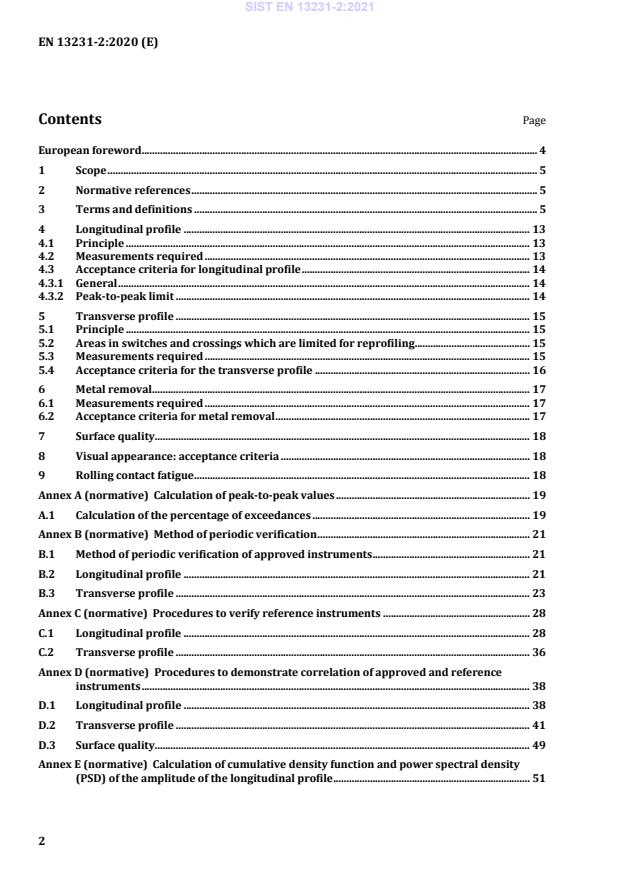
Contents Page
European foreword . 4
1 Scope . 5
2 Normative references . 5
3 Terms and definitions . 5
4 Longitudinal profile . 13
4.1 Principle . 13
4.2 Measurements required . 13
4.3 Acceptance criteria for longitudinal profile . 14
4.3.1 General . 14
4.3.2 Peak-to-peak limit . 14
5 Transverse profile . 15
5.1 Principle . 15
5.2 Areas in switches and crossings which are limited for reprofiling. 15
5.3 Measurements required . 15
5.4 Acceptance criteria for the transverse profile . 16
6 Metal removal . 17
6.1 Measurements required . 17
6.2 Acceptance criteria for metal removal . 17
7 Surface quality. 18
8 Visual appearance: acceptance criteria . 18
9 Rolling contact fatigue . 18
Annex A (normative) Calculation of peak-to-peak values . 19
A.1 Calculation of the percentage of exceedances . 19
Annex B (normative) Method of periodic verification . 21
B.1 Method of periodic verification of approved instruments . 21
B.2 Longitudinal profile . 21
B.3 Transverse profile . 23
Annex C (normative) Procedures to verify reference instruments . 28
C.1 Longitudinal profile . 28
C.2 Transverse profile . 36
Annex D (normative) Procedures to demonstrate correlation of approved and reference
instruments . 38
D.1 Longitudinal profile . 38
D.2 Transverse profile . 41
D.3 Surface quality. 49
Annex E (normative) Calculation of cumulative density function and power spectral density
(PSD) of the amplitude of the longitudinal profile . 51
E.1 Calculation of cumulative density function of the amplitude of the longitudinal
profile . 51
E.2 Calculation of the power spectral density of the amplitude of the longitudinal profile . 53
Annex F (normative) Rail surface quality measurement . 55
F.1 Requirements . 55
F.2 Calculation of the quality index (QI) . 55
F.3 Verification of the functional capability . 56
F.4 Verification of the functional capability . 56
F.5 Coordinate measuring machine (CMM) . 57
F.6 Measurement of the comparison standard using the CMM . 57
F.7 Analysis of data from CMM . 57
F.8 Measurement of the comparison standard using the test instrument . 57
F.9 Maximum deviation between test instrument and CMM . 57
Bibliography . 58
European foreword
This document (EN 13231-2:2020) has been prepared by Technical Committee CEN/TC 256 “Railway
applications”, the secretariat of which is held by DIN.
This European Standard shall be given the status of a national standard, either by publication of an
identical text or by endorsement, at the latest by May 2021, and conflicting national standards shall be
withdrawn at the latest by May 2021.
Attention is drawn to the possibility that some of the elements of this document may be the subject of
patent rights. CEN shall not be held responsible for identifying any or all such patent rights.
This document supersedes EN 13231-3:2012 and EN 13231-4:2013. The main changes compared to the
previous edition are listed below:
— EN 13231-2 merges the previous EN 13231-2 and EN 13231-3;
— updated to display the state of the art;
— mistakes have been solved;
— Clause 7 is new.
This document is part of the series EN 13231 “Railway applications - Track - Acceptance of works” as
listed below:
— Part 1: Works on ballasted track - Plain line, switches and crossings
— Part 2: Acceptance of reprofiling rails in plain line, switches, crossings and expansion devices
— Part 5: Procedures for rail reprofiling in plain line, switches, crossings and expansion devices
According to the CEN-CENELEC Internal Regulations, the national standards organisations of the
following countries are bound to implement this European Standard: Austria, Belgium, Bulgaria,
Croatia, Cyprus, Czech Republic, Denmark, Estonia, Finland, France, Germany, Greece, Hungary, Iceland,
Ireland, Italy, Latvia, Lithuania, Luxembourg, Malta, Netherlands, Norway, Poland, Portugal, Republic of
North Macedonia, Romania, Serbia, Slovakia, Slovenia, Spain, Sweden, Switzerland, Turkey and the
United Kingdom.
1 Scope
This document defines the technical requirements and measurements for the acceptance of works for
longitudinal and/or transverse reprofiling of railway rail heads in plain line, switches and crossings and
expansion devices.
This document applies to Vignole rails of 46 kg/m and above according to EN 13674-1.
2 Normative references
There are no normative references in this document.
3 Terms and definitions
For the purposes of this document, the following terms and definitions apply.
ISO and IEC maintain terminological databases for use in standardization at the following addresses:
• IEC Electropedia: available at http://www.electropedia.org/
• ISO Online browsing platform: available at https://www.iso.org/obp
3.1
reprofiling zones in switches
area where required reprofiling work is done on the switches depending on the position of the rail
within the switch
Note 1 to entry: There are three general areas of treatment as shown in Figure 1.
Key
○ welding/joint 2 zone G (closure panel)
1 zone F (switch panel) 3 zone H (crossing panel)
Figure 1 — Reprofiling zones in switches
3.2
reference points
points A, B and B that describe the area for the transverse rail head profile
1 2
Note 1 to entry: See Figure 2.
Key
1 angle of inclination 5 reference point B1 (see 3.25)
2 rail axis 6 reference point B (see 3.26)
3 reference line (see 3.23) 7 distance between point B1 and reference line (usually 14 mm)
4 reference point A (see 3.24) 8 angle between tangent at point B2 and reference line (usually 45°)
Figure 2 — Definition of terms, and determination of reference points A, B and B on the
1 2
transverse profile
3.3
reprofiling zone
part of the rail head that needs to be treated in the zone described by item 9 as in Figure 3
Note 1 to entry: See Figure 3.
Key
1 angle of inclination (see 3.6) 6 angle of 70°
2 rail axis 7 point C (field side) where the rail profile has an
angle of −5° with respect to reference line
3 reference line (see 3.23) 8 angle of 5° with respect to the reference line
4 reference point A (see 3.24) 9 reprofiling zone from C to C
1 2
5 point C (gauge corner) where the rail profile tangent
has an angle of 70° with respect to reference line
Figure 3 — Reprofiling zone
3.4
deviation of measured transverse profile
part described by item 10 as in Figure 4
Note 1 to entry: See Figure 4. In this example, the range of deviation is negative (measured profile below the
reference rail).
Key
1 angle of inclination (see 3.6) 6 reference profile
2 rail axis 7 measured profile
3 reference line (see 3.23) 8 point where X is maximum
4 reference point A – top of rail where deviation is zero 9 tangent to rail target profile at considered point
(see 3.24)
5 reference point B1 or B2 where deviation is zero (see 10 deviation between 6 and 7 at point 8 –
3.25 and 3.26) perpendicular to 9
Figure 4 — Deviation of measured transverse profile from reference profile
3.5
transverse profile measurement locations for hand-measuring systems in switches
locations for measurement of the transverse profile in a switch by a non-continuous method that are
defined in Figure 5
Note 1 to entry: See Figure 5.
Key
○ welding/joint 1-10 measuring points
A switch panel
B closure panel
C crossing panel
NOTE Point 1 is always on the left facing the switch towards the frog.
Figure 5 — Measuring points for transverse profile for hand-measuring systems in switches
3.6
angle of inclination of rail
nominal angle at which rail is laid; inclined towards the centre of the track
EXAMPLE: 0° (vertical rails), 2,86° (1:20 inclination), 1,91° (1:30 inclination), 1,43° (1:40 inclination), etc.
Note 1 to entry: See Figure 2.
3.7
approved instrument
instrument for measurement of longitudinal or transverse profile, the usage of which is justified by
correlation of its performance with that of a reference instrument in accordance with the defined
procedure
Note 1 to entry: For procedure to demonstrate correlation, see Annex B.
3.8
reference instrument
instrument for the measurement of longitudinal or transverse profile, the performance of which has
been verified in accordance with the procedure defined in Annex C
3.9
test instrument
instrument whose use as a reference instrument or an approved instrument is being tested
3.10
characteristic length
length on the rail travelled during one rotation of a grinding stone or milling wheel
3.11
class 1, class 2
classes of longitudinal profile differentiated by the proportion of a reprofiling site reaching a specified
standard
Note 1 to entry: For longitudinal profile, see 4.3.
3.12
class P, class Q, class R, class S
classes of transverse profile differentiated by the proportion of a reprofiling site reaching a specified
standard
Note 1 to entry: For transverse profile, see 5.4.
3.13
Quality class 1, quality class 2, quality class 3
classes of the surface quality of the reprofiled rail
3.14
cut-off wavelength
wavelength of a sinusoidal profile of which 50 % of the amplitude is transmitted by the profile filter
Note 1 to entry: Profile filters are identified by their cut-off wavelength value, see EN ISO 16610-21.
3.15
deviation of the measured profile
deviation between the measured transverse profile and the reference rail, measured normal to the
surface of the reference rail when the measured transverse profile and the reference rail are aligned at
points A and B or A and B , without rotation of either profile
1 2
Note 1 to entry: The deviation is considered positive when the measured transverse profile is above the
reference rail.
Note 2 to entry: For deviation, see Figure 4.
3.16
facet
flat sector of the transverse profile of a reprofiled rail produced by the reprofiling tool
3.17
primary profile
representation of the measured longitudinal profile before application of any profile filter
3.18
profile filter
electronic device or signal processing which separates profiles into long-wave and short-wave
components, or into components within a specified wavelength range
3.19
filtered profile
profile which results from applying a profile filter to the primary profile
3.20
peak-to-peak limit (ppl)
limit of the value in which the value of the filtered longitudinal profiles shall lie
Note 1 to entry: It is intended as the plus and minus values ± A in which a sinusoidal signal of amplitude A lies.
( )
3.21
percentage exceedance
percentage length of a test site over which a measurement of the amplitude of the filtered profile
exceeds a prescribed limit
3.22
phase correct profile filter
profile filter which does not cause phase shifts which lead to asymmetrical profile distortions
Note 1 to entry: For profile filter, see EN ISO 16610-21.
3.23
track section
continuous part of track with the same track geometry and the same track construction
3.24
range of deviation
difference between the maximum and minimum values of the deviation of the measured transverse
profile
Note 1 to entry: For measured profile, see Figure 4.
3.25
reference line
line normal to the track's longitudinal axis and tangential to the heads of both rails
3.26
reference point A
highest point of the rail referred to the opposite rail of the track where the reference line touches the
rail profile
Note 1 to entry: For specified angle of inclination, see Figure 2
3.27
reference point B
point on the gauge face of a reference rail 14 mm below the reference line
Note 1 to entry: For reference point B1, see Figure 2.
3.28
reference point B
point on the gauge corner of a reference rail at which a line which is tangential to the rail lies at an angle
of 45° to the reference line
Note 1 to entry: For reference point B2, see Figure 2.
3.29
reference profile
transverse profile to which rail is to be reprofiled, within the specified tolerances
3.30
reference rail
rail with the reference profile, at the desired angle of inclination relative to the reference line
Note 1 to entry: For reference rail, see Figure 2.
3.31
reprofiling
action that is undertaken to modify the longitudinal and/or transverse profile of a rail
3.32
reprofiling site
length of track where the rail is to be reprofiled
3.33
reprofiling zone
area of the rail head of a reference rail between the point at which the tangent to the rail lies at an angle
of 70° to the reference line, measured towards the gauge side of the rail, and the point at which the
tangent to the rail lies at an angle of 5° to the reference line, measured towards the field side of the rail
Note 1 to entry: For reprofiling zone, see Figure 3.
3.34
sampling interval
distance between successive points on the rail at which a continuous record of the traced profile is
sampled in order to produce the primary profile
3.35
traced profile
profile of the rail as recorded by the measuring system
3.36
transition length
initial and/or final section of a length of track where the validity of a measurement of longitudinal or
transverse profile is questionable for a variety of reasons, including settling of electronic and digital
components and circuits
4 Longitudinal profile
4.1 Principle
Measurements are made using either a reference instrument, see 3.8, or an approved instrument,
see 3.7. Approved instruments do not offer the same accuracy as reference instruments but are
generally adequate for the purpose of demonstrating compliance with the requirements of this
document.
NOTE An example of an approved instrument is the type of system used for routine corrugation
measurement. Some of the systems used on reprofiling trains fall into this category.
In accordance with current practice, limits are set on the magnitude of the irregularities that can remain
in track after a reprofiling operation. It is recognized, however, that it can be uneconomic to achieve
100 % compliance with these, particularly where isolated rail running surface defects, such as wheel
burn, exist prior to reprofiling. Two classes are therefore offered, differentiated by the percentage of the
reprofiled track meeting the specified criteria. Where isolated top faults exist, class 2 offers a lower cost
option compared to class 1 as it will be achieved with fewer passes. However, a larger number of
isolated non-compliant zones will remain in the reprofiled site.
Class 1 also includes limits for very short (10 mm to 30 mm) and very long (300 mm to 1 000 mm)
wavelength residual irregularities; these are not included in class 2. Where very short waves need to be
removed, in particular for noise reduction, it might also be necessary to specify a criterion for those
wavelengths.
For the necessary annual metrological check, see Annex D.
4.2 Measurements required
The longitudinal profile of the finished reprofiled rail shall be recorded continuously using either a
reference instrument or an approved instrument. Where independent verification is required a
reference instrument shall be used. All measurements undertaken in order to demonstrate compliance
with 4.3 shall be recorded
Due to the complex geometry and short length worked on in switches and crossings and expansion
devices manual measurement systems can be used alternatively. The rail containing the frog shall be
measured only in “Zone G”, see Figure 1; the opposite rail shall be measured in the total ground length.
Longitudinal profile measurements shall be made within a position of 15 mm laterally on the rail from
the reference point A to the gauge corner area, to produce the traced profile.
NOTE It is a known issue that some networks have corrugation on high rail gauge corner. This document
does not deal with this issue. IM and contractor can agree on measurement methods and acceptance criterion.
It is recommended that a digital form of the traced profile, the primary profile, be used for subsequent
analysis.
If such a system is out of order or not available recording details shall be settled in the contract.
The measurements can be undertaken immediately after work or at the latest within 8 days of
reprofiling or before the track has carried 0,3 MGT (Million Gross Tonnes) of traffic.
4.3 Acceptance criteria for longitudinal profile
4.3.1 General
Table 1 gives peak-to-peak limits to be fulfilled to a certain percentage that is given in Table 2. Table 1
and Table 2 together form the acceptance criteria.
4.3.2 Peak-to-peak limit
The primary or traced profile shall be processed to provide a filtered profile within each of the
wavelength ranges given in Table 1.
Table 1 — Peak-to-peak limits
Wavelength range 10 to 30 30 to 100 100 to 300 300 to 1 000
(mm)
peak-to-peak limit ±0,010 ±0,010 ±0,015 ±0,075
(mm)
The percentage of any reprofiling site (according to 3.32) in which the amplitude of the filtered profile
is within the value specified in Table 1 shall be calculated on its total length and shall not be less than
the values given in Table 2 for the class specified.
If on a reprofiling site a track section does not meet this requirement, it shall be clarified if track quality
has an influence on the grinding result. A strong indication for this is, if the failure to meet the
tolerances comes from an isolated short section of track (<50 m), instead of irregularities distributed
over the whole reprofiling site.
Table 2 — Minimum proportion of measurements within peak-to-peak limits according to
Table 1
Wavelength range 10 to 30 30 to 100 100 to 300 300 to 1 000
(mm)
Class 1 95 % 95 % 95 % 95 %
Class 2 No requirement 90 % 90 % No requirement
In plain line, the classification concerns the total length of each reprofiling section.
In switches, crossing and expansion devices, the classification concerns the total length (Zones F, G and
H in Figure 1) of the rail opposite the frog and Zone G only of the rail containing the frog.
No exceedances are allowed for stationary measurements.
5 Transverse profile
5.1 Principle
Measurements are made using either a reference instrument, see 3.8, or an approved instrument,
see 3.7. Approved instruments do not offer the same accuracy as reference instruments, but are
generally adequate for the purpose of demonstrating compliance with the requirements of this
document.
Reprofiling can be undertaken for a variety of reasons. Where reprofiling is undertaken purely for the
removal of corrugation, there could be less need for the rail to be reprofiled with precision. In other
cases, it could be necessary for the reprofiled rail to match closely the ideal profile, represented by the
reference rail, see 3.30. A range of classes is therefore included to enable the client to specify the level of
precision that is appropriate for the site to be reprofiled.
NOTE Where reprofiling is undertaken to improve conicity, class Q, see 5.4, is likely to be appropriate.
The match between the reprofiled rail and the profile of the reference rail is determined by aligning the
two at two points and measuring maximum difference between them, see Figure 4. For straight track,
these points of alignment generally approximate to the rail crown and the gauge point. On the high rail
of curves, this method is not applicable if side wear has occurred and an alternative method of
alignment is therefore used.
For the necessary annual metrological check, see Annex D.
5.2 Areas in switches and crossings which are limited for reprofiling
The areas where the switchblade touches stock rail (Zone F, see Figure 1) and the frog area (Zone H, see
Figure 1) cannot be reprofiled completely. The infrastructure manager can define applicable
restrictions.
5.3 Measurements required
The rail's transverse profile shall be measured using either a reference instrument, see 3.8, or an
approved instrument, see 3.7. Where independent verification is required, a reference instrument shall
be used whereby measurements of each rail shall be made at an interval of not less than 10 m
throughout the reprofiling site. A deviation of 0,1 mm between the reference instrument and approved
instrument would be acceptable according to Annex B.
All measurements undertaken in order to demonstrate compliance with 5.4 shall be recorded.
The measurements can be undertaken immediately after work or at the latest within 8 days of
reprofiling or before the track has carried 0,3 MGT (Million Gross Tons) of traffic.
NOTE It is best practice for measurements to be made immediately after reprofiling.
After reprofiling rails in switches, crossings and expansion devices, additional verifications can be
specified by the IM.
Due to the complex geometry short length worked on in switches and crossings and expansion devices,
manual measurement systems can be used alternatively. The rail containing the frog shall be measured
only in Zone G, see Figure 1, the opposite rail shall be measured in the total ground length.
If such a system is out of order or not available, recording details shall be settled in the contract.
5.4 Acceptance criteria for the transverse profile
Each measured profile shall be aligned with the appropriate reference rail so that the reference points A
and B , or A and B (see Figure 2) on the reference rail coincide with points on the measured profile.
1 2
The alignment shall be undertaken without rotation of either profile.
Profiles comparison shall be made along the reprofiling zone, between points C1 and C2.
Reference points A and B shall be used on side-worn rails and A and B elsewhere.
2 1
The percentage of measured values in any reprofiling site according to 3.30, in which the range of
deviation is less than 0,4 mm, 0,6 mm, 1,0 mm and 1,7 mm, shall be calculated on the total length of the
reprofiling site and shall not be less than the profiles given in Table 3 for the class specified.
The transverse reprofiling shall be specified as one of the four classes as shown in Table 3. For each
class, a division of this range between a positive and negative tolerance shall also be specified. The
percentage of measurements for which the deviation exceeds the range stated shall not exceed the
value given in Table 3 for the class specified.
For example, if reprofiling of class R and a tolerance range of 1,0 mm apportioned as + 0,4 mm/- 0,6 mm
were specified, at least 85 % of measurements should deviate by less than + 0,4 mm/- 0,6 mm from the
prescribed reference profile.
The maximum positive deviations shall be specified, e.g. for the range of deviation 0,6 mm:
+ 0,3 mm/- 0,3 mm, + 0,2 mm/- 0,4 mm.
Table 3 — Minimum proportion of measurements within the specified range
max. range of min. proportion of
deviation measured values
(mm) within specified
deviation range
Class P 0,4 95 %
Class Q 0,6 90 %
Class R 1,0 85 %
Class S 1,7 75 %
The tolerance zone width tends towards 0 at the reference points; at the field side only negative
tolerances are allowed in the reprofiling zone.
In switches, crossings and expansion devices when continuously working measurement systems are
used, the rail containing the frog shall be measured only in Zone G, see Figure 1, and only if this area is
longer than 30 m. The opposite rail shall be measured in the total ground length. With spot-checks
systems, one recording per rail shall be made in front (measurement points 1 and 2) of the switch, one
in the centre of the intermediate rail (measurement points 3 and 4 for the main track and, if applicable,
measurement points 5 and 6) and one at the end of the switch (measurement points 7 and 8 and, if
applicable, measurement points 9 and 10), see Figure 5. In this case, no exceedances are allowed.
6 Metal removal
6.1 Measurements required
Measurements of metal removal from the rail head are required only if there is a requirement in the
contract to demonstrate a minimum or maximum depth of metal removal. All measurements
undertaken in order to demonstrate compliance with 6.2 shall be recorded.
The rail height or height of the rail head shall be measured and the metal removal calculated using an
agreed manual or machine-mounted instrument and recorded once per week or as required by the
contract.
The rail height or height of the rail head shall be measured with a manual instrument before and after
reprofiling at a minimum of 5 positions on each rail at a distance of no less than 0,5 m apart. Machine–
mounted measurements can be undertaken up to 0,5 m and calculated for 10 m sections. Measurements
shall be made within a month of reprofiling or one MGT, whichever comes first. The rail shall be marked
to ensure that manual measurements before and after reprofiling are made within a distance of 10 mm
of each other along the rail. If the rail is initially corrugated, measurements shall be undertaken in the
trough of the corrugation.
Measurement of the rail height or depth of the rail head shall be processed so as to provide the depth of
metal removed within 15 mm transversely of the rail crown, or elsewhere on the rail head as agreed
between client and contractor.
Measurements should be recorded once per week or as required by the contract.
6.2 Acceptance criteria for metal removal
The minimum or maximum depth of metal removed shall be as required by the contract at the
minimum percentage of measurement positions specified by the contract.
7 Surface quality
Short wave corrugation below 10 mm wavelength shall be taken into consideration to evaluate the rail
surface quality.
The quality index (see Table 4) is to be calculated according to the method described in F.2 based on
measurements undertaken with a measuring device according to F.1.
A range of quality classes is provided to enable the client to specify the level of precision that is
appropriate for the site to be reprofiled.
The condition of the rail which is reflected by the value of the quality index has an influence on noise
from the wheel-rail contact.
Table 4 — Quality Index for track surface quality (QI)
Quality class 1 2 3
Quality index QI ≤ 3 QI ≤ 5 QI ≤ 10
(QI)
The index is not valid if any one of the three data sets produces a quality index greater than 10:
— Quality class 1: Tracks with very high demands on surface quality;
— Quality class 2: Tracks with particular demands on surface quality;
— Quality class 3: All other tracks.
The measurements shall be undertaken on each rail every 1 000 m or within a working section
immediately after work. The result shall be part of the work documentation.
8 Visual appearance: acceptance criteria
Where facets are produced by the reprofiling operation, the maximum facet width shall be 4 mm on the
gauge corner, 7 mm on the shoulder and 10 mm within 10 mm of the rail crown. The reprofiling zone
shall be blended smoothly into the parent rail.
The maximum variation in facet width over a 100 mm length of rail shall be 25 % of the maximum
width of the facet.
There shall not be continuous blueing in the reprofiling zone.
9 Rolling contact fatigue
If acceptance criteria are defined based on rolling contact fatigue, removal details shall be defined by
the customer and the supplier in the contract.
Annex A
(normative)
Calculation of peak-to-peak values
A.1 Calculation of the percentage of exceedances
Let Y be a signal in the interval [start, end] and let tol1 and tol2 be the values of the thresholds, with
tol1 < tol2.
The percentage of exceedances (PE) of the signal Y for the tolerances tol1 and tol2 inside the interval
[start, end] is defined as the percentage of the samples where the signal Y has value smaller than tol1 or
bigger than tol2, over the total number of the samples.
The percentage of exceedances could be computed as in the following routine. See Figure A.1 for an
example of the computation.
PE (Y, tol1, tol2, start, nso = 0 number of samples outside the tolerances
end)
tns = 0 total number of the samples inside the interval
For each sample i ϵ [start, end]
tns = tns + 1 tns is always increased
If Y < tol1 or Y > tol2
i i
nso = nso +1 nso is increased only in this case
end
end
nso
PE= 100
tns
return PE
Example:
Key
Y signal
[start, end] interval where the percentage of exceedances shall be calculated (referring to this example
start = 103, end = 131)
tns = 29; total number of the samples inside the interval [start, end]
nso = 20; number of samples outside the tolerance = 7 + 7 + 6
PE 100 68.9
Figure A.1 — Example
==
Annex B
(normative)
Method of periodic verification
B.1 Method of periodic verification of approved instruments
B.1.1 Principle
The approval of train mounted measuring system (approved instrument) is based on Annex B for every
recording system and for an unlimited period. In order to keep the approval valid over time, every
system shall undergo at least an annual metrological check or more frequently according to the
demands of the client. The aim of these actions is to guarantee the correct functioning of the approved
instrument, to prevent deviations and to undertake corrective actions in time. These metrological
actions shall be designed in a way to be done on site with a simple instrumentation.
A quality controller, independent of the machine (internal or external according to e.g. EN ISO 9001),
shall follow the correct execution of these metrological actions. The verifications shall be documented
and accessible on board the machine. They also ensure that required corrective actions are undertaken
within due time. At any moment, the client can ask to see the verification documents.
This confirmation interval is divided into two parts:
1) static metrological confirmation of the approved instrument;
2) dynamic metrological confirmation of the approved instrument.
The following chapters describe a method of verification, which might be adapted according to the
specific requirements of each instrument.
B.2 Longitudinal profile
B.2.1 General
The verification of the approved instrument for longitudinal profile recording shall be done in two
steps:
1) the static verification will allow ensuring the correctness of all the elements constituting the
approved instrument such as probes, processing unit and reporting;
2) the dynamic verification will allow ensuring the repeatability of the approved instrument in its
specific environment in both directions and at working speed.
B.2.2 Static verifications
B.2.2.1 Verification of measuring transducers
An appropriate metrological verification shall be established by the owner of the approved instrument
in order to ensure that each response of the measuring transducers is always correct. This verification
needs to be documented.
B.2.2.2 Verification of processing chain
A simulator shall take the places of the measuring transducers in order to ensure that the processing
unit is always correct. This verification needs to be documented.
B.2.2.3 Documents of verification
The documents of verification shall be stored on the machine and made available for independent
inspection for analysing the conformity of the approved instrument. Figure B.1 shows the process of
verification for documents.
Figure B.1 — Process for documents of verification
B.2.3 Dynamic verification
B.2.3.1 General
The dynamic verifications shall be undertaken in track, both ground and not ground.
The recordings obtained in both working directions shall be compared either by comparison of the
graphic outputs or electronically by comparison of the processed data.
B.2.3.2 Comparison of dynamic behaviour
One section of the track at least 300 m long shall be measured in both directions with the instrument(s)
incorporated in the machine. A graphical superposition of the filtered profiles allows checking possible
differences. In case of non-conformity, a corrective action needs to be undertaken.
B.2.3.3 Comparison of statistical results
One section of the track at least 300 m long shall be measured once in each direction with the
instrument(s) incorporated in the machine. Statistical analysis of the difference between the measured
data for forward and backward measurement should be undertaken and if the data differs by more than
2 % corrective action is required.
The calculation of the exceedances should be undertaken according to Annex C and Table B.1.
Table B.1 — Example of comparison of statistical results
Wavelength 10 to30 30 to 100 to 300 to 10 to 30 to 100 to 300 to
range 100 300 1 000 30 100 300 1 000
mm
Forward, 300 m 98 95 99 100 97 98 98 99
Backward, 97 97 95 100 98 99 99 94
300 m
a a
Difference in % 1 2 4 0 1 1 1 5
a
If the difference is greater than 2 %, a corrective action needs to be undertaken.
B.3 Transverse profile
B.3.1 Principle
The verification of the approved instrument for transverse profile recording shall be done in two steps:
1) the static verification will allow ensuring the correctness of all the elements constituting the
approved instrument such as probes, processing unit and reporting;
2) the dynamic verification will allow ensuring the repeatability of the approved instrument in its
specific environment in both directions and at working speed.
B.3.2 Static verifications
B.3.2.1 Verification of probes and processing chain
The static verification is done by placing a reference profile under the approved instrument. The
comparison of the reference profile against the measured profile within the range of the reprofiling
angles used during work shall satisfy the correct conformity of the approved instrument and shall be
documented.
B.3.2.2 Documents of verification
The documents of verification shall be stored on the machine and made available for independent
inspection and for analysing the conformity of the approved instrument. Figure B.2 shows the process
for reporting.
Figure B.2 — Process for reporting
-----------------
...