

EN 17432:2021
(Main)Packaged refrigerating units for walk-in cold rooms - Classification, performance and energy consumption testing
- Abstract
This document specifies classification criteria, test conditions and test procedures for performance testing of packaged refrigerating units for stationary cold room applications. This includes ductless units for cold storage applications at medium temperatures (MT) and low temperatures (LT) in either compact or split designs, fitted with electrically driven compressors, which work according to the vapour compression cycle.
- Status
- Published
- Publication Date
- 28-Sep-2021
- Withdrawal Date
- 30-Mar-2022
- Technical Committee
- CEN/TC 44 - Household refrigerating appliances and commercial refrigerated cabinets
- Drafting Committee
- CEN/TC 44/WG 7 - Walk-in cold rooms packaged Refrigerating Units
- Current Stage
- 6060 - Definitive text made available (DAV) - Publishing
- Start Date
- 29-Sep-2021
- Due Date
- 11-Sep-2021
- Completion Date
- 29-Sep-2021

Overview
EN 17432:2021 (CEN) defines classification, test conditions and test procedures for performance and energy-consumption testing of packaged refrigerating units for walk‑in cold rooms. It covers ductless units for stationary cold storage at medium temperature (MT, evaporator inlet ≈ 0 °C) and low temperature (LT, evaporator inlet ≈ −20 °C) in both compact and split designs. The standard applies to factory-made systems with electrically driven compressors operating on the vapour‑compression cycle and focuses on repeatable laboratory measurement methods under dry conditions (no evaporator icing).
Key Topics
- Scope & classification
- Labelling by heat‑transfer mediums (e.g., air‑cooled, water‑cooled, liquid‑cooled) for exterior and interior heat exchangers.
- Definitions of packaged, compact and split units.
- Test environment and setup
- Use of a calorimeter room inside a controlled test chamber to reproduce steady‑state conditions.
- Requirements for installation, arrangement of measurement equipment and calibration of the calorimeter room.
- Performance measurements
- Determination of cooling capacity (heat removed) and total electrical power consumption (including fans and auxiliaries).
- Calculation of Energy Efficiency Ratio (EER) as the ratio of cooling capacity to power consumption.
- Measurement of heat recovery capacity for water‑cooled units.
- Test procedure controls
- Specification of steady‑state criteria, data acquisition and measurement uncertainty considerations.
- Recording of operating limits and nominal conditions.
- Limitations
- Current edition specifies tests only under dry conditions; wet/defrost testing is planned for future revisions.
Applications
EN 17432:2021 is practical for:
- Manufacturers validating declared cooling capacity and energy performance for product data sheets and type plates.
- Test laboratories performing standardized performance verification and comparative testing.
- Specifiers, consultants and procurement teams assessing unit selection for walk‑in cold rooms (MT and LT applications).
- Certification and regulatory bodies that require harmonized test data to support compliance, labeling or energy reporting.
- R&D and product development groups optimizing system efficiency and heat recovery features.
Keywords: EN 17432:2021, packaged refrigerating units, walk‑in cold rooms, performance testing, energy consumption testing, cooling capacity, EER, calorimeter room, MT, LT, air‑cooled, water‑cooled.
Related Standards
- EN 378 series (refrigeration system terminology and safety) - referenced for terms and definitions.
- IEC Electropedia / ISO Online Browsing Platform - sources for standardized terminology.
Get Certified
Connect with accredited certification bodies for this standard

DNV
DNV is an independent assurance and risk management provider.

Lloyd's Register
Lloyd's Register is a global professional services organisation specialising in engineering and technology.
DNV Energy Systems
Energy and renewable energy certification.
Sponsored listings
Frequently Asked Questions
EN 17432:2021 is a standard published by the European Committee for Standardization (CEN). Its full title is "Packaged refrigerating units for walk-in cold rooms - Classification, performance and energy consumption testing". This standard covers: This document specifies classification criteria, test conditions and test procedures for performance testing of packaged refrigerating units for stationary cold room applications. This includes ductless units for cold storage applications at medium temperatures (MT) and low temperatures (LT) in either compact or split designs, fitted with electrically driven compressors, which work according to the vapour compression cycle.
This document specifies classification criteria, test conditions and test procedures for performance testing of packaged refrigerating units for stationary cold room applications. This includes ductless units for cold storage applications at medium temperatures (MT) and low temperatures (LT) in either compact or split designs, fitted with electrically driven compressors, which work according to the vapour compression cycle.
EN 17432:2021 is classified under the following ICS (International Classification for Standards) categories: 27.200 - Refrigerating technology. The ICS classification helps identify the subject area and facilitates finding related standards.
EN 17432:2021 is associated with the following European legislation: EU Directives/Regulations: 2009/125/EC; Standardization Mandates: M/495. When a standard is cited in the Official Journal of the European Union, products manufactured in conformity with it benefit from a presumption of conformity with the essential requirements of the corresponding EU directive or regulation.
EN 17432:2021 is available in PDF format for immediate download after purchase. The document can be added to your cart and obtained through the secure checkout process. Digital delivery ensures instant access to the complete standard document.
Standards Content (Sample)
SLOVENSKI STANDARD
01-november-2021
Samostojne hladilne enote za male hladilnice - Razvrstitev, tehnične lastnosti in
preskus porabe energije
Packaged refrigerating units for walk-in cold rooms - Classification, performance and
energy consumption testing
Kälteaggregate für begehbare Kühlräume - Klassifikation, Prüfung der Leistung und des
Energieverbrauchs
Groupes frigorifiques prêts à monter pour chambres froides - Classification, performance
et essai de consommation d'énergie
Ta slovenski standard je istoveten z: EN 17432:2021
ICS:
27.200 Hladilna tehnologija Refrigerating technology
2003-01.Slovenski inštitut za standardizacijo. Razmnoževanje celote ali delov tega standarda ni dovoljeno.
EN 17432
EUROPEAN STANDARD
NORME EUROPÉENNE
September 2021
EUROPÄISCHE NORM
ICS 27.200
English Version
Packaged refrigerating units for walk-in cold rooms -
Classification, performance and energy consumption
testing
Groupes frigorifiques prêts à monter pour chambres Kälteaggregate für begehbare Kühlräume -
froides - Classification, performance et essai de Klassifikation, Prüfung der Leistung und des
consommation d'énergie Energieverbrauchs
This European Standard was approved by CEN on 21 June 2021.
CEN members are bound to comply with the CEN/CENELEC Internal Regulations which stipulate the conditions for giving this
European Standard the status of a national standard without any alteration. Up-to-date lists and bibliographical references
concerning such national standards may be obtained on application to the CEN-CENELEC Management Centre or to any CEN
member.
This European Standard exists in three official versions (English, French, German). A version in any other language made by
translation under the responsibility of a CEN member into its own language and notified to the CEN-CENELEC Management
Centre has the same status as the official versions.
CEN members are the national standards bodies of Austria, Belgium, Bulgaria, Croatia, Cyprus, Czech Republic, Denmark, Estonia,
Finland, France, Germany, Greece, Hungary, Iceland, Ireland, Italy, Latvia, Lithuania, Luxembourg, Malta, Netherlands, Norway,
Poland, Portugal, Republic of North Macedonia, Romania, Serbia, Slovakia, Slovenia, Spain, Sweden, Switzerland, Turkey and
United Kingdom.
EUROPEAN COMMITTEE FOR STANDARDIZATION
COMITÉ EUROPÉEN DE NORMALISATION
EUROPÄISCHES KOMITEE FÜR NORMUNG
CEN-CENELEC Management Centre: Rue de la Science 23, B-1040 Brussels
© 2021 CEN All rights of exploitation in any form and by any means reserved Ref. No. EN 17432:2021 E
worldwide for CEN national Members.
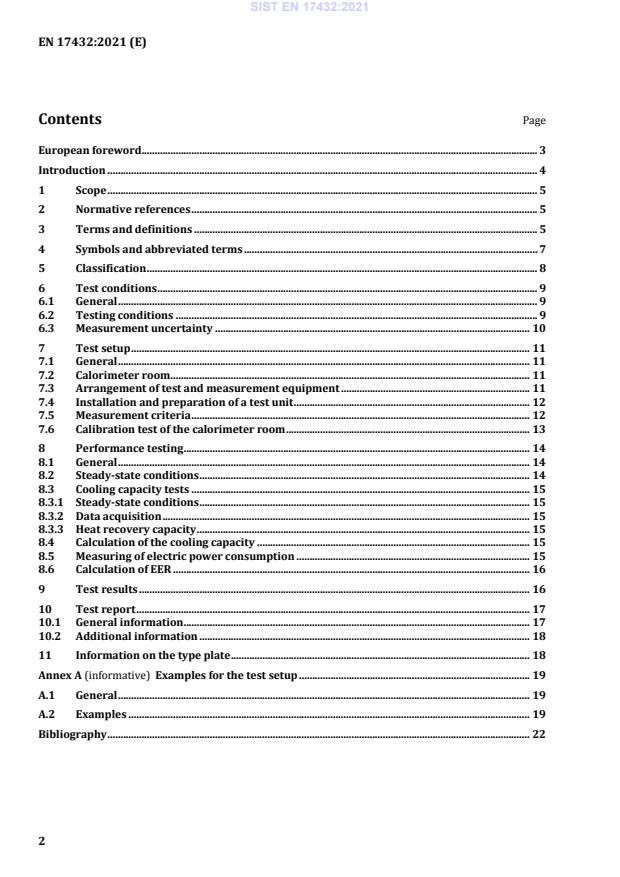
Contents Page
European foreword . 3
Introduction . 4
1 Scope . 5
2 Normative references . 5
3 Terms and definitions . 5
4 Symbols and abbreviated terms . 7
5 Classification . 8
6 Test conditions . 9
6.1 General . 9
6.2 Testing conditions . 9
6.3 Measurement uncertainty . 10
7 Test setup . 11
7.1 General . 11
7.2 Calorimeter room . 11
7.3 Arrangement of test and measurement equipment . 11
7.4 Installation and preparation of a test unit . 12
7.5 Measurement criteria . 12
7.6 Calibration test of the calorimeter room . 13
8 Performance testing . 14
8.1 General . 14
8.2 Steady-state conditions . 14
8.3 Cooling capacity tests . 15
8.3.1 Steady-state conditions . 15
8.3.2 Data acquisition . 15
8.3.3 Heat recovery capacity . 15
8.4 Calculation of the cooling capacity . 15
8.5 Measuring of electric power consumption . 15
8.6 Calculation of EER . 16
9 Test results . 16
10 Test report . 17
10.1 General information . 17
10.2 Additional information . 18
11 Information on the type plate . 18
Annex A (informative) Examples for the test setup . 19
A.1 General . 19
A.2 Examples . 19
Bibliography . 22
European foreword
This document (EN 17432:2021) has been prepared by Technical Committee CEN/TC 44 “Commercial
and Professional Refrigerating Appliances and Systems, Performance and Energy Consumption”, the
secretariat of which is held by UNI.
This European Standard shall be given the status of a national standard, either by publication of an
identical text or by endorsement, at the latest by March 2022, and conflicting national standards shall be
withdrawn at the latest by March 2022.
Attention is drawn to the possibility that some of the elements of this document may be the subject of
patent rights. CEN shall not be held responsible for identifying any or all such patent rights.
This document has been prepared under a Standardization Request given to CEN by the European
Commission and the European Free Trade Association.
Any feedback and questions on this document should be directed to the users’ national standards body.
A complete listing of these bodies can be found on the CEN website.
According to the CEN-CENELEC Internal Regulations, the national standards organisations of the
following countries are bound to implement this European Standard: Austria, Belgium, Bulgaria, Croatia,
Cyprus, Czech Republic, Denmark, Estonia, Finland, France, Germany, Greece, Hungary, Iceland, Ireland,
Italy, Latvia, Lithuania, Luxembourg, Malta, Netherlands, Norway, Poland, Portugal, Republic of North
Macedonia, Romania, Serbia, Slovakia, Slovenia, Spain, Sweden, Switzerland, Turkey and the United
Kingdom.
Introduction
This document was developed in order to provide a suitable method of performance testing of packaged
refrigerating units for stationary cold room applications.
This is the first edition of this document. It includes testing only in so-called “dry conditions”. That means,
the evaporator does not show any ice formation during the test. Although it is well-known, that such
conditions do not represent the typical situation in the practical use of the packaged refrigerating units,
this edition of the document focusses on the description of a test procedure providing reliable test results,
which can be used to compare the performance of different models/types of packaged refrigerating unit.
In order to keep the test procedure in this document practically oriented, tests under so-called “wet
conditions” as well as taking defrost periods into account will be a future Work Item of the responsible
working group. The aim is to integrate such tests in a later revision of this document.
This document reflects the current market situation which shows that only refrigerating units without
integrated pump for the heat transfer medium on the exterior heat exchanger are offered.
1 Scope
This document specifies classification criteria, test conditions and test procedures for performance
testing of packaged refrigerating units for stationary cold room applications. This includes ductless units
for cold storage applications at medium temperatures (MT) and low temperatures (LT) in either compact
or split designs, fitted with electrically driven compressors, which work according to the vapour
compression cycle.
2 Normative references
There are no normative references in this document.
3 Terms and definitions
For the purposes of this document, the following terms and definitions apply.
ISO and IEC maintain terminological databases for use in standardization at the following addresses:
— IEC Electropedia: available at https://www.electropedia.org/
— ISO Online browsing platform: available at https://www.iso.org/obp
3.1
packaged refrigerating unit
functional unit incorporating a complete factory-made refrigerating system, mounted in a suitable frame
and/or enclosure, that is fabricated and transported complete, or in two or more sections and in which
no refrigerant-containing parts are connected on site other than by isolation valves, such as companion
valves, and by interconnecting piping as defined by the manufacturer
Note 1 to entry: A packaged refrigerating unit incorporates at least one refrigerant circuit, and can incorporate
one or more heat transfer circuits.
Note 2 to entry: The terms “factory-made” and “refrigerating system” are defined in EN 378-1.
3.2
compact unit
packaged refrigerating unit, that has been assembled, filled ready for use, and is installed without the
need for connecting any refrigerant-containing parts
3.3
split unit
packaged refrigerating unit, comprising one unit providing cooling to the cold room and one unit used
for condensing the refrigerant
3.4
factory made
manufactured at a dedicated production location under control of a recognized quality system
Note 1 to entry: Assembling in this context means manufacturing.
[SOURCE: EN 378-1:2016, 3.8.5, modified — The present Note 1 to entry was added.]
3.5
interior heat exchanger
heat exchanger in which liquid refrigerant is vaporized by absorbing heat from the interior heat transfer
medium
Note 1 to entry: For the applications regarded here, the interior heat exchanger is usually called “evaporator”.
3.6
exterior heat exchanger
heat exchanger in which the refrigerant is cooled down due to heat dissipation by the exterior heat
transfer medium
Note 1 to entry: For the applications regarded here, the exterior heat exchanger is usually called “condenser”.
3.7
heat transfer medium
medium (water, air, etc.) which transfers heat without undergoing phase changes
3.8
dry bulb temperature
temperature of air measured by a thermometer exposed to the air but shielded from radiation and
moisture
3.9
calorimeter room
insulated enclosure which houses a heating device and the interior heat exchanger
3.10
test chamber
room in which the ambient air can be conditioned and kept in a steady state condition and in which the
exterior heat exchanger as well as the calorimeter room are located
Note 1 to entry: See 7.2 for further explanation.
3.11
cooling capacity
heat per unit of time transferred to the unit via heat transfer medium minus introduced heat of the fans
installed at the interior heat exchanger
3.12
total power consumption
average electrical power consumption of the packaged refrigeration unit, including all electrical supplies
needed for the cooling operation of the unit, over time
3.13
energy efficiency ratio
ratio of cooling capacity to total power consumption of the unit
3.14
operating limits
limitations in terms of maximum and minimum operating conditions (range of pressure, temperature,
voltage, humidity, etc.)
Note 1 to entry: The unit shall work as intended within the operating limits specified by the manufacturer.
3.15
nominal conditions
conditions that define a standard which reveals if a packaged refrigerating unit is working within those
defined limits
3.16
support cold
independently working refrigerating unit to compensate heat losses through the calorimeter room
envelope
3.17
low temperature
LT
application, at which the packaged refrigerating unit is capable of delivering its nominal cooling capacity
at the interior heat exchanger inlet temperature of −20 °C
3.18
medium temperature
MT
application, at which the packaged refrigerating unit is capable of delivering its nominal cooling capacity
at the interior heat exchanger inlet temperature of 0 °C
4 Symbols and abbreviated terms
Table 1 — Symbols
Unit
Symbol Quantity Unit
Symbol
Q
Cooling capacity Watt W
P
Total power consumption Watt W
E
EER Energy efficiency ratio — —
A Length of the air inlet of the interior heat exchanger millimetres mm
Width/height of the air inlet of the interior heat
B millimetres mm
exchanger
q
Heat loss of the calorimeter room Watt per Kelvin W/K
Heat loss
Electric power consumption of the heating device,
all running fans and any other devices being placed
P
Watt W
Heater
inside the calorimeter room which are in use during
calibration of the calorimeter room
T
Internal temperature of the calorimeter room Kelvin K
int
T
Ambient temperature of the test chamber Kelvin K
out
∆T Temperature difference Kelvin K
Temperature of the heat transfer medium at heat
T
Degree Celsius °C
out,w
exchanger outlet
Unit
Symbol Quantity Unit
Symbol
Temperature of the heat transfer medium at heat
T
Degree Celsius °C
int, w
exchanger inlet
ṁ Mass flow kilogram per second kg/s
V Volume cubic metre
m
kilogram per cubic
ρ Density kg/m
metre
Q
Heat capacity of the heat exchanger kilowatt kW
Heat
cubic meters per
3
Volume flow m /s
V
second
Maximum measured external static pressure
∆p
Pascal Pa
i
difference between water inlet and outlet
∆P Static pressure difference Pascal Pa
Q
Total heating capacity of the heating device Watt W
Heat,i
Q
support cold
Cooling capacity of the support cold Watt W
Temperature difference between interior of the
∆T
calorimeter room and exterior of the calorimeter Kelvin K
i
room
Table 2 — Constants
Symbol Description Value
c 4,19 kJ/(kg ∙ K)
Specific heat capacity of water
p
5 Classification
Refrigerating units are labelled by listing their heat transfer mediums. The heat transfer medium of the
exterior heat exchanger (condenser) is listed in the first column, the heat transfer medium of the interior
heat exchanger (evaporator) is listed in the second column (see Table 3).
Table 3 — Labelling of refrigerating units
Heat transfer medium
Term
Exterior heat exchanger Interior heat exchanger
Air Air Air cooled refrigerating unit
Water Air Water cooled refrigerating unit
Liquid Air Liquid cooled refrigerating unit
6 Test conditions
6.1 General
The test procedures defined in this document provide methods for determining cooling capacities and
electrical power consumption of packaged refrigerating units as well as for determining heat recovery
capacities of water-cooled packaged refrigerating units. The tests can be performed under dry conditions
inside a calorimeter room, which is placed in a test chamber.
6.2 Testing conditions
The following test procedures are to be conducted under the nominal conditions given in Tables 4, 5 and
6), unless stated otherwise.
Table 4 — Air-to-air refrigerating unit – Nominal dry conditions
Application Exterior heat
Interior heat exchanger
exchanger
Dry bulb
Dry bulb
Rel. humidity at
temperature at
inlet
temperature at inlet
inlet
a
LT 32 °C −20 °C
a
MT 32 °C 0 °C
a
As low, as to prevent icing on the heat exchanger surface.
The manufacturer may choose the following additional testing conditions for air-to-air refrigerating
units:
— for cold climate: 15 °C for dry bulb temperature at inlet of exterior heat exchanger;
— for hot climate: 43 °C for dry bulb temperature at inlet of exterior heat exchanger
...