

prEN 14885
(Main)Chemical disinfectants and antiseptics - Application of European Standards for chemical disinfectants and antiseptics
- Abstract
This document specifies the European Standards to which products have to conform in order to support the claims for microbicidal activity which are referred to in this document.
This document also specifies terms and definitions which are used in European Standards.
It is applicable to products for which activity is claimed against the following microorganisms: vegetative bacteria (including mycobacteria and Legionella), bacterial spores, yeasts, fungal spores and viruses (including bacteriophages).
It is intended to:
a) enable manufacturers of products to select the appropriate standards to be used in order to provide data which support their claims for a specific product;
b) enable users of the product to assess the information provided by the manufacturer in relation to the use for which they intend to use the product;
c) assist regulatory authorities in assessing claims made by the manufacturer or by the person responsible for placing the product on the market.
It is applicable to products to be used in the area of human medicine, the veterinary area and in food, industrial, domestic and institutional areas.
In the area of human medicine (Working Group 1, i.e. WG 1), it is applicable to chemical disinfectants and antiseptics to be used in areas and situations where disinfection or antisepsis is medically indicated. Such indications occur in patient care
— in hospitals, in community medical facilities, dental institutions and medical laboratories for analyses and research,
— in clinics of schools, of kindergartens and of nursing homes,
— and may also occur in the workplace and in the home. It may also include services such as in laundries and kitchens supplying products directly for the patient.
In the veterinary area (WG 2) it is applicable to chemical disinfectants and antiseptics to be used in the areas of breeding, husbandry, veterinary care facilities, production, transport and disposal of animals and veterinary laboratories for analyses and research. It is not applicable to chemical disinfectants used in the food chain following death and entry to the processing industry.
In food, industrial, domestic and institutional areas (WG 3) it is applicable to chemical disinfectants and antiseptics to be used in processing, distribution and retailing of food of animal or vegetable origin. It is also applicable to products for all public areas where disinfection is not medically indicated (homes, catering, schools, nurseries, transports, hotels, offices etc.) and products used in packaging, biotechnology, laboratories (except laboratories for veterinary and medical analyses and research), pharmaceutical, cosmetic etc. industries.
This document is also applicable to active substances and products under development for which no area of application has yet been specified.
This document will be periodically updated to reflect the current published versions of each standard developed in CEN/TC 216. Independent of this update newly published standards are to be used, even if they are not yet mentioned in EN 14885.
This document does not refer to methods for testing the toxicological and ecotoxicological properties of products or active substances.
- Status
- Not Published
- Publication Date
- 30-Jul-2026
- Technical Committee
- CEN/TC 216 - Chemical disinfectants and antiseptics
- Drafting Committee
- CEN/TC 216/WG 5 - Strategy Group
- Current Stage
- 4060 - Closure of enquiry - Enquiry
- Start Date
- 12-Feb-2026
- Due Date
- 11-Oct-2024
- Completion Date
- 12-Feb-2026

Overview
prEN 14885 - Chemical disinfectants and antiseptics: Application of European Standards - is the CEN document that specifies which European test standards must be used to support microbicidal efficacy claims. Prepared by CEN/TC 216, the standard:
- Defines terms and definitions used across EN standards for disinfectants and antiseptics.
- Identifies the standards and test methods manufacturers should use to substantiate claims of activity against vegetative bacteria (including mycobacteria and Legionella), bacterial spores, yeasts, fungal spores and viruses (including bacteriophages).
- Applies across the medical, veterinary, and food / industrial / domestic / institutional areas and to active substances or products under development.
- Is periodically updated to reflect newly published CEN/TC 216 standards; newly published standards take precedence even before EN 14885 is updated.
Note: prEN 14885 does not cover toxicological or ecotoxicological testing methods.
Key topics and technical requirements
- Normative references and terms: Clarifies which EN standards and dated references are required for specific claims and provides harmonized definitions used across test documents.
- Procedures for claiming activity: Guidance on the category of tests to support product claims (including suspension vs surface testing) and how to combine test data for label claims.
- Area-specific requirements: Separate testing frameworks and pass criteria for:
- Medical area (WG1), including chemical disinfectants considered medical devices.
- Veterinary area (WG2).
- Food, industrial, domestic and institutional areas (WG3).
- Phase 3 and field testing: Annex D provides recommendations for phase 3 (field) tests where laboratory data alone are insufficient.
- Laboratory competence and quality: Includes provisions for precision, repetitions, proficiency testing and mentions testing in compliance with EN ISO/IEC 17025.
- Labeling and user information: Minimum efficacy and use recommendations required on product information (Clause 7).
- Guidance annexes: Differentiation of active/non‑active substances, claim wording translations, and relationship to Regulation (EU) 2017/745 (Annex ZA).
Practical applications and users
Who uses prEN 14885:
- Manufacturers - to select the correct EN standards and test strategies to substantiate microbicidal claims.
- Regulatory authorities - to assess claims and conformity for market authorization and surveillance.
- Purchasers and end users - to interpret manufacturer claims for intended uses in hospitals, clinics, veterinary facilities, food-processing, public spaces, and households.
- Test laboratories - to apply appropriate methods, quality systems and proficiency requirements.
Benefits:
- Harmonizes claim substantiation across Europe.
- Improves transparency for labeling and risk‑based selection of disinfectants and antiseptics.
- Supports regulatory compliance and consistent product evaluation.
Related standards and references
- CEN/TC 216 suite of standards for chemical disinfectants and antiseptics (refer to Clause 2 and Annex F for current list).
- EN ISO/IEC 17025 (laboratory competence).
- Regulation (EU) 2017/745 (medical device safety and performance) - see Annex ZA for relationships.
Relations
- Effective Date
- 30-Aug-2023
Get Certified
Connect with accredited certification bodies for this standard

BSI Group
BSI (British Standards Institution) is the business standards company that helps organizations make excellence a habit.

TÜV Rheinland
TÜV Rheinland is a leading international provider of technical services.

TÜV SÜD
TÜV SÜD is a trusted partner of choice for safety, security and sustainability solutions.
Sponsored listings
Frequently Asked Questions
prEN 14885 is a draft published by the European Committee for Standardization (CEN). Its full title is "Chemical disinfectants and antiseptics - Application of European Standards for chemical disinfectants and antiseptics". This standard covers: This document specifies the European Standards to which products have to conform in order to support the claims for microbicidal activity which are referred to in this document. This document also specifies terms and definitions which are used in European Standards. It is applicable to products for which activity is claimed against the following microorganisms: vegetative bacteria (including mycobacteria and Legionella), bacterial spores, yeasts, fungal spores and viruses (including bacteriophages). It is intended to: a) enable manufacturers of products to select the appropriate standards to be used in order to provide data which support their claims for a specific product; b) enable users of the product to assess the information provided by the manufacturer in relation to the use for which they intend to use the product; c) assist regulatory authorities in assessing claims made by the manufacturer or by the person responsible for placing the product on the market. It is applicable to products to be used in the area of human medicine, the veterinary area and in food, industrial, domestic and institutional areas. In the area of human medicine (Working Group 1, i.e. WG 1), it is applicable to chemical disinfectants and antiseptics to be used in areas and situations where disinfection or antisepsis is medically indicated. Such indications occur in patient care — in hospitals, in community medical facilities, dental institutions and medical laboratories for analyses and research, — in clinics of schools, of kindergartens and of nursing homes, — and may also occur in the workplace and in the home. It may also include services such as in laundries and kitchens supplying products directly for the patient. In the veterinary area (WG 2) it is applicable to chemical disinfectants and antiseptics to be used in the areas of breeding, husbandry, veterinary care facilities, production, transport and disposal of animals and veterinary laboratories for analyses and research. It is not applicable to chemical disinfectants used in the food chain following death and entry to the processing industry. In food, industrial, domestic and institutional areas (WG 3) it is applicable to chemical disinfectants and antiseptics to be used in processing, distribution and retailing of food of animal or vegetable origin. It is also applicable to products for all public areas where disinfection is not medically indicated (homes, catering, schools, nurseries, transports, hotels, offices etc.) and products used in packaging, biotechnology, laboratories (except laboratories for veterinary and medical analyses and research), pharmaceutical, cosmetic etc. industries. This document is also applicable to active substances and products under development for which no area of application has yet been specified. This document will be periodically updated to reflect the current published versions of each standard developed in CEN/TC 216. Independent of this update newly published standards are to be used, even if they are not yet mentioned in EN 14885. This document does not refer to methods for testing the toxicological and ecotoxicological properties of products or active substances.
This document specifies the European Standards to which products have to conform in order to support the claims for microbicidal activity which are referred to in this document. This document also specifies terms and definitions which are used in European Standards. It is applicable to products for which activity is claimed against the following microorganisms: vegetative bacteria (including mycobacteria and Legionella), bacterial spores, yeasts, fungal spores and viruses (including bacteriophages). It is intended to: a) enable manufacturers of products to select the appropriate standards to be used in order to provide data which support their claims for a specific product; b) enable users of the product to assess the information provided by the manufacturer in relation to the use for which they intend to use the product; c) assist regulatory authorities in assessing claims made by the manufacturer or by the person responsible for placing the product on the market. It is applicable to products to be used in the area of human medicine, the veterinary area and in food, industrial, domestic and institutional areas. In the area of human medicine (Working Group 1, i.e. WG 1), it is applicable to chemical disinfectants and antiseptics to be used in areas and situations where disinfection or antisepsis is medically indicated. Such indications occur in patient care — in hospitals, in community medical facilities, dental institutions and medical laboratories for analyses and research, — in clinics of schools, of kindergartens and of nursing homes, — and may also occur in the workplace and in the home. It may also include services such as in laundries and kitchens supplying products directly for the patient. In the veterinary area (WG 2) it is applicable to chemical disinfectants and antiseptics to be used in the areas of breeding, husbandry, veterinary care facilities, production, transport and disposal of animals and veterinary laboratories for analyses and research. It is not applicable to chemical disinfectants used in the food chain following death and entry to the processing industry. In food, industrial, domestic and institutional areas (WG 3) it is applicable to chemical disinfectants and antiseptics to be used in processing, distribution and retailing of food of animal or vegetable origin. It is also applicable to products for all public areas where disinfection is not medically indicated (homes, catering, schools, nurseries, transports, hotels, offices etc.) and products used in packaging, biotechnology, laboratories (except laboratories for veterinary and medical analyses and research), pharmaceutical, cosmetic etc. industries. This document is also applicable to active substances and products under development for which no area of application has yet been specified. This document will be periodically updated to reflect the current published versions of each standard developed in CEN/TC 216. Independent of this update newly published standards are to be used, even if they are not yet mentioned in EN 14885. This document does not refer to methods for testing the toxicological and ecotoxicological properties of products or active substances.
prEN 14885 is classified under the following ICS (International Classification for Standards) categories: 11.080.20 - Disinfectants and antiseptics; 71.100.35 - Chemicals for industrial and domestic disinfection purposes. The ICS classification helps identify the subject area and facilitates finding related standards.
prEN 14885 has the following relationships with other standards: It is inter standard links to EN 14885:2022. Understanding these relationships helps ensure you are using the most current and applicable version of the standard.
prEN 14885 is associated with the following European legislation: EU Directives/Regulations: 2017/745; Standardization Mandates: M/575, M/575 Amd 2. When a standard is cited in the Official Journal of the European Union, products manufactured in conformity with it benefit from a presumption of conformity with the essential requirements of the corresponding EU directive or regulation.
prEN 14885 is available in PDF format for immediate download after purchase. The document can be added to your cart and obtained through the secure checkout process. Digital delivery ensures instant access to the complete standard document.
Standards Content (Sample)
SLOVENSKI STANDARD
01-januar-2026
Kemična razkužila in antiseptiki - Uporaba evropskih standardov za kemična
razkužila in antiseptike
Chemical disinfectants and antiseptics - Application of European Standards for chemical
disinfectants and antiseptics
Chemische Desinfektionsmittel und Antiseptika - Anwendung Europäischer Normen für
chemische Desinfektionsmittel und Antiseptika
Antiseptiques et désinfectants chimiques - Application des Normes européennes sur les
antiseptiques et désinfectants chimiques
Ta slovenski standard je istoveten z: prEN 14885
ICS:
11.080.20 Dezinfektanti in antiseptiki Disinfectants and antiseptics
71.100.35 Kemikalije za dezinfekcijo v Chemicals for industrial and
industriji in doma domestic disinfection
purposes
2003-01.Slovenski inštitut za standardizacijo. Razmnoževanje celote ali delov tega standarda ni dovoljeno.
DRAFT
EUROPEAN STANDARD
NORME EUROPÉENNE
EUROPÄISCHE NORM
November 2025
ICS 71.100.35 Will supersede EN 14885:2022
English Version
Chemical disinfectants and antiseptics - Application of
European Standards for chemical disinfectants and
antiseptics
Antiseptiques et désinfectants chimiques - Application Chemische Desinfektionsmittel und Antiseptika -
des Normes européennes sur les antiseptiques et Anwendung Europäischer Normen für chemische
désinfectants chimiques Desinfektionsmittel und Antiseptika
This draft European Standard is submitted to CEN members for enquiry. It has been drawn up by the Technical Committee
CEN/TC 216.
If this draft becomes a European Standard, CEN members are bound to comply with the CEN/CENELEC Internal Regulations
which stipulate the conditions for giving this European Standard the status of a national standard without any alteration.
This draft European Standard was established by CEN in three official versions (English, French, German). A version in any other
language made by translation under the responsibility of a CEN member into its own language and notified to the CEN-CENELEC
Management Centre has the same status as the official versions.
CEN members are the national standards bodies of Austria, Belgium, Bulgaria, Croatia, Cyprus, Czech Republic, Denmark, Estonia,
Finland, France, Germany, Greece, Hungary, Iceland, Ireland, Italy, Latvia, Lithuania, Luxembourg, Malta, Netherlands, Norway,
Poland, Portugal, Republic of North Macedonia, Romania, Serbia, Slovakia, Slovenia, Spain, Sweden, Switzerland, Türkiye and
United Kingdom.
Recipients of this draft are invited to submit, with their comments, notification of any relevant patent rights of which they are
aware and to provide supporting documentation.
Warning : This document is not a European Standard. It is distributed for review and comments. It is subject to change without
notice and shall not be referred to as a European Standard.
EUROPEAN COMMITTEE FOR STANDARDIZATION
COMITÉ EUROPÉEN DE NORMALISATION
EUROPÄISCHES KOMITEE FÜR NORMUNG
CEN-CENELEC Management Centre: Rue de la Science 23, B-1040 Brussels
© 2025 CEN All rights of exploitation in any form and by any means reserved Ref. No. prEN 14885:2025 E
worldwide for CEN national Members.
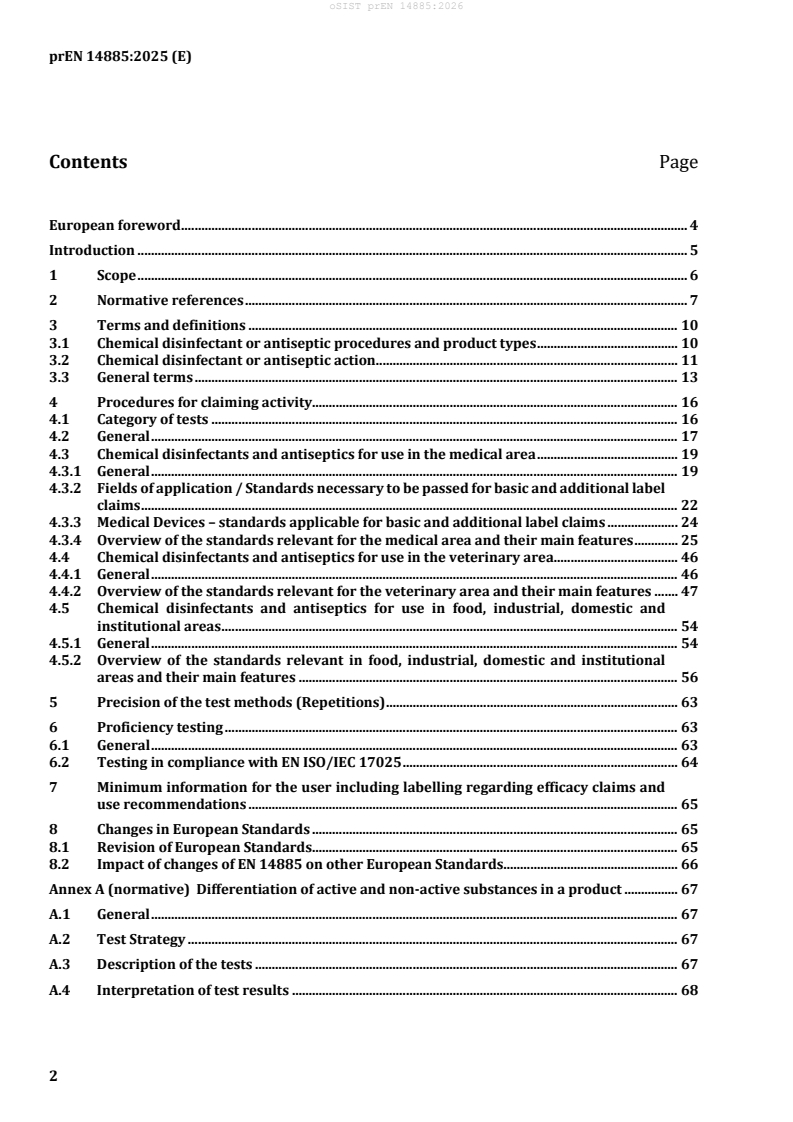
Contents Page
European foreword . 4
Introduction . 5
1 Scope . 6
2 Normative references . 7
3 Terms and definitions . 10
3.1 Chemical disinfectant or antiseptic procedures and product types . 10
3.2 Chemical disinfectant or antiseptic action . 11
3.3 General terms . 13
4 Procedures for claiming activity. 16
4.1 Category of tests . 16
4.2 General . 17
4.3 Chemical disinfectants and antiseptics for use in the medical area . 19
4.3.1 General . 19
4.3.2 Fields of application / Standards necessary to be passed for basic and additional label
claims . 22
4.3.3 Medical Devices – standards applicable for basic and additional label claims . 24
4.3.4 Overview of the standards relevant for the medical area and their main features . 25
4.4 Chemical disinfectants and antiseptics for use in the veterinary area . 46
4.4.1 General . 46
4.4.2 Overview of the standards relevant for the veterinary area and their main features . 47
4.5 Chemical disinfectants and antiseptics for use in food, industrial, domestic and
institutional areas . 54
4.5.1 General . 54
4.5.2 Overview of the standards relevant in food, industrial, domestic and institutional
areas and their main features . 56
5 Precision of the test methods (Repetitions) . 63
6 Proficiency testing . 63
6.1 General . 63
6.2 Testing in compliance with EN ISO/IEC 17025 . 64
7 Minimum information for the user including labelling regarding efficacy claims and
use recommendations . 65
8 Changes in European Standards . 65
8.1 Revision of European Standards . 65
8.2 Impact of changes of EN 14885 on other European Standards. 66
Annex A (normative) Differentiation of active and non-active substances in a product . 67
A.1 General . 67
A.2 Test Strategy . 67
A.3 Description of the tests . 67
A.4 Interpretation of test results . 68
Annex B (informative) Recommendations on the use of terms and definitions in the area of
disinfection and antisepsis. 69
Annex C (informative) Recommendations on claims of efficacy on the basis of activity tests . 71
Annex D (informative) Phase 3 tests and other means of assessing efficacy . 72
D.1 General . 72
D.2 Comparison with phase 2 tests . 72
D.3 Other means of assessing efficacy . 74
D.4 Requirement for a phase 3 test . 75
D.5 Safety . 75
D.6 Design of a phase 3 test . 76
D.7 Performance of a phase 3, step 2 field test . 77
D.8 Results of a phase 3 test . 78
Annex E (informative) Choice of meaningful concentrations when testing products
according to the standards . 79
Annex F (informative) CEN/TC 216 standards in preparation or under revision. 80
F.1 Medical area . 80
F.2 Veterinary area . 80
F.3 Food, industrial, domestic and institutional areas . 80
F.4 Others . 80
Annex G (informative) Translation of definitions (claims) . 81
Annex ZA (informative) Relationship between this European standard and the General
Safety and Performance Requirements of Regulation (EU) 2017/745 aimed to be
covered . 88
Bibliography . 91
European foreword
This document (prEN 14885:2025) has been prepared by Technical Committee CEN/TC 216 “Chemical
disinfectants and antiseptics”, the secretariat of which is held by AFNOR.
This document is currently submitted to the CEN-Enquiry.
This document will supersede EN 14885:2022.
EN 14885:2022 was revised to update the information on existing standards, to include standards
published since 2023 and to give more details how to use the standards for making claims. CEN/TC 216
has prepared a series of standards on chemical disinfectants and antiseptics specifying requirements and
test methods. The purpose of this document is to specify the relationship of the various standards to one
another and to claims and use recommendations.
To allow for different requirements in different areas of application, separate tests and pass criteria have
been or will be prepared for each of the following three areas of application: medical, veterinary, and a
group comprising food, industrial, domestic and institutional areas.
This document only refers to test methods which are currently included in the work programme of
CEN/TC 216 and which are described in Clause 2. It is likely that additional standards which relate to
specific situations will be produced at a later time.
This document was revised to adapt it to the latest state of CEN/TC 216, to correct errors and ambiguities.
The following is a list of significant changes since the last edition:
— Harmonization of the standard: introduction changed accordingly and clarification was added with
the scope that medical devices are encompassed by the standards of WG 1;
— Normative references (2) updated, the standards revised after the last revision of EN 14885 are
signposted;
— Definition for biocidal products added;
— Addition of testing in compliance with EN ISO/IEC 17025 (new 6.2);
— Further aspects for phase 3 tests added;
— New Annex G “Translation of definitions (claims)”;
— New Annex ZA Relationship between this European standard and the General Safety and
Performance Requirements of Regulation (EU) 2017/745 aimed to be covered”
The changes mentioned above have no impact on the use of test results obtained with reference to the
former version of EN 14885 if a standard has not been revised in the meantime. Those results are still
valid. If there is a new edition in Clause 2 cited (standard revised) refer to the information in Clause 8.
This document has been prepared under a standardization request addressed to CEN by the European
Commission. The Standing Committee of the EFTA States subsequently approves these requests for its
Member States.
For the relationship with EU Legislation, see informative Annex ZA, which is an integral part of this
document
Introduction
This document specifies the laboratory methods to be used for testing the activity of products, i.e.
chemical disinfectants (including those considered as medical devices) and antiseptics in order to
support claims that they have specific properties appropriate to their intended application. These
laboratory methods may also be used for active substances and products under development. This
document is not intended to represent disinfection policy guidelines, i.e. guidelines for choosing and
assessing the suitability of products for particular situations.
The CEN standards relate to only a limited range of microbial species. These have been chosen as
representative species taking into account their relative resistance and their relevance to practical use.
The handling properties and the microbiological safety have also been considered in choosing the test
organisms.
The test methods in this document are based on the current scientific state of the art. It is recognized that
at the present time there is only limited knowledge regarding the relationship between the activity of
products as determined by suspension as compared with surface tests, and the relevance of the results
of both tests to conditions of use.
Chemical disinfectants and antiseptics need to always be used responsibly. This needs to take into
account the environmental impact of inappropriate product in-use concentrations (too high or too low)
and of unnecessary use.
This document is continuously updated as the standards it refers to are advanced and evolve. To simplify
the update process, dated references are included in Clause 2, but not throughout the document. Users
should refer to Clause 2 to identify the date of the referenced standard.
1 Scope
This document specifies the European Standards to which products have to conform in order to support
the claims for microbicidal activity which are referred to in this document.
This document also specifies terms and definitions which are used in European Standards.
It is applicable to products for which activity is claimed against the following microorganisms: vegetative
bacteria (including mycobacteria and Legionella), bacterial spores, yeasts, fungal spores and viruses
(including bacteriophages).
It is intended to:
a) enable manufacturers of products to select the appropriate standards to be used in order to provide
data which support their claims for a specific product;
b) enable users of the product to assess the information provided by the manufacturer in relation to the
use for which they intend to use the product;
c) assist regulatory authorities in assessing claims made by the manufacturer or by the person
responsible for placing the product on the market.
It is applicable to products to be used in the area of human medicine, the veterinary area and in food,
industrial, domestic and institutional areas.
In the area of human medicine (Working Group 1, i.e. WG 1), it is applicable to chemical disinfectants and
antiseptics to be used in areas and situations where disinfection or antisepsis is medically indicated. Such
indications occur in patient care
— in hospitals, in community medical facilities, dental institutions and medical laboratories for analyses
and research,
— in clinics of schools, of kindergartens and of nursing homes,
— and may also occur in the workplace and in the home. It may also include services such as in laundries
and kitchens supplying products directly for the patient.
Chemical disinfectants considered as medical devices are encompassed within WG 1.
In the veterinary area (WG 2) it is applicable to chemical disinfectants and antiseptics to be used in the
areas of breeding, husbandry, veterinary care facilities, production, transport and disposal of animals and
veterinary laboratories for analyses and research. It is not applicable to chemical disinfectants used in
the food chain following death and entry to the processing industry.
In food, industrial, domestic and institutional areas (WG 3) it is applicable to chemical disinfectants and
antiseptics to be used in processing, distribution and retailing of food of animal or vegetable origin. It is
also applicable to products for all public areas where disinfection is not medically indicated (homes,
catering, schools, nurseries, transports, hotels, offices etc.) and products used in packaging,
biotechnology, laboratories (except laboratories for veterinary and medical analyses and research),
pharmaceutical, cosmetic etc. industries.
This document is also applicable to active substances and products under development for which no area
of application has yet been specified.
This document will be periodically updated to reflect the current published versions of each standard
developed in CEN/TC 216. Independent of this update newly published standards are to be used, even if
they are not yet mentioned in EN 14885.
This document does not refer to methods for testing the toxicological and ecotoxicological properties of
products or active substances.
2 Normative references
The following documents are referred to in the text in such a way that some or all of their content
constitutes requirements of this document. For dated references, only the edition cited applies. For
undated references, the latest edition of the referenced document (including any amendments) applies.
EN 1040:2005, Chemical disinfectants and antiseptics - Quantitative suspension test for the evaluation of
basic bactericidal activity of chemical disinfectants and antiseptics - Test method and requirements (phase
1)
EN 1275:2005, Chemical disinfectants and antiseptics - Quantitative suspension test for the evaluation of
basic fungicidal or basic yeasticidal activity of chemical disinfectants and antiseptics - Test method and
requirements (phase 1)
EN 1276:2019, Chemical disinfectants and antiseptics - Quantitative suspension test for the evaluation of
bactericidal activity of chemical disinfectants and antiseptics used in food, industrial, domestic and
institutional areas - Test method and requirements (phase 2, step 1)
EN 1499:2013, Chemical disinfectants and antiseptics - Hygienic handwash - Test method and requirements
(phase 2/step 2)
EN 1500:2013, Chemical disinfectants and antiseptics - Hygienic handrub - Test method and requirements
(phase 2/step 2)
EN 1650:2019, Chemical disinfectants and antiseptics - Quantitative suspension test for the evaluation of
fungicidal or yeasticidal activity of chemical disinfectants and antiseptics used in food, industrial, domestic
and institutional areas - Test method and requirements (phase 2, step 1)
EN 1656:2019, Chemical disinfectants and antiseptics - Quantitative suspension test for the evaluation of
bactericidal activity of chemical disinfectants and antiseptics used in the veterinary area - Test method and
requirements (phase 2, step 1)
EN 1657:2024, Chemical disinfectants and antiseptics - Quantitative suspension test for the evaluation of
fungicidal or yeasticidal activity of chemical disinfectants and antiseptics used in the veterinary area - Test
method and requirements (phase 2, step 1)
EN 12353:2021, Chemical disinfectants and antiseptics - Preservation of test organisms used for the
determination of bactericidal (including Legionella), mycobactericidal, sporicidal, fungicidal and virucidal
(including bacteriophages) activity
EN 12791:2016+A1:2017, Chemical disinfectants and antiseptics - Surgical hand disinfection - Test method
and requirements (phase 2, step 2)
EN 13610:2002, Chemical disinfectants - Quantitative suspension test for the evaluation of virucidal activity
against bacteriophages of chemical disinfectants used in food and industrial areas - Test method and
requirements (phase 2, step 1)
EN 13623:2020, Chemical disinfectants and antiseptics - Quantitative suspension test for the evaluation of
bactericidal activity against Legionella of chemical disinfectants for aqueous systems - Test method and
requirements (phase 2, step 1)
EN 13624:2021, Chemical disinfectants and antiseptics - Quantitative suspension test for the evaluation of
fungicidal or yeasticidal activity in the medical area - Test method and requirements (phase 2, step 1)
EN 13697:2023, Chemical disinfectants and antiseptics - Quantitative non-porous surface test for the
evaluation of bactericidal and yeasticidal and/or fungicidal activity of chemical disinfectants used in food,
industrial, domestic and institutional areas without mechanical action - Test method and requirements
without mechanical action (phase 2, step 2)
EN 13704:2018, Chemical disinfectants - Quantitative suspension test for the evaluation of sporicidal
activity of chemical disinfectants used in food, industrial, domestic and institutional areas - Test method and
requirements (phase 2, step 1)
EN 13727:2012+A2:2015, Chemical disinfectants and antiseptics - Quantitative suspension test for the
evaluation of bactericidal activity in the medical area - Test method and requirements (phase 2, step 1)
EN 14204:2025, Chemical disinfectants and antiseptics — Quantitative suspension test for the evaluation
of mycobactericidal activity of chemical disinfectants and antiseptics used in the veterinary area — Test
method and requirements (phase 2, step 1)
EN 14347:2005, Chemical disinfectants and antiseptics — Basic sporicidal activity — Test method and
requirements (phase 1)
EN 14348:2005, Chemical disinfectants and antiseptics - Quantitative suspension test for the evaluation of
mycobactericidal activity of chemical disinfectants in the medical area including instrument disinfectants -
Test methods and requirements (phase 2, step 1)
EN 14349:2025, Chemical disinfectants and antiseptics - Quantitative surface test for the evaluation of
bactericidal activity of chemical disinfectants and antiseptics used in the veterinary area on non-porous
surfaces without mechanical action - Test method and requirements (phase 2, step 2)
EN 14476:2025, Chemical disinfectants and antiseptics — Quantitative suspension test for the evaluation
of virucidal activity in the medical area — Test method and requirements (Phase 2/Step 1)
EN 14561:2006, Chemical disinfectants and antiseptics - Quantitative carrier test for the evaluation of
bactericidal activity for instruments used in the medical area - Test method and requirements (phase 2, step
2)
EN 14562:2006, Chemical disinfectants and antiseptics - Quantitative carrier test for the evaluation of
fungicidal or yeasticidal activity for instruments used in the medical area - Test method and requirements
(phase 2, step 2)
EN 14563:2008, Chemical disinfectants and antiseptics - Quantitative carrier test for the evaluation of
mycobactericidal or tuberculocidal activity of chemical disinfectants used for instruments in the medical
area - Test method and requirements (phase 2, step 2)
EN 14675:2015, Chemical disinfectants and antiseptics - Quantitative suspension test for the evaluation of
virucidal activity of chemical disinfectants and antiseptics used in the veterinary area - Test method and
requirements (Phase 2, step 1)
EN 16437:2014+A1:2019, Chemical disinfectants and antiseptics - Quantitative surface test for the
evaluation of bactericidal activity of chemical disinfectants and antiseptics used in veterinary area on
porous surfaces without mechanical action - Test method and requirements (phase 2, step 2)
EN 16438:2014, Chemical disinfectants and antiseptics - Quantitative surface test for the evaluation of
fungicidal or yeasticidal activity of chemical disinfectants and antiseptics used in the veterinary area on non-
porous surfaces without mechanical action - Test method and requirements (phase 2, step 2)
EN 16615:2015, Chemical disinfectants and antiseptics - Quantitative test method for the evaluation of
bactericidal and yeasticidal activity on non-porous surfaces with mechanical action employing wipes in the
medical area (4- field test) - Test method and requirements (phase 2, step 2)
EN 16616:2022+A1:2025, Chemical disinfectants and antiseptics—- Chemical-thermal textile disinfection
— Test method and requirements (phase 2, step 2)
EN 16777:2018, Chemical disinfectants and antiseptics - Quantitative non-porous surface test without
mechanical action for the evaluation of virucidal activity of chemical disinfectants used in the medical area
- Test method and requirements (phase 2/step 2)
EN 17111:2018, Chemical disinfectants and antiseptics - Quantitative carrier test for the evaluation of
virucidal activity for instruments used in the medical area - Test method and requirements (phase 2, step 2)
EN 17122:2019+A1:2024, Chemical disinfectants and antiseptics - Quantitative non-porous surface test for
the evaluation of virucidal activity of chemical disinfectants and antiseptics used in the veterinary area -
Test method and requirements - Phase2, step2
EN 17126:2018, Chemical disinfectants and antiseptics - Quantitative suspension test for the evaluation of
sporicidal activity of chemical disinfectants in the medical area - Test method and requirements (phase 2,
step 1)
EN 17272:2020, Chemical disinfectants and antiseptics - Methods of airborne room disinfection by
automated process - Determination of bactericidal, mycobactericidal, sporicidal, fungicidal, yeasticidal,
virucidal and phagocidal activities
EN 17387:2021, Chemical disinfectants and antiseptics - Quantitative test for the evaluation of bactericidal
and yeasticidal and/or fungicidal activity of chemical disinfectants in the medical area on non-porous
surfaces without mechanical action - Test method and requirements (phase 2, step 2)
EN 17422:2022, Chemical disinfectants and antiseptics - Quantitative surface test for the evaluation of teat
disinfectants used in the veterinary area - Test method and requirements (phase 2 step 2)
EN 17430:2024, Chemical disinfectants and antiseptics - Hygienic handrub virucidal - Test method and
requirements (phase 2/step 2)
EN 17658:2022, Chemical disinfectants and antiseptics - Chemical textile disinfection for the domestic area
- Test method and requirements (phase 2, step 2)
EN 17846:2023, Chemical disinfectants and antiseptics - Quantitative test method for the evaluation of
sporicidal activity against Clostridioides difficile on non-porous surfaces with mechanical action employing
wipes in the medical area (4-field test) - Test method and requirements (phase 2, step 2)
3 Terms and definitions
For the purposes of this document, the following terms and definitions apply.
ISO and IEC maintain terminological databases for use in standardization at the following addresses:
• IEC Electropedia: available at http://www.electropedia.org/
• ISO Online browsing platform: available at https://www.iso.org/obp
NOTE Some recommendations on the use of terminology in the areas of chemical disinfection and antisepsis
are given in Annex B.
3.1 Chemical disinfectant or antiseptic procedures and product types
3.1.1
antiseptic
product – excluding antibiotics – that is used to bring about antisepsis
3.1.2
antisepsis
application of an antiseptic on living tissues causing an action on the structure or metabolism of
microorganisms to a level judged to be appropriate to prevent and/or limit and/or treat an infection of
those tissues
Note 1 to entry: The term microorganism encompasses bacteria (including mycobacteria and bacterial
endospores), fungi (including moulds, fungal spores and yeasts), viruses (including bacteriophages), algae and
oocysts (see also 3.3.13)
3.1.3
chemical disinfectant
product that is capable of chemical disinfection
3.1.4
chemical disinfection
reduction of the number of microorganisms in or on an inanimate or animate matrix, achieved by the
irreversible action of a product on their structure or metabolism, to a level judged to be appropriate for
a defined purpose
Note 1 to entry: The term microorganism encompasses bacteria (including mycobacteria and bacterial
endospores), fungi (including moulds, fungal spores and yeasts), viruses (including bacteriophages), algae and
oocysts (see also 3.3.13)
Note 2 to entry: Products for antisepsis are excluded
3.1.5
hygienic handrub
treatment of hands by rubbing a product without the addition of water, that is directed against transiently
contaminating microorganisms to prevent their transmission regardless of the resident skin flora
3.1.6
hygienic handwash
treatment of hands by washing with product and water, that is directed against transiently contaminating
microorganisms to prevent their transmission regardless of the resident skin flora
3.1.7
instrument disinfection
chemical disinfection of certain instrument surfaces in the medical and veterinary areas by immersion
3.1.8
surface disinfection
chemical disinfection of a solid surface, including those of certain medical and veterinary instruments
which cannot be immersed, by the application of a product with or without mechanical action
Note 1 to entry: The application includes e.g. wiping, mopping, circulation, flooding, spraying, fogging, etc.
3.1.9
surgical handrub
preoperative treatment of hands by rubbing a product without the addition of water, that is directed
against the flora of microorganisms on hands to prevent the transmission of microorganisms into the
surgical wound
3.1.10
surgical handwash
preoperative treatment of hands by washing with product and water, that is directed against the flora of
microorganisms on hands to prevent the transmission of microorganisms into the surgical wound
3.1.11
textile disinfection
chemical disinfection of textiles through the application of a product by either immersion in a solution or
by processing in a washing machine
3.2 Chemical disinfectant or antiseptic action
3.2.1
algaecidal activity
capability of a product to reduce the quantity of algae as test organisms, specified in the corresponding
standard(s), under defined conditions
3.2.2
bactericidal activity
capability of a product to reduce the number of viable bacterial cells of relevant test organisms, specified
in the corresponding standard(s), under defined conditions
3.2.3
fungicidal activity
capability of a product to reduce the number of viable yeast cells and mould spores of relevant test
organisms, specified in the corresponding standard(s), under defined conditions
3.2.4
microbicidal activity
microbiocidal activity
capability of a product to reduce the number of relevant test organisms including viable bacterial cells
and/or viable yeast cells and/or mould spores and/or viable bacterial endospores and/or infectious virus
particles and/or infectious bacteriophage particles and/or algae and/or oocysts, specified in the
corresponding standard(s)
Note 1 to entry: The above term is a general term, not to be used for claims according to Clause 7 c).
3.2.5
microbistatic activity
microbiostatic activity
capability of a product to inhibit the growth of relevant test organisms, including viable bacterial cells
and/or viable yeast cells and/or mould spores and/or viable bacterial endospores and/or infectious virus
particles and/or infectious bacteriophage particles and/or algae and/or oocysts under defined
conditions
Note 1 to entry: The above term and related terms like “bacteriostatic”, “fungistatic” are used in CEN / TC 216
standards but cannot be used for claims according to the scope (Clause 1).
3.2.6
mycobactericidal activity
capability of a product to reduce the number of viable mycobacterial cells of relevant test organisms,
specified in the corresponding standard(s), under defined conditions
3.2.7
oocysticidal activity
capability of a product to reduce the number of oocysts of relevant test organisms, specified in the
corresponding standard(s), under defined conditions
3.2.8
phagocidal activity
capability of a product to reduce the number of infectious bacteriophage particles of relevant test
organisms, specified in the corresponding standard(s), under defined conditions
3.2.9
sporicidal activity levels
different levels of sporicidal activity with various gradations against aerobic and/or anaerobic bacterial
endospores
Note 1 to entry: The two different levels are: sporicidal activity (3.2.9.1), Sporicidal activity against C. difficile in
human medicine (3.2.9.2).
3.2.9.1
sporicidal activity
capability of a product to reduce the number of viable aerobic and anaerobic bacterial endospores of
relevant test organisms, specified in the corresponding standard(s), under defined conditions
3.2.9.2
sporicidal activity against C. difficile in human medicine
capability of a product to reduce the number of viable bacterial endospores of C. difficile, specified in the
corresponding standard(s), under defined conditions
3.2.10
tuberculocidal activity
capability of a product to reduce the number of viable cells of relevant Mycobacteria as test organism,
specified in the corresponding standard(s), under defined conditions
3.2.11
virucidal activity levels
different levels of virucidal activity with various gradations
Note 1 to entry: The three different levels are: virucidal activity (3.2.11.1), limited spectrum virucidal activity
(3.2.11.2) and virucidal activity against enveloped viruses (3.2.11.3)
3.2.11.1
virucidal activity
capability of a product to reduce the number of infectious virus particles of relevant test organisms,
specified in the corresponding standard(s), under defined conditions
Note 1 to entry: virucidal activity covers enveloped and non-enveloped viruses
3.2.11.2
limited spectrum virucidal activity
capability of a product to reduce the number of infectious virus particles using certain non-enveloped
viruses as test organisms, specified in the corresponding standard(s), under defined conditions, thus
covering virucidal activity against these test organisms, and additionally defined other non-enveloped
virus(es) and all enveloped viruses
3.2.11.3
virucidal activity against enveloped viruses
capability of a product to reduce the number of infectious virus particles using relevant enveloped viruses
as test organism, specified in the corresponding standard(s), thus covering activity against all enveloped
viruses
3.2.12
yeasticidal activity
capability of a product to reduce the number of viable yeast cells of relevant test organisms, specified in
the corresponding standard(s), under defined conditions
3.3 General terms
3.3.1
active substance
substance or microorganism that has an action on or against harmful organisms
[SOURCE: Biocide Product Regulation (EU) 528/2012, Article 3(1)(c)]
Note 1 to entry: In standards developed by CEN/TC 216 only chemical substances are used as active substances.
Note 2 to entry: The term “harmful organism” encompasses bacteria (including mycobacteria and bacterial
endospores), fungi (including moulds, fungal spores and yeasts) and viruses (including bacteriophages), algae and
oocysts.
Note 3 to entry: In standards developed by CEN/TC 216 the term “product” encompasses “active substance”.
3.3.2
additional test conditions
test conditions in a standard that are optional and not obligatory, that may be used for further specific
product claims and/or applications
Note 1 to entry: Such test conditions can be found in the same or in an additional standard.
3.3.3
biocidal product
biocidal products are used to control unwanted organisms that are harmful to human or animal health or
to the environment, or that cause damage to human activities. These harmful organisms include pests
(e.g. insects, rats or mice) and microorganisms (e.g. bacteria, viruses, mould)
[SOURCE: Overview (europa.eu)]
Note 1 to entry: Other definition for biocidal product:
— any substance or mixture, in the form in which it is supplied to the user, consisting of, containing or
generating one or more active substances, with the intention of destroying, deterring, rendering harmless,
preventing the action of, or otherwise exerting a controlling effect on, any harmful organism by any means other
than mere physical or mechanical action,
— any substance or mixture, generated from substances or mixtures which do not themselves fall under
the first indent, to be used with the intention of destroying, deterring, rendering harmless, preventing the action of,
or otherwise exerting a controlling effect on, any harmful organism by any means other than mere physical or
mechanical action,
A treated article that has a primary biocidal function shall be considered a biocidal product.
[SOURCE: Biocide Product Regulation (EU) 528/2012, Article 3(1)(a)]
3.3.4
contact time
time period during application of the product in a test that elapses between its first contact with the test
organisms, and its neutralization
3.3.5
interfering substance
soiling
additional substances simulating the conditions of the soiling level in the test
Note 1 to entry: Two levels of soiling are used in the standards see clean conditions (3.3.5.1) and dirty conditions
(3.3.5.2)
3.3.5.1
clean conditions
conditions representative of surfaces which have been cleaned satisfactorily and/or are known to contain
minimal levels of organic and/or inorganic substances
Note 1 to entry: In the veterinary area, these conditions are called “low level soiling”. The term “low level soiling”
has been introduced to avoid confusion in the veterinary area where the respective levels of soiling are higher.
3.3.5.2
dirty conditions
conditions representative of surfaces which have not been cleaned and are known to contain or
potentially contain organic and/or inorganic substances
Note 1 to entry: In the veterinary area, these conditions are called “high level soiling”. The term “high level
soiling” has been introduced to avoid confusion in the veterinary area where the respective levels of soiling are
higher.
3.3.6
limiting test organism
test organism that requires the highest concentration to give the specified decimal logarithm (lg)
reduction (it is the least susceptible test organism to the product in the chosen experimental conditions)
3.3.7
medical device
any instrument, apparatus, appliance, software, implant, reagent, material or other article intended by
the manufacturer to be used, alone or in combination, for human beings for one or more of the following
specific medical purposes:
— diagnosis, prevention, monitoring, prediction, prognosis, treatment or alleviation of disease,
— diagnosis, monitoring, treatment, alleviation of, or compensation for, an injury or disability,
— investigation, replacement or modification of the anatomy or of a physiological or pathological
process or state,
— providing information by means of in vitro examination of specimens derived from the human body,
including organ, blood and tissue donations,
and which does not achieve its principal intended action by pharmacological, immunological or metabolic
means, in or on the human body, but which may be assisted in its function by such means
The following products shall also be deemed to be medical devices:
— devices for the control or support of conception;
— products specifically intended for the cleaning, disinfection or sterilisation of devices as referred to
in Article 1(4) and of those referred to in the first paragraph of this point
[SOURCE: REGULATION (EU) 2017/745 OF THE EUROPEAN PARLIAMENT AND OF THE COUNCIL of 5
April 2017 on medical devices, amending Directive 2001/83/EC, Regulation (EC) No 178/2002 and
Regulation (EC) No 1223/2009 and repealing Council Directives 90/385/EEC and 93/42/EEC]
Note 1 to entry: In standards developed by CEN/TC 216 only products used to disinfect medical devices are
considered as medical devices
3.3.8
neutralization
process that suppresses the residual microbicidal activity of a product or active substance within a
specific test but does not inactivate or inhibit the test organism using neutralizer and/or dilution (e.g.
membrane filtration)
3.3.9
neutralizer
chemical agent or formulation that is used for neutralization
...