

prEN 1856-2
(Main)Chimneys - Requirements for metal chimneys - Part 2: Metal flue liners and connecting flue pipes
General Information
- Abstract
This document specifies the characteristics of performance for rigid or flexible metal flue liners, rigid metal connecting flue pipes and their fittings used to convey the products of combustion from appliances to the outside atmosphere (including their supports).
This document specifies sootfire resistant flue liners, connecting flue pipes and fittings for combustion appliances burning solid, liquid and gaseous fuels and non-sootfire resistant flue liners, connecting flue pipes and fittings for combustion appliances burning liquid and gaseous fuels only.
NOTE This means that flue liners, connecting flue pipes and fittings designated "O" are not suitable for combustion appliances burning solid fuel.
Vitreous enamelled connecting flue pipes are also covered by this document.
Rigid flue liners can be used as flue liners for renovation or adaptation of existing chimneys and as flue liners of custom built chimneys.
Flexible metal flue liners described in this document are exclusively for renovation or adaptation of existing chimneys. Flexible connecting flue pipes and extensible flexible products designed to be compressed or extended along their length are excluded from the scope of this document.
This document also specifies the characteristics for marking, manufacturer's instructions, product information and evaluation of conformity.
Single wall and multi-wall system chimney products (chimney sections, chimney fittings and terminals, including supports) are covered by prEN 1856-1:2019, even if used as liners for existing chimneys or connecting flue pipes.
- Status
- Not Published
- Technical Committee
- CEN/TC 166 - Chimneys
- Drafting Committee
- CEN/TC 166/SC 2/WG 3 - Metal chimneys - Liners and connecting flue pipes
- Current Stage
- 4098 - Decision to abandon - Enquiry
- Completion Date
- 30-Mar-2021


Overview
prEN 1856-2:2019 - "Chimneys - Requirements for metal chimneys - Part 2: Metal flue liners and connecting flue pipes" is a CEN draft European Standard that defines performance characteristics, testing and conformity requirements for rigid and flexible metal flue liners, rigid connecting flue pipes and their fittings used to convey combustion products to the outside atmosphere. The standard covers sootfire‑resistant and non‑sootfire items (noting products designated “O” are not suitable for solid fuel), manufacturer marking and instructions, and assessment and verification of constancy of performance under the EU Construction Products Regulation (EU 305/2011).
Key topics and technical requirements
- Scope and product definitions: rigid flue liners (usable for new or renovated chimneys), flexible flue liners (for renovation only), rigid connecting flue pipes and fittings; excludes flexible connecting pipes and extensible/compressible flexible products.
- Sootfire resistance: classification and test requirements for liners and fittings for solid, liquid and gaseous fuels.
- Mechanical performance: tensile, crushing, torsion and flexibility tests for liners and connecting pipes.
- Thermal performance: behaviour at normal operating conditions and during thermal testing; requirements to limit heat transfer and ensure safe operation.
- Gas tightness and condensate resistance: tests and acceptance criteria to prevent leaks and corrosion from vapour/liquid condensates.
- Durability and corrosion: accelerated corrosion testing, freeze‑thaw and elastomeric seal performance to ensure service life.
- Marking, documentation and AVCP: manufacturer’s instructions, minimum product data, marking, packaging and factory production control (FPC), plus AVCP procedures aligned with the CPR.
Applications and practical value
- Ensures safe, durable, and code‑compliant metal liners and connecting flue pipes for domestic and commercial combustion appliances.
- Used for renovation projects (rigid and flexible liners), bespoke chimney builds (rigid liners), and in systems where connecting flue pipes must meet gas‑tightness and thermal constraints.
- Supports manufacturers in product design, testing and CE marking; helps installers, specifiers, building inspectors and certifying bodies assess compliance and suitability for fuel types (solid, liquid, gaseous).
Who uses this standard
- Chimney and flue product manufacturers
- HVAC and chimney installers and contractors
- Building designers, architects and consulting engineers
- Testing laboratories and conformity assessment bodies
- Regulatory authorities and construction product certifiers
Related standards
- prEN 1856-1:2019 - Single wall and multi‑wall system chimney products (chimney sections, fittings and terminals) - referenced for full system products.
- EN 1856-2:2009 - earlier version to be superseded by this draft.
Keywords: prEN 1856-2, metal flue liners, connecting flue pipes, sootfire resistant, chimneys, flexible flue liners, gas tightness, corrosion resistance, AVCP, CE marking.
Get Certified
Connect with accredited certification bodies for this standard

DIBt (Deutsches Institut für Bautechnik)
German Institute for Building Technology.
DIN CERTCO
DIN Group product certification.

Aboma Certification B.V.
Specialized in construction, metal, and transport sectors.
Sponsored listings
Frequently Asked Questions
prEN 1856-2 is a draft published by the European Committee for Standardization (CEN). Its full title is "Chimneys - Requirements for metal chimneys - Part 2: Metal flue liners and connecting flue pipes". This standard covers: This document specifies the characteristics of performance for rigid or flexible metal flue liners, rigid metal connecting flue pipes and their fittings used to convey the products of combustion from appliances to the outside atmosphere (including their supports). This document specifies sootfire resistant flue liners, connecting flue pipes and fittings for combustion appliances burning solid, liquid and gaseous fuels and non-sootfire resistant flue liners, connecting flue pipes and fittings for combustion appliances burning liquid and gaseous fuels only. NOTE This means that flue liners, connecting flue pipes and fittings designated "O" are not suitable for combustion appliances burning solid fuel. Vitreous enamelled connecting flue pipes are also covered by this document. Rigid flue liners can be used as flue liners for renovation or adaptation of existing chimneys and as flue liners of custom built chimneys. Flexible metal flue liners described in this document are exclusively for renovation or adaptation of existing chimneys. Flexible connecting flue pipes and extensible flexible products designed to be compressed or extended along their length are excluded from the scope of this document. This document also specifies the characteristics for marking, manufacturer's instructions, product information and evaluation of conformity. Single wall and multi-wall system chimney products (chimney sections, chimney fittings and terminals, including supports) are covered by prEN 1856-1:2019, even if used as liners for existing chimneys or connecting flue pipes.
This document specifies the characteristics of performance for rigid or flexible metal flue liners, rigid metal connecting flue pipes and their fittings used to convey the products of combustion from appliances to the outside atmosphere (including their supports). This document specifies sootfire resistant flue liners, connecting flue pipes and fittings for combustion appliances burning solid, liquid and gaseous fuels and non-sootfire resistant flue liners, connecting flue pipes and fittings for combustion appliances burning liquid and gaseous fuels only. NOTE This means that flue liners, connecting flue pipes and fittings designated "O" are not suitable for combustion appliances burning solid fuel. Vitreous enamelled connecting flue pipes are also covered by this document. Rigid flue liners can be used as flue liners for renovation or adaptation of existing chimneys and as flue liners of custom built chimneys. Flexible metal flue liners described in this document are exclusively for renovation or adaptation of existing chimneys. Flexible connecting flue pipes and extensible flexible products designed to be compressed or extended along their length are excluded from the scope of this document. This document also specifies the characteristics for marking, manufacturer's instructions, product information and evaluation of conformity. Single wall and multi-wall system chimney products (chimney sections, chimney fittings and terminals, including supports) are covered by prEN 1856-1:2019, even if used as liners for existing chimneys or connecting flue pipes.
prEN 1856-2 is classified under the following ICS (International Classification for Standards) categories: 91.060.40 - Chimneys, shafts, ducts. The ICS classification helps identify the subject area and facilitates finding related standards.
prEN 1856-2 is associated with the following European legislation: Standardization Mandates: M/105, M/117. When a standard is cited in the Official Journal of the European Union, products manufactured in conformity with it benefit from a presumption of conformity with the essential requirements of the corresponding EU directive or regulation.
prEN 1856-2 is available in PDF format for immediate download after purchase. The document can be added to your cart and obtained through the secure checkout process. Digital delivery ensures instant access to the complete standard document.
Standards Content (Sample)
SLOVENSKI STANDARD
01-september-2019
Dimniki - Zahteve za kovinske dimnike - 2. del: Kovinske tuljave in dimniški
priključki
Chimneys - Requirements for metal chimneys - Part 2: Metal flue liners and connecting
flue pipes
Abgasanlagen - Anforderungen an Metall-Abgasanlagen - Teil 2: Innenrohre und
Verbindungsstücke aus Metall
Conduits de fumée - Prescriptions pour les conduits de fumée métalliques - Partie 2 :
Tubages et éléments de raccordements métalliques
Ta slovenski standard je istoveten z: prEN 1856-2
ICS:
91.060.40 Dimniki, jaški, kanali Chimneys, shafts, ducts
2003-01.Slovenski inštitut za standardizacijo. Razmnoževanje celote ali delov tega standarda ni dovoljeno.
DRAFT
EUROPEAN STANDARD
NORME EUROPÉENNE
EUROPÄISCHE NORM
May 2019
ICS 91.060.40 Will supersede EN 1856-2:2009
English Version
Chimneys - Requirements for metal chimneys - Part 2:
Metal flue liners and connecting flue pipes
Conduits de fumée - Prescriptions pour les conduits de Abgasanlagen - Anforderungen an Metall-
fumée métalliques - Partie 2 : Tubages et éléments de Abgasanlagen - Teil 2: Innenrohre und
raccordements métalliques Verbindungsstücke aus Metall
This draft European Standard is submitted to CEN members for enquiry. It has been drawn up by the Technical Committee
CEN/TC 166.
If this draft becomes a European Standard, CEN members are bound to comply with the CEN/CENELEC Internal Regulations
which stipulate the conditions for giving this European Standard the status of a national standard without any alteration.
This draft European Standard was established by CEN in three official versions (English, French, German). A version in any other
language made by translation under the responsibility of a CEN member into its own language and notified to the CEN-CENELEC
Management Centre has the same status as the official versions.
CEN members are the national standards bodies of Austria, Belgium, Bulgaria, Croatia, Cyprus, Czech Republic, Denmark, Estonia,
Finland, Former Yugoslav Republic of Macedonia, France, Germany, Greece, Hungary, Iceland, Ireland, Italy, Latvia, Lithuania,
Luxembourg, Malta, Netherlands, Norway, Poland, Portugal, Romania, Serbia, Slovakia, Slovenia, Spain, Sweden, Switzerland,
Turkey and United Kingdom.
Recipients of this draft are invited to submit, with their comments, notification of any relevant patent rights of which they are
aware and to provide supporting documentation.
Warning : This document is not a European Standard. It is distributed for review and comments. It is subject to change without
notice and shall not be referred to as a European Standard.
EUROPEAN COMMITTEE FOR STANDARDIZATION
COMITÉ EUROPÉEN DE NORMALISATION
EUROPÄISCHES KOMITEE FÜR NORMUNG
CEN-CENELEC Management Centre: Rue de la Science 23, B-1040 Brussels
© 2019 CEN All rights of exploitation in any form and by any means reserved Ref. No. prEN 1856-2:2019 E
worldwide for CEN national Members.
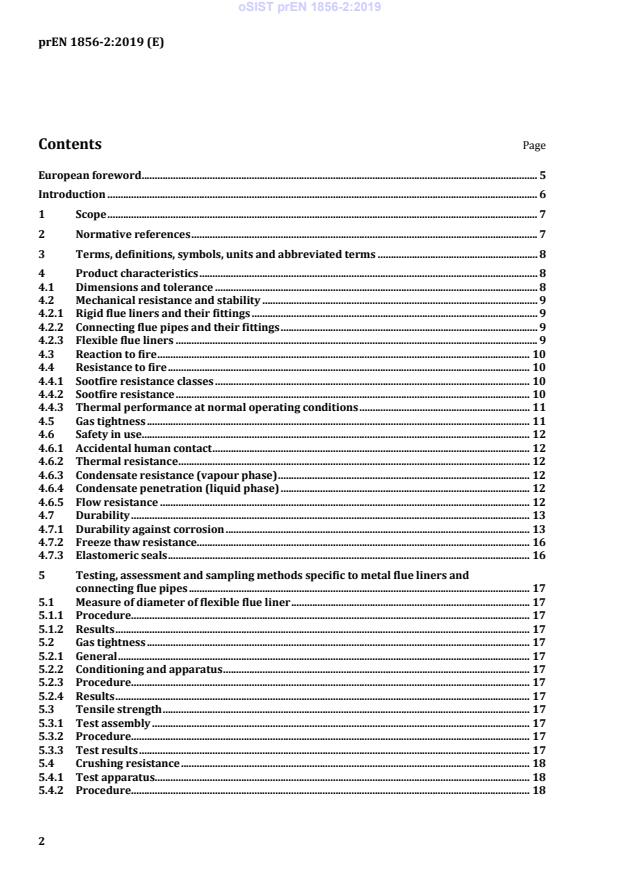
Contents Page
European foreword . 5
Introduction . 6
1 Scope . 7
2 Normative references . 7
3 Terms, definitions, symbols, units and abbreviated terms . 8
4 Product characteristics . 8
4.1 Dimensions and tolerance . 8
4.2 Mechanical resistance and stability . 9
4.2.1 Rigid flue liners and their fittings . 9
4.2.2 Connecting flue pipes and their fittings . 9
4.2.3 Flexible flue liners . 9
4.3 Reaction to fire . 10
4.4 Resistance to fire . 10
4.4.1 Sootfire resistance classes . 10
4.4.2 Sootfire resistance . 10
4.4.3 Thermal performance at normal operating conditions . 11
4.5 Gas tightness . 11
4.6 Safety in use. 12
4.6.1 Accidental human contact . 12
4.6.2 Thermal resistance . 12
4.6.3 Condensate resistance (vapour phase) . 12
4.6.4 Condensate penetration (liquid phase) . 12
4.6.5 Flow resistance . 12
4.7 Durability . 13
4.7.1 Durability against corrosion . 13
4.7.2 Freeze thaw resistance . 16
4.7.3 Elastomeric seals . 16
5 Testing, assessment and sampling methods specific to metal flue liners and
connecting flue pipes . 17
5.1 Measure of diameter of flexible flue liner . 17
5.1.1 Procedure. 17
5.1.2 Results . 17
5.2 Gas tightness . 17
5.2.1 General . 17
5.2.2 Conditioning and apparatus . 17
5.2.3 Procedure. 17
5.2.4 Results . 17
5.3 Tensile strength . 17
5.3.1 Test assembly . 17
5.3.2 Procedure. 17
5.3.3 Test results . 17
5.4 Crushing resistance . 18
5.4.1 Test apparatus. 18
5.4.2 Procedure. 18
5.4.3 Test results . 18
5.5 Flexibility test . 18
5.5.1 Test apparatus . 18
5.5.2 Test conditioning . 19
5.5.3 Procedure . 19
5.5.4 Results . 19
5.6 Torsion strength test . 19
5.6.1 Test apparatus . 19
5.6.2 Test assembly . 20
5.6.3 Procedure . 20
5.6.4 Results . 20
5.7 Thermal performance test . 21
5.7.1 General . 21
5.7.2 Apparatus . 21
5.7.3 Test structures . 21
5.7.4 Test samples . 22
5.7.5 Thermal performance test procedure . 23
6 Assessment and verification of constancy of performance – AVCP . 28
6.1 General . 28
6.2 Type testing . 28
6.2.1 General . 28
6.2.2 Test samples, testing and compliance criteria . 29
6.2.3 Test reports . 30
6.2.4 Shared other party results . 30
6.2.5 Cascading determination of the product type results . 31
6.3 Factory production control (FPC) . 32
6.3.1 General . 32
6.3.2 Characteristics . 33
6.3.3 Product specific characteristics . 35
6.3.4 Initial inspection of factory and of FPC . 35
6.3.5 Continuous surveillance of FPC . 36
6.3.6 Procedure for modifications . 36
6.3.7 One-off components, pre-production products (e.g. prototypes) and components
produced in very low quantity . 36
7 Product classification and designation . 37
7.1 Manufacturer's instructions . 37
7.2 Minimum information to be included in the manufacturer’s documentation and
instructions . 37
7.2.1 General . 37
7.2.2 Rigid flue liners, and their fittings . 37
7.2.3 Connecting flue pipes and their fittings . 37
7.2.4 Flexible flue liners and their fittings . 38
7.3 Classification and designation . 38
8 Marking, labelling and packaging . 41
8.1 Flue liners, connecting flue pipes and their fittings . 41
8.2 Chimney plate . 41
8.3 Packaging . 41
Annex ZA (informative) Relationship of this European Standard with Regulation (EU)
No.305/2011 . 43
ZA.1 Scope and relevant characteristics . 43
ZA.2 System of Assessment and Verification of Constancy of Performance (AVCP) . 47
ZA.3 Assignment of AVCP tasks . 47
Bibliography . 50
European foreword
This document (prEN 1856-2:2019) has been prepared by Technical Committee CEN/TC 166
“Chimneys”, the secretariat of which is held by ASI.
This document is currently submitted to the CEN Enquiry.
This document has been prepared under a mandate given to CEN by the European Commission and the
European Free Trade Association.
For relationship with EU Directive(s), see informative Annex ZA, which is an integral part of this
document.
This document will supersede EN 1856-2:2009.
The main changes in comparison to EN 1856-2:2009 are:
— adoption of the template for harmonized standards under the EU Construction Products Regulation
(305/2011/EU) meaning a clearer definition of the Scope, rewording in Clause 4 "Product
characteristics", Clause 5 "Testing, assessment and sampling methods" and Clause 7 "Product
classification and designation", and adoption of the template for Clause 6 "Assessment and
verification of constancy of performance";
— adoption of the revised "Corrosion tests" specified in prEN 1856-1:2019.
Introduction
The generic word “chimney”, when used in this document, refers to all products used to convey the
products of combustion from appliances to the outside atmosphere, and thus includes all other terms of
common use in the trade, such as: vents, flues, shafts, exhaust systems, ducts, etc.
For addressing the durability against corrosion, a unique corrosion test has been introduced, as described
in prEN 1856-1:2019, Annex A; the material table with minimum material specification of the former
edition has been taken over.
1 Scope
This document specifies the characteristics of performance for rigid or flexible metal flue liners, rigid
metal connecting flue pipes and their fittings used to convey the products of combustion from appliances
to the outside atmosphere (including their supports).
This document specifies sootfire resistant flue liners, connecting flue pipes and fittings for combustion
appliances burning solid, liquid and gaseous fuels and non-sootfire resistant flue liners, connecting flue
pipes and fittings for combustion appliances burning liquid and gaseous fuels only.
NOTE This means that flue liners, connecting flue pipes and fittings designated "O" are not suitable for
combustion appliances burning solid fuel.
Vitreous enamelled connecting flue pipes are also covered by this document.
Rigid flue liners can be used as flue liners for renovation or adaptation of existing chimneys and as flue
liners of custom built chimneys.
Flexible metal flue liners described in this document are exclusively for renovation or adaptation of
existing chimneys. Flexible connecting flue pipes and extensible flexible products designed to be
compressed or extended along their length are excluded from the scope of this document.
This document also specifies the characteristics for marking, manufacturer's instructions, product
information and evaluation of conformity.
Single wall and multi-wall system chimney products (chimney sections, chimney fittings and terminals,
including supports) are covered by prEN 1856-1:2019, even if used as liners for existing chimneys or
connecting flue pipes.
2 Normative references
The following documents are referred to in the text in such a way that some or all of their content
constitutes requirements of this document. For dated references, only the edition cited applies. For
undated references, the latest edition of the referenced document (including any amendments) applies.
EN 573-3:2013, Aluminium and aluminium alloys — Chemical composition and form of wrought products
— Part 3: Chemical composition and form of products
EN 1443:2019, Chimneys — General requirements
prEN 1856-1:2019, Chimneys — Requirements for metal chimneys — Part 1: System chimney products
EN 13216-1:2019, Chimneys — Test methods for system chimneys — Part 1: General test methods
EN 10025-5:2004, Hot rolled products of structural steels — Part 5: Technical delivery conditions for
structural steels with improved atmospheric corrosion resistance
EN 10088-1:2014, Stainless steels — Part 1: List of stainless steels
EN 10131:2006, Cold rolled uncoated and zinc or zinc-nickel electrolytically coated low carbon and high
yield strength steel flat products for cold forming — Tolerances on dimensions and shape
EN 10209:2013, Cold rolled low carbon steel flat products for vitreous enamelling — Technical delivery
conditions
EN 10346:2015, Continuously hot-dip coated steel flat products for cold forming — Technical delivery
conditions
1)
EN 13384-1:2015 , Chimneys - Thermal and fluid dynamic calculation methods - Part 1: Chimneys serving
one heating appliance
EN 13501-1:2018, Fire classification of construction products and building elements — Part 1:
Classification using data from reaction to fire tests
EN 14241-1:2013, Chimneys — Elastomeric seals and elastomeric sealants — Material requirements and
test methods — Part 1: Seals in flue liners
EN 15287-1:2007+A1:2010, Chimneys — Design, installation and commissioning of chimneys — Part 1:
Chimneys for non-roomsealed heating appliances
3 Terms, definitions, symbols, units and abbreviated terms
For the purposes of this document, the terms and definitions given in EN 1443:2019 and
prEN 1856-1:2019 and the following apply.
ISO and IEC maintain terminological databases for use in standardization at the following addresses:
• IEC Electropedia: available at http://www.electropedia.org/
• ISO Online browsing platform: available at https://www.iso.org/obp
3.1
bending radius
minimum radius measured on the inner side of a flexible flue liner when bent
3.2
double skin flexible flue liner
flexible flue liner consisting of two layers of metal, where the inner layer forming the flue is flat and covers
the corrugations
3.3
flue liner kit
flue liner that is installed using a combination of compatible flue liner components, obtained or specified
as a kit from one manufacturing source with product responsibility for the whole flue liner including all
its components
Note 1 to entry: A flue liner kit is not considered a system chimney.
4 Product characteristics
4.1 Dimensions and tolerance
4.1.1 The thickness of materials from which the flue liners, connecting flue pipes and fittings are made
shall be not less than the minimum declared. The tolerance for material thickness shall not be more than
± 10 % of the nominal thickness.
4.1.2 The declared internal diameter of the flue liner, connecting flue pipe and fitting shall not vary by
more than ± 5 mm from the nominal size.
1) This document is impacted by the amendment EN 13384-1:2015/prA1:2018.
When measured in accordance with the procedure explained in 5.1 the internal diameter of the flexible
flue liner shall not be less than the declared diameter.
For rigid connecting flue pipe, the characteristics given in prEN 1856-1:2019, 4.2.2 shall apply.
For flexible flue liners, the internal diameter shall be measured in accordance with 5.1.
Oval flexible liners shall only be factory made and the ovalization ratio shall not exceed 1,5 maximum.
4.1.3 The installed length of rigid flue liners or rigid connecting flue pipes (measured on an assembly
including at least one joint) shall be in accordance with prEN 1856-1:2019, 4.2.4.
4.2 Mechanical resistance and stability
4.2.1 Rigid flue liners and their fittings
Rigid flue liners and their fittings shall comply with prEN 1856-1:2019, 4.3.1, 4.3.2 and 4.3.3 except wind
load.
4.2.2 Connecting flue pipes and their fittings
Connecting flue pipes and their fittings shall comply with prEN 1856-1:2019, 4.3.1, 4.3.2 and 4.3.3 except
wind load.
4.2.3 Flexible flue liners
4.2.3.1 General
Flexible flue liners shall comply with the characteristics of 4.2.3.2 to 4.2.3.7.
4.2.3.2 Compressive strength of fittings and supports
The relevant design load of fittings and supports shall be declared.
The compressive strength characteristics shall be in accordance with prEN 1856-1:2019, 4.3.1.1 and
4.3.1.2.
4.2.3.3 Tensile strength
The relevant design load of flexible flue liners shall be declared.
The flexible flue liner, when tested in accordance with 5.3, shall meet the gas tightness requirement of
4.4.
4.2.3.4 Crushing resistance
When tested in accordance with 5.4, the outside diameter of the flexible flue liner shall not have been
reduced to less than 75 % of its original nominal diameter and shall meet the gas tightness requirement
of 4.4.
4.2.3.5 Flexibility
When tested in accordance with 5.5, the flexible flue liner shall meet the gas tightness requirement of 4.4.
When tested in accordance with 5.5, the inner layer of the double skin flexible flue liner shall remain
overlapped at the minimum declared bending radius.
Oval flexible liners shall be subjected to the test method of 5.5 in both axes of the oval shape.
4.2.3.6 Torsion strength
When a flexible flue liner is tested in accordance with 5.6, it shall meet the gas tightness requirement of
4.4.
4.2.3.7 Pulling force
Before the thermal performance test, as per 5.7.4.1.1, it shall be checked that the pulling force measured
shall be less than 0,5 kN (see also Figure 4).
4.3 Reaction to fire
The reaction to fire shall be declared for chimneys, flue liners, connecting flue pipes, components and
accessories. Classification may be carried out via testing according to the relevant product standard and
in accordance with EN 13501-1:2018.
NOTE Metal chimney liners and connecting flue pipes might be classified A1 according to Commission Decision
[96/603/EC (2)] and need no further testing.
4.4 Resistance to fire
4.4.1 Sootfire resistance classes
The sootfire resistance class of the chimney or product shall be declared.
Sootfire resistance classes are:
— O for chimneys, flue liners, connecting flue pipes, components and accessories without sootfire
resistance;
— G for chimneys, flue liners, connecting flue pipes, components and accessories with sootfire
resistance.
For a sootfire resistant flue liner or connecting flue pipe, the characteristics of 4.4.2 shall be fulfilled.
Under a declared normal operating condition, the characteristics of 4.4.3 shall be fulfilled for the
designated temperature class. Additionally, for both classes G and O, the gas tightness given in 4.5 shall
be met.
4.4.2 Sootfire resistance
4.4.2.1 Rigid flue liners and their fittings
When a rigid flue liner and its fittings, designated as sootfire resistant, is tested according to 5.7.4.2 and
5.7.5.2, it shall meet the gas tightness characteristics defined in 4.5.
4.4.2.2 Connecting flue pipes and their fittings
The minimum distance to combustible material shall be declared, either measured (M) according to 5.7
or calculated (NM) as at least three times their nominal diameter but not less than 375 mm (as specified
rd
in EN 15287-1:2007+A1:2010, 4.3.9.3, 3 paragraph, first sentence for connecting flue pipes naturally
ventilated) and the characteristics of 4.4.3 shall be met.
The maximum surface temperature of combustible material adjacent to a rigid connecting flue pipe and
its fittings designated as sootfire resistant, at the declared distance, shall not exceed 100 °C when related
to an ambient temperature of 20 °C. When a rigid connecting flue pipe and its fittings designated as
sootfire resistant are tested to the test method described in 5.7.4.3 and 5.7.5.2, it shall also meet the gas
tightness requirement of 4.5.
The rigid connecting flue pipes to be tested shall be the largest diameter in the manufacturer’s range, up
to and including 200 mm. The distance to combustible material for rigid connecting flue pipes larger than
that tested shall be increased by a factor. For diameters from 201 to 300 the factor shall be 1 time the
distance to combustible material determined for the 200 mm product, for diameters from 301 to 450 the
factor shall be 1,5, and those diameters from 451 to 600 shall apply a factor of 2, and above 600 the factor
shall be 4.
4.4.2.3 Flexible flue liners and their fittings
When a flexible flue liner and its fittings, designated as sootfire resistant, are tested according to the test
method described in 5.7.5.2, they shall meet the gas tightness characteristics defined in 4.5. The test
sample shall allow the test ball defined in 5.7.4.1.2 to move freely down.
4.4.3 Thermal performance at normal operating conditions
4.4.3.1 Rigid flue liners and their fittings
When a flue liner and its fittings are tested according to the thermal performance test method described
in 5.7.5, they shall meet the gas tightness of 4.5.
4.4.3.2 Connecting flue pipes and their fittings
The minimum distance to combustible material shall be declared (see 7.2.1).
The maximum surface temperature of combustible material adjacent to a rigid connecting flue pipe and
its fittings, at the declared distance, shall not exceed 85 °C when related to an ambient temperature of
20 °C. When a rigid connecting flue pipe and its fittings are tested to the test method described in 5.7.4.3
and 5.7.5.1, it shall also meet the gas tightness requirement of 4.5.
4.4.3.3 Flexible flue liners and their fittings
When a flexible flue liner and its fittings are tested according to the thermal performance test described
in 5.7.4.1 and 5.7.5.1, they shall meet the gas tightness of 4.5. The test sample shall allow the test ball of
5.7.4.1.2 to move freely down.
4.5 Gas tightness
When tested in accordance with 5.2 for flexible flue liners and their fittings or with EN 13216-1:2019, 5.4
for rigid flue liners and rigid connecting flue pipes and their fittings, the leakage rate shall not be greater
than those specified in Table 1. In addition, for positive pressure connecting flue pipes, leakage rate test
shall also be performed on the smallest and largest diameter without thermal performance test.
Table 1 — Leakage rate
a
Pressure Pressure Type of use Test Leakage rate
−1 −2
Class Pa pressure l · s · m
N 1 ≤ 0 for negative pressure chimneys 40 ≤ 2,0
N 2 ≤ 0 for negative pressure chimneys 20 ≤ 3,0
P 1 ≤ 200 for low positive pressure chimneys 200 ≤ 0,006
P 2 ≤ 200 for low positive pressure chimneys 200 ≤ 0,120
M 1 ≤ 1 500 1 500 ≤ 0,006
for medium positive pressure
chimneys
M 2 ≤ 1 500 1 500 ≤ 0,120
for medium positive pressure
chimneys
H 1 ≤ 5 000 for high positive pressure chimneys 5 000 ≤ 0,006
H 2 ≤ 5 000 for high positive pressure chimneys 5 000 ≤ 0,120
a
Pressure at steady-state condition under normal operating conditions.
4.6 Safety in use
4.6.1 Accidental human contact
In case of accidental human contact for a connecting flue pipe, individual member states regulations are
applicable.
4.6.2 Thermal resistance
Where connecting flue pipes are insulated, the declared thermal resistance value, shall be determined in
accordance with prEN 1856-1:2019, 4.7.2.
4.6.3 Condensate resistance (vapour phase)
The characteristics of prEN 1856-1:2019, 4.7.3 shall apply when it is declared that the rigid or flexible
flue liner can be installed with external insulation.
Liners and connecting flue pipes designated as negative pressure and wet which have a liner with a
leakage rate 7 times smaller than the pass mark for the N1 class, or those designated P, M or H may be
judged to be wet designated without undertaking the water vapour diffusion test, provided that the
product passes the condensate penetration resistance requirement of 4.6.4.
4.6.4 Condensate penetration (liquid phase)
Rigid and flexible flue liners, rigid connecting flue pipes and their fittings designated for wet operating
conditions (W) shall be subjected to the characteristics of prEN 1856-1:2019, 4.7.4 and their outer
surface shall remain dry.
4.6.5 Flow resistance
For rigid flue liners and their fittings, connecting flue pipes and their fittings and flexible flue liners and
their fittings, the characteristics of prEN 1856-1:2019, 4.7.6.1 and 4.7.6.2 shall apply.
4.7 Durability
4.7.1 Durability against corrosion
4.7.1.1 General
The characteristics of prEN 1856-1:2019, 4.8.1.1 and 4.8.1.2 shall apply, where prEN 1856-1:2019,
Table 5 shall be replaced by Tables 3 and 5 of this document.
In addition, the material specification of the outer skin of the double skin flue liners and connecting flue
pipes shall be declared.
When tested in accordance with EN 10209:2013, the adherence level of the coating of vitreous enamelled
connecting flue pipes shall not exceed level 3. This test shall be performed after thermal performance test
defined in 5.7 and Figure 7.
4.7.1.2 Durability against corrosion of connecting flue pipes
Durability against corrosion shall be declared as follows:
— corrosion class 1, 2 or 3 as given in EN 1443:2019, Table 4, on the basis of the results of the test
method described in prEN 1856-1:2019, Annex A, or
— "nt" (not tested) on the basis of material type (according to Table 3) and thickness of the connecting
flue pipe. This is only possible for dry operating conditions (D) and wet for class 1 (see Table 2).
NOTE 1 The allowed corrosion resistance class for products which have a declaration on the basis of material
type and thickness is dependent on individual member states regulations where they exist.
NOTE 2 Table 2 is given to clarify the possible designations of corrosion resistance classes.
Corrosion designation shall be as described in Table 2.
Table 2 — Designation of corrosion resistance of connecting flue pipes
Products designated Corrosion Corrosion Corrosion
to … resistance class 1 resistance class 2 resistance class 3
according to
according to according to
EN 1443:2019
EN 1443:2019 EN 1443:2019
a a a
1 2 3
Dry operating
b b b
conditions (D)
nt nt nt
a
a a
Wet operating 2 3
b, c
conditions (W) nt not possible nt not possible
nt
a
1, 2, 3 means "corrosion tested". For additional information, see prEN 1856-1:2019, Tables A.3 and A.4.
b
nt means "not tested" (previously named Vm).
c
Only for temperature classes ≤ T120.
Table 3 — Material specification for connecting flue pipes
Material type Material grade EN Number Standard(s)
designation
a
Black steel 01 S 235 JRG 2 (sheet) 1.0038
EN 10025-5:2004
Aluminium coated 05 DX51D 1.0226
EN 10346:2015
steel
+AS100 to 120 (coating)
DX52D 1.0350
+AS100 to 120 (coating)
b
Aluminium 10 EN AW Al Si 12(A) EN AW - 4047A
EN 573-3:2013
b, c
11 EN AW-AL 99,0 EN AW – 1200
13 EN AW-Al MgSi EN AW - 6060
Stainless steel 20 X5CrNi 18-10 1.4301
EN 10088-1:2014
30 X2CrNi 18-9 1.4307
40 X5CrNiMo 17-12-2 1.4401
d
50 X2CrNiMo 17-12-2 1.4404
60 X2CrNiMo 17-12-3 1.4432
70 X1NiCrMoCu 25-20-5 1.4539
e
80 DC04EK 1.0392
Doubled sided
EN 10131:2006
vitreous enamelled
EN 10209:2013
steel
DC01EK 1.0390
f
Other materials 99 To be declared To be declared To be declared
a
Equivalent for material No. 1.0038 = 1.0330 (material grade DC01).
b
Cu < 0,1 %, Zn < 0,15 %.
c b
Alloys according to EN AW 1050 can be used, provided that these alloys satisfy to footnote of this table and to all
other composition requirements of EN AW 1200.
d
Equivalent for material No. 1.4404 = 1.4571 (material grade X6CrNiMoTi17-12-2).
e
The thickness to be declared in the designation is the thickness of the steel (base material used before
enamelling). In addition, the overall minimum thickness after enamelling should be specified in the DoP.
f
A material type not currently specified in the table (and assigned a material number) may be assigned the
material type 99 for the purpose of designating the product in accordance with Clause 7.
It may be considered as a suitable flue liner material provided that it has passed the appropriate corrosion test
according to its intended designation. The material specification shall be declared (see Clause 7) in the DoP.
EXAMPLE L 50050 represents a flue liner made of 1.4404 stainless steel with a thickness of 0,50 mm.
4.7.1.3 Durability against corrosion of flue liners
Durability against corrosion shall be declared as follows:
— corrosion Class 1, 2 or 3 as given in EN 1443:2019, Table 4, on the basis of the results of the test
method described in prEN 1856-1:2019, Annex A, or
— "nt" (not tested) on the basis of material type (according to Table 5) and thickness of the flue liner.
This is only possible for dry operating conditions (D) in corrosion classes 1 and 2 and for wet
operating conditions (W) in corrosion class 1 (according to EN 1443:2019, Table 4, column 1) and
temperature classes ≤ T120.
NOTE 1 The allowed corrosion resistance class for products which have a declaration on the basis of material
type and thickness is dependent on individual member states regulations where they exist.
NOTE 2 Table 4 is given to clarify the possible designations of corrosion resistance classes.
Corrosion designation shall be as described in Table 4.
Table 4 — Designation of corrosion resistance of flue liners
Products designated Corrosion Corrosion Corrosion
to … resistance class 1 resistance class 2 resistance class 3
according to
according to according to
EN 1443:2019
EN 1443:2019 EN 1443:2019
a a a
1 2 3
Dry operating
b b
conditions (D)
nt nt nt not possible
a a
a
1 3
Wet operating 2
b, c
conditions (W) nt not possible
nt nt not possible
a
1, 2, 3 means "corrosion tested". For additional information, see prEN 1856-1:2019, Tables A.3 and A.4.
b
nt means "not tested" (previously named Vm).
c
Only for temperature classes ≤ T120.
Table 5 — Material specification for flue liners
Material type Material grade EN Number Standard(s) AISI
designation Number
designation
a
Aluminium 10 EN AW Al Si 12(A) EN AW - 4047A EN 573-3:2013 —
a, b
11 EN AW-AL 99,0 EN AW – 1200 —
13 EN AW-Al MgSi EN AW - 6060 —
Stainless steel 20 X5CrNi 18-10 1.4301 EN 10088-1:2014
30 X2CrNi 18-9 1.4307
304L
40 X5CrNiMo 17-12-2 1.4401
c
50 X2CrNiMo 17-12-2 1.4404
316L
60 X2CrNiMo 17-12-3 1.4432
316L
70 X1NiCrMoCu 25-20-5 1.4539 904L
d
Other materials 99 To be declared
a
Cu < 0,1 %, Zn < 0,15 %.
b a
Alloys according to EN AW 1050 can be used, provided that these alloys satisfy to footnote of this table and to
all other composition requirements of EN AW 1200.
c
Equivalent for material No. 1.4404 = 1.4571 (symbol X6CrNiMoTi17-12-2).
d
A material type not currently specified in the table (and assigned a material number) may be assigned the
material type 99 for the purpose of designating the product in accordance with Clause 7.
It may be considered as a suitable flue liner material provided that it has passed the appropriate corrosion test
according to its intended designation. The material specification shall be declared (see Clause 7.2) in the DoP.
EXAMPLE L 50050 represents a flue liner made of 1.4404 stainless steel with a thickness of 0,50 mm.
4.7.2 Freeze thaw resistance
Metal flue liners and connecting flue pipes are considered to satisfy freeze thaw resistance
characteristics.
4.7.3 Elastomeric seals
Elastomeric seals in flue liners and connecting flue pipes (or sealants as described in the scope of
EN 14241-1:2013) shall be in accordance with EN 14241-1.
5 Testing, assessment and sampling methods specific to metal flue liners and
connecting flue pipes
5.1 Measure of diameter of flexible flue liner
5.1.1 Procedure
Measure the internal diameter in three equi-spaced positions around the circumference, at least 30 mm
from end measured from the peak of the convolution.
5.1.2 Results
The average of these three measurements shall be the measured diameter.
5.2 Gas tightness
5.2.1 General
Construct the test assembly according to 5.3.1.
5.2.2 Conditioning and apparatus
Make an airtight seal at both ends of the test sample to connect to a metered air supply. Make a separate
connection to a suitable pressure monitor.
For the gas tightness of a connecting flue pipe, remove the first bend.
5.2.3 Procedure
Deliver air into the test sample at a metered rate in order to achieve the pressure specified in 4.5. Measure
the flow rate needed to maintain the required pressure, both to an accuracy of ± 5,0 %.
5.2.4 Results
Record the air flow rate at the required test pressure.
5.3 Tensile strength
5.3.1 Test assembly
Fix a 1 m length of flexible flue liner from a secured support, using clamp and/or support components as
supplied by the manufacturer and fitted in accordance with the manufacturer’s instructions. Fit an
adapter, as supplied by the manufacturer, to the other end of
...