

EN 12280-3:2002
(Main)Rubber- or plastic-coated fabrics - Accelerated ageing tests - Part 3: Environmental ageing
- Abstract
This part of this European Standard describes a test procedure to assess the effect of humidity in combination with relatively high temperatures on the relevant physical properties of coated fabrics.
It is applicable to all coated fabrics for which it is necessary to assess the long-term resistance to hydrolysis which can result from exposure to warm atmospheres with high moisture content. It is not recommended to evaluate materials that are immersed in water during use.
- Status
- Published
- Publication Date
- 20-Aug-2002
- Technical Committee
- CEN/TC 248 - Textiles and textile products
- Drafting Committee
- CEN/TC 248/WG 4 - Coated fabrics
- Current Stage
- 9060 - Closure of 2 Year Review Enquiry - Review Enquiry
- Start Date
- 02-Dec-2023
- Completion Date
- 02-Dec-2023

Overview
EN 12280-3:2002 - "Rubber- or plastic-coated fabrics - Accelerated ageing tests - Part 3: Environmental ageing" is a CEN European Standard that defines a laboratory procedure to assess the effect of warm, humid atmospheres (environmental ageing) on coated fabrics. The method simulates long-term hydrolysis risks by exposing test specimens to high relative humidity and elevated temperature, allowing manufacturers, testers and specifiers to evaluate durability without real-time ageing.
Key topics and technical requirements
- Purpose: Assess long-term resistance to hydrolysis caused by warm, high-humidity environments. Not intended for materials that are immersed in water during use.
- Reference conditions: Exposure to an atmosphere of at least 95% relative humidity at 70 ± 2 °C.
- Exposure durations: Typical reference periods are 168 ± 2 h (7 days) or 336 ± 2 h (14 days) (multiples permitted).
- Oven and atmosphere controls:
- Air oven with internal ventilation providing 5–15 air changes per hour; incoming air at test temperature.
- Air speed at hygrometer/thermometer ≥ 3 m·s⁻¹.
- Test specimens must be suspended vertically, not closer than 10 mm to each other and 50 mm from oven walls.
- Total specimen volume should not exceed 10% of oven free air space.
- No copper/copper alloys inside the chamber; avoid direct steam injection above 70 °C.
- Specimens:
- Cut from usable width/length per EN ISO 2286-1; size chosen to suit subsequent tests.
- Quantity determined by the physical tests to be performed.
- Post-exposure conditioning and assessment:
- Condition specimens per EN ISO 2231 for at least 24 hours after removal.
- Compare aged vs. unaged specimens using appropriate physical tests (e.g., coating adhesion, abrasion, flex resistance).
- Reporting: Include reference to EN 12280-3:2002, test date, conditioning/testing atmospheres, sample ID, exposure period, measured properties and any deviations.
Applications and users
- Who uses it:
- Coated-fabric manufacturers and compound formulators
- Independent testing laboratories and QC departments
- Product designers, specifiers and procurement teams
- R&D and failure-analysis engineers
- Practical uses:
- Quality control and production acceptance testing
- Material selection for humid/warm service conditions (awnings, inflatable structures, protective covers)
- Comparative benchmarking and validation of new coatings or additives
- Supporting specifications and supplier claims for hydrolysis resistance
Related standards
- EN 12280 series (Part 1: Heat ageing; Part 2: Light/weathering)
- EN ISO 2231 - Conditioning and testing atmospheres
- EN ISO 2286-1 - Roll characteristics / usable width
- Examples of physical tests referenced: EN ISO 7854 (De Mattia), EN ISO 5981, EN ISO 2411, EN ISO 12947-2, prEN 5470-2
This concise procedure makes EN 12280-3:2002 a practical, repeatable method for evaluating environmental ageing of rubber- or plastic-coated fabrics under accelerated humid-heat conditions.
Relations
- Effective Date
- 28-Jan-2026
- Effective Date
- 28-Jan-2026
- Effective Date
- 09-Feb-2026
- Referred By
EN 60836:2005 - Specifications for unused silicone insulating liquids for electrotechnical purposes - Effective Date
- 09-Feb-2026
- Referred By
EN 60836:2015 - Specifications for unused silicone insulating liquids for electrotechnical purposes - Effective Date
- 09-Feb-2026
- Effective Date
- 28-Jan-2026
- Effective Date
- 28-Jan-2026
- Effective Date
- 28-Jan-2026
- Effective Date
- 28-Jan-2026
- Effective Date
- 22-Dec-2008
Get Certified
Connect with accredited certification bodies for this standard

Control Union Certifications
Global certification for agriculture and sustainability.

Hohenstein Institut
Textile testing and certification.

Bureau Veritas Bangladesh
Bureau Veritas certification services in Bangladesh.
Sponsored listings
Frequently Asked Questions
EN 12280-3:2002 is a standard published by the European Committee for Standardization (CEN). Its full title is "Rubber- or plastic-coated fabrics - Accelerated ageing tests - Part 3: Environmental ageing". This standard covers: This part of this European Standard describes a test procedure to assess the effect of humidity in combination with relatively high temperatures on the relevant physical properties of coated fabrics. It is applicable to all coated fabrics for which it is necessary to assess the long-term resistance to hydrolysis which can result from exposure to warm atmospheres with high moisture content. It is not recommended to evaluate materials that are immersed in water during use.
This part of this European Standard describes a test procedure to assess the effect of humidity in combination with relatively high temperatures on the relevant physical properties of coated fabrics. It is applicable to all coated fabrics for which it is necessary to assess the long-term resistance to hydrolysis which can result from exposure to warm atmospheres with high moisture content. It is not recommended to evaluate materials that are immersed in water during use.
EN 12280-3:2002 is classified under the following ICS (International Classification for Standards) categories: 59.080.40 - Coated fabrics. The ICS classification helps identify the subject area and facilitates finding related standards.
EN 12280-3:2002 has the following relationships with other standards: It is inter standard links to EN ISO 2231:1995, EN ISO 2286-1:2016, EN IEC 61203:2025, EN 60836:2005, EN 60836:2015, EN 13121-1:2003, EN 16245-2:2013, EN ISO 150:2007, EN ISO 277:2010; is excused to EN 12280-1:1997. Understanding these relationships helps ensure you are using the most current and applicable version of the standard.
EN 12280-3:2002 is available in PDF format for immediate download after purchase. The document can be added to your cart and obtained through the secure checkout process. Digital delivery ensures instant access to the complete standard document.
Standards Content (Sample)
2003-01.Slovenski inštitut za standardizacijo. Razmnoževanje celote ali delov tega standarda ni dovoljeno.Gumirane ali plastificirane tekstilije - Preskusi pospešenega staranja - 3. del: Okoliško staranjeMit Kautschuk oder Kunststoff beschichtete Textilien - Beschleunigte Alterungsprüfungen - Teil 3: Umweltbezogene AlterungSupports textiles revetus de caoutchouc ou de plastique - Essais de vieillissement accéléré - Partie 3: Vieillissement dans un environnementRubber- or plastic-coated fabrics - Accelerated ageing tests - Part 3: Environmental ageing59.080.40WHNVWLOLMHCoated fabricsICS:Ta slovenski standard je istoveten z:EN 12280-3:2002SIST EN 12280-3:2002en01-november-2002SIST EN 12280-3:2002SLOVENSKI
STANDARD
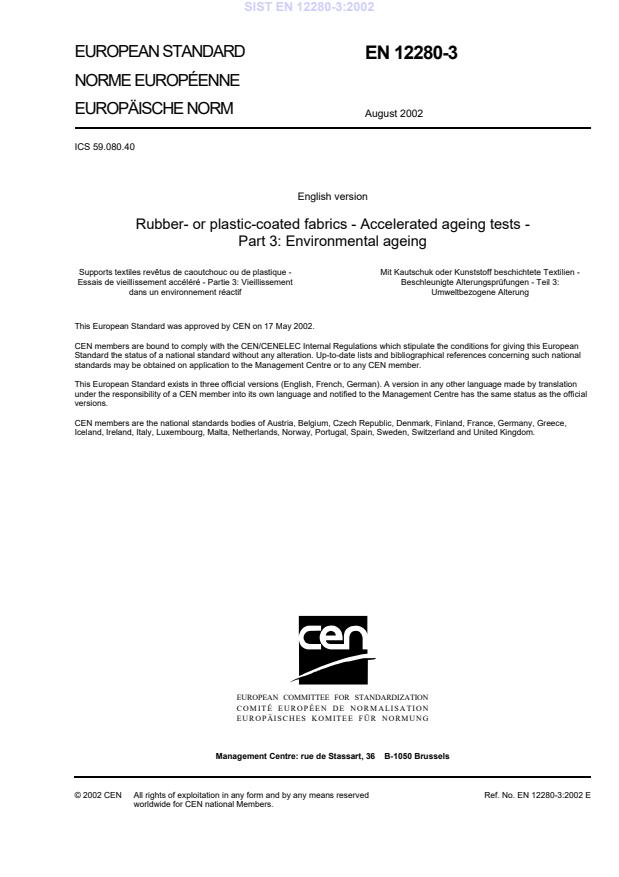
EUROPEAN STANDARDNORME EUROPÉENNEEUROPÄISCHE NORMEN 12280-3August 2002ICS 59.080.40English versionRubber- or plastic-coated fabrics - Accelerated ageing tests -Part 3: Environmental ageingSupports textiles revêtus de caoutchouc ou de plastique -Essais de vieillissement accéléré - Partie 3: Vieillissementdans un environnement réactifMit Kautschuk oder Kunststoff beschichtete Textilien -Beschleunigte Alterungsprüfungen - Teil 3:Umweltbezogene AlterungThis European Standard was approved by CEN on 17 May 2002.CEN members are bound to comply with the CEN/CENELEC Internal Regulations which stipulate the conditions for giving this EuropeanStandard the status of a national standard without any alteration. Up-to-date lists and bibliographical references concerning such nationalstandards may be obtained on application to the Management Centre or to any CEN member.This European Standard exists in three official versions (English, French, German). A version in any other language made by translationunder the responsibility of a CEN member into its own language and notified to the Management Centre has the same status as the officialversions.CEN members are the national standards bodies of Austria, Belgium, Czech Republic, Denmark, Finland, France, Germany, Greece,Iceland, Ireland, Italy, Luxembourg, Malta, Netherlands, Norway, Portugal, Spain, Sweden, Switzerland and United Kingdom.EUROPEAN COMMITTEE FOR STANDARDIZATIONCOMITÉ EUROPÉEN DE NORMALISATIONEUROPÄISCHES KOMITEE FÜR NORMUNGManagement Centre: rue de Stassart, 36
B-1050 Brussels© 2002 CENAll rights of exploitation in any form and by any means reservedworldwide for CEN national Members.Ref. No. EN 12280-3:2002 ESIST EN 12280-3:2002
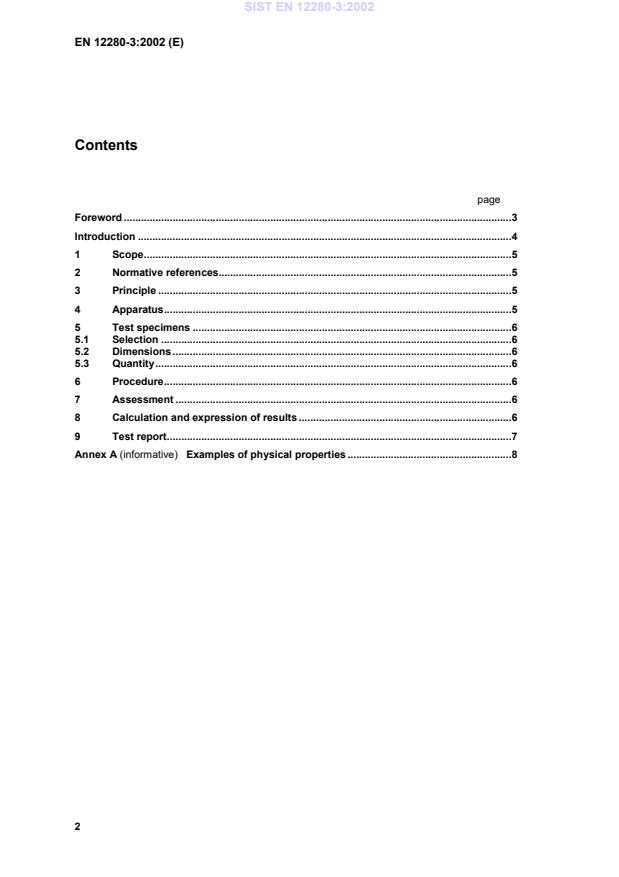
Examples of physical properties.8SIST EN 12280-3:2002
...