

FprEN 17684
(Main)Furniture - Electrically operated furniture - Stability, strength, durability and mechanical safety requirements
General Information
- Abstract
This document specifies stability and mechanical safety requirements and test methods for electrically operated furniture for domestic and non-domestic use, including requirements on shear, compression, entrapment, strength and durability.
The document applies to electrically operated furniture for use in areas accessible by adults and children of all abilities, and domestic pets.
The requirements in this document are intended to minimize the hazards that can occur during intended use and reasonably foreseeable use.
This document includes requirements related to all persons, including children from the age of 4 years in and around the products and the associated hazards.
This document excludes considerations and requirements related to children less than 4 years old operating the product.
This document does not include requirements related to the electrical safety of the item of furniture.
In general, it does not take into account:
- damage to property or the environment.
This document does not apply to:
- seating incorporated in other machines;
- seats in vehicles.
If the electrically operated furniture has additional functions or can be converted into other products, other relevant European Standards can apply.
This document is not applicable to electrically operated furniture which is manufactured before the date of publication of this document.
Wherever the term "furniture" is used in this document, it means electrically operated furniture.
- Status
- Not Published
- Publication Date
- 17-Feb-2027
- Technical Committee
- CEN/TC 207 - Furniture
- Drafting Committee
- CEN/TC 207/WG 9 - Test methods
- Current Stage
- 4599 - Dispatch of FV draft to CMC - Finalization for Vote
- Start Date
- 04-Mar-2026
- Completion Date
- 04-Mar-2026

Overview
FprEN 17684 - Furniture: Electrically operated furniture - Stability, strength, durability and mechanical safety requirements (CEN draft) defines mechanical safety and performance requirements for electrically operated furniture used in domestic and non‑domestic environments. It addresses hazards from moving parts and structural failure during intended and reasonably foreseeable use, including use by adults, children from age 4, and domestic pets. Electrical safety is covered by referenced standards (e.g., prEN IEC 60335‑2‑116) and not by this document.
Key topics and technical requirements
- Stability, strength and durability: Requirements and tests to prevent collapse or excessive deformation under expected loading conditions; durability expectations over product lifetime.
- Mechanical safety (shear, compression, entrapment): Limits and test methods to reduce risks from moving parts - e.g., finger entrapment, shear and compression zones.
- Edges, surfaces and holes: Rules to minimise sharp edges and hazardous openings.
- Specific furniture types: Clauses covering seating, tables, storage furniture, beds, screens and writing boards with tailored requirements for each category.
- Hazard analysis and risk assessment: Identification of significant hazards and required risk‑reduction measures (Clause 4 and Annex A).
- User information: Required user manual content, warnings, assembly, installation and maintenance instructions.
- Test methods: Normative and informative annexes include test methods (Annex B includes finger entrapment testing) and background (Annex C).
- Scope and exclusions: Excludes seating incorporated into other machines, vehicle seats, medical furniture, electrical safety details, and children under 4 operating the product.
Practical applications
- Use this standard to design, test and certify electrically operated furniture for safety compliance, product development, risk assessments and market surveillance.
- Useful for specifying mechanical performance in procurement, quality control, prototype validation and durability testing.
- Helps manufacturers produce safer adjustable desks, motorised recliners, electric beds, height‑adjustable tables, powered storage units and similar products for homes, offices, schools and public spaces.
Who should use this standard
- Electrically operated furniture manufacturers (SMEs to large enterprises)
- Design and R&D engineers developing motorised furniture
- Safety and compliance teams, market surveillance and certification bodies
- Maintenance and service providers
- Specifiers and procurement officers in education, healthcare (non‑medical furniture), hospitality and workplace fit‑outs
Related standards
- prEN IEC 60335‑2‑116 (electrical safety reference)
- EN 1730, EN 12520/12521, EN 14749, EN 1729, EN 1335 and other EN furniture standards referenced for specific test methods and requirements.
Keywords: electrically operated furniture standard, stability strength durability, mechanical safety, shear compression entrapment, prEN 17684, CEN furniture safety.
Frequently Asked Questions
FprEN 17684 is a draft published by the European Committee for Standardization (CEN). Its full title is "Furniture - Electrically operated furniture - Stability, strength, durability and mechanical safety requirements". This standard covers: This document specifies stability and mechanical safety requirements and test methods for electrically operated furniture for domestic and non-domestic use, including requirements on shear, compression, entrapment, strength and durability. The document applies to electrically operated furniture for use in areas accessible by adults and children of all abilities, and domestic pets. The requirements in this document are intended to minimize the hazards that can occur during intended use and reasonably foreseeable use. This document includes requirements related to all persons, including children from the age of 4 years in and around the products and the associated hazards. This document excludes considerations and requirements related to children less than 4 years old operating the product. This document does not include requirements related to the electrical safety of the item of furniture. In general, it does not take into account: - damage to property or the environment. This document does not apply to: - seating incorporated in other machines; - seats in vehicles. If the electrically operated furniture has additional functions or can be converted into other products, other relevant European Standards can apply. This document is not applicable to electrically operated furniture which is manufactured before the date of publication of this document. Wherever the term "furniture" is used in this document, it means electrically operated furniture.
This document specifies stability and mechanical safety requirements and test methods for electrically operated furniture for domestic and non-domestic use, including requirements on shear, compression, entrapment, strength and durability. The document applies to electrically operated furniture for use in areas accessible by adults and children of all abilities, and domestic pets. The requirements in this document are intended to minimize the hazards that can occur during intended use and reasonably foreseeable use. This document includes requirements related to all persons, including children from the age of 4 years in and around the products and the associated hazards. This document excludes considerations and requirements related to children less than 4 years old operating the product. This document does not include requirements related to the electrical safety of the item of furniture. In general, it does not take into account: - damage to property or the environment. This document does not apply to: - seating incorporated in other machines; - seats in vehicles. If the electrically operated furniture has additional functions or can be converted into other products, other relevant European Standards can apply. This document is not applicable to electrically operated furniture which is manufactured before the date of publication of this document. Wherever the term "furniture" is used in this document, it means electrically operated furniture.
FprEN 17684 is classified under the following ICS (International Classification for Standards) categories: 97.140 - Furniture. The ICS classification helps identify the subject area and facilitates finding related standards.
FprEN 17684 is associated with the following European legislation: EU Directives/Regulations: 2006/42/EC, 2023/1230; Standardization Mandates: M/396, M/605. When a standard is cited in the Official Journal of the European Union, products manufactured in conformity with it benefit from a presumption of conformity with the essential requirements of the corresponding EU directive or regulation.
FprEN 17684 is available in PDF format for immediate download after purchase. The document can be added to your cart and obtained through the secure checkout process. Digital delivery ensures instant access to the complete standard document.
Standards Content (Sample)
SLOVENSKI STANDARD
01-julij-2022
Pohištvo - Pohištvo z električnim pogonom - Zahteve za stabilnost, trdnost,
trajnost in in mehansko varnost
Furniture - Electrically operated furniture - Stability, strength, durability and mechanical
safety requirements
Möbel - Elektrisch angetriebene Möbel - Standsicherheit, Festigkeit, Dauerhaltbarkeit
und mechanische Sicherheitsanforderungen
Mobilier - Meubles à commande électrique - Exigences de stabilité, de résistance, de
durabilité et de sécurité mécanique
Ta slovenski standard je istoveten z: prEN 17684
ICS:
97.140 Pohištvo Furniture
2003-01.Slovenski inštitut za standardizacijo. Razmnoževanje celote ali delov tega standarda ni dovoljeno.
DRAFT
EUROPEAN STANDARD
prEN 17684
NORME EUROPÉENNE
EUROPÄISCHE NORM
June 2022
ICS 97.140
English Version
Furniture - Electrically operated furniture - Stability,
strength, durability and mechanical safety requirements
Mobilier - Meubles à commande électrique - Exigences Möbel - Elektrisch angetriebene Möbel -
de stabilité, de résistance, de durabilité et de sécurité Standsicherheit, Festigkeit, Dauerhaltbarkeit und
mécanique mechanische Sicherheitsanforderungen
This draft European Standard is submitted to CEN members for enquiry. It has been drawn up by the Technical Committee
CEN/TC 207.
If this draft becomes a European Standard, CEN members are bound to comply with the CEN/CENELEC Internal Regulations
which stipulate the conditions for giving this European Standard the status of a national standard without any alteration.
This draft European Standard was established by CEN in three official versions (English, French, German). A version in any other
language made by translation under the responsibility of a CEN member into its own language and notified to the CEN-CENELEC
Management Centre has the same status as the official versions.
CEN members are the national standards bodies of Austria, Belgium, Bulgaria, Croatia, Cyprus, Czech Republic, Denmark, Estonia,
Finland, France, Germany, Greece, Hungary, Iceland, Ireland, Italy, Latvia, Lithuania, Luxembourg, Malta, Netherlands, Norway,
Poland, Portugal, Republic of North Macedonia, Romania, Serbia, Slovakia, Slovenia, Spain, Sweden, Switzerland, Turkey and
United Kingdom.
Recipients of this draft are invited to submit, with their comments, notification of any relevant patent rights of which they are
aware and to provide supporting documentation.
Warning : This document is not a European Standard. It is distributed for review and comments. It is subject to change without
notice and shall not be referred to as a European Standard.
EUROPEAN COMMITTEE FOR STANDARDIZATION
COMITÉ EUROPÉEN DE NORMALISATION
EUROPÄISCHES KOMITEE FÜR NORMUNG
CEN-CENELEC Management Centre: Rue de la Science 23, B-1040 Brussels
© 2022 CEN All rights of exploitation in any form and by any means reserved Ref. No. prEN 17684:2022 E
worldwide for CEN national Members.
prEN 17684:2022 (E)
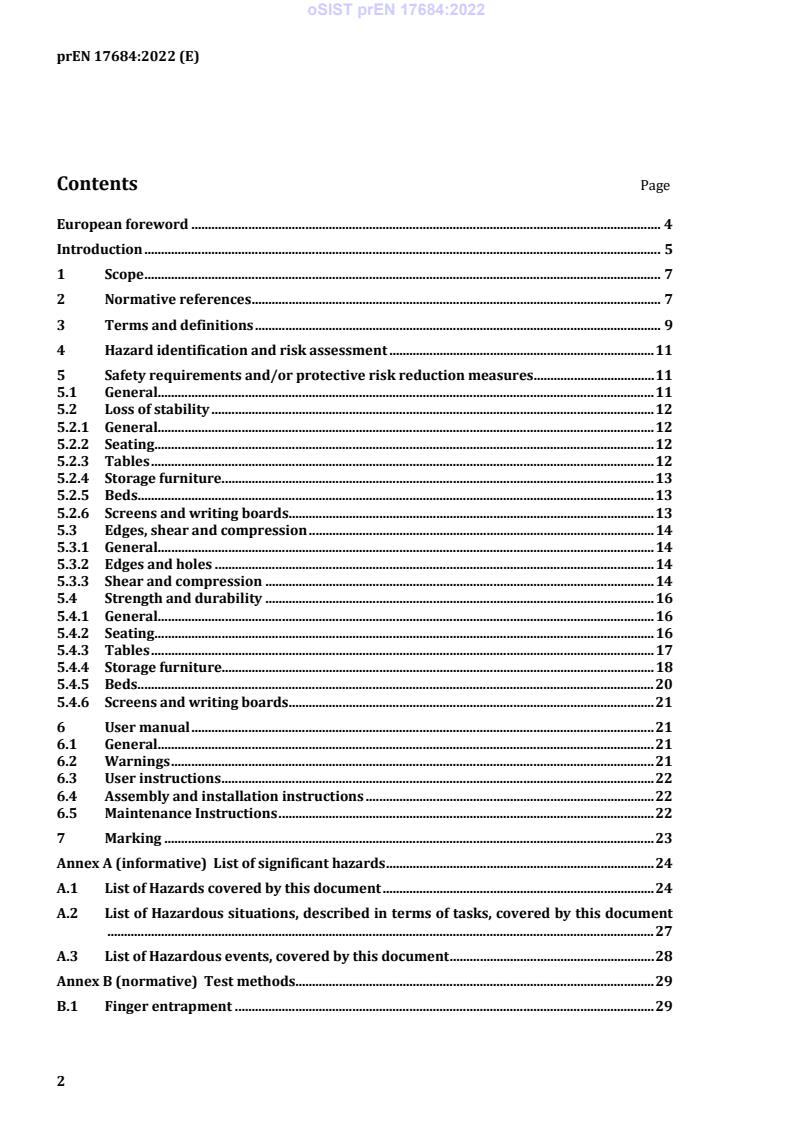
Contents Page
European foreword . 4
Introduction . 5
1 Scope . 7
2 Normative references . 7
3 Terms and definitions . 9
4 Hazard identification and risk assessment . 11
5 Safety requirements and/or protective risk reduction measures . 11
5.1 General. 11
5.2 Loss of stability . 12
5.2.1 General. 12
5.2.2 Seating . 12
5.2.3 Tables . 12
5.2.4 Storage furniture. 13
5.2.5 Beds . 13
5.2.6 Screens and writing boards. 13
5.3 Edges, shear and compression . 14
5.3.1 General. 14
5.3.2 Edges and holes . 14
5.3.3 Shear and compression . 14
5.4 Strength and durability . 16
5.4.1 General. 16
5.4.2 Seating . 16
5.4.3 Tables . 17
5.4.4 Storage furniture. 18
5.4.5 Beds . 20
5.4.6 Screens and writing boards. 21
6 User manual . 21
6.1 General. 21
6.2 Warnings . 21
6.3 User instructions . 22
6.4 Assembly and installation instructions . 22
6.5 Maintenance Instructions . 22
7 Marking . 23
Annex A (informative) List of significant hazards . 24
A.1 List of Hazards covered by this document . 24
A.2 List of Hazardous situations, described in terms of tasks, covered by this document
................................................................................................................................................................... 27
A.3 List of Hazardous events, covered by this document . 28
Annex B (normative) Test methods. 29
B.1 Finger entrapment . 29
prEN 17684:2022 (E)
B.1.1 Test equipment. 29
B.1.2 Test method . 30
Annex C (informative) Background to Furniture Standards . 33
C.1 Introduction . 33
C.2 CEN TC 207, Furniture . 33
C.3 Experience with safety requirements for furniture . 33
C.4 The similar risks shared by furniture, electrically operated furniture and non-
powered furniture . 33
C.5 Type of hazard . 34
C.5.1 Ergonomics . 34
C.5.2 Stability . 34
C.5.3 Risks of break up during operation . 34
C.5.4 Risks due to falling or ejected objects . 34
C.5.5 Risks due to surfaces, edges and angles . 34
C.5.6 Risks due to moving parts . 34
C.5.7 Product information and instructions for use . 34
Annex ZA (informative) Relationship between this European Standard and the essential
requirements of Directive 2006/42/EC aimed to be covered . 35
Bibliography . 38
prEN 17684:2022 (E)
European foreword
This document (prEN 17684:2022) has been prepared by Technical Committee CEN/TC 207 “Furniture”,
the secretariat of which is held by UNI.
This document is currently submitted to the CEN Enquiry.
This document has been prepared under a Standardization Request given to CEN by the European
Commission and the European Free Trade Association, and supports essential requirements of EU
Directive(s).
For relationship with EU Directive(s), see informative Annex ZA, which is an integral part of this
document.
prEN 17684:2022 (E)
Introduction
This document is a type-C document as stated in EN ISO 12100:2010.
This document is of relevance, in particular, for the following stakeholder groups representing the market
players with regard to machinery safety:
— electrically operated furniture manufacturers (small, medium and large enterprises);
— health and safety bodies (regulators, accident prevention organizations, market surveillance, etc.).
Others can be affected by the level of machinery safety achieved with the means of the document by the
above-mentioned stakeholder groups:
— electrically operated furniture users/employers (small, medium and large enterprises);
— electrically operated furniture users/employees (e.g. trade unions, organizations for people with
special needs);
— service providers, e.g. for maintenance (small, medium and large enterprises);
— consumers (in case of electrically operated furniture intended for use by consumers).
The above-mentioned stakeholder groups have been given the possibility to participate in the drafting
process of this document.
The machinery concerned and the extent to which hazards, hazardous situations or hazardous events are
covered are indicated in the Scope of this document.
When requirements of this type-C standard are different from those which are stated in type-A or type-
B standards, the requirements of this type-C standard take precedence over the requirements of the other
standards for machines that have been designed and built according to the requirements of this type-C
standard.
This document has been prepared to meet the needs of manufacturers, users and safety enforcement
authorities, with the primary purpose of providing design and performance for mechanical safety in use
of electrically motorised furniture.
The safety requirements are based on the hazardous situations and events identified during intended
use, and reasonably foreseeable misuse, throughout the expected lifetime of the furniture. The hazards
identified in Clause 4 are based on the knowledge and experience of the design, incidents, accidents and
other risks.
The requirements on edges, surfaces, shear and compression are intended to minimize the hazards from
any moving parts, e.g. the movement of the product or the application or release of an external force by
an electrically operated component.
The strength requirements are intended to minimize the hazards caused by the collapse of furniture
when subjected to the highest levels of loading that might be reasonably expected to occur.
The durability requirements are intended to minimize the hazards during the expected lifetime of the
product, e.g when operating the electrical function.
It should be emphasized that the stability, strength and durability requirements are the same as for non-
electrically operated furniture.
This document exclude any electrically operated furniture for medical purpose.
prEN 17684:2022 (E)
Electrical aspects of electrically operated furniture are covered by normative references to
prEN IEC 60335-2-116:2022.
prEN 17684:2022 (E)
1 Scope
This document specifies stability and mechanical safety requirements and test methods for electrically
operated furniture for domestic and non-domestic use, including requirements on shear, compression,
entrapment, strength and durability.
The document applies to electrically operated furniture for use in areas accessible by adults and children
of all abilities, and domestic pets.
The requirements in this document are intended to minimize the hazards that can occur during intended
use and reasonably foreseeable use.
This document includes requirements related to all persons, including children from the age of 4 years in
and around the products and the associated hazards.
This document excludes considerations and requirements related to children less than 4 years old
operating the product.
This document does not include requirements related to the electrical safety of the item of furniture.
In general, it does not take into account:
— damage to property or the environment.
This document does not apply to:
— seating incorporated in other machines;
— seats in vehicles.
If the electrically operated furniture has additional functions or can be converted into other products,
other relevant European Standards can apply.
This document is not applicable to electrically operated furniture which is manufactured before the date
of publication of this document.
Wherever the term “furniture” is used in this document, it means electrically operated furniture.
2 Normative references
The following documents are referred to in the text in such a way that some or all of their content
constitutes requirements of this document. For dated references, only the edition cited applies. For
undated references, the latest edition of the referenced document (including any amendments) applies.
EN 527-2:2016+A1:2019, Office furniture — Work tables — Part 2: Safety, strength and durability
requirements
EN 581-2:2015, Outdoor furniture — Seating and tables for camping, domestic and contract use — Part 2:
Mechanical safety requirements and test methods for seating
EN 581-3:2017, Outdoor furniture — Seating and tables for camping, domestic and contract use — Part 3:
Mechanical safety requirements for tables
EN 747-1:2012+A1:2015, Furniture — Bunk beds and high beds — Part 1: Safety, strength and durability
requirements
EN 1023-2:2000, Office furniture — Screens — Part 2: Mechanical safety requirements
prEN 17684:2022 (E)
EN 1129-1:1995, Furniture — Foldaway beds — Safety requirements and testing — Part 1: Safety
requirements
EN 1335-2:2018, Office furniture — Office work chair — Part 2: Safety requirements
EN 1725:1998, Domestic furniture — Beds and mattresses — Safety requirements and test methods
EN 1729-2:2012+A1:2015, Furniture — Chairs and tables for educational institutions — Part 2: Safety
requirements and test methods
EN 1730:2012, Furniture — Tables — Test methods for the determination of stability, strength and
durability
EN 12520:2015, Furniture — Strength, durability and safety — Requirements for domestic seating
EN 12521:2015, Furniture — Strength, durability and safety — Requirements for domestic tables
EN 13150:2020, Workbenches for laboratories in educational institutions — Dimensions, safety and
durability requirements and test methods
EN 13759:2012, Furniture — Operating mechanisms for seating and sofa-beds — Test methods
EN 14073-2:2004, Office furniture — Storage furniture — Part 2: Safety requirements
EN 14434:2010, Writing boards for educational institutions — Ergonomic, technical and safety
requirements and their test methods
EN 14749:2016, Furniture — Domestic and kitchen storage units and kitchen-worktops — Safety
requirements and test methods
EN 15372:2016, Furniture — Strength, durability and safety — Requirements for non-domestic tables
EN 16121:2013+A1:2017, Non-domestic storage furniture — Requirements for safety, strength, durability
and stability
EN 16139:2013, Furniture — Strength, durability and safety — Requirements for non-domestic seating
EN 17191:2021, Children’s Furniture — Seating for children — Safety requirements and test methods
EN ISO 12100:2010, Safety of machinery — General principles for design — Risk assessment and risk
reduction (ISO 12100:2010)
prEN IEC 60335-2-116:2022, Household and similar electrical appliances — Safety — Part 2-116:
Particular requirements for furniture with electrically motorised parts
prEN 17684:2022 (E)
3 Terms and definitions
For the purposes of this document, the following terms and definitions apply.
ISO and IEC maintain terminological databases for use in standardization at the following addresses:
— ISO Online browsing platform: available at https://www.iso.org/obp
— IEC Electropedia: available at https://www.electropedia.org/
3.1
children
young persons comprising very young children, young children and older children
[SOURCE: EN 60335-1:2012, definition 3.Z.1]
3.2
very young children
young persons aged from 0 up to and including 3 years
[SOURCE: EN 60335-1:2012, definition 3.Z.2]
3.3
young children
young persons older than 3 years and younger than 8 years
[SOURCE: EN 60335-1:2012, definition 3.Z.3]
3.4
older children
young persons aged from 8 years up to and including 14 years
[SOURCE: EN 60335-1:2012, definition 3.Z.4]
3.5
stability
ability to withstand forces that tend to cause furniture to overturn
3.6
overturn
event at which furniture pivots to the point beyond which the furniture continues to fall
3.7
hazard
potential source of harm
[SOURCE: EN ISO 12100:2010, 3.6]
prEN 17684:2022 (E)
3.8
relevant hazard
hazard, which is identified as being present at, or associated with, the furniture
Note 1 to entry: A relevant hazard is identified as the result of one step of the process described in
EN ISO 12100:2010, Clause 5.
Note 2 to entry: This term is included as basic terminology for type-B and type-C standards.
[SOURCE: EN ISO 12100:2010, 3.7]
3.9
significant hazard
hazard which has been identified as relevant and which requires specific action by the designer (3.10) to
eliminate or to reduce the risk according to the risk assessment
Note 1 to entry: This term is included as basic terminology for type-B and type-C standards.
[SOURCE: EN ISO 12100:2010, 3.8]
3.10
designer
person who prepares or modifies the designs, or gives instructions to any person under their control to
do so
3.11
risk
combination of the probability of occurrence of harm and the severity of that harm
3.12
furniture
article intended to support human activities such as sitting, eating, sleeping, working or storing things
[SOURCE: prEN 60335-2-116:2022, definition 3.5.101]
3.13
nominal load
load capacity of the furniture (3.12) declared by the manufacturer
3.14
electrically operated functions
movements of parts or components of furniture (3.12) by means of electrical actuators
Note 1 to entry: Such as drawers, tabletops, reclining seats, etc.
3.15
leading edge
closing edge of two components that is likely to create significant shear or compression points, which are
easily accessible,and likely to cause injury
Note 1 to entry: One of the components could be the floor, ceiling or other structure.
prEN 17684:2022 (E)
4 Hazard identification and risk assessment
Annex A contains a list of hazards that can be present with electrically operated furniture (3.12). A hazard
analysis shall be carried out to identify any further hazards that might be present.
A risk assessment shall be carried out on those hazards identified in the hazard identification. This risk
assessment shall give particular consideration to:
a) the intended operation of the furniture, including instructions available, maintenance, setting and
cleaning;
b) unexpected start-up/operation;
c) access from all directions;
d) reasonably foreseeable misuse of the furniture;
e) the effect of failure in the control system;
f) and where necessary, the hazards associated with the specific application.
Risks (3.11) shall be eliminated or reduced first by design or by substitution, then by guarding and other
complementary measures. Any residual risks shall then be reduced by other measures (e.g. warnings,
signs, training).
The requirements contained in Clause 5 derive from the iterative process consisting of applying
safeguarding measures that are described in EN ISO 12100:2010 to the hazards identified in Annex A.
NOTE EN ISO 12100:2010 provides requirements and guidance in performing hazard identification and risk
reduction.
The use and location of the furniture and the type of control system can influence the severity and
probability of risk created by electrically operated furniture. Risks are increasing when:
— elderly or disabled people can come in contact with the moving parts of the furniture;
— children come in contact with the moving parts of the furniture;
— the furniture is equipped with a means of remote-control;
— the lack of visibility of a hazard;
— the velocity of the electrically operated moving parts relatively to other parts.
5 Safety requirements and/or protective risk reduction measures
5.1 General
The furniture shall comply with the safety requirements and/or protective/risk reduction measures of
this clause. In addition, the furniture shall be designed according to the principles of EN ISO 12100:2010
for relevant but not significant hazards which are not dealt with by this document.
The requirements in this clause shall be verified using the specified test methods.
The tests may be carried out on an electrically operated furniture item representative of the production
model.
prEN 17684:2022 (E)
5.2 Loss of stability
5.2.1 General
Hazards identified according to Clause 4. shall be prevented by design and construction. The conditions
covered are listed below.
For furniture not covered by the use and applicability as listed in this clause (5.2), the requirement is
verified by prEN IEC 60335-2-116:2022, 20.1.
5.2.2 Seating
5.2.2.1 General
The seating shall not overturn.
5.2.2.2 Seating for domestic use
Requirements specified in 5.2.2 are verified by EN 12520:2015, 5.3 Stability.
5.2.2.3 Seating for non-domestic use
Requirements specified in 5.2.2 are verified by EN 16139:2013, 4.3 Stability.
5.2.2.4 Work chair for office use
Requirements specified in 5.2.2 are verified by EN 1335-2:2018, 4.4 Stability tests and requirements.
5.2.2.5 Seating for educational use
Requirements specified in 5.2.2 are verified by EN 1729-2:2012+A1:2015, 5.2 Stability.
5.2.2.6 Seating for outdoor use
For loungers the requirements specified in 5.2.2 are verified by Test no 10, 11 and 12 in EN 581-2:2015,
6.2, Table 1.
For other seating for outdoor use the requirements specified in 5.2.2 are verified by Test no 11, 12 and
13 in EN 581-2:2015, 7.2, Table 2.
5.2.2.7 Seating for children
Requirements specified in 5.2.2 are verified by EN 17191:2021, Clause 10 Stability requirements.
5.2.3 Tables
5.2.3.1 General
The table shall not overturn.
5.2.3.2 Tables for domestic use
Requirements specified in 5.2.3 are verified by EN 12521:2015, 5.3 Stability.
5.2.3.3 Tables for non-domestic use
Requirements specified in 5.2.3 are verified by EN 15372:2016, 5.3 Stability.
5.2.3.4 Tables for office use
Requirements specified in 5.2.3 are verified by EN 527-2:2016+A1:2019, 4.3 Stability.
prEN 17684:2022 (E)
5.2.3.5 Tables for educational use
Requirements specified in 5.2.3 are verified by EN 1729-2:2012+A1:2015, 6.1 Stability.
5.2.3.6 Workbenches for laboratories in educational institutions
Requirements specified in 5.2.3 are verified by EN 13150:2020, 6.2 Stability.
5.2.3.7 Tables for outdoor use
Requirements specified in 5.2.3 are verified by EN 581-3:2017, 5.2 Stability.
5.2.4 Storage furniture
5.2.4.1 General
The storage furniture shall not overturn.
5.2.4.2 Storage furniture for domestic use
Requirements specified in 5.2.4 are verified by EN 14749:2016, 5.4 Stability.
5.2.4.3 Storage furniture for non-domestic use
Requirements specified in 5.2.4 are verified by EN 16121:2013+A1:2017, 5.6 Stability.
5.2.4.4 Storage furniture for office use
Requirements specified in 5.2.4 are verified by EN 14073-2:2004, 3.5.1, Table 2, test no 11 Stability.
5.2.5 Beds
5.2.5.1 General
The bed shall not overturn.
5.2.5.2 Beds for domestic use
Requirements specified in 5.2.5 are verified by EN 1725:1998, 7.2 Stability.
5.2.5.3 Bunk beds and high beds for domestic and non-domestic use
Requirements specified in 5.2.5 are verified by EN 747-1:2012+A1:2015, 4.4 Stability.
5.2.6 Screens and writing boards
5.2.6.1 General
The screen or writing board shall not overturn.
5.2.6.2 Screens
Requirements specified in 5.2.6 are verified by EN 1023-2:2000, 6.1 Stability for non-load bearing
screens or EN 1023-2:2000, 6.2 Stability for load bearing screens.
5.2.6.3 Writing boards
Requirements specifies in 5.2.6 are verified by EN 14434:2010, 6.2 Stability of mobile boards.
prEN 17684:2022 (E)
5.3 Edges, shear and compression
5.3.1 General
Hazards identified according to Clause 4. shall be prevented by design and construction. The conditions
covered are listed below.
5.3.2 Edges and holes
5.3.2.1 Edges
All parts of the furniture with which the user comes into contact during intended use, shall be designed
so that physical injury and damage are avoided.
This requirement is met when:
a) edges which are directly in contact with the user are rounded or chamfered,
b) all other edges accessible during intended use are free from burrs and/or sharp edges.
5.3.2.2 Holes in tubular/rigid components
There shall be no holes in the ends of tubular components or holes in rigid components in accessible parts
between 8 mm and 12 mm, unless the depth of penetration is less than 10 mm. This requirement is
fulfilled if there is no hazard present when tested in accordance with B.1.
5.3.3 Shear and compression
In order to minimize the effects shear and compression hazards safety distances for body part groups as
shown below shall be maintained:
1) for fingers and thumb, the safe zones are < 8 mm or > 25 mm. No gaps shall be created between 8 mm
and 25 mm;
2) for hands and feet, the safe zones are < 50 mm or > 100 mm. No gaps shall be created between 50 mm
and 100 mm;
3) for head the safe zone is > 250 mm. There shall be no closing gaps between 200 mm and 250 mm;
4) for torso the safe zone is > 500 mm. No closing gaps between 250 mm and 500 mm.
If these closing gaps cannot maintained, one of the following requirements shall be fulfilled:
a) access to the gaps defined above shall be prevented by means of guarding; or
b) forces exerted by the moving parts for the body parts at risk shall not exceed the values given in
Table 1; or
c) speed of moving parts for different product groups shall not exceed the values given in Table 2; or
d) operation of moving parts shall be resticted to “hold to run” (biased off switches) devices.
The force according to Table 1 shall be measured by using an appropriate force transducer with a
resultant spring constant of 75 N/mm (±10 %).
The force measurement shall be carried out at the leading edge (3.15).
prEN 17684:2022 (E)
Table 1 — Forces body parts can withstand
Maximum
Closing gap Initial maximum Sustained max
permissible force
size force for 0,5 s force after 5 s
Body part at risk
0,5 s to 5 s
(mm) (N) (N)
(N)
Fingers and
8 to 25 280 140 50
thumb
Hands, feet legs
50 to 100 280 140 50
and arms
Head 200 to 250 280 140 50
Torso (including
250 to 500 280 140 50
chest)
NOTE The forces are based on adult data.
The speed according to Table 2 shall be measured by using an appropriate equipment.
The speed measurement shall be carried out at the leading edge (3.15).
Table 2 — Maximum speeds of moving parts
Speed of moving parts
Product group
(mm/s)
Desk/tables/worksurfaces 80
Recliner chairs 100
Riser/recliner chairs 40
Beds 50
Storage units 50
a
Storage components with a total mass of less
then 10 kg
a
Storage components with a total mass of more
than 10 kg to 25 kg
a
Storage components with a total mass of more
than 25 kg or more
Writing boards and TV stands 80
Other furniture 80
a
The total mass shall be calculated as defined in the appropriate EN standard for storage furniture.
-----
...