


EN 4709-007:2026
(Main)Aerospace series - Unmanned Aircraft Systems - Part 007: General product requirements for UAS of classes C5 and C6
Luft- und Raumfahrt - Unbemannte Luftfahrzeugsysteme - Teil 007: Allgemeine Produktanforderungen für UAS der Klassen C5 und C6
Série aérospatiale - Aéronefs télépilotés - Partie 007 : Exigences produit générales pour les classes d'UAS C5 et C6
Aeronavtika - Letalski sistemi brez posadke - 007. del: Splošne zahteve za proizvode za UAS razredov C5 in C6
General Information
- Status
- Not Published
- Publication Date
- 15-Apr-2026
- Technical Committee
- CEN/TC 471 - Aviation and aeronautics
- Drafting Committee
- CEN/TC 471/WG 1 - Unmanned Aircraft Systems
- Current Stage
- 6055 - CEN Ratification completed (DOR) - Publishing
- Start Date
- 16-Feb-2026
- Completion Date
- 16-Feb-2026

Overview
EN 4709-007:2026, titled Aerospace series - Unmanned Aircraft Systems - Part 007: General product requirements for UAS of classes C5 and C6, is a European standard developed by CEN/TC 471. It establishes general product requirements for unmanned aircraft systems (UAS) belonging to classes C5 and C6, according to Commission Delegated Regulation (EU) 2019/945 and its subsequent amendments, focusing on safe, reliable, and compliant UAS product design.
The standard supports industry stakeholders in complying with EU legislation, particularly with technical specifications and verification methods relevant to CE marking for UAS. It covers requirements for electrically powered UAS intended for standard scenarios within the 'specific' category, emphasizing performance, operational information, and command-control link robustness. EN 4709-007 helps ensure high safety standards, transparent pilot information, and product quality for professional UAS operations.
Key Topics
- Design and Configuration Requirements: Specifies design constraints for UAS in classes C5 and C6, including configuration restrictions and the absence of fixed wings unless tethered.
- Performance and Compliance Testing: Introduces detailed performance specifications and verification methods to support objective compliance assessment.
- Operational Information: Outlines requirements for clear, real-time information on UAS position, speed, and height, including graphical interface standards and mapping accuracy.
- Command-and-Control (C2) Link Monitoring: Defines robust monitoring of C2 links, requiring visual, aural, and haptic alerts for signal strength, and the differentiation between caution and warning signals.
- User Interface and Alerts: Recommends interface design for critical alerts, symbology, readability, and information presentation, ensuring remote pilots are promptly informed of non-normal conditions.
- Accuracy and Testing Methods: Provides guidance for ground and in-flight accuracy tests using recognized reference points and measurement techniques, supporting reliable operations.
Applications
EN 4709-007:2026 is essential for:
- UAS Manufacturers: Guidance for the development and CE marking of advanced UAS platforms used in the 'specific' category, especially those intended for operations such as extended visual line of sight (EVLOS), beyond visual line of sight (BVLOS), and complex automated missions.
- Operators and Integrators: Clear criteria for assessing product suitability, system configuration, and compliance with European regulatory frameworks.
- Regulatory Authorities: A reference for product conformity assessment, market surveillance, and the harmonization of UAS safety requirements.
- Standardized Training: Ensures remote pilots are familiar with interfaces, alerts, and system limitations, promoting consistent, safe use across diverse operational scenarios such as infrastructure inspection, surveying, emergency services, and logistics.
Key features such as low-speed mode, graphical mapping, positional accuracy, and alert differentiation have practical value in urban, industrial, and complex airspace environments where operational safety and information clarity are critical.
Related Standards
- EN 4709-001: Aerospace series - Unmanned Aircraft Systems - Part 001: Product requirements and verification; provides foundational definitions and verification approaches referenced throughout EN 4709-007.
- EN 4709-005: Aerospace series - Unmanned Aircraft Systems - Part 005: Verification method for the Geocaging function; relevant for systems with geocaging capabilities.
- Commission Delegated Regulation (EU) 2019/945: Main regulatory framework for UAS product requirements within the EU.
- EN 61310-1: Safety of machinery - Indication, marking and actuation - Requirements for visual, acoustic, and tactile signals; a guiding reference for alert signals covered under UAS standards.
By aligning with EN 4709-007, stakeholders benefit from harmonized requirements that support innovation, facilitate market access, and help sustain safe operational practices for unmanned aircraft systems throughout Europe.
Get Certified
Connect with accredited certification bodies for this standard

BSI Group
BSI (British Standards Institution) is the business standards company that helps organizations make excellence a habit.

Bureau Veritas
Bureau Veritas is a world leader in laboratory testing, inspection and certification services.

DNV
DNV is an independent assurance and risk management provider.
Sponsored listings
Frequently Asked Questions
EN 4709-007:2026 is a draft published by the European Committee for Standardization (CEN). Its full title is "Aerospace series - Unmanned Aircraft Systems - Part 007: General product requirements for UAS of classes C5 and C6". This standard covers: Aerospace series - Unmanned Aircraft Systems - Part 007: General product requirements for UAS of classes C5 and C6
Aerospace series - Unmanned Aircraft Systems - Part 007: General product requirements for UAS of classes C5 and C6
EN 4709-007:2026 is classified under the following ICS (International Classification for Standards) categories: 49.020 - Aircraft and space vehicles in general. The ICS classification helps identify the subject area and facilitates finding related standards.
EN 4709-007:2026 is associated with the following European legislation: EU Directives/Regulations: 2019/945; Standardization Mandates: M/567. When a standard is cited in the Official Journal of the European Union, products manufactured in conformity with it benefit from a presumption of conformity with the essential requirements of the corresponding EU directive or regulation.
EN 4709-007:2026 is available in PDF format for immediate download after purchase. The document can be added to your cart and obtained through the secure checkout process. Digital delivery ensures instant access to the complete standard document.
Standards Content (Sample)
SLOVENSKI STANDARD
oSIST prEN 4709-007:2024
01-januar-2024
Aeronavtika - Letalski sistemi brez posadke - 007. del: Splošne zahteve za
proizvode za UAS razredov C5 in C6
Aerospace series - Unmanned Aircraft Systems - Part 007: General product
requirements for UAS of classes C5 and C6
Luft- und Raumfahrt - Unbemannte Luftfahrzeugsysteme - Teil 007: Allgemeine
Produktanforderungen für UAS der Klassen C5 und C6
Série aérospatiale - Aéronefs télépilotés - Partie 007 : Exigences produit générales pour
les classes d'UAS C5 et C6
Ta slovenski standard je istoveten z: prEN 4709-007
ICS:
49.020 Letala in vesoljska vozila na Aircraft and space vehicles in
splošno general
oSIST prEN 4709-007:2024 en,fr,de
2003-01.Slovenski inštitut za standardizacijo. Razmnoževanje celote ali delov tega standarda ni dovoljeno.
oSIST prEN 4709-007:2024
oSIST prEN 4709-007:2024
DRAFT
EUROPEAN STANDARD
prEN 4709-007
NORME EUROPÉENNE
EUROPÄISCHE NORM
November 2023
ICS
English Version
Aerospace series - Unmanned Aircraft Systems - Part 007:
General product requirements for UAS of classes C5 and
C6
Luft- und Raumfahrt - Unbemannte
Luftfahrzeugsysteme - Teil 007: Allgemeine
Produktanforderungen für UAS der Klassen C5 und C6
This draft European Standard is submitted to CEN members for enquiry. It has been drawn up by the Technical Committee
CEN/TC 471.
If this draft becomes a European Standard, CEN members are bound to comply with the CEN/CENELEC Internal Regulations
which stipulate the conditions for giving this European Standard the status of a national standard without any alteration.
This draft European Standard was established by CEN in three official versions (English, French, German). A version in any other
language made by translation under the responsibility of a CEN member into its own language and notified to the CEN-CENELEC
Management Centre has the same status as the official versions.
CEN members are the national standards bodies of Austria, Belgium, Bulgaria, Croatia, Cyprus, Czech Republic, Denmark, Estonia,
Finland, France, Germany, Greece, Hungary, Iceland, Ireland, Italy, Latvia, Lithuania, Luxembourg, Malta, Netherlands, Norway,
Poland, Portugal, Republic of North Macedonia, Romania, Serbia, Slovakia, Slovenia, Spain, Sweden, Switzerland, Türkiye and
United Kingdom.
Recipients of this draft are invited to submit, with their comments, notification of any relevant patent rights of which they are
aware and to provide supporting documentation.
Warning : This document is not a European Standard. It is distributed for review and comments. It is subject to change without
notice and shall not be referred to as a European Standard.
EUROPEAN COMMITTEE FOR STANDARDIZATION
COMITÉ EUROPÉEN DE NORMALISATION
EUROPÄISCHES KOMITEE FÜR NORMUNG
CEN-CENELEC Management Centre: Rue de la Science 23, B-1040 Brussels
© 2023 CEN All rights of exploitation in any form and by any means reserved Ref. No. prEN 4709-007:2023 E
worldwide for CEN national Members.
oSIST prEN 4709-007:2024
prEN 4709-007:2023 (E)
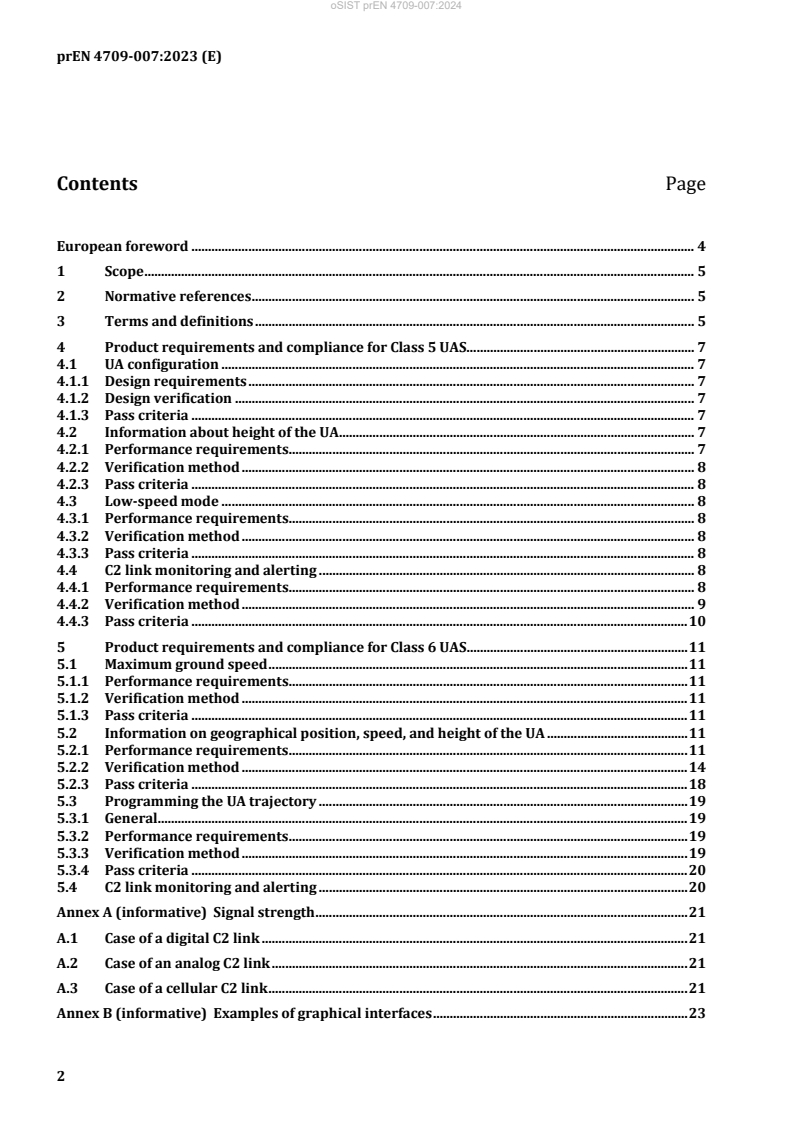
Contents Page
European foreword . 4
1 Scope . 5
2 Normative references . 5
3 Terms and definitions . 5
4 Product requirements and compliance for Class 5 UAS. 7
4.1 UA configuration . 7
4.1.1 Design requirements . 7
4.1.2 Design verification . 7
4.1.3 Pass criteria . 7
4.2 Information about height of the UA . 7
4.2.1 Performance requirements . 7
4.2.2 Verification method . 8
4.2.3 Pass criteria . 8
4.3 Low-speed mode . 8
4.3.1 Performance requirements . 8
4.3.2 Verification method . 8
4.3.3 Pass criteria . 8
4.4 C2 link monitoring and alerting . 8
4.4.1 Performance requirements . 8
4.4.2 Verification method . 9
4.4.3 Pass criteria . 10
5 Product requirements and compliance for Class 6 UAS. 11
5.1 Maximum ground speed . 11
5.1.1 Performance requirements . 11
5.1.2 Verification method . 11
5.1.3 Pass criteria . 11
5.2 Information on geographical position, speed, and height of the UA . 11
5.2.1 Performance requirements . 11
5.2.2 Verification method . 14
5.2.3 Pass criteria . 18
5.3 Programming the UA trajectory . 19
5.3.1 General. 19
5.3.2 Performance requirements . 19
5.3.3 Verification method . 19
5.3.4 Pass criteria . 20
5.4 C2 link monitoring and alerting . 20
Annex A (informative) Signal strength . 21
A.1 Case of a digital C2 link . 21
A.2 Case of an analog C2 link . 21
A.3 Case of a cellular C2 link . 21
Annex B (informative) Examples of graphical interfaces . 23
oSIST prEN 4709-007:2024
prEN 4709-007:2023 (E)
Annex C (informative) Colours and size recommendations for alerts . 26
Annex D (informative) Example of ways to program the UA's trajectory . 29
Annex ZA (informative) Relationship between this document and the essential
requirements of Delegated regulation (EU) 2019/945 of 12 March 2019 on
unmanned aircraft systems and on third-country operators of unmanned aircraft
systems aimed to be covered. 30
Bibliography . 31
oSIST prEN 4709-007:2024
prEN 4709-007:2023 (E)
European foreword
This document (prEN 4709-007:2023) has been prepared by Technical Committee CEN/TC 471 UAS,
the secretariat of which is held by BNAE.
This document is currently submitted to the CEN Enquiry.
This document has been prepared under a standardization request addressed to CEN by the European
Commission. The Standing Committee of the EFTA States subsequently approves these requests for its
Member States.
For the relationship with EU Legislation, see informative Annex ZA, which is an integral part of this
document.
oSIST prEN 4709-007:2024
prEN 4709-007:2023 (E)
1 Scope
This document provides technical specification and verification methods to support compliance with
Commission Delegated Regulation (EU) 2019/945 of 12 March 2019 amended by Commission
Delegated Regulation (EU) 2020/1058 of 27 April 2020 on unmanned aircraft systems and on third-
country operators of unmanned aircraft systems.
This includes compliance with product requirements for UAS intended to be operated under a standard
scenario in the ‘specific’ category (class C5 and class C6 UAS).
This document covers neither UAS intended to be operated in the “Specific” or “Certified” categories of
UAS operations nor UAS lighter than air (e.g. airships and balloons).
Compliance with this document assists in complying with CE marking technical requirements.
This document is only applicable for UA with energy sources based on electro-chemical technologies.
Additional hazards that occur from the characteristics of the payload are excluded and are under the
responsibility of the manufacturer and operator.
The present document covers requirements expressed in Annex, Part 16 requirements (1), (3), (4) and
(6) and Part 17 requirements (1), (3), (6) and (7) of the Regulation 2020/1058.
2 Normative references
The following documents are referred to in the text in such a way that some or all of their content
constitutes requirements of this document. For dated references, only the edition cited applies. For
undated references, the latest edition of the referenced document (including any amendments) applies.
EN 4709-001:—, Aerospace series — Unmanned Aircraft Systems — Part 001: Product requirements and
verification
EN 4709-005:—, Aerospace series — Unmanned Aircraft Systems — Part 005: Verification method for
the Geocaging function
3 Terms and definitions
For the purposes of this document, the terms and definitions given in EN 4709-001 and the following
apply.
ISO and IEC maintain terminology databases for use in standardization at the following addresses:
— ISO Online browsing platform: available at https://www.iso.org/obp/
— IEC Electropedia: available at https://www.electropedia.org/
3.1
alert
indication on the equipment to control the UA remotely meant to attract the attention of and identify to
the remote pilot a non-normal operational or system condition
Note 1 to entry: alerts are classified at levels or categories corresponding to Warning and Caution.
Note 2 to entry: alert indications also include non-normal range markings.
Under preparation. Stage at the time of publication: prEN 4709-001:2021.
Under preparation. Stage at the time of publication: prEN 4709-005:2023.
oSIST prEN 4709-007:2024
prEN 4709-007:2023 (E)
3.2
caution
level or category of alert for conditions that require immediate remote pilot awareness and a less
urgent subsequent remote pilot response than a warning alert
3.3
haptic signal
any type of signal that is transferred to the hand of the user through the handheld equipment to control
the UA remotely in the form of vibrations
3.4
nominal mode
basic modes of operation encountered in normal operation in the absence of any loss of features,
functions or capabilities, or degradation of performance
3.5
warning
level or category of alert for conditions that require immediate remote pilot awareness and immediate
remote pilot response
3.6
orientation reference
reference providing the orientation or direction of a given map with respect to the directions on the
ground or any other reference specified by the manufacturer
EXAMPLE Magnetic north.
3.7
controlled ground area
ground area where the UAS is operated and within which the UAS operator can ensure that only
involved persons are present
3.8
positioning system
system of instrumental and computational components for determining position
EXAMPLES Inertial, integrated, linear, optical and satellite positioning systems
3.9
view
visual content displayed on the graphical interface, which allows the adjustable display of all the
required and supportive visual information by the usage of different windows and zoom levels
3.10
field of view
geographical area that is currently displayed on the view
3.11
total station
electronic tachymeter
tachymeter with microprocessor(s), display and memory for opto-electronic distance measurement,
angle reading, processing, displaying and storing of measurement data
[SOURCE: ISO 9849:2017(en), 3.1.20]
oSIST prEN 4709-007:2024
prEN 4709-007:2023 (E)
3.12
global navigation satellite system
GNSS
system that comprises several networks of satellites that transmit radio signals containing time and
distance data that can be picked up by a receiver, allowing the user to identify the location of the
receiver anywhere around the world
[SOURCE: ISO 7078:2020, 3.1.26]
3.13
GNSS receiver
electronic device that receives and digitally processes signals from GNSS satellites in order to provide
position, velocity and time (of the receiver)
[SOURCE: ISO 7078:2020, 3.5.27]
3.14
clear and concise information
extent to which an information is presented
Note 1 to entry: the information considered in this document is the geographical position (i.e. latitude and
longitude, WGS 84, …) of the UA, its speed and its height above the surface or take-off point according to
Commission Delegated Regulation (EU) 2020/1058 of 27 April 2020 Annex, Part 16 and Part 17.
Note 2 to entry: the attributes considered are visibility, character height, object size, syntax for physical
quantities and units and accuracy.
4 Product requirements and compliance for Class 5 UAS
4.1 UA configuration
4.1.1 Design requirements
Unless the UA is tethered, the UA is not equipped with fixed wings, whether or not equipped with VTOL
capabilities.
4.1.2 Design verification
Unless tethered, verify by visual inspection that the UA is not equipped with fixed wings.
4.1.3 Pass criteria
The UA is not equipped with fixed wings.
4.2 Information about height of the UA
4.2.1 Performance requirements
4.2.1.1 Update rate
Refer to 5.2 for the height of the UA.
4.2.1.2 Height of the UA
Refer to 5.2 for the height of the UA.
oSIST prEN 4709-007:2024
prEN 4709-007:2023 (E)
4.2.2 Verification method
Refer to 5.2 for the height of the UA.
4.2.3 Pass criteria
Compliance with pass criteria, refer to 5.2 for the height of the UA.
4.3 Low-speed mode
4.3.1 Performance requirements
(1) Unless tethered, the UA shall be equipped with a selectable “low-speed mode” limiting the ground
speed to not more than 5 m/s.
(2) The manufacturer shall provide in the manufacturer’s instructions:
a. the procedure how to set the speed, how to select (“activate”) and de-select (“deactivate”) the
“low-speed mode”;
b. conditions and limitations that affect the “Low-speed mode”.
4.3.2 Verification method
— Verify by review of the manufacturers’ instructions that the UA is equipped with a “Low-speed
mode”.
— Determine the maximum horizontal speed of the UA when “Low-speed mode” is selected by any of
the tests described in EN 4709-001:— , 4.2.2.
— Verify that the maximum horizontal speed in all possible flight modes and in any possible direction
of level flight is not exceeded.
— Repeat the selected test 3 times and consider the maximum value measured.
4.3.3 Pass criteria
(1) Compliance with the low-speed mode requirement.
(2) Verify by review of the manufacturer’s instructions that the following is provided:
a. the procedure how to set the speed, how to select (“activate”) and de-select (“deactivate”) the
“low speed mode”;
b. conditions and limitations that affect the “Low-speed mode”.
4.4 C2 link monitoring and alerting
4.4.1 Performance requirements
The UAS shall monitor the command-and-control link and shall provide to the remote pilot:
(1) a visual signal strength indication with at least four levels (strong, medium, weak, loss of C2 link);
(2) a visual caution signal accompanied by an aural and/or haptic alert in case of weak signal strength
indication;
oSIST prEN 4709-007:2024
prEN 4709-007:2023 (E)
(3) a visual warning signal accompanied by an aural and/or haptic alert within a period of time defined
in the manufacturer’s instructions after loss of C2 link. A delay of up to 5 seconds is considered as
an acceptable delay. Otherwise, the manufacturer should provide a risk assessment proving the
safe operation in case of C2 link loss.
(4) (2) and (3) requirements shall be distinguishable;
(5) The signal strength indication shall be based on an index value (or a fusion of several signal
metrics) and appropriate threshold determined by the manufacturer;
NOTE 1 Examples of these values and thresholds for different transmission technologies are given in Annex A.
NOTE 2 For the display of the alert, colours and size recommendations are presented in Annex C.
NOTE 3 For aural, visual and haptic alerts, guidance can be found in EN 61310-1.
NOTE 4 Examples of visual indications:
— warning light at the equipment to control the UA remotely;
— text message on the display of the equipment to control the UA remotely;
— depiction indicating the need for action on the equipment to control the UA remotely.
(6) the manufacturer’s instructions shall include detailed information and specification.
The manufacturer shall define the visual signal strength indication, visual caution signal and visual
warning. Aural and haptic alerts should also be described in the manufacturer’s instructions with
their expected scheme (such as type, frequency, duration and pattern).
4.4.2 Verification method
Carry out the following tests for each of the requirements three times:
(1) visual signal strength indication;
Turn on the UA and the equipment to control the UA remotely and check that the signal strength is
visually provided. Observe the signal strength indication during the tests described in
EN 4709-001:— , 6.7.1 and verify that the indication is continuously provided and reflects a
reduced link quality.
(2) caution signal;
Reduce the signal strength.
NOTE 1 The test can consist of using shielding e.g. entering into building or using a shielded box without
closing to reduce signal strength reception or place UA at the limits of the signal range and move away from
UA with the equipment to control the UA remotely.
(3) warning signal;
Reduce signal strength to loss of connection.
NOTE 2 Perform the test per EN 4709-001:— , 6.7.1.2.1.
(4) characteristics of caution and warning signals;
oSIST prEN 4709-007:2024
prEN 4709-007:2023 (E)
While performing the tests in 4.4.2 (1), (2) and (3), observe and record all visual, aural and haptic
alerts encountered during the test phase.
(5) signal strength measurement;
Perform the following test:
— connect the UA and the equipment to control the UA remotely;
— place the UAS in optimal signal conditions (UA and equipment to control the UA remotely in
close proximity in the case of direct communication) and check the signal quality indicator;
— record signal quality index value and visual signal strength indication on the display;
— gradually reduce signal quality by moving the UA away from the equipment to control the UA
remotely, or by using a signal attenuation system;
— keep recording the signal quality index value and signal strength indication on the display until
the command-and-control link is lost;
— repeat the process three times.
(6) manufacturers’ instructions;
Verify by review of the manufacturer’s instructions that signal strength indication, visual, aural and
or haptic signals are described and specified.
4.4.3 Pass criteria
(1) Visual signal strength indication.
Verify that the signal strength indicated varies from strong signal, medium signal, weaker signal(s)
to no signal reflecting signal strength reduction according to requirement 1 to 3.
(2) Caution signal.
Verify that in case the signal reaches the low value as defined by the manufacturer, a respective
signal is initiated.
(3) Warning signal.
Verify that in case of signal loss, a respective signal is issued within a time frame specified in the
manufacturer’s instructions.
(4) Characteristics of caution and warning signals.
Both signals are distinguishable from each other.
(5) Signal strength measurement.
The visual signal strength indication on the display follows the evolutions of the signal quality index
value as described by the manufacturer. The visual signal strength indication changes at ± 5 % of
the threshold values. If the command-and-control signal is lost, the visual signal strength indication
indicates it.
oSIST prEN 4709-007:2024
prEN 4709-007:2023 (E)
(6) Manufacturer’s instructions.
By review of manufacturer’s instructions, the required information is provided. Aural and haptic
alerts correspond to the alerts described in the manufacturer’s instructions.
5 Product requirements and compliance for Class 6 UAS
5.1 Maximum ground speed
5.1.1 Performance requirements
(1) The manufacturer shall declare the maximum ground speed in level flight in the manufacturer’s
instructions.
(2) The declared maximum speed shall not exceed 50 m/s in level flight.
(3) The maximum speed of the UA shall not exceed the declared maximum ground speed in horizontal
flight in all directions.
5.1.2 Verification method
The verification methodology given in EN 4709-001:— , 4.2.2 shall be applied.
5.1.3 Pass criteria
(1) Verify by review of the manufacturer’s instructions that the maximum ground speed is declared.
(2) Verify that the declared maximum ground speed does not exceed 50 m/s.
(3) Verify that the measured ground speed in level flight does not exceed the declared maximum.
5.2 Information on geographical position, speed, and height of the UA
5.2.1 Performance requirements
5.2.1.1 Update rate
The geographical position of the UA, its speed and its height shall be updated at least every second.
5.2.1.2 Information on geographical position of the UA
5.2.1.2.1 Graphical interface information
The geographical position of the UA shall be shown by a graphical interface included within the
equipment to control the UA remotely. The graphical interface shall allow to display during the flight:
— the geographical position of the UA;
— the position of the take-off point or the position of the remote pilot;
— have a selectable/variable scale;
— provide a map orientation reference and/or any other orientation aid as specified by the
manufacturer.
Where the map is movable on the screen, the geographical interface shall have the possibility to centre
the UA or any other selected item by the remote pilot.
oSIST prEN 4709-007:2024
prEN 4709-007:2023 (E)
All the symbology of items represented on the geographical interface shall be explained in the
manufacturer’s instructions.
Depending on the scale, all elements may not be visible at all times.
NOTE Annex B provides examples of graphical interfaces showing the geographical position of the UA.
The graphical interface shall respect the following requirements:
(1) A geographical map is shown.
(2) The geographical map shows (all of the following):
a. UA location;
b. remote pilot location and/or position of the take-off point (icon);
c. a basemap allowing to locate the drone in its environment. A satellite map is recommended.
However, a map showing only roads, buildings, and other man-made features can be accepted
if it is accurate enough to detect the relative movement of the UA with respect to its
environment;
d. orientation reference and/or any other orientation aid as specified by the manufacturer.
(3) Where a function is provided to manipulate the Field of View (pan, tilt, zoom, centre on location),
the View subject to demonstration is considered appropriate for the intended operation according
to the guidance provided in the manufacturer’s instructions. In addition to such guidance, the view
respects the following requirements:
a. it can be manipulated to display the whole operational volume;
b. it can be manipulated to display both UA, remote pilot and take-off point position; and
c. it can be manipulated to display the UA and the object(s) the UA is intended to interact with.
(4) The UA location is shown as an icon or as a
...