

EN 14404-6:2024
(Main)Personal protective equipment - Knee protectors for work in the kneeling position - Part 6: Requirements for kneeling systems (type 4)
- Abstract
This document specifies requirements for knee protectors (kneeling systems (type 4)) and performance levels for use when working in a kneeling position in order to reduce injuries to the knees caused by continuous pressure and penetration. Requirements for the marking of kneeling systems and the information to be supplied by the manufacturer are given. Where protection against additional hazards is claimed, performance requirements from other standards are applicable.
This document does not apply to knee protectors which are not attached to the body in use and that are medical devices or are intended for sports and motorcycles.
- Status
- Published
- Publication Date
- 21-May-2024
- Technical Committee
- CEN/TC 162 - Protective clothing including hand and arm protection and lifejackets
- Drafting Committee
- CEN/TC 162/WG 5 - Resistance to mechanical impact of protective clothing
- Current Stage
- 6060 - Definitive text made available (DAV) - Publishing
- Start Date
- 22-May-2024
- Due Date
- 28-Mar-2021
- Completion Date
- 22-May-2024
- Directive
- 2016/425 - Regulation (EU) 2016/425 of the European Parliament and of the Council of 9 March 2016 on personal protective equipment and repealing Council Directive 89/686/EECOJ Ref: 2025/895, OJ, OJ L, OJ L, 2025/895 OJ Date: 16-May-2025

Overview
EN 14404-6:2024 - Personal protective equipment - Knee protectors for work in the kneeling position - Part 6: Requirements for kneeling systems (type 4). Published by CEN in 2024, this European standard specifies performance requirements, marking and manufacturer information for kneeling systems (knee protectors attached to the body that include additional functions, e.g., frames or kneeling seats). It aims to reduce knee injuries caused by continuous pressure and penetration while working in a kneeling position. The standard excludes standalone knee mats, medical devices, and equipment intended for sports or motorcycles.
Key topics and technical requirements
- Performance levels: Four levels defined by penetration resistance and force distribution:
- Level 0 - no penetration protection; force distribution < 30 N on flat even surface.
- Level 1 - penetration resistance ≥ 100 N; force distribution < 30 N (flat surface).
- Level 1U - penetration resistance ≥ 100 N; force distribution < 30 N (uneven surface).
- Level 2 - penetration resistance ≥ 250 N; force distribution < 30 N (uneven surface).
- Force distribution and penetration tests are specified via referenced test methods in EN 14404-1:2024.
- Zone of protection: Minimum dimensions for the patellar and infrapatellar protection zone must be met; manufacturers must identify and mark this zone.
- Restraint and fit: Requirements for straps/restraint systems to keep the device positioned on the leg during use and to allow easy standing/movement to preserve circulation.
- Innocuousness and ergonomics: Materials must comply with EN ISO 13688:2013 (innocuousness); ergonomic tests ensure comfort on flat and uneven surfaces.
- Optional water resistance: Clauses allow water resistance testing where wet-work protection is claimed (e.g., wet cement).
- Marking & manufacturer information: Specific graphical symbols for vertical alignment and left/right knee, size designation (based on knee girth), performance level, and user information are mandatory.
Applications and who uses it
This standard is intended for:
- PPE manufacturers designing and certifying kneeling systems (type 4)
- Product testing laboratories that perform EN 14404-1 test methods
- Procurement and compliance officers in construction, flooring, plumbing, tiling, installation and industrial maintenance who specify knee protection
- Occupational safety professionals and ergonomists assessing knee injury prevention measures Practical applications include workplace solutions where prolonged or repetitive kneeling occurs and where integrated functions (e.g., standing aids, kneeling seats) are required along with knee protection.
Related standards
- EN 14404-1:2024 - Test methods (normative reference)
- EN ISO 13688:2013 - Protective clothing - General requirements (innocuousness)
- Other parts of EN 14404 series:
- Part 2: wearable knee protectors (type 1)
- Part 3 & 4: combinations/interoperable pads and garments (type 2)
- Part 5: knee mats (type 3)
- See Annex ZA in EN 14404-6 for the relationship with EU Regulation 2016/425 (PPE Regulation).
Keywords: EN 14404-6:2024, kneeling systems, knee protectors, PPE, knee protection, performance levels, penetration resistance, force distribution, CEN.
Relations
- Effective Date
- 19-Jan-2023
- Effective Date
- 28-Jan-2026
- Effective Date
- 28-Jan-2026
Get Certified
Connect with accredited certification bodies for this standard

CIS Institut d.o.o.
Personal Protective Equipment (PPE) certification body. Notified Body NB-2890 for EU Regulation 2016/425 PPE.

Kiwa BDA Testing
Building and construction product certification.
Kmetijski inštitut Slovenije
Agricultural Institute of Slovenia. Soil testing, plant health, agricultural product analysis.
Sponsored listings
Frequently Asked Questions
EN 14404-6:2024 is a standard published by the European Committee for Standardization (CEN). Its full title is "Personal protective equipment - Knee protectors for work in the kneeling position - Part 6: Requirements for kneeling systems (type 4)". This standard covers: This document specifies requirements for knee protectors (kneeling systems (type 4)) and performance levels for use when working in a kneeling position in order to reduce injuries to the knees caused by continuous pressure and penetration. Requirements for the marking of kneeling systems and the information to be supplied by the manufacturer are given. Where protection against additional hazards is claimed, performance requirements from other standards are applicable. This document does not apply to knee protectors which are not attached to the body in use and that are medical devices or are intended for sports and motorcycles.
This document specifies requirements for knee protectors (kneeling systems (type 4)) and performance levels for use when working in a kneeling position in order to reduce injuries to the knees caused by continuous pressure and penetration. Requirements for the marking of kneeling systems and the information to be supplied by the manufacturer are given. Where protection against additional hazards is claimed, performance requirements from other standards are applicable. This document does not apply to knee protectors which are not attached to the body in use and that are medical devices or are intended for sports and motorcycles.
EN 14404-6:2024 is classified under the following ICS (International Classification for Standards) categories: 13.340.50 - Leg and foot protection. The ICS classification helps identify the subject area and facilitates finding related standards.
EN 14404-6:2024 has the following relationships with other standards: It is inter standard links to EN 14404:2004+A1:2010, EN 14404-1:2024, EN ISO 13688:2013. Understanding these relationships helps ensure you are using the most current and applicable version of the standard.
EN 14404-6:2024 is associated with the following European legislation: EU Directives/Regulations: 2016/425; Standardization Mandates: M/031, M/571, M/571 Amd 1. When a standard is cited in the Official Journal of the European Union, products manufactured in conformity with it benefit from a presumption of conformity with the essential requirements of the corresponding EU directive or regulation.
EN 14404-6:2024 is available in PDF format for immediate download after purchase. The document can be added to your cart and obtained through the secure checkout process. Digital delivery ensures instant access to the complete standard document.
Standards Content (Sample)
SLOVENSKI STANDARD
01-oktober-2024
Nadomešča:
SIST EN 14404:2005+A1:2010
Osebna varovalna oprema - Ščitniki za kolena za delo v klečečem položaju - 6. del:
Zahteve za sisteme za varovanje kolen (tip 4)
Personal protective equipment - Knee protectors for work in the kneeling position - Part
6: Requirements for kneeling systems (type 4)
Persönliche Schutzausrüstung - Knieschutz für Arbeiten in kniender Haltung - Teil 6:
Anforderungen an Knieschutz-Systeme (Typ 4)
Équipements de protection individuelle - Protecteurs de genoux pour le travail à genoux -
Partie 6 : Exigences relatives aux systèmes d’agenouillement (type 4)
Ta slovenski standard je istoveten z: EN 14404-6:2024
ICS:
13.340.50 Varovanje nog in stopal Leg and foot protection
2003-01.Slovenski inštitut za standardizacijo. Razmnoževanje celote ali delov tega standarda ni dovoljeno.
EN 14404-6
EUROPEAN STANDARD
NORME EUROPÉENNE
May 2024
EUROPÄISCHE NORM
ICS 13.340.50 Supersedes EN 14404:2004+A1:2010
English Version
Personal protective equipment - Knee protectors for work
in the kneeling position - Part 6: Requirements for
kneeling systems (type 4)
Équipements de protection individuelle - Protecteurs Persönliche Schutzausrüstung - Knieschutz für
de genoux pour le travail à genoux - Partie 6 : Arbeiten in kniender Haltung - Teil 6: Anforderungen
Exigences relatives aux systèmes d'agenouillement an Knieschutz-Systeme (Typ 4)
(type 4)
This European Standard was approved by CEN on 20 June 2022.
CEN members are bound to comply with the CEN/CENELEC Internal Regulations which stipulate the conditions for giving this
European Standard the status of a national standard without any alteration. Up-to-date lists and bibliographical references
concerning such national standards may be obtained on application to the CEN-CENELEC Management Centre or to any CEN
member.
This European Standard exists in three official versions (English, French, German). A version in any other language made by
translation under the responsibility of a CEN member into its own language and notified to the CEN-CENELEC Management
Centre has the same status as the official versions.
CEN members are the national standards bodies of Austria, Belgium, Bulgaria, Croatia, Cyprus, Czech Republic, Denmark, Estonia,
Finland, France, Germany, Greece, Hungary, Iceland, Ireland, Italy, Latvia, Lithuania, Luxembourg, Malta, Netherlands, Norway,
Poland, Portugal, Republic of North Macedonia, Romania, Serbia, Slovakia, Slovenia, Spain, Sweden, Switzerland, Türkiye and
United Kingdom.
EUROPEAN COMMITTEE FOR STANDARDIZATION
COMITÉ EUROPÉEN DE NORMALISATION
EUROPÄISCHES KOMITEE FÜR NORMUNG
CEN-CENELEC Management Centre: Rue de la Science 23, B-1040 Brussels
© 2024 CEN All rights of exploitation in any form and by any means reserved Ref. No. EN 14404-6:2024 E
worldwide for CEN national Members.
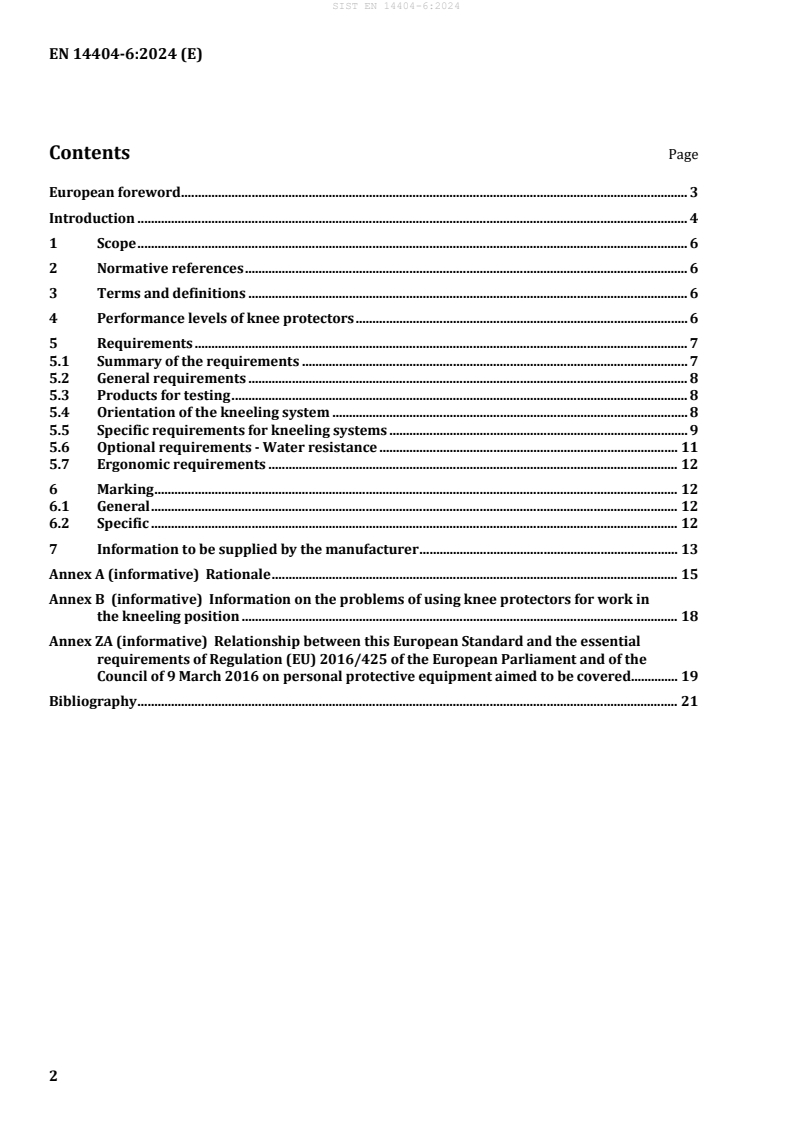
Contents Page
European foreword . 3
Introduction . 4
1 Scope . 6
2 Normative references . 6
3 Terms and definitions . 6
4 Performance levels of knee protectors . 6
5 Requirements . 7
5.1 Summary of the requirements . 7
5.2 General requirements . 8
5.3 Products for testing . 8
5.4 Orientation of the kneeling system . 8
5.5 Specific requirements for kneeling systems . 9
5.6 Optional requirements - Water resistance . 11
5.7 Ergonomic requirements . 12
6 Marking . 12
6.1 General . 12
6.2 Specific . 12
7 Information to be supplied by the manufacturer . 13
Annex A (informative) Rationale . 15
Annex B (informative) Information on the problems of using knee protectors for work in
the kneeling position . 18
Annex ZA (informative) Relationship between this European Standard and the essential
requirements of Regulation (EU) 2016/425 of the European Parliament and of the
Council of 9 March 2016 on personal protective equipment aimed to be covered. 19
Bibliography . 21
European foreword
This document (EN 14404-6:2024) has been prepared by Technical Committee CEN/TC 162 “Protective
clothing including hand and arm protection and life jackets”, the secretariat of which is held by DIN.
This European Standard shall be given the status of a national standard, either by publication of an
identical text or by endorsement, at the latest by November 2024 and conflicting national standards shall
be withdrawn at the latest by November 2024.
Attention is drawn to the possibility that some of the elements of this document may be the subject of
patent rights. CEN shall not be held responsible for identifying any or all such patent rights.
This document, together with EN 14404-1 to EN 14404-5, will supersede EN 14404:2004+A1:2010.
This document has been prepared under a standardization request addressed to CEN by the European
Commission. The Standing Committee of the EFTA States subsequently approves these requests for its
Member States.
For the relationship with EU Legislation, see informative Annex ZA, which is an integral part of this
document.
EN 14404 “Personal protective equipment — Knee protectors for work in the kneeling position” is split into
6 parts:
— Part 1: Test methods;
— Part 2: Requirements for wearable knee protectors (type 1);
— Part 3: Requirements for the individual combination of knee pads and garments (type 2);
— Part 4: Requirements for the combination of interoperable knee pads and garments (type 2);
— Part 5: Requirements for knee mats (type 3);
— Part 6: Requirements for kneeling systems (type 4).
With the splitting of the standard, the following changes were made:
— definition of the protection zone;
— new combination of interoperable knee pads with interoperable garments (EN 14404-4);
— a bend test for interoperable knee pad was introduced;
— normative references were updated, further normative references are included;
— the cleaning of garments was taken into account;
— an uneven test surface and test was introduced;
— no more "UNISIZE" size; adjustment of size designation;
— additional markings were added.
Any feedback and questions on this document should be directed to the users’ national standards body.
A complete listing of these bodies can be found on the CEN website.
According to the CEN-CENELEC Internal Regulations, the national standards organizations of the
following countries are bound to implement this European Standard: Austria, Belgium, Bulgaria, Croatia,
Cyprus, Czech Republic, Denmark, Estonia, Finland, France, Germany, Greece, Hungary, Iceland, Ireland,
Italy, Latvia, Lithuania, Luxembourg, Malta, Netherlands, Norway, Poland, Portugal, Republic of North
Macedonia, Romania, Serbia, Slovakia, Slovenia, Spain, Sweden, Switzerland, Türkiye and the United
Kingdom.
Introduction
Kneeling is a frequently occurring working position, but one which is problematic from an occupational
health viewpoint. Without knee protectors, workers can suffer immediate injuries from hard surfaces and
small stones and similar objects lying on the surfaces. However, no knee protector can ensure that
workers will not suffer medical complications if they are required to kneel for long periods.
It is important that knee protectors do not compromise venous drainage in the leg while kneeling or
standing up. Therefore, it is important that it is easy for workers to change position and to stand up to re-
establish a normal blood circulation at frequent intervals while wearing knee protectors.
Work in a kneeling position involves the risk of chronic diseases such as prepatellar bursitis and cartilage
injuries caused by continuous pressure on the knees. Knee protection is therefore recommended for all
work in the kneeling position. The protection should distribute forces evenly and prevent small hard
objects on the ground causing injuries. Many workers have pre-existing damage to their knees,
particularly to their cartilages from sports injuries and from previous work. These injuries will be made
worse by further kneeling. Wearing knee protectors cannot correct existing damage but should slow
down further damaging effects.
Work in a kneeling position can expose the skin of the shins, knees and thighs to toxic and corrosive
materials normally kept off the body while walking and standing by waterproof or water-resistant
footwear. Knee protectors and trousers for use with such wet materials and particularly wet cement,
should take this into account and provide adequate protection.
For working in a kneeling position, four types of knee protectors exist:
— wearable knee protectors (type 1),
— knee pads in combination with garments (type 2),
— knee mats (type 3), and
— kneeling systems (type 4).
1 Scope
This document specifies requirements for knee protectors (kneeling systems (type 4)) and performance
levels for use when working in a kneeling position in order to reduce injuries to the knees caused by
continuous pressure and penetration. Requirements for the marking of kneeling systems and the
information to be supplied by the manufacturer are given. Where protection against additional hazards
is claimed, performance requirements from other standards are applicable.
This document does not apply to knee protectors which are not attached to the body in use and that are
medical devices or are intended for sports and motorcycles.
2 Normative references
The following documents are referred to in the text in such a way that some or all of their content
constitutes requirements of this document. For dated references, only the edition cited applies. For
undated references, the latest edition of the referenced document (including any amendments) applies.
EN 14404-1:2024, Personal protective equipment - Knee protectors for work in the kneeling position - Part
1: Test methods
EN ISO 13688:2013, Protective clothing - General requirements (ISO 13688:2013)
3 Terms and definitions
For the purposes of this document, the following terms and definitions apply.
ISO and IEC maintain terminology databases for use in standardization at the following addresses:
— ISO Online browsing platform: available at https://www.iso.org/obp/
— IEC Electropedia: available at https://www.electropedia.org/
3.1
knee protectors, kneeling systems (type 4)
knee protectors that can be worn on the body for one or both knees, which are parts of devices with
additional functions
Note 1 to entry: Additional functions such as a frame to aid standing up, or a kneeling seat.
3.2
restraint
part of the kneeling system which keeps this fixed in position on the leg
3.3
zone of protection
area of the knee protector that is intended to provide the user with protection of patellar and infrapatellar
areas against continuous pressure and penetration
4 Performance levels of knee protectors
The performance level of knee protectors is only specified by the penetration resistance and the force
distribution.
4 performance levels are specified. The tests for the performance levels are described in 4.4 and 4.5 of
EN 14404-1:2024.
— Level 0: knee protectors providing no protection against penetration and with a force distribution
less than 30 N when tested on flat even surface
— Level 1: knee protectors providing protection against penetration at a force of at least 100 N and
with a force distribution less than 30 N when tested on flat even surface
— Level 1U: knee protectors providing protection against penetration at a force of at least 100 N and a
force distribution less than 30 N when tested on uneven surface.
— Level 2: knee protectors providing protection against penetration at a force of at least 250 N and
with a force distribution less than 30 N when tested on uneven surface
5 Requirements
5.1 Summary of the requirements
The summary of the requirements and the tests applicable are given in Table 1.
Table 1 — Summary of requirements for kneeling systems (type 4) that are worn on the body
and the tests applicable
Level
Clause Clauses describing the tests
Subject
number applicable
0 1 1U 2
5.2 General requirements X X X X EN 14404-1:2024, 4.1 and 4.2
EN 14404-1:2024, 4.3.1;
5.2 Innocuousness X X X X
EN ISO 13688:2013, 4.2
5.3 Products for testing X X X X 5.3
Orientation of the kneeling system
5.4.1 X X X X 5.4.1
Vertical alignment
Orientation of the kneeling system
5.4.2 X X X X 5.4.2
Knee, right/left
5.5.1.1 Size designation X X X X 5.5.1.1
5.5.1.2 Dimension of protective zone X X X X EN 14404-1:2024, 4.3.2
Penetration resistance
5.5.2 n.a. X X X EN 14404-1:2024, 4.4
(Performance levels 1, 1U and 2)
Force distribution on a flat even
5.5.3.1 X X n.a. n.a. EN 14404-1:2024, 4.5.2.1
surface
Force distribution on an uneven
5.5.3.2 n.a. n.a. X X EN 14404-1:2024, 4.5.2.2
surface
5.5.4 Peak transmitted force X X X X EN 14404-1:2024, 4.6.2
5.5.5.1 General requirements for restraint X X X X EN 14404-1:2024, 4.7.1
5.5.5.2 Restraint to the body X X X X EN 14404-1:2024, 4.11
Optional requirement for water
5.6 X X X X EN 14404-1:2024, 4.8.4
resistance
Level
Clause Clauses describing the tests
Subject
number applicable
0 1 1U 2
Restraint and comfort during use on a
5.7.1 X X n.a. n.a. EN 14404-1:2024, 4.10.1
flat even surface
Restraint and comfort during use on an
5.7.2 n.a. n.a. X X EN 14404-1:2024, 4.10.2
uneven surface
5.7.3 Compliance of straps X X X X EN 14404-1:2024, 4.11
6 Marking X X X X Clause 6
7 Manufacturer information X X X X Clause 7
n.a.: non-applicable
5.2 General requirements
Kneeling systems shall meet the general requirements.
Kneeling systems shall be safe to use and fit for their intended application defined by the manufacturer.
They shall be designed and manufactured to provide knee protection when used according to the
information supplied by the manufacturer, without endangering the user.
There shall not be hard or sharp edges, seams, buckles or other items on the inner surfaces (especially
within the zone of protection) of the products that could harm the user during normal use. Visual and
tactile examination shall be made according to EN 14404-1:2024, 4.3.1.
Kneeling systems shall meet the innocuousness requirements EN ISO 13688:2013, 4.2. Construction
materials and incorporated substances shall not harm those being in or coming into contact with them.
5.3 Products for testing
The manufacturer shall submit complete and ready-to-use 8 knee protection systems for testing.
The manufacturer shall provide the documents and data required for the testing.
5.4 Orientation of the kneeling system
5.4.1 Vertical alignment
The marking below (Figure 1) shall be used on the side facing the knee and pointing upwards.
Figure 1 — Graphical symbol –Indication for (vertical) alignment
5.4.2 Knee right, left
When a differentiation is necessary to indicate the side of the body (left/right) the following marking
(Figure 2 and Figure 3) shall be used respectively for the left knee and for the right knee.
Figure 2 — Graphical symbol –Marking of left knee side at which the kneeling system is to be
worn
Figure 3 — Graphical symbol –Marking of right knee side at which the kneeling system is to be
worn
5.5 Specific requirements for kneeling systems
5.5.1 Size and dimension
5.5.1.1 Size designation
The size system used by the manufacturer shall be based on the knee girth (knee girth range for which
the kneeling system has been designed, expressed in cm) and explained.
5.5.1.2 Dimension of protection zone
The zone of protection identified by the manufacturer (information supplied by the manufacturer) shall
be equal to or exceed the minimum dimensions specified in Table 2, when determined as described in
EN 14404-1:2024, 4.3.2.
Annex A gives information about the zone of protection. It is based on the dimensions of the human body
zones to be protected: prepatellar and infrapatellar zones.
The form of the zone of protection is shown in Figure 4.
Table 2 — Dimensions of the zones of protection of the kneeling system
Kneeling system Minimum values for length and width Ma
...