

EN 14387:2021
(Main)Respiratory protective devices - Gas filter(s) and combined filter(s) - Requirements, testing, marking
- Abstract
This document refers to gas filters and combined filters for use as replaceable components in unassisted respiratory protective devices (RPD) with the exception of escape devices.
Filters for use against CO are excluded from this document.
Laboratory tests are included for the assessment of compliance with the requirements.
Some filters complying with this document can also be suitable for use with assisted respiratory protective devices and/or escape devices. If so they need to be tested and marked in accordance with the appropriate European Standard.
- Status
- Published
- Publication Date
- 23-Feb-2021
- Withdrawal Date
- 30-Aug-2021
- Technical Committee
- CEN/TC 79 - Respiratory protective devices
- Drafting Committee
- CEN/TC 79/WG 4 - Filters and absorption devices
- Current Stage
- 6060 - Definitive text made available (DAV) - Publishing
- Start Date
- 24-Feb-2021
- Due Date
- 06-Sep-2019
- Completion Date
- 24-Feb-2021


Overview
EN 14387:2021 (CEN) specifies requirements, testing and marking for gas filters and combined filters used as replaceable components in unassisted respiratory protective devices (RPD). The standard covers laboratory tests for compliance, classification by type and capacity, packaging, conditioning and the information that manufacturers must supply. Filters for protection against carbon monoxide (CO) are excluded. Some filters that meet EN 14387:2021 may also be suitable for assisted RPDs or escape devices, but these require separate testing and marking to the appropriate standard.
Key Topics and Requirements
- Scope and exclusions: Applies to gas filters and combined filters used in unassisted RPDs; explicitly excludes CO filters and escape-device filters unless re‑tested/marked.
- Classification: Filters are classified by type (e.g., Types A, B, E, K, AX, SX, multi-type and combined filters) and capacity classes; manufacturers must state limitations and intended uses.
- Performance requirements: Laboratory tests assess gas capacity, inhalation resistance, and filter penetration under specified conditioning (temperature, mechanical strength).
- Design, materials and ergonomics: Requirements cover connection compatibility, mass, twin/multiple filter arrangements, and hazardous materials in components.
- Packaging and conditioning: Storage, shelf-life marking, and mechanical/temperature conditioning procedures for testing are specified.
- Marking and information: Filters and packaging must be marked with type, capacity, limitations, storage conditions, and manufacturer information; manufacturers must provide user information and warnings.
- Quality and safety process: The 2021 revision adds use of a risk assessment approach (e.g., FMEA) and introduces twin filters; clogging references were removed from the previous edition.
Practical Applications and Users
Who uses EN 14387:2021:
- Manufacturers and designers of gas and combined filters for RPDs - to design, test and mark products to meet European requirements.
- Test laboratories and certification bodies - to perform harmonized laboratory testing and conformity assessments.
- Occupational safety professionals and procurement teams - to select appropriate filters for workplace chemical hazards and ensure compliance with PPE regulations.
- Regulators and conformity assessors - to reference harmonized test methods and marking rules within the EU PPE framework (see Annex ZA).
How it’s used:
- Selecting the correct filter type and capacity for specific gas/vapour hazards.
- Specifying product marking, packaging and storage instructions to maintain performance.
- Conducting laboratory verification of inhalation resistance, gas capacity and durability.
Related Standards
- EN 143:2021 - Particle filters (requirements, testing, marking)
- EN 148-1:2018 - Facepiece thread connections
- EN 13274-3:2001 - Breathing resistance test method
- EN 13274-7:2019 - Particle filter penetration test method
- EN ISO 16972:2020 - Vocabulary and graphical symbols
- Regulation 2016/425/EU - PPE essential health and safety requirements (informative Annex ZA relationship)
Keywords: EN 14387:2021, gas filters, combined filters, respiratory protective devices, RPD, testing, requirements, marking, CEN, gas filter classification, inhalation resistance, gas capacity.
Relations
- Effective Date
- 08-Jun-2022
- Effective Date
- 28-Jan-2026
- Effective Date
- 28-Jan-2026
- Effective Date
- 28-Jan-2026
- Refers
EN 143:2021 - Respiratory protective devices - Particle filters - Requirements, testing, marking - Effective Date
- 28-Jan-2026
- Effective Date
- 28-Jan-2026
- Effective Date
- 17-Jun-2026
- Effective Date
- 28-Jan-2026
- Effective Date
- 28-Jan-2026
- Effective Date
- 28-Jan-2026
- Effective Date
- 28-Jan-2026
Get Certified
Connect with accredited certification bodies for this standard

CIS Institut d.o.o.
Personal Protective Equipment (PPE) certification body. Notified Body NB-2890 for EU Regulation 2016/425 PPE.

Kiwa BDA Testing
Building and construction product certification.
Kmetijski inštitut Slovenije
Agricultural Institute of Slovenia. Soil testing, plant health, agricultural product analysis.
Sponsored listings
Frequently Asked Questions
EN 14387:2021 is a standard published by the European Committee for Standardization (CEN). Its full title is "Respiratory protective devices - Gas filter(s) and combined filter(s) - Requirements, testing, marking". This standard covers: This document refers to gas filters and combined filters for use as replaceable components in unassisted respiratory protective devices (RPD) with the exception of escape devices. Filters for use against CO are excluded from this document. Laboratory tests are included for the assessment of compliance with the requirements. Some filters complying with this document can also be suitable for use with assisted respiratory protective devices and/or escape devices. If so they need to be tested and marked in accordance with the appropriate European Standard.
This document refers to gas filters and combined filters for use as replaceable components in unassisted respiratory protective devices (RPD) with the exception of escape devices. Filters for use against CO are excluded from this document. Laboratory tests are included for the assessment of compliance with the requirements. Some filters complying with this document can also be suitable for use with assisted respiratory protective devices and/or escape devices. If so they need to be tested and marked in accordance with the appropriate European Standard.
EN 14387:2021 is classified under the following ICS (International Classification for Standards) categories: 13.340.30 - Respiratory protective devices. The ICS classification helps identify the subject area and facilitates finding related standards.
EN 14387:2021 has the following relationships with other standards: It is inter standard links to EN 14387:2004+A1:2008, EN 148-1:2018, EN 13274-3:2001, EN ISO 16972:2020, EN 143:2021, EN 13274-7:2019, EN 17969:2026, EN 133:2001, EN 12083:1998, EN 134:1998, EN 405:2001+A1:2009. Understanding these relationships helps ensure you are using the most current and applicable version of the standard.
EN 14387:2021 is associated with the following European legislation: EU Directives/Regulations: 2016/425, 89/686/EEC; Standardization Mandates: M/031, M/571, M/571 Amd 1. When a standard is cited in the Official Journal of the European Union, products manufactured in conformity with it benefit from a presumption of conformity with the essential requirements of the corresponding EU directive or regulation.
EN 14387:2021 is available in PDF format for immediate download after purchase. The document can be added to your cart and obtained through the secure checkout process. Digital delivery ensures instant access to the complete standard document.
Standards Content (Sample)
SLOVENSKI STANDARD
01-julij-2021
Nadomešča:
SIST EN 14387:2004+A1:2008
Oprema za varovanje dihal - Filter(-ri) za pline in kombinirani filter(-ri) - Zahteve,
preskušanje, označevanje
Respiratory protective devices - Gas filter(s) and combined filter(s) - Requirements,
testing, marking
Atemschutzgeräte - Gasfilter und Kombinationsfilter - Anforderungen, Prüfung,
Kennzeichnung
Appareils de protection respiratoire - Filtres antigaz et filtres combinés - Exigences,
essais, marquage
Ta slovenski standard je istoveten z: EN 14387:2021
ICS:
13.340.30 Varovalne dihalne naprave Respiratory protective
devices
2003-01.Slovenski inštitut za standardizacijo. Razmnoževanje celote ali delov tega standarda ni dovoljeno.
EN 14387
EUROPEAN STANDARD
NORME EUROPÉENNE
February 2021
EUROPÄISCHE NORM
ICS 13.340.30 Supersedes EN 14387:2004+A1:2008
English Version
Respiratory protective devices - Gas filter(s) and combined
filter(s) - Requirements, testing, marking
Appareils de protection respiratoire - Filtres anti-gaz et Atemschutzgeräte - Gasfilter und Kombinationsfilter -
filtres combinés - Exigences, essais, marquage Anforderungen, Prüfung, Kennzeichnung
This European Standard was approved by CEN on 4 January 2021.
CEN members are bound to comply with the CEN/CENELEC Internal Regulations which stipulate the conditions for giving this
European Standard the status of a national standard without any alteration. Up-to-date lists and bibliographical references
concerning such national standards may be obtained on application to the CEN-CENELEC Management Centre or to any CEN
member.
This European Standard exists in three official versions (English, French, German). A version in any other language made by
translation under the responsibility of a CEN member into its own language and notified to the CEN-CENELEC Management
Centre has the same status as the official versions.
CEN members are the national standards bodies of Austria, Belgium, Bulgaria, Croatia, Cyprus, Czech Republic, Denmark, Estonia,
Finland, France, Germany, Greece, Hungary, Iceland, Ireland, Italy, Latvia, Lithuania, Luxembourg, Malta, Netherlands, Norway,
Poland, Portugal, Republic of North Macedonia, Romania, Serbia, Slovakia, Slovenia, Spain, Sweden, Switzerland, Turkey and
United Kingdom.
EUROPEAN COMMITTEE FOR STANDARDIZATION
COMITÉ EUROPÉEN DE NORMALISATION
EUROPÄISCHES KOMITEE FÜR NORMUNG
CEN-CENELEC Management Centre: Rue de la Science 23, B-1040 Brussels
© 2021 CEN All rights of exploitation in any form and by any means reserved Ref. No. EN 14387:2021 E
worldwide for CEN national Members.
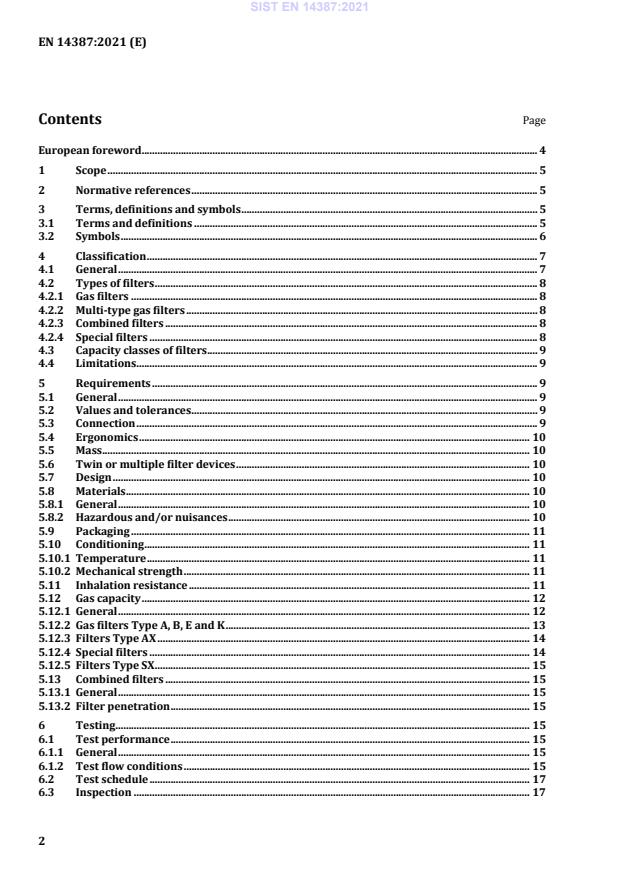
Contents Page
European foreword . 4
1 Scope . 5
2 Normative references . 5
3 Terms, definitions and symbols . 5
3.1 Terms and definitions . 5
3.2 Symbols . 6
4 Classification . 7
4.1 General . 7
4.2 Types of filters . 8
4.2.1 Gas filters . 8
4.2.2 Multi-type gas filters . 8
4.2.3 Combined filters . 8
4.2.4 Special filters . 8
4.3 Capacity classes of filters . 9
4.4 Limitations . 9
5 Requirements . 9
5.1 General . 9
5.2 Values and tolerances . 9
5.3 Connection . 9
5.4 Ergonomics . 10
5.5 Mass . 10
5.6 Twin or multiple filter devices . 10
5.7 Design . 10
5.8 Materials . 10
5.8.1 General . 10
5.8.2 Hazardous and/or nuisances . 10
5.9 Packaging . 11
5.10 Conditioning . 11
5.10.1 Temperature . 11
5.10.2 Mechanical strength . 11
5.11 Inhalation resistance . 11
5.12 Gas capacity . 12
5.12.1 General . 12
5.12.2 Gas filters Type A, B, E and K . 13
5.12.3 Filters Type AX . 14
5.12.4 Special filters . 14
5.12.5 Filters Type SX . 15
5.13 Combined filters . 15
5.13.1 General . 15
5.13.2 Filter penetration . 15
6 Testing . 15
6.1 Test performance . 15
6.1.1 General . 15
6.1.2 Test flow conditions . 15
6.2 Test schedule . 17
6.3 Inspection . 17
6.4 Conditioning . 18
6.4.1 Temperature . 18
6.4.2 Mechanical strength . 18
6.5 Inhalation resistance . 19
6.6 Gas capacity . 19
6.6.1 General . 19
6.6.2 Filters Type A, B, E and K. 20
6.6.3 Filters Type AX . 20
6.6.4 Special filters . 20
6.6.5 Filters Type SX . 20
7 Marking . 21
7.1 General . 21
7.2 Filters . 21
7.3 Filter package . 22
8 Information supplied by the manufacturer . 23
Annex ZA (informative) Relationship between this European Standard and the essential
health and safety requirements of Regulation 2016/425/EU [2016 OJ L81] aimed to
be covered . 25
Bibliography . 27
European foreword
This document (EN 14387:2021) has been prepared by Technical Committee CEN/TC 79 “Respiratory
protective devices”, the secretariat of which is held by DIN.
This European Standard shall be given the status of a national standard, either by publication of an
identical text or by endorsement, at the latest by August 2021, and conflicting national standards shall
be withdrawn at the latest by August 2021.
Attention is drawn to the possibility that some of the elements of this document may be the subject of
patent rights. CEN shall not be held responsible for identifying any or all such patent rights.
This document supersedes EN 14387:2004+A1:2008.
The following changes have been made compared to EN 14387:2004+A1:2008:
a) definitions and symbols added;
b) description deleted;
c) nominal values and tolerances changed;
d) use of a risk assessment, e.g. a Failure Modes and Effect Analysis (FMEA), added;
e) twin filters added;
f) clogging deleted;
g) in Table 1 column referring to maximum resistance after clogging deleted;
h) values in Table 2, Gas capacity and test conditions of gas filters of types A, B, E and K, changed;
i) visual inspection changed to inspection and detailed list inserted;
j) all figures adapted to the changes made in the test procedures, where appropriate.
This document has been prepared under a mandate given to CEN by the European Commission and the
European Free Trade Association, and supports essential requirements of EU Directive(s).
For relationship with EU Directive(s), see informative Annex ZA, which is an integral part of this
document.
According to the CEN-CENELEC Internal Regulations, the national standards organisations of the
following countries are bound to implement this European Standard: Austria, Belgium, Bulgaria,
Croatia, Cyprus, Czech Republic, Denmark, Estonia, Finland, France, Germany, Greece, Hungary, Iceland,
Ireland, Italy, Latvia, Lithuania, Luxembourg, Malta, Netherlands, Norway, Poland, Portugal, Republic of
North Macedonia, Romania, Serbia, Slovakia, Slovenia, Spain, Sweden, Switzerland, Turkey and the
United Kingdom.
1 Scope
This document refers to gas filters and combined filters for use as replaceable components in
unassisted respiratory protective devices (RPD) with the exception of escape devices.
Filters for use against CO are excluded from this document.
Laboratory tests are included for the assessment of compliance with the requirements.
Some filters complying with this document can also be suitable for use with assisted respiratory
protective devices and/or escape devices. If so they need to be tested and marked in accordance with
the appropriate European Standard.
2 Normative references
The following documents are referred to in the text in such a way that some or all of their content
constitutes requirements of this document. For dated references, only the edition cited applies. For
undated references, the latest edition of the referenced document (including any amendments) applies.
EN 134:1998, Respiratory protective devices - Nomenclature of components
EN 143:2021, Respiratory protective devices - Particle filters - Requirements, testing, marking
EN 148-1:2018, Respiratory protective devices - Threads for facepieces - Part 1: Standard thread
connection
EN 13274-3:2001, Respiratory protective devices - Methods of test - Part 3: Determination of breathing
resistance
EN 13274-7:2019, Respiratory protective devices - Methods of test - Part 7: Determination of particle filter
penetration
EN ISO 16972:2020, Respiratory protective devices - Vocabulary and graphical symbols (ISO 16972:2020)
3 Terms, definitions and symbols
3.1 Terms and definitions
For the purposes of this document, the terms and definitions given in EN ISO 16972:2020, EN 134:1998
and the following apply.
ISO and IEC maintain terminological databases for use in standardization at the following addresses:
• IEC Electropedia: available at http://www.electropedia.org/
• ISO Online browsing platform: available at https://www.iso.org/obp
3.1.1
as received
not pre-conditioned or modified to carry out a test
[SOURCE: EN ISO 16972:2020, definition 3.16]
3.1.2
ready for assembly state
component with seals, plugs or other environmental protective means, if applicable, still in place
[SOURCE: EN ISO 16972:2020, definition 3.195]
3.1.3
ready for use state
respiratory protective device (RPD) ready to be donned as described by the manufacturer
Note 1 to entry: In line with the information supplied by the manufacturer for donning the RPD, further actions
can be necessary.
[SOURCE: EN ISO 16972:2020, definition 3.198]
3.2 Symbols
For the purposes of this document, the following symbols apply.
3.2.1
See information supplied by the manufacturer
3.2.2
Crossed out 2: Symbol “for single shift use only”
NOTE: During one shift multiple use is allowed.
3.2.3
Hour glass “end of shelf life”
YYYY-MM
Key: YYYY = year, MM = month
3.2.4
Temperature range of storage conditions
Key: -xx °C to +yy °C
3.2.5
Maximum humidity of storage conditions
Key: < xx %
3.2.6
Filters to be used with a full face mask but not to be connected directly to a half mask
3.2.7
Twin or multiple filters
3.2.8
Maximum time of use of HgP3 filters
4 Classification
4.1 General
Gas filters are classified by type and class.
4.2 Types of filters
4.2.1 Gas filters
Gas filters are produced in one of the following types:
— Type A
For use against certain organic gases, vapours and substances with a boiling point higher than 65 °C
as specified by the manufacturer.
— Type B
For use against certain inorganic gases and vapours as specified by the manufacturer.
— Type E
For use against sulphur dioxide and other acidic gases and vapours as specified by the
manufacturer.
— Type K
For use against ammonia and organic ammonia derivatives as specified by the manufacturer.
— Type AX
For use against certain organic gases and vapours with a boiling point lower than or equal to 65 °C
as specified by the manufacturer.
Type AX filters are for single shift use only and shall be marked with the symbol given in 3.3.2.
— Type SX
For use against specific named gases and vapours as specified by the manufacturer.
4.2.2 Multi-type gas filters
Filters which are a combination of two or more of the above types excluding type SX and which meet
the requirements of each type separately.
4.2.3 Combined filters
Gas or multi-type gas filters incorporating a particle filter in accordance with EN 143:2021.
4.2.4 Special filters
— Type NOP3
For use against nitrogen oxides, e.g. NO, NO , NO .
2 X
— Type HgP3
For use against mercury.
These filters shall always incorporate a P3 filter in accordance with EN 143:2021 and may be combined
with each other and/or types specified in 4.2.1 except for type SX.
4.3 Capacity classes of filters
Gas filters of types A, B, E and K are classified in terms of capacity as follows:
— Class 1 low capacity filters;
— Class 2 medium capacity filters;
— Class 3 high capacity filters.
Capacity of any class of filters includes lower classes of the same type.
The classification of combined filter(s) includes particle filter(s) in accordance with EN 143:2021.
No capacity classes are assigned to the following filter types:
AX, SX, NOP3 and HgP3.
4.4 Limitations
Filters are reusable unless they are designated for single shift use only.
HgP3 filters are for a maximum use time of 50 h.
5 Requirements
5.1 General
All test samples specified in the related test clauses shall meet the relevant requirements.
Where it is required in a specific clause the manufacturer shall declare that a risk assessment, e.g. a
Failure Modes and Effect Analysis (FMEA) has been conducted.
NOTE Further information is given in EN 60812 [1].
5.2 Values and tolerances
Temperature limits, values which describe test conditions and that are not stated as maxima or minima
shall be subject to a tolerance of ± 5 %. Unless otherwise specified, the ambient conditions for testing
shall be between 16 °C and 32 °C and (50 ± 30) % relative humidity.
Any temperature limits specified shall be subject to an accuracy of ± 1 °C.
5.3 Connection
The connection between filter(s) and respiratory interface with which it is intended to be used shall be
robust and leaktight.
The manufacturer shall supply a declaration that this was addressed by a risk assessment, e.g. a FMEA.
Threads conforming to EN 148-2 or EN 148-3 shall not be used.
The connection between filter and facepiece may be achieved by a special connector or a screw thread
including a thread conforming to EN 148-1:2018.
If the filter is designated to be used on a twin or multiple filter facepiece or has any other thread, it shall
not be possible to connect it to a thread conforming to EN 148-1:2018.
The filter shall be readily replaceable without use of special tools and shall be designed or marked to
prevent incorrect assembly.
Check in accordance with 6.2.
5.4 Ergonomics
The requirements of this document are intended to take account of the interaction between the wearer,
the RPD, and where possible the working environment in which the RPD is likely to be used. Filters
shall satisfy 5.5, 5.7, 5.8 and 5.11.
Check in accordance with 6.2 and test in accordance with 6.5.
5.5 Mass
The maximum mass of filter(s) designated to be used directly connected to a half mask or quarter mask
shall not exceed 300 g.
The maximum mass of filter(s) designated to be used directly connected to a full face mask shall not
exceed 500 g and shall be marked with the symbol given in 3.2.6.
Check in accordance with 6.2.
5.6 Twin or multiple filter devices
Where respirators are designed to use more than one filter, through which the flow is proportioned, all
relevant requirements specified in this document are to be met by the complete set of filters.
If, however, it is intended that a single filter of a twin or multiple filter device may be used alone, then
the requirements of the full flow rate for the tests, as stated in this document, shall be met.
In the information supplied by the manufacturer all necessary information on how to use twin or
multiple filters shall be given.
Testing shall be performed in accordance with 6.1 and checked in accordance with 6.2.
5.7 Design
The surface of any part of the device likely to come in contact with the wearer shall be free from sharp
edges and burrs.
Check in accordance with 6.2.
5.8 Materials
5.8.1 General
Materials used shall be suitable to withstand the intended use and conditions, (e.g. temperatures,
humidity and corrosive environments) as stated by the manufacturer unless specified in this document.
The manufacturer shall supply a declaration that this was addressed by a risk assessment, e.g. a FMEA.
Check in accordance with 6.2
5.8.2 Hazardous and/or nuisances
Any material of the filter media or any gaseous products that may be released by the air flow through
the filter shall not be known to constitute a hazard or nuisance for the wearer.
The manufacturer shall supply a declaration that this was addressed by a risk assessment, e.g. a FMEA.
Check in accordance with 6.2.
5.9 Packaging
Where appropriate, filters shall be factory sealed in such a way that the breaking of the factory sealing
can be identified.
Check in accordance with 6.2.
5.10 Conditioning
5.10.1 Temperature
Filters in their ready for assembly state shall be subjected to the temperature conditioning in
accordance w
...