

EN 1860-1:2024
(Main)Appliances, solid fuels and firelighters for barbecueing - Part 1: Barbecues burning solid fuels - Requirements and test methods
- Abstract
This document specifies requirements for barbecues that burn solid fuels with regard to materials, construction, design, test methods, markings and instructions relating to them.
This document also applies to barbecues originally burning non-solid fuels that have been converted to burn solid fuels.
This document does not apply to single use barbecues. Single use barbecues are covered by EN 1860-4.
- Status
- Published
- Publication Date
- 19-Nov-2024
- Technical Committee
- CEN/TC 281 - Appliances, solid fuels and firestarters for barbecuing
- Drafting Committee
- CEN/TC 281/WG 1 - Barbecues burning solid fuels
- Current Stage
- 6060 - Definitive text made available (DAV) - Publishing
- Start Date
- 20-Nov-2024
- Due Date
- 30-Jul-2024
- Completion Date
- 20-Nov-2024

Overview
EN 1860-1:2024 - published by CEN in November 2024 - specifies requirements and test methods for barbecues burning solid fuels. It covers materials, construction, design, markings and instructions for portable, closed, open, permanent and insert barbecues that use solid fuels. The standard also applies to appliances originally designed for non-solid fuels that have been converted to burn solid fuels. Single-use disposable barbecues are excluded (see EN 1860-4).
Key topics and technical requirements
EN 1860-1:2024 structures the safety and performance requirements into clear clauses and test methods. Major topics include:
Materials and construction
- Requirements for metal sheet/tube thickness (notably a minimum of 0.65 mm for many accessible parts, with specific enamelled exceptions).
- Protection against rough surfaces, burrs and sharp edges (test reference EN 71-1:2014+A1:2018).
Components and accessories
- Rules for fuel compartments, fuel grates, ash compartment / ash catcher, cooking grids, rotisserie/rotating spits, drip pans and stands.
- Definitions for barbecue categories (portable, closed, open, permanent, insert).
Test methods
- Thermal tests (use and safety scenarios), combustibility, stability (portable, permanent), handling, cooking grid performance and perforation tests.
- Additional thermal testing when a product can be used as either an open or closed barbecue.
Marking, instructions and packaging
- Mandatory markings, graphical symbols (to be positioned adjacent to each other), and user instructions to reduce misuse and risk during barbecuing.
Other considerations
- Coatings shall not release ignitable or solid substances during thermal testing.
- Compatibility with food-contact legislation is noted (e.g., Regulation (EC) No 1935/2004).
Applications and who uses this standard
EN 1860-1:2024 is essential for:
- Barbecue manufacturers and designers developing solid-fuel appliances or converting gas/electric models to solid fuel.
- Test laboratories and conformity assessment bodies conducting thermal, stability and safety testing.
- Retailers and importers ensuring products meet EU national standards before sale.
- Product safety engineers, certification bodies and regulators enforcing market access and consumer safety.
- Technical writers and instruction designers creating compliant packaging, warnings and user manuals.
Related standards
- EN 1860-2 - Barbecue charcoal and briquettes (requirements and tests)
- EN 1860-3 - Firelighters (requirements and tests)
- EN 1860-4 - Single-use barbecues
- EN 71-1:2014+A1:2018 - referenced for mechanical/physical safety tests
Keywords: EN 1860-1:2024, barbecues burning solid fuels, barbecue safety, CEN standard, requirements and test methods, fuel compartment, ash catcher, thermal test, stability testing.
Relations
- Effective Date
- 27-Nov-2024
- Effective Date
- 28-Jan-2023
- Effective Date
- 28-Jan-2026
- Effective Date
- 28-Jan-2026
Frequently Asked Questions
EN 1860-1:2024 is a standard published by the European Committee for Standardization (CEN). Its full title is "Appliances, solid fuels and firelighters for barbecueing - Part 1: Barbecues burning solid fuels - Requirements and test methods". This standard covers: This document specifies requirements for barbecues that burn solid fuels with regard to materials, construction, design, test methods, markings and instructions relating to them. This document also applies to barbecues originally burning non-solid fuels that have been converted to burn solid fuels. This document does not apply to single use barbecues. Single use barbecues are covered by EN 1860-4.
This document specifies requirements for barbecues that burn solid fuels with regard to materials, construction, design, test methods, markings and instructions relating to them. This document also applies to barbecues originally burning non-solid fuels that have been converted to burn solid fuels. This document does not apply to single use barbecues. Single use barbecues are covered by EN 1860-4.
EN 1860-1:2024 is classified under the following ICS (International Classification for Standards) categories: 97.040.20 - Cooking ranges, working tables, ovens and similar appliances. The ICS classification helps identify the subject area and facilitates finding related standards.
EN 1860-1:2024 has the following relationships with other standards: It is inter standard links to EN 1860-1:2013+A1:2017/AC:2017, EN 1860-1:2013+A1:2017, EN 71-1:2014+A1:2018, EN 1860-2:2023. Understanding these relationships helps ensure you are using the most current and applicable version of the standard.
EN 1860-1:2024 is available in PDF format for immediate download after purchase. The document can be added to your cart and obtained through the secure checkout process. Digital delivery ensures instant access to the complete standard document.
Standards Content (Sample)
SLOVENSKI STANDARD
01-januar-2025
Nadomešča:
SIST EN 1860-1:2013+A1:2017/AC:2018
Naprave, trdna goriva in naprave za vžiganje žara - 1. del: Žari na trdna goriva -
Zahteve in preskusne metode
Appliances, solid fuels and firelighters for barbecueing - Part 1: Barbecues burning solid
fuels - Requirements and test methods
Geräte, feste Brennstoffe und Anzündhilfen zum Grillen - Teil 1: Grillgeräte für feste
Brennstoffe - Anforderungen und Prüfverfahren
Appareils, combustibles solides et allume-feu pour la cuisson au barbecue - Partie 1:
Barbecues utilisant les combustibles solides - Exigences et méthodes d'essai
Ta slovenski standard je istoveten z: EN 1860-1:2024
ICS:
75.160.10 Trda goriva Solid fuels
97.040.20 Štedilniki, delovni pulti, Cooking ranges, working
pečice in podobni aparati tables, ovens and similar
appliances
2003-01.Slovenski inštitut za standardizacijo. Razmnoževanje celote ali delov tega standarda ni dovoljeno.
EN 1860-1
EUROPEAN STANDARD
NORME EUROPÉENNE
November 2024
EUROPÄISCHE NORM
ICS 97.040.20 Supersedes EN 1860-1:2013+A1:2017
English Version
Appliances, solid fuels and firelighters for barbecueing -
Part 1: Barbecues burning solid fuels - Requirements and
test methods
Appareils, combustibles solides et allume-feu pour la Geräte, feste Brennstoffe und Anzündhilfen zum Grillen
cuisson au barbecue - Partie 1: Barbecues utilisant les - Teil 1: Grillgeräte für feste Brennstoffe -
combustibles solides - Exigences et méthodes d'essai Anforderungen und Prüfverfahren
This European Standard was approved by CEN on 13 October 2024.
CEN members are bound to comply with the CEN/CENELEC Internal Regulations which stipulate the conditions for giving this
European Standard the status of a national standard without any alteration. Up-to-date lists and bibliographical references
concerning such national standards may be obtained on application to the CEN-CENELEC Management Centre or to any CEN
member.
This European Standard exists in three official versions (English, French, German). A version in any other language made by
translation under the responsibility of a CEN member into its own language and notified to the CEN-CENELEC Management
Centre has the same status as the official versions.
CEN members are the national standards bodies of Austria, Belgium, Bulgaria, Croatia, Cyprus, Czech Republic, Denmark, Estonia,
Finland, France, Germany, Greece, Hungary, Iceland, Ireland, Italy, Latvia, Lithuania, Luxembourg, Malta, Netherlands, Norway,
Poland, Portugal, Republic of North Macedonia, Romania, Serbia, Slovakia, Slovenia, Spain, Sweden, Switzerland, Türkiye and
United Kingdom.
EUROPEAN COMMITTEE FOR STANDARDIZATION
COMITÉ EUROPÉEN DE NORMALISATION
EUROPÄISCHES KOMITEE FÜR NORMUNG
CEN-CENELEC Management Centre: Rue de la Science 23, B-1040 Brussels
© 2024 CEN All rights of exploitation in any form and by any means reserved Ref. No. EN 1860-1:2024 E
worldwide for CEN national Members.
Contents Page
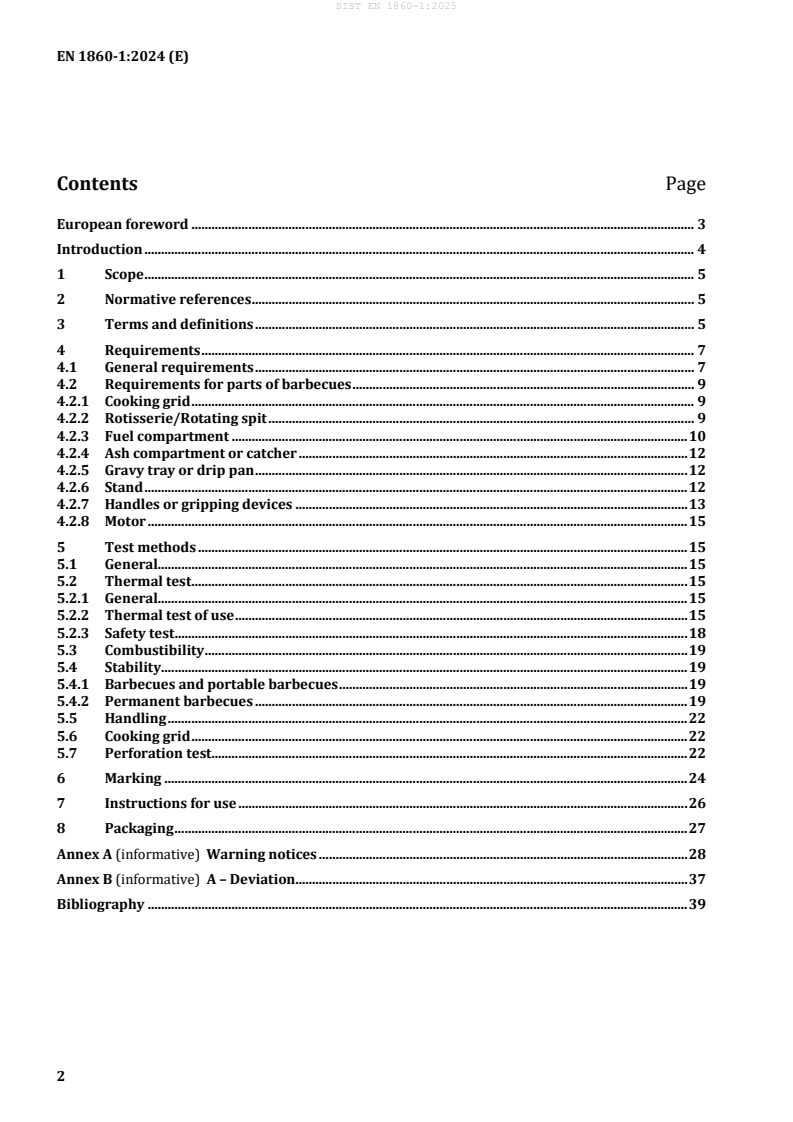
European foreword . 3
Introduction . 4
1 Scope . 5
2 Normative references . 5
3 Terms and definitions . 5
4 Requirements . 7
4.1 General requirements . 7
4.2 Requirements for parts of barbecues . 9
4.2.1 Cooking grid . 9
4.2.2 Rotisserie/Rotating spit . 9
4.2.3 Fuel compartment . 10
4.2.4 Ash compartment or catcher . 12
4.2.5 Gravy tray or drip pan . 12
4.2.6 Stand . 12
4.2.7 Handles or gripping devices . 13
4.2.8 Motor . 15
5 Test methods . 15
5.1 General. 15
5.2 Thermal test . 15
5.2.1 General. 15
5.2.2 Thermal test of use . 15
5.2.3 Safety test . 18
5.3 Combustibility . 19
5.4 Stability . 19
5.4.1 Barbecues and portable barbecues . 19
5.4.2 Permanent barbecues . 19
5.5 Handling . 22
5.6 Cooking grid . 22
5.7 Perforation test. 22
6 Marking . 24
7 Instructions for use . 26
8 Packaging . 27
Annex A (informative) Warning notices . 28
Annex B (informative) A – Deviation. 37
Bibliography . 39
European foreword
This document (EN 1860-1:2024) has been prepared by Technical Committee CEN/TC 281
“Appliances, solid fuels and firelighters for barbecuing”, the secretariat of which is held by UNE.
This European Standard shall be given the status of a national standard, either by publication of an
identical text or by endorsement, at the latest by May 2025, and conflicting national standards shall
be withdrawn at the latest by May 2025.
Attention is drawn to the possibility that some of the elements of this document may be the subject
of patent rights. CEN shall not be held responsible for identifying any or all such patent rights.
This document supersedes EN 1860-1:2013+A1:2017.
EN 1860-1:2013+A1:2017:
a) the normative references have been updated;
b) the terms and definitions have been updated for clarification purposes and a definition for
« insert barbecue » has been added;
c) in 4.1 and 4.2.4, the thickness requirement for parts made from metal sheet or tubes has been
reduced from 0,7 mm to 0,65 mm;
d) in 4.2.3.1, the notion of multiple fuel compartments has been added;
e) in 5.2.2.2, a further test has been added for the case that the barbecue may be used as open
barbecue or closed barbecue according to the user instructions;
f) in Clauses 6 and 8 it has been clarified that the graphical symbols shall be positioned adjacent to
each other on the product or on the packaging, respectively;
g) throughout the document several wordings have been revised editorially for clarification.
The structure of EN 1860, Appliances, solid fuels and firelighters for barbecueing, is as follows:
— Part 2: Barbecue charcoal and barbecue charcoal briquettes - Requirements and test methods;
— Part 3: Firelighters for igniting solid fuels for use in barbecues and grill applications - Requirements and
test methods;
— Part 4: Single use barbecues burning solid fuels - Requirements and test methods.
Any feedback and questions on this document should be directed to the users’ national standards
body. A complete listing of these bodies can be found on the CEN website.
According to the CEN-CENELEC Internal Regulations, the national standards organisations of the
following countries are bound to implement this European Standard: Austria, Belgium, Bulgaria,
Croatia, Cyprus, Czech Republic, Denmark, Estonia, Finland, France, Germany, Greece, Hungary,
Iceland, Ireland, Italy, Latvia, Lithuania, Luxembourg, Malta, Netherlands, Norway, Poland, Portugal,
Republic of North Macedonia, Romania, Serbia, Slovakia, Slovenia, Spain, Sweden, Switzerland,
Türkiye and the United Kingdom.
Introduction
This document is part 1 of the European Standard series for appliances, solid fuels and firelighters for
barbecuing, which is intended to reduce the risks which can occur during and through barbecuing with
solid fuels.
This part should be read in conjunction with parts 2 and 3.
1 Scope
This document specifies requirements for barbecues that burn solid fuels with regard to materials,
construction, design, test methods, markings and instructions relating to them.
This document also applies to barbecues originally burning non-solid fuels that have been converted to
burn solid fuels.
This document does not apply to single use barbecues. Single use barbecues are covered by EN 1860-4.
2 Normative references
The following documents are referred to in the text in such a way that some or all of their content
constitutes requirements of this document. For dated references, only the edition cited applies. For
undated references, the latest edition of the referenced document (including any amendments) applies.
EN 71-1:2014+A1:2018, Safety of toys — Part 1: Mechanical and physical properties
EN 1860-2, Appliances, solid fuels and firelighters for barbecuing — Part 2: Barbecue charcoal and
barbecue charcoal briquettes — Requirements and test methods
3 Terms and definitions
For the purposes of this document, the following terms and definitions apply.
ISO and IEC maintain terminology databases for use in standardization at the following addresses:
— ISO Online browsing platform: available at https://www.iso.org/obp/
— IEC Electropedia: available at https://www.electropedia.org/
3.1
barbecue
appliance designed only for outdoor cooking in the open air
Note 1 to entry: The cooking support can be a grid, a griddle or a spit.
3.2
barbecue categories
3.2.1
portable barbecue
appliance that can be carried with one hand without parts falling off when dismantled or folded
Note 1 to entry: It can be classified as either closed (see 3.2.2) or open (see 3.2.3).
3.2.2
closed barbecue
appliance designed for cooking outdoors by means of radiant and convection heat with a lid which may
have air vents and consisting at least of a fuel compartment, a cooking grid and/or a rotisserie/rotating
spit
3.2.3
open barbecue
appliance designed for cooking outdoors by means of radiant heat consisting at least of a fuel
compartment, a cooking grid and/or a rotisserie/rotating spit
3.2.4
permanent barbecue
outdoor appliance designed to be permanently installed
Note 1 to entry: It may consist of pre-fabricated elements fitted together. It may include a pre-fabricated hood
and removable parts.
Note 2 to entry: It can be classified as either closed (see 3.2.2) or open (see 3.2.3).
3.2.5
insert barbecue
outdoor appliance which can be installed in an enclose or to put on trolley/support
Note 1 to entry: It can be classified as either closed (see 3.2.2) or open (see 3.2.3).
3.3
fuel compartment
part of the barbecue where the fuel is burnt
Note 1 to entry: It may have, or be a fuel grate and may have air vents.
Note 2 to entry: In closed barbecues the fuel compartment is the fuel grate or the fuel grate with fuel rails or
baskets or a fuel tray.
3.4
fuel grate
perforated part of the barbecue on which the fuel is placed
3.5
ash compartment
ash catcher
part of the barbecue intended to catch any ash or embers which may fall from the fuel compartment or
fuel grate
3.6
barbecue accessory
part of the barbecue which hold the food to be barbecued during cooking
3.7
barbecue accessories
3.7.1
cooking grid
part of the barbecue on which the food to be cooked is placed and/or which can take on the function of
the fuel grate
3.7.2
rotisserie spit
rotating spit
metal rod suitable for skewering the food to be cooked via the truncated cone on one side and which can
be rotated by hand and/or via a motor in a suitable support
3.7.3
rotisserie meat fork
clamping device on the rotisserie/rotating spit that can be slid onto and fixed in any position on which
the food to be cooked can be secured
3.7.4
gravy tray
device to collect juices and drippings to be consumed
3.8
removable part
part of a barbecue which can be removed without the use of a tool
3.9
usable area
area or part of a barbecue component and accessories intended to come into contact with the food to be
barbecued during cooking
Note 1 to entry: when using rotisserie/rotating spit, the term “usable length” can be used.
3.10
drip pan
device to collect waste drippings not to be consumed
3.11
stand
support structure of a barbecue onto which the functional parts of the barbecue are located
3.12
silk paper
thin, soft, relatively hard to tear paper
3.13
windshield
component of the barbecue used to minimise undesirable effect of the wind during the use of the
barbecue
4 Requirements
4.1 General requirements
When testing as described in 5.2, the coatings of the barbecue accessories shall not liberate any solid
substance nor ignite. Also, any solid substance coming from other parts of the barbecue shall not ignite
nor fall into the usable area.
NOTE Requirements on materials and articles intended to come into contact with food can be found in
applicable legislation, e.g. Regulation (EC) No 1935/2004. Extra requirements can exist in some EU countries.
It shall be possible to assemble and dismantle portable barbecues as described in the instructions for use
either without the aid of a tool or using the tool that is supplied. Components shall be fixed in such a way
that they cannot fall off during transportation.
When assembling, operating and manipulating the barbecue, accessible edges and corners shall be free
from burr. Barbecues or parts of barbecues shall not have any rough surfaces, sharp edges or corners that
can cause an injury. In case of doubt to determine whether rough surface, sharp edges or corners can
cause an injury, a test shall be done in accordance with EN 71-1:2014+A1:2018, 8.11. For the bars of the
cooking grids and charcoal grids, the test in EN 71-1:2014+A1:2018 is not applicable. General
requirements as described above shall be satisfied.
All accessible parts of the barbecue components made of metal sheet or tubes of thickness less
than 0,65 mm coating excluded shall be as shown in Figures 1, 2, 3 or 4. Excluding coating, a thickness
between 0,5 mm and 0,65 mm is also acceptable, provided they are glass or porcelain enamelled on both
sides and a test shall be carried out in accordance with EN 71-1:2014+A1:2018, 8.11.
For thickness requirements of fuel compartment and ash compartment, see 4.2.3.1 and 4.2.4.
Figure 1 — Fully edged
Figure 2 — Folded and flattened
Figure 3 — Rolled and closed
Dimension in millimetres
Figure 4 — Rolled and half closed
The construction of the barbecue shall be such that when placed horizontally the change of the fuel
compartment position, according to the instruction for use and the insertion and removal of barbecue
accessories with the cooking grid and/or rotisserie/rotating spit loaded as described in 5.5, shall be
possible without the barbecue tipping over or components becoming detached or moved in such a way
that they are no longer capable of fulfilling their functions. The last sentence’s requirements shall be also
satisfied when testing the barbecue as described in 5.2.
When tested in accordance with the test methods specified in Clause 5, a barbecue shall not:
a) show any deformation of a component that compromises the use and safety of the barbecue;
b) have any component showing cracks and/or fractures;
NOTE A permanent barbecue can show cracks and/or fractures which do not influence the safety.
c) have any components falling off;
d) show any deviations from the temperature and safety requirements mentioned in the test
descriptions.
4.2 Requirements for parts of barbecues
4.2.1 Cooking grid
The clear distance between the bars of the cooking grid shall not exceed 20 mm before, during and after
testing according to 5.2 and 5.6. This requirement relates to the usable area of the grid, which shall be at
least 80 % of the horizontal area of the fuel compartment, vertically projected.
If the cooking grid has the function of a fuel grate, the clear distance between the bars of the grate and
also, in the case of vertical fuel compartment, of those between the grate and the edges of the fuel
container shall not exceed 20 mm before, during and after testing according to 5.2 and 5.6.
The cooking grid shall rest on its supporting points in the most unfavourable position when loaded as
described in 5.5. When the load has been removed the deformation of each grid bar shall not exceed 5 %
relative to the length of the bar when tested according to 5.6.
Manually adjustable cooking grids up to 400 mm diameter or longest side measurement shall be fitted
with one handle minimum, cooking grids over 400 mm diameter or longest side measurement shall be
fitted with two handles. If the cooking grid position is adjustable, this adjustment shall be possible
without the operator's hand coming into direct contact with the cooking grid.
Removable or movable handles shall be attached to the cooking grid in such a way that tipping to the side
or forwards when loaded as described in 5.5 shall not be possible.
A handle is not required when the height of the cooking grid can be adjusted through a mechanical device.
The barbecue shall be designed in such a way that when the fuel compartment is uniformly loaded to
75 % of its capacity according to 5.2, the cooking grid in its most unfavourable position shall not come
into contact with the fuel.
4.2.2 Rotisserie/Rotating spit
The end of the rotisserie/rotating spit shall have the shape of a truncated cone of minimum diameter not
less than 1,5 mm and not exceeding 3 mm and a taper angle between 60° and 90°.
The rotisserie/rotating spit shall have a permanent or removable handle of at least 100 mm usable
length.
The handle for any motor supplied with it shall be 80 mm minimum length.
If the distance between the support points of the rotisserie/rotating spit exceeds 800 mm a second
handle shall be provided unless the motor has the function of a handle.
The handle (or handles) shall be fitted to the rotisserie/rotating spit in such a way that when tested in
accordance with 5.2.2 the surface temperatures shall not exceed the values specified in Table 3.
The rotisserie/rotating spit shall have a minimum of two adjustable and fixable rotisserie meat forks.
When loading the rotisserie/rotating spit with 0,5 kg per 100 mm usable length according to 5.5 it shall
rest on all its supporting points.
The other components of the barbecue or the fuel load following the instructions for use shall not come
into contact with a cylinder 200 mm in diameter and of a length equivalent to at least 60 % of the usable
rotisserie/rotating spit length placed centrally around the rotisserie/rotating spit and in the centre of the
rotisserie/rotating spit. If several rotisserie spit positions are possible, this requirement shall be met for
at least one position.
4.2.3 Fuel compartment
4.2.3.1 General
All fuel compartments made of steel sheet, whether multiple or single, shall:
— be considered separately;
— respect a minimum thickness (coating excluded) as specified in Table 1.
A compartmentalized fuel compartment shall be considered as a single fuel compartment.
The thickness shall be measured in three different points:
— one to be in the centre of the bottom (even if the bottom has a fuel grate above it);
— two on the opposite sides at minimum 150 mm from each other;
If one side of the fuel compartment is a grate, only two sides are measured.
The thickness shall be considered the average of the measurements.
On finished products ready to be commercialized:
1) Measure the total thickness “T ” in the three points of the fuel compartment.
t
2) Measure at these same points on both sides the thickness of the coating C and C .
ext int
3) Calculate by subtraction the thickness of the uncoated steel sheet in each. T = T – (C + C ).
t ext int
4) Calculate the average from them.
Table 1 — Minimum thickness of steel sheet for fuel compartments
Grid size diameter or longest side measurement
Thickness
relative to the fuel compartments
mm mm
≤ 400 0,7
> 400 0,8
The measuring equipment used shall be selected so that the uncertainty requirements of 0,01 mm
measured is met.
For fuel compartments with a grid size diameter or longest side measurement ≤ 400 mm, a thickness
(coating excluded) between 0,5 mm and 0,7 mm is acceptable, provided they are glass or porcelain
enamelled on both sides and withstand the tests according to:
a) 5.2.2 one time and 5.2.3 two times consecutively; and
b) 5.7.
Fuel compartments made of cast metal require a minimum thickness coating excluded of 2,5 mm.
Fuel compartments made of materials other than steel sheet or cast material (excluding permanent
barbecues) shall withstand the tests according to:
a) 5.2.2 one time and 5.2.3 two times consecutively; and
b) 5.7.
4.2.3.2 Openings
If the fuel compartment after assembly has openings, these shall meet the following requirements when
tested as described in 5.2 and 5.3.
The number of openings in the flat base of the fuel compartment shall not exceed four and shall be
dimensioned so that a sphere of 3 mm in diameter will not fall through them, their area shall not exceed
50 mm .
Other openings, other than in the flat base, if circular should have a diameter not exceeding 8 mm, or, if a
different shape, their area shall not exceed 50 mm .
With larger openings the barbecue shall be equipped with an ash catcher or the barbecue shall be
designed so that it is impossible for any embers or fuel to fall out or roll off when tested as described
in 5.2 and 5.3.
4.2.3.3 Depth of the fuel compartment
The minimum depth of the fuel compartment shall be as indicated in Table 2. The minimum depth shall
be available over 80 % of the usable area of the fuel compartment.
Table 2 — Minimum depth of the fuel compartment
Grid size diameter or longest side measurement Minimum depth of fuel
relative to the fuel compartments compartment
mm mm
≤ 400 50
> 400 60
The measuring equipment used shall be selected so that the uncertainty requirement of 0,1 mm
measured is met.
If the fuel compartment is a grate Table 2 shall not be taken into account, but it shall have an ash catcher.
If the fuel compartment has several possible positions, stops shall be provided to secure it in each of these
positions.
For permanent barbecues part of the structure can be used as the fuel compartment when calculating the
minimum depth shown in Table 2.
For permanent barbecues the front side of the fuel compartment can be open if it is protected by a flat
protection plane minimum 130 mm deep to prevent embers from falling to the ground as shown
in Figure 5.
Dimensions in millimetres
Key
A fuel compartment
B flat protection plane
Figure 5 — Top view of flat protection plane for permanent barbecue
4.2.4 Ash compartment or catcher
Ash compartments or catcher made of sheet metal require a minimum thickness (coating excluded) of
0,65 mm.
For ash compartments or catchers with a diameter or longest side measurement ≤ 400 mm, a thickness
(coating excluded) between 0,5 mm and 0,65 mm is acceptable, provided they are glass or porcelain
enamelled on both sides.
4.2.5 Gravy tray or drip pan
If the barbecue has a gravy tray or drip pan with the barbecue in the horizontal position it shall either be
arranged in such a way that its contents flow away from the fuel compartment or have a recess at least
5 mm deep and the horizontal distance between the grate and the beginning of the recess shall be at least
30 mm, when the base of the gravy tray or drip pan is horizontal.
4.2.6 Stand
If the stand is foldable, the folding elements shall be capable of being locked in the operating position of
the barbecue. A locking and/or unlocking device shall not operate unintentionally.
The stand shall support the barbecue when tested in any position as described in 5.4. The barbecue shall
not tip over and when used in accordance with the instructions for use no components shall fall off.
If the stand or barbecue has wheels or castors to enable it to be moved:
a) no parts or accessories shall fall off during movement;
b) means shall be provided to prevent accidental movement of the stand or barbecue during normal
use;
This requirement is satisfied if:
1) at least one of the wheels or castors is fitted with a brake or a blocking system; or
2) at least one of the support points of the barbecue is not made of a wheel or a castor.
c) a gripping device shall be provided to move the barbecue safely while cold.
4.2.7 Handles or gripping devices
Lid and adjustable cooking grid handles shall have a usable area of at least 80 mm. Separate requirements
apply for rotisserie/rotating spit handles (see 4.2.2).
The temperature shall be taken only of lid and adjustable cooking grid handles which are needed during
operation of the barbecue.
The temperature of all other handles or gripping devices (e.g. air control of lid, ash tray or non-adjustable
cooking grid) shall not be taken if it is clearly stated the use of mitts, gloves or a tool in the instructions
for use (e.g. graphical symbol or a sentence).
The surface temperatures over the full usable part of the handle or gripping device shall not exceed the
values specified in Table 3 when tested in accordance with 5.2.2. In case of handles uniform in shape and
longer than 80 mm, temperatures shall be measured as shown in Figures 6 and 7.
Table 3 — Surface temperatures over ambient temperature
Temperature
Material
K
Metal 35
Glass/ceramics 45
Plastics 60
Wood 70
Key
1 80 mm usable area
Figure 6 — Example of useful parts of gripping area for cooking grid handles
Key
1 80 mm usable area
Figure 7 — Example of useful parts of gripping area for cooking grid handles
4.2.8 Motor
For a barbecue supplied with a motor with spring winding or battery operated, or if the use of a specific
motor is permitted by the instructions for use, the following shall apply:
— the motor shall operate the rotisserie/rotating spit for at least 30 min without having to rewind the
motor or replace the batteries;
— there shall be no risk, when rewinding the motor or replacing the batteries of the operator’s hand
coming into contact with other part of the barbecue with surface temperatures exceeding the values
specified in Table 3.
This requirement applies for the rotisserie/rotating spit loaded as described in 4.2.2.
The motors supplied shall still be capable of moving the rotisserie/rotating spit loaded as described in
4.2.2 after testing in accordance with 5.2.
5 Test methods
5.1 General
The compliance of requirements given in Clause 4 shall be verified by visual examination, linear
measurement, function testing and/or calculation, unless otherwise specified.
Testing shall be carried out using charcoal/charcoal briquettes in accordance with EN 1860-2.
Testing shall be carried out at a temperature of (20 ± 5) °C. Testing shall be done in locations where the
movement of air is less than 0,5 m/s.
For testing purposes each individual weight shall not exceed 0,5 kg and 100 mm in any dimension.
5.2 Thermal test
5.2.1 General
The thermal test shall be performed in two parts – a thermal test of use (see 5.2.2) and a safety test
(see 5.2.3).
After thermal tests, verify whether the marking as specified in Clause 6 is still legible or has not come
away.
5.2.2 Thermal test of use
5.2.2.1 General
The appliance is placed on a 25 mm thick wooden horizontal panel with the surface coated with matt
black paint as shown in Figures 8 and 9.
Thermocouple sensors are located in the panel at the centre of 200 mm squares, 3 mm from the surface
of the panel.
Dimensions in millimetres
Figure 8 — View of alternative thermocouple sensors positioning
Dimensions in millimetres
Figure 9 —Top view of thermocouple sensors positioning in a matt black painted surface
For permanent barbecues, the temperature measurement of the horizontal plane is not required and the
combustibility test shall be carried out as described in 5.3.
5.2.2.2 Closed barbecues
The barbecue shall be loaded with fuel according to instruction for use (quantity and kind of fuel). If,
there are several fuel load recommendations, the fuel load shall be done in the most unfavourable
condition for the heating of the handles of the cooking grid (which can be handled during cooking) and
the horizontal plane.
The fuel load shall produce an average temperature of 200 °C for a duration of 20 min (starting when the
centre has reached 200 °C) measured in one central point by thermocouple.
The lid shall be closed according to instruction for use.
In the case of utilization of a rotisserie/rotating spit only, the temperature will be measured in three
points centred on the rotisserie/rotating spit and distant of 100 mm.
Handles temperature shall be taken by contact sensor only.
This measurement shall be taken as soon as the temperature of the cooking grid (described previously in
this subclause) will be at its maximum temperature.
Thermal tests shall comply:
— with requirements of 4.2.7 for the handles;
— with the temperature of the horizontal plane, on which the barbecue is placed shall not exceed the
ambient temperature by more than 50 K.
If the instructions for use also provide the use of the barbecue as an open barbecue, these thermal tests
shall be followed by the thermal tests described in 5.2.2.3. The barbecue is then opened and its lid
positioned according to the instructions for use or, in the absence of information, removed.
5.2.2.3 Open barbecues
The fuel compartment of the barbecue shall be filled with lump charcoal in accordance with EN 1860-2
up to the cooking grid in its lowest position.
This filling is removed from the fuel compartment and weighed.
Then 75 % of the weight is refilled into the fuel compartment and ignited.
Handles temperature shall be taken by contact sensor only.
Thermal tests shall comply:
— with requirements of 4.2.7 for the handles;
— with the temperature of the horizontal plane, on which the barbecue is placed shall not exceed the
ambient temperature by more than 50 K.
5.2.2.4 Permanent barbecues
The barbecue shall be loaded with fuel according to the instruction for use (quantity and kind of fuel).
If, there are several fuel load recommendations, the fuel load shall be done in the most unfavourable
condition for the heating of the handles of the cooking grid (which can be handled during cooking) and
the horizontal plane.
When wood and charcoal can be both used, the test shall be performed with charcoal.
Handles temperature shall be taken by contact sensor only.
This measurement shall be taken as soon as the temperature of the cooking grid (described previously in
this subclause) will be at its maximum temperature.
Thermal tests shall comply with the following:
— the requirements of 4.2.7 for the handles;
— the paper in accordance with combustibility test in 5.3 shall not catch fire (small holes are allowed)
and the plywood shall not become singed.
In case of closed permanent barbecue only, the fuel load shall produce an average temperature of 200 °C
for a duration of 20 min (starting when the centre has reached 200 °C) measured in one central point by
thermocouple. In this case the lid shall be closed according to the instruction for use. Handles
temperature shall be taken as soon as the temperature of the cooking grid (described previously in this
subclause) will be at its maximum temperature. In the case of utilization of a rotisserie/rotating spit only,
the temperature will be measured in three points centred on the rotisserie/rotating spit and distant
of 100 mm.
5.2.3 Safety test
5.2.3.1 Closed barbecues
The fuel compartment shall be completely filled with lump charcoal in accordance with EN 1860-2 up to
the cooking grid in its lowest position.
This filling is removed from the fuel compartment and weighed.
Then 75 % of the weight is refilled into the fuel compartment and ignited.
The test is performed without lid and cooking grid.
The fuel is then allowed to burn completely to ashes and then removed.
The test is repeated one time while performing the combustibility test according to 5.3.
After these two tests, the barbecue is visually examined for deformation, charring or the structure
becoming loose and to ensure that all components still fit. The requirements of 4.1 a), b) and c) shall be
verified.
The barbecue is placed on a 10° inclined plane and filled as described in 5.4.
The barbecue shall remain stable and all components shall stay in place.
If the instruction for use also provide the use of the barbecue as an open barbecue, the test is carried out
in accordance with 5.2.3.2, without lid.
5.2.3.2 Open barbecues
The fuel compartment shall be completely filled with lump charcoal in accordance with EN 1860-2 up to
the cooking grid in its lowest position.
This filling is removed from the fuel compartment and weighed.
Then 75 % of the weight is refilled into the fuel compartment and ignited.
The test is performed without cooking grid.
The test is performed while doing the combustibility test according to 5.3.
The fuel is then allowed to burn completely to ashes and then removed.
After this test, the barbecue is visually examined for deformation, charring or the structure becoming
loose and to ensure that all components still fit. The requirements of 4.1 a), b) and c) shall be verified.
The barbecue is placed on a 10° inclined plane and filled as described in 5.4.
The barbecue shall remain stable and all components shall stay in place.
5.2.3.3 Permanent barbecues
The test shall be carried out with two consecutive loads of fir timber with a moisture content of (20 ± 4) %
cut to listels of section (50 ± 5) mm × (50 ± 5) mm and the same length as the fuel compartment and
placed in such a way as to form one layer with a distance of 10 mm between adjacent listels covering the
complete surface of the fuel compartment.
The second load shall be 50 % in volume of the first load and shall be loaded not later than 30 min after
the first lighting. Operate the barbecue until both loads are burnt completely.
After these two tests, the barbecue is visually examined to ensure that all components still fit. Eventual
cracks and fractures appeared during tests shall not influence the usability and the general safety of the
barbecue. The requirements of 4.1 a), b) and c) shall be verified.
5.3 Combustibility
The barbecue shall be placed on a plywood plane of natural colour additionally closed with white silk
2 2
paper. This white silk paper shall have a weight between 12 g/m and 25 g/m . The barbecue shall be
loaded and operated as described in 5.2.3.
The size of the test area shall correspond to the barbecue installation area, plus a margin of 250 mm all
round. During the test the paper shall not catch fire (small holes are allowed) and the plywood shall not
become singed.
5.4 Stability
5.4.1 Barbecues and portable barbecues
The barbecue is placed on a plane made of plywood at an angle of 10° to the horizontal. To prevent the
barbecue from slipping or rotating, it may be stopped at the contact points without restricting the
possibility of tipping over. The barbecue shall not tip over in any of the most unfavourable positions and
conditions for use when loaded as described in 5.2.2 and the rotisserie spit loaded as described in 4.2.2.
Then the barbecue shall be placed on a horizontal plane with the fuel compartment loaded as described
in 5.2.2 and the cooking grid loaded with a charge of 1 kg/dm of the usable area of the cooking grid
uniformly distributed.
During these two tests the requirements of 4.1 a), b) and c) shall be verified by visual examination and
linear measurement.
5.4.2 Permanent barbecues
5.4.2.1 Permanent barbecues with hood
The stability test shall be an impact resistance test carried out as shown in Figure 11, with the impact
point in the central rear part at 1,3 m from the horizontal base, a drop height of 1,0 m and using a
spheroconical bag according to Figure 10. The mass of the spheroconical bag shall be 10 % of the total
mass of the barbecue with a maximum of 50 kg. The barbecue shall be built according to the instructions
for installation and use.
In the mass evaluation the prefabricated elements not structurally fitted (e.g. a bench) shall be excluded.
During this test the requirements of 4.1 a), b) and c) shall be verified by visual examination and linear
measurement.
Dimensions in millimetres
Filled closed bag Empty open bag
Key
1 leather string
2 eight canvas sections
3 leather bottom
Figure 10 — Spheroconical bag for the stability test
Dimensions in millimetres
Key
1 pulley 5 drop height
2 winch 6 rear of the permanent barbecue
3 cable 7 horizontal surface
4 length 8 snap-hook releasable from a distance
Figure 11 — Stability test
5.4.2.2 Permanent barbecues without hood
The permanent barbecue without hood shall be tested according to 5.4.1.
5.5 Handling
The barbecue is placed as described in 5.2:
a) the cooking grid is loaded with 0,25 kg/dm uniformly distributed over the usable area;
b) the rotisserie/rotating spit is loaded with 0,5 kg/dm usable length, uniformly distributed.
It shall be verified that barbecue accessories can be inserted or removed and the position of the fuel
compartment can be changed, as described in the instructions for use.
5.6 Cooking grid
The barbecue is placed as described in 5.2. After testing in accordance with 5.2.2, the cooking grid is
loaded with 0,5 kg/dm of the usable area. The load shall be removed after 1 min.
A permanent deformation of each cooking grid bar shall be measured and shall comply with 4.2.1.
5.7 Perforation test
Using the arrangement shown in Figure 12, the test object is placed on a horizontal solid steel support of
minimum 10 mm thickness.
The guide tube shall be placed vertically above the test object on the centre line of the 20 mm diameter
hole. Position the mass in the top of the tube with the point 1 m above the test object. The mass is allowed
to fall by gravity onto the test object.
The test fails if the test object is perforated.
This subclause should be read in conjunction with 4.2.3.1.
Dimensions in millimetres
Key
1 mass (700 ± 7) g 5 solid steel support 10 mm × 100 mm × 200 mm
2 marking 6 test object
3 point hardened 7 solid bottom
4 guide tube 8 free fall
Figure 12 — Perforation test by gravity
-----
...