

EN 15882-1:2011+A1:2017
(Main + Amendment)Extended application of results from fire resistance tests for service installations - Part 1: Ducts
- Abstract
This European Standard identifies parameters that affect the fire resistance of ducts for ventilation purposes. It also identifies the factors that need to be considered when deciding whether, or by how much a parameter can be extended either positively or negatively when contemplating the fire resistance on an untested variation in the construction.
This European Standard, where applicable, gives guidance on additional tests that are needed to extend the field of application.
The European Standard gives the principles behind how a conclusion on the influence of specific parameters/constructional details relating to the relevant criteria (E, I, S) can be achieved.
This European Standard only applies to ducts tested to EN 1366 1. Duct sections for use other than in fire resisting heating, ventilation and air conditioning (HVAC) systems are not covered by this European Standard. It does not cover ducts used for smoke control which are tested in accordance with EN 1366 8 or EN 1366 9.
- Status
- Published
- Publication Date
- 07-Nov-2017
- Withdrawal Date
- 07-May-2018
- Technical Committee
- CEN/TC 127 - Fire safety in buildings
- Drafting Committee
- CEN/TC 127/WG 2 - Services
- Current Stage
- 6060 - Definitive text made available (DAV) - Publishing
- Start Date
- 08-Nov-2017
- Completion Date
- 08-Nov-2017

Overview
EN 15882-1:2011+A1:2017 - Extended application of results from fire resistance tests for service installations - Part 1: Ducts (CEN) provides a structured method to extend fire resistance test results from tested ventilation ducts to untested variations of the same duct construction. The standard identifies the parameters that influence fire resistance of ducts for ventilation purposes and gives guidance on when additional tests are required to support an extended field of application.
Key topics and requirements
- Scope limitation: Applies only to ducts tested to EN 1366‑1 (fire resistance tests for service installations - ducts). It does not cover smoke-control ducts (EN 1366‑8 / EN 1366‑9) or duct sections used outside HVAC fire‑resisting systems.
- Performance criteria: Focuses on the relevant criteria E (integrity), I (insulation) and S (smoke leakage) as used for duct classification in EN 13501‑3.
- Critical parameters: Lists and analyses factors affecting fire resistance, such as:
- Orientation (vertical/horizontal), shape and cross‑section changes (rectangular/circular)
- Wall/floor thickness and type, protective material type and thickness
- Pressure variations (positive/negative differential - e.g. >300 Pa / 500 Pa thresholds referenced)
- Supports, hangers, anchors, spacing between supports, length between flanges/spigots
- Joints, access panels, compensators, integrated components (fans, silencers), and combustible materials inside ducts
- Methodology: Requires systematic evaluation of each parameter (often in tabular form) to determine whether a proposed variation will maintain, reduce or require additional testing to confirm the original classification.
- Additional testing & assessment: Where parameter changes could adversely affect E/I/S performance, the standard gives principles for required additional tests, maximum dimensions eligible for classification extension, and how to document an extended application report.
Practical applications and users
This standard is used by:
- Manufacturers of fire‑resisting ventilation ducts and fire‑protected steel ducts to justify variations without full retesting.
- Fire testing laboratories and certification bodies preparing extended application assessments or classification reports.
- Fire safety engineers, HVAC designers and consultants specifying ducts for fire compartmentation and performance-based designs.
- Regulatory authorities and specifiers who evaluate equivalence of untested duct variants against tested reference products.
Practical benefits include reduced need for full-scale retesting, clear justification for acceptable construction variations, and a transparent route to maintain product classifications for fire‑resisting ducts.
Related standards
- EN 1366‑1 - Fire resistance tests for ducts (required base test)
- EN 13501‑3 - Classification using fire resistance test data (E, I, S)
- EN 1363‑1, EN 1366‑8, EN 1366‑9 - Related fire test methods and exclusions
Keywords: EN 15882-1:2011+A1:2017, fire resistance of ducts, extended application, ventilation ducts, fire tests, EN 1366-1, HVAC, duct classification.
Relations
- Effective Date
- 08-Jun-2022
- Effective Date
- 23-Aug-2017
- Effective Date
- 28-Jan-2026
- Effective Date
- 28-Jan-2026
- Effective Date
- 28-Jan-2026
- Effective Date
- 28-Jan-2026
- Effective Date
- 28-Jan-2026
- Referred By
EN 1366-1:2014+A1:2020 - Fire resistance tests for service installations - Part 1: Ventilation ducts - Effective Date
- 28-Jan-2026
- Referred By
EN 1366-1:2014 - Fire resistance tests for service installations - Part 1: Ventilation ducts - Effective Date
- 28-Jan-2026
- Effective Date
- 28-Jan-2026
- Effective Date
- 28-Jan-2026
- Effective Date
- 28-Jan-2026
Get Certified
Connect with accredited certification bodies for this standard

DIBt (Deutsches Institut für Bautechnik)
German Institute for Building Technology.
DIN CERTCO
DIN Group product certification.

Kiwa BDA Testing
Building and construction product certification.
Sponsored listings
Frequently Asked Questions
EN 15882-1:2011+A1:2017 is a standard published by the European Committee for Standardization (CEN). Its full title is "Extended application of results from fire resistance tests for service installations - Part 1: Ducts". This standard covers: This European Standard identifies parameters that affect the fire resistance of ducts for ventilation purposes. It also identifies the factors that need to be considered when deciding whether, or by how much a parameter can be extended either positively or negatively when contemplating the fire resistance on an untested variation in the construction. This European Standard, where applicable, gives guidance on additional tests that are needed to extend the field of application. The European Standard gives the principles behind how a conclusion on the influence of specific parameters/constructional details relating to the relevant criteria (E, I, S) can be achieved. This European Standard only applies to ducts tested to EN 1366 1. Duct sections for use other than in fire resisting heating, ventilation and air conditioning (HVAC) systems are not covered by this European Standard. It does not cover ducts used for smoke control which are tested in accordance with EN 1366 8 or EN 1366 9.
This European Standard identifies parameters that affect the fire resistance of ducts for ventilation purposes. It also identifies the factors that need to be considered when deciding whether, or by how much a parameter can be extended either positively or negatively when contemplating the fire resistance on an untested variation in the construction. This European Standard, where applicable, gives guidance on additional tests that are needed to extend the field of application. The European Standard gives the principles behind how a conclusion on the influence of specific parameters/constructional details relating to the relevant criteria (E, I, S) can be achieved. This European Standard only applies to ducts tested to EN 1366 1. Duct sections for use other than in fire resisting heating, ventilation and air conditioning (HVAC) systems are not covered by this European Standard. It does not cover ducts used for smoke control which are tested in accordance with EN 1366 8 or EN 1366 9.
EN 15882-1:2011+A1:2017 is classified under the following ICS (International Classification for Standards) categories: 13.220.50 - Fire-resistance of building materials and elements; 91.140.30 - Ventilation and air-conditioning systems. The ICS classification helps identify the subject area and facilitates finding related standards.
EN 15882-1:2011+A1:2017 has the following relationships with other standards: It is inter standard links to EN 15882-1:2011, EN 15882-1:2011/FprA1:2017, EN 1366-1:1999, EN ISO 898-1:2013, EN 1363-1:2012, EN 13501-3:2025, EN 13501-2:2007+A1:2009, EN 1366-1:2014+A1:2020, EN 1366-1:2014, EN 15882-2:2015, EN 15882-5:2021, EN 15882-2:2022. Understanding these relationships helps ensure you are using the most current and applicable version of the standard.
EN 15882-1:2011+A1:2017 is associated with the following European legislation: EU Directives/Regulations: 305/2011; Standardization Mandates: M/117. When a standard is cited in the Official Journal of the European Union, products manufactured in conformity with it benefit from a presumption of conformity with the essential requirements of the corresponding EU directive or regulation.
EN 15882-1:2011+A1:2017 is available in PDF format for immediate download after purchase. The document can be added to your cart and obtained through the secure checkout process. Digital delivery ensures instant access to the complete standard document.
Standards Content (Sample)
2003-01.Slovenski inštitut za standardizacijo. Razmnoževanje celote ali delov tega standarda ni dovoljeno.Razširjena uporaba rezultatov preskusov požarne odpornosti servisnih inštalacij - 1. del: Požarni kanaliErweiterter Anwendungsbereich der Ergebnisse aus Feuerwiderstandsprüfungen für Installationen - Teil 1: LeitungenApplication étendue des résultats des essais de résistance au feu des installations de service - Partie 1: ConduitsExtended application of results from fire resistance tests for service installations - Part 1: Ducts91.060.40Dimniki, jaški, kanaliChimneys, shafts, ducts13.220.50Požarna odpornost gradbenih materialov in elementovFire-resistance of building materials and elementsICS:Ta slovenski standard je istoveten z:EN 15882-1:2011+A1:2017SIST EN 15882-1:2012+A1:2018en,fr,de01-januar-2018SIST EN 15882-1:2012+A1:2018SLOVENSKI
STANDARDSIST EN 15882-1:20121DGRPHãþD
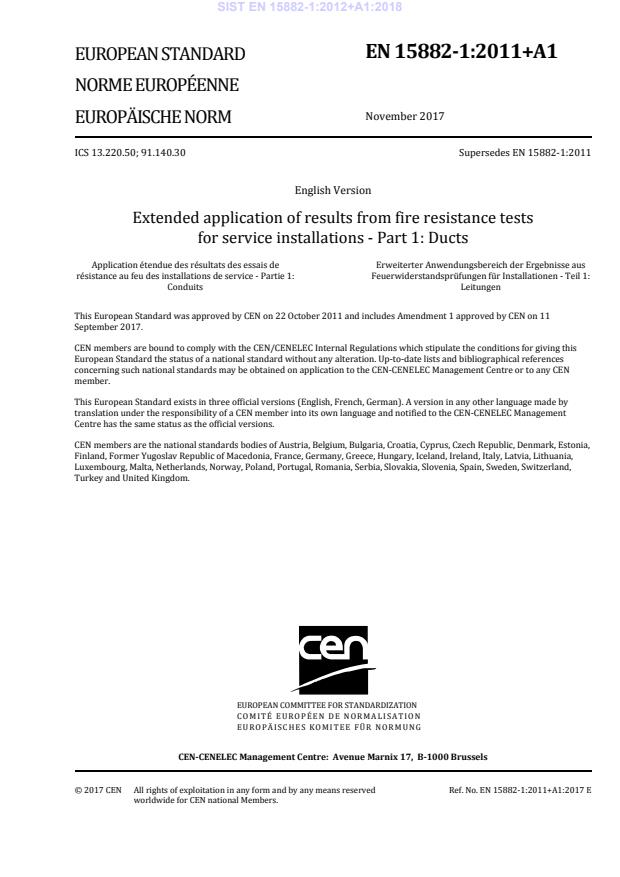
EUROPEAN STANDARD NORME EUROPÉENNE EUROPÄISCHE NORM
EN 15882-1:2011+A1
November
t r s y ICS
s uä t t rä w râ
{ sä s v rä u r Supersedes EN
s w z z tæ sã t r s sEnglish Version
Extended application of results from fire resistance tests for service installations æ Part
sã Ducts Application étendue des résultats des essais de résistance au feu des installations de service æ Partie
sã Conduits
Erweiterter Anwendungsbereich der Ergebnisse aus Feuerwiderstandsprüfungen für Installationen æ Teil
sã Leitungen This European Standard was approved by CEN on
t t October
t r s s and includes Amendment
s approved by CEN on
s s September
t r s yä
egulations which stipulate the conditions for giving this European Standard the status of a national standard without any alterationä Upætoædate lists and bibliographical references concerning such national standards may be obtained on application to the CENæCENELEC Management Centre or to any CEN memberä
translation under the responsibility of a CEN member into its own language and notified to the CENæCENELEC Management Centre has the same status as the official versionsä
CEN members are the national standards bodies of Austriaá Belgiumá Bulgariaá Croatiaá Cyprusá Czech Republicá Denmarká Estoniaá Finlandá Former Yugoslav Republic of Macedoniaá Franceá Germanyá Greeceá Hungaryá Icelandá Irelandá Italyá Latviaá Lithuaniaá Luxembourgá Maltaá Netherlandsá Norwayá Polandá Portugalá Romaniaá Serbiaá Slovakiaá Sloveniaá Spainá Swedená Switzerlandá Turkey and United Kingdomä
EUROPEAN COMMITTEE FOR STANDARDIZATION COMITÉ EUROPÉEN DE NORMALISATION EUROPÄISCHES KOMITEE FÜR NORMUNG
CEN-CENELEC Management Centre:
Avenue Marnix 17,
B-1000 Brussels
t r s y CEN All rights of exploitation in any form and by any means reserved worldwide for CEN national Membersä Refä Noä EN
s w z z tæ sã t r s s ªA sã t r s y ESIST EN 15882-1:2012+A1:2018
1) DiAP = Direct field of application. 2) EXAP = Extended field of application. SIST EN 15882-1:2012+A1:2018
Width = 1250 mm Height = 1000 mm Decrease distance OK [ = /+E] OK [ = /+I] OK [ = /+S]
Effect of supports on
...