

FprEN 18192
(Main)Masonry products - Environmental product declarations for masonry units - Product category rules complementary to EN 15804:2012+A2:2019/AC:2021
General Information
- Abstract
This document provides product category rules (PCR) guidance for the development of environmental declarations for masonry units according to EN 15804:2012+A2:2019.
This document defines the parameters to be reported, the EPD types (and life cycle stages) to be covered, the rules to be followed in order to generate life cycle inventories (LCI) and conduct life cycle impact assessments (LCIA), and the data quality to be used in the development of EPDs.
This document is also applicable to clay construction products manufactured with the same materials and using the same processes as clay masonry units,
In addition to the common parts of EN 15804:2012+A2:2019, this document:
— defines the system boundaries;
— defines the modelling and assessment of material-specific characteristics;
— defines allocation procedures for multi-output processes along the production chain;
— defines allocation procedures for reuse and recycling;
— includes the rules for calculating the LCI and the LCIA underlying the EPD;
— provides guidance/specific rules for the determination of the reference service life (RSL);
— gives guidance on the establishment of default scenarios; and
— gives guidance on default functional units for masonry products.
This document is intended to be used for cradle to gate, cradle to gate with options or cradle to grave assessments, when the intention is clearly stated in the system boundary description.
- Status
- Not Published
- Publication Date
- 24-Feb-2027
- Technical Committee
- CEN/TC 125 - Masonry
- Drafting Committee
- CEN/TC 125/WG 8 - Environmental product declaration
- Current Stage
- 4599 - Dispatch of FV draft to CMC - Finalization for Vote
- Start Date
- 11-Sep-2026
- Due Date
- 09-Sep-2026
- Completion Date
- 11-Sep-2026

Overview
FprEN 18192 is a CEN draft standard for masonry products that sets product category rules (PCR) for environmental product declarations (EPD) for masonry units. It complements EN 15804:2012+A2:2019 and supports consistent, transparent, and comparable environmental reporting across the masonry sector.
This standard is relevant for manufacturers, specifiers, and sustainability professionals who need reliable construction product EPDs. It defines the rules for reporting, life cycle assessment, data quality, and the life cycle stages to include. It is intended for cradle to gate, cradle to gate with options, and cradle to grave assessments, provided the system boundary is clearly stated.
The scope also extends to certain clay construction products made with the same materials and processes as clay masonry units.
Key Topics
FprEN 18192 provides practical PCR guidance for masonry unit EPD development, including:
- System boundaries
- Life cycle inventory (LCI) rules
- Life cycle impact assessment (LCIA) rules
- Data quality requirements
- Allocation procedures for multi-output processes
- Reuse and recycling allocation rules
- Reference service life (RSL) guidance
- Default scenarios for masonry products
- Functional unit and declared unit guidance
The document covers masonry units conforming to EN 771-1 to EN 771-6, including:
- Clay masonry units
- Calcium silicate masonry units
- Aggregate concrete masonry units
- Autoclaved aerated concrete masonry units
- Manufactured stone masonry units
- Natural stone masonry units
A key feature is the treatment of carbonation across the life cycle, including production, use, and end-of-life stages. The draft also supports transparent reporting of environmental information based on EN 15804 life cycle modules and includes guidance for module D benefits and loads beyond the system boundary.
Applications
FprEN 18192 is designed to support environmental product declarations for masonry units in real-world construction workflows. Typical applications include:
- Product sustainability documentation
- Environmental benchmarking for masonry products
- Procurement and specification support
- Whole-building sustainability assessment inputs
- Construction product communication in business-to-business contexts
The standard is especially useful when preparing EPDs for masonry products used in masonry construction, where consistent calculations and clearly defined scenarios help improve comparability and credibility.
It also provides value for companies seeking to communicate environmental performance in line with broader European construction sustainability standards.
Related Standards
FprEN 18192 is closely aligned with the European framework for construction sustainability, including:
- EN 15804:2012+A2:2019 - Core rules for environmental product declarations of construction products
- EN 15643 - Framework for sustainability assessment of buildings and civil engineering works
- EN 15978 - Assessment of environmental performance of buildings
- EN 15941 - Data quality for environmental assessment of products and construction works
- EN 15942 - EPD communication format for business-to-business use
- EN 16757:2022 - PCR for concrete and concrete elements
- EN 17672 - Horizontal rules for business-to-consumer EPD communication
For organizations working with masonry product EPDs, FprEN 18192 provides the sector-specific rules needed to apply EN 15804 consistently and professionally.
Get Certified
Connect with accredited certification bodies for this standard

BSI Group
BSI (British Standards Institution) is the business standards company that helps organizations make excellence a habit.

Bureau Veritas
Bureau Veritas is a world leader in laboratory testing, inspection and certification services.

DNV
DNV is an independent assurance and risk management provider.
Sponsored listings
Frequently Asked Questions
FprEN 18192 is a draft published by the European Committee for Standardization (CEN). Its full title is "Masonry products - Environmental product declarations for masonry units - Product category rules complementary to EN 15804:2012+A2:2019/AC:2021". This standard covers: This document provides product category rules (PCR) guidance for the development of environmental declarations for masonry units according to EN 15804:2012+A2:2019. This document defines the parameters to be reported, the EPD types (and life cycle stages) to be covered, the rules to be followed in order to generate life cycle inventories (LCI) and conduct life cycle impact assessments (LCIA), and the data quality to be used in the development of EPDs. This document is also applicable to clay construction products manufactured with the same materials and using the same processes as clay masonry units, In addition to the common parts of EN 15804:2012+A2:2019, this document: — defines the system boundaries; — defines the modelling and assessment of material-specific characteristics; — defines allocation procedures for multi-output processes along the production chain; — defines allocation procedures for reuse and recycling; — includes the rules for calculating the LCI and the LCIA underlying the EPD; — provides guidance/specific rules for the determination of the reference service life (RSL); — gives guidance on the establishment of default scenarios; and — gives guidance on default functional units for masonry products. This document is intended to be used for cradle to gate, cradle to gate with options or cradle to grave assessments, when the intention is clearly stated in the system boundary description.
This document provides product category rules (PCR) guidance for the development of environmental declarations for masonry units according to EN 15804:2012+A2:2019. This document defines the parameters to be reported, the EPD types (and life cycle stages) to be covered, the rules to be followed in order to generate life cycle inventories (LCI) and conduct life cycle impact assessments (LCIA), and the data quality to be used in the development of EPDs. This document is also applicable to clay construction products manufactured with the same materials and using the same processes as clay masonry units, In addition to the common parts of EN 15804:2012+A2:2019, this document: — defines the system boundaries; — defines the modelling and assessment of material-specific characteristics; — defines allocation procedures for multi-output processes along the production chain; — defines allocation procedures for reuse and recycling; — includes the rules for calculating the LCI and the LCIA underlying the EPD; — provides guidance/specific rules for the determination of the reference service life (RSL); — gives guidance on the establishment of default scenarios; and — gives guidance on default functional units for masonry products. This document is intended to be used for cradle to gate, cradle to gate with options or cradle to grave assessments, when the intention is clearly stated in the system boundary description.
FprEN 18192 is classified under the following ICS (International Classification for Standards) categories: 13.020.50 - Ecolabelling; 91.080.30 - Masonry. The ICS classification helps identify the subject area and facilitates finding related standards.
FprEN 18192 is associated with the following European legislation: EU Directives/Regulations: 305/2011. When a standard is cited in the Official Journal of the European Union, products manufactured in conformity with it benefit from a presumption of conformity with the essential requirements of the corresponding EU directive or regulation.
FprEN 18192 is available in PDF format for immediate download after purchase. The document can be added to your cart and obtained through the secure checkout process. Digital delivery ensures instant access to the complete standard document.
Standards Content (Sample)
SLOVENSKI STANDARD
01-december-2025
Zidarski proizvodi - Okoljske deklaracije za proizvode za zidake - Pravila za
kategorije proizvodov, ki dopolnjujejo EN 15804:2012+A2:2019
Masonry products - Environmental product declarations for masonry units - Product
category rules complementary to EN 15804:2012+A2:2019
Mauerwerksprodukte - Umweltproduktdeklaration für Mauersteine -
Produktkategorienregeln ergänzend zu EN 15804:2012+A2:2019
Produit de maçonnerie - Déclarations environnementales de produits relative aux
éléments de maçonnerie - Règles de définition des catégories de produit
complémentaires à l’EN 15804:2012+A2:2019
Ta slovenski standard je istoveten z: prEN 18192
ICS:
13.020.50 Označevanje z ekološko Ecolabelling
nalepko
91.080.30 Zidane konstrukcije Masonry
2003-01.Slovenski inštitut za standardizacijo. Razmnoževanje celote ali delov tega standarda ni dovoljeno.
DRAFT
EUROPEAN STANDARD
prEN 18192
NORME EUROPÉENNE
EUROPÄISCHE NORM
October 2025
ICS 13.020.50; 91.080.30
English Version
Masonry products - Environmental product declarations
for masonry units - Product category rules complementary
to EN 15804:2012+A2:2019
Produit de maçonnerie - Déclarations Mauerwerksprodukte - Umweltproduktdeklaration für
environnementales de produits relative aux éléments Mauersteine - Produktkategorienregeln ergänzend zu
de maçonnerie - Règles de définition des catégories de EN 15804:2012+A2:2019
produit complémentaires à l'EN 15804:2012+A2:2019
This draft European Standard is submitted to CEN members for enquiry. It has been drawn up by the Technical Committee
CEN/TC 125.
If this draft becomes a European Standard, CEN members are bound to comply with the CEN/CENELEC Internal Regulations
which stipulate the conditions for giving this European Standard the status of a national standard without any alteration.
This draft European Standard was established by CEN in three official versions (English, French, German). A version in any other
language made by translation under the responsibility of a CEN member into its own language and notified to the CEN-CENELEC
Management Centre has the same status as the official versions.
CEN members are the national standards bodies of Austria, Belgium, Bulgaria, Croatia, Cyprus, Czech Republic, Denmark, Estonia,
Finland, France, Germany, Greece, Hungary, Iceland, Ireland, Italy, Latvia, Lithuania, Luxembourg, Malta, Netherlands, Norway,
Poland, Portugal, Republic of North Macedonia, Romania, Serbia, Slovakia, Slovenia, Spain, Sweden, Switzerland, Türkiye and
United Kingdom.
Recipients of this draft are invited to submit, with their comments, notification of any relevant patent rights of which they are
aware and to provide supporting documentation.
Warning : This document is not a European Standard. It is distributed for review and comments. It is subject to change without
notice and shall not be referred to as a European Standard.
EUROPEAN COMMITTEE FOR STANDARDIZATION
COMITÉ EUROPÉEN DE NORMALISATION
EUROPÄISCHES KOMITEE FÜR NORMUNG
CEN-CENELEC Management Centre: Rue de la Science 23, B-1040 Brussels
© 2025 CEN All rights of exploitation in any form and by any means reserved Ref. No. prEN 18192:2025 E
worldwide for CEN national Members.
prEN 18192:2025 (E)
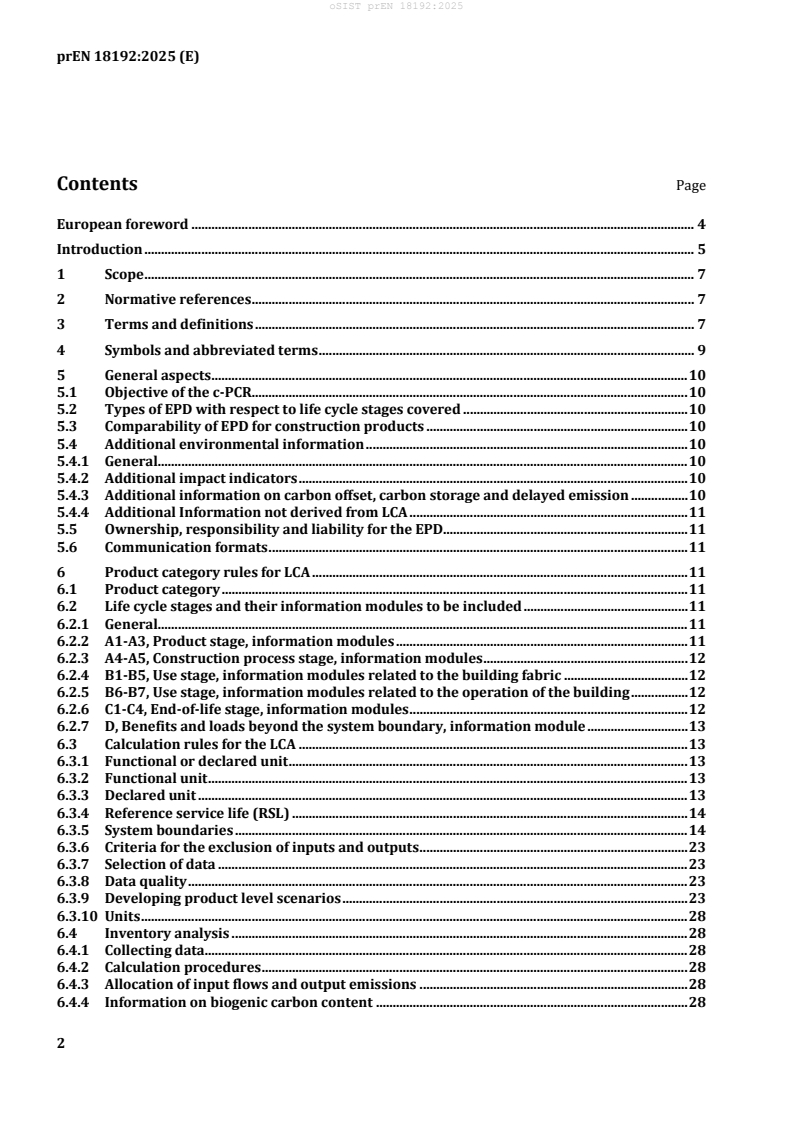
Contents Page
European foreword . 4
Introduction . 5
1 Scope . 7
2 Normative references . 7
3 Terms and definitions . 7
4 Symbols and abbreviated terms . 9
5 General aspects . 10
5.1 Objective of the c-PCR. 10
5.2 Types of EPD with respect to life cycle stages covered . 10
5.3 Comparability of EPD for construction products . 10
5.4 Additional environmental information . 10
5.4.1 General. 10
5.4.2 Additional impact indicators . 10
5.4.3 Additional information on carbon offset, carbon storage and delayed emission . 10
5.4.4 Additional Information not derived from LCA . 11
5.5 Ownership, responsibility and liability for the EPD. 11
5.6 Communication formats . 11
6 Product category rules for LCA . 11
6.1 Product category . 11
6.2 Life cycle stages and their information modules to be included . 11
6.2.1 General. 11
6.2.2 A1-A3, Product stage, information modules . 11
6.2.3 A4-A5, Construction process stage, information modules . 12
6.2.4 B1-B5, Use stage, information modules related to the building fabric . 12
6.2.5 B6-B7, Use stage, information modules related to the operation of the building . 12
6.2.6 C1-C4, End-of-life stage, information modules . 12
6.2.7 D, Benefits and loads beyond the system boundary, information module . 13
6.3 Calculation rules for the LCA . 13
6.3.1 Functional or declared unit . 13
6.3.2 Functional unit . 13
6.3.3 Declared unit . 13
6.3.4 Reference service life (RSL) . 14
6.3.5 System boundaries . 14
6.3.6 Criteria for the exclusion of inputs and outputs . 23
6.3.7 Selection of data . 23
6.3.8 Data quality . 23
6.3.9 Developing product level scenarios . 23
6.3.10 Units . 28
6.4 Inventory analysis . 28
6.4.1 Collecting data . 28
6.4.2 Calculation procedures . 28
6.4.3 Allocation of input flows and output emissions . 28
6.4.4 Information on biogenic carbon content . 28
prEN 18192:2025 (E)
6.5 Impact assessment . 28
6.5.1 General . 28
6.5.2 Core environmental impact indicators . 29
6.5.3 Additional environmental impact indicators . 29
7 Content of the EPD . 29
7.1 Declaration of general information . 29
7.2 Declaration of environmental indicators derived from LCA . 29
7.2.1 General . 29
7.2.2 Rules for declaring LCA information per module . 29
7.2.3 Indicators describing environmental impacts based on Life Cycle Impact Assessment
(LCIA) . 29
7.2.4 Indicators describing resource use and environmental information based on Life Cycle
Inventory (LCI) . 29
7.2.5 Information on biogenic carbon content . 30
7.3 Scenarios and additional technical information . 30
7.3.1 General . 30
7.3.2 Construction process stage . 30
7.3.3 B1-B7 use stage . 30
7.3.4 End-of-life . 30
7.4 Additional information on release of dangerous substances to indoor air, soil and water
during the use stage . 31
7.4.1 Indoor air . 31
7.4.2 Soil and water . 31
7.5 Aggregation of information modules . 31
8 Project report . 31
8.1 General . 31
8.2 LCA-related elements of the project report . 31
8.3 Documentation on additional information . 31
8.4 Data availability for verification . 31
9 Verification and validity of an EPD. 31
Annex A (normative) Requirements and guidance on the reference service life. 32
Annex B (informative) Waste . 33
Annex C (informative) Impact categories and related indicators, methodologies and
characterization factors (CF) . 34
Annex D (informative) End of life formulae . 35
Annex E (informative) Schemes to be applied for data quality assessment of generic and specific
data . 36
Annex F (informative) Product stage guidance for the definition of system boundaries . 37
Annex G (informative) Re-carbonation of masonry units . 39
Bibliography . 42
prEN 18192:2025 (E)
European foreword
This document (prEN 18192:2025) has been prepared by Technical Committee CEN/TC 125
“Masonry”, the secretariat of which is held by BSI.
This document is currently submitted to the CEN Enquiry.
prEN 18192:2025 (E)
Introduction
This document provides rules for environmental product declarations (EPD) for masonry units. It
complements the core product category rules for all construction products and services given in
EN 15804:2012+A2:2019, Sustainability of construction works — Environmental product declarations —
Core rules for the product category of construction products.
This document provides additional rules for EPD of masonry units. It complements the core rules for all
construction products and services as established in EN 15804:2012+A2:2019.
EPD information is expressed in information modules as defined in EN 15804:2012+A2:2019, which
allow easy organization and expression of data packages throughout the life cycle of masonry units. The
approach requires that the underlying data should be consistent, reproducible and comparable.
In line with EN 15804:2012+A2:2019, the EPD is expressed in a form that allows aggregation to provide
complete information for buildings. This document does not deal with aggregation at the building level
nor does this document describe the rules for applying EPD in a building assessment.
This document refers to and mirrors relevant parts of EN 16757:2022, Sustainability of construction
works — Environmental product declarations — Product Category Rules for concrete and concrete
elements, drafted to cover concrete products to CEN/TC 104 and precast concrete products to CEN/TC
229. In respect of the mechanism for re-carbonation of clay and cementitious masonry units, this
document references and follows the calculation methodology of of EN 16757:2022 Annex G, G.2, ‘CO
uptake by carbonation — Guidance on calculation’.
The document deals with a limited number of quantifiable parameters as predefined in
EN 15804:2012+A2:2019. Future revisions of EN 15804 may lead to the incorporation in this document
of additional predetermined parameters. This document provides the means for developing an
environmental declaration for masonry units in the context of the suite of standards that are intended to
assess the sustainability of construction works.
This suite of standards includes:
— EN 15643, Sustainability of construction works — Framework for assessment of buildings and civil
engineering works;
— EN 15978, Sustainability of construction works — Assessment of environmental performance of
buildings — Calculation methods;
— EN 15804:2012+A2:2019, Sustainability of construction works — Environmental product declaration
—Core rules for the product category of construction products;
— EN 15941, Sustainability of construction works — Environmental product declarations — Data quality
for the environmental assessment of products and construction works — Selection and use of data;
— EN 15942, Sustainability of construction works — Environmental product declarations —
Communication format — Business to business;
— CEN/TR 16970:2016, Sustainability of construction works — Guidance for the implementation of
EN 15804;
— EN 17472 Sustainability of construction works —Sustainability assessment of civil engineering works
— Calculation methods;
— EN 17672 Sustainability of construction works — Environmental product declarations — Horizontal
rules for business to consumer communication; and
prEN 18192:2025 (E)
— EN 17680 Sustainability of construction works — Evaluation of the potential for sustainable
refurbishment of buildings.
prEN 18192:2025 (E)
1 Scope
This document provides product category rules (PCR) guidance for the development of environmental
declarations for masonry units according to EN 15804:2012+A2:2019.
This document defines the parameters to be reported, the EPD types (and life cycle stages) to be covered,
the rules to be followed in order to generate life cycle inventories (LCI) and conduct life cycle impact
assessments (LCIA), and the data quality to be used in the development of EPDs.
This document is also applicable to clay construction products manufactured with the same materials
and using the same processes as clay masonry units,
In addition to the common parts of EN 15804:2012+A2:2019, this document:
— defines the system boundaries;
— defines the modelling and assessment of material-specific characteristics;
— defines allocation procedures for multi-output processes along the production chain;
— defines allocation procedures for reuse and recycling;
— includes the rules for calculating the LCI and the LCIA underlying the EPD;
— provides guidance/specific rules for the determination of the reference service life (RSL);
— gives guidance on the establishment of default scenarios; and
— gives guidance on default functional units for masonry products.
This document is intended to be used for cradle to gate, cradle to gate with options or cradle to grave
assessments, when the intention is clearly stated in the system boundary description.
2 Normative references
The following documents are referred to in the text in such a way that some or all of their content
constitutes requirements of this document. For dated references, only the edition cited applies. For
undated references, the latest edition of the referenced document (including any amendments) applies.
EN 15804:2012+A2:2019, Sustainability of construction works - Environmental product declarations - Core
rules for the product category of construction products
3 Terms and definitions
For the purposes of this document, the terms and definitions given in EN 15804:2012+A2:2019 and the
following apply.
ISO and IEC maintain terminology databases for use in standardization at the following addresses:
— IEC Electropedia: available at https://www.electropedia.org/
— ISO Online browsing platform: available at https://www.iso.org/obp/ui/
3.1
end of waste status
certain specified waste which ceases to be waste after it has undergone a recycling or other recovery
operation and complies with the following conditions:
prEN 18192:2025 (E)
a) the substance or object is used for specific purposes;
b) a market or demand exists for such a substance or object;
c) the substance or object fulfils the technical requirements for the specific purposes and meets the
existing legislation and standards applicable to products; and
d) the use of the substance or object will not lead to overall adverse environmental or human health
impacts
Note 1 to entry: Adapted from Directive 2008/98/EC 3.1.
3.2
aggregate
granular material of natural, manufactured, or recycled origin used in construction
[SOURCE: EN 12620:2002+A1:2008, X.X]
3.3
masonry unit
preformed component intended for use in masonry construction
[SOURCE: EN 771:2011+A1:2015, X.X]
3.4
clay masonry unit
masonry unit made from clay or other argillaceous materials with or without sand, fuel or other additives
fired at a sufficiently high temperature to achieve a ceramic bond
[SOURCE: EN 771-1:2011+A1:2015, X.X]
3.5
calcium silicate masonry units
CSMU
masonry units made predominantly from lime and siliceous materials, hardened by high pressure steam
[SOURCE: EN 771-2:2011+A1:2015, X.X]
3.6
carbonation
carbon dioxide reaction with calcium and magnesium containing minerals to form carbonates
3.7
aggregate concrete masonry unit
masonry unit manufactured from cementitious binder, aggregates and water and which may contain
admixtures and additions and colouring pigments and other materials incorporated or applied during or
subsequent to unit manufacture
[SOURCE: EN 771-3:2011+A1:2015, X.X]
prEN 18192:2025 (E)
3.8
autoclaved aerated concrete masonry unit
AAC masonry unit
masonry unit manufactured from hydraulic binders such as cement and/or lime, combined with siliceous
based fine material, cell generating material and water and cured with high pressure steam in autoclaves
[SOURCE: EN 771-4:2011+A1:2015, X.X]
3.9
manufactured stone masonry unit
facing masonry unit having at least one exposed face with a close structure formed from either one or
two homogeneous mixtures of aggregate, cementitious binder and other materials moulded under
pressure and/or vibration and with or without further processing, intended to resemble and be used as
an alternative to natural stone
[SOURCE: EN 771-5:2011+A1:2015, X.X]
3.10
natural stone masonry unit
masonry unit manufactured from natural stone
[SOURCE: EN 771-6:2011+A1:2015, X.X]
3.11
cement
finely ground inorganic material which, when mixed with water, forms a paste that sets and hardens by
means of hydration reactions and processes and which, after hardening, retains its strength and stability
even under water
[SOURCE: EN 197-1:2011, X.X]
3.12
additives
addition or admixture added during the mixing process in order to improve certain properties or to
achieve special properties
[SOURCE: EN 206:2013+A2:2021, X.X]
3.13
quicklime
air lime mainly in the oxide form which reacts exothermically on contact with water
Note 1 to entry: Quicklime is available in a range of sizes from lump to powder.
[SOURCE: EN 459-1:2015, X.X - Modified to remove term defined and add note to entry]
4 Symbols and abbreviated terms
For the purposes of this document, the symbols and abbreviations given in EN 15804:2012+A2:2019 and
the following apply.
EOL End of life
FU Functional unit
prEN 18192:2025 (E)
DU Declared unit
CSMU Calcium silicate masonry unit
AAC Autoclaved aerated concrete
c-PCR Complementary product category rules
5 General aspects
5.1 Objective of the c-PCR
The objective of this c-PCR is to provide rules specific to masonry units for the application of
EN 15804:2012+A2:2019. In addition to the objectives of EN 15804, this document aims to:
— define the parameters being declared collated and reported;
— describe which stages of a product’s life cycle are considered in the EPD and which processes are to
be included in the life cycle stages;
— define rules for the development of scenarios;
— communicate EPDs and environmental information about masonry units; and
— ensure that comparisons between construction products are only carried out in the context of their
application in construction works.
NOTE This c-PCR enables transparency for the EPD-development for masonry units.
5.2 Types of EPD with respect to life cycle stages covered
For masonry units, the following type of EPD shall be declared: cradle to grave and module D (A, B, C and
D). This declaration shall be based on a functional unit or a declared unit.
EN 15804:2012+A2:2019 applies.
5.3 Comparability of EPD for construction products
EN 15804:2012+A2:2019 applies.
5.4 Additional environmental information
5.4.1 General
EN 15804:2012+A2:2019 applies.
5.4.2 Additional impact indicators
In addition to the text in EN 15804:2012+A2:2019:
For clay masonry units, the additional environmental impact indicators shall be declared. This
declaration shall be based on a functional unit or declared unit.
5.4.3 Additional information on carbon offset, carbon storage and delayed emission
EN 15804:2012+A2:2019 applies.
prEN 18192:2025 (E)
5.4.4 Additional Information not derived from LCA
EN 15804:2012+A2:2019 applies.
5.5 Ownership, responsibility and liability for the EPD
EN 15804:2012+A2:2019 applies.
5.6 Communication formats
EN 15804:2012+A2:2019 applies.
6 Product category rules for LCA
6.1 Product category
The product category referred to in this document includes masonry units conforming to EN 771-1 to
EN 771-6.
6.2 Life cycle stages and their information modules to be included
6.2.1 General
See 5.2.
6.2.2 A1-A3, Product stage, information modules
In addition to the text of EN 15804:2012+A2:2019:
When the full LCI of constituents is not available, impact indicators and aspects from the EPDs complying
to EN 15804:2012+A2:2019 for the constituents, covering modules A1 to A3, can be used for the
assessment of module A1 of the masonry unit. If transport is included, then the impacts and aspects
covering modules A1 to A4 can be used for the assessment of modules A1 and A2 (see Figure 1).
prEN 18192:2025 (E)
NOTE For the use of aggregates in masonry units, when the EPD of aggregates is used, modules A1 to A3 of the
aggregate EPD becomes part of modules A1 of masonry unit EPD and module A4 of aggregate EPD becomes part of
modules A2 of masonry unit EPD if relevant and in accordance with the supply chain scenario.
Figure 1 — EPD for constituents (top) and for masonry units (bottom)
6.2.3 A4-A5, Construction process stage, information modules
EN 15804:2012+A2:2019 applies.
6.2.4 B1-B5, Use stage, information modules related to the building fabric
EN 15804:2012+A2:2019 applies.
NOTE Carbonation of masonry units takes place in module B1.
6.2.5 B6-B7, Use stage, information modules related to the operation of the building
EN 15804:2012+A2:2019 applies.
6.2.6 C1-C4, End-of-life stage, information modules
EN 15804:2012+A2:2019 applies.
NOTE Carbonation of masonry units can also take place in these modules.
prEN 18192:2025 (E)
6.2.7 D, Benefits and loads beyond the system boundary, information module
EN 15804:2012+A2:2019 applies.
At the end of life of masonry units, there are many options for new uses, e.g. ground clay masonry units
may be used as a cement replacement in concrete production with a potential reduction of up to 230 kg
CO / tonne [15].
6.3 Calculation rules for the LCA
6.3.1 Functional or declared unit
EN 15804:2012+A2:2019 applies.
6.3.2 Functional unit
6.3.2.1 General
EN 15804:2012+A2:2019 applies.
6.3.2.2 Performance in a functional unit
EN 15804:2012+A2:2019 applies.
6.3.3 Declared unit
In addition to the text in EN 15804:2012+A2:2019:
For clay masonry units:
— The declared unit for clay construction products is: 1 tonne of a clay product.
2 3
— Other units are allowed (e.g. m or m ) only if conversion factors are included in the EPD in order to
make the transition to 1 tonne in a transparent way.
— The gross dry density (kg/m ) should be specified in the EPD.
For calcium silicate masonry units:
— The declared unit is: 1 m CSMU.
— By dividing the results by the gross dry density you get the Life cycle assessment results per tonne.
3 3
NOTE Example of declared unit is: 1 m of CSMU with a gross dry density of e.g. 2000 kg/m .
For aggregate concrete and manufactured stone masonry units:
— The declared unit is: m of a declared thickness (cm)
— Other units are allowed (e.g. tonne or m ) only if conversion factors are included in the EPD in order
to make the transition to m in a transparent way.
— The gross dry density (kg/m ) should be specified in the EPD.
For AAC masonry units:
3 3
— The declared unit is: 1 m AAC of a declared gross dry density (kg/m ).
— Other units (e.g. m of a declared thickness (cm) and a declared gross dry density) are also allowed.
prEN 18192:2025 (E)
For natural stone masonry units:
— The declared unit is: m of a declared thickness (cm).
6.3.4 Reference service life (RSL)
6.3.4.1 General
In addition to the text in EN 15804:2012+A2:2019:
Masonry units have a RSL normally exceeding that of the construction works.
Under normal service conditions, the RSL of masonry units may be taken to be at least 150 years.
NOTE The RSL can be specified by national requirements or the intended use.
6.3.4.2 Scenarios for RSL and functional unit
EN 15804:2012+A2:2019 applies.
6.3.5 System boundaries
6.3.5.1 General
In addition to the text in EN 15804:2012+A2:2019:
For masonry units, the following type of EPD shall be declared: cradle to grave and module D (A, B, C and
D).
The general layout of system boundaries may be found in Figure 2.
prEN 18192:2025 (E)
Figure 2 — General layout of system boundaries
Within the system boundaries, the impact of carbonation during the production, storage, use and the end-
of-life stages of the product shall be taken into account.
Carbonation is a natural process which can occur during the life cycle of masonry units containing
reactive calcium components. Carbonation is a continuous process, if the building is demolished earlier
than the RSL, then carbonation should be taken into account at the end of life.
The quantity of CO bound varies according to the exposure conditions in use.
Annex G provides methods to assess carbon dioxide uptake through carbonation. Other calculation
methods may be used if transparently documented.
prEN 18192:2025 (E)
When carbonation is not taken into account, this shall be stated on the EPD. When carbonation is taken
into account, assumptions made have to be specified.
For carbonization characterization factor, see 6.5.1.
Clause 6.3.5.5 clearly defines the system boundaries of the end-of-life stage, in order to distinguish
between the benefits within and beyond the system boundaries.
6.3.5.2 Product stage
In addition to the text in EN 15804:2012+A2:2019:
A1 Production of raw materials or constituent products.
All resources (raw materials and constituent products) entering the production process shall be declared.
The main raw and auxiliary materials for the different masonry unit types are:
Clay masonry units
Raw materials:
— Primary raw materials (including source) (e.g. clay, sand, loam, additives) including extraction and
processing;
— Processing of secondary materials, (including source);
— Recycled or return production materials;
— Energy (including source); and
— Water (including source).
Auxiliary materials and consumables:
— Manufacturing of packaging of raw materials (if relevant);
— Additions;
— Insulation materials (if relevant);
— Packaging; and
— Pallets.
Calcium silicate masonry units (CSMU)
Raw materials:
— Aggregates (including source), including extraction and processing;
— Recycled or return production materials;
— Quicklime;
— Hydrated lime;
— Steam (if generated outside the plant);
— Water (including source); and
prEN 18192:2025 (E)
— Energy (including source).
Auxiliary materials and consumables:
— Water conditioners (e.g. NaCl, NaOH, HCl);
— Pallets; and
— Packaging.
Aggregate concrete and manufactured stone masonry units
Raw materials:
— Cement;
— Other binders;
— Aggregates (including source), including extraction and processing;
— Fibres (if relevant);
— Recycled or return production materials;
— Water (including source); and
— Energy (including source).
Auxiliary materials and consumables:
— Admixtures;
— Additions;
— Steel reinforcement (if relevant);
— Mould oil;
— Insulation material (if relevant);
— Packaging; and
— Pallets.
Autoclaved aerated concrete masonry units (AAC)
Raw materials:
— Cement;
— Quicklime;
— Hydrated lime;
— Quartz sand;
— Quartz powder;
prEN 18192:2025 (E)
— Rock powder;
— Fly ash;
— Return slurry;
— Recycled AAC, anhydrite (natural, from industry);
— Gypsum (natural or flue gas desulphurization);
— Aluminium powder;
— Aluminium paste;
— Water (including source); and
— Energy (including source).
Auxiliary materials and consumables:
— Mould oil;
— Grinding balls;
— Superplasticizer;
— Hydrophobic agents;
— Steam additives;
— Water conditioners (e.g. NaCl, NaOH, HCl);
— Pallets; and
— Packaging.
Natural stone masonry units
Raw materials:
— Stone (including source), including extraction and processing;
— Quarry drilling and cutting consumables (e.g. wires, chains, drills);
— Mining consumables (e.g. airbags, explosives);
— Lubricants (e.g. process oils and greases, excluding heavy maintenance);
— Water (including source); and
— Energy (including source).
Auxiliary materials and consumables:
— Packaging and storage materials;
prEN 18192:2025 (E)
— Pallets; and
— Factory cutting and finishing consumables (e.g. wires, chains, discs, polishing head, abrasives).
A2 Transport of raw materials (including packaging material) to the production site and any internal
transport (lifts, cranes, etc.).
A3 Manufacturing
All inputs and outputs used during the different stages of the production process shall be considered. The
main stages for the different masonry unit types are:
Clay masonry units
— Mixing;
— Moulding/extrusion;
— Engobe/glazing;
— Drying and firing;
— Finishing processes;
— Packaging (including production);
— Storing/handling;
— Treatment of production waste; and
— Treatment of packaging waste.
Calcium silicate masonry units (CSMU)
— Water processing;
— Raw material processing (if relevant);
— Steam (if internally generated);
— Mixing;
— Moulding;
— Autoclaving;
— Sawing/splitting/cropping (only if required);
— Packaging (including packaging material, mostly externally delivered) (if applicable);
— Internal transport;
— Storing;
— Internal recycling; and
— Treatment of packaging waste.
prEN 18192:2025 (E)
Aggregate concrete and manufactured stone masonry units
— Raw material processing (if relevant);
— Production of auxiliary materials;
— Mixing;
— Moulding;
— Curing;
— Internal recycling;
— Internal transport;
— Any additional treatment of the product (heating, surface treatment, etc.)
— Packaging;
— Storing; and
— Treatment of packaging waste.
Autoclaved aerated concrete (AAC) masonry units
— Raw material processing (e.g. milling);
— Mixing;
— Moulding;
— Curing;
— Cutting;
— Water processing and steam generation;
— Autoclaving;
— Packaging;
— Storing;
— Internal recycling; and
— Treatment of packaging waste.
Natural stone masonry units
— Quarry stone squaring;
— Transport of blocks to the factory;
— Internal transport;
prEN 18192:2025 (E)
— Block handling, sawing and finishing;
— Packaging;
— Treatment of packaging waste; and
— Storing.
NOTE 1 The lists are not exhaustive and some items might not be relevant for all processes.
NOTE 2 Annex G provides methods to assess the carbon dioxide uptake through carbonation of masonry units
which in some cases also can take place at the manufacturing stage.
6.3.5.3 Construction stage
In addition to the text in EN 15804:2012+A2:2019:
A5 Installation in the building
In general, the use of energy and water during the installation of masonry units is negligible. Unloading
of trucks and cutting of masonry units on site is considered negligible, and the few unused offcuts are also
considered negligible. Cutting and installation of masonry units is usually done manually (without any
mechanical assistance).
NOTE Cutting of natural stone units is normally carried out in the factory.
However, some processes may be relevant (e.g. cutting of units using power tools or the use of lifting
machinery). This is particularly the case for heavy or larger format masonry units when mechanical
equipment such as cranes are used. Even so, site lifting/handling with cranes may be considered
negligible.
Handling of take-back quantities and packaging (if applicable) should be taken into account. As a general
approach, national scenarios for packaging should be used, if no other data are available.
Disposal of any packaging material (if relevant) shall be taken into account.
A description of the reference scenarios used for the construction phase shall be part of the EPD where
relevant.
When a functional unit is declared, details of any ancillary materials (e.g. mortars including water used
for site-mixed mortar) shall be included.
6.3.5.4 Use stage
6.3.5.4.1 General
EN 15804:2012+A2:2019 applies.
6.3.5.4.2 B1-B5, Use stage information modules related to the building fabric
In addition to the text in EN 15804:2012+A2:2019:
B1:
When carbonation is taken into account during the use stage, it shall be taken into account in module B1
(see Annex G).
Masonry units not containing organic materials do not contain volatile components.
The naturally ionizing radiation of masonry units is extremely low, permitting unlimited use of these
products from a radiological perspective.
prEN 18192:2025 (E)
Masonry units can be used without any restrictions with regards to radiation.
NOTE The European Commission “Radiation Protection 112 report as well as a number of national reports
show that the activity concentration values are well below the thresholds for exemption or clearance of materials,
the gamma radiation is well below the reference level and the activity concentration index (I) is well below 1
according to the Directive 2013/59/EURATOM.”
B2-B5: Masonry units generally require no maintenance and no repairs during the use phase, no
replacement and no refurbishment and therefore no impact shall be declared in these modules.
6.3.5.4.3 B6-B7, Use stage information modules related to the operation of buildings
B6-B7: these modules are not relevant for masonry units.
6.3.5.5 End-of-life stage
In addition to the text in EN 15804:2012+A2:2019:
NOTE 1 The legal interpretation of End-of-Waste can differ significantly at a national level.
Figure 3 — Typical processes at the end-of-life of masonry units and their assignment to the
life cycle modules C1-C4 and D (transport processes not shown)
When carbonation is taken into account during the end-of-life stage, it shall be taken into account in
module C (see Annex G).
An assessment of which amount (percentage) of masonry unit waste reaches the end of waste status
should be based on locally available data.
NOTE 2 It is technically possible for (crushed) masonry units to fully reach the end of waste stage when correctly
sorted out.
prEN 18192:2025 (E)
6.3.5.6 Benefits and loads beyond the product system boundary in module D
In addition to the text in EN 15804:2012+A2:2019:
See Figure 3 for assignment of impacts.
NOTE For the calculation procedures and examples, see 6.3.9.5.
6.3.6 Criteria for the exclusion of inputs and outputs
EN 15804:2012+A2:2019 applies.
6.3.7 Selection of data
EN 15804:2012+A2:2019 applies.
6.3.8 Data quality
6.3.8.1 General
EN 15804:2012+A2:2019 applies.
6.3.8.2 Data quality requirements
EN 15804:2012+A2:2019 applies.
6.3.8.3 Data quality assessment schemes applied on generic or specific data used and
established in the EPD
EN 15804:2012+A2:2019 applies.
6.3.9 Developing product level scenarios
6.3.9.1 General
In addition to the text of EN 15804:2012+A2:2019:
The description of the unit (functional or declared) is the basis for developing the life cycle scenario (e.g.
different scenarios for exposed and non-exposed masonry units). EN 15804:2012+A2:2019, 6.3.9
excludes modules A1 to A3 from product scenarios. Therefore, the main topics to be included in the
appropriate life cycle stages are the following, where relevant:
— downstream transport (A4);
— method of installation on site (A5);
— reference service life for the unit and relevant in-use conditions (B1 to B5);
— for each destination (crushing, stockpiling and disposal) percentage of constituents use after
demolition (C1 to C4); and
— benefits and loads beyond the system boundary (D).
6.3.9.2 Construction stage
6.3.9.2.1 A4, Transportati
...