

EN 1789:2007
(Main)Medical vehicles and their equipment - Road ambulances
- Abstract
This European Standard specifies requirements for the design, testing, performance and equipping of road ambulances used for the transport and care of patients. It contains requirements for the patient’s compartment.
This European Standard does not cover the requirements for approval and registration of the vehicle and the training of the staff which is the responsibility of the authority/authorities in the country where the ambulance is to be registered.
This European Standard is applicable to road ambulances capable of transporting at least one person on a stretcher.
Requirements are specified for categories of road ambulances based in increasing order of the level of treatment that can be carried out. These are the patient transport ambulance (types A1 A2), the emergency ambulance (type B) and the mobile intensive care unit (type C).
This European Standard gives general requirements for medical devices carried in road ambulances and used therein and outside hospitals and clinics in situations where the ambient conditions can differ from normal indoor conditions.
- Status
- Withdrawn
- Publication Date
- 08-May-2007
- Withdrawal Date
- 13-Apr-2010
- Technical Committee
- CEN/TC 239 - Rescue systems
- Current Stage
- 9960 - Withdrawal effective - Withdrawal
- Start Date
- 14-Apr-2010
- Completion Date
- 14-Apr-2010
- Directive
- 93/42/EEC - Medical devicesOJ Ref: C, C 41 OJ Date: 19-Feb-2009



Relations
- Effective Date
- 22-Dec-2008
- Effective Date
- 22-Dec-2008
- Effective Date
- 19-Jan-2023
- Effective Date
- 23-May-2009
Get Certified
Connect with accredited certification bodies for this standard

TÜV Rheinland
TÜV Rheinland is a leading international provider of technical services.

TÜV SÜD
TÜV SÜD is a trusted partner of choice for safety, security and sustainability solutions.

BSI Group
BSI (British Standards Institution) is the business standards company that helps organizations make excellence a habit.
Sponsored listings
Frequently Asked Questions
EN 1789:2007 is a standard published by the European Committee for Standardization (CEN). Its full title is "Medical vehicles and their equipment - Road ambulances". This standard covers: This European Standard specifies requirements for the design, testing, performance and equipping of road ambulances used for the transport and care of patients. It contains requirements for the patient’s compartment. This European Standard does not cover the requirements for approval and registration of the vehicle and the training of the staff which is the responsibility of the authority/authorities in the country where the ambulance is to be registered. This European Standard is applicable to road ambulances capable of transporting at least one person on a stretcher. Requirements are specified for categories of road ambulances based in increasing order of the level of treatment that can be carried out. These are the patient transport ambulance (types A1 A2), the emergency ambulance (type B) and the mobile intensive care unit (type C). This European Standard gives general requirements for medical devices carried in road ambulances and used therein and outside hospitals and clinics in situations where the ambient conditions can differ from normal indoor conditions.
This European Standard specifies requirements for the design, testing, performance and equipping of road ambulances used for the transport and care of patients. It contains requirements for the patient’s compartment. This European Standard does not cover the requirements for approval and registration of the vehicle and the training of the staff which is the responsibility of the authority/authorities in the country where the ambulance is to be registered. This European Standard is applicable to road ambulances capable of transporting at least one person on a stretcher. Requirements are specified for categories of road ambulances based in increasing order of the level of treatment that can be carried out. These are the patient transport ambulance (types A1 A2), the emergency ambulance (type B) and the mobile intensive care unit (type C). This European Standard gives general requirements for medical devices carried in road ambulances and used therein and outside hospitals and clinics in situations where the ambient conditions can differ from normal indoor conditions.
EN 1789:2007 is classified under the following ICS (International Classification for Standards) categories: 11.160 - First aid; 43.160 - Special purpose vehicles. The ICS classification helps identify the subject area and facilitates finding related standards.
EN 1789:2007 has the following relationships with other standards: It is inter standard links to EN 1789:1999/A1:2003, EN 1789:1999, EN 1789:2007+A1:2010, EN 1789:2007/FprA1. Understanding these relationships helps ensure you are using the most current and applicable version of the standard.
EN 1789:2007 is associated with the following European legislation: EU Directives/Regulations: 93/42/EEC, 93/44/EEC; Standardization Mandates: M/023. When a standard is cited in the Official Journal of the European Union, products manufactured in conformity with it benefit from a presumption of conformity with the essential requirements of the corresponding EU directive or regulation.
EN 1789:2007 is available in PDF format for immediate download after purchase. The document can be added to your cart and obtained through the secure checkout process. Digital delivery ensures instant access to the complete standard document.
Standards Content (Sample)
2003-01.Slovenski inštitut za standardizacijo. Razmnoževanje celote ali delov tega standarda ni dovoljeno.Medical vehicles and their equipment - Road ambulancesVéhicules de transport sanitaire et leurs équipements - Ambulances routieresRettungsdienstfahrzeuge und deren Ausrüstung - KrankenkraftwagenTa slovenski standard je istoveten z:EN 1789:2007SIST EN 1789:2007en,fr,de43.160Vozila za posebne nameneSpecial purpose vehicles11.160First aidICS:SIST EN 1789:2000/A1:2003SIST EN 1789:20001DGRPHãþDSLOVENSKI
STANDARDSIST EN 1789:200701-september-2007
EUROPEAN STANDARDNORME EUROPÉENNEEUROPÄISCHE NORMEN 1789May 2007ICS 11.160; 43.160Supersedes EN 1789:1999
English VersionMedical vehicles and their equipment - Road ambulancesVéhicules de transport sanitaire et leurs équipements -Véhicule d'ambulancesRettungsdienstfahrzeuge und deren Ausrüstung -KrankenkraftwagenThis European Standard was approved by CEN on 24 February 2007.CEN members are bound to comply with the CEN/CENELEC Internal Regulations which stipulate the conditions for giving this EuropeanStandard the status of a national standard without any alteration. Up-to-date lists and bibliographical references concerning such nationalstandards may be obtained on application to the CEN Management Centre or to any CEN member.This European Standard exists in three official versions (English, French, German). A version in any other language made by translationunder the responsibility of a CEN member into its own language and notified to the CEN Management Centre has the same status as theofficial versions.CEN members are the national standards bodies of Austria, Belgium, Bulgaria, Cyprus, Czech Republic, Denmark, Estonia, Finland,France, Germany, Greece, Hungary, Iceland, Ireland, Italy, Latvia, Lithuania, Luxembourg, Malta, Netherlands, Norway, Poland, Portugal,Romania, Slovakia, Slovenia, Spain, Sweden, Switzerland and United Kingdom.EUROPEAN COMMITTEE FOR STANDARDIZATIONCOMITÉ EUROPÉEN DE NORMALISATIONEUROPÄISCHES KOMITEE FÜR NORMUNGManagement Centre: rue de Stassart, 36
B-1050 Brussels© 2007 CENAll rights of exploitation in any form and by any means reservedworldwide for CEN national Members.Ref. No. EN 1789:2007: E
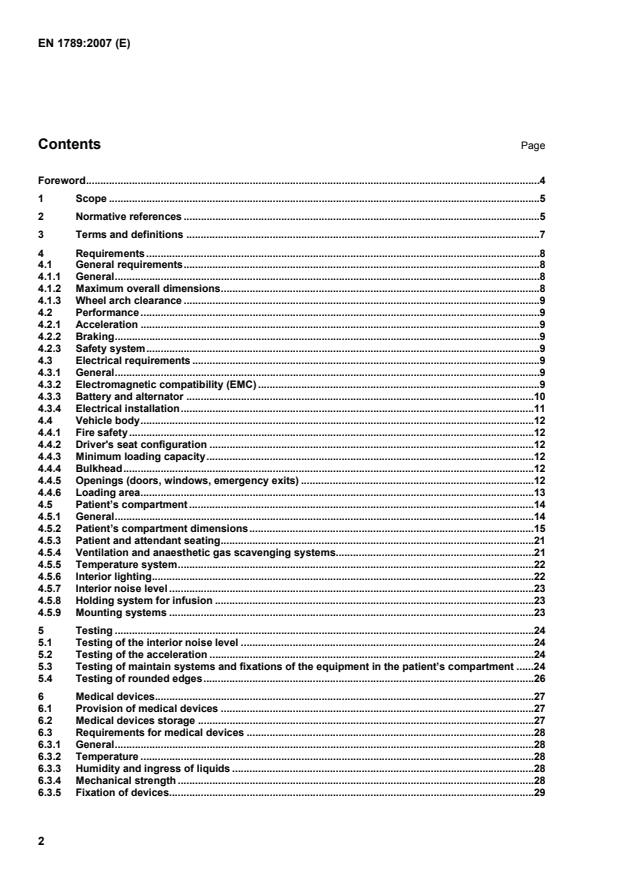
Recognition.39 A.1 Recognition and visibility of ambulances.39 A.2 Recognition of personnel.39 Annex B (informative)
Test summary.40 Annex C (informative)
Certificate of compliance.41 Annex ZA (informative)
Relationship between this European Standard and the Essential Requirements of EU Directive 93/42/EEC concerning medical devices.42 Bibliography.43
(IEC 60068-2-29:1987) EN 60068-2-32, Basic environmental testing procedures — Part 2: Tests; test Ed: free fall (IEC 60068-2-32:1975 + A1:1982 + A2:1990) EN 60068-2-64, Environmental testing — Part 2: Test methods — Test Fh: Vibration, broad-band random (digital control) and guidance (IEC 60068-2-64:1993 + Corrigendum 1993) EN 60601-1 (all parts), Medical electrical equipment EN 60601-2 (all parts), Medical electrical equipment EN 60601-2-4, Medical electrical equipment — Part 2-4: Particular requirements for the safety of cardiac
defibrillators (IEC 60601-2-4:2002) EN ISO 407, Small medical gas cylinders — Pin-index yoke- type valve connections (ISO 407:2004) EN ISO 9919, Medical electrical equipment — Particular requirements for the basic safety and essential
performance of pulse oximeter equipment for medical use (ISO 9919:2005) EN ISO 10079-1:1999, Medical suction equipment — Part 1: Electrically powered suction equipment — Safety requirements (ISO 10079-1:1999) EN ISO 10079-2:1999, Medical suction equipment — Part 2: Manually powered suction equipment
(ISO 10079-2:1999) EN ISO 10079-3:1999, Medical suction equipment — Part 3: Suction equipment powered from a vacuum or pressure source (ISO 10079-3:1999) EN ISO 10524-1, Pressure regulators for use with medical gases — Part 1: Pressure regulators and pressure regulators with flow-metering devices (ISO 10524-1:2006) EN ISO 10524-3, Pressure regulators for use with medical gases — Part 3: Pressure regulators integrated with cylinder valves (ISO 10524-3:2005) EN ISO 11197:2004, Medical supply units (ISO 11197:2004) EN ISO 14971, Medical devices — Application of risk management to medical devices
(ISO 14971:2007) prEN ISO 15002, Flow-metering devices for connection to terminal units of medical gas pipeline systems (ISO/DIS 15002:2006) EN ISO 19054, Rail systems for supporting medical equipment (ISO 19054:2005) EN ISO 20345, Personal protective equipment — Safety footwear (ISO 20345:2004) EN ISO 21647, Medical electrical equipment – Particular requirements for the basic safety and essential performance of respiratory gas monitors (ISO 21647:2004)
ISO 3795, Road vehicles, and tractors and machinery for agriculture and forestry — Determination of burning behaviour of interior materials ISO 5128:1980, Acoustics— Measurement of noise inside motor vehicles 3 Terms and definitions For the purposes of this document, the following terms and definitions apply. 3.1 patient and emergency patient
3.1.1 patient person whose condition requires appropriately trained personnel to provide medical care and/or suitable transport 3.1.2 emergency patient patient who through sickness, injury or other circumstances is in immediate or imminent danger to life unless emergency treatment and/or monitoring and suitable transport to diagnostic facilities or medical treatment is provided 3.2 ambulance vehicle or craft intended to be crewed by a minimum of two appropriately trained staff for the provision of care and transport of at least one stretchered patient 3.3 types of road ambulances2)
3.3.1 type A: patient transport ambulance road ambulance designed and equipped for the transport of patients who are not expected to become emergency patients. Two types of patient transport ambulance exist: type A1: suitable for transport of a single patient; type A2: suitable for transport of one or more patient(s) (on stretcher(s) and/or chair(s)) 3.3.2 type B: emergency ambulance road ambulance designed and equipped for the transport, basic treatment and monitoring of patients
1) IEC/TC 64 “Electrical installations and protection against electric shock” is developing the revision of IEC 60364-7-708. The draft is presently at the DIS stage. The standard, when ready, will be published as the first edition of the new section 7-721 “Electrical installations in caravans and motor caravans”. 2) Road ambulances are road vehicles which comply with type approval for special use vehicles according to Directive 70/156/EEC in the last applicable amended version.
Table 1 — Minimum capacity/power Type of road ambulance
A1 A2 B C Nominal voltage 12 V 54 Ah 54 Ah up to
4 seats and 80 Ah more than 4 seats in the compartment 80 Ah 80 Ah Starter
battery(ies) Nominal voltage 24 V – – 63 Ah (2 × 12 V) 63 Ah (2 × 12 V) Nominal voltage 12 V – – 80 Ah a 80 Ah Additional b battery(ies) Nominal voltage 24 V – – 63 Ah a (2 × 12 V) 63 Ah (2 × 12 V) Alternator power 700 W 700 W 1 200 W 1 200 W a Recommended for special operational conditions. b Additional batteries shall have high cyclic stability (e.g. gel batteries) and of a sealed type.
NOTE 2 When the engine is idling electrical stability should be maintained between electrical load and alternator output. In order to achieve this it may be necessary to fit an electrical load prioritisation device to the vehicle.
Table 2 — 12 V connections for medical devices in patient’s compartment Type of road ambulance
A1 A2 B C Minimum number of connections 2 2 4 4
4.3.4.3 Any additional electrical systems fitted to the base vehicle shall be separate from the base vehicle electrical system and the body or chassis shall not be used as an earth return for additional circuits. All circuits in the additional system(s) shall have separate overload protection3). All circuits shall be well defined and cables clearly marked at the connection points and at a maximum of 1m intervals along its length. The system shall have enough circuits and be so constructed that when/if a circuit fails all illumination and medical technical equipment can be switched to an alternative power source. 4.3.4.4 The wiring and, where applicable conduits, shall withstand vibrations. No wiring shall be located in or pass through conduit intended for medical gas installation. The wiring shall not be loaded higher than that stated by the wire manufacture. 4.3.4.5 Where there are different voltage systems, the connections shall be non-interchangeable.
3) Overload protection may consist of either fuses or so called Electronic Management Control systems.
A1 A2 B C Number of seats and/or stretcher facilities (in addition to the drivers seat) 3 4 3 4 5 a a With two stretchers.
4.4.4 Bulkhead A full bulkhead4) or a bulkhead with a door shall separate the driver’s compartment from the patient’s compartment. Where a door is fitted, it shall not be possible to drive the vehicle with the door in the open position. This door shall be secured against opening if the road ambulance is in motion. One or two windows with a minimum separation of 100 mm shall be provided in the bulkhead made of material complying with the requirements of Directive 92/22/EEC modified. The windows shall allow direct visual contact with the driver. The opening area of the window shall have a maximum area of 0,12 m². It shall be secured against self-opening and shall have an adjustable blind or other means of preventing the driver being disturbed by the light of the patient’s compartment. 4.4.5 Openings (doors, windows, emergency exits) 4.4.5.1 General There shall be a minimum of two openings – one at the rear (door/tailgate) and one at the side (door/window) of the patient’s compartment. All openings shall have seals to protect against the ingress of water. All openings shall comply with the minimum dimensions set out in Table 4.
4) Also called a "partition wall".
A1
a mm A2
a mm B mm C mm Side opening Height c Width c b 800 600 1.200 660 1.400 660 Rear opening Height Width 900 900 900 900 1.200 1.050 1.500 1.050 a Corner radius of conversions which reduce the opening area by less than 10 % are permitted. b The dimensions provided by the original manufacturer shall not be reduced. c If it is a window, the height and width dimensions may be interchanged. See EN 1865 for stretcher dimensions which should be taken into account. 4.4.5.2 Doors Each external door of the patient’s compartment shall be fitted with a security system which enables the following: a) lock and unlock from inside without use of a key5); b) lock and unlock from outside with use of a key5); c) unlock from the outside using a key5) when the door is locked from the inside. NOTE This security system may be integrated with an optional central locking system. The patient’s compartment doors shall be capable of being positively restrained in the open position. An audible and/or visual signal shall warn the driver when any door is not completely closed when the vehicle is in motion. 4.4.5.3 Windows In the patient’s compartment, there shall be a minimum of two external windows. There shall be one on each side or one on one side and the rear. The windows shall be positioned or screened to ensure patient’s privacy when required. Windows shall be made of material complying with the requirements of Directive 92/22/EEC modified. 4.4.6 Loading area The loading area dimensions shall be in accordance with Table 5.
5) The key can be a mechanical or non-mechanical device.
A1 A2 B C Tailgate height (in the open position) (see Figure 1) a H2 minimum 1 800 mm 1 800 mm 1 900 mm 1 900 mm Loading angle (stretcher)
maximum 16° b 16° b 16° b 16° b Loading height (stretcher) When the patient is manually loaded or unloaded on the stretcher, the centre of the stretcher handles shall be no more than 825 mm above ground level. The maximum height of either the floor or the loading holding assembly above ground level shall not exceed 750 mm at net vehicle mass plus loose equipment. a From ground to lowest point of fully opened tailgate at gross vehicle mass. b The loading angle shall be kept as low as possible.
Where a ramp or lift is installed between ground level and vehicle floor level it shall be covered with a anti-slip surface and capable of taking a constant load of 350 kg. In the event of a power failure the loading device shall be capable of being operated manually.
Figure 1 — Tailgate height (in the open position) 4.5 Patient’s compartment 4.5.1 General The patient’s compartment shall be designed and constructed to accommodate the medical devices listed in Tables 9 to 19 in accordance with the vehicle type. The ceiling, the interior side walls and the doors of the patient’s compartment shall be lined with a material that is non-permeable and resistant to disinfectant. The edges of surfaces shall be designed and/or sealed in such a way that no fluid can infiltrate. If the floor arrangement does not allow fluids to flow away, one or more drain with plugs shall be provided.
= height between centre of seat and floor covering.
Figure 2 — Patient's compartment dimensions for type A1 (schematic)
a
Dimensions for Type A2 with more than four seats in the patient’s compartment. The length (L) shall be
3 100 mm, width (W) 1 500 mm. From a heights of 1 500 mm to 1 750 mm the sides shall have a radius no greater than 250 mm. The height (H) shall be 1 750 mm. Figure 3 — Patient's compartment dimensions for type A2 (schematic)
a
Area I When it is necessary to facilitate emergency treatment there shall be a minimum of 500 mm between the lining of the bulkhead and the head-end part of the stretcher frame or stretcher platform measured in the mid-axis and at the height of the stretcher. A minimum height of 1 600 mm shall be provided. Area II A minimum height of 1 600 mm shall be provided. Area III A flat and horizontal surface of a minimum length of 400 mm shall be provided alongside the stretcher from the head-end part of the stretcher frame. A minimum height of 1 300 mm shall be provided. Figure 4 — Patient's compartment dimensions for type B (schematic)
6) Also called “ergonomic space”.
a
Reduced (25 mm maximum) in the roof area over the stretcher. b
Where the height of the wheel arch exceeds 400 mm, the clearance width between the wheel arches above 400 mm
shall not be less than 1 250 mm. Figure 5 — Treatment area dimensions for type C
4.5.3 Patient and attendant seating The minimum number of patient and attendant seats shall be as given in Table 6. Table 6 — Number of patient and attendant seats Type of road ambulance
A1 A2 B C Minimum number
1 2 2 2 on one side of the stretcher 1 1 – – Position(s) on one side of the stretcher upper 2/3 end – – 1 1 Position(s) at head or side of stretcher – 1 a 1 1 a Only when fewer than four seats. The seats shall comply with the minimum dimensions set out in Table 7. Table 7 — Minimum dimensions for seating
Single seat (patient) mm Single seat (attendant) mm Folding seat (attendant) mm Width 450 450 450 Depth 400 330 330 Height above seat a 920 920 920 Thickness of upholstery 50 50 50 a Measured vertically above and in the middle of the 75 kg loaded seat. NOTE Where possible the seat height should be adjustable. Seats fitted in accordance with Tables 6 and 7 shall be installed in either forward or rear-facing positions. Head restraints shall be fitted in accordance with Directive 78/932/EEC. Backrests shall be constructed to a minimum dimension of 300 mm × 100 mm, the upholstery of which shall be a minimum thickness of 20 mm. Seats for patients and attendants shall not be permanently fixed in a side-facing position. 4.5.4 Ventilation and anaesthetic gas scavenging systems 4.5.4.1 Ventilation system There shall be a ventilation system which shall provide a minimum of 20 air changes per hour when the vehicle is stationary.
A1 Ix A2 Ix B Ix C Ix Patient area (stretcher)
minimum: 100 100 300 a 300 a Surrounding area minimum: 30 30 50 50 a Additionally there shall be a facility for switching the lighting level down to 150500+ lx.
Light levels shall be measured along the central longitudinal axis of the stretcher at the head, mid-point and foot position with the stretcher in its normal position for transportation in the ambulance. 4.5.7 Interior noise level The interior noise level acro
...