


FprEN 14363-2
(Main)Railway applications - Testing and simulation for the assessment of running characteristics of rail vehicles operated on the heavy rail network - Part 2: Safety against derailment on twisted track
General Information
- Abstract
This document is applicable to all rail vehicles including OTMs and Road-rail machines, which are operated on the heavy rail network with nominal track gauge 1 435 mm and nominal static vertical wheelset forces up to 350 kN.
This document may also be applicable (partly or in full) to:
— rail systems with different track layout, e. g. urban rail systems and/or;
— rail systems with other than 1 435 mm nominal track gauge and/or;
— non-public rail networks and vehicles, e. g. mine rail systems.
NOTE For rail systems other than 1 435 mm track gauge or urban rail systems, the related post processing, limit values and test conditions could be different. They are specified nationally or individually taking into account track design and operating conditions.
This document applies to the assessment of safety against derailment on twisted tracks of rail vehicles which:
— are newly designed;
— have had relevant design modifications; or
— have relevant changes in their operating conditions.
- Status
- Not Published
- Publication Date
- 04-Nov-2026
- Technical Committee
- CEN/TC 256 - Railway applications
- Drafting Committee
- CEN/TC 256/WG 10 - Vehicle/Track Interaction
- Current Stage
- 4599 - Dispatch of FV draft to CMC - Finalization for Vote
- Start Date
- 28-May-2026
- Due Date
- 13-Jun-2025
- Completion Date
- 28-May-2026

Overview
FprEN 14363-2: Railway applications - Testing and simulation for the assessment of running characteristics of rail vehicles operated on the heavy rail network - Part 2: Safety against derailment on twisted track is a draft standard developed by CEN (European Committee for Standardization). This standard defines procedures for testing and simulating the safety of rail vehicles against derailment risks when operating on twisted tracks. It applies to all types of railway rolling stock, including on-track machines (OTMs) and road-rail vehicles, running on heavy rail networks with a track gauge of 1 435 mm and static wheelset forces up to 350 kN. The standard is also referenced for rail systems with different layouts or gauges, as well as non-public or industrial rail networks, with possible specific adaptations.
Key Topics
- Assessment of Safety Against Derailment: Provides standardized methods to evaluate rail vehicle stability and resistance to derailment, specifically addressing the effects of twisted track geometry.
- Applicability: Covers newly designed vehicles, vehicles with major modifications, and those with changed operational contexts. While primarily for heavy rail networks of 1 435 mm gauge, the standard may be partly applied to urban, narrow-gauge, or industrial systems with adaptations.
- Test Methods: Details three primary methods for safety assessment:
- Test on a physically twisted track with specified curvature and twist values.
- Combination of twist test rigs and flat track analysis.
- Twist and yaw test rigs for analyzing vehicle and bogie interaction.
- Vehicle Types: Includes guidance for various vehicle designs: bogie and non-bogie vehicles, articulated vehicles, those with multiple suspension levels, and vehicles equipped with self-steering wheelsets or air suspension systems.
- Track and Vehicle Test Conditions: Defines environmental and operational conditions to be met during testing, including track geometry, friction, wheel profile limits, and loading states (such as empty, loaded, or with air springs inflated/deflated).
- Signal Processing and Evaluation: Establishes requirements for the measurement and processing of signals, such as filtering wheel lift and wheel-rail forces to ensure accurate and relevant test results.
Applications
FprEN 14363-2 is a critical reference for railway engineers, vehicle manufacturers, test institutes, and safety authorities concerned with rail vehicle acceptance and certification. Key applications include:
- New Vehicle Approval: Ensuring that new rail vehicles meet defined safety thresholds against derailment on twisted tracks as part of the overall acceptance process.
- Vehicle Modifications: Providing a framework for reassessing safety after significant design or operational changes in existing fleets.
- Test Planning and Simulation: Defining test setups, procedures, and simulation requirements for verifying compliance, both in laboratory and on-track scenarios.
- International and National Adaptation: Supporting national rail authorities and operators in adapting test and evaluation procedures for non-standard railways, including urban transit and industrial systems, by identifying where local specifications or limits may differ.
- Maintenance and Safety Audits: Serving as a benchmark for periodic assessments or incident investigations, ensuring ongoing compliance with derailment safety criteria.
Related Standards
FprEN 14363-2 belongs to a broader family of rail standards, including:
- prEN 14363-1: General principles for testing and simulation of running characteristics for heavy rail vehicles.
- prEN 14363-3: Stationary tests not mandatory at the European level.
- prEN 14363-4: Detailed guidance for on-track testing.
- prEN 14363-5: Methods for simulations and calculations to support safety assessments.
- EN 17343: Railway applications - General terms and definitions.
- EN 13848-5: Rules for track geometry quality.
- EN 14033-2: Testing of special vehicles in degraded track conditions.
- UIC 530-2: Reference results for running gear assessment.
Practical Value
Adopting FprEN 14363-2 ensures robust, harmonized approaches to derailment testing and simulation, supporting interoperability, safety, and regulatory compliance for rail vehicle acceptance across Europe. By following its structured methodologies, stakeholders can minimize derailment risks, improve operational reliability, and streamline cross-border vehicle certification, which is essential for modern rail networks.
Keywords: FprEN 14363-2, railway safety, derailment prevention, twisted track, rail vehicle testing, rail standards, CEN, heavy rail, dynamic assessment, rail vehicle acceptance, railway applications.
Relations
- Effective Date
- 19-Jan-2023
- Effective Date
- 20-Oct-2021
Get Certified
Connect with accredited certification bodies for this standard

IRIS Certification (UNIFE)
International Railway Industry Standard certification.

TÜV SÜD Rail GmbH
TÜV SÜD railway certification services.

Bureau Veritas Railway Certification
Railway and transportation certification.
Sponsored listings
Frequently Asked Questions
FprEN 14363-2 is a draft published by the European Committee for Standardization (CEN). Its full title is "Railway applications - Testing and simulation for the assessment of running characteristics of rail vehicles operated on the heavy rail network - Part 2: Safety against derailment on twisted track". This standard covers: This document is applicable to all rail vehicles including OTMs and Road-rail machines, which are operated on the heavy rail network with nominal track gauge 1 435 mm and nominal static vertical wheelset forces up to 350 kN. This document may also be applicable (partly or in full) to: — rail systems with different track layout, e. g. urban rail systems and/or; — rail systems with other than 1 435 mm nominal track gauge and/or; — non-public rail networks and vehicles, e. g. mine rail systems. NOTE For rail systems other than 1 435 mm track gauge or urban rail systems, the related post processing, limit values and test conditions could be different. They are specified nationally or individually taking into account track design and operating conditions. This document applies to the assessment of safety against derailment on twisted tracks of rail vehicles which: — are newly designed; — have had relevant design modifications; or — have relevant changes in their operating conditions.
This document is applicable to all rail vehicles including OTMs and Road-rail machines, which are operated on the heavy rail network with nominal track gauge 1 435 mm and nominal static vertical wheelset forces up to 350 kN. This document may also be applicable (partly or in full) to: — rail systems with different track layout, e. g. urban rail systems and/or; — rail systems with other than 1 435 mm nominal track gauge and/or; — non-public rail networks and vehicles, e. g. mine rail systems. NOTE For rail systems other than 1 435 mm track gauge or urban rail systems, the related post processing, limit values and test conditions could be different. They are specified nationally or individually taking into account track design and operating conditions. This document applies to the assessment of safety against derailment on twisted tracks of rail vehicles which: — are newly designed; — have had relevant design modifications; or — have relevant changes in their operating conditions.
FprEN 14363-2 is classified under the following ICS (International Classification for Standards) categories: 45.060.01 - Railway rolling stock in general. The ICS classification helps identify the subject area and facilitates finding related standards.
FprEN 14363-2 has the following relationships with other standards: It is inter standard links to EN 14363:2016+A2:2022, EN 14363:2016+A1:2018. Understanding these relationships helps ensure you are using the most current and applicable version of the standard.
FprEN 14363-2 is associated with the following European legislation: EU Directives/Regulations: 2016/797/EU, 2016/797/EU, 2016/797/EU, 2016/797/EU, 2016/797/EU, 2016/797/EU, 2016/797/EU, 2016/797/EU, 2016/797/EU, 2016/797/EU, 2016/797/EU, 2016/797/EU, 2016/797/EU; Standardization Mandates: M/483, M/591. When a standard is cited in the Official Journal of the European Union, products manufactured in conformity with it benefit from a presumption of conformity with the essential requirements of the corresponding EU directive or regulation.
FprEN 14363-2 is available in PDF format for immediate download after purchase. The document can be added to your cart and obtained through the secure checkout process. Digital delivery ensures instant access to the complete standard document.
Standards Content (Sample)
SLOVENSKI STANDARD
01-september-2025
Železniške naprave - Preskušanje in simulacija za oceno voznih lastnosti
železniških vozil, ki obratujejo na omrežju težkih železniških prog - 2. del: Varnost
pred iztirjenjem na zasukanih tirih
Railway applications - Testing and simulation for the acceptance of running
characteristics of railway vehicles operated on the heavy rail network - Part 2: Safety
against derailment on twisted track
Bahnanwendungen - Prüfungen und Simulationen für die Bewertung der fahrtechnischen
Eigenschaften von Schienenfahrzeugen, die auf dem Vollbahnnetz betrieben werden -
Teil 2: Sicherheit gegen Entgleisen in Gleisverwindungen
Applications ferroviaires - Essais en vue de l'évaluation du comportement dynamique
des véhicules ferroviaires circulant sur un réseau du système ferroviaire lourd - Partie 2:
Aptitude au franchissement des gauches de voie, sans déraillement
Ta slovenski standard je istoveten z: prEN 14363-2
ICS:
45.060.01 Železniška vozila na splošno Railway rolling stock in
general
2003-01.Slovenski inštitut za standardizacijo. Razmnoževanje celote ali delov tega standarda ni dovoljeno.
DRAFT
EUROPEAN STANDARD
prEN 14363-2
NORME EUROPÉENNE
EUROPÄISCHE NORM
June 2025
ICS Will supersede EN 14363:2016+A2:2022
English Version
Railway applications - Testing and simulation for the
acceptance of running characteristics of railway vehicles
operated on the heavy rail network - Part 2: Safety against
derailment on twisted track
Applications ferroviaires ¿ Essais en vue de l'évaluation Bahnanwendungen - Versuche und Simulationen für
du comportement dynamique des véhicules die Bewertung der fahrtechnischen Eigenschaften von
ferroviaires circulant sur un réseau du système Schienenfahrzeugen, die auf dem Vollbahnnetz
ferroviaire lourd ¿ Partie 2: Aptitude au betrieben werden - Teil 2: Sicherheit gegen Entgleisen
franchissement des gauches de voie, sans déraillement in Gleisverwindungen
This draft European Standard is submitted to CEN members for enquiry. It has been drawn up by the Technical Committee
CEN/TC 256.
If this draft becomes a European Standard, CEN members are bound to comply with the CEN/CENELEC Internal Regulations
which stipulate the conditions for giving this European Standard the status of a national standard without any alteration.
This draft European Standard was established by CEN in three official versions (English, French, German). A version in any other
language made by translation under the responsibility of a CEN member into its own language and notified to the CEN-CENELEC
Management Centre has the same status as the official versions.
CEN members are the national standards bodies of Austria, Belgium, Bulgaria, Croatia, Cyprus, Czech Republic, Denmark, Estonia,
Finland, France, Germany, Greece, Hungary, Iceland, Ireland, Italy, Latvia, Lithuania, Luxembourg, Malta, Netherlands, Norway,
Poland, Portugal, Republic of North Macedonia, Romania, Serbia, Slovakia, Slovenia, Spain, Sweden, Switzerland, Türkiye and
United Kingdom.
Recipients of this draft are invited to submit, with their comments, notification of any relevant patent rights of which they are
aware and to provide supporting documentation.
Warning : This document is not a European Standard. It is distributed for review and comments. It is subject to change without
notice and shall not be referred to as a European Standard.
EUROPEAN COMMITTEE FOR STANDARDIZATION
COMITÉ EUROPÉEN DE NORMALISATION
EUROPÄISCHES KOMITEE FÜR NORMUNG
CEN-CENELEC Management Centre: Rue de la Science 23, B-1040 Brussels
© 2025 CEN All rights of exploitation in any form and by any means reserved Ref. No. prEN 14363-2:2025 E
worldwide for CEN national Members.
prEN 14363-2:2025 (E)
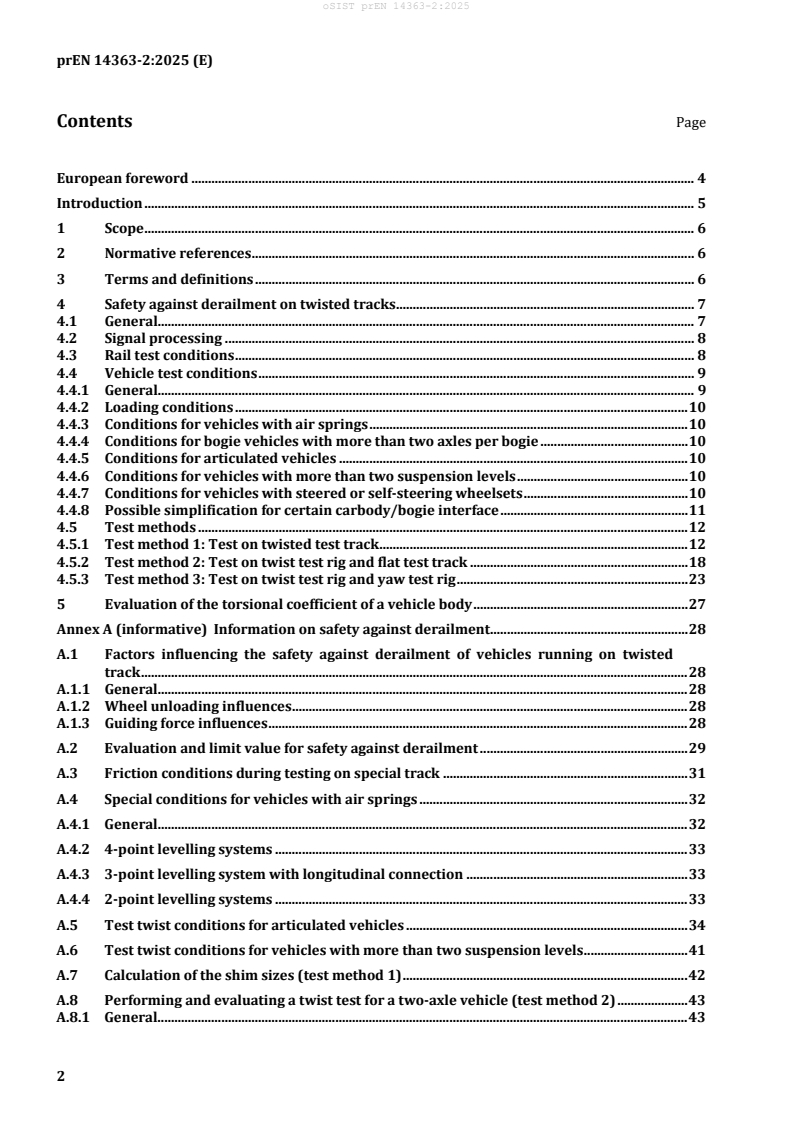
Contents Page
European foreword . 4
Introduction . 5
1 Scope . 6
2 Normative references . 6
3 Terms and definitions . 6
4 Safety against derailment on twisted tracks . 7
4.1 General. 7
4.2 Signal processing . 8
4.3 Rail test conditions . 8
4.4 Vehicle test conditions . 9
4.4.1 General. 9
4.4.2 Loading conditions . 10
4.4.3 Conditions for vehicles with air springs . 10
4.4.4 Conditions for bogie vehicles with more than two axles per bogie . 10
4.4.5 Conditions for articulated vehicles . 10
4.4.6 Conditions for vehicles with more than two suspension levels . 10
4.4.7 Conditions for vehicles with steered or self-steering wheelsets . 10
4.4.8 Possible simplification for certain carbody/bogie interface . 11
4.5 Test methods . 12
4.5.1 Test method 1: Test on twisted test track . 12
4.5.2 Test method 2: Test on twist test rig and flat test track . 18
4.5.3 Test method 3: Test on twist test rig and yaw test rig . 23
5 Evaluation of the torsional coefficient of a vehicle body . 27
Annex A (informative) Information on safety against derailment . 28
A.1 Factors influencing the safety against derailment of vehicles running on twisted
track . 28
A.1.1 General. 28
A.1.2 Wheel unloading influences . 28
A.1.3 Guiding force influences . 28
A.2 Evaluation and limit value for safety against derailment . 29
A.3 Friction conditions during testing on special track . 31
A.4 Special conditions for vehicles with air springs . 32
A.4.1 General. 32
A.4.2 4-point levelling systems . 33
A.4.3 3-point levelling system with longitudinal connection . 33
A.4.4 2-point levelling systems . 33
A.5 Test twist conditions for articulated vehicles . 34
A.6 Test twist conditions for vehicles with more than two suspension levels . 41
A.7 Calculation of the shim sizes (test method 1) . 42
A.8 Performing and evaluating a twist test for a two-axle vehicle (test method 2) . 43
A.8.1 General. 43
prEN 14363-2:2025 (E)
A.8.2 Required test rig . 43
A.8.3 Performing the twist test . 44
A.8.4 Evaluation of twist diagrams . 44
A.9 Performing and evaluation of a twist test for a vehicle with two bogies with two
axles (test method 2) . 46
A.9.1 General . 46
A.9.2 Required test rig . 46
A.9.3 Performing and evaluating a combined body and bogie twist test (test method 2,
variant 1) . 47
A.9.4 Performing separate twist tests on bogie centre distance and bogie wheel base (test
method 2, variant 2) . 50
Annex B (informative) Tests for determination of the torsional coefficient of a vehicle body . 55
B.1 Force-deflection measurement directly at the vehicle body . 55
B.2 Force-deflection measurement at the contact points between wheel and rail after
blocking of the suspension(s) between wheelset (bogie frame) and vehicle body . 56
Annex ZA (informative) Relationship between this European Standard and the Essential
Requirements of EU Directive (EU) 2016/797 aimed to be covered . 57
Bibliography . 59
prEN 14363-2:2025 (E)
European foreword
This document (prEN 14363-2:2025) has been prepared by Technical Committee CEN/TC 256 “Railway
applications”, the secretariat of which is held by DIN.
This document is currently submitted to the CEN Enquiry.
This document together with prEN 14363-1:2025, prEN 14363-3:2025, prEN 14363-4:2025 and
prEN 14363 5:2025, will supersede EN 14363:2016+A2:2022.
The EN 14363 Series “Railway applications — Testing and Simulation for the assessment of running
characteristics of rail vehicles operated on the heavy rail network” consists of the following parts:
— prEN 14363-1:2025, General;
— prEN 14363-2:2025, Safety against derailment on twisted track;
— prEN 14363-3:2025, Stationary tests that are not obligatory on European level;
— prEN 14363-4:2025, On-track testing;
— prEN 14363-5:2025, Simulations/calculations;
— prCEN/TR 14363-6:2025, Technical Report providing background information to the EN 14363 series
of standards (under development).
This document has been prepared under a standardization request addressed to CEN by the European
Commission. The Standing Committee of the EFTA States subsequently approves these requests for its
Member States.
For the relationship with EU Legislation, see informative Annex ZA, which is an integral part of this
document.
prEN 14363-2:2025 (E)
Introduction
General information for the application of this document is given in prEN 14363-1:2025.
prEN 14363-2:2025 (E)
1 Scope
This document applies to all railway vehicles including OTM’s and Road-rail machines, which are
operated on the heavy rail network with standard track gauge 1 435°mm and nominal static vertical
wheelset forces up to 350 kN.
This document may also be applicable (partly or in full) to:
— rail systems with different track layout, e. g. urban rail systems and/or;
— rail systems with other than 1 435 mm nominal track gauge and/or;
— non-public rail networks and vehicles, e. g. mine rail systems.
NOTE For rail systems other than 1 435 mm track gauge or urban rail systems, the related post analysis, limit
values and test conditions could be different. They are specified nationally taking into account track design and
operating conditions.
This document applies to the assessment of safety against derailment on twisted tracks of railway
vehicles which:
— are newly developed;
— have had relevant design modifications; or
— have changes in their operating conditions.
2 Normative references
The following documents are referred to in the text in such a way that some or all of their content
constitutes requirements of this document. For dated references, only the edition cited applies. For
undated references, the latest edition of the referenced document (including any amendments) applies.
prEN 14363-1:2025 , Railway applications — Testing and Simulation for the assessment of running
characteristics of rail vehicles operated on the heavy rail network — Part 1: General
prEN 14363-4:2025, Railway applications — Testing and Simulation for the assessment of running
characteristics of rail vehicles operated on the heavy rail network — Part 4: On-track testing
EN 17343:2023, Railway Applications — General terms and definitions
3 Terms and definitions
For the purposes of this document, the terms and definitions given in EN 17343:2023 and
prEN 14363-1:2025 apply.
ISO and IEC maintain terminology databases for use in standardization at the following addresses:
— ISO Online browsing platform: available at https://www.iso.org/obp/
— IEC Electropedia: available at https://www.electropedia.org/
No terms and definitions are listed in this document.
At draft stage.
prEN 14363-2:2025 (E)
4 Safety against derailment on twisted tracks
4.1 General
The test methods described in this clause are intended to ensure that vehicles can run safely on twisted
tracks. The existence of twist in railway tracks is fundamental. This is a result of transition layout
between levelled track and canted track as well as cross level deviations (maintenance limits). When
running through twisted tracks there is an increased risk of derailment because of the risk of initiating
flange climbing as a result of reduced vertical wheel force and high lateral forces. The vertical wheel
forces are influenced by the following effects:
— twist on bogie wheel base;
— twist on bogie centre distance or axle distance for non-bogie vehicles;
— torsional hysteresis;
— eccentricity of centre of gravity;
— twist of the bogie and vehicle body as a result of tolerances or vehicle design;
— eccentricity of the centre of gravity due to cant excess – this influence is eliminated in the test;
— roll torque of the lateral axle box forces.
NOTE 1 It is assumed that the reduction in the guiding forces in larger curve radii has a stronger influence on
the safety against derailment than the higher unloading of the guiding wheel due to the higher allowed cant excess
in these radii.
The test methods for proving safety against derailment create an artificial and extreme situation for the
vehicles.
This sub clause specifies three test methods to investigate the derailment performance of vehicles while
negotiating twisted track. All three test methods are derived from work by ORE (later ERRI) and
subsequently reported in documents prepared by the B55 groups of ORE. The objective of the test
methods is common but the methods that are described below are independent and shall not be directly
compared. In addition, the values and conditions referred to in each method shall only apply to that
method; it is not possible to directly compare test conditions and numerical results between the test
methods.
The test conditions specified in the three test methods detailed below for the assessment of safety
against derailment on twisted track do not represent the worst conditions which could occur.
Nevertheless, experience over many years has demonstrated that vehicles that comply with the
assessment criteria specified in this sub clause operate safely on European Railways. It is recommended
that this assessment by test or replaced by calculation as described in prEN 14363-5:2024 is carried out
before executing a possible on-track testing. In case of testing, one of the methods described below shall
be used.
Test method 1 represents a vehicle negotiating track with a 150 m radius curve with defined twist in
the track. The assessment criterion is the wheel lift Δz.
Test method 2 determines the guiding forces between wheel and rail as a vehicle negotiates a 150 m
radius curve without twist. It measures separately the change in vertical wheel force when the vehicle is
subjected to twisted track. The assessment criterion is the ratio of guiding force and vertical wheel force
on the outer wheel (Y/Q) . This method includes the possibility of approval by calculation based on
a
previous test results of a reference vehicle.
prEN 14363-2:2025 (E)
NOTE 2 ORE B55, Rp.8 [5] gives a lot of models and parameters for freight- and special vehicles that can be
used to describe a reference vehicle.
Test method 3 determines the bogie yaw resistance (X-factor) when negotiating the minimum radius
curve specified for the vehicle. It measures separately the relative wheel unloading ΔQ/Q when the
vehicle is subjected to twisted track. The assessment criterion is the X-factor together with the relative
wheel unloading ΔQ/Q. Where it is not possible to demonstrate the simultaneous acceptable
performance of both criteria using Method 3 (phase 1), validated computer simulations according to
informative Annex A of prEN 14363-5:2025, may be used.
The three test methods result in safe operation of the vehicles when the track twist including design
twist and cross level is maintained in accordance with the rules given in EN 13848 5:2017, 7.6.
NOTE 3 The requirements for assessment of safety against derailment on twisted track of special vehicles
operated in degraded working track are given in EN 14033-2:2017.
For the extension of field of application, the assessment by calculation or testing is only necessary if the
modification of the parameters might increase the risk of derailment.
NOTE 4 The most important factors influencing the safety against derailment are given in Clause A.1.
A dispensation from tests and calculations of the safety against derailment is allowed for freight
wagons, if the parameters and running gear types match with those that have shown results compliant
with the limit value in published tests or calculations and the nominal wheel flange angle is 70°.
NOTE 5 Parameters and running gear types that meet the required criteria are included in the tabulated results
given in Appendix A, Appendix B and Appendix C of UIC 530–2:2008 [6] available on the UIC-website.
4.2 Signal processing
The assessed signal for wheel lift Δz shall be low-pass filtered with a cut-off frequency between 5 Hz
and 1 Hz depending on the speed in order to eliminate the detection of very short duration of wheel
climbing occurrences.
If the Y and Q-forces are measured continuously with instrumented wheelsets, the signals shall be
filtered as described in prEN 14363-4:2024, Table 7 for on-track testing.
4.3 Rail test conditions
Tests according to test method 1 and test method 2 shall be done under nominally dry conditions in
order to consider high friction forces between wheel and rail.
Information used in the determination of the rail conditions shall be gathered by measuring:
— Y and Q on the inner leading wheel;
i i
— angle of attack α; and
— average vertical wheel force Q of the leading wheelset;
F0
and evaluated as described below.
During tests, the coefficient τ shall be at least 80 % of the value expected for dry rails. Therefore, the
condition:
(Y/Q) ≥ 0,8 · τ + γ
i dry
as a function of the angle of attack shall be respected. In the above formula the contact angle of the tread
γ at the contact point on the inner rail shall be inserted.
prEN 14363-2:2025 (E)
The coefficient τ represents the ratio of the lateral friction force and the vertical force. For pure
dry
lateral creepage the coefficient τ for dry rail conditions is defined as follows (see Clause A.3):
dry
𝑛𝑛
𝑛𝑛 𝑛𝑛
1 1 1
� � =� � +� �
𝜏𝜏 𝑎𝑎 𝑏𝑏⋅𝛼𝛼
dry
where
𝑄𝑄 − 242,5 𝑄𝑄 + 57 150
𝐹𝐹0 𝐹𝐹0
𝑎𝑎 =
100 000
𝑄𝑄 − 242,5 𝑄𝑄 + 21 950
𝐹𝐹0 𝐹𝐹0
𝑏𝑏 =
𝑛𝑛 = 0,005 𝑄𝑄 + 2,2
𝐹𝐹0
angle of attack α in rad and static vertical wheel force Q in kN.
F0
If the actual mean vertical wheel force on the inner rail during the test differs from Q it is permitted to
F0
use this value in the above formulae.
The maximum values of τ are obtained for the maximum values of α.
dry
NOTE These formulae were determined with a wheel diameter of 1 m and static vertical wheel forces
between 40 kN and 112,5 kN. For the application in this document, they are deemed to be valid also outside these
conditions.
If the angle of attack is replaced with the total creepage (lateral and longitudinal creepage), this formula
describes the friction /creepage diagram for dry track.
If during the tests a coefficient higher than 100 % of τ occurred, the tests may be repeated.
dry
To determine friction during tests, the measurement of the angle of attack is necessary.
The method to determine the friction during tests is not appropriate if the angle of attack is very small
(e. g. below 0,0015 rad). In the case of bogies with a low angle of attack determination of the friction
conditions is to be done by measuring on a leading wheelset of a vehicle which generates a higher angle
of attack.
4.4 Vehicle test conditions
4.4.1 General
For test method 1 and test method 2 the effects of the running direction and the direction of curvature
shall be analysed taking the vehicle design and the distribution of vertical wheelset forces in the vehicle
into consideration. The test conditions and the wheelsets to be tested shall be determined for the worst
case as a result of this analysis.
EXAMPLE For single vehicles with two wheelsets or bogies, the two outer wheelsets should be analysed in
the leading position, unless the vehicle is symmetrical; then testing of one wheelset could be sufficient.
For all test methods all the relevant connections between body and bogie of the vehicle which influence
the assessment quantities shall be correctly attached. If it is necessary to remove dampers for a correct
shimming in test method 1, the effect on the vertical wheel forces shall be studied taking into account
the low test speed. The result of this study shall be respected in the final assessment of the test results.
Single vehicles which are a part of a trainset may be tested separately. It shall be demonstrated that the
test condition represents the forces and moments that exist when the vehicle is installed in the train set.
prEN 14363-2:2025 (E)
As long as the coupling forces and moments are lower or equal to the forces and moments between
vehicles equipped with standard buffers and draw gear at their ends, vehicles may be tested separately.
4.4.2 Loading conditions
Vehicles shall be tested in the empty condition (see prEN 14363-1:2025, 5.3.2).
If the suspension is nonlinear, safety against derailment shall be tested in the worst combination of load
and stiffness (e. g. this will occur for a two-rate spring at the smallest loading point above the
application point of the second stiffness where, at full vehicle test twist, the relieved second stiffness
just remains in contact/operation).
4.4.3 Conditions for vehicles with air springs
Safety against derailment shall be tested with inflated and deflated air springs.
For deflated cases, the most critical situation shall be tested (usually all bogies deflated).
With inflated air spring the vertical wheel force distribution may be changed by the response time of
the levelling system. The type of the levelling system has an important influence (e. g. 4-point levelling,
3-point levelling and 2-point levelling), informative Annex A gives some additional information.
The effect of the levelling system’s response time shall be investigated. During the test the effects of the
levelling system shall be measured by including breaks in the test procedure to enable the system to
stabilize.
4.4.4 Conditions for bogie vehicles with more than two axles per bogie
For test method 1 and test method 2 vehicle test twist for a bogie is related to the outer wheel base of
the bogie. Twist displacements of intermediate wheelsets shall be interpolated.
4.4.5 Conditions for articulated vehicles
In the case of articulated vehicles where adjacent vehicle-bodies are suspended on a common running
gear or articulation, the influence of inter-vehicle constraints shall be analysed in order to determine
their significance. The test conditions and the wheelsets to be tested shall be determined as a result of
this analysis. Intermediate running gear or bogies shall also be tested. It could be necessary to test more
than one vehicle body at the same time.
Clause A.5 gives some additional information and examples.
4.4.6 Conditions for vehicles with more than two suspension levels
The word suspension is used to indicate freedom between adjacent bodies which may or may not
include springs or dampers. Clause A.6 shows an example of such an arrangement, many other different
types exist.
The relevant vehicle test twists for the individual suspension levels shall be defined by analogy to the
rules given for bogie vehicles for each test method. Clause A.6 gives an example for the vehicle
illustrated.
4.4.7 Conditions for vehicles with steered or self-steering wheelsets
For vehicles including mechanisms which steer the wheelsets (actively and/or passively), the track
conditions (e. g. S-curves) may lead to angles of attack which are larger than those obtained on the test
track. This shall be considered in the tests for test method 1 and test method 2. The worst conditions
occurring in operation with regard to the angle of attack shall be determined. Normally, in full curves
the angles of attack and therefore the guiding forces are low. However, in transitions or reverse curves
prEN 14363-2:2025 (E)
the steering mechanism may generate adverse angles of attack. In order to get the highest guiding
forces during the test, these additional angles of attack shall be simulated by suitable methods (e. g. by
removing the steering mechanism and fixing the wheelsets to this angle of attack).
For vehicles with self-steering wheelsets which show a major influence of wheel/rail contact geometry
on the steering effect and the resulting angle of attack, appropriate investigations shall be carried out.
4.4.8 Possible simplification for certain carbody/bogie interface
For vehicles with P > 250 kN in the case when test method 3 is used and in the case when the interface
F0
between carbody and bogie consists only of a so-called centre casting, possibly in combination with
constant contact side bearers, the bogie rotational test to derive the X-factor, see 4.5.3.3, may be
omitted and be replaced with the following procedure:
By calculations it shall be ensured that the X-factor will not exceed the limit value given in 4.5.3.4. In the
calculation a margin of at least 10 % to the limit value shall be demonstrated.
If non-constant contact side bearers are used, these do not need to be included in the calculations, if it
can be shown that they would not be in contact if the test is actually performed.
The following shall be considered:
— verified friction coefficient over the range of load in question, used from drawings and component
type tests;
— the vertical contact force between side bearers and carbody as well as between centre pan and
bogie, if applicable;
— deflection of bogie structure or of carbody structure do not need to be considered if it can be
expected that the influence of these only have negligible influence. The rationale for the compliance
with this requirement shall be provided in the report;
— a static calculation of the resisting yaw moment is sufficient.
NOTE The reason for this is that this test is performed at very low speed.
Vehicles not fit for using test method 3, 4.5.3 can only be used where all of the following conditions are
fulfilled:
— the vehicle in question is a vehicle where sub-systems important to the running dynamics
properties can be said to be designed according to state-of-the art principles;
— vehicles with two two-axle bogies per carbody or articulated vehicle with two axle bogies.
In the case of articulated vehicles particular requirements are put on the test site for the wheel
unloading test.
The nominal flange angles of the wheels are between 68° and 70°.
In the case a vehicle does not qualify for using test method 3, as an alternative to use test method 1 or
test method 2 as in 4.1, calculations based on test results of a reference vehicle, may be used to show
compliance with the requirements. In this case calculation of test method 2 shall be used.
prEN 14363-2:2025 (E)
4.5 Test methods
4.5.1 Test method 1: Test on twisted test track
4.5.1.1 General
The safety against derailment shall be determined by measuring the wheel lift of the outer wheel of the
leading wheelset when running through a curved twisted test track. The (Y/Q) values shall be
a
measured, (Y/Q)a,max be calculated and the results shall be reported but (Y/Q)a,max is not an assessment
quantity.
4.5.1.2 Test conditions
The vehicle test twist values shall be applied as follows:
— for bogie test twist:
+
+
𝑔𝑔 = 7 if 2a ≤ 4 m and
𝑡𝑡𝑡𝑡𝑡𝑡𝑡𝑡
+
if 2a > 4 m
+
𝑔𝑔 = + 2,0
𝑡𝑡𝑡𝑡𝑡𝑡𝑡𝑡
+
2𝑎𝑎
+ +
with 2a as the bogie wheel base in m and g in ‰.
test
— for vehicle body test twist:
∗
𝑔𝑔 = 7 if 2a ≤ 4 m and
𝑡𝑡𝑡𝑡𝑡𝑡𝑡𝑡
if 4 m < 2a ≤ 20 m
∗
𝑔𝑔 = + 2,0
𝑡𝑡𝑡𝑡𝑡𝑡𝑡𝑡
2𝑎𝑎
∗
𝑔𝑔 = 3 if 20 m < 2a ≤ 30 m
𝑡𝑡𝑡𝑡𝑡𝑡𝑡𝑡
if 2a > 30 m
∗
𝑔𝑔 =
𝑡𝑡𝑡𝑡𝑡𝑡𝑡𝑡
2𝑎𝑎
with 2a as the longitudinal dimension of twist in m (for single vehicles the longitudinal dimension of
twist equals 2a*, the distance between centre pivots for vehicles with bogies or the distance of the
wheelsets for non-bogie vehicles) and g* in ‰.
test
+
For bogie vehicles the twist due to the bogie wheel base 2a and the twist due to the bogie centre
distance 2a* shall be combined as shown in Figure 1.
prEN 14363-2:2025 (E)
Key
1 vertical displacement
2 bogie test twist
3 vehicle body test twist
Figure 1 — Combination of bogie and vehicle body test twist
+
Figure 2 shows the test twist values depending on length dimensions 2a and 2a*. The maximum
vertical height difference from twist shall be 90 mm which corresponds to a twist value of 3 ‰ at 30 m.
For lengths greater than 30 m the vertical height difference from twist shall be 90 mm.
Key
h twist height
2a twist length
Figure 2 — Test twist values and twist heights
prEN 14363-2:2025 (E)
For articulated vehicles the influence of bodies and bogies that are not being tested shall also be
considered and actions shall be taken to identify these influences. Where appropriate, these influences
shall be removed by physical means (for example by shims) or the influence mitigated by other means
(for example by calculation to demonstrate the consequence on the performance) or minimized to a
justifiable level.
The objective is to apply the correct test twist to the vehicle. The condition of the test track shall be
determined; using the measured track condition (twist, length of twist, cant, length of constant cant)
any necessary adjustments to the vehicle (for example by the use of shims) to achieve the required test
+
twist conditions shall be determined and reported. The achieved test twists (g , g*) in the most critical
+
position shall not deviate by more than 10 % from the intended values (g , g* ).
test test
The influence of longitudinal forces in the train set shall be minimized. The vehicle shall not be braked.
The speed shall be constant and not exceed 10 km/h.
Tests shall be carried out successfully a minimum of 3 times.
4.5.1.3 Track features
Figure 3 contains an example for installing a test track with characteristics described below.
Key
1/R curvature
U cant
1 running direction
X track coordinate
Figure 3 — Example for general layout of test track
Tests shall be done on a test track with the following characteristics:
— nominal curve radius R = 150 m;
prEN 14363-2:2025 (E)
— nominal gauge in the range between 1 440 mm and 1 465 mm along the test track, variations
of ± 5 mm around the nominal value are accepted;
— test track shall not exceed a tolerance for mean to peak alignment of 10 mm; section of twisted track
with constant curvature and a nominal twist of 3 ‰;
— the twist is realized by varying the height of the outer rail from a positive to a negative cant. It is
also permitted to use a horizontal track centre line by lowering and lifting both rails; the actual cant
shall be measured at each rail fastening position and documented;
— sudden changes of contact geometry, gauge and curvature within the tolerances shall be avoided
inside the measuring area. If sudden changes of contact geometry, gauge or curvature are included
together with friction values at the upper end of the acceptable range, the test can be too severe and
the test may be repeated.
Test conditions as described in 4.3 (dry rail conditions) shall be fulfilled for the inner rail. For the outer
rail the test shall be carried out with wheel flange and rail in a dry condition and no residual lubrication
shall be present. This shall be documented.
4.5.1.4 Vehicle condition
The test shall be planned to ensure that the direction of running and track curvature are in such a way
that the wheel with the lowest vertical wheel force of a tested wheelset is tested in the leading position
running on the outer rail of the curve. This may include additional shims in the suspensions. The aim is
to make sure that the lower vertical wheel force is located at the most unfavourable position. The
achieved vertical wheel force distribution shall be verified.
It is not necessary to test at the maximum permitted vertical wheel force difference.
For vehicles with air suspension the vertical wheel force distribution in the inflated and the deflated
condition is different. This may lead to different requirements for shimming. If it can be demonstrated
by the measured Y and Q forces, that one suspension condition is less critical with a sufficient margin
), then the shimming for the more critical condition
(10 % difference between the two results of (Y/Q)a
with respect to wheel climbing is acceptable for both conditions.
If the installed twist of the test track is smaller than the test twist specified in 6.1.5.1.2, the missing twist
shall be included within the vehicle, for example by including shims in the springs (and anti-roll bar
seats) in an appropriate way. Justification of the used method of shimming shall be documented. This
shall demonstrate that the effect of the shimming achieves the same effect as the application of the
required twist at track level. Clause A.7 contains suggestions for calculating the thickness of the shims
depending on their location.
The nominal flange angle of the design wheel profile of the vehicle used for the test shall be ≤ 70°. If the
vehicle is normally equipped with a profile with a nominal flange angle > 70°, a special profile with a
flange angle of 70° shall be used for testing.
NOTE On new wheelsets or after machining the actual values of flange angles that are achieved can vary by
the extent allowed by the tolerances defined in the specification for the wheel profile.
If the vehicle to be investigated was not only transferred to the test site but was already operated for a
certain distance, it is required that the flange angle of the wheel profile or the contact angle during a
theoretical wheel climbing is ≤ 71°. If the wheel flange angle is above this value, the test may be
regarded as valid in the conditions stated in 4.5.1.6. The wheel profiles used for the test shall be
measured at the beginning of these tests and documented.
It is not required to reprofile wheels during the test. Measurement of flange angle before starting the
test is sufficient.
prEN 14363-2:2025 (E)
4.5.1.5 Measurement
The following values shall be measured:
— lateral forces on the inner and outer wheel of the tested wheelset Y , Y ;
i a
— vertical wheel forces on the inner and outer wheel of the tested wheelset Qi, Qa;
— angle of attack of a leading wheelset α (see 4.3);
— wheel lift Δz = (z – z ) of the guiding wheel of the tested wheelset.
The reference value z is obtained with the wheelset on a straight track. Forces shall be measured either
by:
— appropriate devices on the rail; or
— appropriate devices on the vehicle.
The wheel lift is defined as the vertical displacement between the wheel tread and the rail head. Minor
deviations from this definition are allowed, see Figure 4.
NOTE 1 A mathematically exact definition of the wheel lift is not useful, as the limit was determined based on
measurements where two displacement sensors measured the vertical distance between a rig mounted on the
axle box and the rails in front and behind the wheel. The longitudinal distance from the wheel was the same in
front and behind. The zero position was determined on straight track before entrance of the curve. Any
application, whether it be for measurements or for simulation can take this practice into account.
Figure 4 — Definition of wheel lift
In the case of rail measurements, the measuring positions have to fulfil the following conditions as
shown in Figure 5:
— measuring positions shall be within the twisted part of the track;
— in zone 2 where the track twist first influences the whole vehicle the distance between two
measuring sections shall not be greater than 1,5 m;
— in zone 1 and zone 3 of the twisted track the distance between two measuring sections shall not be
greater than 3 m.
NOTE 2 For testing articulated trains, it is useful to extend zone 2 towards the end of the twisted section in
order to cover also the area where the maximum wheel unloading occurs.
For each measuring section the value of (Y/Q) of the leading wheelset shall be recorded. Wheel lift of
a
the outer wheel of the leading wheelset Δz shall be recorded continuously.
prEN 14363-2:2025 (E)
To determine the friction conditions (Y/Q) and α have to be evaluated as mean values of all measuring
i
sections or of a continuous recorded signal.
If vehicle based measurement is used, the processing of measuring signals shall be done by analogy to
the above conditions.
Key
1 zone 1 3 zone 3 5 running direction x track coordinate
2 zone 2 4 measuring points u cant
Figure 5 — Track based measuring positions to be used in test method 1 in the twisted curve
4.5.1.6 Assessment
Assessment is made for the maximum value Δz of wheel lift of the outer wheel of the tested wheelset.
max
The limit value is Δz ≤ Δz = 5 mm, this shall be achieved on the three separate tests.
max lim
This limit value is defined for typical combinations of wheel and rail profiles such as S1002 according to
EN 13715:2020 and 49E1, 54E1 or 50E6 according to EN 13674-1:2011+A1:2017. For other profiles,
this limit can be adapted, if the contact point reaches the part of the flange with the angle of 70° at
wheel lifts only above 5 mm.
The three successful tests are not necessarily consecutive test runs. However, if two consecutive tests
fail, despite valid test conditions, the vehicle shall be rejected.
When the flange angle is above the value specified in 4.5.1.4, the test run shall be considered as
successful if both following conditions are achieved:
— Δz ≤ Δz = 5 mm;
max lim
— (Y/Q) ≤ (Y/Q) = 1,2.
a,max a,lim
If wheel lift is higher than the limit, additionally (Y/Q)a on the outer rail shall be checked. If (Y/Q)a is
below the value 1,12 (value corresponding a friction value of 0,4 and flange angle of 70°) the test shall
be repeated.
prEN 14363-2:2025 (E)
NOTE If a wheel lift occurs at low values of (Y/Q) , this is an indication of excessive friction on the outer rail.
a
4.5.1.7 Reporting
Additionally to the general reporting according to prEN 14363-1, 5.5 for each test condition that was
part of the test programme the following details shall be included:
— the actual detail of the track features of the test site at the time of the test, including reference to
the point identified in 4.5.1.3;
— shims applied as specified in 4.5.1.2 and 4.5.1.4;
— speed of passage through the test site;
— Y/Q for inner and outer rails at all measuring positions;
— maximum value of Δz.
4.5.1.8 Dispensation
Based on the test results
...