EN 1216:1998
(Main)Heat exchangers - Forced circulation air-cooling and air-heating coils - Test procedures for establishing the performance
Heat exchangers - Forced circulation air-cooling and air-heating coils - Test procedures for establishing the performance
This European Standard applies to forced circulation air-cooling or air-heating coils operating:a) with an evaporating or condensing refrigerant;b) with a cooling or heating fluid;c) without fans. Operation with steam is not part of the standard.
Wärmeaustauscher - Luftkühler und Lufterhitzer für erzwungene Konvektion - Prüfverfahren zur Leistungsfeststellung
Diese Europäische Norm gilt für Luftkühler und Lufterhitzer mit Zwangsumlauf, die: a) mit einem verdampfenden oder kondensierenden Kältemittel; b) mit einem Kühl- oder Heizmedium; c) ohne Ventilatoren betrieben werden. Der Betrieb mit Dampf ist nicht Gegenstand dieser Europäischen Norm.
Echangeurs thermiques - Batteries à ailettes à circulation forcée - Procédures d'essai pour la détermination des performances
La présente norme européenne s'applique aux batteries à ailettes à circulation forcée à refroidissement ou à réchauffement d'air fonctionnant: a) avec un fluide frigorigène en évaporation ou en condensation ; b) avec un fluide refroidissant ou chauffant ; c) sans ventilateur. Le fonctionnement avec de la vapeur n'est pas couvert par cette norme européenne.
Prenosniki toplote – Hladilniki in grelniki zraka s prisilno konvekcijo – Postopki preskušanja za ugotavljanje tehničnih karakteristik
General Information
- Status
- Published
- Publication Date
- 15-Dec-1998
- Technical Committee
- CEN/TC 110 - Heat exchangers
- Current Stage
- 9093 - Decision to confirm - Review Enquiry
- Start Date
- 12-Oct-2023
- Completion Date
- 14-Apr-2025
- Directive
- 89/106/EEC - Construction products
Relations
- Effective Date
- 22-Dec-2008
Overview
EN 1216:1998 - a CEN European Standard - defines test procedures for establishing the performance of forced circulation air‑cooling and air‑heating coils. The standard applies to coils operating with:
- an evaporating or condensing refrigerant,
- a cooling or heating fluid, and
- without fans (i.e., coils tested under forced‑circulation fluid conditions but not fan‑driven airflows).
Operation with steam is explicitly excluded from the scope. EN 1216 provides a common basis for measuring and reporting coil thermal performance so results are comparable across manufacturers and test laboratories.
Key Topics
- Scope and applicability - defines which coil types and service fluids are covered and the exclusion of steam-operated coils.
- Test procedures - sets out standardized methods to determine coil performance under controlled conditions.
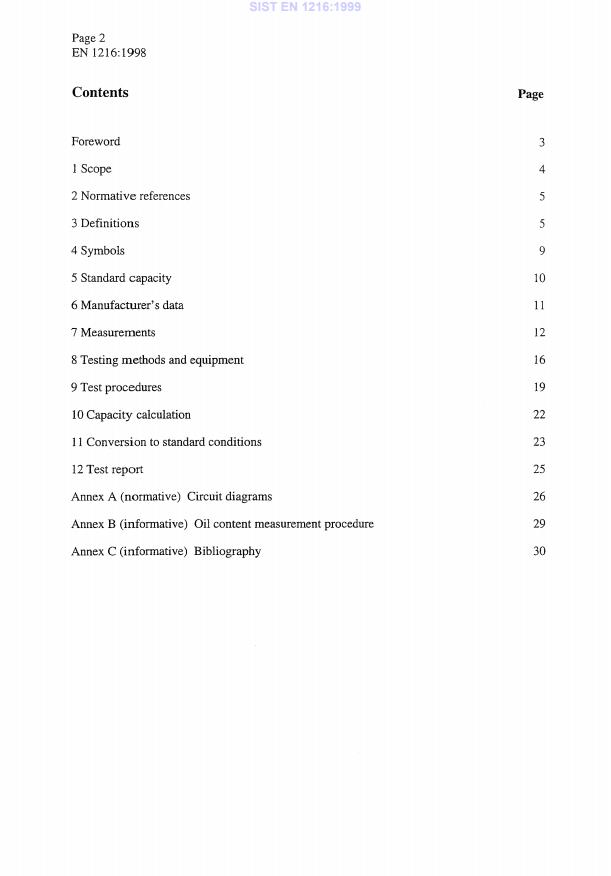
- Performance parameters - addresses key measurable outcomes such as thermal capacity, heat transfer performance and hydraulic/air‑side characteristics relevant to air‑cooling and air‑heating coils.
- Test reporting - guidance for documenting test conditions and results to ensure repeatability and comparability across tests.
- Safety and reproducibility - requirements to ensure tests are performed safely and results can be validated by third parties.
(EN 1216 focuses on the procedures and reporting necessary to establish performance; it does not prescribe installation practices or service requirements.)
Applications
EN 1216 is used when reliable, comparable performance data for forced‑circulation air coils are required:
- Product development and validation - manufacturers use it to verify design performance before market release.
- Type testing and quality control - production and R&D test labs apply the standard to confirm batch consistency.
- Specification and procurement - engineers and procurement teams rely on standardized test data for selecting coils in HVAC, refrigeration and process‑cooling projects.
- Performance comparison - consultants and independent testing bodies use EN 1216 to benchmark products.
Who will use this standard: HVAC engineers, coil manufacturers, test laboratories, product certifiers, and procurement/specification teams.
Related Standards
For complete conformity in HVAC and refrigeration projects, EN 1216 is typically used alongside other CEN/EN standards covering fan systems, refrigerant testing, and coil installation/commissioning. Note that steam coil testing and fan‑driven coil testing are covered by other standards outside the scope of EN 1216.
Keywords: EN 1216, heat exchangers, forced circulation, air‑cooling coils, air‑heating coils, test procedures, performance testing, CEN, HVAC testing.
Frequently Asked Questions
EN 1216:1998 is a standard published by the European Committee for Standardization (CEN). Its full title is "Heat exchangers - Forced circulation air-cooling and air-heating coils - Test procedures for establishing the performance". This standard covers: This European Standard applies to forced circulation air-cooling or air-heating coils operating:a) with an evaporating or condensing refrigerant;b) with a cooling or heating fluid;c) without fans. Operation with steam is not part of the standard.
This European Standard applies to forced circulation air-cooling or air-heating coils operating:a) with an evaporating or condensing refrigerant;b) with a cooling or heating fluid;c) without fans. Operation with steam is not part of the standard.
EN 1216:1998 is classified under the following ICS (International Classification for Standards) categories: 27.060.30 - Boilers and heat exchangers. The ICS classification helps identify the subject area and facilitates finding related standards.
EN 1216:1998 has the following relationships with other standards: It is inter standard links to EN 1216:1998/A1:2002. Understanding these relationships helps ensure you are using the most current and applicable version of the standard.
EN 1216:1998 is associated with the following European legislation: EU Directives/Regulations: 305/2011, 89/106/EEC; Standardization Mandates: M/BC/CEN/87/5. When a standard is cited in the Official Journal of the European Union, products manufactured in conformity with it benefit from a presumption of conformity with the essential requirements of the corresponding EU directive or regulation.
You can purchase EN 1216:1998 directly from iTeh Standards. The document is available in PDF format and is delivered instantly after payment. Add the standard to your cart and complete the secure checkout process. iTeh Standards is an authorized distributor of CEN standards.
Standards Content (Sample)
2003-01.Slovenski inštitut za standardizacijo. Razmnoževanje celote ali delov tega standarda ni dovoljeno.Wärmeaustauscher - Luftkühler und Lufterhitzer für erzwungene Konvektion - Prüfverfahren zur LeistungsfeststellungEchangeurs thermiques - Batteries a ailettes a circulation forcée - Procédures d'essai pour la détermination des performancesHeat exchangers - Forced circulation air-cooling and air-heating coils - Test procedures for establishing the performance27.060.30Grelniki vode in prenosniki toploteBoilers and heat exchangersICS:Ta slovenski standard je istoveten z:EN 1216:1998SIST EN 1216:1999en01-december-1999SIST EN 1216:1999SLOVENSKI
ST
...
Die Norm EN 1216:1998 behandelt die Testverfahren zur Feststellung der Leistung von Luftkühlern und Luftheizern mit erzwungener Zirkulation, die überwiegend in der HVAC-Branche Anwendung finden. Diese europäische Norm ist von großer Bedeutung für Hersteller und Betreiber von Systemen, die auf Luftkühlung oder -heizung angewiesen sind, da sie die Qualität und Effizienz dieser Komponenten bewertet. Der Anwendungsbereich der EN 1216:1998 umfasst spezifisch solche Luftkühler und -heizer, die mit einem verdampfenden oder kondensierenden Kältemittel sowie mit einem Kälte- oder Heizmedium betrieben werden. Besonders hervorzuheben ist, dass die Norm keine Lüfter beinhaltet, was sie für eine Vielzahl von Anwendungen im Bereich der Klimatisierung und Wärmeübertragung relevant macht. Die Ausschlussklausel bezüglich des Betriebs mit Dampf gewährleistet eine präzise und zielgerichtete Bewertung der Technologien, die in vielen modernen Gebäuden und Anlagen eingesetzt werden. Ein wesentlicher Stärke dieser Norm ist die systematische und standardisierte Herangehensweise an die Testverfahren. Durch die Etablierung klarer Messkriterien und Testszenarien stellt die EN 1216:1998 sicher, dass die Leistung von Luftkühl- und -heizsystemen nachvollziehbar und vergleichbar ist. Dies ermöglicht es Herstellern, die Effizienz ihrer Produkte zu maximieren und den Endverbrauchern qualitativ hochwertige Systeme anzubieten, die den erforderlichen Standards entsprechen. Die Relevanz der EN 1216:1998 erstreckt sich über nationale Grenzen hinaus und stärkt die Marktakzeptanz von zertifizierten Produkten in Europa. Durch die Einhaltung dieser Norm können Unternehmen sicherstellen, dass ihre Produkte wettbewerbsfähig sind und die Anforderungen des Marktes sowie der gesetzlichen Vorgaben erfüllen. Dies trägt nicht nur zur Förderung der Energiesparmaßnahmen bei, sondern unterstützt auch die nachhaltige Entwicklung im Gebäudesektor. Insgesamt bietet die EN 1216:1998 wertvolle Richtlinien für alle Beteiligten im Bereich der Luftkühlung und -heizung, indem sie die Basis für qualitativ hochwertige, leistungsfähige Produkte schafft und damit den Marktstandard für HVAC-Systeme weiter oben hält.
The standard EN 1216:1998 addresses the performance testing of forced circulation air-cooling and air-heating coils. Its scope is precisely defined, catering to systems that operate with evaporating or condensing refrigerants, cooling or heating fluids, and specifically excludes systems that function with steam or utilize fans. This delineation ensures clarity in application and compliance for manufacturers and operators within the HVAC industry. One of the strengths of this standard lies in its comprehensive approach to establishing performance through precise test procedures. These procedures allow for consistent results across different systems, facilitating comparisons and evaluations that contribute to reliability and efficiency in air-cooling and air-heating coil systems. The standard is instrumental for engineers and technicians as it provides a clear methodological framework for assessing the operational capabilities of these coils, ensuring that they meet necessary performance benchmarks. The relevance of SIST EN 1216:1999 in today's industry cannot be understated. As demands for energy efficiency and improved thermal performance increase, adherence to established standards such as EN 1216:1998 is crucial for manufacturers aiming to meet regulatory requirements and market expectations. Furthermore, the focus on forced circulation systems is particularly pertinent given their widespread use in commercial and industrial applications. Overall, this standard serves as a key resource for stakeholders seeking to enhance system design, development, and application in the air-cooling and air-heating sector.
La norme EN 1216:1998, intitulée "Échangeurs de chaleur - Bobines de refroidissement et de chauffage d'air à circulation forcée - Procédures d'essai pour établir la performance", se pose comme un document fondamental pour le secteur des systèmes de climatisation et de chauffage. Sa portée est clairement définie, englobant les bobines à circulation forcée utilisant soit un fluide frigorigène en phase d'évaporation ou de condensation, soit un fluide de refroidissement ou de chauffage, tout en précisant que l'utilisation de ventilateurs n'est pas requise. En revanche, l'opération avec de la vapeur est explicitement exclue, ce qui permet de concentrer les efforts sur des systèmes à circulation d'air. Un des points forts de cette norme réside dans ses procédures d'essai rigoureuses pour établir la performance des bobines. Ces procédures garantissent que les performances sont mesurées de manière cohérente, fournissant ainsi des résultats fiables pour les fabricants et les utilisateurs finaux. En effet, cette standardisation permet de comparer différents équipements en s'appuyant sur des méthodes éprouvées et acceptées à l’échelle européenne. La pertinence de la norme EN 1216:1998 est également soulignée par la nécessité croissante de systèmes de chauffage et de refroidissement efficaces, en phase avec les exigences environnementales actuelles. Par le biais de cette standardisation, les acteurs du marché peuvent s’assurer de la conformité de leurs produits aux standards de qualité et de performance exigés, favorisant ainsi des installations durables et économes en énergie. De plus, elle contribue à l'amélioration continue des technologies de climatisation et de chauffage, encourageant l'innovation dans un secteur en constante évolution. En somme, la norme SIST EN 1216:1999 se positionne comme une référence cruciale pour l'évaluation des bobines à circulation d'air, affirmant son importance dans la quête de l'efficacité énergétique et de la durabilité au sein des systèmes d'échange de chaleur.
EN 1216:1998は、強制循環空気冷却および空気加熱コイルに関する重要な欧州規格であり、特にそのパフォーマンスを確立するための試験手順に焦点を当てています。この標準は、蒸発または凝縮 refrigerantを使用した冷却または加熱流体を駆使し、ファンなしで運転されるコイルに適用されます。蒸気を用いた運転については、範囲外となっています。 この標準の強みは、明確な試験手順を提供している点にあります。性能を正確に測定し、評価を行うための基準があることで、製品の信頼性が向上します。また、異なる設計や材料で製造されたコイルの性能を公平に比較できる点も評価されます。このように、EN 1216:1998は、製造業者、エンジニア、および研究者にとって不可欠な資料です。 さらに、空気冷却および空気加熱への技術的要求を厳格に設定していることにより、この標準は特定の産業用途においても重要な基盤を提供しています。それにより、業界全体の品質向上とエネルギー効率化にも寄与しています。EN 1216:1998の適用範囲は、冷却及び加熱技術の進展とともに、その関連性を持続的に維持しています。
EN 1216:1998 표준은 강제 순환 공기 냉각 및 공기 가열 코일의 성능을 평가하기 위한 시험 절차에 관한 중요한 지침을 제공합니다. 이 표준은 두 가지 주요 범위에 초점을 맞춥니다. 첫 번째는 기화 또는 응축 하는 냉매를 사용하는 시스템과 관련이 있으며, 두 번째는 냉각 또는 난방 유체를 활용하는 시스템에도 적용됩니다. 특히 이 표준은 팬을 사용하지 않는 경우에 국한되어 있으며, 스팀과의 운전은 포함되지 않는 점이 명확하게 정의되어 있습니다. EN 1216:1998의 강점은 명확한 시험 절차와 함께 성능 평가를 위한 포괄적인 프레임워크를 제공하여, 사용자와 제조업체가 설계 및 성능 기준을 일관되게 적용할 수 있도록 합니다. 이는 다양한 환경에서 열교환기의 신뢰성을 높이는 데 기여하며, 궁극적으로 에너지 효율성을 증대시킵니다. 또한 유럽 전역에서 채택된 표준으로서, 국제적인 상호 운용성을 확보하도록 도와줍니다. 본 표준의 적합성은 냉각 및 난방 시스템의 운영 관리 및 유지보수 효율성을 증대시키는 데 특히 유용합니다. 시험 절차를 통해 제품의 성능을 정량적으로 평가할 수 있기 때문에, 제조업체와 사용자 간의 신뢰를 구축하고, 시장 경쟁력을 강화하는 데 중요한 역할을 합니다. EN 1216:1998은 열교환기 관련 산업에서 필수적인 기준으로 자리 잡아, 보다 효율적이고 신뢰할 수 있는 시스템 구축에 기여할 것입니다.


Questions, Comments and Discussion
Ask us and Technical Secretary will try to provide an answer. You can facilitate discussion about the standard in here.
Loading comments...