


EN 4709-001:2025
(Main)Aerospace series - Unmanned Aircraft Systems - Part 001: Product requirements and verification
Aerospace series - Unmanned Aircraft Systems - Part 001: Product requirements and verification
This document provides means of compliance with Parts 1 to 6 of Commission delegated (EU) .../... of XXX on making available on the market of unmanned aircraft intended for use in the ‘open’ category and on third-country UAS operators proposed in the Opinion 01/2018.
This includes compliance with product requirements for all UAS authorized to operate in the ‘open’ category (class C0, C1, C2, C3 and C4 UAS) and the electronic identification system.
This document does not cover "Specific" or "Certified" category of UAS.
Compliance with this document assists in complying with CE marking technical requirements and covers, but is not limited to:
I. Physical and mechanical properties;
II. Flammability;
III. Electrical properties;
IV. Functional Safety.
This European Standard is only applicable for UA with energy sources based on electro-chemical technologies.
Additional hazards that occur from the characteristics of the payload are excluded and are under the responsibility of the manufacturer and operator.
Luft- und Raumfahrt - Unbemannte Luftfahrzeugsysteme - Teil 001: Anforderungen und Prüfverfahren
Série aérospatiale - Aéronefs télépilotés - Partie 001 : Exigences produit et méthodes de vérification
Le présent document fournit les moyens de se conformer aux Parties 1 à 6 de/du ... de la
Commission (UE) .../... du XXX sur la mise à disposition sur le marché d'aéronefs télé-pilotés (UA)
destinés à être utilisés dans la catégorie « ouverte » et sur les exploitants d'UAS de pays tiers proposés
dans le document « Opinion n° 01/2018 ».
Cela comprend la conformité aux exigences du produit pour tous les UAS autorisés à fonctionner dans la
catégorie « ouverte » (UAS de classe C0, C1, C2, C3 et C4) et le système d'identification électronique.
Le présent document ne couvre pas les catégories « spécifique » ou « certifiée » des UAS.
La conformité au présent document aide à se conformer aux exigences techniques du marquage CE et
couvre, sans toutefois s'y limiter, les caractéristique suivantes :
I. Propriétés physiques et mécaniques ;
II. Inflammabilité ;
III. Propriétés électriques ;
IV. Sécurité fonctionnelle.
La présente norme ne s'applique qu'aux aéronefs télé-pilotés (UA) utilisant des sources d'énergie
basées sur des technologies électrochimiques.
Les risques supplémentaires liés aux caractéristiques de la charge utile sont exclus et relèvent de la
responsabilité du fabricant et de l'exploitant.
Aeronavtika - Letalski sistemi brez posadke - 001. del: Zahteve za proizvod in preverjanje proizvodov
General Information
- Status
- Not Published
- Publication Date
- 17-Mar-2026
- Withdrawal Date
- 09-Feb-2021
- Technical Committee
- CEN/TC 471 - Aviation and aeronautics
- Drafting Committee
- CEN/TC 471/WG 1 - Unmanned Aircraft Systems
- Current Stage
- 6055 - CEN Ratification completed (DOR) - Publishing
- Start Date
- 22-Sep-2025
- Completion Date
- 22-Sep-2025
Overview
EN 4709-001:2025 - Aerospace series | Unmanned Aircraft Systems - Part 001: Product requirements and verification (CEN) defines product-level requirements and verification methods for UAS placed on the EU market for operation in the “open” category. The standard supports compliance with the relevant Commission delegated EU regulation (Parts 1–6) and with CE‑marking technical requirements. It applies to class C0, C1, C2, C3 and C4 UAS and the electronic identification system, but excludes the “specific” and “certified” UAS categories. This standard is applicable only to UAS using electro‑chemical energy sources; payload-specific hazards are outside its scope and remain the manufacturer’s/operator’s responsibility.
Key topics and technical requirements
EN 4709-001 organizes product requirements by UAS class and provides performance criteria, verification methods and pass/fail criteria. Major technical areas covered include:
- Physical and mechanical properties (construction, MTOM limits, mechanical strength, ground‑impact considerations)
- Minimizing injury to people (design measures, speed limits, safe‑control features)
- Electrical properties and flammability for electro‑chemical energy sources (battery safety, power management)
- Functional safety and fail‑safe behaviours (loss of command & control, low‑speed modes, tethering options)
- Operational limits and protections (maximum speed/height, geo‑awareness, airspace limitation functions)
- Identification & traceability (electronic identification, unique physical serial number, Direct Remote Identification)
- Supportive requirements (manufacturer’s instructions, information notices, sound power/noise requirements, lights)
- Verification content: test procedures, verification methods and clearly stated pass criteria for each requirement.
Practical applications and users
This standard is intended for:
- UAS manufacturers and OEMs designing for the EU “open” category and preparing CE marking documentation
- Compliance and conformity assessment bodies and test laboratories conducting product verification and certification testing
- Design engineers and safety teams implementing mechanical, electrical and functional‑safety measures
- Importers, distributors and integrators responsible for placing compliant UAS on the EU market
- Regulators and aviation authorities referencing harmonized product requirements and test methods
Practical benefits include a structured route to market compliance, harmonized test methods, and clearer expectations for product safety, identification and performance for classes C0–C4.
Related standards
EN 4709-001 complements other CEN/CENELEC and EASA technical requirements for UAS, and should be used alongside the delegated EU regulation parts for the “open” category and applicable EN/ISO standards on batteries, electrical safety and EMC when preparing conformity evidence.
Keywords: EN 4709-001:2025, unmanned aircraft systems, UAS product requirements, open category UAS, CE marking, class C0 C1 C2 C3 C4, electronic identification, UAS verification, functional safety.

Get Certified
Connect with accredited certification bodies for this standard

BSI Group
BSI (British Standards Institution) is the business standards company that helps organizations make excellence a habit.

Bureau Veritas
Bureau Veritas is a world leader in laboratory testing, inspection and certification services.

DNV
DNV is an independent assurance and risk management provider.
Sponsored listings
Frequently Asked Questions
EN 4709-001:2025 is a draft published by the European Committee for Standardization (CEN). Its full title is "Aerospace series - Unmanned Aircraft Systems - Part 001: Product requirements and verification". This standard covers: This document provides means of compliance with Parts 1 to 6 of Commission delegated (EU) .../... of XXX on making available on the market of unmanned aircraft intended for use in the ‘open’ category and on third-country UAS operators proposed in the Opinion 01/2018. This includes compliance with product requirements for all UAS authorized to operate in the ‘open’ category (class C0, C1, C2, C3 and C4 UAS) and the electronic identification system. This document does not cover "Specific" or "Certified" category of UAS. Compliance with this document assists in complying with CE marking technical requirements and covers, but is not limited to: I. Physical and mechanical properties; II. Flammability; III. Electrical properties; IV. Functional Safety. This European Standard is only applicable for UA with energy sources based on electro-chemical technologies. Additional hazards that occur from the characteristics of the payload are excluded and are under the responsibility of the manufacturer and operator.
This document provides means of compliance with Parts 1 to 6 of Commission delegated (EU) .../... of XXX on making available on the market of unmanned aircraft intended for use in the ‘open’ category and on third-country UAS operators proposed in the Opinion 01/2018. This includes compliance with product requirements for all UAS authorized to operate in the ‘open’ category (class C0, C1, C2, C3 and C4 UAS) and the electronic identification system. This document does not cover "Specific" or "Certified" category of UAS. Compliance with this document assists in complying with CE marking technical requirements and covers, but is not limited to: I. Physical and mechanical properties; II. Flammability; III. Electrical properties; IV. Functional Safety. This European Standard is only applicable for UA with energy sources based on electro-chemical technologies. Additional hazards that occur from the characteristics of the payload are excluded and are under the responsibility of the manufacturer and operator.
EN 4709-001:2025 is classified under the following ICS (International Classification for Standards) categories: 49.020 - Aircraft and space vehicles in general. The ICS classification helps identify the subject area and facilitates finding related standards.
EN 4709-001:2025 is associated with the following European legislation: EU Directives/Regulations: 2019/945; Standardization Mandates: M/567. When a standard is cited in the Official Journal of the European Union, products manufactured in conformity with it benefit from a presumption of conformity with the essential requirements of the corresponding EU directive or regulation.
EN 4709-001:2025 is available in PDF format for immediate download after purchase. The document can be added to your cart and obtained through the secure checkout process. Digital delivery ensures instant access to the complete standard document.
Standards Content (Sample)
SLOVENSKI STANDARD
oSIST prEN 4709-001:2021
01-julij-2021
Aeronavtika - Letalski sistemi brez posadke - 001. del: Zahteve za proizvod in
preverjanje proizvodov
Aerospace series - Unmanned Aircraft Systems - Part 001: Product requirements and
verification
Luft- und Raumfahrt - Unbemannte Luftfahrzeugsysteme - Teil 001: Anforderungen und
Prüfverfahren
Série aérospatiale - Aéronefs télépilotés - Partie 001 : Exigences produit et méthodes de
vérification
Ta slovenski standard je istoveten z: prEN 4709-001
ICS:
49.020 Letala in vesoljska vozila na Aircraft and space vehicles in
splošno general
oSIST prEN 4709-001:2021 en,fr,de
2003-01.Slovenski inštitut za standardizacijo. Razmnoževanje celote ali delov tega standarda ni dovoljeno.
oSIST prEN 4709-001:2021
oSIST prEN 4709-001:2021
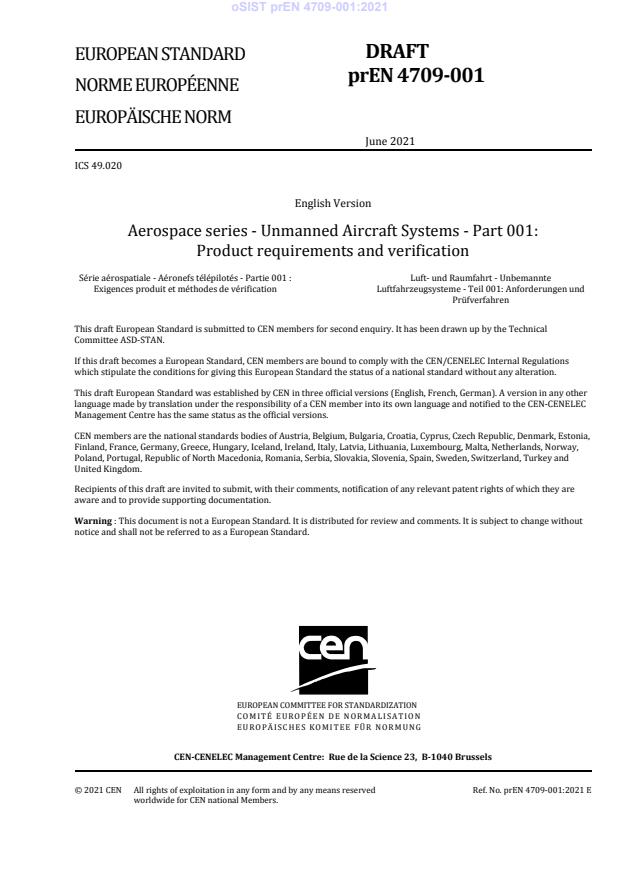
DRAFT
EUROPEAN STANDARD
prEN 4709-001
NORME EUROPÉENNE
EUROPÄISCHE NORM
June 2021
ICS 49.020
English Version
Aerospace series - Unmanned Aircraft Systems - Part 001:
Product requirements and verification
Série aérospatiale - Aéronefs télépilotés - Partie 001 : Luft- und Raumfahrt - Unbemannte
Exigences produit et méthodes de vérification Luftfahrzeugsysteme - Teil 001: Anforderungen und
Prüfverfahren
This draft European Standard is submitted to CEN members for second enquiry. It has been drawn up by the Technical
Committee ASD-STAN.
If this draft becomes a European Standard, CEN members are bound to comply with the CEN/CENELEC Internal Regulations
which stipulate the conditions for giving this European Standard the status of a national standard without any alteration.
This draft European Standard was established by CEN in three official versions (English, French, German). A version in any other
language made by translation under the responsibility of a CEN member into its own language and notified to the CEN-CENELEC
Management Centre has the same status as the official versions.
CEN members are the national standards bodies of Austria, Belgium, Bulgaria, Croatia, Cyprus, Czech Republic, Denmark, Estonia,
Finland, France, Germany, Greece, Hungary, Iceland, Ireland, Italy, Latvia, Lithuania, Luxembourg, Malta, Netherlands, Norway,
Poland, Portugal, Republic of North Macedonia, Romania, Serbia, Slovakia, Slovenia, Spain, Sweden, Switzerland, Turkey and
United Kingdom.
Recipients of this draft are invited to submit, with their comments, notification of any relevant patent rights of which they are
aware and to provide supporting documentation.
Warning : This document is not a European Standard. It is distributed for review and comments. It is subject to change without
notice and shall not be referred to as a European Standard.
EUROPEAN COMMITTEE FOR STANDARDIZATION
COMITÉ EUROPÉEN DE NORMALISATION
EUROPÄISCHES KOMITEE FÜR NORMUNG
CEN-CENELEC Management Centre: Rue de la Science 23, B-1040 Brussels
© 2021 CEN All rights of exploitation in any form and by any means reserved Ref. No. prEN 4709-001:2021 E
worldwide for CEN national Members.
oSIST prEN 4709-001:2021
prEN 4709-001:2021 (E)
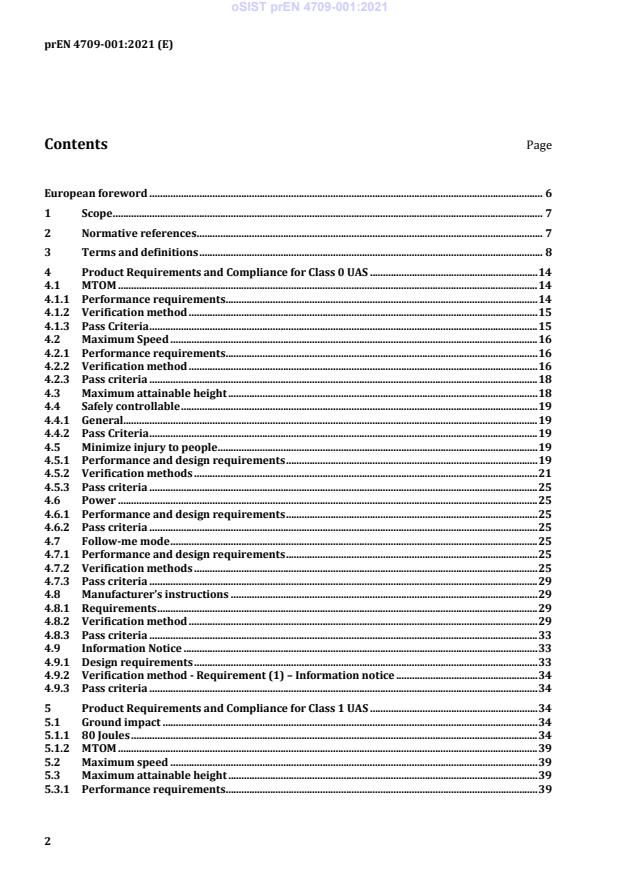
Contents Page
European foreword . 6
1 Scope . 7
2 Normative references . 7
3 Terms and definitions . 8
4 Product Requirements and Compliance for Class 0 UAS . 14
4.1 MTOM . 14
4.1.1 Performance requirements . 14
4.1.2 Verification method . 15
4.1.3 Pass Criteria . 15
4.2 Maximum Speed . 16
4.2.1 Performance requirements . 16
4.2.2 Verification method . 16
4.2.3 Pass criteria . 18
4.3 Maximum attainable height . 18
4.4 Safely controllable . 19
4.4.1 General. 19
4.4.2 Pass Criteria . 19
4.5 Minimize injury to people . 19
4.5.1 Performance and design requirements . 19
4.5.2 Verification methods . 21
4.5.3 Pass criteria . 25
4.6 Power . 25
4.6.1 Performance and design requirements . 25
4.6.2 Pass criteria . 25
4.7 Follow-me mode . 25
4.7.1 Performance and design requirements . 25
4.7.2 Verification methods . 25
4.7.3 Pass criteria . 29
4.8 Manufacturer’s instructions . 29
4.8.1 Requirements . 29
4.8.2 Verification method . 29
4.8.3 Pass criteria . 33
4.9 Information Notice . 33
4.9.1 Design requirements . 33
4.9.2 Verification method - Requirement (1) – Information notice . 34
4.9.3 Pass criteria . 34
5 Product Requirements and Compliance for Class 1 UAS . 34
5.1 Ground impact . 34
5.1.1 80 Joules . 34
5.1.2 MTOM . 39
5.2 Maximum speed . 39
5.3 Maximum attainable height . 39
5.3.1 Performance requirements . 39
oSIST prEN 4709-001:2021
prEN 4709-001:2021 (E)
5.3.2 Verification method . 40
5.3.3 Pass criteria . 44
5.4 Safely controllable . 45
5.4.1 General . 45
5.4.2 Pass Criteria . 45
5.5 Mechanical strength . 45
5.5.1 Performance and design requirements . 45
5.5.2 Verification methods . 47
5.5.3 Pass Criteria . 56
5.6 Minimize injury to people . 56
5.7 Loss of data link . 56
5.8 Sound power . 56
5.8.1 General . 56
5.8.2 Performance and design requirements . 57
5.8.3 Verification method . 57
5.8.4 Pass Criteria . 59
5.9 Power . 59
5.10 Unique physical serial number . 59
5.11 Direct Remote Identification . 59
5.12 Geo-awareness . 59
5.13 Airspaces limitation function . 59
5.14 Battery low level . 59
5.15 Lights . 59
5.16 Follow-me mode . 59
5.17 Manufacturer’s instructions . 59
5.17.1 Requirements . 59
5.17.2 Verification method . 60
5.17.3 Pass criteria . 65
5.18 Information notice . 66
5.18.1 Design requirements . 66
5.18.2 Verification method - Requirement (1) – Information notice . 66
5.18.3 Pass criteria . 66
6 Product Requirements and Compliance for Class 2 UAS . 66
6.1 MTOM . 66
6.1.1 General . 66
6.1.2 Pass Criteria . 66
6.2 Maximum attainable height . 66
6.3 Safely controllable . 67
6.3.1 Performance and design requirements . 67
6.3.2 Verification method . 69
6.3.3 Pass criteria . 75
6.4 Mechanical strength . 76
6.5 Tethered UA . 76
6.6 Minimize injury to people . 76
6.6.1 General . 76
6.6.2 Performance and design requirements . 76
6.6.3 Verification method - Requirement (6) – Speed limit . 76
6.6.4 Pass Criteria . 77
6.7 Command and Control (C2) link . 77
6.7.1 Loss of C2 link . 77
6.7.2 C2 link protection . 80
6.8 Low speed mode . 81
oSIST prEN 4709-001:2021
prEN 4709-001:2021 (E)
6.8.1 Performance requirements . 81
6.8.2 Verification method - Requirement (1) – Low speed mode . 82
6.8.3 Pass criteria . 82
6.9 Sound power . 82
6.10 Power . 82
6.11 Direct Remote Identification . 82
6.12 Geoawareness . 82
6.13 Airspace limitation function . 82
6.14 Battery low level . 82
6.14.1 Performance requirements . 82
6.14.2 Test methods . 83
6.14.3 Pass criteria . 84
6.15 Lights . 84
6.16 Manufacturer’s instructions . 84
6.16.1 Requirements . 84
6.16.2 Verification method . 85
6.16.3 Pass criteria . 90
6.17 Information Notice . 91
6.17.1 Design requirements . 91
6.17.2 Verification method - Requirement (1) – Information notice . 91
6.17.3 Pass criteria . 91
7 Product Requirements and Compliance for Class 3 UAS . 91
7.1 MTOM . 91
7.1.1 General. 91
7.1.2 Pass Criteria . 91
7.2 Maximum characteristic dimension . 91
7.2.1 Design requirements . 91
7.2.2 Verification methods . 92
7.2.3 Pass Criteria . 94
7.3 Maximum attainable height . 94
7.4 Safely controllable . 94
7.4.1 General. 94
7.4.2 Pass Criteria . 94
7.5 Tethered UA . 95
7.5.1 Performance and design requirements . 95
7.5.2 Verification methods . 97
7.5.3 Pass Criteria . 101
7.6 Loss of data link - Performance requirements . 102
7.7 Sound power . 102
7.8 Power . 102
7.9 Unique physical serial number . 102
7.10 Direct Remote Identification . 102
7.11 Geoawareness . 102
7.12 Airspace limitation function . 102
7.13 Data link protection . 102
7.14 Battery low level . 102
7.15 Lights . 102
7.16 Manufacturer’s instructions . 102
7.16.1 Requirements . 102
7.16.2 Verification method . 103
7.16.3 Pass criteria . 108
7.17 Information Notice . 109
oSIST prEN 4709-001:2021
prEN 4709-001:2021 (E)
7.17.1 Design requirements . 109
7.17.2 Verification method - Requirement (1) – Information notice . 109
7.17.3 Pass criteria . 109
8 Product Requirements and Compliance for Class 4 UAS . 109
8.1 MTOM . 109
8.1.1 General . 109
8.1.2 Pass Criteria . 109
8.2 Safely controllable . 110
8.2.1 Design and performance requirements . 110
8.2.2 Verification method . 110
8.2.3 Pass criteria . 116
8.3 Automatic control modes conditions . 116
8.3.1 Performance requirements . 116
8.3.2 Verification method . 116
8.3.3 Pass criteria . 117
8.3.4 Test methods . 118
8.4 Manufacturer’s instructions . 120
8.4.1 Requirements . 120
8.4.2 Verification method . 120
8.4.3 Pass criteria . 125
8.5 Information Notice . 126
8.5.1 Design requirements . 126
8.5.2 Verification method - Requirement (1) – Information notice . 126
8.5.3 Pass criteria . 126
Annex A (informative) Recommendations for the design to reduce the probability and
effects of laceration by propellers . 127
A.1 Mechanical Safeguards . 127
A.2 Operational safeguards . 127
A.2.1 Mechanical Shock Detection . 127
A.2.2 Emergency Stop . 127
Annex B (informative) Verification method for distinguishing UA with different class marks . 129
Annex ZA (informative) Relationship between this document and the essential
requirements of Delegated regulation (EU) 2019/945 of 12th March 2019 on
unmanned aircraft systems and on third-country operators of unmanned aircraft
systems aimed to be covered. 130
Bibliography . 133
oSIST prEN 4709-001:2021
prEN 4709-001:2021 (E)
European foreword
This document (prEN 4709-001:2021) has been prepared by the Aerospace and Defence Industries
Association of Europe — Standardization (ASD-STAN).
After enquiries and votes carried out in accordance with the rules of this Association, this document has
received the approval of the National Associations and the Official Services of the member countries of
ASD-STAN, prior to its presentation to CEN.
This document is currently submitted to the second Enquiry.
This document was originally reviewed by the Domain Technical Coordinator of ASD-STAN's
Autonomous flying Domain.
This document has been prepared under a mandate given to CEN by the European Commission and the
European Free Trade Association, and supports essential requirements of EU Directive(s).
For relationship with EU Directive(s), see informative Annex ZA, which is an integral part of this
document.
oSIST prEN 4709-001:2021
prEN 4709-001:2021 (E)
1 Scope
This document provides technical specification and verification method to support compliance with
Commission Delegated Regulation (EU) 2019/945 of 12 March 2019 on unmanned aircraft systems and
on third-country operators of unmanned aircraft systems.
This includes compliance with product requirements for all UAS authorized to operate in the ‘open’
category (class C0, C1, C2, C3 and C4 UAS).
This document does not cover “Specific” or “Certified” categories of UAS as well not UAS lighter than air
(e.g. airships and balloons).
Compliance with this document assists in complying with CE marking technical requirements.
This document is only applicable for UA with energy sources based on electro-chemical technologies.
Additional hazards that occur from the characteristics of the payload are excluded and are under the
responsibility of the manufacturer and operator.
2 Normative references
The following documents are referred to in the text in such a way that some or all of their content
constitutes requirements of this document. For dated references, only the edition cited applies. For
undated references, the latest edition of the referenced document (including any amendments) applies.
EN 71-1:2014+A1:2018, Safety of toys - Part 1: Mechanical and physical properties
prEN 4709-002:2020, Aerospace series — Unmanned Aircraft Systems — Part 002: Direct Remote
Identification
prEN 4709-003:2020, Aerospace series — Unmanned Aircraft Systems — Part 003: Geo-awareness
requirements
prEN 4709-004:2020, Aerospace series — Unmanned Aircraft Systems — Part 004: Lighting requirements
EN IEC 62368-1:2020, Audio/video, information and communication technology equipment - Part 1:
Safety requirements
EN ISO 2307:2019, Fibre ropes - Determination of certain physical and mechanical properties (ISO
2307:2019)
EN ISO 3744:2010, Acoustics - Determination of sound power levels and sound energy levels of noise
sources using sound pressure - Engineering methods for an essentially free field over a reflecting plane
(ISO 3744:2010)
oSIST prEN 4709-001:2021
prEN 4709-001:2021 (E)
3 Terms and definitions
For the purposes of this document, the following terms and definitions apply.
ISO and IEC maintain terminological databases for use in standardization at the following addresses:
• ISO Online browsing platform: available at http://www.iso.org/obp
• IEC Electropedia: available at http://www.electropedia.org/
3.1
automatic flight
flight following pre-programmed instructions, loaded in the unmanned aircraft (UA) flight control
system that the UA executes
3.2
open category
category of UAS operation that, considering the risks involved, does not require a prior authorisation by
the competent authority nor a declaration by the UAS operator before the operation takes place
3.3
specific category
category of UAS operation that, considering the risks involved, requires an authorization by the
competent authority before the operation takes place and takes into account the mitigation measures
identified in an operational risk assessment, except for certain standard scenarios where a declaration
by the operator is sufficient
3.4
certified category
category of UAS operation that, considering the risks involved, requires the certification of the UA,
a licensed remote pilot and an operator approved by the competent authority, in order to ensure an
appropriate level of safety
3.5
competent authority
authority responsible for the certification, authorization and oversight of UAS air operations in the
Member State where the UAS operator has its principal place of business or place of residence
3.6
direct remote electronic identification
function for broadcasting the identity of the UA so that it can be directly received by existing mobile
devices within the broadcasting range
3.7
follow-me mode
means a mode of operation of a UAS where the unmanned aircraft constantly follows the remote pilot
within a predetermined radius
3.8
geo-awareness
means a function that, based on the data provided by Member States, detects a potential breach of
airspace limitations and alerts the remote pilots so that they can take immediate and effective action to
prevent that breach
oSIST prEN 4709-001:2021
prEN 4709-001:2021 (E)
3.9
hazard
condition or an object with the potential to cause injuries, damage, loss of material or a reduction of the
ability to perform a prescribed function
3.10
Maximum Take-Off Mass
MTOM
maximum take-off mass of the UA in the heaviest combination with accessories, payloads and batteries,
as defined by the manufacturer when placing the product on the market, at which the UA can be safely
operated
Note 1 to entry: As opposed to classical manned aircraft, small unmanned aircraft can have removable or
adaptable items that are neither the payload nor the batteries, but are considered as part of the UA itself. When
applying the MTOM definition to the UA, the term UA is to be understood as including all accessories that are
neither payloads nor batteries but that relate directly to the UA and can be attached to it.
3.11
unmanned aircraft system operator
legal or natural person who operates or intends to operate one or more UAS
3.12
remote pilot
natural person responsible for safely conducting the flight of a UA by operating its flight controls, either
manually or, when the UA flies automatically, by monitoring its course and remaining able to intervene
and change its course at any time
3.13
return home
fail safe function that upon loss of data link will direct the UA back to predefined home position
3.14
standard scenario
description of a type of operation included in a certification specification issued by EASA, for which a
specific operations risk assessment (SORA) has been conducted
3.15
Unmanned Aircraft
UA
aircraft operating or designed to operate autonomously or to be piloted remotely without a pilot on
board
3.16
Unmanned Aircraft System
UAS
unmanned aircraft and its associated elements which are operated with no pilot on board
Note 1 to entry: ISO/CD 21384-2.
oSIST prEN 4709-001:2021
prEN 4709-001:2021 (E)
3.17
Visual Line Of Sight
VLOS
type of operation in which the remote pilot maintains continuous unobstructed and unaided visual
contact with the UA, allowing the remote pilot to monitor the flight path of the UA in relation to other
aircraft, persons, and obstacles, for the purpose of maintaining separation from them and avoiding
collisions
3.18
equipment to control unmanned aircraft remotely
instrument, equipment, mechanism, apparatus, appurtenance, software or accessory that is necessary
for the safe operation of a UA, other than a part, and which is not carried on board that UA
3.19
payload
means instrument, mechanism, equipment, part, apparatus, appurtenance, or accessory, including
communications equipment, that is installed in or attached to the aircraft and is not used or intended to
be used in operating or controlling an aircraft in flight, and is not part of an airframe, engine, or
propeller
3.20
configuration
basic design arrangement of the UA: fixed-wing, rotary wing or multicopter
3.21
list of items
list provided with the description of the UA in the technical documentation that identifies the UA and all
removable and adaptable items that can be attached to the main structure of the UA and are provided in
any packaging configurations in which the UAS is placed on the market
Note 1 to entry: The list includes all payloads and batteries but not spare parts. The list identifies the items by part
number and mass.
3.22
non-configurable UA
UA with a single combination that cannot be combined with other payloads (if any) or removable
batteries (if removable)
Note 1 to entry: A non-configurable UA is the UA itself and its list of items contains only the UA.
3.23
primary structural elements
primary structural elements are those parts of the structure of the UA the failure of which would lead to
a hazardous or more serious failure condition, e.g. primary UA structure bearing aerodynamic, inertial
and propulsion forces; control surface and control system structural elements, control surface hinges;
structural elements of systems used in launching and recovery phases ([8])
oSIST prEN 4709-001:2021
prEN 4709-001:2021 (E)
3.24
tether
a tether in the sense of this standard is a mechanical device for the purpose of effectively restraining the
UA within the range permitted by the length of the tether as its primary function
Note 1 to entry: A tether in the sense of this standard is not any cable linking the UA to the ground e.g. an electric
cable powering the UA, even if it was the only source of power and a loss of connection would inevitably lead to a
loss of flight. However, the tether may be used to transmit electrical power to the UA as a secondary function.
3.25
mode of control
mode of control is used to distinguish between different methods of exercising control over the
direction of flight of the UA
Note 1 to entry: This includes but is not limited to attitude, heading, track, speed, altitude, rate of climb. All flight
modes are clearly defined in the flight manual explaining how pilot input (e.g. sticks) are associated to air vehicle
degrees of freedom. Necessary conditions for each flight mode is also defined (e.g. GPS coverage is necessary for
ground velocity or position control mode)
3.26
control operational modes
the UA can be operated in the following operational modes, according to STANAG4703 UL47.1
definition here rephrased. The expression “control operational modes” is used to address safety
relevant control categories
Note 1 to entry: Several flight control modes can be used for each category
3.27
automatic mode
control operational mode where UA attitude, speed and flight path are fully controlled by the flight
control system
Note 1 to entry: No pilot input is needed to address flight controls and vehicle steering, other than to change the
operational mode, load or modify the required flight plan or waypoint parameters. Examples of automatic modes
are waypoint path navigation, waypoint holding (hovering/loitering), automatic take-off, automatic landing,
follow-me mode, return to home, etc.
3.28
semi-automatic mode
control operational mode where the remote pilot commands outer loop parameters such as altitude,
heading and air speed
Note 1 to entry: The flight control system operates the UA controls to achieve the commanded outer loop
parameter value. Envelope flight protection and/or control decoupling functions should be in place in this control
operational mode. The flight manual clearly specifies, for any possible/available control mode that is classified as
semi-automatic, for each degree of freedom, the level of involvement of the pilot to addre
...
Questions, Comments and Discussion
Ask us and Technical Secretary will try to provide an answer. You can facilitate discussion about the standard in here.
Loading comments...