

EN 10222-5:2017
(Main)Steel forgings for pressure purposes - Part 5: Martensitic, austenitic and austenitic-ferritic stainless steels
- Abstract
This European Standard specifies the technical delivery conditions for forgings for pressure purposes, made of stainless steels, including creep resisting steels. Chemical composition and mechanical properties are specified.
NOTE Once this standard is published in the EU Official Journal (OJEU) under Directive 2014/68/EU, presumption of conformity to the Essential Safety Requirements (ESRs) of Directive 2014/68/EU is limited to technical data of materials in this standard and does not presume adequacy of the material to a specific item of equipment. Consequently, the assessment of the technical data stated in this material standard against the design requirements of this specific item of equipment to verify that the ESRs of Directive 2014/68/EU are satisfied, needs to be done. The series EN 10222-1 to EN 10222−5 is structured so that the data related to different materials is in the part allocated for that material. The presumption of conformity to the Essential Safety Requirements of Directive 2014/68/EU depends on both the text in part 1 and the data in part 2, 3, 4 or 5.
General information on technical delivery conditions is given in EN 10021.
- Status
- Published
- Publication Date
- 11-Apr-2017
- Withdrawal Date
- 30-Oct-2017
- Technical Committee
- ECISS/TC 111 - Steel castings and forgings
- Drafting Committee
- ECISS/TC 111 - Steel castings and forgings
- Current Stage
- 9092 - Decision on results of review/2YR ENQ - revise - Review Enquiry
- Start Date
- 24-Nov-2023
- Completion Date
- 21-Oct-2026


Overview
EN 10222-5:2017 - Steel forgings for pressure purposes (Part 5) defines the technical delivery conditions for stainless-steel forgings used in pressure equipment. It covers martensitic, austenitic and austenitic‑ferritic (duplex) stainless steels, including creep‑resisting grades. The standard specifies required chemical composition, mechanical properties, heat treatment regimes and testing/inspection obligations for forgings intended for pressure purposes.
Key topics and requirements
- Scope: Applies to forgings for pressure equipment made from specified stainless steel grades; chemical and mechanical data are given in tables within the standard.
- Steel classification & designation: Grades are grouped by microstructure - martensitic, austenitic and austenitic‑ferritic - and referenced to EN 10088‑1 steel numbers and names (examples in Table 1 and 2).
- Heat treatment and delivery condition: Solution annealing, tempering and quenching/tempering requirements are listed per grade (Table 1). Cooling media (air, oil, water) and special tempering notes are provided.
- Chemical composition: Cast analysis and allowable product analysis deviations are defined (Tables 2 & 3). Some grades include controlled elements (e.g., Ti, Nb, N) and optional controlled sulphur.
- Mechanical properties and elevated‑temperature data: Tensile, proof strength (including elevated‑temperature tests) and optional impact testing requirements are specified; reference creep data are provided in Annex A.
- Corrosion testing: Resistance to intergranular corrosion for austenitic and duplex steels is addressed with reference to EN ISO 3651‑2.
- Inspection, sampling, tests and marking: Procedures are aligned with EN 10222‑1 general requirements; test methods, retests, sampling and marking rules are included.
- Post‑weld heat treatment (PWHT): Guidance for PWHT is given in Annex B.
- Compliance note: When published in the OJEU under Directive 2014/68/EU, the standard offers presumption of conformity only to the material technical data; designers must verify material suitability for the specific equipment to meet Essential Safety Requirements.
Practical applications
- Specification and procurement of stainless steel forgings for boilers, pressure vessels, heat exchangers, valves and high‑temperature pressure parts.
- Material selection and quality acceptance for components requiring corrosion resistance, elevated‑temperature strength, or creep resistance.
- Basis for manufacturer delivery documentation, factory inspection and testing regimes.
Who uses this standard
- Pressure equipment manufacturers and fabricators
- Metallurgists and materials engineers
- Procurement/specification engineers in oil & gas, power generation, chemical and petrochemical industries
- Notified bodies and conformity assessment teams referencing Directive 2014/68/EU
Related standards
- EN 10222‑1 (General requirements for open die forgings)
- EN 10088‑1 (List of stainless steels)
- EN ISO 3651‑2 (Intergranular corrosion testing)
- Directive 2014/68/EU (Pressure equipment directive)
Relations
- Effective Date
- 19-Apr-2017
- Effective Date
- 19-Apr-2017
- Effective Date
- 28-Jan-2026
- Effective Date
- 28-Jan-2026
- Effective Date
- 06-May-2026
- Effective Date
- 28-Jan-2026
- Effective Date
- 28-Jan-2026
- Effective Date
- 28-Jan-2026
- Effective Date
- 28-Jan-2026
- Effective Date
- 28-Jan-2026
- Effective Date
- 28-Jan-2026
- Effective Date
- 28-Jan-2026
- Effective Date
- 28-Jan-2026
- Effective Date
- 28-Jan-2026
- Effective Date
- 28-Jan-2026
Get Certified
Connect with accredited certification bodies for this standard

Element Materials Technology
Materials testing and product certification.

Inštitut za kovinske materiale in tehnologije
Institute of Metals and Technology. Materials testing, metallurgical analysis, NDT.
Sponsored listings
Frequently Asked Questions
EN 10222-5:2017 is a standard published by the European Committee for Standardization (CEN). Its full title is "Steel forgings for pressure purposes - Part 5: Martensitic, austenitic and austenitic-ferritic stainless steels". This standard covers: This European Standard specifies the technical delivery conditions for forgings for pressure purposes, made of stainless steels, including creep resisting steels. Chemical composition and mechanical properties are specified. NOTE Once this standard is published in the EU Official Journal (OJEU) under Directive 2014/68/EU, presumption of conformity to the Essential Safety Requirements (ESRs) of Directive 2014/68/EU is limited to technical data of materials in this standard and does not presume adequacy of the material to a specific item of equipment. Consequently, the assessment of the technical data stated in this material standard against the design requirements of this specific item of equipment to verify that the ESRs of Directive 2014/68/EU are satisfied, needs to be done. The series EN 10222-1 to EN 10222−5 is structured so that the data related to different materials is in the part allocated for that material. The presumption of conformity to the Essential Safety Requirements of Directive 2014/68/EU depends on both the text in part 1 and the data in part 2, 3, 4 or 5. General information on technical delivery conditions is given in EN 10021.
This European Standard specifies the technical delivery conditions for forgings for pressure purposes, made of stainless steels, including creep resisting steels. Chemical composition and mechanical properties are specified. NOTE Once this standard is published in the EU Official Journal (OJEU) under Directive 2014/68/EU, presumption of conformity to the Essential Safety Requirements (ESRs) of Directive 2014/68/EU is limited to technical data of materials in this standard and does not presume adequacy of the material to a specific item of equipment. Consequently, the assessment of the technical data stated in this material standard against the design requirements of this specific item of equipment to verify that the ESRs of Directive 2014/68/EU are satisfied, needs to be done. The series EN 10222-1 to EN 10222−5 is structured so that the data related to different materials is in the part allocated for that material. The presumption of conformity to the Essential Safety Requirements of Directive 2014/68/EU depends on both the text in part 1 and the data in part 2, 3, 4 or 5. General information on technical delivery conditions is given in EN 10021.
EN 10222-5:2017 is classified under the following ICS (International Classification for Standards) categories: 77.140.30 - Steels for pressure purposes; 77.140.85 - Iron and steel forgings. The ICS classification helps identify the subject area and facilitates finding related standards.
EN 10222-5:2017 has the following relationships with other standards: It is inter standard links to EN 10222-5:1999, EN 10222-5:1999/AC:2000, EN ISO 3651-2:1998, EN 10088-1:2014, EN 14917:2021+A1:2026, EN 12516-1:2005, EN 10222-1:2017, EN 764-4:2014, EN 16668:2016+A1:2018, EN 13480-2:2024, EN 1092-1:2018, EN 15001-1:2023, EN 1759-1:2004, EN 12952-2:2021, EN 1503-1:2000. Understanding these relationships helps ensure you are using the most current and applicable version of the standard.
EN 10222-5:2017 is associated with the following European legislation: EU Directives/Regulations: 2014/68/EU, 97/23/EC; Standardization Mandates: M/071. When a standard is cited in the Official Journal of the European Union, products manufactured in conformity with it benefit from a presumption of conformity with the essential requirements of the corresponding EU directive or regulation.
EN 10222-5:2017 is available in PDF format for immediate download after purchase. The document can be added to your cart and obtained through the secure checkout process. Digital delivery ensures instant access to the complete standard document.
Standards Content (Sample)
2003-01.Slovenski inštitut za standardizacijo. Razmnoževanje celote ali delov tega standarda ni dovoljeno.Schmiedestücke aus Stahl für Druckbehälter - Teil 5: Martensitische, austenitische und ferritisch-austenitische nichtrostende StählePièces forgées en acier pour appareils à pression - Partie 5: Aciers inoxydables austénitiques martensitiques et austénoferritiquesSteel forgings for pressure purposes - Part 5: Martensitic, austenitic and ferritic-austenitic stainless steels77.140.85Železni in jekleni kovani izdelkiIron and steel forgings77.140.30Jekla za uporabo pod tlakomSteels for pressure purposesICS:Ta slovenski standard je istoveten z:EN 10222-5:2017SIST EN 10222-5:2017en,fr,de01-junij-2017SIST EN 10222-5:2017SLOVENSKI
STANDARDSIST EN 10222-5:2000/AC:2004SIST EN 10222-5:20001DGRPHãþD
EUROPEAN STANDARD NORME EUROPÉENNE EUROPÄISCHE NORM
EN 10222-5
April
t r s y ICS
y yä s v rä u râ
y yä s v rä z w Supersedes EN
s r t t tæ wã s { { {English Version
Steel forgings for pressure purposes æ Part
wã Martensiticá austenitic and austeniticæferritic stainless steels Pièces forgées en acier pour appareils à pression æ Partie
wã Aciers inoxydables austénitiques martensitiques et austénoferritiques
Schmiedestücke aus Stahl für Druckbehälter æ Teil
wã Martensitischeá austenitische und austenitischeæferritisch nichtrostende Stähle This European Standard was approved by CEN on
t w December
t r s xä
egulations which stipulate the conditions for giving this European Standard the status of a national standard without any alterationä Upætoædate lists and bibliographical references concerning such national standards may be obtained on application to the CENæCENELEC Management Centre or to any CEN memberä
translation under the responsibility of a CEN member into its own language and notified to the CENæCENELEC Management Centre has the same status as the official versionsä
CEN members are the national standards bodies of Austriaá Belgiumá Bulgariaá Croatiaá Cyprusá Czech Republicá Denmarká Estoniaá Finlandá Former Yugoslav Republic of Macedoniaá Franceá Germanyá Greeceá Hungaryá Icelandá Irelandá Italyá Latviaá Lithuaniaá Luxembourgá Maltaá Netherlandsá Norwayá Polandá Portugalá Romaniaá Serbiaá Slovakiaá Sloveniaá Spainá Swedená Switzerlandá Turkey and United Kingdomä
EUROPEAN COMMITTEE FOR STANDARDIZATION COMITÉ EUROPÉEN DE NORMALISATION EUROPÄISCHES KOMITEE FÜR NORMUNG
CEN-CENELEC Management Centre:
Avenue Marnix 17,
B-1000 Brussels
t r s y CEN All rights of exploitation in any form and by any means reserved worldwide for CEN national Membersä Refä Noä EN
s r t t tæ wã t r s y ESIST EN 10222-5:2017
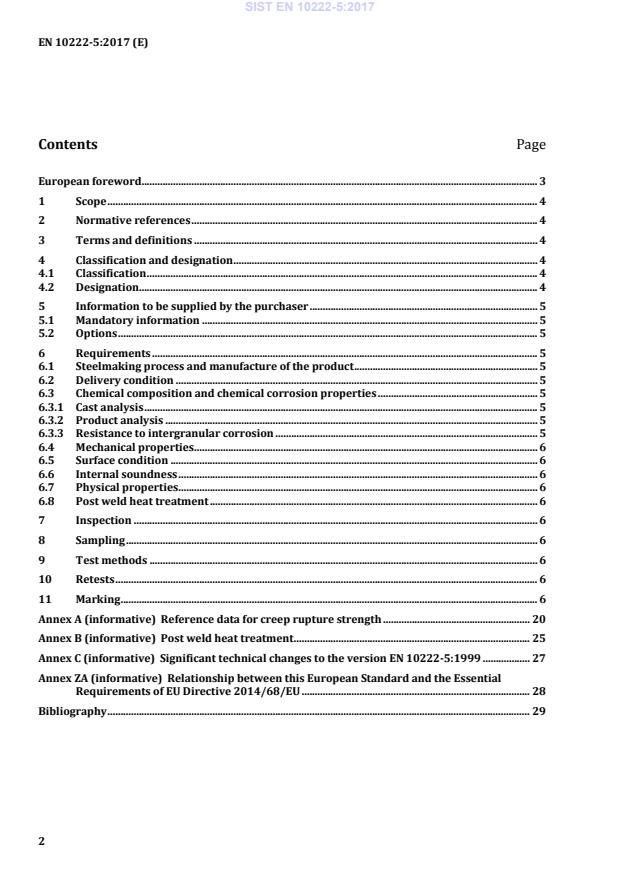
Reference data for creep rupture strength . 20 Annex B (informative)
Post weld heat treatment . 25 Annex C (informative)
Significant technical changes to the version EN 10222-5:1999 . 27 Annex ZA (informative)
Relationship between this European Standard and the Essential Requirements of EU Directive 2014/68/EU . 28 Bibliography . 29
— Part 1: General requirements for open die forgings — Part 2: Ferritic and martensitic steels with specified elevated temperature properties — Part 3: Nickel steels with specified low temperature properties — Part 4: Weldable fine grain steels with high proof strength — Part 5: Martensitic, austenitic and austenitic-ferritic stainless steels. Annex C provides details about significant technical changes to EN 10222-5:1999. According to the CEN-CENELEC Internal Regulations, the national standards organisations of the following countries are bound to implement this European Standard: Austria, Belgium, Bulgaria, Croatia, Cyprus, Czech Republic, Denmark, Estonia, Finland, Former Yugoslav Republic of Macedonia, France, Germany, Greece, Hungary, Iceland, Ireland, Italy, Latvia, Lithuania, Luxembourg, Malta, Netherlands, Norway, Poland, Portugal, Romania, Serbia, Slovakia, Slovenia, Spain, Sweden, Switzerland, Turkey and the United Kingdom. SIST EN 10222-5:2017
EN 10222-1:2017, Table 1), the testing temperature should be agreed at the time of enquiry and order. Otherwise, the test shall be carried out at 300 °C, except for the austenitic-ferritic steels, where the test shall be carried out at 250 °C. 6.4.4 The impact test, if applicable (see EN 10222-1:2017, Table 1), shall be carried out at 20 °C. Where impact tests at low temperature have been agreed (see EN 10222-1:2017, Table 1), the test temperature shall also be agreed at the time of enquiry and order. 6.4.5 Reference data for 1 % (plastic) creep strain and creep rupture are given in Annex A. 6.5 Surface condition See EN 10222-1. 6.6 Internal soundness See EN 10222-1. 6.7 Physical properties For reference data on physical properties, see EN 10088-1:2014, Annex E. 6.8 Post weld heat treatment Guidelines for the purchaser on post weld heat treatment are given in Annex B. 7 Inspection See EN 10222-1. 8 Sampling See EN 10222-1. 9 Test methods See EN 10222-1. 10 Retests See EN 10222-1. 11 Marking See EN 10222-1. SIST EN 10222-5:2017
+QT a, od Austenitic steelse X2CrNi18–9 1.4307 +AT 1 025 to 1 100 w, a X2CrNi19–11 1.4306 +AT 1 000 to 1 100 w, a X2CrNiN18–10 1.4311 +AT 1 000 to 1 100 w, a X5CrNi18–10 1.4301 +AT 1 000 to 1 100 w, a X6CrNiTi18–10 1.4541 +AT 1 020 to 1 120 w, a X6CrNiNb18–10 1.4550 +AT 1 020 to 1 120 w, a X6CrNi18–10 1.4948 +AT 1 050 to 1 120 w, a X6CrNiTiB18–10 1.4941 +AT 1 070 to 1 140 w, a X7 CrNiNb18–10 1.4912 +AT 1 070 to 1 125 w, a X2CrNiMo17–12–2 1.4404 +AT 1 020 to 1 120 w, a X2CrNiMoN 17–11–2 1.4406 +AT 1 020 to 1 120 w, a X5CrNiMo17–12–2 1.4401 +AT 1 020 to 1 120 w, a X6CrNiMoTi 17–12–2 1.4571 +AT 1 020 to 1 120 w, a X2 CrNiMo17–12–3 1.4432 +AT 1 020 to 1 120 w, a X2CrNiMoN 17–13–3 1.4429 +AT 1 020 to 1 120 w, a X3CrNiMo17–13–3 1.4436 +AT 1 020 to 1 120 w, a X2CrNiMo18–14–3 1.4435 +AT 1 020 to 1 120 w, a X3CrNiMoN17–13–3 1.4910 +AT 1 020 to 1 100 w, a X2CrNiMoN17–13–5 1.4439 +AT 1 060 to 1 120 w, a X1NiCrMoCu25–20–5 1.4539 +AT 1 060 to 1 120 w, a X1CrNiMoCuN20–18–7 1.4547 +AT 1 020 to 1 120 w, a X1CrNiMoCuN25–20–7 1.4529 +AT 1 020 to 1 100 w, a X2CrNiCu19–10 1.4650 +AT 1 050 to 1 125 w, a X3CrNiMo18–12–3 1.4449 +AT 1 050 to 1 125 w, a SIST EN 10222-5:2017
0,05 0,70 1,50 0,040 0,015 12,0 to 14,0 0,30 to 0,70 3,5 to 4,5
0,020 – Austenitic steels X2CrNi18–9 1.4307
0,030 1,00 2,00 0,045 0,015b 17,5 to 19,5 – 8,0 to 10,5
0,10 – X2CrNi19–11 1.4306
0,030 1,00 2,00 0,045 0,015b 18,0 to 20,0 – 10,0 to 12,0
0,10 – X2CrNiN18–10 1.4311
0,030 1,00 2,00 0,045 0,015b 17,5 to 19,5 – 8,5 to 11,5 0,12 to 0,22 – X5CrNi18–10 1.4301
0,07 1,00 2,00 0,045 0,015b 17,5 to 19,5 – 8,0 to 10,5
0,10 – X6CrNiTi18–10 1.4541
0,08 1,00 2,00 0,045 0,015b 17,0 to 19,0 – 9,0 to 12,0 – Ti:5 x C to 0,70 X6CrNiNb18–10 1.4550
0,08 1,00 2,00 0,045 0,015b 17,0 to 19,0 – 9,0 to 12,0 – Nb:10 x C to 1,00 X6CrNi18–10 1.4948 0,04 to 0,08 1,00 2,00 0,035 0,015b 17,0 to 19,0 – 8,0 to 11,0
0,10 – X6CrNiTiB18–10 1.4941 0,04 to 0,08 1,00 2,00 0,035 0,015b 17,0 to 19,0 – 9,0 to 12,0 – Ti: 5 x C to 0,80
B:0,0015 to 0,0050 X7CrNiNb18–10 1.4912 0,04 to 0,10 1,00 2,00 0,045 0,015b 17,0 to 19,0 – 9,0 to 12,0 – Nb:10 x C to 1,20 X2CrNiMo17–12–2 1.4404
0,030 1,00 2,00 0,045 0,015b 16,5 to 18,5 2,00 to 2,50 10,0 to 13,0
0,10 – X2CrNiMoN17–11–2 1.4406
0,030 1,00 2,00 0,045 0,015b 16,5 to 18,5 2,00 to 2,50 10,0 to 12,5 0,12 to 0,22 – SIST EN 10222-5:2017
0,07 1,00 2,00 0,045 0,015b 16,5 to 18,5 2,00 to 2,50 10,0 to 13,0
0,10 – X6CrNiMoTi17–12–2 1.4571
0,08 1,00 2,00 0,045 0,015b 16,5 to 18,5 2,00 to 2,50 10,5 to 13,5 – Ti:5 x C to 0,70 X2CrNiMo17–12–3 1.4432
0,030 1,00 2,00 0,045 0,015b 16,5 to 18,5 2,50 to 3,00 10,5 to 13,0
0,10 – X2CrNiMoN17–13–3 1.4429
0,030 1,00 2,00 0,045 0,015b 16,5 to 18,5 2,50 to 3,00 11,0 to 14,0 0,12 to 0,22 – X3CrNiMo17–13–3 1.4436
0,05 1,00 2,00 0,045 0,015b 16,5 to 18,5 2,50 to 3,00 10,5 to 13,0
0,10 – X2CrNiMo18–14–3 1.4435
0,030 1,00 2,00 0,045 0,015b 17,0 to 19,0 2,50 to 3,00 12,5 to 15,0
0,10 – X3CrNiMoBN17–13–3 1.4910
0,04 0,75 2,00 0,035 0,015 16,0 to 18,0 2,00 to 3,00 12,0 to 14,0 0,10 to 0,18 B:0,0015 to 0,0050 X2CrNiMoN17–13–5 1.4439
0,030 1,00 2,00 0,045 0,015 16,5 to 18,5 4,00 to 5,00 12,5 to 14,5 0,12 to 0,22 – X1NiCrMoCu25–20–5 1.4539
0,020 0,70 2,00 0,030 0,010 19,0 to 21,0 4,00 to 5,00 24,0 to 26,0
0,15 Cu: 1,20 to 2,00 X1CrNiMoCuN20–18–7 1.4547
0,020 0,70 1,00 0,030 0,010 19,5 to 20,5 6,00 to 7,00 17,5 to 18,5 0,18 to 0,25 Cu: 0,50 to 1,00 X1CrNiMoCuN25–20–7 1.4529
0,020 0,50 1,00 0,030 0,010 19,0 to 21,0 6,00 to 7,00 24,0 to 26,0 0,15 to 0,25 Cu: 0,50 to 1,50 X2CrNiCu19–10 1.4650
0,030 1,00 2,00 0,045 0,015 18,5 to 20,0 – 9,0 to 10,0
0,08 Cu
1,0 X3CrNiMo18–12–3 1.4449
0,035 1,00 2,00 0,045 0,015 17,0 to 18,2 2,25 to 2,75 11,5 to 12,5
0,08 Cu
1,0 SIST EN 10222-5:2017
0,030 1,00 2,00 0,035 0,015 22,0 to 24,0 0,10 to 0,60 3,5 to 5,5 0,05 to 0,20 Cu: 0,10 to 0,60 X2CrNiMoN22–5–3 1.4462
0,030 1,00 2,00 0,035 0,015 21,0 to 23,0 2,50 to 3,5 4,5 to 6,5 0,10 to 0,22 – X2CrNiMoCuN25–6–3 1.4507
0,030 0,70 2,00 0,035 0,015 24,0 to 26,0 3,00 to 4,0 6,0 to 8,0 0,20 to 0,30 Cu: 1,00 to 2,50 X2CrNiMoN25–7–4 1.4410
0,030 1,00 2,00 0,035 0,015 24,0 to 26,0 3,00 to 4,5 6,0 to 8,0 0,24 to 0,35 – X2CrNiMoCuWN25–7–4 1.4501
0,030 1,00 1,00 0,035 0,015 24,0 to 26,0 3,00 to 4,0 6,0 to 8,0 0,20 to 0,30 W: 0,50 to 1,00
Cu: 0,50 to1,00 a Elements not listed in this table may not be intentionally added to the steel without the agreement of the purchaser except for finishing the cast. All appropriate precautions are to be taken to avoid the addition of such elements from scrap and other materials used in production which would im
...