

CEN/TR 17603-32-05:2022
(Main)Space engineering - Structural materials handbook - Part 5: New advanced materials, advanced metallic materials, general design aspects and load transfer and design of joints
- Abstract
The structural materials handbook, SMH, combines materials and design information on established polymer matrix composites with provisional information on the emerging groups of newer advanced materials and their composites. Design aspects are described, along with factors associated with joining and manufacturing. Where possible, these are illustrated by examples or case studies.
The Structural materials handbook contains 8 Parts.
A glossary of terms, definitions and abbreviated terms for these handbooks is contained in Part 8.
The parts are as follows:
Part 1 Overview and material properties and applications Clauses 1 ‐ 9
Part 2 Design calculation methods and general design aspects Clauses 10 ‐ 22
Part 3 Load transfer and design of joints and design of structures Clauses 23 ‐ 32
Part 4 Integrity control, verification guidelines and manufacturing Clauses 33 ‐ 45
Part 5 New advanced materials, advanced metallic materials, general design aspects and load transfer and design of joints Clauses 46 ‐ 63
Part 6 Fracture and material modelling, case studies and design and integrity control and inspection Clauses 64 ‐ 81
Part 7 Thermal and environmental integrity, manufacturing aspects, in‐orbit and health monitoring, soft materials, hybrid materials and nanotechnoligies Clauses 82 ‐ 107
Part 8 Glossary
NOTE: The 8 parts will be numbered TR17603-32-01 to TR 17603-32-08
- Status
- Published
- Publication Date
- 18-Jan-2022
- Technical Committee
- CEN/CLC/TC 5 - Space
- Drafting Committee
- CEN/CLC/TC 5/WG 6 - Upstream standards
- Current Stage
- 6060 - Definitive text made available (DAV) - Publishing
- Start Date
- 19-Jan-2022
- Due Date
- 29-Dec-2022
- Completion Date
- 19-Jan-2022


Overview
CEN/TR 17603-32-05:2022 - Space engineering: Structural materials handbook - Part 5 provides consolidated guidance on new advanced materials and advanced metallic materials, together with general design aspects and practical guidance on load transfer and design of joints for space structures. Part 5 (Clauses 46–63) is one component of an eight‑part Structural Materials Handbook (SMH) developed under CEN/CLC/JTC 5 and published by SIST/CEN. The Technical Report combines material data, processing considerations and design‑oriented commentary illustrated where possible by examples and case studies.
Key topics and technical scope
Part 5 covers a broad set of technical subjects relevant to aerospace and space‑system structural engineering:
- Advanced aluminium alloys (including Al‑Li, Al‑Sc families), aluminum metal‑matrix composites (Al‑MMCs), fibre‑metal laminates and associated properties and processing routes.
- Advanced titanium alloys and titanium‑matrix composites, including microstructure, heat treatment, manufacturing methods and mechanical/thermal properties.
- Metal matrix composites (discontinuously and continuously reinforced), oxide dispersion‑strengthened (ODS) alloys and rapidly solidified powders (RSP).
- Design aspects: general design principles for structural elements, selection criteria for materials, and translation of material behaviour into usable design values.
- Load transfer and joints: mechanics of joints, fastening and bonding methods, load paths, and factors that influence joint integrity in space environments.
- Manufacturing, machining, welding, processing constraints and material availability considerations that affect design choices.
- Performance topics such as tensile, fatigue, fracture and stress‑corrosion behaviour, plus guidance on testing and deriving design values.
- Extensive references and cross‑links to other guidance documents (ECSS, ASTM and other standards) where applicable.
Practical applications
This Technical Report is intended to be used for:
- Selection and specification of structural materials for satellites, launch‑vehicle structures, payload supports and lightweight space frames.
- Design and verification of joints, bolted and bonded interfaces, and load paths in space hardware.
- Early‑stage materials trade studies to balance mass savings, manufacturability and structural integrity.
- Informing procurement specifications and compatibility checks for new or emerging alloy systems and composites.
Who should use this standard
- Aerospace and space‑systems structural engineers and designers
- Materials scientists and metallurgists working on space hardware
- Manufacturing and quality engineers involved in machining, welding and joining of advanced metals/composites
- Standards developers, certification bodies and procurement specialists
Related standards
Part 5 is one of eight SMH parts (TR17603‑32‑01 to TR17603‑32‑08). The report also cites and aligns with wider aerospace standards (for example ECSS and ASTM documents) to support design and verification activities.
Get Certified
Connect with accredited certification bodies for this standard

BUREAU VERITAS Certification Germany
Bureau Veritas certification in Germany.

Element Materials Technology
Materials testing and product certification.

AQMS Ltd.
AQMS provides ISO certification to SMEs across the UK.
Sponsored listings
Frequently Asked Questions
CEN/TR 17603-32-05:2022 is a technical report published by the European Committee for Standardization (CEN). Its full title is "Space engineering - Structural materials handbook - Part 5: New advanced materials, advanced metallic materials, general design aspects and load transfer and design of joints". This standard covers: The structural materials handbook, SMH, combines materials and design information on established polymer matrix composites with provisional information on the emerging groups of newer advanced materials and their composites. Design aspects are described, along with factors associated with joining and manufacturing. Where possible, these are illustrated by examples or case studies. The Structural materials handbook contains 8 Parts. A glossary of terms, definitions and abbreviated terms for these handbooks is contained in Part 8. The parts are as follows: Part 1 Overview and material properties and applications Clauses 1 ‐ 9 Part 2 Design calculation methods and general design aspects Clauses 10 ‐ 22 Part 3 Load transfer and design of joints and design of structures Clauses 23 ‐ 32 Part 4 Integrity control, verification guidelines and manufacturing Clauses 33 ‐ 45 Part 5 New advanced materials, advanced metallic materials, general design aspects and load transfer and design of joints Clauses 46 ‐ 63 Part 6 Fracture and material modelling, case studies and design and integrity control and inspection Clauses 64 ‐ 81 Part 7 Thermal and environmental integrity, manufacturing aspects, in‐orbit and health monitoring, soft materials, hybrid materials and nanotechnoligies Clauses 82 ‐ 107 Part 8 Glossary NOTE: The 8 parts will be numbered TR17603-32-01 to TR 17603-32-08
The structural materials handbook, SMH, combines materials and design information on established polymer matrix composites with provisional information on the emerging groups of newer advanced materials and their composites. Design aspects are described, along with factors associated with joining and manufacturing. Where possible, these are illustrated by examples or case studies. The Structural materials handbook contains 8 Parts. A glossary of terms, definitions and abbreviated terms for these handbooks is contained in Part 8. The parts are as follows: Part 1 Overview and material properties and applications Clauses 1 ‐ 9 Part 2 Design calculation methods and general design aspects Clauses 10 ‐ 22 Part 3 Load transfer and design of joints and design of structures Clauses 23 ‐ 32 Part 4 Integrity control, verification guidelines and manufacturing Clauses 33 ‐ 45 Part 5 New advanced materials, advanced metallic materials, general design aspects and load transfer and design of joints Clauses 46 ‐ 63 Part 6 Fracture and material modelling, case studies and design and integrity control and inspection Clauses 64 ‐ 81 Part 7 Thermal and environmental integrity, manufacturing aspects, in‐orbit and health monitoring, soft materials, hybrid materials and nanotechnoligies Clauses 82 ‐ 107 Part 8 Glossary NOTE: The 8 parts will be numbered TR17603-32-01 to TR 17603-32-08
CEN/TR 17603-32-05:2022 is classified under the following ICS (International Classification for Standards) categories: 49.140 - Space systems and operations. The ICS classification helps identify the subject area and facilitates finding related standards.
CEN/TR 17603-32-05:2022 is associated with the following European legislation: Standardization Mandates: M/496. When a standard is cited in the Official Journal of the European Union, products manufactured in conformity with it benefit from a presumption of conformity with the essential requirements of the corresponding EU directive or regulation.
CEN/TR 17603-32-05:2022 is available in PDF format for immediate download after purchase. The document can be added to your cart and obtained through the secure checkout process. Digital delivery ensures instant access to the complete standard document.
Standards Content (Sample)
SLOVENSKI STANDARD
01-marec-2022
Vesoljska tehnika - Priročnik o strukturnih materialih - 5. del: Novi napredni
materiali, napredni kovinski materiali, splošni konstrukcijski vidiki ter prenos
obremenitve in oblikovanje sklepov
Space engineering - Structural materials handbook - Part 5: New advanced materials,
advanced metallic materials, general design aspects and load transfer and design of
joints
Raumfahrttechnik - Handbuch der Konstruktionswerkstoffe - Teil 5: Neue fortschrittliche
Werkstoffe, fortschrittliche metallische Werkstoffe, allgemeine Konstruktionsaspekte und
Lastabtragung und Auslegung von Verbindungen
Ingénierie spatiale - Manuel des matériaux structuraux - Partie 5 : Matériaux avancés
nouveaux, matériaux métalliques avancés, aspects généraux de conception, transferts
des charges et conception des jonctions
Ta slovenski standard je istoveten z: CEN/TR 17603-32-05:2022
ICS:
49.140 Vesoljski sistemi in operacije Space systems and
operations
2003-01.Slovenski inštitut za standardizacijo. Razmnoževanje celote ali delov tega standarda ni dovoljeno.
TECHNICAL REPORT CEN/TR 17603-32-05
RAPPORT TECHNIQUE
TECHNISCHER BERICHT
January 2022
ICS 49.140
English version
Space engineering - Structural materials handbook - Part
5: New advanced materials, advanced metallic materials,
general design aspects and load transfer and design of
joints
Ingénierie spatiale - Manuel des matériaux structuraux Raumfahrttechnik - Handbuch der
- Partie 5 : Matériaux avancés nouveaux, matériaux Konstruktionswerkstoffe - Teil 5: Neue fortschrittliche
métalliques avancés, aspects généraux de conception, Werkstoffe, fortschrittliche metallische Werkstoffe,
transferts des charges et conception des jonctions allgemeine Konstruktionsaspekte und Lastabtragung
und Auslegung von Verbindungen
This Technical Report was approved by CEN on 29 November 2021. It has been drawn up by the Technical Committee
CEN/CLC/JTC 5.
CEN and CENELEC members are the national standards bodies and national electrotechnical committees of Austria, Belgium,
Bulgaria, Croatia, Cyprus, Czech Republic, Denmark, Estonia, Finland, France, Germany, Greece, Hungary, Iceland, Ireland, Italy,
Latvia, Lithuania, Luxembourg, Malta, Netherlands, Norway, Poland, Portugal, Republic of North Macedonia, Romania, Serbia,
Slovakia, Slovenia, Spain, Sweden, Switzerland, Turkey and United Kingdom.
CEN-CENELEC Management Centre:
Rue de la Science 23, B-1040 Brussels
© 2022 CEN/CENELEC All rights of exploitation in any form and by any means
Ref. No. CEN/TR 17603-32-05:2022 E
reserved worldwide for CEN national Members and for
CENELEC Members.
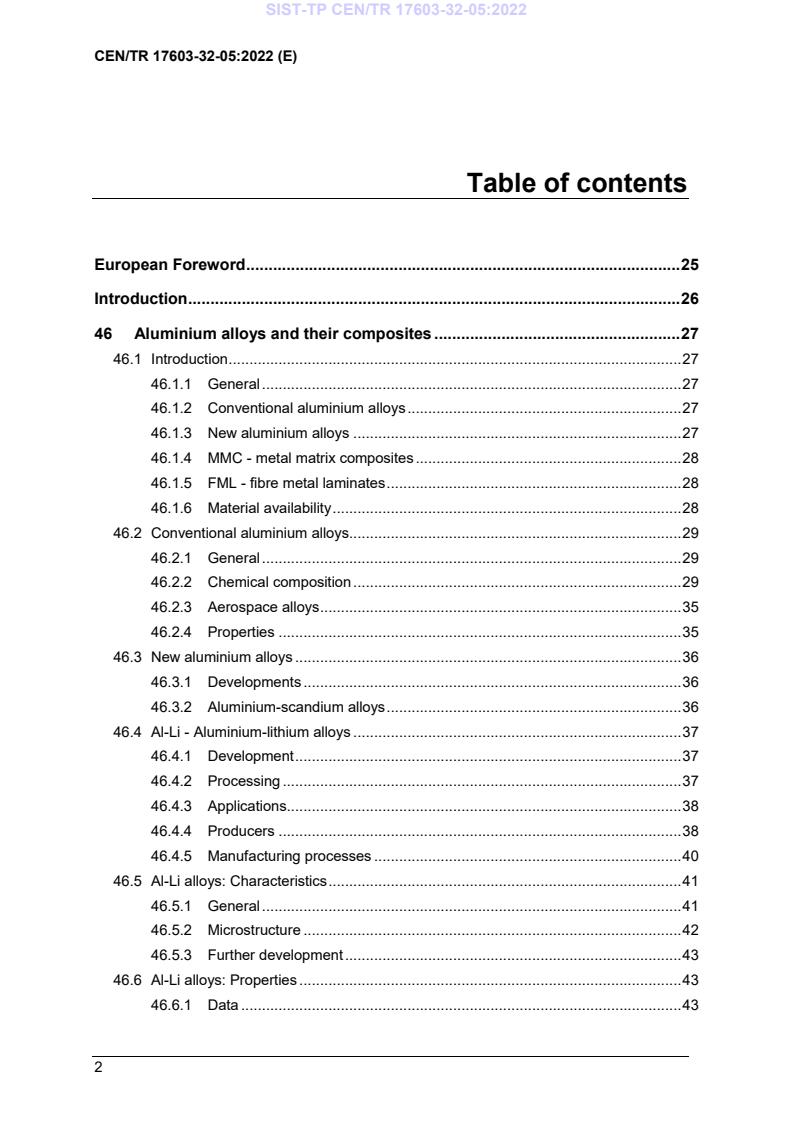
Table of contents
European Foreword . 25
Introduction . 26
46 Aluminium alloys and their composites . 27
46.1 Introduction . 27
46.1.1 General . 27
46.1.2 Conventional aluminium alloys . 27
46.1.3 New aluminium alloys . 27
46.1.4 MMC - metal matrix composites . 28
46.1.5 FML - fibre metal laminates . 28
46.1.6 Material availability . 28
46.2 Conventional aluminium alloys. 29
46.2.1 General . 29
46.2.2 Chemical composition . 29
46.2.3 Aerospace alloys . 35
46.2.4 Properties . 35
46.3 New aluminium alloys . 36
46.3.1 Developments . 36
46.3.2 Aluminium-scandium alloys . 36
46.4 Al-Li - Aluminium-lithium alloys . 37
46.4.1 Development . 37
46.4.2 Processing . 37
46.4.3 Applications. 38
46.4.4 Producers . 38
46.4.5 Manufacturing processes . 40
46.5 Al-Li alloys: Characteristics . 41
46.5.1 General . 41
46.5.2 Microstructure . 42
46.5.3 Further development . 43
46.6 Al-Li alloys: Properties . 43
46.6.1 Data . 43
46.6.2 Tensile properties . 43
46.6.3 Fracture properties . 45
46.6.4 Fatigue properties . 47
46.6.5 Design values . 51
46.6.6 Further development alloys . 52
46.7 Al-Li alloys: Stress corrosion cracking . 52
46.7.1 General . 52
46.7.2 Test . 53
46.7.3 Stress corrosion cracking resistance . 53
46.7.4 Recent alloys . 56
46.8 Al-Li alloys: Manufacturing aspects . 57
46.8.1 General . 57
46.8.2 Machining . 57
46.8.3 Welding . 57
46.8.4 Cost implications . 58
46.8.5 Applications. 59
46.8.6 Mass-saving . 59
46.9 Al-Li alloys: Potential applications . 59
46.9.1 General factors . 59
46.9.2 Space Shuttle external tank . 60
46.9.3 A380 - Floor beams . 62
46.10 Oxide dispersion strengthened (ODS) alloys . 63
46.10.1 Type and effect of dispersions . 63
46.10.2 Processing . 63
46.10.3 Cost factors . 64
46.10.4 Applications. 64
46.10.5 Properties . 65
46.11 Rapidly solidified powder (RSP) alloys . 71
46.11.1 Processing . 71
46.11.2 Microstructure . 72
46.11.3 Development . 72
46.11.4 Ambient temperature . 72
46.11.5 Elevated temperature . 74
46.12 Al-MMCs - Metal matrix composites . 76
46.12.1 Introduction . 76
46.12.2 Manufacturing processes . 76
46.12.3 Reinforcement materials . 77
46.12.4 MMC nomenclature . 77
46.12.5 Advantages of MMC’s . 78
46.12.6 Material availability . 78
46.12.7 Sources of further information . 79
46.13 Discontinuously reinforced Al-MMCs . 80
46.13.1 Features . 80
46.13.2 Development . 80
46.13.3 Matrix alloys . 80
46.13.4 Types of reinforcement . 80
46.13.5 Processing . 83
46.14 Discontinuously reinforced Al-alloys: Properties . 85
46.14.1 General . 85
46.14.2 Powder metallurgy MMCs . 86
46.14.3 MMC’s produced by melt infiltration processes . 92
46.14.4 Spray-formed materials . 99
46.14.5 Further information . 100
46.15 Continuously Reinforced Al-Alloy MMC . 101
46.15.1 General . 101
46.15.2 Fibres . 101
46.15.3 Matrix alloys . 104
46.15.4 Characteristics . 104
46.15.5 Processing . 105
46.16 Continuously reinforced Al-alloy MMC: Properties . 106
46.16.1 Mechanical properties . 106
46.16.2 Physical properties . 111
46.17 Al-alloy MMC: Potential applications . 111
46.17.1 Benefits of Aluminium-matrix composites . 111
46.17.2 High specific strength and temperature resistance . 112
46.17.3 High specific stiffness and good thermal properties. 112
46.17.4 High conductivity with low thermal expansion . 113
46.17.5 High specific stiffness and dimensional stability . 113
46.17.6 High specific strength and chemical resistance . 113
46.18 References . 113
46.18.1 General . 113
46.18.2 Sources . 122
46.18.3 ECSS documents . 123
46.18.4 ASTM standards . 123
46.18.5 Other standards . 123
47 Titanium alloys and their composites . 125
47.1 Introduction . 125
47.2 Conventional alloys . 125
47.2.1 Material selection factors. 125
47.2.2 Microstructure . 126
47.2.3 Effect of alloy elements . 126
47.2.4 Alloy classes . 127
47.2.5 Alloys for aerospace use . 128
47.2.6 Heat treatment . 130
47.2.7 Mechanical properties . 130
47.2.8 Physical properties . 136
47.3 New alloys . 137
47.3.1 Developments . 137
47.3.2 Processing techniques . 137
47.4 Superplastic forming and diffusion bonding . 138
47.4.1 Superplasticity . 138
47.4.2 Diffusion bonding . 138
47.4.3 SPF/DB fabrication. 138
47.4.4 Materials . 139
47.5 Discontinuously reinforced Ti-alloys . 140
47.5.1 Difficulties . 140
47.5.2 Particulate reinforcements . 140
47.5.3 Processing . 141
47.5.4 Properties . 141
47.5.5 Further development . 141
47.6 Continuous fibre reinforced Ti-alloy MMC . 141
47.6.1 Composite development . 141
47.6.2 Monofilament reinforcements . 142
47.6.3 Matrix selection . 143
47.6.4 Composite process technologies . 143
47.7 Continuous fibre reinforced Ti-alloy MMC: properties . 144
47.7.1 Composite optimisation . 144
47.7.2 Tensile strength and stiffness . 144
47.7.3 Fatigue . 146
47.7.4 Fracture toughness . 147
47.7.5 Elevated temperatures . 147
47.7.6 Thermo-mechanical fatigue . 147
47.8 Titanium alloys: Effect of hydrogen . 149
47.8.1 Material degradation mechanisms . 149
47.9 Titanium alloys: Effect of oxygen . 150
47.9.1 Oxidation . 150
47.9.2 Ignition and burning . 151
47.10 Coatings and protection systems . 151
47.10.1 Requirements . 151
47.10.2 Potential coatings . 151
47.11 Ti-alloys and MMCs: Potential applications . 152
47.11.1 Current use . 152
47.11.2 Developments . 152
47.11.3 Aerospace applications . 153
47.12 References . 154
47.12.1 General . 154
47.12.2 ECSS documents . 157
48 Superalloys and their composites . 158
48.1 Introduction . 158
48.1.1 General . 158
48.1.2 Alloy development . 158
48.1.3 Composites . 158
48.1.4 Service environment . 159
48.1.5 Coating systems . 159
48.2 Conventional alloys . 159
48.2.1 General . 159
48.2.2 Alloy groups . 159
48.2.3 Aircraft engine applications . 160
48.2.4 Spacecraft engine applications . 168
48.3 New alloys . 171
48.3.1 Developments . 171
48.3.2 Directional solidification (DS) . 172
48.3.3 Single crystal (SC) . 172
48.3.4 Powder metallurgy (PM) . 173
48.3.5 Oxide dispersion strengthened (ODS) alloys . 175
48.4 Discontinuously reinforced composites . 177
48.5 Continuously reinforced composites . 178
48.5.1 Composite development . 178
48.6 Tungsten fibre reinforced superalloy (TFRS) composites . 179
48.6.1 Development . 179
48.6.2 Matrix alloys . 180
48.6.3 Mechanical properties . 180
48.6.4 Characteristics . 186
48.7 Effect of hydrogen. 186
48.7.1 Degradation mechanisms. 186
48.7.2 Hydrogen embrittlement (HE) . 187
48.7.3 Hydrogen environment embrittlement (HEE) . 188
48.7.4 Material sensitivity . 188
48.7.5 Creep in hydrogen environments . 191
48.7.6 Fatigue in hydrogen environments . 196
48.7.7 Fracture characteristics . 197
48.8 Effect of oxygen . 200
48.8.1 Material selection factors. 200
48.8.2 Oxidation . 200
48.8.3 Oxidation resistance . 200
48.8.4 Ignition and burn . 201
48.9 Coatings and protection systems . 202
48.9.1 Requirements . 202
48.9.2 Types of coatings . 203
48.9.3 Coating systems . 203
48.9.4 Coated components . 203
48.9.5 Hydrogen fuel . 203
48.10 Diffusion coatings . 204
48.10.1 Types of coatings . 204
48.11 Overlay coatings . 207
48.11.1 Development . 207
48.12 Thermal barrier coatings (TBC) . 209
48.12.1 Function . 209
48.12.2 Coating construction . 210
48.13 Coating influence on design . 211
48.13.1 Factors . 211
48.13.2 Effect of coatings on mechanical properties . 213
48.13.3 Chemical interaction . 214
48.13.4 Residual strains . 215
48.13.5 Tensile behaviour . 217
48.13.6 Fatigue resistance . 218
48.13.7 Creep and relaxation . 221
48.13.8 Creep fatigue . 226
48.14 Coatings: Future developments . 227
48.14.1 Materials . 227
48.14.2 Service temperature . 228
48.14.3 Hydrogen environments . 228
48.15 Superalloys: Potential applications . 228
48.15.1 Conventional alloys . 228
48.16 References . 230
48.16.1 General . 230
48.16.2 ECSS documents . 234
49 Intermetallic materials . 235
49.1 Introduction . 235
49.1.1 Types of intermetallic compounds . 235
49.2 Aluminide development . 235
49.2.1 Features . 235
49.2.2 Applications. 236
49.2.3 Property data . 237
49.2.4 Availability . 237
49.3 Nickel aluminides . 237
49.3.1 Characteristics . 237
49.4 Nickel aluminides: Properties . 240
49.4.1 General . 240
49.4.2 Mechanical properties . 240
49.4.3 Oxidation resistance . 243
49.4.4 Aqueous corrosion . 243
49.4.5 Coefficient of thermal expansion (CTE) . 243
49.5 Titanium aluminides . 244
49.5.1 General . 244
49.5.2 Characteristics . 244
49.5.3 Effect of micro-alloying or doping . 245
49.6 Titanium aluminides: Properties . 247
49.6.1 General . 247
49.6.2 Mechanical properties . 247
49.6.3 Oxidation resistance . 255
49.6.4 Thermophysical properties . 256
49.7 Iron aluminides . 260
49.7.1 Characteristics . 260
49.8 Processing . 263
49.8.1 Development . 263
49.8.2 Material processing . 263
49.8.3 Joining . 266
49.9 Further developments . 266
49.9.1 Intermetallic compounds . 266
49.9.2 Intermetallic matrix composites (IMC) . 267
49.9.3 Protective coatings . 268
49.10 Intermetallic matrix composites . 268
49.10.1 General . 268
49.10.2 Development . 268
49.10.3 High temperature Ti-based IMC . 270
49.11 Intermetallics: Potential applications . 274
49.11.1 General . 274
49.11.2 Spaceplanes . 276
49.12 References . 276
49.12.1 General . 276
50 Refractory and precious metals . 280
50.1 Introduction . 280
50.2 Materials . 280
50.2.1 General . 280
50.2.2 Characteristics . 280
50.2.3 Basic properties . 281
50.2.4 Alloys . 282
50.3 Applications . 282
51 Beryllium . 283
51.1 Introduction . 283
51.2 Characteristics . 283
51.2.1 Features . 283
51.2.2 Applications. 283
51.3 Products and facilities . 284
51.3.1 Source . 284
51.3.2 Materials . 284
51.3.3 Grades . 284
51.3.4 Fabrication . 285
51.4 Properties . 286
51.4.1 Influence of microstructure . 286
51.4.2 Grades . 286
51.4.3 Mechanical properties . 287
51.4.4 Effect of temperature . 287
51.5 Health and safety . 294
51.5.1 Facilities . 294
51.5.2 Health aspects . 294
51.5.3 Extraction . 295
51.6 Potential applications . 295
51.6.1 Resumé . 295
51.7 References . 295
51.7.1 General . 295
52 Ceramic matrix composites . 296
52.1 Introduction . 296
52.2 Continuous fibre composites . 296
52.2.1 Matrix groups . 296
52.2.2 Composite development . 298
52.2.3 Technology status . 301
52.2.4 Characteristics . 301
52.3 Carbon fibre reinforced silicon carbide . 302
52.3.1 General . 302
52.3.2 Fibres . 303
52.3.3 Matrix . 303
52.3.4 Characteristics . 304
52.3.5 C/SiC LPI liquid polymer infiltration process . 306
52.3.6 C/C-SiC LSI liquid silicon infiltration process . 314
52.4 Silicon carbide fibre reinforced silicon carbide . 315
52.4.1 Technology status . 315
52.4.2 Applications. 316
52.4.3 Characteristics . 316
52.4.4 Manufacturing of SiC-SiC . 316
52.5 SiC-SiC composite: Properties. 317
52.5.1 General . 317
52.5.2 Mechanical properties . 317
52.5.3 Environment . 320
52.6 Whisker reinforced composites . 321
52.6.1 Development . 321
52.6.2 Properties . 324
52.6.3 Applications. 324
52.7 Potential applications . 324
52.7.1 Resumé . 324
52.7.2 High temperature applications . 324
52.7.3 High precision optical structures. 327
52.8 References . 329
52.8.1 General . 329
53 Glass and glass-ceramic matrix composites . 337
53.1 Introduction . 337
53.2 Continuous fibre composites . 337
53.2.1 Characteristics . 337
53.2.2 Composite development . 338
53.2.3 Manufacture . 339
53.3 Carbon fibre reinforced composites . 340
53.3.1 Material . 340
53.3.2 Mechanical properties . 340
53.3.3 Applications. 343
53.4 Silicon carbide fibre reinforced composites . 344
53.4.1 Composite development . 344
53.4.2 Effect of in-situ fibre strength . 346
53.4.3 Effect of fibre-matrix bonding . 346
53.5 Silicon carbide reinforced composites: properties . 346
53.5.1 LAS matrix composites .
...