

EN 10218-1:2012
(Main)Steel wire and wire products - General - Part 1: Test methods
- Abstract
This European Standard specifies the methods for the general testing of steel wire and wire products which have been cold worked, annealed or oil hardened and tempered and/or coated and are of constant cross section, either round, or special section. It includes tensile testing, torsion testing, reverse bend testing, wrapping test, bend test, reverse torsion test, compression test, deep etch test, hardness test, quench hardenability test, fatigue test, wire cast measurement, artificial ageing, decarburization test, non-destructive tests, grain size tests, segregation test, non-metallic inclusion test and chemical analysis.
- Status
- Published
- Publication Date
- 10-Jan-2012
- Withdrawal Date
- 30-Jul-2012
- Technical Committee
- ECISS/TC 106 - Wire rod and wires
- Drafting Committee
- ECISS/TC 106 - Wire rod and wires
- Current Stage
- 9093 - Decision to confirm - Review Enquiry
- Start Date
- 06-Feb-2025
- Completion Date
- 21-Oct-2026

Overview - EN 10218-1:2012 (Steel wire and wire products - Test methods)
EN 10218-1:2012 is the CEN European Standard that defines test methods for steel wire and wire products of constant cross-section (round or special section) that have been cold worked, annealed, oil‑hardened-and‑tempered and/or coated. It establishes standardized procedures for mechanical, metallurgical and chemical testing used for product acceptance, quality control and material qualification across the wire industry.
Key topics and technical requirements
The standard specifies a comprehensive set of test methods, including:
- Tensile testing (in accordance with EN ISO 6892‑1/2) - sample selection, preparation, cross‑section measurement and gripping recommendations (e.g., wrap ends for ≤1 mm wire; knotted wire test option).
- Torsion and reverse torsion tests (ISO 7800 / ISO 9649) and simple torsion for ductility/surface defect detection.
- Bend, reverse bend and wrapping tests (ISO 7801 / ISO 7802) to assess ductility, coilability and coating adherence.
- Compression test to detect surface cracking (not suitable for <4.0 mm wire).
- Deep etch test for surface defect detection, including procedure notes (e.g., immersion in 50% HCl / 50% water at ≥60 °C, time scaled to diameter; stress relief for some high‑carbon steels).
- Hardness testing (EN ISO 6506 / EN ISO 6508) - surface, core and through‑hardness distinctions.
- Quench hardenability (Jominy reference suggested in disputes) and fatigue testing (axial and rotating bend variants).
- Wire cast measurement (circular, helix, spiral cast), artificial ageing, decarburization depth, grain size, segregation, non‑metallic inclusion (EN 10247 based methods) and chemical analysis.
- Non‑destructive tests and retest procedures.
The document also references and aligns with multiple normative standards for sampling, micrography and hardness/tensile test methods.
Practical applications - who uses EN 10218‑1:2012
- Manufacturers of steel wire and coated wire products - to verify production quality and compliance.
- Independent testing laboratories and quality control departments - to perform standardized mechanical and metallurgical tests.
- Procurement/specification engineers and inspectors - to define acceptance criteria in purchase orders and product standards.
- R&D and materials engineers - for comparative testing, material qualification and failure analysis.
- Certification bodies and national standards organizations for harmonized conformity assessment across Europe.
Related standards
- EN 10218‑2: Wire dimensions and tolerances (companion part covering geometric requirements)
- EN ISO 6892‑1 / EN ISO 6892‑2 (tensile testing)
- ISO 7800 / ISO 7801 / ISO 7802 / ISO 9649 (wire torsion, bend, wrapping and reverse torsion tests)
- EN 10021, EN 10247 and relevant EN/ISO micrographic and hardness standards
EN 10218‑1:2012 is essential for consistent testing practice and reliable quality assurance of steel wire products across manufacturing, inspection and procurement workflows.
Relations
- Effective Date
- 18-Jan-2012
- Effective Date
- 25-Aug-2026
- Effective Date
- 25-Aug-2026
- Effective Date
- 25-Aug-2026
- Effective Date
- 25-Aug-2026
- Effective Date
- 19-Aug-2026
- Effective Date
- 28-Jan-2026
- Effective Date
- 28-Jan-2026
- Effective Date
- 28-Jan-2026
- Effective Date
- 28-Jan-2026
- Effective Date
- 28-Jan-2026
- Effective Date
- 28-Jan-2026
- Effective Date
- 28-Jan-2026
- Effective Date
- 28-Jan-2026
- Effective Date
- 28-Jan-2026
Get Certified
Connect with accredited certification bodies for this standard

Element Materials Technology
Materials testing and product certification.

Inštitut za kovinske materiale in tehnologije
Institute of Metals and Technology. Materials testing, metallurgical analysis, NDT.
Sponsored listings
Frequently Asked Questions
EN 10218-1:2012 is a standard published by the European Committee for Standardization (CEN). Its full title is "Steel wire and wire products - General - Part 1: Test methods". This standard covers: This European Standard specifies the methods for the general testing of steel wire and wire products which have been cold worked, annealed or oil hardened and tempered and/or coated and are of constant cross section, either round, or special section. It includes tensile testing, torsion testing, reverse bend testing, wrapping test, bend test, reverse torsion test, compression test, deep etch test, hardness test, quench hardenability test, fatigue test, wire cast measurement, artificial ageing, decarburization test, non-destructive tests, grain size tests, segregation test, non-metallic inclusion test and chemical analysis.
This European Standard specifies the methods for the general testing of steel wire and wire products which have been cold worked, annealed or oil hardened and tempered and/or coated and are of constant cross section, either round, or special section. It includes tensile testing, torsion testing, reverse bend testing, wrapping test, bend test, reverse torsion test, compression test, deep etch test, hardness test, quench hardenability test, fatigue test, wire cast measurement, artificial ageing, decarburization test, non-destructive tests, grain size tests, segregation test, non-metallic inclusion test and chemical analysis.
EN 10218-1:2012 is classified under the following ICS (International Classification for Standards) categories: 77.140.65 - Steel wire, wire ropes and link chains. The ICS classification helps identify the subject area and facilitates finding related standards.
EN 10218-1:2012 has the following relationships with other standards: It is inter standard links to EN 10218-1:1994, ISO 7801:1984, ISO 9649:1990, ISO 7802:1983, ISO 7800:2003, EN ISO 6892-2:2026, EN ISO 6506-1:2014, EN 2591-205:1996, EN 10247:2017, EN ISO 6892-2:2018, EN ISO 6508-1:2023, EN ISO 6892-1:2019, EN ISO 6508-2:2023, EN ISO 377:2017, EN 10021:2006. Understanding these relationships helps ensure you are using the most current and applicable version of the standard.
EN 10218-1:2012 is available in PDF format for immediate download after purchase. The document can be added to your cart and obtained through the secure checkout process. Digital delivery ensures instant access to the complete standard document.
Standards Content (Sample)
2003-01.Slovenski inštitut za standardizacijo. Razmnoževanje celote ali delov tega standarda ni dovoljeno.HStahldraht und Drahterzeugnisse - Allgemeines - Teil 1: PrüfverfahrenFils et produits tréfilés en acier - Généralités - Partie 1: Méthodes d'essaiSteel wire and wire products - General - Part 1: Test methods77.140.65Jeklene žice, jeklene vrvi in verigeSteel wire, wire ropes and link chainsICS:Ta slovenski standard je istoveten z:EN 10218-1:2012SIST EN 10218-1:2012en,fr,de01-marec-2012SIST EN 10218-1:2012SLOVENSKI
STANDARDSIST EN 10218-1:19971DGRPHãþD
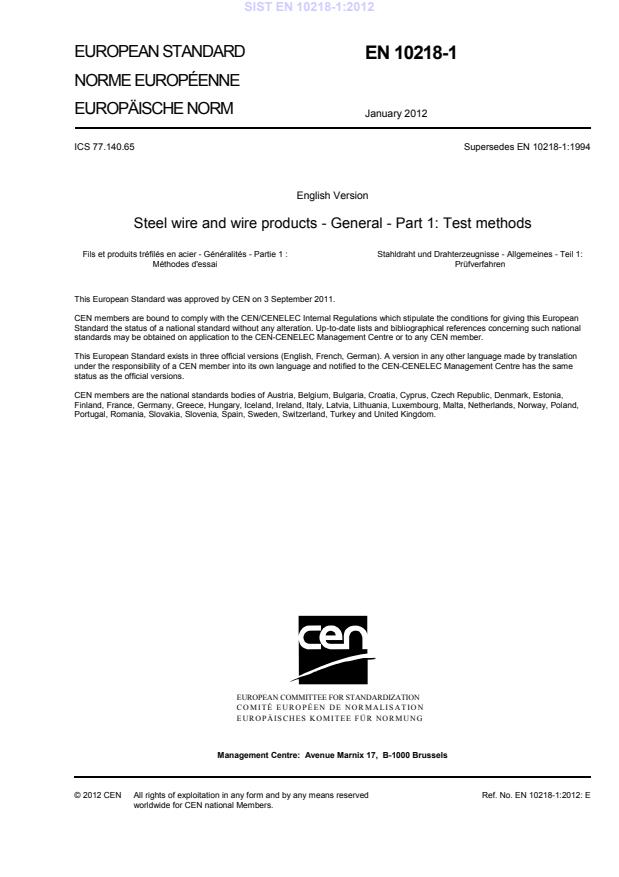
EUROPEAN STANDARD NORME EUROPÉENNE EUROPÄISCHE NORM
EN 10218-1
January 2012 ICS 77.140.65 Supersedes EN 10218-1:1994English Version
Steel wire and wire products - General - Part 1: Test methods
Fils et produits tréfilés en acier - Généralités - Partie 1 : Méthodes d'essai
Stahldraht und Drahterzeugnisse - Allgemeines - Teil 1: Prüfverfahren This European Standard was approved by CEN on 3 September 2011.
CEN members are bound to comply with the CEN/CENELEC Internal Regulations which stipulate the conditions for giving this European Standard the status of a national standard without any alteration. Up-to-date lists and bibliographical references concerning such national standards may be obtained on application to the CEN-CENELEC Management Centre or to any CEN member.
This European Standard exists in three official versions (English, French, German). A version in any other language made by translation under the responsibility of a CEN member into its own language and notified to the CEN-CENELEC Management Centre has the same status as the official versions.
CEN members are the national standards bodies of Austria, Belgium, Bulgaria, Croatia, Cyprus, Czech Republic, Denmark, Estonia, Finland, France, Germany, Greece, Hungary, Iceland, Ireland, Italy, Latvia, Lithuania, Luxembourg, Malta, Netherlands, Norway, Poland, Portugal, Romania, Slovakia, Slovenia, Spain, Sweden, Switzerland, Turkey and United Kingdom.
EUROPEAN COMMITTEE FOR STANDARDIZATION
COMITÉ EUROPÉEN DE NORMALISATION EUROPÄISCHES KOMITEE FÜR NORMUNG
Management Centre:
Avenue Marnix 17,
B-1000 Brussels © 2012 CEN All rights of exploitation in any form and by any means reserved worldwide for CEN national Members. Ref. No. EN 10218-1:2012: ESIST EN 10218-1:2012
...