

EN 2516:2023
(Main)Aerospace series - Passivation of corrosion resisting steels and decontamination of nickel or cobalt base alloys
- Abstract
This document specifies several chemical methods of passivation for corrosion resisting steels (austenitic, ferritic, martensitic and precipitation hardenable) and of decontamination for nickel or cobalt base alloys.
- Status
- Published
- Publication Date
- 19-Dec-2023
- Withdrawal Date
- 25-Jul-2022
- Technical Committee
- ASD-STAN - Aerospace
- Drafting Committee
- ASD-STAN/D 4/S 6 - Surface treatments for Metallic
- Current Stage
- 6060 - Definitive text made available (DAV) - Publishing
- Start Date
- 20-Dec-2023
- Completion Date
- 20-Dec-2023

Overview
EN 2516:2023 (CEN) - “Aerospace series - Passivation of corrosion resisting steels and decontamination of nickel or cobalt base alloys” defines chemical passivation and decontamination methods used in aerospace manufacture to restore or improve corrosion resistance after fabrication. It covers austenitic, ferritic, martensitic and precipitation‑hardenable stainless steels and nickel or cobalt base alloys, specifying process limits, inspection methods and quality assurance requirements. The standard supersedes EN 2516:2020 and includes recommended bath types and procedural controls (Annex A).
Key topics and requirements
- Scope & applicability
- Applies to corrosion resisting steels (austenitic, ferritic, martensitic, precipitation hardenable) and nickel/cobalt base alloys.
- Not applicable to unalloyed/low‑alloy carbon steels, powder metallurgy alloys, case‑hardened/carburized/nitrided surfaces, soldered/brazed parts or parts with unmaskable cavities.
- Surface preparation
- Parts must be fully fabricated prior to treatment. Pre‑treatments (cleaning, degreasing, descaling, blasting, pickling, rinsing, masking) are required and must leave parts substantially free of organic and metallic contamination.
- Passivation / decontamination processes
- Table 1 lists bath types and composition ranges (nitric acid, citric acid, sodium dichromate, copper sulfate and optional wetting agents/inhibitors). Options include anodic treatments and multi‑step procedures.
- De‑embrittlement requirements apply after acid pickling for high‑strength steels (example: steels with UTS ≥ 1 100 MPa require thermal treatment around 190 ± 14 °C for a minimum duration-see Table 2).
- Inspection & acceptance
- Visual inspection: surfaces must be clean and free of pitting or treatment damage (slight discoloration allowed).
- Absence of iron contamination: verified by salt spray (EN ISO 9227 NSS) or copper sulfate test. Copper sulfate test recipe: 8 g CuSO4·5H2O + 2–3 ml H2SO4 in 500 ml demineralized water; keep surface wet ≥ 6 min.
- Process controls
- Water conductivity ≤ 100 µS/cm (unless prime specifies otherwise). Chemical concentrations monitored at regular intervals.
- Drying air must be dry and oil‑free.
- Quality assurance
- Processor must be an approved aerospace production organization with a quality management system (e.g., EN 9100 or equivalent). Process qualification, batch acceptance and fault sanctions are specified.
- Health, safety & environment
- Local regulations shall be followed; the standard draws attention to chemical hazards and waste handling.
Practical applications and users
- Target users: aerospace manufacturers, surface treatment processors, metallurgists, procurement specialists and quality engineers involved in finishing stainless steels and nickel/cobalt alloys for aircraft components.
- Practical uses: specifying passivation methods on procurement documents, qualifying processors, establishing inspection criteria (salt spray and copper sulfate), and ensuring parts meet corrosion resistance after machining, forming, shot peening or pickling.
Related standards
- EN ISO 9227 - Corrosion tests in artificial atmospheres (salt spray)
- EN 9100 (or equivalent) - Aerospace quality management systems
Keywords: EN 2516:2023, passivation, corrosion resisting steels, decontamination, nickel base alloys, cobalt base alloys, aerospace passivation, copper sulfate test, salt spray test, process qualification.
Relations
- Effective Date
- 19-Jan-2023
- Refers
EN ISO 9227:2022 - Corrosion tests in artificial atmospheres - Salt spray tests (ISO 9227:2022) - Effective Date
- 28-Jan-2026
- Effective Date
- 28-Jan-2026
- Effective Date
- 28-Jan-2026
- Effective Date
- 28-Jan-2026
- Effective Date
- 28-Jan-2026
- Effective Date
- 28-Jan-2026
- Effective Date
- 28-Jan-2026
- Effective Date
- 28-Jan-2026
- Effective Date
- 28-Jan-2026
- Effective Date
- 28-Jan-2026
- Effective Date
- 28-Jan-2026
- Effective Date
- 28-Jan-2026
- Effective Date
- 28-Jan-2026
- Referred By
EN 4813:2017 - Aerospace series - Flange couplings - Cap, in heat resisting steel - Inch series - Effective Date
- 28-Jan-2026
Get Certified
Connect with accredited certification bodies for this standard

BUREAU VERITAS Certification Germany
Bureau Veritas certification in Germany.

Element Materials Technology
Materials testing and product certification.

AQMS Ltd.
AQMS provides ISO certification to SMEs across the UK.
Sponsored listings
Frequently Asked Questions
EN 2516:2023 is a standard published by the European Committee for Standardization (CEN). Its full title is "Aerospace series - Passivation of corrosion resisting steels and decontamination of nickel or cobalt base alloys". This standard covers: This document specifies several chemical methods of passivation for corrosion resisting steels (austenitic, ferritic, martensitic and precipitation hardenable) and of decontamination for nickel or cobalt base alloys.
This document specifies several chemical methods of passivation for corrosion resisting steels (austenitic, ferritic, martensitic and precipitation hardenable) and of decontamination for nickel or cobalt base alloys.
EN 2516:2023 is classified under the following ICS (International Classification for Standards) categories: 49.040 - Coatings and related processes used in aerospace industry. The ICS classification helps identify the subject area and facilitates finding related standards.
EN 2516:2023 has the following relationships with other standards: It is inter standard links to EN 2516:2020, EN ISO 9227:2022, EN 4710-03:2015, EN 4307:2005, EN 4234:2009, EN 4810:2017, EN 3052:2009, EN 3138:2001, EN 4710-06:2015, EN 4802:2017, EN 2879:2017, EN 4634:2009, EN 3278:2012, EN 2888:2006, EN 4813:2017. Understanding these relationships helps ensure you are using the most current and applicable version of the standard.
EN 2516:2023 is available in PDF format for immediate download after purchase. The document can be added to your cart and obtained through the secure checkout process. Digital delivery ensures instant access to the complete standard document.
Standards Content (Sample)
SLOVENSKI STANDARD
01-februar-2024
Aeronavtika - Pasiviranje korozijsko odpornih jekel in dekontaminacija nikljevih ali
kolbatovih zlitin
Aerospace series - Passivation of corrosion resisting steels and decontamination of
nickel or cobalt base alloys
Luft- und Raumfahrt - Passivieren von korrosionsbeständigen Stählen und
Dekontaminierung von Nickel- oder Kobaltlegierungen
Série aérospatiale - Passivation des aciers résistant à la corrosion et décontamination
des alliages base nickel ou cobalt
Ta slovenski standard je istoveten z: EN 2516:2023
ICS:
49.025.10 Jekla Steels
2003-01.Slovenski inštitut za standardizacijo. Razmnoževanje celote ali delov tega standarda ni dovoljeno.
EN 2516
EUROPEAN STANDARD
NORME EUROPÉENNE
December 2023
EUROPÄISCHE NORM
ICS 49.040 Supersedes EN 2516:2020
English Version
Aerospace series - Passivation of corrosion resisting steels
and decontamination of nickel or cobalt base alloys
Série aérospatiale - Passivation des aciers résistant à la Luft- und Raumfahrt - Passivieren von
corrosion et décontamination des alliages base nickel korrosionsbeständigen Stählen und Dekontaminierung
ou cobalt von Nickel- oder Kobaltlegierungen
This European Standard was approved by CEN on 9 July 2023.
CEN members are bound to comply with the CEN/CENELEC Internal Regulations which stipulate the conditions for giving this
European Standard the status of a national standard without any alteration. Up-to-date lists and bibliographical references
concerning such national standards may be obtained on application to the CEN-CENELEC Management Centre or to any CEN
member.
This European Standard exists in three official versions (English, French, German). A version in any other language made by
translation under the responsibility of a CEN member into its own language and notified to the CEN-CENELEC Management
Centre has the same status as the official versions.
CEN members are the national standards bodies of Austria, Belgium, Bulgaria, Croatia, Cyprus, Czech Republic, Denmark, Estonia,
Finland, France, Germany, Greece, Hungary, Iceland, Ireland, Italy, Latvia, Lithuania, Luxembourg, Malta, Netherlands, Norway,
Poland, Portugal, Republic of North Macedonia, Romania, Serbia, Slovakia, Slovenia, Spain, Sweden, Switzerland, Türkiye and
United Kingdom.
EUROPEAN COMMITTEE FOR STANDARDIZATION
COMITÉ EUROPÉEN DE NORMALISATION
EUROPÄISCHES KOMITEE FÜR NORMUNG
CEN-CENELEC Management Centre: Rue de la Science 23, B-1040 Brussels
© 2023 CEN All rights of exploitation in any form and by any means reserved Ref. No. EN 2516:2023 E
worldwide for CEN national Members.
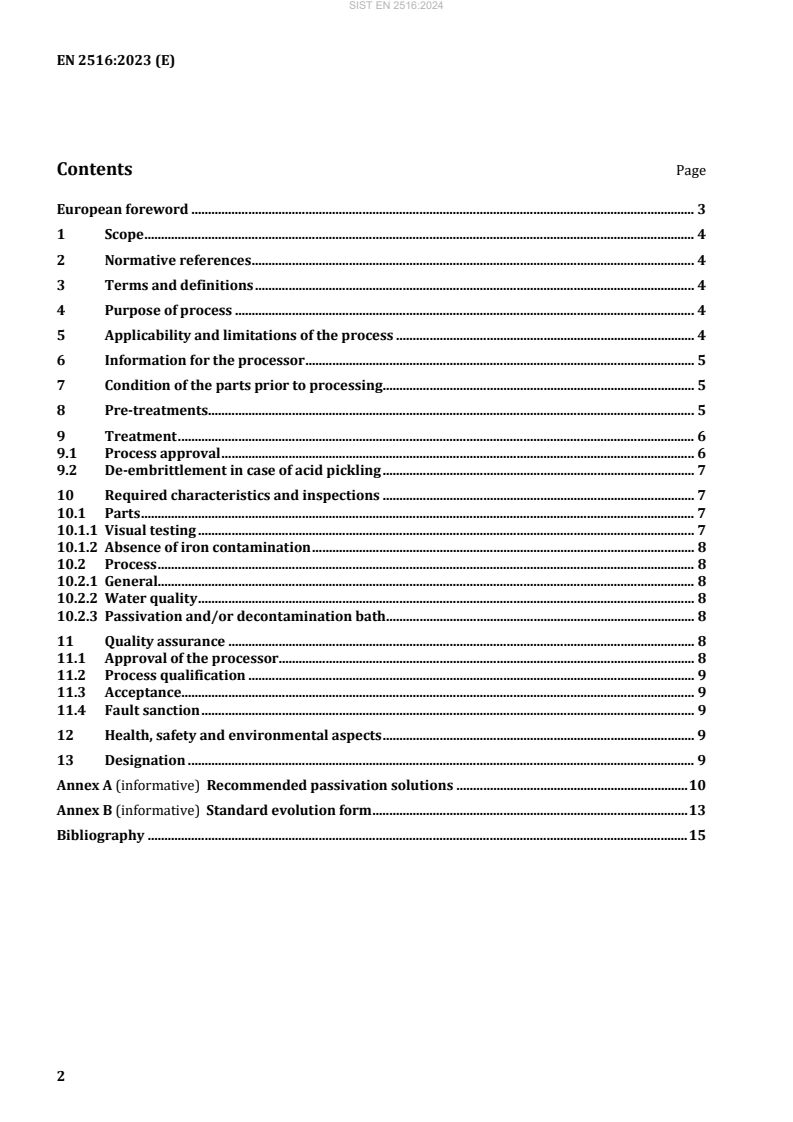
Contents Page
European foreword . 3
1 Scope . 4
2 Normative references . 4
3 Terms and definitions . 4
4 Purpose of process . 4
5 Applicability and limitations of the process . 4
6 Information for the processor . 5
7 Condition of the parts prior to processing. 5
8 Pre-treatments . 5
9 Treatment . 6
9.1 Process approval . 6
9.2 De-embrittlement in case of acid pickling . 7
10 Required characteristics and inspections . 7
10.1 Parts . 7
10.1.1 Visual testing . 7
10.1.2 Absence of iron contamination . 8
10.2 Process . 8
10.2.1 General. 8
10.2.2 Water quality . 8
10.2.3 Passivation and/or decontamination bath . 8
11 Quality assurance . 8
11.1 Approval of the processor. 8
11.2 Process qualification . 9
11.3 Acceptance. 9
11.4 Fault sanction . 9
12 Health, safety and environmental aspects . 9
13 Designation . 9
Annex A (informative) Recommended passivation solutions . 10
Annex B (informative) Standard evolution form . 13
Bibliography . 15
European foreword
This document (EN 2516:2023) has been prepared by the Aerospace and Defence Industries
Association of Europe — Standardization (ASD-STAN).
After enquiries and votes carried out in accordance with the rules of this Association, this
document has received the approval of the National Associations and the Official Services of the
member countries of ASD-STAN, prior to its presentation to CEN.
This document shall be given the status of a national standard, either by publication of an identical
text or by endorsement, at the latest by June 2024, and conflicting national standards shall be
withdrawn at the latest by June 2024.
Attention is drawn to the possibility that some of the elements of this document may be the subject
of patent rights. CEN shall not be held responsible for identifying any or all such patent rights.
This document supersedes EN 2516:2020.
The main changes with respect to the previous edition are listed in Annex B.
According to the CEN-CENELEC Internal Regulations, the national standards organizations of the
following countries are bound to implement this document: Austria, Belgium, Bulgaria, Croatia,
Cyprus, Czech Republic, Denmark, Estonia, Finland, France, Germany, Greece, Hungary, Iceland,
Ireland, Italy, Latvia, Lithuania, Luxembourg, Malta, Netherlands, Norway, Poland, Portugal,
Republic of North Macedonia, Romania, Serbia, Slovakia, Slovenia, Spain, Sweden, Switzerland,
Türkiye and the United Kingdom.
1 Scope
This document specifies several chemical methods of passivation for corrosion resisting steels
(austenitic, ferritic, martensitic and precipitation hardenable) and of decontamination for nickel or
cobalt base alloys.
2 Normative references
The following documents are referred to in the text in such a way that some or all of their content
constitutes requirements of this document. For dated references, only the edition cited applies. For
undated references, the latest edition of the referenced document (including any amendments) applies.
EN ISO 9227, Corrosion tests in artificial atmospheres — Salt spray tests (ISO 9227)
3 Terms and definitions
No terms and definitions are listed in this document.
ISO and IEC maintain terminology databases for use in standardization at the following addresses:
— ISO Online browsing platform: available at https://www.iso.org/obp/
— IEC Electropedia: available at https://www.electropedia.org/
4 Purpose of process
To improve the corrosion resistance characteristics of a part after such treatments as machining,
forming, tumbling and shot peening by removing foreign metal contamination due to these operations.
Passivation shall not be used on castings, welded or brazed parts, carburized or nitrided surfaces nor on
parts with mating surfaces when entrapment of acids may occur.
5 Applicability and limitations of the process
This document is applicable for the corrosion resisting alloys listed in Table A.2.
This document is not applicable for:
— unalloyed or low-alloyed carbon steel;
— powder metallurgy alloys;
— surface modified steel i.e. with case-hardened, carburized or nitrided surfaces;
— soldered or brazed parts;
— items containing joints and cavities where it is not possible to mask prior to passivation or to
ensure complete removal of the passivation solution.
6 Information for the processor
— Designation, refer to Clause 13.
— Reference of the material standard and its metallurgical condition.
— Process schedule, if necessary.
— Areas to be masked.
7 Condition of the parts prior to processing
Fabrication of the parts shall have been completed before treatment.
8 Pre-treatments
All parts shall be submitted to a surface preparation process. The surface preparation process may
include mechanical and/or chemical and/or electrochemical methods, singly or in combination.
Necessary sub steps (e.g. cleaning, degreasing, descaling, abrasive blasting, activation, pickling, rinsing,
drying, masking) depend on the degree of contamination. Although descaling or other steps may be
necessary before passivation can be effective, these steps shall be indicated in the process instructions.
The composition of appropriate surface preparation chemicals may depend on the grade of the
corrosion resisting steel to be treated. Alloying elements, contaminations and mechanical processing
may influence the sensitivity of the corrosion resisting steels and nickel or cobalt base alloys.
The result of the surface preparation treatment shall demonstrate a reproducible process and surface
condition. Particularly, the resulting conditioned parts shall be substantially free of contaminants and
other undesired organic and metallic residues from storage, transport and fabrication processes (e.g.
oil, grease, forming compounds, lubricants, coolants, cutting fluids, rust, scale, foreign metal or other
contaminations).
The surface preparation shall not induce pitting corrosion or intergranular corrosion
...