

EN 549:2019/prA1
(Amendment)Rubber materials for seals and diaphragms for gas appliances and gas equipment
- Abstract
This document specifies requirements and associated test methods for rubber materials used in gas installations, gas equipment and gas appliances in contact with 1st, 2nd and 3rd family combustible gases as classified in EN 437:2018, additionally LPG, bio methane and bio LPG, in the same quality, are covered. It also establishes a classification based on temperature range and hardness. This document is applicable to materials from which homogeneous seals and homogeneous or reinforced diaphragms are manufactured.
Since the dimensions and shape of the components differ from those of standard test pieces taken from sheet material as used for type testing of the rubber materials according to this document, tolerances have been made in the requirements specified by Annex A for the components with respect to those specified for standard test pieces.
The range of operating temperatures covered by this document is –40 °C to +150 °C.
For applications with potential condensation, this document is not applicable for silicon rubber, e.g. above 200 hPa (200 mbar) nominal pressure or at temperatures below 0 °C with 3rd family gases.
- Status
- Not Published
- Publication Date
- 22-Mar-2023
- Technical Committee
- CEN/TC 208 - Elastomeric seals for joints in pipework and pipelines
- Current Stage
- 4060 - Closure of enquiry - Enquiry
- Start Date
- 27-Oct-2022
- Due Date
- 01-Feb-2023
- Completion Date
- 27-Oct-2022



Overview
EN 549:2019/prA1 - Rubber materials for seals and diaphragms for gas appliances and gas equipment (CEN) specifies material requirements and test methods for rubber used in gas installations, appliances and equipment that contact combustible gases (1st, 2nd and 3rd family per EN 437:2018), plus LPG, biomethane and bio‑LPG. It covers homogeneous seals and homogeneous or reinforced diaphragms over an operating temperature range of −40 °C to +150 °C, and includes special tolerances for finished components (Annex A). The amendment (prA1) adds voluntary tests for volume change and stress relaxation.
Key topics and technical requirements
- Material scope: Homogeneous seals and homogeneous/reinforced diaphragms for gas applications (1st–3rd family gases, LPG, biomethane, bio‑LPG).
- Temperature range: −40 °C to +150 °C.
- Hardness classification: Three hardness classes (H1, H2, H3) with hardness tolerance ±5 IRHD.
- Mechanical properties:
- Tensile strength: H1 ≥ 5 MPa; H2/H3 ≥ 7 MPa.
- Elongation at break: ≥ 125% for all classes.
- Compression set: ≤ 40% (with specified high/low temperature limits).
- Ageing and chemical resistance:
- Limits on change in hardness, tensile strength and elongation after ageing.
- Resistance to gas: limits on change in mass after immersion/drying (e.g. +10% / −5% for immersion/drying mass change as specified).
- Resistance to condensate/liquid phase of combustible gases: higher allowed mass change (e.g. immersion up to +20%); applicable only if declared resistant.
- Additional voluntary tests (prA1):
- Stress relaxation in compression (ISO 3384 Method A; measurements to 90 days; example 90 d limits: H1 21%, H2 18%, H3 21%).
- Change of volume after gas and condensate exposure (procedures defined in modified test clauses).
- Silicone note: For applications with potential condensation, the standard is not applicable to silicone rubber in certain conditions (e.g. above 200 hPa or below 0 °C with 3rd family gases). Silicone has special exceptions for mass/hardness change.
Applications and who uses this standard
- Manufacturers of rubber seals and diaphragms for domestic and industrial gas appliances.
- OEMs, gas‑equipment designers and materials engineers specifying sealing materials for gas installations.
- Test laboratories performing material qualification, type testing and component testing (see Annex A tolerances for finished parts).
- Regulatory bodies, procurement and quality assurance teams that require compliance with European gas safety standards.
Related standards
- EN 437:2018 - classification of family gases (referenced for gas families).
- EN 682:2002+A1:2005 - elastomeric seals for pipes and fittings (added to bibliography).
- ISO 3384:1999 - method referenced for stress relaxation testing.
Keywords: EN 549:2019/prA1, rubber materials, seals, diaphragms, gas appliances, gas equipment, test methods, hardness IRHD, compression set, stress relaxation, resistance to gas, condensate.
Relations
- Merged Into
EN 549:2019+A1:2023 - Rubber materials for seals and diaphragms for gas appliances and gas equipment - Effective Date
- 15-Mar-2023
- Effective Date
- 22-Dec-2021
Get Certified
Connect with accredited certification bodies for this standard

DIN CERTCO
DIN Group product certification.
Institut za varilstvo d.o.o. (Welding Institute)
Slovenia's leading welding institute since 1952. ISO 3834, EN 1090, pressure equipment certification, NDT personnel, welder qualification. Only IIW Au

Smithers Quality Assessments
US management systems and product certification.
Sponsored listings
Frequently Asked Questions
EN 549:2019/prA1 is a draft published by the European Committee for Standardization (CEN). Its full title is "Rubber materials for seals and diaphragms for gas appliances and gas equipment". This standard covers: This document specifies requirements and associated test methods for rubber materials used in gas installations, gas equipment and gas appliances in contact with 1st, 2nd and 3rd family combustible gases as classified in EN 437:2018, additionally LPG, bio methane and bio LPG, in the same quality, are covered. It also establishes a classification based on temperature range and hardness. This document is applicable to materials from which homogeneous seals and homogeneous or reinforced diaphragms are manufactured. Since the dimensions and shape of the components differ from those of standard test pieces taken from sheet material as used for type testing of the rubber materials according to this document, tolerances have been made in the requirements specified by Annex A for the components with respect to those specified for standard test pieces. The range of operating temperatures covered by this document is –40 °C to +150 °C. For applications with potential condensation, this document is not applicable for silicon rubber, e.g. above 200 hPa (200 mbar) nominal pressure or at temperatures below 0 °C with 3rd family gases.
This document specifies requirements and associated test methods for rubber materials used in gas installations, gas equipment and gas appliances in contact with 1st, 2nd and 3rd family combustible gases as classified in EN 437:2018, additionally LPG, bio methane and bio LPG, in the same quality, are covered. It also establishes a classification based on temperature range and hardness. This document is applicable to materials from which homogeneous seals and homogeneous or reinforced diaphragms are manufactured. Since the dimensions and shape of the components differ from those of standard test pieces taken from sheet material as used for type testing of the rubber materials according to this document, tolerances have been made in the requirements specified by Annex A for the components with respect to those specified for standard test pieces. The range of operating temperatures covered by this document is –40 °C to +150 °C. For applications with potential condensation, this document is not applicable for silicon rubber, e.g. above 200 hPa (200 mbar) nominal pressure or at temperatures below 0 °C with 3rd family gases.
EN 549:2019/prA1 is classified under the following ICS (International Classification for Standards) categories: 23.040.80 - Seals for pipe and hose assemblies; 83.140.50 - Seals. The ICS classification helps identify the subject area and facilitates finding related standards.
EN 549:2019/prA1 has the following relationships with other standards: It is inter standard links to EN 549:2019+A1:2023, EN 549:2019. Understanding these relationships helps ensure you are using the most current and applicable version of the standard.
EN 549:2019/prA1 is associated with the following European legislation: EU Directives/Regulations: 2016/426; Standardization Mandates: M/BC/CEN/89/6. When a standard is cited in the Official Journal of the European Union, products manufactured in conformity with it benefit from a presumption of conformity with the essential requirements of the corresponding EU directive or regulation.
EN 549:2019/prA1 is available in PDF format for immediate download after purchase. The document can be added to your cart and obtained through the secure checkout process. Digital delivery ensures instant access to the complete standard document.
Standards Content (Sample)
SLOVENSKI STANDARD
01-oktober-2022
Gumeni materiali za tesnila in membrane v plinskih aparatih in plinskih napravah -
Dopolnilo A1
Rubber materials for seals and diaphragms for gas appliances and gas equipment
Elastomer-Werkstoffe für Dichtungen und Membranen in Gasgeräten und Gasanlagen
Matériaux à base de caoutchouc pour joints d'étanchéité et membranes destinés aux
appareils à gaz et matériels pour le gaz
Ta slovenski standard je istoveten z: EN 549:2019/prA1
ICS:
83.140.50 Tesnila Seals
91.140.40 Sistemi za oskrbo s plinom Gas supply systems
2003-01.Slovenski inštitut za standardizacijo. Razmnoževanje celote ali delov tega standarda ni dovoljeno.
DRAFT
EUROPEAN STANDARD
EN 549:2019
NORME EUROPÉENNE
EUROPÄISCHE NORM
prA1
August 2022
ICS 23.040.80; 83.140.50
English Version
Rubber materials for seals and diaphragms for gas
appliances and gas equipment
Matériaux à base de caoutchouc pour joints Elastomer-Werkstoffe für Dichtungen und Membranen
d'étanchéité et membranes destinés aux appareils à in Gasgeräten und Gasanlagen
gaz et matériels pour le gaz
This draft amendment is submitted to CEN members for enquiry. It has been drawn up by the Technical Committee CEN/TC 208.
This draft amendment A1, if approved, will modify the European Standard EN 549:2019. If this draft becomes an amendment,
CEN members are bound to comply with the CEN/CENELEC Internal Regulations which stipulate the conditions for inclusion of
this amendment into the relevant national standard without any alteration.
This draft amendment was established by CEN in three official versions (English, French, German). A version in any other
language made by translation under the responsibility of a CEN member into its own language and notified to the CEN-CENELEC
Management Centre has the same status as the official versions.
CEN members are the national standards bodies of Austria, Belgium, Bulgaria, Croatia, Cyprus, Czech Republic, Denmark, Estonia,
Finland, France, Germany, Greece, Hungary, Iceland, Ireland, Italy, Latvia, Lithuania, Luxembourg, Malta, Netherlands, Norway,
Poland, Portugal, Republic of North Macedonia, Romania, Serbia, Slovakia, Slovenia, Spain, Sweden, Switzerland, Türkiye and
United Kingdom.
Recipients of this draft are invited to submit, with their comments, notification of any relevant patent rights of which they are
aware and to provide supporting documentation.
Warning : This document is not a European Standard. It is distributed for review and comments. It is subject to change without
notice and shall not be referred to as a European Standard.
EUROPEAN COMMITTEE FOR STANDARDIZATION
COMITÉ EUROPÉEN DE NORMALISATION
EUROPÄISCHES KOMITEE FÜR NORMUNG
CEN-CENELEC Management Centre: Rue de la Science 23, B-1040 Brussels
© 2022 CEN All rights of exploitation in any form and by any means reserved Ref. No. EN 549:2019/prA1:2022 E
worldwide for CEN national Members.
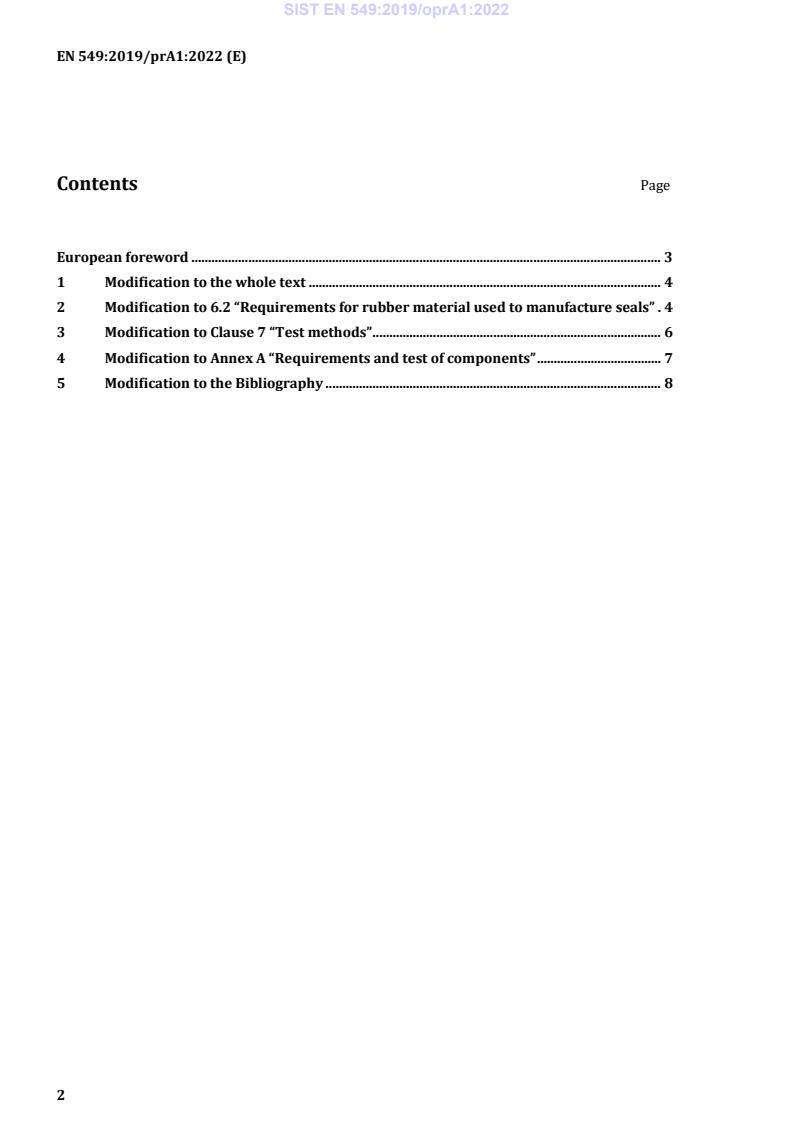
Contents Page
European foreword . 3
1 Modification to the whole text . 4
2 Modification to 6.2 “Requirements for rubber material used to manufacture seals” . 4
3 Modification to Clause 7 “Test methods” . 6
4 Modification to Annex A “Requirements and test of components” . 7
5 Modification to the Bibliography . 8
European foreword
This document (EN 549:2019/prA1:2022) has been prepared by Technical Committee CEN/TC 208
“Elastomeric seals for joints in pipework and pipelines”, the secretariat of which is held by BSI.
This document is currently submitted to the CEN Enquiry.
This amendment adds voluntary tests for sealing materials regarding resistance to gas - change of
volume, resistance to condensate/liquid phase of combustible gases – change of volume and stress
relaxation in compression.
This document has been prepared under a Standardization Request given to CEN by the European
Commission and the European Free Trade Association, and supports essential requirements of EU
Directive(s) / Regulation(s).
For relationship with EU Directive(s) / Regulation(s), see informative Annex ZA, which is an integral part
of EN 549:2019.
1 Modification to the whole text
In the entire document, for all instances found:
Replace “EN 549:2019” with “EN 549:2019+prA1:2022”.
2 Modification to 6.2 “Requirements for rubber material used to manufacture
seals”
Delete the existing Table 3 and replace with the following:
Table 3 — Requirements for rubber material used to manufacture seals
Hardness class
Property Unit
H1 H2 H3
Hardness
Tolerance on stated nominal hardness IRHD-M ±5 ±5 ±5
Tensile strength MPa ≥ 5 ≥ 7 ≥ 7
Elongation at break % ≥ 125 ≥ 125 ≥ 125
Compression set
a % ≤ 40 ≤ 40 ≤ 40
— at high temperature
— at low temperature 0 °C % ≤ 40 ≤ 40 ≤ 40
— at low temperature −20 °C % ≤ 50 ≤ 50 ≤ 50
— at low temperature −30 °C % ≤ 70 ≤ 70 ≤ 70
— at low temperature −40 °C % ≤ 75 ≤ 75 ≤ 75
Resistance to ageing
— change in hardness, max. IRHD-M ±10 ±10 ±10
— change in tensile strength, max. % − 40 − 40 − 40
— change in elongation at break, max. % − 40 − 40 − 40
b
Resistance to gas
— change in mass after immersion, max. %
+10 +10 +10
−5 −5 −5
— change in mass after drying, max. %
+5 +5 +5
−8 −8 −8
Resistance to condensate/liquid phase of
c
combustible gases
— change in mass after immersion, max. % +
...