

EN 15814:2011+A2:2014
(Main + Amendment)Polymer modified bituminous thick coatings for waterproofing - Definitions and requirements
- Abstract
This European Standard specifies the definitions and requirements of prefabricated polymer modified bituminous thick coatings used for the waterproofing of below ground structures. It applies to both one-component and two-component products. These products can be used with or without inlay.
This European Standard does not apply to products that are to be used for roof waterproofing.
- Status
- Published
- Publication Date
- 16-Dec-2014
- Withdrawal Date
- 29-Sep-2016
- Current Stage
- 9092 - Decision on results of review/2YR ENQ - revise - Review Enquiry
- Start Date
- 20-Apr-2017
- Completion Date
- 21-Oct-2026



Overview
EN 15814:2011+A2:2014 - Polymer modified bituminous thick coatings for waterproofing - Definitions and requirements - is a CEN European Standard that defines terminology, performance requirements and conformity assessment procedures for prefabricated, emulsion‑based polymer modified bituminous thick coatings (PMBC) used for the waterproofing of below‑ground structures. It covers both one‑component and two‑component products, which may be applied with or without an inlay. The standard explicitly does not apply to roof waterproofing products.
Key topics and technical requirements
- Definitions: Clarifies key terms such as PMBC, inlay, free film, crack bridging ability and pressure water.
- Essential characteristics: Specifies mandatory performance characteristics and classification systems, including:
- Crack bridging ability (Classes CB0–CB2) - test method EN 15812.
- Resistance to rain (Classes R0–R3) - test method EN 15816 with time-based classes.
- Water resistance - requirements for absence of coloration, debonding and material changes (EN 15817).
- Flexibility at low temperature (EN 15813) and dimensional stability at high temperature (EN 15818).
- Reduction of layer thickness when fully dried - limit ≤ 50 % (EN 15819).
- Watertightness (Classes W1, W2A, W2B) - specified pressures, durations and minimum dry layer thickness (EN 15820).
- Resistance to compression (Classes C0–C2) - defined stress levels and minimum dry layer thickness (EN 15815).
- Reaction to fire - classification to be declared per EN 13501‑1 and tested per Annex A.
- Assessment and verification (AVCP): Describes type testing, factory production control (FPC), test report requirements and procedures for Declaration of Performance (DoP) and CE marking in accordance with the Construction Products Regulation (Annex ZA).
Applications and users
Practical uses:
- Waterproofing of basements, foundations, retaining walls, tunnels, underground car parks and other below‑ground structures subjected to groundwater or pressure water. Who benefits from the standard:
- Manufacturers of PMBC for designation of product families, testing and DoP/CE compliance.
- Specifiers and consultants selecting durable, tested waterproofing systems for below‑ground applications.
- Contractors and applicators implementing PMBC systems with or without inlay.
- Testing laboratories performing type testing and performance verification.
- Regulatory bodies and building authorities assessing compliance with EU CPR provisions.
Related standards
Standards referenced for test methods and classification include (selection):
- EN 15812, EN 15813, EN 15815, EN 15816, EN 15817, EN 15818, EN 15819, EN 15820
- EN 13501‑1 (reaction to fire classification)
- EN 1931 (water vapour transmission) and other referenced EN/EN ISO methods used in test protocols.
Keywords: EN 15814:2011+A2:2014, polymer modified bituminous thick coatings, PMBC, below‑ground waterproofing, crack bridging, watertightness, AVCP, Declaration of Performance, CE marking.
Relations
- Effective Date
- 19-Jan-2023
- Effective Date
- 18-Jan-2023
- Effective Date
- 05-Aug-2026
- Refers
EN ISO 3451-1:2026 - Plastics - Determination of ash - Part 1: General methods (ISO 3451-1:2026) - Effective Date
- 10-Jun-2026
- Effective Date
- 04-Feb-2026
- Effective Date
- 28-Jan-2026
- Effective Date
- 28-Jan-2026
- Effective Date
- 28-Jan-2026
- Effective Date
- 28-Jan-2026
- Effective Date
- 28-Jan-2026
- Effective Date
- 28-Jan-2026
- Effective Date
- 28-Jan-2026
- Refers
EN 15816:2011 - Polymer-modified bituminous thick coatings for waterproofing - Resistance to rain - Effective Date
- 28-Jan-2026
- Refers
EN ISO 3451-1:2019 - Plastics - Determination of ash - Part 1: General methods (ISO 3451-1:2019) - Effective Date
- 28-Jan-2026
- Effective Date
- 28-Jan-2026
Get Certified
Connect with accredited certification bodies for this standard

DIBt (Deutsches Institut für Bautechnik)
German Institute for Building Technology.
DIN CERTCO
DIN Group product certification.

Aboma Certification B.V.
Specialized in construction, metal, and transport sectors.
Sponsored listings
Frequently Asked Questions
EN 15814:2011+A2:2014 is a standard published by the European Committee for Standardization (CEN). Its full title is "Polymer modified bituminous thick coatings for waterproofing - Definitions and requirements". This standard covers: This European Standard specifies the definitions and requirements of prefabricated polymer modified bituminous thick coatings used for the waterproofing of below ground structures. It applies to both one-component and two-component products. These products can be used with or without inlay. This European Standard does not apply to products that are to be used for roof waterproofing.
This European Standard specifies the definitions and requirements of prefabricated polymer modified bituminous thick coatings used for the waterproofing of below ground structures. It applies to both one-component and two-component products. These products can be used with or without inlay. This European Standard does not apply to products that are to be used for roof waterproofing.
EN 15814:2011+A2:2014 is classified under the following ICS (International Classification for Standards) categories: 91.100.50 - Binders. Sealing materials. The ICS classification helps identify the subject area and facilitates finding related standards.
EN 15814:2011+A2:2014 has the following relationships with other standards: It is inter standard links to EN 15814:2011/FprA2, EN 15814:2011+A1:2012, EN 13238:2026, EN ISO 3451-1:2026, EN ISO 11925-2:2026, EN 15812:2011, EN ISO 1183-1:2025, EN 459-2:2010, EN 15813:2011, EN 13501-1:2018, EN ISO 11925-2:2020, EN 15815:2011, EN 15816:2011, EN ISO 3451-1:2019, EN 15820:2011. Understanding these relationships helps ensure you are using the most current and applicable version of the standard.
EN 15814:2011+A2:2014 is associated with the following European legislation: EU Directives/Regulations: 305/2011; Standardization Mandates: M/102. When a standard is cited in the Official Journal of the European Union, products manufactured in conformity with it benefit from a presumption of conformity with the essential requirements of the corresponding EU directive or regulation.
EN 15814:2011+A2:2014 is available in PDF format for immediate download after purchase. The document can be added to your cart and obtained through the secure checkout process. Digital delivery ensures instant access to the complete standard document.
Standards Content (Sample)
2003-01.Slovenski inštitut za standardizacijo. Razmnoževanje celote ali delov tega standarda ni dovoljeno.Bitumenske debeloslojne prevleke, modificirane s polimeri - Definicije in zahteveKunststoffmodifizierte Bitumendickbeschichtungen zur Bauwerksabdichtung - Begriffe und AnforderungenRevêtements bitumineux épais modifiés aux polymères pour imperméabilisation - Définitions et exigencesPolymer modified bituminous thick coatings for waterproofing - Definitions and requirements91.100.50Veziva. Tesnilni materialiBinders. Sealing materialsICS:Ta slovenski standard je istoveten z:EN 15814:2011+A2:2014SIST EN 15814:2011+A2:2015en,fr,de01-marec-2015SIST EN 15814:2011+A2:2015SLOVENSKI
STANDARDSIST EN 15814:2011+A1:20121DGRPHãþD
EUROPEAN STANDARD NORME EUROPÉENNE EUROPÄISCHE NORM
EN 15814:2011+A2
December 2014 ICS 91.100.50 Supersedes EN 15814:2011+A1:2012
English Version
Polymer modified bituminous thick coatings for waterproofing - Definitions and requirements
Revêtements bitumineux épais modifiés aux polymères pour imperméabilisation - Définitions et exigences
Kunststoffmodifizierte Bitumendickbeschichtungen zur Bauwerksabdichtung - Begriffe und Anforderungen This European Standard was approved by CEN on 14 July 2011 and includes Amendment 1 approved by CEN on 20 August 2012 and Amendment 2 approved by CEN on 6 October 2014.
CEN members are bound to comply with the CEN/CENELEC Internal Regulations which stipulate the conditions for giving this European Standard the status of a national standard without any alteration. Up-to-date lists and bibliographical references concerning such national standards may be obtained on application to the CEN-CENELEC Management Centre or to any CEN member.
This European Standard exists in three official versions (English, French, German). A version in any other language made by translation under the responsibility of a CEN member into its own language and notified to the CEN-CENELEC Management Centre has the same status as the official versions.
CEN members are the national standards bodies of Austria, Belgium, Bulgaria, Croatia, Cyprus, Czech Republic, Denmark, Estonia, Finland, Former Yugoslav Republic of Macedonia, France, Germany, Greece, Hungary, Iceland, Ireland, Italy, Latvia, Lithuania, Luxembourg, Malta, Netherlands, Norway, Poland, Portugal, Romania, Slovakia, Slovenia, Spain, Sweden, Switzerland, Turkey and United Kingdom.
EUROPEAN COMMITTEE FOR STANDARDIZATION
COMITÉ EUROPÉEN DE NORMALISATION
EUROPÄISCHES KOMITEE FÜR NORMUNG
CEN-CENELEC Management Centre:
Avenue Marnix 17,
B-1000 Brussels © 2014 CEN All rights of exploitation in any form and by any means reserved worldwide for CEN national Members. Ref. No. EN 15814:2011+A2:2014 E SIST EN 15814:2011+A2:2015
Reaction to fire — Specifications for mounting specimens in the test rigs . 15 Annex ZA (informative)
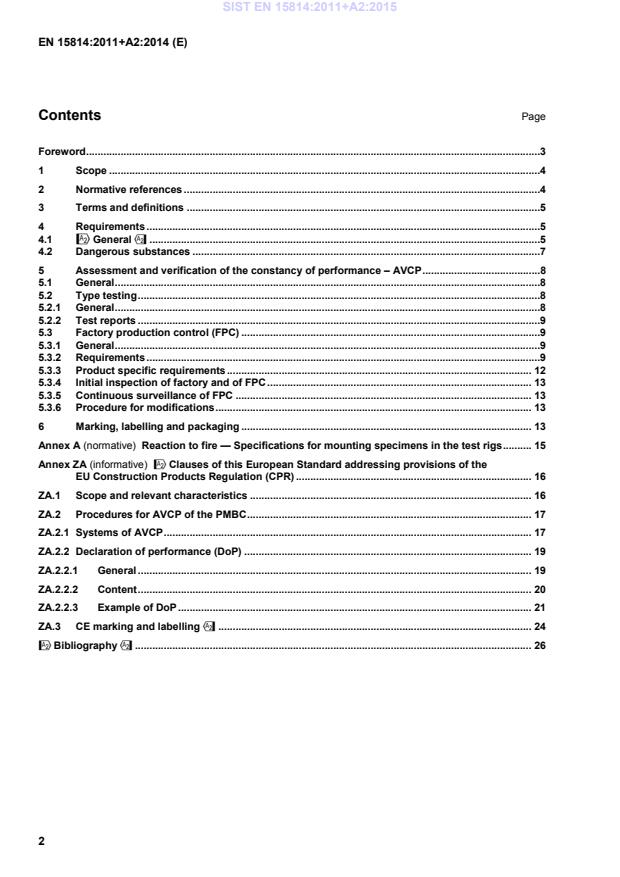
#Clauses of this European Standard addressing provisions of the EU Construction Products Regulation (CPR) . 16 ZA.1 Scope and relevant characteristics . 16 ZA.2 Procedures for AVCP of the PMBC . 17 ZA.2.1 Systems of AVCP . 17 ZA.2.2 Declaration of performance (DoP) . 19 ZA.2.2.1 General . 19 ZA.2.2.2 Content . 20 ZA.2.2.3 Example of DoP . 21 ZA.3 CE marking and labelling$ . 24 #Bibliography$ . 26
Crack width ≥ 1 mm dry layer thickness
≥ 3 mm (MLV) Class CB 2 No damage
Crack width ≥ 2 mm dry layer thickness
≥ 3 mm (MLV) EN 15812 Method A or B NOTE The test method has to be declared with the classification.
2 Resistance to rain Class R0 No require-ment
Class R1 ≤ 24 h
wet layer thickness ≥ 3 mm (MLV) Class R2 ≤ 8 h
wet layer thickness ≥ 3 mm (MLV) Class R3 ≤ 4 h
wet layer
thickness ≥ 3 mm (MLV) EN 15816 3 Water resistance 1.No colouration of the water 2.No debonding from inlay, if used dry layer ≥ 4 mm #3. No changes to the material$ EN 15817 4 Flexibility at low temperature !deleted text" No cracks EN 15813 5 Dimensional stability at high temperature !deleted text" No sliding or draining down EN 15818 6 Reduction of layer thickness when fully dried ≤ 50 % (MLV) EN 15819 7 Reaction to fire Class to be declared according to EN 13501-1
Testing in accordance with the specifications in the classification standard EN 13501-1and Annex A.
thickness without inlay ≥ 3 mm (MLV) Class W2A ≥ 72 h at 0,075 N/mm2 dry layer thickness with inlay ≥ 4 mm with inlay (MLV) Class W2B ≥ 72 h at
0,075 N/mm2 dry layer thickness without inlay ≥ 4 mm without inlay (MLV) EN 15820 9 Resistance to compression a Class C0 No requirement Class C1 Stabilization at ≤ 50 % (change maximum 3 % within 3 subse-quent days) 0,06 MN/m2 dry layer thickness ≥ 3 mm (MLV) Class C2A Stabilization at ≤ 50 % (change maximum 3 % within 3 subse-quent days) 0,30 MN/m2 dry layer thickness ≥ 4 mm with inlay (MLV) Class C2B Stabilization at ≤ 50 % (change maximum 3 % within 3 subse-quent days) 0,30 MN/m2 dry layer thickness ≥ 4 mm without inlay (MLV) EN 15815 !a The testing procedure of characteristics are also related to durability aspects." manufacturer's limiting value (MLV) value stated by the manufacturer to be met during testing. The manufacturer's limiting value can be a minimum or a maximum value according to statements made under product characteristics of this document When required, the water vapour diffusion resistance shall be tested in accordance with EN 1931. # 4.2 Dangerous substances National regulations on dangerous substances may require verification and declaration on release, and sometimes content, when construction products covered by this standard are placed on those markets. In the absence of European harmonised test methods, verification and declaration on release/content should be done taking into account national provisions in the place of use. NOTE An informative database covering European and national provisions on dangerous substances is available at the Construction web site on EUROPA accessed through: http://ec.europa.eu/enterprise/construction/cpd-ds/.$ SIST EN 15814:2011+A2:2015
— Solids content EN ISO 3251 Weekly or per batch ± 4 % absolute — Ash content (only for products with ash content ≥ 5 mass %) EN ISO 3451-1, method A testing at a temperature of (475 ± 25 ) °C Weekly or per batch ± 2 % absolute For the B-component (only for two component PMBC)
— Bulk density (for powder
component) EN ISO 3923-1 or EN 459-2:2010, 6.3 Weekly or per batch ± 0,1 g/cm3 — Density (for liquid
component) EN ISO 2811-1 Weekly or per batch ± 0,1 g/cm3 For the cured PMBC — Density EN ISO 1183-1, method A Weekly or per batch ± 0,1 g/cm3 Identification for inlays:
— Type — Mass per unit area — Strength and elongation at break To be stated. Depending on the type of inlay, a suitable test has to be applied at incoming products. At incoming products ----- For the purpose of the Factory Production Control alternative tests to those given in Table 2 may be used, provided that a correlation of the results between both tests, for the product in question, is established. The use of alternative tests shall be recorded and maintained. 5.3.2.6 Non-complying products The manufacturer sh
...