

EN 17795-5:2023
(Main)Entertainment technology - Codes of Practice - Part 5: Lifting and motion operations in the event industry
General Information
- Abstract
This code of practice provides a set of guidelines for lifting and motion operations related to machinery and machinery installations used in staging and production facilities for events.
This document is pertinent to all the machinery phases, assembly, commissioning, setting, operation and dismantling employed in the event industry including machinery defined in point j, Article 1.2 of the Machinery Directive (2006/42/EC): "machinery intended to move performers during artistic performances".
This document also applies to machinery and machinery installations based on new technologies or specially designed installations which are not expressly mentioned here but which nevertheless operate in a similar manner or are meant for similar purposes to those listed above.
This document does not provide specific details but is intended to provide general guidelines on planning and the process of lifting and motion operations.
- Status
- Published
- Publication Date
- 12-Dec-2023
- Technical Committee
- CEN/TC 433 - Entertainment technology - Equipment, technical installations and machinery used on stages and other production areas within the entertainment industry
- Drafting Committee
- CEN/TC 433/WG 04 - Codes of practice
- Current Stage
- 6060 - Definitive text made available (DAV) - Publishing
- Start Date
- 13-Dec-2023
- Due Date
- 30-May-2023
- Completion Date
- 13-Dec-2023

Overview
EN 17795-5:2023 - Entertainment technology - Codes of Practice - Part 5: Lifting and motion operations in the event industry is a CEN code of practice that provides general guidelines for planning and managing lifting and motion operations used in staging and production facilities. It covers machinery and installations used across all project phases (assembly, commissioning, operation, dismantling) and explicitly includes machinery intended to move performers (per Machinery Directive 2006/42/EC, point j). The document applies to conventional systems and new or bespoke technologies that perform similar functions.
Key topics and technical scope
This part of EN 17795 focuses on process, planning and safe practice rather than prescriptive technical specifications. Key topics include:
- Project phases: concept, preliminary design, final design, work preparation, off‑site test build, on‑site installation, lifting operations, hand‑over/commissioning, show use, dismantling and post‑production evaluation.
- Rigging and lifting systems: definitions and guidance on rigging systems, rigging points, primary and secondary suspensions, determinate vs indeterminate systems, redundancy and load distribution.
- Load concepts: entertainment load limit (ELL) and entertainment load limit at rest (ELL/R) and related considerations for selecting lifting equipment and accessories.
- Lift planning: preparation of lift plans (rig plans), procedures, drawings, schedules and responsibilities for safe lifting operations.
- People and competence: roles and responsibilities, requirement for a competent person, communications systems and protocols for coordinated operations.
- Risk management: risk assessment, risk management plans, identification of overhead obstructions, performer flying, rescue procedures and flight path considerations.
- Equipment selection: guidance on choosing machinery and control systems, including reference to equipment labelled under EN 17206 and custom-built systems.
Practical applications and who uses it
EN 17795-5 is intended for professionals involved in event production and venue operations. Typical users:
- Venue managers and structural engineers assessing support capacity
- Production managers, technical directors and rigging supervisors planning lifts
- Riggers, technicians and operators conducting assembly, commissioning and shows
- Manufacturers and suppliers of motion equipment and lifting accessories
- Safety officers, inspectors and training providers
Benefits include improved safety, consistent lift planning, clearer allocation of responsibilities, and better integration of rigging, machinery and performer safety into production workflows.
Related standards
- EN 17206 - Machinery for stages and production areas - safety requirements and inspections (referenced for machinery selection)
- EN 17115 - Design and manufacture specifications for aluminium and steel trusses
- EN 17795 series (Parts 1–7) - broader codes of practice covering entertainment technology topics
Keywords: EN 17795-5:2023, lifting and motion operations, entertainment technology, event industry, rigging, lift plan, performer flying, ELL, risk assessment.
Relations
- Effective Date
- 28-Jan-2026
- Effective Date
- 28-Jan-2026
- Effective Date
- 28-Jan-2026
- Effective Date
- 28-Jan-2026
Frequently Asked Questions
EN 17795-5:2023 is a standard published by the European Committee for Standardization (CEN). Its full title is "Entertainment technology - Codes of Practice - Part 5: Lifting and motion operations in the event industry". This standard covers: This code of practice provides a set of guidelines for lifting and motion operations related to machinery and machinery installations used in staging and production facilities for events. This document is pertinent to all the machinery phases, assembly, commissioning, setting, operation and dismantling employed in the event industry including machinery defined in point j, Article 1.2 of the Machinery Directive (2006/42/EC): "machinery intended to move performers during artistic performances". This document also applies to machinery and machinery installations based on new technologies or specially designed installations which are not expressly mentioned here but which nevertheless operate in a similar manner or are meant for similar purposes to those listed above. This document does not provide specific details but is intended to provide general guidelines on planning and the process of lifting and motion operations.
This code of practice provides a set of guidelines for lifting and motion operations related to machinery and machinery installations used in staging and production facilities for events. This document is pertinent to all the machinery phases, assembly, commissioning, setting, operation and dismantling employed in the event industry including machinery defined in point j, Article 1.2 of the Machinery Directive (2006/42/EC): "machinery intended to move performers during artistic performances". This document also applies to machinery and machinery installations based on new technologies or specially designed installations which are not expressly mentioned here but which nevertheless operate in a similar manner or are meant for similar purposes to those listed above. This document does not provide specific details but is intended to provide general guidelines on planning and the process of lifting and motion operations.
EN 17795-5:2023 is classified under the following ICS (International Classification for Standards) categories: 97.200.10 - Theatre, stage and studio equipment. The ICS classification helps identify the subject area and facilitates finding related standards.
EN 17795-5:2023 has the following relationships with other standards: It is inter standard links to EN 17206:2020, EN 17115:2018, EN ISO 28721-2:2025, EN ISO 28765:2022. Understanding these relationships helps ensure you are using the most current and applicable version of the standard.
EN 17795-5:2023 is available in PDF format for immediate download after purchase. The document can be added to your cart and obtained through the secure checkout process. Digital delivery ensures instant access to the complete standard document.
Standards Content (Sample)
SLOVENSKI STANDARD
01-februar-2024
Razvedrilna tehnologija - Kodeks ravnanja - 5. del: Dvigovanje in premikanje pri
dejavnostih v prireditveni industriji
Entertainment technology - Codes of Practice - Part 5: Lifting and motion operations in
the event industry
Veranstaltungstechnik - Verfahrensregeln - Teil 5: Hebe- und Bewegungsvorgänge in
der Veranstaltungsindustrie
Technologies du spectacle - Codes de bonnes pratique - Partie 5 : Opérations de levage
et de mouvement dans l'industrie de l'événementiel
Ta slovenski standard je istoveten z: EN 17795-5:2023
ICS:
97.200.10 Gledališka, odrska in Theatre, stage and studio
studijska oprema ter delovne equipment
postaje
2003-01.Slovenski inštitut za standardizacijo. Razmnoževanje celote ali delov tega standarda ni dovoljeno.
EN 17795-5
EUROPEAN STANDARD
NORME EUROPÉENNE
December 2023
EUROPÄISCHE NORM
ICS 97.200.10
English Version
Entertainment technology - Codes of Practice - Part 5:
Lifting and motion operations in the event industry
Technologies du spectacle - Codes de bonnes pratique - Veranstaltungstechnik - Verfahrensregeln - Teil 5:
Partie 5 : Opérations de levage et de mouvement dans Hebe- und Bewegungsvorgänge in der
l'industrie de l'événementiel Veranstaltungsindustrie
This European Standard was approved by CEN on 20 November 2023.
CEN members are bound to comply with the CEN/CENELEC Internal Regulations which stipulate the conditions for giving this
European Standard the status of a national standard without any alteration. Up-to-date lists and bibliographical references
concerning such national standards may be obtained on application to the CEN-CENELEC Management Centre or to any CEN
member.
This European Standard exists in three official versions (English, French, German). A version in any other language made by
translation under the responsibility of a CEN member into its own language and notified to the CEN-CENELEC Management
Centre has the same status as the official versions.
CEN members are the national standards bodies of Austria, Belgium, Bulgaria, Croatia, Cyprus, Czech Republic, Denmark, Estonia,
Finland, France, Germany, Greece, Hungary, Iceland, Ireland, Italy, Latvia, Lithuania, Luxembourg, Malta, Netherlands, Norway,
Poland, Portugal, Republic of North Macedonia, Romania, Serbia, Slovakia, Slovenia, Spain, Sweden, Switzerland, Türkiye and
United Kingdom.
EUROPEAN COMMITTEE FOR STANDARDIZATION
COMITÉ EUROPÉEN DE NORMALISATION
EUROPÄISCHES KOMITEE FÜR NORMUNG
CEN-CENELEC Management Centre: Rue de la Science 23, B-1040 Brussels
© 2023 CEN All rights of exploitation in any form and by any means reserved Ref. No. EN 17795-5:2023 E
worldwide for CEN national Members.
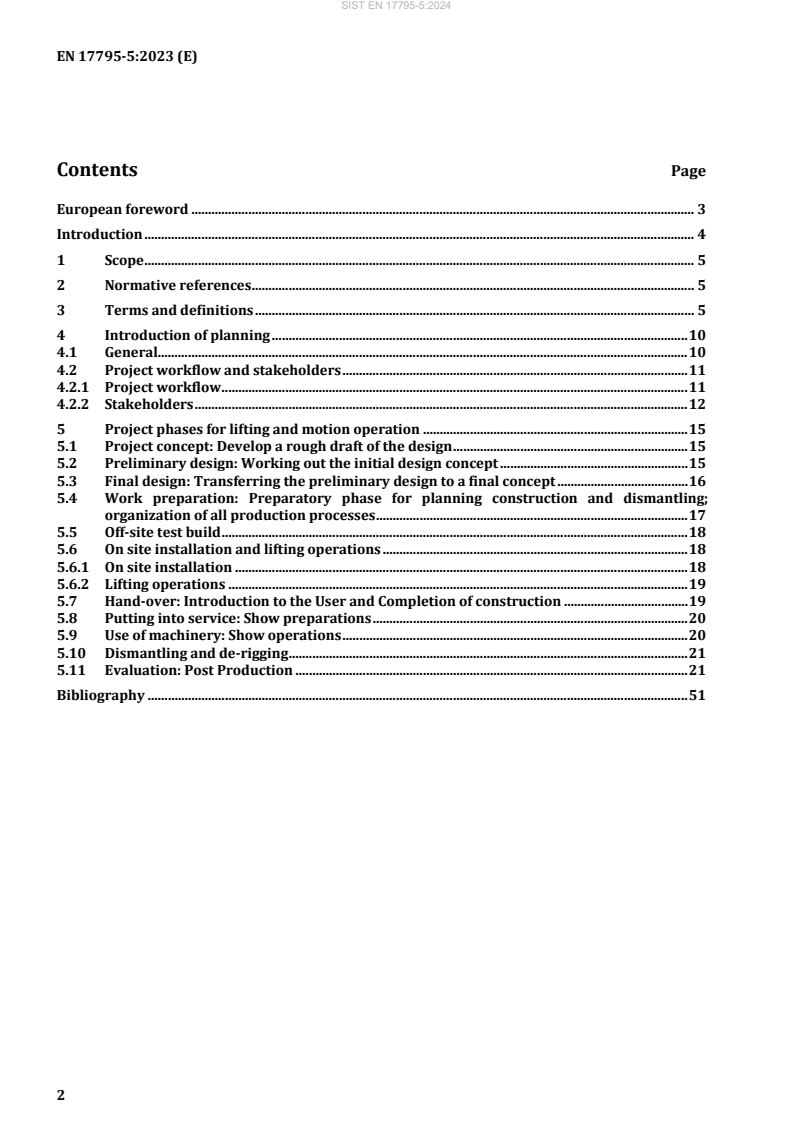
Contents Page
European foreword . 3
Introduction . 4
1 Scope . 5
2 Normative references . 5
3 Terms and definitions . 5
4 Introduction of planning . 10
4.1 General. 10
4.2 Project workflow and stakeholders . 11
4.2.1 Project workflow . 11
4.2.2 Stakeholders . 12
5 Project phases for lifting and motion operation . 15
5.1 Project concept: Develop a rough draft of the design . 15
5.2 Preliminary design: Working out the initial design concept . 15
5.3 Final design: Transferring the preliminary design to a final concept . 16
5.4 Work preparation: Preparatory phase for planning construction and dismantling;
organization of all production processes . 17
5.5 Off-site test build . 18
5.6 On site installation and lifting operations . 18
5.6.1 On site installation . 18
5.6.2 Lifting operations . 19
5.7 Hand-over: Introduction to the User and Completion of construction . 19
5.8 Putting into service: Show preparations . 20
5.9 Use of machinery: Show operations . 20
5.10 Dismantling and de-rigging . 21
5.11 Evaluation: Post Production . 21
Bibliography . 51
European foreword
This document (EN 17795-5:2023) has been prepared by Technical Committee CEN/TC 433
“Entertainment Technology – Machinery, equipment and installations”, the secretariat of which is held
by DIN.
This European Standard shall be given the status of a national standard, either by publication of an
identical text or by endorsement, at the latest by June 2024, and conflicting national standards shall be
withdrawn at the latest by June 2024.
Attention is drawn to the possibility that some of the elements of this document may be the subject of
patent rights. CEN shall not be held responsible for identifying any or all such patent rights.
EN 17795 consists of the following parts, under the general title Entertainment technology — Code of
practice:
— Part 1: General requirements
— Part 2: Load carrying devices
— Part 3: Performer flying operations
— Part 4: Temporary demountable structures
— Part 5: Lifting and motion operations in the event industry
— Part 6: Load bearing equipment
— Part 7: Lifting accessories
Any feedback and questions on this document should be directed to the users’ national standards body.
A complete listing of these bodies can be found on the CEN website.
According to the CEN-CENELEC Internal Regulations, the national standards organisations of the
following countries are bound to implement this European Standard: Austria, Belgium, Bulgaria, Croatia,
Cyprus, Czech Republic, Denmark, Estonia, Finland, France, Germany, Greece, Hungary, Iceland, Ireland,
Italy, Latvia, Lithuania, Luxembourg, Malta, Netherlands, Norway, Poland, Portugal, Republic of North
Macedonia, Romania, Serbia, Slovakia, Slovenia, Spain, Sweden, Switzerland, Türkiye and the United
Kingdom.
Document in preparation.
Introduction
This document has been prepared by CEN/TC 433/WG 4 with the aim to produce a code of practice for
lifting and motion operations within the event industry. All references to lifting include motion.
This document intends to provide general guidelines for venues, operators, production management,
technical directors, technicians, manufacturers, performers and others working in the event industry for
local, national and international projects. It should facilitate a smooth process and a safe work
environment when workers are involved in assembly, use and dismantling operations. This document
does not provide details in regard to specific lifting and motion operations.
A project in the event industry always starts with an artistic concept that needs to be translated to a
technical solution. This creates a balance between the solution and the artistic performance. To be able
to achieve the artistic concept safely, this document intends to clarify the many details that need to be
addressed, such as:
— skills knowledge and experience that may be appropriate for those involved;
— the structural capacity and integrity of the venue and other supporting elements;
— documentation and operation requirements;
— steps for safe assembly, use and dismantling of machinery and equipment;
— custom equipment and equipment selection.
Specifically, when selecting machinery and control systems, this document provides guidelines for the
selection of equipment labelled under the references described under EN 17206:2020 Entertainment
technology — Machinery for stages and other production areas — Safety requirements and inspections and
equipment without such labels and custom built machinery.
Additionally, this document addresses details of situations that give might rise to danger, such as:
— event industry specific loads (lights, sound, set, video);
— static or moving loads above people;
— supporting structures and load distribution;
— general guidelines on moving or flying performers, rescue procedures and flight path.
Besides the technical requirements, this code of practice describes the process of selecting and using
lifting machinery in the event industry and the steps that shall be considered before any lifting operations
can take place.
In addition to the flowchart provided, this document includes some references that may be useful relating
to:
— the requirements for all actions specified in the flowchart, see Annex A through H;
— examples of possible responsibilities of the technicians involved in the lifting operation, see Annex I.
The process and flow chart describe several preparatory phases and the lifting operation itself. Each
action specifies who bears responsibility and, if applicable, the normative references.
The process description is based on a large-scale production for the event industry. Smaller productions
with less complex movements can follow the same process and structure combining some of the phases.
1 Scope
This code of practice provides a set of guidelines for lifting and motion operations related to machinery
and machinery installations used in staging and production facilities for events.
This document is pertinent to all the machinery phases, assembly, commissioning, setting, operation and
dismantling employed in the event industry including machinery defined in point j, Article 1.2 of the
Machinery Directive (2006/42/EC): “machinery intended to move performers during artistic
performances”.
This document also applies to machinery and machinery installations based on new technologies or
specially designed installations which are not expressly mentioned here but which nevertheless operate
in a similar manner or are meant for similar purposes to those listed above.
This document does not provide specific details but is intended to provide general guidelines on planning
and the process of lifting and motion operations.
2 Normative references
The following documents are referred to in the text in such a way that some or all of their content
constitutes requirements of this document. For dated references, only the edition cited applies. For
undated references, the latest edition of the referenced document (including any amendments) applies.
EN 17115, Entertainment technology — Specifications for design and manufacture of aluminium and steel
trusses
EN 17206, Entertainment technology — Machinery for stages and other production areas — Safety
requirements and inspections
3 Terms and definitions
For the purposes of this document, the terms and definitions given in EN 17206, EN 17115 and the
following apply.
ISO and IEC maintain terminology databases for use in standardization at the following addresses:
— ISO Online browsing platform: available at https://www.iso.org/obp
— IEC Electropedia: available at https://www.electropedia.org/
3.1
attachment point
fixed or non-fixed structural element or component to which the load is attached
3.2
code of practice
set of written guidelines and recommendations which represent sound good practices as currently
undertaken by competent and conscientious practitioners
3.3
communications protocol
system of rules and etiquette enabling orderly communication amongst multiple users of a
communications system
3.4
communications system
reliable means of communication between parties, typically utilizing duplex intercom or two-way radios
Note 1 to entry: Video can supplement audio.
3.5
commission
put into service
process of assuring that the equipment is installed and tested according to the manufacturers’
specifications and the users’ operational requirements
3.6
competent person
person with sufficient practical and theoretical knowledge and experience to carry out the person’s
duties, and who is aware of the limits of the person’s competency, expertise and knowledge
[SOURCE: EN 17206:2020, 3.1.1]
3.7
determinate rigging system
load system in which all loads and reactions (applied loads to the suspension points) are known
Note 1 to entry: Characteristics are:
— Reaction forces are predictable and can be calculated using basic mathematical equations;
— By definition and for purposes of calculation they do not have redundant suspensions;
— Variations in an object’s lift height caused by operating one or more hoists in a group will not result in
unpredictable or large changes in reaction forces.
EXAMPLE Above examples assume adequate support is provided. See Figure 1.
[SOURCE: EN 17206:2020, B.2]
Single point
Two points on truss
Three points on truss circle or triangular configuration
Figure 1 — Determinate load system
3.8
entertainment load limit
ELL
maximum load that an item of lifting equipment is designed to raise, lower or sustain
Note 1 to entry: For further information see Annex J.
[SOURCE: EN 17206:2020, 3.2.4 – modified, Note added]
3.9
entertainment load limit at rest
ELL/R
maximum load that an item of lifting equipment is designed to sustain at rest
Note 1 to entry: Due to additional measures (such as locking pins in elevators), the entertainment load limit at rest
could be higher than the entertainment load limit that the machine is capable of moving.
Note 2 to entry: For further information see Annex J.
[SOURCE: EN 17206:2020, 3.2.5 – modified, Note 2 added]
3.10
equipment failure
termination of the ability of an equipment to perform a required function
Note 1 to entry: After failure the equipment has a fault.
Note 2 to entry: “Failure” is an event, as distinguished from “fault”, which is a state.
3.11
flight path
intended or desired path of motion of an object or person
3.12
indeterminate rigging system
load system in which the reactions (applied loads of the suspension points) cannot be fully determined
Note 1 to entry: Characteristics are:
— Reaction forces can only be calculated using complex analytical methods;
— Small variations in lift height can produce potentially dangerous variations in reaction forces;
— The number of suspensions in an indeterminate system can provide redundancy, making it possible for a
suspension failure to occur without causing collapse of the system.
EXAMPLE See Figure 2.
[SOURCE: EN 17206:2020, B.2]
Three or more points on a truss;
Four points on truss circle grid;
Four points on truss grid
Figure 2 — Indeterminate load system
3.13
lift plan
rig plan
set of procedures, schedules, drawings, tables, and documents needed for a safe lifting operation
3.14
lifting system
system
all rigging, lifting and control equipment required to create and control movement of loads
3.15
load
object or objects to be lifted
3.16
motion equipment
lifting equipment intended to move loads (including performers) during rehearsals and shows
3.17
mousing
use of wire or other material to prevent the unintentional opening of a connector or hook
3.18
overhead obstruction
object that blocks the intended flight path of a lift
3.19
performer flying
performer being suspended, lifted or moved
3.20
point load
concentrated load applied at a single location
3.21
primary suspension
suspension point intended to actively carry the applied load
Note 1 to entry: See also 3.28 secondary suspension.
3.22
redundancy
use of additional measures that share load to safeguard against a suspension
failure
3.23
rigging
activities required to rig, remove, or secure equipment used in tension in staging, production and
exhibition facilities for display, events and theatrical productions
3.24
rigging assembly
rigging hardware used in combination to perform a particular function
3.25
rigging point
connection of concentrated loads to a support structure according to the rigging plan
3.26
rigging system
rigging equipment used to support the lifting and motion system from a supporting structure
Note 1 to entry: The rigging system is part of the lifting and motion system.
3.27
risk assessment
formal process used to identify hazards and mitigate risk
3.28
risk management plan
document detailing procedures to ensure the ongoing identification of hazards and mitigation of risk
3.29
secondary suspension
additional rigging used to support the load in case of primary suspension equipment failure
Note 1 to entry: This term has historically also been referred to in the entertainment industry as “safeties”.
3.30
sling angle factor
multipliers that account for increased forces in slings when they are not vertical
3.31
suspension
equipment in the load path that supports the load
3.32
title block
portion of a drawing that identifies the drawing contents
3.33
trim height
vertical distance from a datum to a specified point on a suspended object
3.34
working load limit
WLL
maximum allowable load to be applied to a lifting component as specified by the manufacturer
Note 1 to entry: For further information see Annex J.
3.35
safe working load
SWL
load which is borne by the load carrying or securing device, or directly by the load bearing equipment
Note 1 to entry: SWL is defined by the user according to the reduction below WLL or the ELL, due to the load
applied to the load bearing device, the self-weight of the load carrying devices (e.g. truss), normative or legal
requirements, environmental conditions, or any other condition that may require any reduction in favour of greater
security.
Note 2 to entry: For further information see Annex J.
3.36
work role
WR
different tasks that workers involved in the event may need to carry out during the event
Note 1 to entry: The list of functions described is only indicative and not exhaustive.
Note 2 to entry: Annex I provides some examples of skills and capabilities associated with certain activities and
tasks.
Note 3 to entry: One worker can hold different and simultaneous responsibilities if they have the relevant skills,
knowledge and experience to carry out all the functions safely.
4 Introduction of planning
4.1 General
Artistic designs in the event industry often involve lifting operations to fulfil the design. Planning lifting
operations start with the question: “How can this operation be done in a safe way?”
The “safe way” is dependent on:
— the building (or other structure) and environment where the lifting operation will take place;
— the lifting and or motion equipment intended use;
— the Use Case according to EN 17206 (if applicable);
— the load;
— the movement;
— the technical skills of the responsible persons.
The larger and heavier the load, the more complex the movement, the more challenging the
environmental conditions and the higher the risk, then more detailed and sophisticated the design and
engineering will need to be to meet all the requirements of the artistic vision.
Besides the engineering, the management process required for a safe lifting operation shall be robust.
This code of practices describes the working process and some of the factors that should be considered
before the lifting operation can take place. This document also describes how to act during the lifting
operation and how to maintain the lifting equipment for subsequent use.
The process involves various preparatory phases and lifting or motion operations; it describes the actions
and its outputs, who bears responsibility for such results and, where applicable, on which normative
references they are based.
The whole process description (see Clause 5) is based on a large production in the event industry.
Productions like:
— big rock concerts in arenas;
— large musicals;
— festival stages;
— large scale operas.
Smaller productions or simple lifting movements follow much the same process and structure, however
they may combine several phases.
Depending on the kind of event the organizational structure will be different. The employer is responsible
for setting up an organizational structure with job descriptions, safety rules, health and safety at work
arrangements and a responsibility structure.
The employer can assign duties to other employees. When assigning duties, these should be specified in
writing.
To ensure a safe event all content and processes are planned in detail to guarantee a safe event
(applicable local laws and regulations can provide additional information).
Risks shall be assessed and adequate measures for control of the risks shall be recorded in writing. A risk
assessment shall assess the risks of subcontractors and other people that may be affected. When a risk
assessment includes machinery hazards during lifting and motion operations, it should follow
EN ISO 12100 guidelines and EN 17206.
An evaluation after the event will help with future planning, estimating risks and to optimize the process.
4.2 Project workflow and stakeholders
4.2.1 Project workflow
The project workflow is a schematic process description (see Figure 1), based on a large production in
the event industry.
Depending on the nature of the event, organizational structures may vary, but the process remains the
same.
The project work flow is split up in 4 phases:
— design;
— installation;
— use;
— dismantling and de-rigging.
A detailed description of all steps is given in Clause 5.
4.2.2 Stakeholders
4.2.2.1 Initiator
The initiator of a project could be a private person, persons or company initiating a project and hiring all
staff and the venue only for this project; or it could be the director/employer at a particular venue like an
opera house with a mix of employed personnel and subcontractors.
In this standard, the initiator has the role of commissioning client in the sense that it is highest in rank
regarding responsibility for safety and ensuring a safe work environment. Sometimes the initiator also
could have the role of artistic designer or artistic director.
4.2.2.2 Venue owner/ venue management
The management may be the owner of the building/location, a management company or a lessee of the
building/location. It is the legal entity that is in charge of the premises.
NOTE Hereafter referred to as venue management.
The venue can be, but is not limited to:
— A permanent building with a permanent stage, stages or production areas;
— A permanent location that is temporarily used for staging or production purposes, like an old factory;
— Temporary demountable structures.
The venue management shall provide documentation of the building’s structural capacity and operational
code of practice.
4.2.2.3 Artistic designer
The artistic designer shall cooperate with the production staff to achieve a safe and creative solution to
the task at hand.
4.2.2.4 Technical production entity
The technical production entity can be one person, or a company with various persons carrying out this
task together.
Its responsibilities include:
— overlaying all drawings from all departments in one set of coordinated drawings;
— foreseeing and identifying problems and conflicts and escalating them to the client and other
stakeholders;
— monitoring the execution of tasks and responsibilities of others;
— providing plans to authorities where necessary;
— organizing, chairing and making records of meetings;
— formulating agreements between parties;
— budgeting;
— planning from concept (5.1) to evaluation (5.11).
4.2.2.5 Contractors
Contractors are the third parties that carry out tasks as specified by the technical production. Contractors
can be providers like lighting and rigging companies, or the self-employed. This work may alternatively
be carried out by in-house departments where they exist.
Figure 3 — Work flow for a large production
5 Project phases for lifting and motion operation
5.1 Project concept: Develop a rough draft of the design
During the concept phase the artistic team develops a rough draft of the design, a “sketch”. Relevant
expertise relating to the practicalities and safety considerations should be involved at this point, typically
by the assignment of a technical production team.
NOTE See Annex I, WR G for examples of the expertise that can be relevant.
The technical production team should evaluate:
— the nature and extent of the load;
— the structural load-bearing capacity of the building or structure where the lifting and motion
operation will take place;
— environmental conditions;
— the physical effects of the proposed movements;
— whether the lifting and motion operation will take place above people.
5.2 Preliminary design: Working out the initial design concept
In the preliminary design phase, the initial design is worked out in more detail and drawings are
produced. During this phase, the following shall be considered by people with the relevant expertise:
— Spatial design of all elements/loads to be lifted, suitable lifting equipment types and capacities, and
how redundancy can be used to avoid the need for secondary suspension;
— Motion elements, possible flight paths and choreography;
— If applicable: necessary motion equipment;
— If applicable: possibilities and restrictions for motion equipment;
— Estimated loads, and load variations;
— Organisational structure of the team of technicians as part of the overall production;
— How planning is integrated with the rest of production;
— Assigning tasks and responsibilities for the design phase (technical production, rigging and lifting
plans, lighting design, sound design etc);
— Preliminary budget and estimate of the costs;
— Identifying who will carry out the design risk assessments and who will address residual risks and
prepare method statements and implement the required control measures;
— Preliminary risk analysis, possibly resulting in topics to be investigated;
— Planning shall take into account applicable standards as well as aiming for best practice.
NOTE 1 See Annex I, WR F and WR G for examples of the expertise that can be relevant.
— The preliminary design should be approved by people with the relevant expertise. After approval, it
is submitted to the client;
— If the preliminary design is approved, the project can continue into the final design;
— If the preliminary design is rejected, either the concept or the preliminary design needs to be
changed, depending on the reason and extend of the rejection.
NOTE 2 See Annex I, WR G and WR F for examples of the expertise that can be required respectively for such
approval, and relevant support.
After a change, the preliminary design shall be submitted once more for approval.
5.3 Final design: Transferring the preliminary design to a final concept
In the final design phase, all ideas will be worked out into plans that will actually be built. In this phase
the following will be worked out:
— Spatial design of all elements/loads to be lifted, suitable lifting equipment types and capacities, and
how redundancy can be used to avoid the need for secondary suspension, where applicable;
— Motion elements, flight paths and choreography;
— Take-off and landing zones of flying performers or loads;
— Necessary motion equipment (with type, maximum and minimum speed, capacity etc.);
— Possibilities and restrictions for motion equipment;
— Detailed plan with loads and load variations;
— Schedule of the circumstances in which the requested movement shall be performed;
— Organisational structure of the team of technicians;
— Planning for the installation, use and derig/dismantling phases;
— Identifying tasks and responsibilities for the installation, use and derig/dismantling phases;
— Determination of budget and costs;
— Risk assessments, method statements and implementation of risk control measures;
— Analysis and engineering of the building or structure where the load will be applied.
The final design should be approved by people with the relevant expertise. After approval, it is submitted
to the client:
— If the final design is approved, the project can continue;
— If the final design is rejected, either the concept or the final design needs to be changed, depending
on the reason and extent of the rejection, all above actions shall be repeated;
— After a change, the final design shall be submitted for approval once more.
NOTE 1 See Annex I, WR G and WR F for examples of the expertise that can be required respectively for such
approval, and relevant support.
Furthermore, a final scheme/drawing with all the point loads to be applied to the structure of the venue
shall be sent in for approval by a competent person.
NOTE 2 See Annex I, WR J for examples of the expertise that can be relevant.
— If the final point load scheme is approved, the project can continue into the installation phase;
— If the final point load scheme is rejected, either the final design or the preliminary design or the
concept needs to be changed, depending on the reason and extend of the rejection.
After a change, the final point load scheme shall to be submitted for approval once more.
All actions in the final design shall reflect the actions listed in Annex A.
All drawings shall be in accordance with Annex B.
Equipment selections in accordance with EN 17206:2020, Annex C “Requirements for Equipment
Selection” is highly recommended.
5.4 Work preparation: Preparatory phase for planning construction and dismantling;
organization of all production processes
After the acceptance of the final design of the concept the risk assessment shall be completed.
Based on the final design and the risk assessment, the work preparation shall lead to working documents
in which all requirements are detailed to enable the actual installation to take place at all venues.
In this phase all contractors will work out respective plans, with equipment, workers, tasks,
responsibilities and if applicable, for different venues.
During the work preparation, the following will be worked out:
— organisational structure of the team of technicians;
— detailed planning for the installation, use and derig/dismantling phases;
— assignment of tasks and responsibilities for the installation, use and end/dismantling phases;
— monitoring of budget and costs;
— development of the risk assessment, writing method statements and implementation of risk control
measures, with supervision of those actions done by contractors;
— and, resulting from the risk assessment, set-up of an inspection and maintenance scheme with items
and intervals for the equipment operated during the show preparation and show period.
Time scheduling or another project management document showing:
— crew/staff calls;
— materials and equipment requirements;
— logistics;
— communication procedures.
5.5 Off-site test build
This phase will not occur in every project. The purpose of this phase is to make the build-up at the actual
location as efficient as possible.
The result of this phase will therefore be a fully developed project plan. Under the guidance of a person
with the relevant expertise, the production will be set up, and lifting and movements will be tested.
NOTE 1 See Annex I, WR E for examples of the expertise that can be relevant.
In general, the following actions will take place during the test build:
— Assembly of rigging parts will be checked for conformity with design requirements, visual
inspections will be done on parts and connections important for structural integrity;
— A test run will be done to confirm the designed flight path(s);
Where movement involves people:
— Fall protection systems will be tested for ergonomics, stability etc and will be adjusted if necessary;
— A test run will be done with a dummy load;
— The assembly of rigging parts shall be approved by a person with the relevant expertise.
NOTE 2 See Annex I, WR G and WR F for examples of the expertise that can be required respectively for such
approval, and relevant support.
— If the assembly of rigging parts is rejected, either the concept or the final design shall be changed and
the appropriate steps on flow chart (see Figure 3) shall be repeated.
After the off-site test build, project planning will be reviewed and approved by a person with the relevant
expertise and the risk assessment shall be amended if necessary.
NOTE 3 See Annex I, WR E for examples of the expertise that can be relevant.
5.6 On site installation and lifting operations
5.6.1 On site installation
In this phase all rigging assemblies and lifting equipment will be installed in the venue.
Before starting work, a toolbox meeting should communicate the hierarchy and distribution of
responsibilities, task assignments and review communication procedures, security and emergency
measures, both for the assembly itself and for the venue.
Works shall be done under supervision of a person with the relevant expertise.
NOTE See Annex I, WR E for examples of the expertise that can be relevant.
PPE and work equipment shall be visually checked for proper condition. Environmental conditions shall
be monitored for change and equipment assembled and used in accordance with the lifting plan and
manufacturer’s instructions.
If secondary suspensions are needed, they should be installed such that time spent working at height is
reduced to the minimum possible while employing the most appropriate means of access.
All on site installation work shall comply with Annex D “Requirements for On Site Installation”.
5.6.2 Lifting operations
Lifting operations shall be planned and coordinated in advance. The crew shall be briefed, and a
communications protocol shall be established.
The result of this phase shall be:
— a lifting system at the right trim;
— a system that shall safety achieve the desired flight path or rehearsed movements.
All components and the integrity of the system shall be visually checked prior to any lifting operation.
The capacity of the equipment shall meet or exceed the design specifications in the lifting plan. All
equipment found to be defective shall be marked and quarantined.
Loads shall be attached in a manner that does not damage the load and/or equipment, respects WLL and
the ELL and the SWL, prevents from unplanned swinging or shifting the load, and is used in accordance
with manufacturer’s specifications.
The lifting plan and sequence should be adhered to at all times. The Supervisor and operator shall visually
check the system and flight path prior to any movement. All movements shall be supervised by a
competent person with clear and direct view of the moving load. Where this cannot be achieved spotters
shall be assigned. Effective communication between operator, supervisor and spotters shall be
established. Once the load is “floating” system integrity shall be verified.
All objects should be positioned at trim height according to the lift plan ensuring appropriate load sharing
and avoiding dynamics loading as much as possible.
Load monitoring equipment is highly recommended when performing a multi-point lift or for lifting
operations when dynamic loads are involved.
All lifting operation shall ensure the safety of performers, crew and patrons in the event of equipment
failure, without compromising the structural integrity of the building. Consideration shall be given to
redundancy of multi-point (i.e. 3 or more) suspensions; accounting for the number and load capacity of
suspensions and secondary suspensions if needed.
When the rigging system is taken into service, and the safe working condition for the intended use is
confirmed by a competent person, the system can be handed over for use.
NOTE See Annex I, WR E, WR H or WR J for examples of the expertise that can be relevant.
All lifting operations shall comply with Annex E.
5.7 Hand-over: Introduction to the User and Completion of construction
Now that the entire lifting system is ready for use, it shall be formally handed over to the client by the
supplier.
NOTE 1 See Annex I, WR J and WR G for examples of the expertise that can be required respectively for the
approval, and relevant review.
Note that in case of a temporary system, the lifting and motion equipment may be operated by persons
employed by the supplier of the lifting and motion equipment. And thus, this one technician’s role shifts
from ‘installer’ to ‘user’.
The requested and agreed movements of the lifting system are shown to the client or client’s nominated
contractor/operator.
After acceptance by the client or client’s nominated contractor/operator the system can be transferred
to another user.
When appropriate, test reports, inspection and maintenance instructions should be handed over.
Operating instructions for the lifting system and a description of the movements shall be handed over.
If necessary, training with the lifting system shall be given to new crew or users.
In the case of proposed changes to the lifting system the workflow shall be followed and changes
reviewed and approved where required by people with the relevant expertise.
NOTE 2 See Annex I, WR J and WR G for examples of the expertise that can be required respectively for the
approval, and relevant review.
5.8 Putting into service: Show preparations
This phase is intended to program, test and rehearse the proposed movements, it is normally done
without audience.
Task and responsibilities shall be clearly specified, and a review of the risk assessment and a method
statement carried out. Communication protocols and systems shall be reviewed to ensure safety and
smooth show operations.
Crew shall be trained, the equipment shall be checked and logged, and the movements shall be rehearsed.
Operators shall maintain good visual contact with the effect or direct camera and monitoring system. All
crew members shall be alert for any new risk that may occur. In performer flying the rescue plan shall be
devised, tested and rehearsed before the first production rehearsal, and periodically rehearsed
thereafter.
Scenic automation and controlled effects shall be provided with safety features/elements to ensure safe
motion.
Any other potential hazard included in the risk assessment shall be considered.
The result of this phase shall be:
— lifting and motion equipment programmed and ready for show;
— operators and crew members trained and prepared for the show.
Putting into service and show preparations shall be done in accordance with Annex F.
Movements for the show shall be programmed within the limits of the lifting system by a person with the
relevant expertise.
NOTE See Annex I, WR H for examples of the expertise that can be relevant.
For simple and sufficiently rehearsed movements that are stored in the control system and replayed on
cue, the operator may be trained only in the replay function and emergency procedures.
5.9 Use of machinery: Show operations
Show operations shall be done in accordance with Annex F.
During a run of shows, pre-use checks and periodic inspections are required. The specific checks and
frequency at which they need to be carried out shall be as per the manufacturer’s instruction.
Additionally, a risk assessment might increase the frequency of the inspections or detail additional
inspections.
If there are new crew members, they shall be informed of the instructions for the use of the lifting system.
5.10 Dismantling and de-rigging
In this phase the lifting system and associated rigging will be de-rigged from the supporting structure
and removed/stored as required.
Dismantling shall be done in accordance with Annex G. After dismantling, the venue shall be handed over
by technical production (see 4.2.2.4) to the venue management (see 4.2.2.2).
When this phase is completed, the person in charge should make such checks as are appropriate and
liaise with the venue management in terms of any damages or other findings of note.
NOTE See Annex I, WR E for examples of the responsibilities that can be relevant.
5.11 Evaluation: Post Production
The result of this phase shall be an evaluation report in which finances, time and quality are descr
...