

EN 15836-2:2010
(Main)Plastics - Plasticized poly(vinyl chloride) (PVC-P) membranes for inground swimming pools - Part 2: Reinforced membranes of nominal thickness equal to or greater than 1,5 mm
- Abstract
This European Standard specifies the visual, dimensional, mechanical and durability characteristics of reinforced membranes made of plasticized poly(vinyl chloride) (PVC-P) sheets assembled together a polyester reinforcement, whose nominal thickness is greater than or equal to 1,5 mm, intended to be used to contribute to the leaktightness of inground swimming pools, implemented in situ. It also specifies the characteristics of the composition of the PVC-P used to produce the membranes.
It applies specifically to reinforced membranes intended for use in swimming pools where the water temperature is less than or equal to 32 °C. If the membrane manufacturer permits a temperature of water continuously maintained above 32 °C, this document also applies.
- Status
- Published
- Publication Date
- 22-Jun-2010
- Technical Committee
- CEN/TC 402 - Private family Swimming Pools and related materials/equipment and accessories
- Drafting Committee
- CEN/TC 249/WG 14 - PVC-P swimming pool liners
- Current Stage
- 9020 - Submission to 2 Year Review Enquiry - Review Enquiry
- Start Date
- 15-Oct-2026
- Completion Date
- 15-Oct-2026

Overview
EN 15836-2:2010 is a CEN European Standard that specifies requirements for reinforced plasticized poly(vinyl chloride) (PVC‑P) membranes used as waterproofing liners for inground swimming pools. It applies to reinforced PVC‑P membranes with a nominal thickness ≥ 1.5 mm, consisting of PVC‑P sheets assembled with a polyester reinforcement, intended to contribute to the leaktightness of permanently installed in‑ground pools. The standard targets pools with water temperature ≤ 32 °C (and also applies if the manufacturer permits continuous operation above 32 °C).
Key topics and technical requirements
- Scope of material: Reinforced PVC‑P membranes (manufactured by extrusion, calendering or cast spreading) with polyester reinforcement.
- Thickness: Nominal thickness equal to or greater than 1.5 mm.
- Composition limits:
- Calcium carbonate (CaCO3) content ≤ 3% by mass (see Annex A procedures).
- Total heavy metals (Pb, Cd, Hg, Cr(VI), As) ≤ 100 mg/kg (method in Annex A), and exclusion of classification as certain carcinogens/mutagens/reproductive toxicants per Directive 76/769/EEC.
- Physical properties & test methods:
- Mass per unit area declared by manufacturer, verified per EN 1849-2.
- Water absorption ≤ 1% after 168 h immersion at (23 ± 2) °C (EN ISO 62).
- Visual inspection over a minimum 2 m length per EN 1850-2 (no visible bubbles, blisters, major defects).
- Dimensional, mechanical and durability tests referenced to established EN/ISO methods (e.g., EN ISO 62, EN ISO 175, EN ISO 4892-2).
- Durability & resistance: Includes assessment procedures for chlorine resistance, staining resistance, abrasion, UV exposure and slip resistance (normative annexes B–D).
- Sampling & conditioning: Test specimens taken from unused rolls and conditioned in standard atmosphere 23/50 (23 ± 2 °C, 50 ± 10% RH) per EN ISO 291 prior to testing.
- Marking & designation: Requirements for manufacturer declarations and marking for traceability and specification compliance.
Applications and who uses this standard
EN 15836-2:2010 is essential for:
- Pool liner manufacturers and compounders of PVC‑P reinforced membranes
- Product testing laboratories and quality assurance teams
- Architects, pool designers and installers specifying waterproofing liners for inground pools
- Regulatory authorities and specifiers responsible for safety, environmental compliance and material performance Use cases include product development, conformity assessment, procurement specifications, and on‑site acceptance testing for pool installations.
Related standards
- EN 15836-1 (Part 1: homogenous membranes ≥ 0.75 mm)
- Normative references used in EN 15836-2: EN 1849-2, EN 1850-2, EN ISO 62, EN ISO 175, EN ISO 4892-2, EN ISO 291, EN 12311-2, EN 12310-2, EN 12316-2, etc.
Keywords: EN 15836-2:2010, PVC‑P membranes, reinforced membranes, inground swimming pools, pool liners, durability, chlorine resistance, heavy metals limit.
Relations
- Effective Date
- 28-Jan-2026
- Effective Date
- 28-Jan-2026
- Effective Date
- 28-Jan-2026
- Effective Date
- 28-Jan-2026
- Effective Date
- 28-Jan-2026
- Effective Date
- 28-Jan-2026
- Effective Date
- 28-Jan-2026
- Effective Date
- 28-Jan-2026
- Effective Date
- 28-Jan-2026
- Effective Date
- 28-Jan-2026
- Effective Date
- 28-Jan-2026
- Effective Date
- 28-Jan-2026
- Effective Date
- 28-Jan-2026
- Effective Date
- 28-Jan-2026
- Effective Date
- 28-Jan-2026
Get Certified
Connect with accredited certification bodies for this standard

DIN CERTCO
DIN Group product certification.

Smithers Quality Assessments
US management systems and product certification.
Sponsored listings
Frequently Asked Questions
EN 15836-2:2010 is a standard published by the European Committee for Standardization (CEN). Its full title is "Plastics - Plasticized poly(vinyl chloride) (PVC-P) membranes for inground swimming pools - Part 2: Reinforced membranes of nominal thickness equal to or greater than 1,5 mm". This standard covers: This European Standard specifies the visual, dimensional, mechanical and durability characteristics of reinforced membranes made of plasticized poly(vinyl chloride) (PVC-P) sheets assembled together a polyester reinforcement, whose nominal thickness is greater than or equal to 1,5 mm, intended to be used to contribute to the leaktightness of inground swimming pools, implemented in situ. It also specifies the characteristics of the composition of the PVC-P used to produce the membranes. It applies specifically to reinforced membranes intended for use in swimming pools where the water temperature is less than or equal to 32 °C. If the membrane manufacturer permits a temperature of water continuously maintained above 32 °C, this document also applies.
This European Standard specifies the visual, dimensional, mechanical and durability characteristics of reinforced membranes made of plasticized poly(vinyl chloride) (PVC-P) sheets assembled together a polyester reinforcement, whose nominal thickness is greater than or equal to 1,5 mm, intended to be used to contribute to the leaktightness of inground swimming pools, implemented in situ. It also specifies the characteristics of the composition of the PVC-P used to produce the membranes. It applies specifically to reinforced membranes intended for use in swimming pools where the water temperature is less than or equal to 32 °C. If the membrane manufacturer permits a temperature of water continuously maintained above 32 °C, this document also applies.
EN 15836-2:2010 is classified under the following ICS (International Classification for Standards) categories: 83.140.10 - Films and sheets. The ICS classification helps identify the subject area and facilitates finding related standards.
EN 15836-2:2010 has the following relationships with other standards: It is inter standard links to EN ISO 291:2008, EN ISO 846:1997, EN 20105-A02:1994, EN 1848-2:2001, EN ISO 5470-1:1999, EN 12316-2:2013, EN 1850-2:2001, EN 495-5:2013, EN 12310-2:2018, EN 1849-2:2019, EN 1107-2:2001, EN 12311-2:2000, EN ISO 4892-2:2006, EN ISO 62:2008, EN ISO 175:2000. Understanding these relationships helps ensure you are using the most current and applicable version of the standard.
EN 15836-2:2010 is available in PDF format for immediate download after purchase. The document can be added to your cart and obtained through the secure checkout process. Digital delivery ensures instant access to the complete standard document.
Standards Content (Sample)
2003-01.Slovenski inštitut za standardizacijo. Razmnoževanje celote ali delov tega standarda ni dovoljeno.Kunststoffe - Membranen aus weichmacherhaltigem Polyvinylchlorid (PVC–P) für erdverlegte Schwimmbäder - Teil 2: Verstärkte Membranen mit einer Nenndicke von mindestens 1,5 mmPlastiques - Membranes en poly(chlorure de vinyle) plastifié (PVC-P) pour piscines enterrées - Partie 2: Membranes armées d'épaisseur nominale supérieure ou égale à 1,5 mmPlastics - Plasticized poly(vinyl chloride) (PVC-P) membranes for inground swimming pools - Part 2: Reinforced membranes of nominal thickness equal to or greater than 1,5 mm83.140.10Filmi in folijeFilms and sheetsICS:Ta slovenski standard je istoveten z:EN 15836-2:2010SIST EN 15836-2:2010en,fr,de01-september-2010SIST EN 15836-2:2010SLOVENSKI
STANDARD
EUROPEAN STANDARD NORME EUROPÉENNE EUROPÄISCHE NORM
EN 15836-2
June 2010 ICS 83.140.10 English Version
Plastics - Plasticized poly(vinyl chloride) (PVC-P) membranes for inground swimming pools -Part 2: Reinforced membranes of nominal thickness equal to or greater than 1,5 mm
Plastiques - Membranes en poly(chlorure de vinyle) plastifié (PVC-P) pour piscines enterrées - Partie 2: Membranes armées d'épaisseur nominale supérieure ou égale à 1,5 mm
Kunststoffe - Kunststoffbahnen aus weichmacherhaltigem Polyvinylchlorid (PVC-P) für erdverlegte Schwimmbäder - Teil 2: Verstärkte Bahnen mit einer Nenndicke von mindestens 1,5 mm This European Standard was approved by CEN on 19 May 2010.
CEN members are bound to comply with the CEN/CENELEC Internal Regulations which stipulate the conditions for giving this European Standard the status of a national standard without any alteration. Up-to-date lists and bibliographical references concerning such national standards may be obtained on application to the CEN Management Centre or to any CEN member.
This European Standard exists in three official versions (English, French, German). A version in any other language made by translation under the responsibility of a CEN member into its own language and notified to the CEN Management Centre has the same status as the official versions.
CEN members are the national standards bodies of Austria, Belgium, Bulgaria, Croatia, Cyprus, Czech Republic, Denmark, Estonia, Finland, France, Germany, Greece, Hungary, Iceland, Ireland, Italy, Latvia, Lithuania, Luxembourg, Malta, Netherlands, Norway, Poland, Portugal, Romania, Slovakia, Slovenia, Spain, Sweden, Switzerland and United Kingdom.
EUROPEAN COMMITTEE FOR STANDARDIZATION
COMITÉ EUROPÉEN DE NORMALISATION EUROPÄISCHES KOMITEE FÜR NORMUNG
Management Centre:
Avenue Marnix 17,
B-1000 Brussels © 2010 CEN All rights of exploitation in any form and by any means reserved worldwide for CEN national Members. Ref. No. EN 15836-2:2010: ESIST EN 15836-2:2010
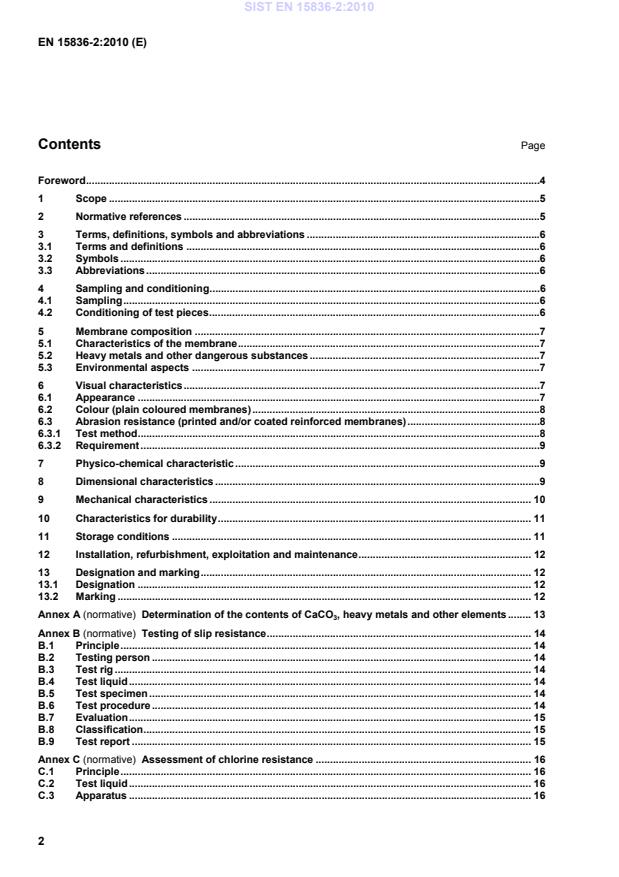
Determination of the contents of CaCO3, heavy metals and other elements . 13Annex B (normative)
Testing of slip resistance . 14B.1 Principle . 14B.2 Testing person . 14B.3 Test rig . 14B.4 Test liquid . 14B.5 Test specimen . 14B.6 Test procedure . 14B.7 Evaluation . 15B.8 Classification . 15B.9 Test report . 15Annex C (normative)
Assessment of chlorine resistance . 16C.1 Principle . 16C.2 Test liquid . 16C.3 Apparatus . 16SIST EN 15836-2:2010
Assessment of the resistance to staining agents . 18D.1 Principle. 18D.2 Staining agents . 18D.3 Apparatus . 18D.4 Test specimens . 18D.5 Procedure . 18D.6 Expression of results . 19D.7 Test report . 19Bibliography . 20 SIST EN 15836-2:2010
According to the CEN/CENELEC Internal Regulations, the national standards organizations of the following countries are bound to implement this European Standard: Austria, Belgium, Bulgaria, Croatia, Cyprus, Czech Republic, Denmark, Estonia, Finland, France, Germany, Greece, Hungary, Iceland, Ireland, Italy, Latvia, Lithuania, Luxembourg, Malta, Netherlands, Norway, Poland, Portugal, Romania, Slovakia, Slovenia, Spain, Sweden, Switzerland and the United Kingdom.
EN 1850-2:2001, Flexible sheets for waterproofing — Determination of visible defects — Part 2: Plastic and rubber sheets for roof waterproofing EN 12310-2, Flexible sheets for waterproofing — Determination of resistance to tearing — Part 2: Plastic and rubber sheets for roof waterproofing EN 12311-2:2000, Flexible sheets for waterproofing — Determination of tensile properties — Part 2: Plastic and rubber sheets for roof waterproofing EN 12316-2, Flexible sheets for waterproofing — Determination of peel resistance of joints — Part 2: Plastic and rubber sheets for roof waterproofing EN 20105-A02, Textiles — Tests for colour fastness — Part A02: Grey scale for assessing change in colour (ISO 105-A02:1993) EN ISO 62:2008, Plastics — Determination of water absorption (ISO 62:2008) EN ISO 175:2000, Plastics — Methods of test for the determination of the effects of immersion in liquid chemicals (ISO 175:1999) EN ISO 291, Plastics — Standard atmospheres for conditioning and testing (ISO 291:2008) EN ISO 846:1997, Plastics — Evaluation of the action of microorganisms (ISO 846:1997) SIST EN 15836-2:2010
mass per unit area declared by the manufacturer, in grams per square metre 3.3 Abbreviations CaCO3
calcium carbonate PVC-P
plasticized poly(vinyl chloride) 4 Sampling and conditioning 4.1 Sampling The test pieces shall be taken only from rolls of unused membranes. 4.2 Conditioning of test pieces Unless otherwise specified by the applicable test method, the test pieces used for the determination of the characteristics shall be conditioned before testing for at least 4 h in standard atmosphere 23/50 [(23 ± 2) °C, (50 ± 10) % HR] according to EN ISO 291. SIST EN 15836-2:2010
Test parameters Test method Mass per unit area
Ms 105+−% g/m2 Ms
mass per unit area declared by the manufacturer
EN 1849-2 Water absorption
≤ 1 % mass Duration of immersion Test temperature
168 h (23 ± 2) °C
EN ISO 62:2008, Method 1 a CaCO3 content ≤
3 % mass
Annex A a The edges of the test pieces may be made leaktight by dissolution of PVC-P in tétrahydrofurane (THF).
5.2 Heavy metals and other dangerous substances The PVC-P membranes should conform to all national and international regulations in force. The PVC-P membranes shall consist of materials that are not substances classified as carcinogen category 1 or carcinogen category 2, mutagen category 1 or mutagen category 2, toxic to reproduction category 1 or toxic to reproduction category 2 (see Directive 76/769/EEC [1]). The total concentration of lead (Pb), cadmium (Cd), mercury (Hg), hexavalent chromium [Cr(VI)] and arsenic (As) shall not exceed 100 mg/kg. NOTE This requirement is based on the concentration levels of heavy metals present in packaging as defined in Directive 94/62/EC, Article 11 [2]. For the determination of the total concentration of Pb, Cd, Hg, Cr(VI) and As, the method given in Annex A shall be used. 5.3 Environmental aspects The PVC-P compounds are recyclable materials that can be treated in a material recovery process intended to save resources while minimising harmful emissions into air, water and soil as well as their impacts on human health. NOTE A scheme for the characterisation of plastics waste is given in EN 15347 [3] and data for the characterisation of PVC recyclates are given in EN 15346 [4]. 6 Visual characteristics 6.1 Appearance Visible defects in the reinforced membrane shall be determined using the method specified in EN 1850-2. SIST EN 15836-2:2010
...