

prEN 12094-7
(Main)Fixed firefighting systems - Components for gas extinguishing systems - Part 7: Requirements and test methods for nozzles
General Information
- Abstract
This document specifies requirements and test methods for room protection nozzles which introduce CO2, inert gas or halocarbon gas into a protected zone. The design of the nozzles will influence discharge rate and thus the pressure drop in the piping network. This standard is not applicable to local application nozzles.
- Status
- Not Published
- Technical Committee
- CEN/TC 191 - Fixed firefighting systems
- Drafting Committee
- CEN/TC 191/WG 6 - Gas extinguishing Systems and components
- Current Stage
- 3098 - Decision to reject - Consensus building
- Due Date
- 07-Aug-2009
- Completion Date
- 07-Aug-2009



Overview
prEN 12094-7 - "Fixed firefighting systems - Components for gas extinguishing systems - Part 7: Requirements and test methods for nozzles" (CEN draft, 2006) defines the design, performance and type-test requirements for room protection nozzles used to discharge CO2, inert gases or halocarbon gases into protected enclosures. The standard covers nozzle geometry, flow and distribution characteristics, durability (pressure, thermal and corrosion resistance), protection devices and required documentation. It does not apply to local (direct) application nozzles.
Keywords: prEN 12094-7, gas extinguishing systems, room protection nozzles, CO2 nozzles, inert gas nozzles, halocarbon nozzles, test methods
Key Topics
- Scope & Terms: Definitions for room protection nozzle, flow rate, distribution characteristics, nozzle efficiency factor and working pressure.
- Design requirements:
- Metal parts to be corrosion-resistant (e.g., stainless steel, copper, galvanized steel).
- Manufacturer to state system/type and pressures (e.g., CO2 low/high pressure; inert and halocarbon working and minimum nozzle pressures).
- Connection threads to comply with ISO/EN thread standards (ISO 7-1, EN ISO 228-1).
- Nozzle openings & filters:
- Minimum individual discharge opening: 1 mm.
- No filter required for openings ≥ 3 mm; required for openings < 3 mm.
- Filter mesh between 0.5 mm and 0.8 mm; unrestricted filter area ≥ 5× nozzle cross section.
- Performance & tests:
- Verification of flow rate and distribution characteristics (uniform distribution volume).
- Resistance tests for pressure, heat, cold shock (for CO2/halocarbons), corrosion, stress corrosion and vibration.
- Nozzle protection device must eject clear at test pressures between 0.1 bar and 3 bar without affecting distribution.
- Documentation, marking & conformity: Type tests, factory production control, marking and requirements related to CE/Construction Products Directive (Annex ZA).
Applications
- Used by manufacturers for product design and type testing and to prepare technical files and installation instructions.
- Used by fire protection engineers & system designers to select nozzles that meet hydraulic and distribution requirements and to calculate pressure drop in piping networks.
- Used by test laboratories, certification bodies, installers and specifiers to confirm compliance, ensure reliable discharge rates and prevent nozzle blockage.
- Important for projects involving room flooding using CO2, inert gas (argon/nitrogen mixtures) or halocarbon agents where uniform distribution and proven nozzle performance are critical.
Related Standards
- EN 12094 series (components for gas extinguishing systems)
- ISO 14520 (gaseous fire-extinguishing systems - physical properties and system design)
- ISO 7-1, EN ISO 228-1 (pipe thread standards)
- EN ISO 9001 (quality management related to production and testing)
This standard is essential for ensuring safe, reliable nozzle performance and correct hydraulic design in fixed gaseous fire-extinguishing systems.
Get Certified
Connect with accredited certification bodies for this standard

CIS Institut d.o.o.
Personal Protective Equipment (PPE) certification body. Notified Body NB-2890 for EU Regulation 2016/425 PPE.

Kiwa BDA Testing
Building and construction product certification.
Kmetijski inštitut Slovenije
Agricultural Institute of Slovenia. Soil testing, plant health, agricultural product analysis.
Sponsored listings
Frequently Asked Questions
prEN 12094-7 is a draft published by the European Committee for Standardization (CEN). Its full title is "Fixed firefighting systems - Components for gas extinguishing systems - Part 7: Requirements and test methods for nozzles". This standard covers: This document specifies requirements and test methods for room protection nozzles which introduce CO2, inert gas or halocarbon gas into a protected zone. The design of the nozzles will influence discharge rate and thus the pressure drop in the piping network. This standard is not applicable to local application nozzles.
This document specifies requirements and test methods for room protection nozzles which introduce CO2, inert gas or halocarbon gas into a protected zone. The design of the nozzles will influence discharge rate and thus the pressure drop in the piping network. This standard is not applicable to local application nozzles.
prEN 12094-7 is classified under the following ICS (International Classification for Standards) categories: 13.220.10 - Fire-fighting; 13.220.20 - Fire protection. The ICS classification helps identify the subject area and facilitates finding related standards.
prEN 12094-7 is associated with the following European legislation: Standardization Mandates: M/109. When a standard is cited in the Official Journal of the European Union, products manufactured in conformity with it benefit from a presumption of conformity with the essential requirements of the corresponding EU directive or regulation.
prEN 12094-7 is available in PDF format for immediate download after purchase. The document can be added to your cart and obtained through the secure checkout process. Digital delivery ensures instant access to the complete standard document.
Standards Content (Sample)
SLOVENSKI oSIST prEN 12094-7:2006
PREDSTANDARD
marec 2006
Vgrajeni gasilni sistemi – Sestavni deli sistemov za gašenje s plinom – 7. del:
Zahteve in preskusne metode za šobe
Fixed firefighting systems – Components for gas extinguishing systems – Part 7:
Requirements and test methods for nozzles
ICS 13.220.10 Referenčna številka
© Standard je založil in izdal Slovenski inštitut za standardizacijo. Razmnoževanje ali kopiranje celote ali delov tega dokumenta ni dovoljeno
EUROPEAN STANDARD
DRAFT
NORME EUROPÉENNE
EUROPÄISCHE NORM
January 2006
ICS 13.220.10; 13.220.20 Will supersede EN 12094-7:2000
English Version
Fixed firefighting systems - Components for gas extinguishing
systems - Part 7: Requirements and test methods for nozzles
Installations fixes de lutte contre l'incendie - Éléments Ortsfeste Brandbekämpfungsanlagen - Bauteile für
constitutifs des installations d'extinction à gaz - Partie 7 : Löschanlagen mit gasförmigen Löschmitteln - Teil 7:
Exigences et méthodes d'essai pour diffuseurs Anforderungen und Prüfverfahren für Düsen
This draft European Standard is submitted to CEN members for enquiry. It has been drawn up by the Technical Committee CEN/TC 191.
If this draft becomes a European Standard, CEN members are bound to comply with the CEN/CENELEC Internal Regulations which
stipulate the conditions for giving this European Standard the status of a national standard without any alteration.
This draft European Standard was established by CEN in three official versions (English, French, German). A version in any other language
made by translation under the responsibility of a CEN member into its own language and notified to the Management Centre has the same
status as the official versions.
CEN members are the national standards bodies of Austria, Belgium, Cyprus, Czech Republic, Denmark, Estonia, Finland, France,
Germany, Greece, Hungary, Iceland, Ireland, Italy, Latvia, Lithuania, Luxembourg, Malta, Netherlands, Norway, Poland, Portugal, Romania,
Slovakia, Slovenia, Spain, Sweden, Switzerland and United Kingdom.
Recipients of this draft are invited to submit, with their comments, notification of any relevant patent rights of which they are aware and to
provide supporting documentation.
: This document is not a European Standard. It is distributed for review and comments. It is subject to change without notice and
Warning
shall not be referred to as a European Standard.
EUROPEAN COMMITTEE FOR STANDARDIZATION
COMITÉ EUROPÉEN DE NORMALISATION
EUROPÄISCHES KOMITEE FÜR NORMUNG
Management Centre: rue de Stassart, 36 B-1050 Brussels
© 2006 CEN All rights of exploitation in any form and by any means reserved Ref. No. prEN 12094-7:2006: E
worldwide for CEN national Members.
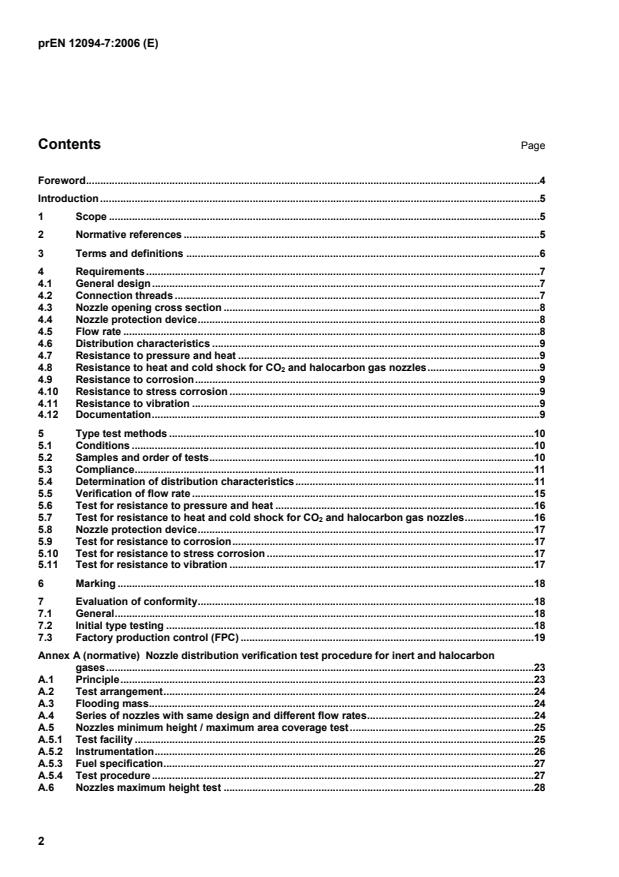
Contents Page
Foreword.4
Introduction .5
1 Scope .5
2 Normative references .5
3 Terms and definitions .6
4 Requirements.7
4.1 General design.7
4.2 Connection threads .7
4.3 Nozzle opening cross section .8
4.4 Nozzle protection device.8
4.5 Flow rate .8
4.6 Distribution characteristics .9
4.7 Resistance to pressure and heat .9
4.8 Resistance to heat and cold shock for CO and halocarbon gas nozzles.9
4.9 Resistance to corrosion.9
4.10 Resistance to stress corrosion .9
4.11 Resistance to vibration .9
4.12 Documentation.9
5 Type test methods .10
5.1 Conditions .10
5.2 Samples and order of tests.10
5.3 Compliance.11
5.4 Determination of distribution characteristics.11
5.5 Verification of flow rate .15
5.6 Test for resistance to pressure and heat .16
5.7 Test for resistance to heat and cold shock for CO and halocarbon gas nozzles.16
5.8 Nozzle protection device.17
5.9 Test for resistance to corrosion.17
5.10 Test for resistance to stress corrosion .17
5.11 Test for resistance to vibration .17
6 Marking .18
7 Evaluation of conformity.18
7.1 General.18
7.2 Initial type testing .18
7.3 Factory production control (FPC) .19
Annex A (normative) Nozzle distribution verification test procedure for inert and halocarbon
gases.23
A.1 Principle.23
A.2 Test arrangement.24
A.3 Flooding mass.24
A.4 Series of nozzles with same design and different flow rates.24
A.5 Nozzles minimum height / maximum area coverage test.25
A.5.1 Test facility .25
A.5.2 Instrumentation.26
A.5.3 Fuel specification.27
A.5.4 Test procedure.27
A.6 Nozzles maximum height test .28
A.7 Determination of distribution performance of the nozzle .28
Annex ZA (informative) Clauses of this European Standard addressing the provisions of the
Construction Products Directive .29
ZA.1 Scope and relevant characteristics .29
ZA.2 Procedure for the attestation of conformity of nozzles.30
ZA.2.1 Systems of attestation of conformity.30
ZA.2.2 Certificate and Declaration of conformity.30
ZA.3 CE marking and labelling.31
Bibliography.33
Foreword
This document (prEN 12094-7:2006) has been prepared by Technical Committee CEN/TC 191 “Fixed
firefighting systems”, the secretariat of which is held by BSI.
This document is currently submitted to the CEN Enquiry.
This document will supersede EN 12094-7:2000.
This document has been prepared under a mandate given to CEN by the European Commission and the
European Free Trade Association, and supports essential requirements of EU Directive(s).
For relationship with EU Directive(s), see informative annex ZA, which is an integral part of this document.
This document is part of a series concerned with gas extinguishing system components.
The following European Standards are planned to cover:
gas extinguishing systems (EN 12094)
sprinkler systems (EN 12259 and EN 12845)
powder systems (EN 12416)
explosion protection systems (EN 26184)
foam systems (EN 13565)
hose systems (EN 671)
smoke and heat control systems (EN 12101)
water spray systems (EN 14816)
This European Standard has the general title "Fixed firefighting systems – Components for gas extinguishing
systems" and will consist of the following parts:
Part 1: Requirements and test methods for electrical automatic control and delay devices
Part 2: Requirements and test methods for non-electrical automatic control and delay devices
Part 3: Requirements and test methods for manual triggering and stop devices
Part 4: Requirements and test methods for container valve assemblies and their actuators
Part 5: Requirements and test methods for high and low pressure selector valves and their actuators
Part 6: Requirements and test methods for non electrical disable devices
Part 7: Requirements and test methods for nozzles
Part 8: Requirements and test methods for connectors
Part 9: Requirements and test methods for special fire detectors
Part 10: Requirements and test methods for pressure gauges and pressure switches
Part 11: Requirements and test methods for mechanical weighing devices
Part 12: Requirements and test methods for pneumatic alarm devices
Part 13: Requirements and test methods for check valves and non-return valves
Part 16: Requirements and test methods for odorizing devices for CO low pressure systems
Part 17: Requirements and test methods for pipe hangers
Part 20: Requirements and test methods for the compatibility of components
Introduction
It has been assumed in the preparation of this Standard that the execution of its provisions is entrusted to
appropriately qualified and experienced people.
All pressure data in this document are given as gauge pressures in bar, unless otherwise stated.
5 -2
NOTE 1 bar = 10 N m = 100 kPa.
1 Scope
This document specifies requirements and test methods for room protection nozzles which introduce CO ,
inert gas or halocarbon gas into a protected zone.
The design of the nozzles will influence discharge rate and thus the pressure drop in the piping network.
This standard is not applicable to local application nozzles.
2 Normative references
The following referenced documents are indispensable for the application of this document. For dated
references, only the edition cited applies. For undated references, the latest edition of the referenced
document (including any amendments) applies.
ISO 7-1, Pipe threads where pressure-tight joints are made on the threads - Part 1: Dimensions, tolerances
and designation
EN ISO 228-1, Pipe threads where pressure-tight joints are not made on the threads - Part 1: Dimensions,
tolerances and designation
EN ISO 9001:2000, Quality management systems – Requirements (ISO 9001:2000)
ISO 14520 (all Parts), Gaseous fire-extinguishing systems – Physical properties and system design
3 Terms and definitions
For the purposes of this document the following terms and definitions apply.
3.1
CO -high-pressure installation
fire extinguishing installation in which the CO is stored at ambient temperature. For example, the pressure of
the CO in storage is p = 58,6 bar at 21 °C
2 abs
3.2
CO -low-pressure installation
fire extinguishing installation in which the CO is stored at low temperature, normally –19 °C to –21 °C
3.3
cross section
total area of all smallest geometrical single areas
3.4
distribution characteristics
volume in which the extinguishant is distributed uniformly from a nozzle
3.5
filter
a component to prevent blockage of nozzles
3.6
flow rate
mass flow of extinguishant against time
3.7
functional reliability
ability of function under different working conditions
3.8
halocarbon gas
extinguishant which contains as primary components one or more organic compounds containing one or more
of the elements fluorine, chlorine, bromine or iodine
3.9
halocarbon gas installation
fire extinguishing installation in which the halocarbon gas is stored at ambient temperature
3.10
inert gas
non liquefied gas or mixture of gases which extinguishes the fire mainly by reducing the oxygen-concentration
in the protected zone, e.g. Argon, Nitrogen or CO or mixtures of these gases
3.11
inert gas installation
fire extinguishing installation in which the inert gas is stored at ambient temperature
3.12
nozzle
component to achieve a predetermined flow rate and a uniformed distribution characteristic of the
extinguishant into or onto a protected hazard
3.13
nozzle efficiency factor
nozzle specific ratio between the real storage mass and the theoretical storage mass based on the
extinguishing concentration
3.14
nozzle protection device
component to protect nozzles against exterior dirt
3.15
resistance coefficient
value for the calculation of the pressure drop in a component under flow condition
3.16
room protection nozzle
nozzle, from which extinguishant is discharged for distribution throughout an enclosure
3.17
working pressure
pressure at which the component is used in the system
4 Requirements
4.1 General design
4.1.1 The test sample shall comply to the technical description (drawings, parts list, description of functions,
operating and installation instructions) when checked in accordance with 5.3.
Metal parts of the component shall be made of corrosion resistant materials, e.g. stainless steel, copper,
copper alloy or corrosion-protected steel (e.g. galvanized steel).
4.1.2 For CO nozzles, the manufacturer shall specify the type of system (CO -low pressure and/or CO -
2 2 2
high pressure).
4.1.3 For inert gas nozzles, the manufacturer shall specify the working pressure and the minimum nozzle
pressure.
4.1.4 For halocarbon gas nozzles, the manufacturer shall specify:
a) the type of system (halocarbon gas and storage pressure at + 20 °C); and
b) the working pressure; and
c) the minimum nozzle pressure.
4.2 Connection threads
Connection threads shall comply with National Standards, European Standards or International Standards, e.g.
ISO 7-1 and EN ISO 228-1.
NOTE For the purpose of this sub-clause, the term "International" means also "internationally recognized".
4.3 Nozzle opening cross section
The minimum dimension of any individual discharge opening of the nozzle shall not be smaller than 1 mm.
Nozzles with dimension of discharge opening ≥ 3 mm shall not be equipped with a filter. Nozzles with
dimensions of discharge openings < 3 mm shall be equipped with a filter.
The filter shall be made of corrosion resistant metal. The unrestricted filter surface area shall be at least five
times the nozzle cross section. The mesh of the filter shall be between 0,5 mm and 0,8 mm, measured in the
plane of the hole.
To prevent blockage of the nozzle by solid-phase particles the cross sectional area of the nozzle should
decrease in the direction of flow. Orifice plates are not allowed in nozzles for extinguishants which can partly
change to solid phase, except where blockage of downstream flow paths/orifices by solid-phase particles is
prevented by the design of the nozzle.
4.4 Nozzle protection device
If the nozzle opening is protected against exterior dirt with a cap or similar cover, this protection device shall
eject clear of the nozzle's full opening cross section at a test pressure between 0,1 bar and 3 bar when tested in
accordance with 5.8. The protection device shall not affect extinguishant distribution.
4.5 Flow rate
4.5.1 For CO nozzles the manufacturer shall specify the information which describes the flow rate of the
nozzle in kilograms medium per second as follows:
a) in the pressure range from 10 bar to 18 bar depending on storage pressure at storage temperature -20 °C
for CO -low pressure;
b) in the pressure range from 14 bar to 50 bar depending on storage pressure at storage temperature
+ 20 °C for CO -high pressure.
The flow characteristics figures given by the manufacturer shall be within ± 10 % of the value(s) determined in
accordance with 5.5.2.
Where filters are installed, these shall be taken into account when determining the flow rate.
4.5.2 For inert gas nozzles the manufacturer shall specify the information which describes the flow rate of
the nozzle in kilograms medium per second in the pressure range from 2 bar to the working pressure and in
the temperature range from – 20 °C to + 20 °C.
The flow characteristics figures given by the manufacturer shall be within ± 10 % of the value(s) determined in
accordance with 5.5.3.
Where filters are installed, these shall be taken into account when determining the flow rate.
4.5.3 For halocarbon gas nozzles the manufacturer shall specify the information which describes the flow
rate of the nozzle in kilograms medium per second in the pressure range from the minimum nozzle pressure
to 1 bar below the storage pressure depending on storage pressure at + 20 °C.
The flow characteristics figures given by the manufacturer shall be within ± 10 % of the value(s) determined in
accordance with 5.5.4.
Where filters are installed, these shall be taken into account when determining the flow rate.
4.6 Distribution characteristics
4.6.1 For CO nozzles, the distribution of extinguishant shall be tested in accordance with 5.4.2.
4.6.2 For inert gas nozzles, the distribution of extinguishant shall be tested in accordance with 5.4.3 or in
accordance with Annex A.
4.6.3 For halocarbon gas nozzles, the distribution of extinguishant shall be tested in accordance with 5.4.4
or in accordance with Annex A.
4.7 Resistance to pressure and heat
The nozzles shall be able to withstand the test pressures and temperatures given in Table 1.
Table 1 — Test pressure and temperature
Type of system Test pressure Test temperature
bar °C
High-pressure CO 60 600
Low-pressure CO 25 600
Inert gas working pressure 600
Halocarbon gas working pressure 600
Following testing for pressure and heat resistance in accordance with 5.6, the nozzles shall show no signs of
deterioration which could impair proper performance.
4.8 Resistance to heat and cold shock for CO and halocarbon gas nozzles
The nozzles shall withstand both the high temperatures generated during a fire and the cold shock caused by
the extinguishant as it is discharged. Following testing for heat and cold shock resistance in accordance with 5.7,
the nozzles shall show no signs of deterioration which could impair proper functioning.
4.9 Resistance to corrosion
The performance of the nozzles shall not be adversely affected as a result of the corrosion test in accordance
with 5.9.
4.10 Resistance to stress corrosion
Any copper alloy part used in nozzles shall not crack, when tested in accordance with 5.10.
4.11 Resistance to vibration
Nozzles assembled from several parts shall not be damaged, when tested in accordance with 5.11.
4.12 Documentation
4.12.1 The manufacturer shall prepare and maintain documentation.
4.12.2 The manufacturer shall prepare installation and user documentation, which shall be submitted to the
testing authority together with the sample(s). This documentation shall comprise at least the following:
a) a general description of the component, including a list of its features and functions;
b) a technical specification including:
1) the information mentioned in 4.1;
2) sufficient information to permit an assessment of the compatibility with other components of the
system (if applicable e.g. mechanical, electrical or software compatibility);
c) installation instructions including mounting instructions;
d) operating instructions;
e) maintenance instructions;
f) routine testing instructions if appropriate.
4.12.3 The manufacturer shall prepare design documentation, which shall be submitted to the testing
authority together with the sample(s). This documentation shall include drawings, parts lists, block diagrams (if
applicable), circuit diagrams (if applicable) and a functional description to such an extent that compliance with
this document can be checked and that a general assessment of the design is possible.
5 Type test methods
5.1 Conditions
The components shall be assembled for test as specified in the technical description. The tests shall be
carried out at a temperature of (25 ± 10) °C, except when otherwise specified for a particular test.
The tolerance for all test parameters is 5 %, unless otherwise stated.
5.2 Samples and order of tests
When testing a nozzle type with only one size, four test samples are necessary. The order of tests is shown in
Table 2.
Table 2 — Order of tests
Test methods Order of tests for
Sample A Sample B Sample C Sample D
5.3 Compliance 1 1 1 1
5.4 Determination of distribution characteristics 2
5.5 Determination of flow rate 2/4
5.6 Test for resistance to pressure and heat 2
5.7 Test for resistance to heat and cold shock 3
5.8 Nozzle protection device 2
5.9 Test for resistance to corrosion 3
5.10 Test for resistance to stress corrosion 3
5.11 Vibration test 3
When testing a series of nozzles, where the nozzles are of identical design with the exception of their size (cross
section of discharge opening), the following test samples are necessary:
2 test samples of smallest size,
1 test sample of medium size,
2 test samples of largest size,
1 or more test samples of a size agreed with the testing authority.
NOTE By this agreement, the dimensions of already available test rooms for test 5.4 may be taken into account.
The order of tests for this case shall be as follows:
First test sample of smallest size: as test sample A of Table 2.
Second test sample of smallest size: as test sample D of Table 2.
Test sample of medium size: as test sample A of Table 2 without tests 3 and 4.
First test sample of largest size: as test sample A of Table 2 without tests 3 and 4.
Second test sample of largest size: as test sample B of Table 2.
Test sample(s) of the size agreed with the testing authority: as test sample C of Table 2.
5.3 Compliance
This test relates to the requirement of 4.1.
A visual and measurement check shall be made to determine whether the nozzles correspond to the description
in the technical literature (drawings, parts lists, description of function, operating and installation instruction).
5.4 Determination of distribution characteristics
5.4.1 General
This test relates to the requirement of 4.6.
5.4.2 CO -Nozzles
For testing the distribution characteristics with one or more nozzles in a test room the following test conditions
shall be set-up:
a) test room: area 30 m ± 30% with a relation of length to width of (1 -0/+1), height 5 m ± 30%, volume
150 m ± 20%
b) pressure in the CO supply container: (20 ± 1) bar;
c) pressure at the nozzle: (13 ± 2) bar;
d) flow rate: (1 ± 0,1) kg/m referenced to the volume of the test room;
e) gaseous phase time maximum 10 s. The mass flow during this time shall not exceed 10 % of the mass of
the liquid phase;
f) liquid phase time (60 ± 5) s. The CO supply shall be shut down immediately after this period.
Concentration measurements shall be made to determine whether the CO is distributed evenly in the volume
served by the nozzle(s). The deviation of the concentration of the different measuring points shall be at
maximum five percentage points (60 ± 10) s after the end of the discharge. The test set-up is shown in Figure 1.
The test room shall be equipped with a pressure relief opening in the ceiling or near the ceiling. The pressure
relief opening shall be closed when the flooding mass has been discharged.
A visual check shall be made, to ensure that no significant quantity of CO "dry-ice" is present in the test room
15 min after the conclusion of testing.
a) front view of the test room b) side view of the test room
c) top view of the test room
Key
p pressure measuring point
m mass measuring point
h room height, in metres
b width of room according to the flow rate of nozzle, in metres
l length of room according to the flow rate of nozzle, in metres
M to M concentration measuring points 1 to 6
1 6
Arrangement for concentration measuring points:
height above floor
M ; M: 0,1 × h
1 6
M ; M: 0,5 × h
2 5
M ; M: 0,9 × h
3 4
distance from walls
M , M , M and M: 0,1 × l from wall of length b and 0,1 × b from wall of length l
1 2 3 4
M and M: 0,5 × l from wall of length b and 0,1 × b from wall of length l.
2 5
Figure 1 — Test configuration for CO room protection nozzles
5.4.3 Inert gas nozzles
The tests may be done using any Inert gas or gaseous CO .
For testing the distribution characteristic with one or more nozzles in a test room the following test conditions
shall be set up:
2 2
a) test room: area 30 m ± 9 m with a relation of length to width of 1:2, height 5 m ± 1,5 m, volume
3 3
150 m ± 30 m ;
b) flooding mass: a mass which gives an Oxygen-reduction from a volume fraction of 20,8% to (13 ± 1)% in
the test room; the gas supply shall be shut down immediately after flooding of the flooding mass;
c) start-pressure in the supply container: design pressure of the system bar, but maximum 50 bar;
− 5
d) pressure at the nozzle during the tests: in the range of 50 % to 75 % of the pressure in the supply
container;
e) flooding time: (60 ± 5) s;
f) supply mass: maximum 120 % of the flooding mass.
Oxygen concentration measurements shall be made to determine whether the test gas is distributed evenly in
the volume served by the nozzle(s). The deviation of the concentration of the different measuring points shall
be at maximum volume fraction of 0,7 % Oxygen (60 ± 10) s after the end of the discharge. The test set-up
except the test gas supply shall be as shown in Figure 1. The test room shall be equipped with a pressure
relief opening in the ceiling or near the ceiling. The pressure relief opening shall be closed when the flooding
mass has been discharged.
5.4.4 Halocarbon gas nozzles
The test shall be done using the extinguishant.
For testing the distribution characteristic with one or more nozzles in a test room the following test conditions
shall be set up:
2 2
a) test room: area 30 m ± 9 m with a relation of length to width of 1:2, height 5 m ± 1,5 m, volume
3 3
150 m ± 30 m ;
b) supply mass: a mass which gives the extinguishing concentration for Heptane % in accordance with
− 5
the relevant part of ISO 14520 for the extinguishant;
c) superpressurization (if applicable): lowest specified storage pressure at 20 °C;
d) pressure at the nozzle (mean pressure during liquid phase flooding): maximum 80 % of specified
minimum nozzle pressure;
e) flooding time: (10 ± 1) s
Concentration measurements (preferably extinguishant concentration) shall be made to determine whether
the test gas is distributed evenly in the volume served by the nozzle(s). The concentration at all measuring
points shall reach at least a concentration of 5 % relative below the extinguishing concentration for Heptane
(10 ± 5) s after the end of the discharge. With the established minimum concentration as above, the deviation,
i.e. the maximum minus minimum concentration between the different measuring points shall be ≤ 10 % of the
extinguishing concentration for Heptane. The test set-up except the test gas supply shall be as shown in
Figure 1. The test room shall be equipped with a pressure relief opening in the ceiling or near the ceiling. The
pressure relief opening shall be closed when the flooding mass has been discharged.
A visual check or a check by other suitable means shall be made, to ensure that no liquid extinguishant is
present in the test room after the conclusion of testing.
5.5 Verification of flow rate
5.5.1 General
This test relates to the requirements of 4.5.
5.5.2 CO -Nozzles
Checks shall be made to determine whether the test samples comply with the flow rate indicated by the
manufacturer. Deviations shall not exceed ± 10 %. The test set-up is shown in Figure 2.
Key
t1 Temperature at the nozzle P2 Pressure in the container D diptube (if applicable)
t2 Temperature in the container C supply container m mass measuring point
P1 Pressure at the nozzle V container valve N nozzle
Figure 2 — Test configuration for flow rate test for CO nozzles
5.5.3 Inert gas nozzles
Checks shall be made to determine whether the test samples comply with the flow rate indicated by the
manufacturer. Deviations shall not exceed ± 10 %. The test set-up is generally shown in Figure 2. Diptube,
measuring point t2 and measuring point P2 are not necessary.
5.5.4 Halocarbon gas nozzles
Checks shall be made to determine whether the test samples comply with the flow rate indicated by the
manufacturer. Deviations shall not exceed ± 10 %. The test set-up is shown in Figure 2.
5.6 Test for resistance to pressure and heat
This test relates to the requirements of 4.7.
A nozzle is connected to the test vessel. The nozzle is connected with a pressure source and is subjected to a
temperature of (600 ± 30)°C for a period of 10 min. Then the gaseous test medium, e.g. gaseous phase CO ,
nitrogen or air shall flow through the heated nozzle body for at least 10 s,
for CO -high pressure nozzles at (60 ± 3) bar,
for CO -low pressure nozzles at (25 ± 2) bar,
for inertgas nozzles at the specified working pressure,
for halocarbon gas nozzles at the specified working pressure.
NOTE In case of test pressures exceeding 60 bar, the nozzle outlet(s) may be partly or fully blocked by suitable
means (without affecting the strength characteristics of the component) to prevent damage of test equipment by excessive
gas flow.
The pressure shall be measured at a distance of (1 ± 0,1) m upstream from the nozzle. The nominal diameter
of the pipe between pressure measuring point and nozzle shall be not less than the nominal size of the
connection thread of the nozzle tested.
5.7 Test for resistance to heat and cold shock for CO and halocarbon gas nozzles
The test relates to the requirements of 4.8.
Connect the sample to a CO vessel which incorporates a diptube and is capable of delivering liquid CO at an
2 2
absolute pressure of (20 ± 1) bar. A 2-position, 3-port ball valve (bypass-valve) shall be installed in the pipework
between the vessel and the sample which allows the CO flow from the vessel to be controlled.
The pipework between the vessel and the bypass-valve shall be dimensioned to reach a pressure of at least
17 bar at the bypass-valve. The nominal diameter of the bypass-valve and the connected pipe shall be not less
than the nominal size of the connection thread of the nozzle tested.
The length of the connected pipe shall be (1 ± 0,1) m. In one position, the bypass-valve allows the CO to pass
through the sample. In the other position, the bypass position, the outlet to the sample is closed and the CO
flow is diverted via an appropriate pipework, which is dimensioned to reach a stable flow of liquid CO at the
bypass-valve within 35 s.
Subject the sample to a temperature of (600 ± 30) °C in a furnace for a period of 10 min. Just before completion
of the heating period commence CO flow through the bypass.
Upon stabilisation of liquid CO flow and completion of the heating period divert flow through the sample for a
period of 10 s. The pressure at the bypass-valve shall be at least 17 bar during this period.
Remove the sample for inspection.
5.8 Nozzle protection device
This test relates to the requirements of 4.4.
The nozzle with protection device shall be mounted on pipe equipped with a pressure gauge. The pressure in
the pipe shall be raised by 1 bar/min. The pressure required to eject the protection device clear of the nozzle's
full opening cross section shall be measured.
5.9 Test for resistance to corrosion
This test relates to the requirements of 4.9.
A sample shall be suspended freely in its normal installation attitude.
The test set-up comprises a container 5 l volume, made of heat-resistant glass and with a corrosion-resistant
cover which is shaped to prevent condensate dripping onto the samples. If a container 10 l volume is used, the
quantities of chemicals given below shall be doubled. The container is heated electrically and the side walls are
cooled with water. A thermostat regulates the heating so as to maintain a temperature of approximately 45 °C
inside the container. During testing water is passed through a cooling coil wrapped around the container; it shall
flow fast enough that its temperature at the discharge point is below 30 °C.
The combination of heating and cooling is designed to ensure that vapours will condense on the surface of the
samples. The sulphur dioxide atmosphere is generated in the 5 l container with a solution of 20 g of sodium
3 3
thiosulphate (Na S O x 5H O) in 500 cm of distilled water, to which 20 cm of dilute sulphuric acid is added
2 2 3 2
daily. The dilute sulphuric acid comprises 128 cm of one molar sulphuric acid (H SO ) dissolved in 1 l of distilled
2 4
water. The test samples shall be removed from the container after eight days; the container shall be cleaned.
Then the procedure described above is repeated for a further period of eight days.
After a total of 16 days, the samples are removed from the container and allowed to dry for seven days at a
temperature of (20 ± 5) °C at maximum relative humidity of 70 %.
5.10 Test for resistance to stress corrosion
This test relates to the requirements of 4.10.
Use a glass container of (20 ± 10) l volume fitted with a capillary tube vent. The aqueous ammonia solution shall
have a specific weight of (0,94 ± 0,02) kg/l. The container is filled with (10 ± 0,5) ml of the solution for each litre
of container volume.
Degrease the sample for test and expose for 10 days to the moist atmosphere of ammonia and air, at a
temperature of (34 ± 2) °C. The samples are positioned (40 ± 5) mm above the level of the liquid.
After testing, the samples are cleaned and dried and subjected to careful visual examination. To make cracking
clearly visible, the liquid penetration method shall be used.
5.11 Test for resistance to vibration
This test relates to the requirements of 4.11.
The sample is attached to a vibration table using fixed materials provided by the manufacturer.
The sample is then subjected to sine-wave vibration in all three axes, in a range of 10 Hz to 150 Hz. The
frequency is raised uniformly at a rate of one octave every 30 min. The vibration acceleration is 1 g in the
frequency range from 10 Hz to 50 Hz and 3 g in the 51 Hz to 150 Hz range.
No deterioration or detachment of parts shall occur. The components shall be able to function after the vibration
test.
6 Marking
Nozzles shall be marked with the following information:
a) supplier’s name or trademark; and
b) model designation/size; and
c) serial or batch number.
The markings shall be non-detachable, non-flammable, permanent and legible.
7 Evaluation of conformity
7.1 General
The compliance of the component with the requirements of this document shall be demonstrated by:
initial type testing,
factory production control by the manufacturer.
NOTE The manufacturer is a natural or legal person, who places the component on the market under his own name.
Normally, the manufacturer designs and manufactures the component himself. As a first alternative, he may have it
designed, manufactured, assembled, packed, processed or labelled by subcontracting. As a second alternative he may
assemble, pack, process, or label ready-made products.
The manufacturer shall ensure:
that the initial type testing in accordance with this document is initiated and carried out (where relevant,
under the responsibility of a product certification body); and
that the component continuously complies with the initial type testing samples, for which compliance with
this document has been verified.
He shall always retain the overall control and shall have the necessary competence to take the responsibility
for the component.
The manufacturer shall be fully responsible for the conformity of that component to all relevant regulatory
requirements. However, where the manufacturer uses components already shown to conform to those
requirements relevant for that component (e.g. by CE marking) the manufacturer is not required to repeat the
evaluation which led to such conformity. Where the manufacturer uses components not already shown to
conform, it is his responsibility to undertake the necessary evaluation to show conformity.
7.2 Initial type testing
7.2.1 Initial type testing shall be performed to demonstrate conformity with this document.
All characteristics given in clause 4 (except 4.12) shall be subject to this initial type testing, except as
described in 7.2.3 to 7.2.5.
7.2.2 In the case of modification of the component or of the method of production (where these may affect
the stated properties), initial type testing shall be performed. All characteristics given in clause 4 (except 4.12),
which may be changed by the modification, shall be subjected to this initial type testing, except as described
in 7.2.3 to 7.2.5.
7.2.3 Tests previously performed in accordance with the provisions of this document may be taken into
account providing that they were made to the same or a more rigorous test method under the same system of
attestation of conformity on the same component or components of similar design, construction and
functionality, such that the results are applicable to the component in question.
NOTE Same system of attestation of conformity means testing by an independent third party under the responsibility
of a product certification body which is now a notified product certification body.
7.2.4 Components may be grouped into families where one or more characteristics are the same for all
components within that family or the test results are representative of all components within that family. In this
case not all components of the family have to be tested for the purposes of the initial type testing.
7.2.5 Test samples shall be representative of the normal production. If the test samples are prototypes, they
shall be representative of the intended future production and shall be selected by the manufacturer.
NOTE In the case of prototypes and third party certification, this means that it is the manufacturer not the third party
who is responsible for selecting the samples. During the initial inspection of the factory and of the factory production
control (see 7.3), it is verified that the component continuously complies with the initial type testing samples.
7.2.6 If the technical documentation of the test samples does not give a sufficient basis for later compliance
checks, a reference sample (identified and marked) shall remain available for this purpose.
7.2.7 All initial type testing and its results shall be documented in a test report.
7.3 Factory production control (FPC)
7.3.1 General
The manufacturer shall establish, document and maintain an FPC system to ensure that the components
placed on the market conform with the stated performance characteristics.
If the manufacturer has the component designed, manufactured, assembled, packed, processed and labelled
by subcontracting, FPC of the subcontractor may be ta
...