

EN ISO/IEC 80079-34:2020
(Main)Explosive atmospheres - Part 34: Application of quality management systems for Ex Product manufacture (ISO/IEC 80079-34:2018)
- Abstract
ISO/IEC 80079-34:2018 specifies particular requirements and information for establishing and maintaining a quality management system to manufacture Ex Products in accordance with the certificates. While it does not preclude the use of other quality management systems that are compatible with the objectives of ISO 9001:2015 and which provide equivalent results, the minimum requirements are given in this document.
This second edition cancels and replaces the first edition, published in 2011, and constitutes a full technical revision. The significant changes with respect to the previous edition should be considered as minor technical revisions. However, the clause numbering in regard to the previous edition has changed in order to be in line with ISO 9001:2015. The normal Table of Significant Changes has not been included for this reason.
This publication is published as a double logo standard. This standard should be read in conjunction with ISO 9001:2015
- Status
- Published
- Publication Date
- 24-Mar-2020
- Technical Committee
- CEN/TC 305 - Potentially explosive atmospheres - Explosion prevention and protection
- Drafting Committee
- CEN/TC 305/WG 4 - Terminology and Methodology
- Current Stage
- 6060 - Definitive text made available (DAV) - Publishing
- Start Date
- 25-Mar-2020
- Completion Date
- 25-Mar-2020



Overview
EN ISO/IEC 80079-34:2020 (Explosive atmospheres - Part 34) specifies particular requirements and guidance for establishing and maintaining a quality management system (QMS) for the manufacture of Ex Products (equipment and protective systems intended for use in explosive atmospheres). Published by CEN and aligned with ISO/IEC 80079-34:2018, this European adoption is a full technical revision of the 2011 edition and is intended to be read in conjunction with ISO 9001:2015. The document sets minimum QMS requirements to ensure that production consistently delivers products that conform to design certificates and applicable regulatory requirements.
Key topics and requirements
- QMS scope for Ex Product manufacture: Defines the structure and information needed to demonstrate control of processes affecting safety-relevant characteristics of Ex equipment.
- Minimum documented procedures and records: Requirements for traceability, configuration control, nonconforming product handling and corrective actions consistent with ISO 9001 objectives.
- Production and verification activities: Controls and routine tests related to manufacturing, assembly and final acceptance (examples from the standard’s informative annexes include pressure tests, insulation resistance, functional tests and sealing checks).
- Supplier and material control: Selection, verification and documentation of safety‑relevant materials and components used in Ex Products.
- Audit and assessment: Internal and external audit requirements; guidance for Notified Bodies assessing quality systems under EU Directive 2014/34/EU (ATEX).
- Product-specific guidance (informative annexes): Examples and additional checks for product families such as fans, petrol dispensers, electrostatic spraying equipment and protective systems.
Practical applications
- Ensures manufactured Ex Products match the EU-type examination sample and maintain certificate conformity during serial production.
- Helps manufacturers implement a QMS tailored to explosion-protection requirements while remaining compatible with ISO 9001:2015.
- Supports documented procedures for routine testing, final inspection and release of Ex equipment to market.
- Facilitates compliance with Directive 2014/34/EU through harmonized references and annex guidance.
Who uses this standard
- Manufacturers of explosion-protected equipment and protective systems (Ex Products)
- Quality managers and production engineers implementing QMS for Ex manufacture
- Compliance and regulatory teams preparing technical files for EU market access
- Notified Bodies and auditors assessing quality systems under ATEX/2014/34/EU
Related standards
- ISO 9001:2015 - Quality management systems
- IEC 60079 series / EN IEC 60079-0 - General requirements for equipment in explosive atmospheres
- Product-specific harmonized standards (referenced in the standard’s annexes)
EN ISO/IEC 80079-34:2020 is an essential reference for organizations that need a compliant, auditable QMS focused on the safe manufacture of Ex Products for explosive atmospheres.
Relations
- Effective Date
- 10-Feb-2026
- Effective Date
- 25-Aug-2026
- Effective Date
- 25-Aug-2026
- Effective Date
- 25-Aug-2026
- Effective Date
- 09-Feb-2026
- Effective Date
- 28-Jan-2026
- Effective Date
- 28-Jan-2026
- Effective Date
- 28-Jan-2026
- Effective Date
- 28-Jan-2026
- Effective Date
- 28-Jan-2026
- Consolidated By
ISO/IEC 80079-34:2018 - Explosive atmospheres — Part 34: Application of quality management systems for Ex Product manufacture - Effective Date
- 12-Feb-2026
- Effective Date
- 05-Jun-2024
Get Certified
Connect with accredited certification bodies for this standard

IMQ S.p.A. (Certification)
Italian electrical product certification.

SLG Prüf- und Zertifizierungs GmbH
German testing and certification body.

UL Solutions
Global safety science company with testing, inspection and certification.
Sponsored listings
Frequently Asked Questions
EN ISO/IEC 80079-34:2020 is a standard published by the European Committee for Standardization (CEN). Its full title is "Explosive atmospheres - Part 34: Application of quality management systems for Ex Product manufacture (ISO/IEC 80079-34:2018)". This standard covers: ISO/IEC 80079-34:2018 specifies particular requirements and information for establishing and maintaining a quality management system to manufacture Ex Products in accordance with the certificates. While it does not preclude the use of other quality management systems that are compatible with the objectives of ISO 9001:2015 and which provide equivalent results, the minimum requirements are given in this document. This second edition cancels and replaces the first edition, published in 2011, and constitutes a full technical revision. The significant changes with respect to the previous edition should be considered as minor technical revisions. However, the clause numbering in regard to the previous edition has changed in order to be in line with ISO 9001:2015. The normal Table of Significant Changes has not been included for this reason. This publication is published as a double logo standard. This standard should be read in conjunction with ISO 9001:2015
ISO/IEC 80079-34:2018 specifies particular requirements and information for establishing and maintaining a quality management system to manufacture Ex Products in accordance with the certificates. While it does not preclude the use of other quality management systems that are compatible with the objectives of ISO 9001:2015 and which provide equivalent results, the minimum requirements are given in this document. This second edition cancels and replaces the first edition, published in 2011, and constitutes a full technical revision. The significant changes with respect to the previous edition should be considered as minor technical revisions. However, the clause numbering in regard to the previous edition has changed in order to be in line with ISO 9001:2015. The normal Table of Significant Changes has not been included for this reason. This publication is published as a double logo standard. This standard should be read in conjunction with ISO 9001:2015
EN ISO/IEC 80079-34:2020 is classified under the following ICS (International Classification for Standards) categories: 29.260.20 - Electrical apparatus for explosive atmospheres. The ICS classification helps identify the subject area and facilitates finding related standards.
EN ISO/IEC 80079-34:2020 has the following relationships with other standards: It is inter standard links to EN ISO/IEC 80079-34:2011, IEC 60050-426:2008, ISO 9001:2015, IEC 60079-0:2017, ISO 9000:2015, EN 14133:2003, EN ISO 15547-2:2005, EN 14460:2018, EN 14460:2006, EN 17673:2022, ISO/IEC 80079-34:2018, prEN ISO/IEC 80079-34. Understanding these relationships helps ensure you are using the most current and applicable version of the standard.
EN ISO/IEC 80079-34:2020 is associated with the following European legislation: EU Directives/Regulations: 2014/34/EU; Standardization Mandates: M/BC/CEN/92/46. When a standard is cited in the Official Journal of the European Union, products manufactured in conformity with it benefit from a presumption of conformity with the essential requirements of the corresponding EU directive or regulation.
EN ISO/IEC 80079-34:2020 is available in PDF format for immediate download after purchase. The document can be added to your cart and obtained through the secure checkout process. Digital delivery ensures instant access to the complete standard document.
Standards Content (Sample)
SLOVENSKI STANDARD
01-junij-2020
Nadomešča:
SIST EN ISO/IEC 80079-34:2011
Eksplozivne atmosfere - 34. del: Uporaba sistemov kakovosti za izdelavo opreme
(ISO/IEC 80079-34:2018)
Explosive atmospheres - Part 34: Application of quality systems for equipment
manufacture (ISO/IEC 80079-34:2018)
Explosionsgefährdete Bereiche - Teil 34: Anwendung von
Qualitätsmanagementsystemen für die Herstellung von Ex-Produkten (ISO/IEC 80079-
34:2018)
Atmosphères explosives - Partie 34: Application des systèmes de qualité pour la
fabrication d'équipements (ISO/IEC 80079-34:2018)
Ta slovenski standard je istoveten z: EN ISO/IEC 80079-34:2020
ICS:
03.120.99 Drugi standardi v zvezi s Other standards related to
kakovostjo quality
13.230 Varstvo pred eksplozijo Explosion protection
2003-01.Slovenski inštitut za standardizacijo. Razmnoževanje celote ali delov tega standarda ni dovoljeno.
EN ISO/IEC 80079-34
EUROPEAN STANDARD
NORME EUROPÉENNE
March 2020
EUROPÄISCHE NORM
ICS 29.260.20 Supersedes EN ISO/IEC 80079-34:2011
English Version
Explosive atmospheres - Part 34: Application of quality
systems for ex product manufacture (ISO/IEC 80079-
34:2018)
Atmosphères explosives - Partie 34: Application de Explosionsgefährdete Bereiche - Teil 34: Anwendung
systèmes de management de la qualité pour la von Qualitätsmanagementsystemen für die Herstellung
fabrication des produits Ex (ISO/CEI 80079-34:2018) von Ex-Produkten (ISO/IEC 80079-34:2018)
This European Standard was approved by CEN on 29 December 2019.
CEN members are bound to comply with the CEN/CENELEC Internal Regulations which stipulate the conditions for giving this
European Standard the status of a national standard without any alteration. Up-to-date lists and bibliographical references
concerning such national standards may be obtained on application to the CEN-CENELEC Management Centre or to any CEN
member.
This European Standard exists in three official versions (English, French, German). A version in any other language made by
translation under the responsibility of a CEN member into its own language and notified to the CEN-CENELEC Management
Centre has the same status as the official versions.
CEN members are the national standards bodies of Austria, Belgium, Bulgaria, Croatia, Cyprus, Czech Republic, Denmark, Estonia,
Finland, France, Germany, Greece, Hungary, Iceland, Ireland, Italy, Latvia, Lithuania, Luxembourg, Malta, Netherlands, Norway,
Poland, Portugal, Republic of North Macedonia, Romania, Serbia, Slovakia, Slovenia, Spain, Sweden, Switzerland, Turkey and
United Kingdom.
EUROPEAN COMMITTEE FOR STANDARDIZATION
COMITÉ EUROPÉEN DE NORMALISATION
EUROPÄISCHES KOMITEE FÜR NORMUNG
CEN-CENELEC Management Centre: Rue de la Science 23, B-1040 Brussels
© 2020 CEN All rights of exploitation in any form and by any means reserved Ref. No. EN ISO/IEC 80079-34:2020 E
worldwide for CEN national Members.
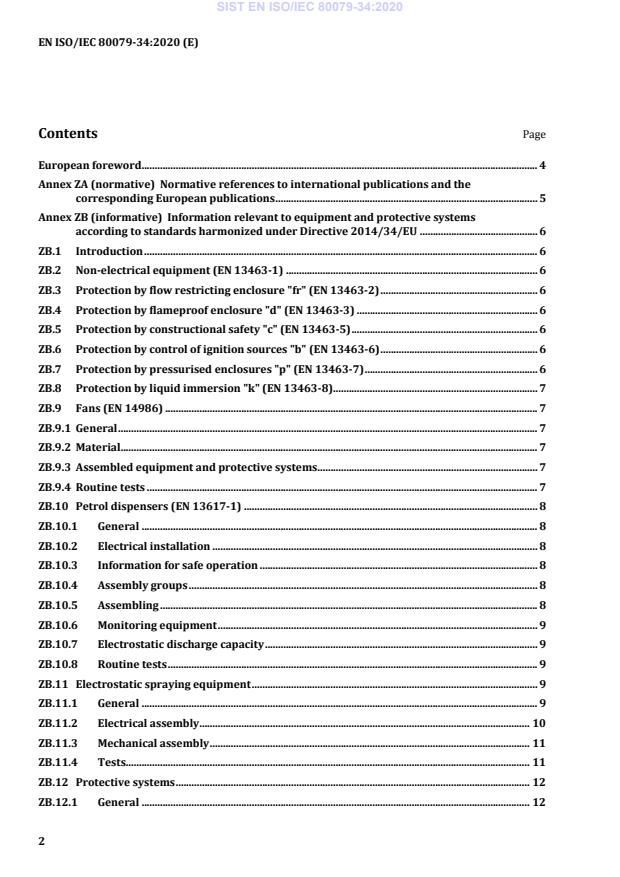
Contents Page
European foreword . 4
Annex ZA (normative) Normative references to international publications and the
corresponding European publications . 5
Annex ZB (informative) Information relevant to equipment and protective systems
according to standards harmonized under Directive 2014/34/EU . 6
ZB.1 Introduction . 6
ZB.2 Non-electrical equipment (EN 13463-1) . 6
ZB.3 Protection by flow restricting enclosure "fr" (EN 13463-2) . 6
ZB.4 Protection by flameproof enclosure "d" (EN 13463-3) . 6
ZB.5 Protection by constructional safety "c" (EN 13463-5) . 6
ZB.6 Protection by control of ignition sources "b" (EN 13463-6) . 6
ZB.7 Protection by pressurised enclosures "p" (EN 13463-7) . 6
ZB.8 Protection by liquid immersion "k" (EN 13463-8) . 7
ZB.9 Fans (EN 14986) . 7
ZB.9.1 General . 7
ZB.9.2 Material . 7
ZB.9.3 Assembled equipment and protective systems . 7
ZB.9.4 Routine tests . 7
ZB.10 Petrol dispensers (EN 13617-1) . 8
ZB.10.1 General . 8
ZB.10.2 Electrical installation . 8
ZB.10.3 Information for safe operation . 8
ZB.10.4 Assembly groups . 8
ZB.10.5 Assembling . 8
ZB.10.6 Monitoring equipment . 9
ZB.10.7 Electrostatic discharge capacity . 9
ZB.10.8 Routine tests . 9
ZB.11 Electrostatic spraying equipment . 9
ZB.11.1 General . 9
ZB.11.2 Electrical assembly . 10
ZB.11.3 Mechanical assembly . 11
ZB.11.4 Tests . 11
ZB.12 Protective systems . 12
ZB.12.1 General . 12
ZB.12.2 Explosion resistant equipment (EN 14460) . 12
ZB.12.3 Explosion venting devices (EN 14797) . 12
ZB.12.4 Explosion isolation systems (EN 15089) . 13
ZB.12.5 Flameless explosion venting devices (EN 16009) . 14
ZB.12.6 Explosion diverters (EN 16020) . 14
ZB.12.7 Explosion isolation flap valves (EN 16447) . 15
Annex ZC (informative) Significant changes between these European Annexes and the
European Annexes of EN ISO/IEC 80079-34:2011 . 16
Annex ZD (informative) Relationship between this European Standard and the essential
requirements of 2014/34/EU [2014 OJ L96] aimed to be covered . 18
European foreword
The text of ISO/IEC 80079-34:2018 has been prepared by Technical Committee ISO/TMB "Technical
Management Board - groups” of the International Organization for Standardization (ISO) and has been
taken over as EN ISO/IEC 80079-34:2020 by Technical Committee CEN/TC 305 “Potentially explosive
atmospheres - Explosion prevention and protection” the secretariat of which is held by DIN.
This European Standard shall be given the status of a national standard, either by publication of an
identical text or by endorsement, at the latest by September 2020, and conflicting national standards
shall be withdrawn at the latest by March 2023.
Attention is drawn to the possibility that some of the elements of this document may be the subject of
patent rights. CEN shall not be held responsible for identifying any or all such patent rights.
This document supersedes EN ISO/IEC 80079-34:2011.
This document has been prepared under a mandate given to CEN by the European Commission and the
European Free Trade Association, and supports essential requirements of EU Directive(s).
For relationship with EU Directives, see informative Annex ZA, ZB, ZC and ZD, which are an integral part
of this document.
According to the CEN-CENELEC Internal Regulations, the national standards organizations of the
following countries are bound to implement this European Standard: Austria, Belgium, Bulgaria,
Croatia, Cyprus, Czech Republic, Denmark, Estonia, Finland, France, Germany, Greece, Hungary, Iceland,
Ireland, Italy, Latvia, Lithuania, Luxembourg, Malta, Netherlands, Norway, Poland, Portugal, Republic of
North Macedonia, Romania, Serbia, Slovakia, Slovenia, Spain, Sweden, Switzerland, Turkey and the
United Kingdom.
Endorsement notice
The text of ISO/IEC 80079-34:2018 has been approved by CEN as EN ISO/IEC 80079-34:2020 without
any modification.
Annex ZA
(normative)
Normative references to international publications and the corresponding
European publications
The following referenced documents are indispensable for the application of this document. For dated
references, only the edition cited applies. For undated references, the latest edition of the referenced
document (including any amendments) applies.
NOTE Where an International Publication has been modified by common modifications, indicated by (mod),
the relevant EN/HD applies.
Publication Year Title EN/HD Year
IEC 60050-426 — International Electrotechnical Vocabulary — — —
Part 426: Equipment for explosive
atmospheres
IEC 60079-0 — Explosive atmospheres — Part 0: EN IEC 60079-0 2018
Equipment — General requirements
ISO 9000 2015 Quality management systems — EN ISO 9000 2015
Fundamentals and vocabulary
Annex ZB
(informative)
Information relevant to equipment and protective systems according to
standards harmonized under Directive 2014/34/EU
ZB.1 Introduction
The requirements laid down in the Directive and the standards harmonized under the Directive are the
basis for the quality assurance of the production process and the assessment of the quality system as
well. The quality system must ensure that the products resulting from the regular production process
comply with the types tested in the EU-type examination and with the applicable requirements of the
Directive.
This annex draws attention to a number of standards harmonized under the Directive which can be
used to gain detailed information on specific requirements. These references might be useful for
manufacturers to check whether the safety-relevant aspects are considered in the quality system and
covered by adequate procedures (see 8). They can also be used for internal or external quality audits
(see 9.1 and 9.2).
In quality system assessments according to Annexes IV and VII of Directive 2014/34/EU performed by
a Notified Body the auditing team must have knowledge with regard to the product specific
requirements according to the Directive.
NOTE The following examples do not cover all protection concepts and product specific requirements but
give some advice and will be supplemented to in the next edition.
ZB.2 Non-electrical equipment (EN 13463-1)
Safety aspects are covered by clause A.14 for non-electrical equipment (EN ISO 80079-36).
ZB.3 Protection by flow restricting enclosure "fr" (EN 13463-2)
Safety aspects are covered by the general clause for non-electrical equipment (EN ISO 80079-36).
ZB.4 Protection by flameproof enclosure "d" (EN 13463-3)
The same safety aspects as for electrical equipment apply (see A.3; for aspects of dust ignition
protection, see also A.10).
ZB.5 Protection by constructional safety "c" (EN 13463-5)
Safety aspects are covered by clause A.15 for non-electrical equipment (EN ISO 80079-37).
ZB.6 Protection by control of ignition sources "b" (EN 13463-6)
Safety aspects are covered by clause A.16 for non-electrical equipment (EN ISO 80079-37).
ZB.7 Protection by pressurised enclosures "p" (EN 13463-7)
The same safety aspects as for electrical equipment apply (A.6), according to A.14.1.
ZB.8 Protection by liquid immersion "k" (EN 13463-8)
Safety aspects are covered by clause A.17 for non-electrical equipment (EN ISO 80079-37).
ZB.9 Fans (EN 14986)
ZB.9.1 General
The following safety aspects as specified in the technical file should be realised by systematic
production techniques and/or verifications and tests on the basis of written procedures.
ZB.9.2 Material
Selection of specified materials; material name complies with the requirement;
material properties (composition with regard to corrosion, thermal conduction and mechanical
sparks, mass fraction of aluminium, titanium, magnesium, zirconium, flammability);
cracks, inclusions, blow holes and porosity (either by a visual test or another suitable test method
depending on exposure);
heat treatment (e.g. hardening, tempering);
dimensional accuracy including all parts without machining.
ZB.9.3 Assembled equipment and protective systems
Adaption of suitable electrical equipment (explosion group, temperature class, equipment
category);
adaption of specified protective systems for fans of category 1G.
ZB.9.4 Routine tests
Sealing systems (fit, lubrication, initial tension, primary pressure);
dynamic vibrations (e.g. critical rotation speed, bearing at standstill or at transport);
functional test of the complete assembly (distance between rotor/stator modules, clamping,
clearance, free room of motion);
excess rotation speed;
thickness of linings;
impeller-shaft attachment (avoidance of drift, joint is secured against loosening);
mounting of autonomous protective systems, if applicable;
functional test of the temperature monitoring devices in the flame arresters, if applicable;
pressure test for fans of category 1G, if applicable.
ZB.10 Petrol dispensers (EN 13617-1)
ZB.10.1 General
The following safety aspects as specified in the technical file should be realised by systematic
production techniques and/or verifications and tests on the basis of written procedures.
ZB.10.2 Electrical installation
Type of cable;
installation of cable;
correct wiring;
connection technique;
torque of screwed connections (traceability).
ZB.10.3 Information for safe operation
Availability of operating instructions;
marking on the type label (technical data, type of protection, etc.);
passing on of warning notes;
maintenance instructions.
ZB.10.4 Assembly groups
Drives or electrical equipment;
subassemblies (gears, couplings, belts);
components;
safety-relevant verifications for the interconnection of apparatus, subassemblies and components;
protective systems within the gas recirculation system.
ZB.10.5 Assembling
Correct components and parts;
minimum distances of moving parts (rotor/stator);
measures performed for equipotential bonding (to ground, between subassemblies);
protective covers.
ZB.10.6 Monitoring equipment
Installation of sensors and actuators (fail safe characteristics, separate power supply);
installation of sensors (position, correct interfacing, prevention of lag elements);
tests during maintenance (according to operating instructions);
functional tests and precision control;
insulation of cables.
For additional information, see also ZB.6.
ZB.10.7 Electrostatic discharge capacity
Materials (electrostatic discharge capacity resp. surface resistance of non-metallic parts, belts,
tubes, etc.);
limitation of the surface area for the corresponding explosion group;
thickness of the material for the corresponding explosion group.
ZB.10.8 Routine tests
Pressure test;
deactivation/activation of the controlling system before release;
insulation resistance;
functional test.
ZB.11 Electrostatic spraying equipment
ZB.11.1 General
The following safety aspects as specified in the technical file should be realised by systematic
production techniques and/or verifications and tests on the basis of written procedures.
Electrostatic spraying equipment according to the following harmonized standards:
EN 50050-1,
EN 50050-2,
EN 50050-3,
EN 50176,
EN 50177,
EN 50223.
NOTE This section ZB.11 may also be used for electrostatic spraying equipment in accordance with EN 50059
and EN 50348 harmonized under directive 2006/42/EC.
ZB.11.2 Electrical assembly
The characteristics of the following parts including control devices and accessories should be tested
with respect to the application in electrostatic spraying equipment; this means normally that the
marking on the component parts or the packaging is verified where appropriate statistical methods
may be applied as necessary:
selection of the high voltage transformer (type, manufacturer, insulation, voltage);
equipotential bonding and grounding system for the spraying equipment and control device;
number of stages of the cascade and turn ratio of the high-voltage transformer and the capacity of
the cascade;
assembling, type and value of each current limiting resistor, diode, Zener diode, capacitor or any
other safety-relevant component (e.g. hardware-watch-dog);
manual or automatic assembly of printed circuit boards;
fixing and soldering of transformer, diodes, capacitors of the cascades;
date of expiry and storage of adhesives and casting compounds;
mixing procedures (e.g. pressure, temperature, time characteristics);
surface treatment (degreasing or equivalent measures are usually required immediately before the
potting process to ensure proper adhesion);
processing, e.g. filling instructions, void-free potting, temperature conditions;
curing process including: curing time, all relevant environmental factors, provisions made to ensure
that the curing process will proceed (e.g. mains power failure detection);
selection and installation of the display;
selection and installation of power supply and line filter of the control device;
selection of cable (high voltage, low voltage);
length, type and electric strength of the cable including grounding and screening if applicable;
connection techniques and fixing method of cables between controlling device and spraying
equipment.
NOTE 1 For printed circuit boards, the manufacturer should provide a list of safety-relevant electronic
components (e.g. resistors, Zener diodes) used. 100 % of the listed components should be tested. This can be done
by visual test or for SMD-components by assuring correct charging of the component insertion automat and by
visual test of correct positioning or by automated test equipment (ATE) provided that each individual safety-
relevant electronic component is considered and that a visual inspection is performed to check the type code and
direction of components.
NOTE 2 If the SMD-insertion automat selects the correct component carrier on the basis of a value
measurement of the component, this measuring function should be calibrated.
ZB.11.3 Mechanical assembly
Materials of spraying equipment and control devices should be inspected for stability, cracks,
inclusions, bubbling and porosity;
dimensional accuracy, evenness, surface roughness, fitting accuracy, depth of bushings, flanges and
threads of the nozzles of spraying equipment and accessories (extensions, angles, etc.);
dimensional accuracy and position accuracy of the electrode(s) with respect to the nozzle;
uniformity of joints;
gaps and dimensions between the bell and the stator;
balancing of rotating parts;
mounting of spraying equipment and control unit;
torque of the screwed connections if safety relevant;
IP protection (see ZB.2.6 for details);
continuous weld seams;
mounting of annular and flat gaskets;
continuity of moulded tongues and grooves;
application of adhesives.
ZB.11.4 Tests
I and I of the spraying equipment with and without associated accessories;
max short-circuit
U of the spraying equipment with and without associated accessories;
max
open-circuit monitoring between spraying equipment and control device, if applicable;
response of the safety facilities in case of simulated malfunction, if applicable.
Where spraying equipment and associated accessories are intended to be combined user-defined,
criteria of acceptance for the tests should consider the worst case.
ZB.12 Protective systems
ZB.12.1 General
The following safety aspects as specified in the technical file should be realised by systematic
production techniques and/or verifications and tests on the basis of written procedures:
the properties of dissipative plastics are proven by the manufacturer by dint of a material
certificate and examined at least through routine tests (e.g. in accordance with HD 429, neglecting
the climate);
layer thicknesses of non-conductive coatings are examined by routine tests at a sufficient amount of
adequate measuring points;
packing boxes without a temperature control are tightened with a predefined torque;
every examination is documented.
NOTE Routine tests can be a requirement in certificates or be required by the auditing notified body.
ZB.12.2 Explosion resistant equipment (EN 14460)
The following safety aspects as specified in the technical file should be realised by systematic
production techniques and/or verifications and tests on the basis of written procedures:
pressure shock resistant devices are manufactured according to EN 13445-4, if designed according
to EN 13445-3;
pressure test for each cast part is carried out;
pressure test is carried out according to EN 14460:2018, Table 1, lasting at least 3 min (routine
test); if this is impossible due to technical or safety-relevant reasons, there must be material;
certificates according to EN 10204, or non-destructive tests of the weld seams (at least supersonic)
as well as a dimensions comparison must be carried through;
weld seams are tested considering the weld seam factor;
material certificates according to EN 13445-2 are available for the pressure-loaded main parts;
correct marking and warning labels (e.g. maximum operational pressure, maximum operational
temperature, if necessary);
correct assembling.
For further aspects regarding pressure resistance, see A.3 of this standard.
ZB.12.3 Explosion venting devices (EN 14797)
The following safety aspects as specified in the technical file should be realised by systematic
production techniques and/or verifications and tests on the basis of written procedures:
the static activation overpressure (see EN 14491);
leak test, if applicable;
material certificates for the explosion venting devices (e.g. for the plates processed, rubber clamp
profiles);
stability tests are required for explosion venting valves as well as for the baskets for flameless
devices;
dimensional accuracy (e.g. gaps, predetermined breaking points of the bursting discs, wall
thicknesses of the processed plates;
gaskets;
mass of the insulation, if applicable;
heating installations on the moveable elements, if applicable;
weld seams are tested considering the weld seam factor;
correct marking and warning labels (e.g. maximum operational pressure, maximum operational
temperature, if necessary);
correct assembling;
number of tests according Table 2 (EN 14797) for non-reusable venting devices.
ZB.12.4 Explosion isolation systems (EN 15089)
The following safety aspects as specified in the technical file should be realised by systematic
production techniques and/or verifications and tests on the basis of written procedures:
closing time of the system (sum of the activation time of sensor, activation time of isolation device
and closing time of the isolation device) are tested in routine tests (see EN 15089);
operating values of all sensors (e.g. pressure, temperature, light);
correct implementation of required safety functions (e.g. control and indicating equipment
settings);
dimensional accuracy, particularly of the sealing elements;
dimensions of enclosure, rotors, blades, discs and gaskets;
gaps between rotors and enclosures of rotary valves;
mechanical integrity for the maximum explosion overpressure according to the intended use;
closing force of passive explosion protection valves;
installations in the interior necessary for safe operation (e.g. rotors of rotary valves, blades, discs,
sleeves);
proof of material (e.g. type of steel, suppressant);
welding procedure, if applicable;
correct marking and warning labels (e.g. maximum operational pressure, maximum operational
temperature, if necessary);
correct assembling;
maintenance when the wear limit is reached (in case of rotary valves);
use of the correct extinguishing powder and filling quantity (in case of extinguishing barriers);
information on maintenance.
ZB.12.5 Flameless explosion venting devices (EN 16009)
A flameless venting device is a combination of a venting device with flame extinguishing elements.
The following safety aspects as specified in the technical file should be realized by systematic
production techniques and/or verifications and tests on the basis of written procedures:
all aspects of ZB.12.3 "Explosion venting devices" (EN 14797);
material certificates of the flame extinguishing elements;
dimensional accuracy of the flame extinguishing elements (e.g. gaps, layer thickness);
gaskets;
pressure resistance of the mechanical mounting / casing of the flame extinguishing elements;
correct assembling;
information on maintenance;
correct marking and warning labels (e.g. maximum operational pressure, maximum operational
temperature, if necessary).
ZB.12.6 Explosion diverters (EN 16020)
An explosion diverter is a mechanical explosion resistant device (typically installed in a pipe) which is
equipped with an explosion venting device.
The following safety aspects as specified in the technical file should be realized by systematic
production techniques and/or verifications and tests on the basis of written procedures:
All aspects of ZB.12.2 "Explosion resistant equipment" (EN 14460);
in case
a) the explosion venting device is purchased from other manufacturers:
by control of incoming goods it is safeguarded that the installation of the venting device is
permitted on explosion diverters according to the intended use of the venting device
Correct marking and warning labels (e.g. maximum operational pressure, maximum
operational temperature, if necessary).
b) the venting device is produced by the manufacturer of the explosion diverter itself:
all aspects of ZB.12.3 "Explosion venting devices" (EN 14797);
the expected maximum explosion pressure in pipes at the maximum permissible installation
distance is taken into account (according to the intended use).
correct assembling;
information on maintenance;
correct marking and warning labels (e.g. maximum operational pressure, maximum operational
temperature, if necessary).
ZB.12.7 Explosion isolation flap valves (EN 16447)
The following safety aspects as specified in the technical file should be realized by systematic
production techniques and/or verifications and tests on the basis of written procedures:
material certificates;
pressure resistance;
functional safety of the locking mechanism;
correct assembling;
mechanical integrity for the maximum explosion overpressure according to the intended use;
information on maximum and minimum installation distance;
information on maintenance;
correct marking and warning labels (e.g. maximum dust load of the process flow, maximum
operational pressure, maximum operational temperature, if necessary).
Annex ZC
(informative)
Significant changes between these European Annexes and the European
Annexes of EN ISO/IEC 80079-34:2011
This document will supersede EN ISO/IEC 80079-34:2011.
Table ZC.1 — Significant changes between these European Annexes and the European Annexes
of EN ISO/IEC 80079-34:2011
Type
Significant changes Clause Minor and Extension Major
editorial technical
changes changes
Normative references were updated according ZA X
to ISO/IEC 80079-34
Changed references; shift of technical ZB X
information to Annex A; editorial
improvements
Added a new subsection related to EN 16009 ZB.12.5 X
Added a new subsection related to EN 16020 ZB.12.6 X
Added a new subsection related to EN 16447 ZB.12.7 X
NOTE 1 The technical changes referred to include the significant technical changes from the revised EN but this
is not an exhaustive list of all modifications from the previous version.
Explanations
A) Definitions
Minor and editorial changes clarification
decrease of technical requirements
minor technical change
editorial corrections
Changes in a standard classified as ‘Minor and editorial changes’ refer to changes regarding the
previous standard, which modify requirements in an editorial or a minor technical way. In addition,
changes of the wording to clarify technical requirements without any technical change are classified as
‘Minor and editorial changes’.
A reduction in level of existing requirement is also classified as ‘Minor and editorial changes’.
Extension addition of technical options
Changes in a standard classified as ‘extension’ refers to changes regarding the previous standard, which
add new or modify existing technical requirements, in a way that new options are given, but without
increasing requirements for equipment that was fully compliant with the previous standard. Therefore
these ‘extensions’ will not have to be considered for products in conformity with the preceding edition.
Major technical changes addition of technical requirements
increase of technical requirements
Changes in a standard classified as ‘Major technical change’ refer to changes regarding the previous
standard that add new technical requirements or increase the level of existing technical requirements,
in a way that a product in conformity with the preceding standard will not always be able to fulfil the
requirements given in the new standard. ‘Major technical changes’ have to be considered for products
in conformity with the preceding edition. For every change classified as ‘Major technical change’,
additional information is provided in clause B) of Annex ZC.
1)
NOTE 2 These changes represent current technological knowledge . However, these changes should not
normally have an influence on equipment already placed on the market.
B) Information about the background of ‘Major technical changes’
None
1)
See also ATEX Guidelines (2017), § 140 and Annex ZD.
Annex ZD
(informative)
Relationship between this European Standard and the essential
requirements of 2014/34/EU [2014 OJ L96] aimed to be covered
This European Standard has been prepared under a Commission’s standardization request
M/BC/CEN/92/46 to provide one voluntary means of conforming to essential requirements of
2014/34/EU of the European Parliament and of the Council of 26 February 2014 on the harmonisation
of the laws of the Member States relating to equipment and protective systems intended for use in
potentially explosive atmospheres (recast).
Once this standard is cited in the Official Journal of the European Union under that Directive,
compliance with the normative clauses of this standard given in Table ZD.1 confers, within the limits of
the scope of this standard, a presumption of conformity with the corresponding essential requirements
of that Directive, and associated EFTA regulations.
Table ZD.1 — Correspondence between this European Standard and
Annex II of Directive 2014/34/EU [2014 OJ L96]
Essential Requirements of Clause(s)/sub-clause(s) Remarks/Notes
2014/34/EU of this EN
1, 2, 3 All clauses Construction and quality aspects
are mainly addressed through
contents of annex IV and VII of
Directive 2014/34/EU (rather
than annex II)
WARNING 1 — Presumption of conformity stays valid only as long as a reference to this European
Standard is maintained in the list published in the Official Journal of the European Union. Users of this
standard should consult frequently the latest list published in the Official Journal of the European
Union.
WARNING 2 — Other Union legislation may be applicable to the product(s) falling within the scope of
this standard.
Bibliography
Add the following references:
ATEX 2014/34/EU Guidelines (2nd Edition – 2017)
EN 1834 (all parts), Reciprocating internal combustion engines — Safety requirements for design and
construction of engines for use in potentially explosive atmospheres
EN 10204, Metallic products — Types of inspection documents
EN 13445-2, Unfired pressure vessels — Part 2: Materials
EN 13445-3, Unfired pressure vessels — Part 3: Design
EN 13445-4, Unfired pressure vessels — Part 4: Fabrication
2)
EN 13463-2 , Non-electrical equipment for use in potentially explosive atmospheres — Part 2: Protection
by flow restricting enclosure 'fr'
3)
EN 13463-3 , Non-electrical equipment for use in potentially explosive atmospheres — Part 3: Protection
by flameproof enclosure 'd'
4)
prEN 13463-7 , Non-electrical equipment for use in potentially explosive atmospheres — Part 7:
Protection by pressurisation 'p'
EN 13617-1, Petrol filling stations — Part 1: Safety requirements for construction and performance of
metering pumps, dispensers and remote pumping units
EN 14460:2018, Explosion resistant equipment
EN 14491, Dust explosion venting protective systems
EN 14678-1, LPG equipment and accessories — Construction and performance of LPG equipment for
automotive filling stations — Part 1: Dispensers
EN 14797, Explosion venting devices
EN 14986, Design of fans working in potentially explosive atmospheres
EN 15089, Explosion isolation systems
EN 16009, Flameless explosion venting devices
EN 16020, Explosion diverters
EN 16447, Explosion isolation flap valves
2)
This standard has been withdrawn, but there can be products on the market in accordance with this standard.
3)
This standard has been withdrawn, but there can be products on the market in accordance with this standard.
4)
This draft standard is now abandoned.
EN 24003, Permeable sintered metal materials — Determination of bubble test pore size
EN 50050 (all parts), Electrical apparatus for potentially explosive atmospheres — Electrostatic hand-
held spraying equipment
EN 50059, Electrostatic hand-held spraying equipment - Safety requirements - Hand-held spraying
equipment for non-ignitable coating materials
EN 50176, Stationary electrostatic application equipment for ignitable liquid coating material - Safety
requirements
EN 50177, Stationary electrostatic application equipment for ignitable coating powders - Safety
requirements
EN 50223, Stationary electrostatic application equipment for ignitable flock material - Safety
requirements
EN 50348, Stationary electrostatic application equipment for non-ignitable liquid coating material -
Safety requirements
EN 50495, Safety devices required for the safe functioning of equipment with respect to explosion risks
EN 60079 (all parts), Explosive atmospheres
EN ISO 2738, Sintered metal materials, excluding hardmetals — Permeable sintered metal materials —
Determination of density, oil content and open porosity
EN ISO 16852, Flame arresters — Performance requirements, test methods and limits for use
EN ISO/IEC 17000, Conformity assessment — Vocabulary and general principles
EN ISO/IEC 17021-1, Conformity assessment — Requirements for bodies providing audit and certification
of management systems — Part 1: Requirements
EN ISO/IEC 17050-2, Conformity assessment — Supplier's declaration of conformity — Part 2: Supporting
documentation
EN ISO 19011, Guidelines for auditing management systems
EN ISO 80079-36, Explosive atmospheres — Part 36: Non-electrical equipment for explosive
atmospheres — Basic method and requirements
EN ISO 80079-37, Explosive atmospheres — Part 37: Non-electrical equipment for explosive
atmospheres — Non-electrical type of protection constructional safety "c", control of ignition sources "b",
liquid immersion "k"
EN ISO/IEC 80079-38, Explosive atmospheres — Part 38: Equipment and components in explosive
atmospheres in underground mines
HD 429, Methods of test for volume resistivity and surface resistivity of solid electrical insulating materials
(IEC 60093)
ISO/IEC 80079-34
Edition 2.0 2018-08
INTERNATIONAL
STANDARD
NORME
INTERNATIONALE
Explosive atmospheres –
Part 34: Application of quality management systems for Ex Product manufacture
Atmosphères explosives –
Partie 34: Application de systèmes de management de la qualité pour la
fabrication des produits Ex
INTERNATIONAL
ELECTROTECHNICAL
COMMISSION
COMMISSION
ELECTROTECHNIQUE
INTERNATIONALE
ICS 03.120.01; 29.260.20 ISBN 978-2-8322-6024-1
– 2 – ISO/IEC 80079-34:2018 © IEC 2018
CONTENTS
FOREWORD . 6
INTRODUCTION . 8
1 Scope . 9
2 Normative references . 9
3 Terms and definitions . 9
4 Context of the organization . 11
4.1 Understanding the organization and its context . 11
4.2 Understanding the needs and expectations of interested parties . 12
4.3 Determining the scope of the quality management system . 12
4.4 Quality management system and its processes . 13
5 Leadership . 14
5.1 Leadership and commitment . 14
5.1.1 General . 14
5.1.2 Customer focus . 14
5.2 Policy . 15
5.2.1 Establishing the quality policy . 15
5.2.2 Communicating the quality policy . 15
5.3 Organizational roles, responsibilities and authorities . 15
6 Planning . 16
6.1 Actions to address risks and opportunities .
...