

EN 1789:2020
(Main)Medical vehicles and their equipment - Road ambulances
- Abstract
This European Standard specifies requirements for the design, testing, performance and equipping of road ambulances used for the transport, monitoring, treatment and care of patients. It contains requirements for the patient’s compartment in terms of the working environment, ergonomic design and the safety of the crew and patients.This European Standard does not cover the training of the staff which is the responsibility of the authority/authorities in the country where the ambulance is to be registered.
This European Standard is applicable to road ambulances capable of transporting at least one person on a stretcher and excludes the transportation of hospital beds.
This standard also specifies requirements for ambulances intended to carry transport incubator systems.
The European Standard covers the specific requirements of each type of road ambulance which are
designated according to the patient condition e.g. patient transport road ambulance types A1, A2, B and C.
This European Standard gives general requirements for medical devices carried in road ambulances and used therein and outside hospitals and clinics in situations where the ambient conditions can differ from normal indoor conditions.
- Status
- Withdrawn
- Publication Date
- 01-Sep-2020
- Withdrawal Date
- 20-Oct-2026
- Technical Committee
- CEN/TC 239 - Rescue systems
- Current Stage
- 9960 - Withdrawal effective - Withdrawal
- Start Date
- 13-Dec-2023
- Completion Date
- 21-Oct-2026
- Directive
- 93/42/EEC - Medical devicesOJ Ref: L, L 129 OJ Date: 15-Apr-2021



Relations
- Effective Date
- 09-Sep-2020
- Effective Date
- 11-Oct-2023
- Effective Date
- 25-Aug-2026
- Effective Date
- 25-Aug-2026
- Effective Date
- 25-Aug-2026
- Effective Date
- 09-Feb-2026
- Effective Date
- 09-Feb-2026
- Effective Date
- 09-Feb-2026
- Effective Date
- 09-Feb-2026
- Effective Date
- 09-Feb-2026
- Effective Date
- 28-Jan-2026
- Effective Date
- 28-Jan-2026
- Refers
EN 1865-5:2012 - Patient handling equipment used in road ambulances - Part 5: Stretcher support - Effective Date
- 28-Jan-2026
- Effective Date
- 28-Jan-2026
- Effective Date
- 28-Jan-2026
Get Certified
Connect with accredited certification bodies for this standard

TÜV Rheinland
TÜV Rheinland is a leading international provider of technical services.

TÜV SÜD
TÜV SÜD is a trusted partner of choice for safety, security and sustainability solutions.

BSI Group
BSI (British Standards Institution) is the business standards company that helps organizations make excellence a habit.
Sponsored listings
Frequently Asked Questions
EN 1789:2020 is a standard published by the European Committee for Standardization (CEN). Its full title is "Medical vehicles and their equipment - Road ambulances". This standard covers: This European Standard specifies requirements for the design, testing, performance and equipping of road ambulances used for the transport, monitoring, treatment and care of patients. It contains requirements for the patient’s compartment in terms of the working environment, ergonomic design and the safety of the crew and patients.This European Standard does not cover the training of the staff which is the responsibility of the authority/authorities in the country where the ambulance is to be registered. This European Standard is applicable to road ambulances capable of transporting at least one person on a stretcher and excludes the transportation of hospital beds. This standard also specifies requirements for ambulances intended to carry transport incubator systems. The European Standard covers the specific requirements of each type of road ambulance which are designated according to the patient condition e.g. patient transport road ambulance types A1, A2, B and C. This European Standard gives general requirements for medical devices carried in road ambulances and used therein and outside hospitals and clinics in situations where the ambient conditions can differ from normal indoor conditions.
This European Standard specifies requirements for the design, testing, performance and equipping of road ambulances used for the transport, monitoring, treatment and care of patients. It contains requirements for the patient’s compartment in terms of the working environment, ergonomic design and the safety of the crew and patients.This European Standard does not cover the training of the staff which is the responsibility of the authority/authorities in the country where the ambulance is to be registered. This European Standard is applicable to road ambulances capable of transporting at least one person on a stretcher and excludes the transportation of hospital beds. This standard also specifies requirements for ambulances intended to carry transport incubator systems. The European Standard covers the specific requirements of each type of road ambulance which are designated according to the patient condition e.g. patient transport road ambulance types A1, A2, B and C. This European Standard gives general requirements for medical devices carried in road ambulances and used therein and outside hospitals and clinics in situations where the ambient conditions can differ from normal indoor conditions.
EN 1789:2020 is classified under the following ICS (International Classification for Standards) categories: 11.160 - First aid; 43.160 - Special purpose vehicles. The ICS classification helps identify the subject area and facilitates finding related standards.
EN 1789:2020 has the following relationships with other standards: It is inter standard links to EN 1789:2007+A2:2014, EN 1789:2020+A1:2023, IEC 60364-7-721:2017, ISO 3795:1989, ISO 5128:1980, EN 60601-1-12:2015, EN 60601-1:2006/A1:2013, EN 60601-2-4:2011, EN 60601-1:2006, EN 60601-2-27:2014, EN ISO 10524-2:2019, EN 455-2:2015, EN 1865-5:2012, EN ISO 19054:2006, EN ISO 19054:2006/A1:2016. Understanding these relationships helps ensure you are using the most current and applicable version of the standard.
EN 1789:2020 is associated with the following European legislation: EU Directives/Regulations: 93/42/EEC; Standardization Mandates: M/023. When a standard is cited in the Official Journal of the European Union, products manufactured in conformity with it benefit from a presumption of conformity with the essential requirements of the corresponding EU directive or regulation.
EN 1789:2020 is available in PDF format for immediate download after purchase. The document can be added to your cart and obtained through the secure checkout process. Digital delivery ensures instant access to the complete standard document.
Standards Content (Sample)
SLOVENSKI STANDARD
01-december-2020
Nadomešča:
SIST EN 1789:2007+A2:2015
Medicinska vozila in pripadajoča oprema - Cestna reševalna vozila
Medical vehicles and their equipment - Road ambulances
Rettungsdienstfahrzeuge und deren Ausrüstung - Krankenkraftwagen
Véhicules de transport sanitaire et leurs équipements - Ambulances routières
Ta slovenski standard je istoveten z: EN 1789:2020
ICS:
11.160 Prva pomoč First aid
43.160 Vozila za posebne namene Special purpose vehicles
2003-01.Slovenski inštitut za standardizacijo. Razmnoževanje celote ali delov tega standarda ni dovoljeno.
EN 1789
EUROPEAN STANDARD
NORME EUROPÉENNE
September 2020
EUROPÄISCHE NORM
ICS 11.160; 43.160 Supersedes EN 1789:2007+A2:2014
English Version
Medical vehicles and their equipment - Road ambulances
Véhicules de transport sanitaire et leurs équipements - Rettungsdienstfahrzeuge und deren Ausrüstung -
Ambulances routières Krankenkraftwagen
This European Standard was approved by CEN on 13 April 2020.
CEN members are bound to comply with the CEN/CENELEC Internal Regulations which stipulate the conditions for giving this
European Standard the status of a national standard without any alteration. Up-to-date lists and bibliographical references
concerning such national standards may be obtained on application to the CEN-CENELEC Management Centre or to any CEN
member.
This European Standard exists in three official versions (English, French, German). A version in any other language made by
translation under the responsibility of a CEN member into its own language and notified to the CEN-CENELEC Management
Centre has the same status as the official versions.
CEN members are the national standards bodies of Austria, Belgium, Bulgaria, Croatia, Cyprus, Czech Republic, Denmark, Estonia,
Finland, France, Germany, Greece, Hungary, Iceland, Ireland, Italy, Latvia, Lithuania, Luxembourg, Malta, Netherlands, Norway,
Poland, Portugal, Republic of North Macedonia, Romania, Serbia, Slovakia, Slovenia, Spain, Sweden, Switzerland, Turkey and
United Kingdom.
EUROPEAN COMMITTEE FOR STANDARDIZATION
COMITÉ EUROPÉEN DE NORMALISATION
EUROPÄISCHES KOMITEE FÜR NORMUNG
CEN-CENELEC Management Centre: Rue de la Science 23, B-1040 Brussels
© 2020 CEN All rights of exploitation in any form and by any means reserved Ref. No. EN 1789:2020 E
worldwide for CEN national Members.
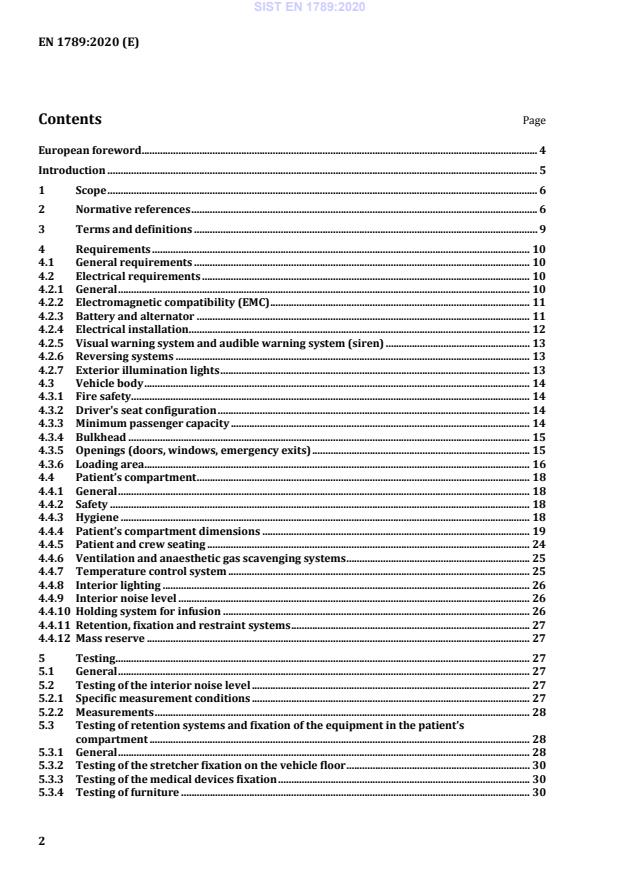
Contents Page
European foreword . 4
Introduction . 5
1 Scope . 6
2 Normative references . 6
3 Terms and definitions . 9
4 Requirements . 10
4.1 General requirements . 10
4.2 Electrical requirements . 10
4.2.1 General . 10
4.2.2 Electromagnetic compatibility (EMC) . 11
4.2.3 Battery and alternator . 11
4.2.4 Electrical installation . 12
4.2.5 Visual warning system and audible warning system (siren) . 13
4.2.6 Reversing systems . 13
4.2.7 Exterior illumination lights . 13
4.3 Vehicle body . 14
4.3.1 Fire safety . 14
4.3.2 Driver's seat configuration . 14
4.3.3 Minimum passenger capacity . 14
4.3.4 Bulkhead . 15
4.3.5 Openings (doors, windows, emergency exits) . 15
4.3.6 Loading area. 16
4.4 Patient’s compartment . 18
4.4.1 General . 18
4.4.2 Safety . 18
4.4.3 Hygiene . 18
4.4.4 Patient’s compartment dimensions . 19
4.4.5 Patient and crew seating . 24
4.4.6 Ventilation and anaesthetic gas scavenging systems . 25
4.4.7 Temperature control system . 25
4.4.8 Interior lighting . 26
4.4.9 Interior noise level . 26
4.4.10 Holding system for infusion . 26
4.4.11 Retention, fixation and restraint systems . 27
4.4.12 Mass reserve . 27
5 Testing . 27
5.1 General . 27
5.2 Testing of the interior noise level . 27
5.2.1 Specific measurement conditions . 27
5.2.2 Measurements . 28
5.3 Testing of retention systems and fixation of the equipment in the patient’s
compartment . 28
5.3.1 General . 28
5.3.2 Testing of the stretcher fixation on the vehicle floor . 30
5.3.3 Testing of the medical devices fixation . 30
5.3.4 Testing of furniture . 30
5.3.5 Test procedure . 31
5.4 Testing of rounded edges and radius inside the patient's compartment. 32
5.4.1 Testing of rounded edges . 32
5.4.2 Testing of radius inside the patient's compartment . 33
5.5 Procedure to verify the patient's compartment specifications . 33
5.6 Procedure to verify the loading area specifications . 33
5.6.1 General . 33
5.6.2 Procedure to verify the loading angle of 16° . 33
5.7 Procedure to verify the dimensions of the patient's compartment . 35
5.7.1 Type A and B road ambulances. 35
5.7.2 Type C road ambulances . 35
5.8 Procedure to verify the seats dimensions of the patient's compartment . 36
5.9 Testing of the ventilation system . 36
5.10 Testing of the heating system . 37
5.11 Testing of the cooling system . 37
5.11.1 Test procedure . 37
5.11.2 Testing of independent air conditioning system . 38
5.12 Testing of interior lighting . 38
5.13 Testing of infusion holding system . 38
6 Equipment and medical devices . 39
6.1 Provision of medical devices . 39
6.2 Medical devices storage. 39
6.3 Requirements for medical devices . 39
6.3.1 General . 39
6.3.2 Temperature . 39
6.3.3 Humidity and ingress of liquids . 39
6.3.4 Mechanical strength . 39
6.3.5 Fixation of devices . 40
6.3.6 Electrical safety . 40
6.3.7 User interface . 40
6.3.8 Gas installation . 40
6.3.9 Marking and instructions . 42
6.3.10 Maintenance . 42
6.4 List of equipment . 42
Annex A (informative) Test summary . 52
Annex B (informative) Recognition . 53
B.1 Recognition and visibility of ambulances . 53
B.2 Recognition of crew . 53
Annex C (informative) Hygiene . 54
Annex D (informative) A–deviations . 55
D.1 Deviation in Spain. 55
Annex ZA (informative) Relationship between this European Standard and the essential
requirements of Directive 93/42/EEC [OJ L 169] aimed to be covered . 56
Bibliography . 57
European foreword
This document (EN 1789:2020) has been prepared by Technical Committee CEN/TC 239 “Rescue
systems”, the secretariat of which is held by DIN.
This European Standard shall be given the status of a national standard, either by publication of an
identical text or by endorsement, at the latest by February 2021, and conflicting national standards
shall be withdrawn at the latest by March 2022.
Attention is drawn to the possibility that some of the elements of this document may be the subject of
patent rights. CEN shall not be held responsible for identifying any or all such patent rights.
This document supersedes EN 1789:2007+A2:2014.
This document has been prepared under a standardization request given to CEN by the European
Commission and the European Free Trade Association, and supports essential requirements of
EU Directive(s).
For relationship with EU Directive(s), see informative Annex ZA which is an integral part of this
document.
According to the CEN-CENELEC Internal Regulations, the national standards organisations of the
following countries are bound to implement this European Standard: Austria, Belgium, Bulgaria,
Croatia, Cyprus, Czech Republic, Denmark, Estonia, Finland, France, Germany, Greece, Hungary, Iceland,
Ireland, Italy, Latvia, Lithuania, Luxembourg, Malta, Netherlands, Norway, Poland, Portugal, Republic of
North Macedonia, Romania, Serbia, Slovakia, Slovenia, Spain, Sweden, Switzerland, Turkey and the
United Kingdom.
Introduction
Road ambulances are subject to a higher risk in use. The exact circumstances of operation cannot
always be planned or anticipated in detail.
Vehicles are designed so as to be safe. Design requirements can be derived from European and national
occupational safety and health legislation.
Under EU law, employers are responsible for carrying out a risk assessment (89/391/EEC, OSH
framework directive) and for provision of safe work equipment (89/655/EEC, use of work equipment
directive) that allows employees to work without their health being at risk.
The document was first developed in the late 1990s to define a common approach to requirements to
enhance patient and crew safety. The document has evolved and matured through several amendments
and revisions.
This latest revision work of EN 1789 has had two key objectives:
— The first objective was to revise the technical side of the document with more manageable
verification in mind, while maintaining the high quality and strict nature of the requirements.
— The second objective was to check all the references and regulations, paying special attention to EU
regulations and updated standardization rules.
Testing of special purpose vehicle, such as an ambulance, is complex. Multiple functions (e.g. fixations,
maintain systems, noise, illumination, heating, cooling etc.) may require numerous tests, which can be
destructive. In this edition, carefully planned tests according to worst-case scenario strategies have
reduced the number of destructive tests without sacrificing test qualities.
The previous edition of this standard (EN 1789:2007+A2:2014) contained a number of direct
references to EU regulations. According to CEN Internal Regulations Part 3:2017 and to avoid
duplication as well as outdated references and to enable use of this standard independently of the ECE
rules, EU regulations and directives, these references have now been removed from the normative
section of the standard.
This document is a reference document which can be used in support of regulations.
For the purpose of verification of an ambulance according to EU vehicle approval process, a section of
EN 1789:2007+A1:2010+A2:2014 (i.e. patient’s compartment) has been referenced directly in
Regulation (EU) 2018/858.
CEN/TC 239 has agreed to a transition period of a maximum of 18 months in order to accommodate the
different organisational structures that are necessary for the transport of patients are responsible for
providing sufficient time for the technical implementation. At the date of publication of EN 1789, the
presumption of conformity of the superseded standard has not yet been established in the Official
Journal of the European Union. Users of the standard are invited to check the date in the Official Journal
of the European Union against the transition period established by CEN/TC 239.
1 Scope
This document specifies requirements for the design, testing, performance and equipping of road
ambulances used for the transport, monitoring, treatment and care of patients. It contains requirements
for the patient’s compartment in terms of the working environment, ergonomic design and the safety of
the crew and patients. This document does not cover the training of the crew, which is the
responsibility of the authority/authorities in the country where the ambulance is to be registered.
This document is applicable to road ambulances capable of transporting at least one patient on a
stretcher and excludes the transportation of hospital beds.
This document also specifies requirements for ambulances intended to carry transport incubator
systems.
This document covers the specific requirements of each type of road ambulance, which are designated
according to the patient condition.
This document gives general requirements for medical devices carried in road ambulances and used
therein and outside hospitals and clinics in situations where the ambient conditions can differ from
normal indoor conditions.
2 Normative references
The following documents are referred to in the text in such a way that some or all of their content
constitutes requirements of this document. For dated references, only the edition cited applies. For
undated references, the latest edition of the referenced document (including any amendments) applies.
CEN/TS 16165:2016, Determination of slip resistance of pedestrian surfaces - Methods of evaluation
DIN 51130:2014, Testing of floor coverings - Determination of the anti-slip property - Workrooms and
fields of activities with slip danger - Walking method - Ramp test
EN 3-7:2004+A1:2007, Portable fire extinguishers - Part 7: Characteristics, performance requirements
and test methods
EN 443:2008, Helmets for fire fighting in buildings and other structures
EN 455-1:2020, Medical gloves for single use - Part 1: Requirements and testing for freedom from holes
EN 455-2:2015, Medical gloves for single use - Part 2: Requirements and testing for physical properties
EN 794-3:1998+A2:2009, Lung ventilators - Part 3: Particular requirements for emergency and transport
ventilators
EN 1041:2008+A1:2013, Information supplied by the manufacturer of medical devices
EN 1865-1:2010+A1:2015, Patient handling equipment used in road ambulances - Part 1: General
stretcher systems and patient handling equipment
EN 1865-2:2010+A1:2015, Patient handling equipment used in road ambulances - Part 2: Power assisted
stretcher
EN 1865-4:2012, Patient handling equipment used in road ambulances - Part 4: Foldable patient transfer
chair
EN 1865-5:2012, Patient handling equipment used in road ambulances - Part 5: Stretcher support
EN 12470-1:2000+A1:2009, Clinical thermometers - Part 1: Metallic liquid-in-glass thermometers with
maximum device
EN 13544-1:2019, Respiratory therapy equipment - Part 1: Nebulizing systems and their components
EN 13976-1:2018, Rescue systems - Transportation of incubators - Part 1: Interface requirements
EN 60601-1:2006+A1:2013, Medical electrical equipment - Part 1: General requirements for basic safety
and essential performance (IEC 60601-1:2005 + Cor.:2006 + Cor.:2007 + A1:2012)
EN 60601-1-12:2015, Medical electrical equipment - Part 1-12: General requirements for basic safety and
essential performance - Collateral Standard: Requirements for medical electrical equipment and medical
electrical systems intended for use in the emergency medical services environment
EN 60601-2-4:2011, Medical electrical equipment - Part 2-4: Particular requirements for the basic safety
and essential performance of cardiac defibrillators
EN 60601-2-27:2014, Medical electrical equipment - Part 2-27: Particular requirements for the basic
safety and essential performance of electrocardiographic monitoring equipment
EN ISO 407:2004, Small medical gas cylinders - Pin-index yoke-type valve connections (ISO 407:2004)
EN ISO 5359:2014+A1:2017, Anaesthetic and respiratory equipment - Low-pressure hose assemblies for
use with medical gases (ISO 5359:2014 + Amd 1:2017)
EN ISO 9170-1:—, Terminal units for medical gas pipeline systems — Part 1: Terminal units for use with
compressed medical gases and vacuum (ISO/DIS 9170-1:2016)
EN ISO 7396-1:2016+A1:2019, Medical gas pipeline systems - Part 1: Pipeline systems for compressed
medical gases and vacuum (ISO 7396-1:2016 + Amd 1:2017)
EN ISO 10079-1:2015+A1:2019, Medical suction equipment - Part 1: Electrically powered suction
equipment (ISO 10079-1:2015 + Amd 1:2018)
EN ISO 10079-2:2014, Medical suction equipment - Part 2: Manually powered suction equipment (ISO
10079-2:2014)
EN ISO 10079-3:2014, Medical suction equipment - Part 3: Suction equipment powered from a vacuum or
positive pressure gas source (ISO 10079-3:2014)
EN ISO 10524-1:2019, Pressure regulators for use with medical gases - Part 1: Pressure regulators and
pressure regulators with flow-metering devices (ISO 10524-1:2018)
EN ISO 10524-2:2019, Pressure regulators for use with medical gases - Part 2: Manifold and line pressure
regulators (ISO 10524-2:2018)
EN ISO 10524-3:2019, Pressure regulators for use with medical gases - Part 3: Pressure regulators
integrated with cylinder valves (VIPRs) (ISO 10524-3:2019)
EN ISO 11197:2018, Medical supply units (ISO/DIS 11197:2018)
Under preparation. Stage at time of publication: prEN ISO 9170-1:2017
EN ISO 14971:2019, Medical devices - Application of risk management to medical devices
(ISO 14971:2019)
EN ISO 15002:2008, Flow-metering devices for connection to terminal units of medical gas pipeline
systems (ISO 15002:2008)
EN ISO 15223-1:2016, Medical devices - Symbols to be used with medical device labels, labelling and
information to be supplied - Part 1: General requirements (ISO 15223-1:2016, Corrected version 2017-03)
EN ISO 19054:2006+A1:2016, Rail systems for supporting medical equipment (ISO 19054:2005+
Amd1:2016)
EN ISO 20471:2013+A1:2016, High visibility clothing — Test methods and requirements
(ISO 20471:2013, Corrected version 2013-06-01+Amd 1:2016)
EN ISO 21420:2020-06, Protective gloves - General requirements and test methods (ISO 21420:2020)
EN ISO 80601-2-55:2018, Medical electrical equipment - Part 2-55: Particular requirements for the basic
safety and essential performance of respiratory gas monitors (ISO 80601-2-55:2018)
EN ISO 80601-2-61:2019, Medical electrical equipment - Part 2-61: Particular requirements for basic
safety and essential performance of pulse oximeter equipment (ISO 80601-2-61:2017, Corrected version
2018-02)
IEC 60364-7-721:2017, Low-voltage electrical installations — Part 7-721: Requirements for special
installations or locations — Electrical installations in caravans and motor caravans
ISO 3795:1989, Road vehicles, and tractors and machinery for agriculture and forestry — Determination
of burning behaviour of interior materials
ISO 5128:1980, Acoustics — Measurement of noise inside motor vehicles
Under preparation. Stage at time of publication: EN ISO 11197:2018
3 Terms and definitions
For the purposes of this document, the following terms and definitions apply.
ISO and IEC maintain terminological databases for use in standardization at the following addresses:
— IEC Electropedia: available at http://www.electropedia.org/
— ISO Online browsing platform: available at http://www.iso.org/obp
3.1
patient
person whose condition requires appropriately trained personnel to provide medical care and/or
suitable transport
3.2
emergency patient
patient who through sickness, injury or other circumstances is in immediate or imminent danger to life
unless emergency treatment and/or monitoring and suitable transport to diagnostic facilities or
medical treatment is provided
3.3
road ambulance
vehicle intended to be crewed by a minimum of two appropriately trained crew members for the
provision of care and transport of at least one stretchered patient
3.4
type A road ambulance
patient transport ambulance
vehicle designed and equipped for the transport of patients who are not expected to become emergency
patients
Note 1 to entry: Two types of patient transport ambulance exist:
— type A1: suitable for transport of a single patient;
— type A : suitable for transport of one or more patient(s) (on stretcher(s) and seat(s)).
3.5
type B road ambulance
emergency ambulance
vehicle designed and equipped for the transport, basic treatment and monitoring of patients
3.6
type C road ambulance
mobile intensive care unit
vehicle designed and equipped for the transport, advanced treatment and monitoring of patients
3.7
net vehicle mass
net mass of the road ambulance including the driver taken as 75 kg, 90% fuel tank and all fixed
installations
Note 1 to entry: Loose portable patient handling, sanitary, medical and technical equipment are not included in
net vehicle mass.
3.8
road ambulance loading capacity
difference between the permissible gross vehicle mass and the net vehicle mass of the road ambulance
Note 1 to entry: This represents the mass that may be distributed on the road ambulance such that the
permissible axle loads are not exceeded.
3.9
fixation system
system or device to ensure the permanent fixation of medical devices or other equipment into the road
ambulance
3.10
retention system
bracket or other interface device used to secure a mobile or transportable item of equipment or medical
device in the road ambulance without the use of tools
3.11
restraint system
device or combination of devices that minimize movement of the vehicle occupants during crash or
major deceleration (e.g. seat belts)
3.12
patient compartment
interior section of an road ambulance for patient treatment and/or transport
4 Requirements
4.1 General requirements
Road ambulances and equipment shall, when operated in normal use and maintained according to the
instructions of the manufacturer, cause no safety hazard which could reasonably be foreseen using risk
management procedures, e.g. in accordance with EN ISO 14971:2019, and which is connected with their
intended application, in normal condition and in single fault condition.
4.2 Electrical requirements
4.2.1 General
Electrical installations added to the base vehicle shall comply with those clauses of
IEC 60364-7-721:2017 which are applicable to road ambulances. For the supply system of the medical
equipment EN 60601-1:2006+A1:2013 and EN 60601-1-12:2015, Clause 11 shall apply.
4.2.2 Electromagnetic compatibility (EMC)
In order to minimize the risk to the safe operation of the complete road ambulance and any of the
equipment operated on or in the vehicle from the effects of electromagnetic influences:
— Communication equipment (e.g. radio installation) shall comply with national and/or European
regulations.
— The complete operational vehicle shall consist of components, equipment or sub systems that
comply or are certified as conforming to the respective industry EMC regulations.
A road ambulance as supplied and certified may not be fully equipped and therefore some
responsibility for added equipment after conversion rests with the customer/user.
4.2.3 Battery and alternator
Batteries shall be positioned to allow maintenance without removing the battery from its securing
device. The construction of the battery and all connections to it shall be such as to prevent any
possibility of an inadvertent short circuit.
For types A2, B and C road ambulances the electrical system shall be capable of holding a reserve of
electrical power for restarting the engine.The characteristics of the alternator, the starter batteries as
well as additional batteries, if fitted, shall comply with Table 1.
Additional batteries may be required to power the medical devices carried on board and the intended
use of the road ambulance.
Table 1 — Minimum capacity/power
Type of road ambulance
A A B C
1 2
Nominal 54 Ah 54 Ah up to 80 Ah 80 Ah
voltage 4 seats and 80
12 V Ah for more than
4 seats in the
Starter
patient
battery(ies)
compartment
Nominal – – 63 Ah 63 Ah
voltage (2 × 12 V) (2 × 12 V)
24 V
Nominal – – a 80 Ah
80 Ah
voltage
12 V
Additional
b
battery(ies)
Nominal – – a 63 Ah
63 Ah
voltage (2 × 12 V)
(2 × 12 V)
24 V
Alternator power 700 W 700 W 1 200 W 1 200 W
a
Recommended for special operational conditions.
b
Additional batteries shall have high cyclic stability (e.g. gel batteries) and shall be of a sealed type.
When the engine is idling electrical stability should be maintained between electrical load and
alternator output. In order to achieve this it may be necessary to fit an electrical load prioritization
device to the vehicle.
4.2.4 Electrical installation
4.2.4.1 In type B and C road ambulances there shall be a recessed externally mounted power
connector to enable external power to be provided for operations such as the following:
— charging battery(ies);
— operating medical devices, when installed;
— operating a patient compartment heater, when installed;
— operating an engine preheater, when installed.
The connector for 110 V or 220/240 V shall be a male connector and not interfere with the electrical
and mechanical safety.
It shall not be possible to start the engine whilst it is connected to an external power supply unless an
automatic mechanical disconnection is fitted.
If no automatic mechanical disconnection is fitted, the connector shall be on the driver’s side.
The 110 V or 220/240 V circuit shall be protected either by an “earth leakage device” with a maximum
setting of 30 mA or by a separate transformer. If the protection is given only by an “earth leakage
device” there shall be a label near the plug that reads as follows: “CAUTION! CONNECT ONLY TO AN
AUTHORISED SOCKET.”
4.2.4.2 A minimum number of separately protected 12 V DC outlets shall be available according to
Table 2. The outlets shall be available for medical devices, located in the area of use and in the storage
area. The nominal voltage shall be 13,8 V. Voltage fluctuations shall not exceed the range of 12,4 V and
15,1 V.
The power supply shall continuously supply the medical devices with electrical power with the engine
running. The outlets for the medical devices shall be labelled with the nominal voltage and current
rating. The outlets shall have a visible indication under intended operational conditions in order to
show if there is voltage on the outlet.
If the road ambulance is intended to carry a transport incubator system it shall have a four-pole
connector as specified in EN 13976-1:2018, subclause 4.2.3, Figure 2. In that case the nominal current
needs to be assessed (minimum 23 Amp according to EN 13976-1:2018, subclause 4.1.3).
Table 2 — 12 V connections for medical devices in patient’s compartment
Type of road ambulance
A A B C
1 2
1 1 1 1 3 1 3 1
Minimum number of
connections
10 15 10 15 10 15 10 15
Minimum capacity in
Ampere
4.2.4.3 Any additional electrical systems fitted to the base vehicle shall be separate from the base
vehicle electrical system and the body or chassis shall not be used as an earth return for additional
circuits.
All circuits in the additional system(s) shall have separate overload protection. All circuits shall be well
identified and cables clearly marked at the connection points and at a maximum of 1 m intervals along
its length.
NOTE Overload protection can consist of either fuses or so called Electronic Management Control systems.
The system shall have enough circuits and be so constructed that when/if a circuit fails the patient
treatment area shall remain illuminated and at least one power supply source for medical technical
equipment shall still work.
Every power socket in the patient compartment shall be fitted with a permanently visible indicator light
to confirm that there is power to the socket.
4.2.4.4 No wiring shall be located in or pass through conduit intended for medical gas installation.
The wiring shall not be loaded higher than that stated by the wire manufacturer.
4.2.4.5 Where there are different voltage systems, the connections shall be non-interchangeable.
4.2.5 Visual warning system and audible warning system (siren)
4.2.5.1 General
The road ambulance shall be fitted with a visual warning and audible warning system (in accordance
with national regulations) to alert other road vehicles and pedestrians of its approach, in order to
expedite its journey through traffic, whilst being used for emergency operation.
4.2.5.2 Visual warning system
The vehicle shall have 360-degree visibility of warning lights around the vehicle.
Recommended additional warning lights for type B and type C road ambulances are:
— additional warning lights facing forward, sideways of the vehicle (front and rear corner) and facing
backwards to ensure traffic safety and high visibility in heavy traffic.
4.2.5.3 Audible warning systems (siren)
The vehicle shall have an audible warning system additional to the warning lights. The audible warning
system shall activate the visual warning light.
The audible alarm can only be in function if the visible alarm is in operation.
4.2.6 Reversing systems
The ambulance shall be fitted with an audible reversing warning alarm, activated by the selection of the
reverse gear. This function shall be possible to disable from the driver seating position, with default
back to on, when reverse gear is engaged the next time.
There shall be a system enabling the driver to detect obstacles behind.
4.2.7 Exterior illumination lights
Exterior lighting with a minimum of 5 lx illuminating the surrounding the patient compartment area
according to Figure 1 shall be provided on type B and type C vehicles. Illumination shall be measured at
ground level.
Dimensions in millimetres
Key
Grey area Area of illumination of at least 5 lx
Figure 1 — Exterior lighting for type B and type C
4.3 Vehicle body
4.3.1 Fire safety
All interior materials shall have a burning rate of less than 100 mm/minute when tested in accordance
with ISO 3795:1989.
4.3.2 Driver's seat configuration
For all types of road ambulances the ergonomic space of the driver’s compartment and of the seat
adjustment as approved by the base manufacturer shall not be reduced.
4.3.3 Minimum passenger capacity
The minimum passenger capacity shall be in accordance with Table 3.
NOTE Passenger includes crew, patient and accompanying persons.
Table 3 — Minimum passenger capacity
Type of road ambulance
A A B C
1 2
Number of passengers on seats
and/or stretchers (in addition to 3 4 3
a
the driver)
a
With two stretchers.
A notice shall be displayed in the drivers' compartment stating the maximum number of seated and
stretcher passengers that can be carried.
The notice shall be supplied by the manufacturer taking into account the maximum weight capacity of
the vehicle.
4.3.4 Bulkhead
A full bulkhead or a bulkhead with a door shall separate the driver’s compartment from the patient’s
compartment. Where a door is fitted, it shall not be possible to drive the vehicle with the door in the
open position. This door shall be secured against opening if the road ambulance is in motion.
NOTE A bulkhead is also called a “partition wall”.
One or two windows with a minimum separation of 100 mm shall be provided in the bulkhead. The
windows shall allow direct visual contact with the driver. The opening area of the window shall have a
maximum area of 0,2 m . It shall be secured against self-opening and shall have an adjustable blind or
other means of preventing the driver being disturbed by the light of the patient’s compartment.
4.3.5 Openings (doors, windows, emergency exits)
4.3.5.1 General
The patient compartment shall have at least two openings. One at the rear (door/tailgate) and one at
the side.
All openings shall have seals to protect against the ingress of water.
All openings shall comply with the minimum dimensions according to Table 4.
Table 4 — Minimum opening dimensions in the patient's compartment
Type of road ambulance
a a
B C
A A
1 2
mm mm
mm mm
c b 800 1 200 1 400
Height
Side opening
600 660 660
c
Width
Height 900 900 1 200 1 500
Rear opening
Width 900 900 1 050 1 050
a
Corner radius of conversions which reduce the opening area by less than 10 % are permitted.
b
The dimensions provided by the original manufacturer shall not be reduced.
c
If it is a window, the height and width dimensions may be interchanged.
4.3.5.2 Emergency exits
The patient compartment shall have at least two emergency exits on different sides of the vehicle. One
of the emergency exits can be on the roof. The emergency exits shall be easy to open from the inside.
The side door and rear door can be used as emergency exits. The free minimum size shall be 500 mm x
700 mm.
4.3.5.3 Doors
There shall be a central locking system which shall be possible to operate from the driver and patient
compartment.
Each external door allowing direct access to the patient’s compartment shall be fitted with a security
system which enables the following:
a) lock and unlock from inside without use of a key;
b) lock and unlock from outside with use of a key;
c) unlock from the outside using a key when the door is locked from the inside;
NOTE 1 This security system can be integrated with an optional central locking system.
NOTE 2 The key can be a mechanical or non-mechanical device.
The patient’s compartment doors shall be capable of being positively restrained in the open position.
An audible and/or visual signal shall warn the driver when any external door including those not
allowing direct access to the patient's compartment, is not completely closed when the vehicle is in
motion.
Handles and/or handrails of all access points shall be accessible from the outside.
4.3.5.4 Windows
In the patient’s compartment, there shall be a minimum of two external windows. There shall be one on
each side or one on one side and the rear.
The windows shall be positi
...