

EN 1621-2:2014
(Main)Motorcyclists' protective clothing against mechanical impact - Part 2: Motorcyclists' back protectors - Requirements and test methods
- Abstract
This European Standard specifies the minimum coverage to be provided by motorcyclists’ back protectors worn by riders in normal traffic situations. The standard contains the requirements for the performance of the protectors under impact and details of the test methods. Requirements for sizing, ergonomic requirements, and requirements for innocuousness, labelling and the provision of information are included.
- Status
- Published
- Publication Date
- 14-Jan-2014
- Withdrawal Date
- 30-Jul-2014
- Technical Committee
- CEN/TC 162 - Protective clothing including hand and arm protection and lifejackets
- Drafting Committee
- CEN/TC 162/WG 9 - Motorcycle rider protective clothing
- Current Stage
- 9092 - Decision on results of review/2YR ENQ - revise - Review Enquiry
- Start Date
- 04-Oct-2024
- Completion Date
- 21-Oct-2026
89/686/EEC - Personal protective equipment (PPE)OJ Ref: C, C 445 OJ Date: 12-Dec-2014



Overview - EN 1621-2:2014 (back protectors)
EN 1621-2:2014 is the CEN European Standard that specifies requirements and test methods for motorcyclists’ back protectors. It defines minimum coverage, impact performance, sizing and ergonomic requirements, innocuousness, labelling and the information manufacturers must supply. The standard covers three protector types - full back (FB), central back (CB) and lower/lumbar back (LB) - and sets two performance levels (Level 1 and Level 2) to balance protection and wearability.
Key topics and technical requirements
- Scope & protector types: Defines full, central and lower back protectors and the protected zones relative to the user’s waist-to-shoulder length (sizing is specified as a range up to 5 cm).
- Minimum zones of protection: Zone geometry is tied to the largest user’s waist-to-shoulder length (tabled proportions are used to determine A–F dimensions for each protector shape).
- Impact attenuation & test methods:
- Bar impactor and anvil tests using a guided drop mass with kinetic energy ≈ 50 J.
- Force transducer requirements (frequency response ≥ 7 kHz, calibrated range ≥ 70 kN).
- Performance levels: Level 1 (mean transmitted force ≤ 18 kN, single strike ≤ 24 kN) and Level 2 (mean ≤ 9 kN, single strike ≤ 12 kN).
- Wet impact test is mandatory; high and low temperature impact tests are optional when claimed.
- Ergonomics and fit: Protectors must remain in position during use (unless designed to be incorporated into garments) and have protective area aligned with the spine; lower back protectors must cover the lumbar region.
- Innocuousness, labelling & information: Requirements mirror EN 1621-1 for materials safety; manufacturers must mark sizing (pictogram) and provide usage/coverage information.
- Durability: After impact there must be no hazardous fragmentation or sharp edges (some cracking or soft debris loss is allowed).
Applications and who uses EN 1621-2:2014
- Manufacturers and designers of motorcycle protective clothing - to design back protectors that meet EU/CEN safety expectations.
- Test laboratories and certification bodies - to perform standardised impact, wet and temperature testing and certify products to Level 1 or Level 2.
- Retailers & procurement officers - to verify product claims and label/size information.
- Regulators and standards committees - to reference for consumer safety and PPE conformity (see Annex ZA for relationship to EU directives).
- Riders and consumer guides - to understand what certified back protectors protect against and the difference between Level 1 and Level 2.
Related standards
- EN 1621-1: Motorcyclists' limb joint impact protectors - requirements and test methods
- EN 1621-3 / EN 1621-4: Other parts under development (chest protectors, inflatable protectors)
Keywords: EN 1621-2:2014, motorcyclists' back protectors, impact attenuation, test methods, CEN standard, protective clothing, ergonomic requirements, sizing, labelling, wet impact test.
Relations
- Effective Date
- 22-Jan-2014
- Effective Date
- 22-Jan-2014
- Effective Date
- 09-Feb-2026
- Effective Date
- 28-Jan-2026
- Effective Date
- 28-Jan-2026
- Effective Date
- 28-Jan-2026
- Effective Date
- 28-Jan-2026
- Effective Date
- 28-Jan-2026
- Effective Date
- 28-Jan-2026
- Effective Date
- 28-Jan-2026
- Effective Date
- 28-Jan-2026
- Effective Date
- 28-Jan-2026
Get Certified
Connect with accredited certification bodies for this standard

CIS Institut d.o.o.
Personal Protective Equipment (PPE) certification body. Notified Body NB-2890 for EU Regulation 2016/425 PPE.

Kiwa BDA Testing
Building and construction product certification.
Kmetijski inštitut Slovenije
Agricultural Institute of Slovenia. Soil testing, plant health, agricultural product analysis.
Sponsored listings
Frequently Asked Questions
EN 1621-2:2014 is a standard published by the European Committee for Standardization (CEN). Its full title is "Motorcyclists' protective clothing against mechanical impact - Part 2: Motorcyclists' back protectors - Requirements and test methods". This standard covers: This European Standard specifies the minimum coverage to be provided by motorcyclists’ back protectors worn by riders in normal traffic situations. The standard contains the requirements for the performance of the protectors under impact and details of the test methods. Requirements for sizing, ergonomic requirements, and requirements for innocuousness, labelling and the provision of information are included.
This European Standard specifies the minimum coverage to be provided by motorcyclists’ back protectors worn by riders in normal traffic situations. The standard contains the requirements for the performance of the protectors under impact and details of the test methods. Requirements for sizing, ergonomic requirements, and requirements for innocuousness, labelling and the provision of information are included.
EN 1621-2:2014 is classified under the following ICS (International Classification for Standards) categories: 13.340.10 - Protective clothing. The ICS classification helps identify the subject area and facilitates finding related standards.
EN 1621-2:2014 has the following relationships with other standards: It is inter standard links to EN 1621-2:2003/AC:2006, EN 1621-2:2003, ISO 6487:2012, EN 1621-1:2012, EN 1621-4:2013, EN 17092-2:2020, EN 17092-3:2020, EN 17092-4:2020, EN ISO 12402-6:2020, EN 17092-6:2020, EN 17092-5:2020, EN 17092-1:2020. Understanding these relationships helps ensure you are using the most current and applicable version of the standard.
EN 1621-2:2014 is associated with the following European legislation: EU Directives/Regulations: 2016/425, 89/686/EEC; Standardization Mandates: M/031. When a standard is cited in the Official Journal of the European Union, products manufactured in conformity with it benefit from a presumption of conformity with the essential requirements of the corresponding EU directive or regulation.
EN 1621-2:2014 is available in PDF format for immediate download after purchase. The document can be added to your cart and obtained through the secure checkout process. Digital delivery ensures instant access to the complete standard document.
Standards Content (Sample)
2003-01.Slovenski inštitut za standardizacijo. Razmnoževanje celote ali delov tega standarda ni dovoljeno.Motorradfahrer-Schutzkleidung gegen mechanische Belastung - Teil 2: Rückenprotektoren - Anforderungen und PrüfverfahrenVêtements de protection contre les chocs mécaniques pour motocyclistes - Partie 2 : Protecteurs dorsaux - Exigences et méthodes d'essaiMotorcyclists' protective clothing against mechanical impact - Part 2: Motorcyclists' back protectors - Requirements and test methods43.140Motorna kolesa in mopediMotor cycles and mopeds13.340.10Varovalna oblekaProtective clothingICS:Ta slovenski standard je istoveten z:EN 1621-2:2014SIST EN 1621-2:2014en,fr,de01-marec-2014SIST EN 1621-2:2014SLOVENSKI
STANDARDSIST EN 1621-2:2003/AC:2006SIST EN 1621-2:20031DGRPHãþD
EUROPEAN STANDARD NORME EUROPÉENNE EUROPÄISCHE NORM
EN 1621-2
January 2014 ICS 13.340.10 Supersedes EN 1621-2:2003English Version
Motorcyclists' protective clothing against mechanical impact - Part 2: Motorcyclists' back protectors - Requirements and test methods
Vêtements de protection contre les chocs mécaniques pour motocyclistes - Partie 2 : Protecteurs dorsaux - Exigences et méthodes d'essai
Motorradfahrer-Schutzkleidung gegen mechanische Belastung - Teil 2: Rückenprotektoren - Anforderungen und Prüfverfahren This European Standard was approved by CEN on 26 October 2013.
CEN members are bound to comply with the CEN/CENELEC Internal Regulations which stipulate the conditions for giving this European Standard the status of a national standard without any alteration. Up-to-date lists and bibliographical references concerning such national standards may be obtained on application to the CEN-CENELEC Management Centre or to any CEN member.
This European Standard exists in three official versions (English, French, German). A version in any other language made by translation under the responsibility of a CEN member into its own language and notified to the CEN-CENELEC Management Centre has the same status as the official versions.
CEN members are the national standards bodies of Austria, Belgium, Bulgaria, Croatia, Cyprus, Czech Republic, Denmark, Estonia, Finland, Former Yugoslav Republic of Macedonia, France, Germany, Greece, Hungary, Iceland, Ireland, Italy, Latvia, Lithuania, Luxembourg, Malta, Netherlands, Norway, Poland, Portugal, Romania, Slovakia, Slovenia, Spain, Sweden, Switzerland, Turkey and United Kingdom.
EUROPEAN COMMITTEE FOR STANDARDIZATION
COMITÉ EUROPÉEN DE NORMALISATION EUROPÄISCHES KOMITEE FÜR NORMUNG
CEN-CENELEC Management Centre:
Avenue Marnix 17,
B-1000 Brussels © 2014 CEN All rights of exploitation in any form and by any means reserved worldwide for CEN national Members. Ref. No. EN 1621-2:2014 ESIST EN 1621-2:2014
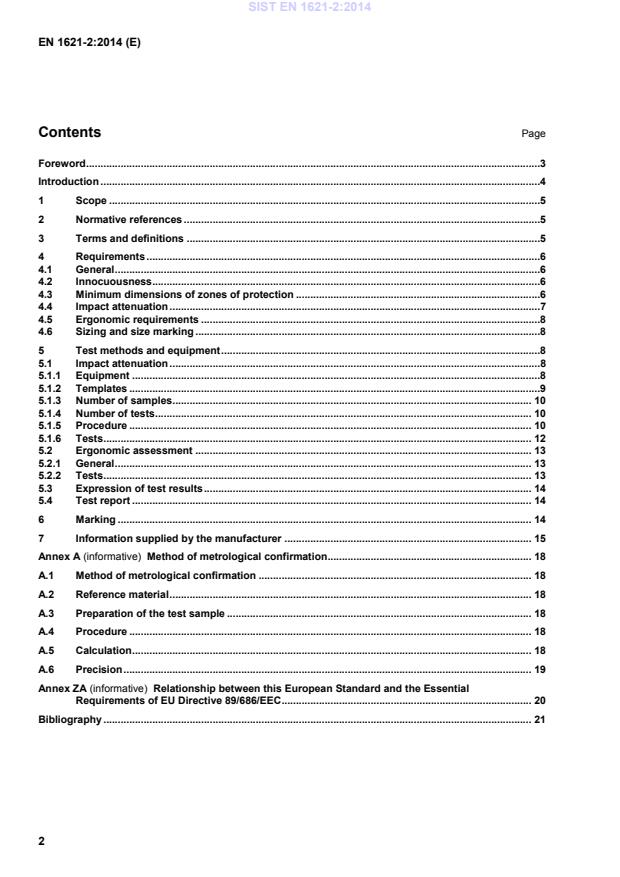
Method of metrological confirmation. 18 A.1 Method of metrological confirmation . 18 A.2 Reference material . 18 A.3 Preparation of the test sample . 18 A.4 Procedure . 18 A.5 Calculation . 18 A.6 Precision . 19 Annex ZA (informative)
Relationship between this European Standard and the Essential Requirements of EU Directive 89/686/EEC . 20 Bibliography . 21
1) Under development. SIST EN 1621-2:2014
Key 1 waist to shoulder length 2 waist line Figure 1 — Body dimensions 3.6 waist line on a subject standing upright, the line in the plane of the waist, 50 mm above the supra-crystal plane which is at the level of the highest points of the iliac crests Note 1 to entry: The dimension of 50 mm is an example which refers to a subject of height 1,78 m; it needs to be scaled pro rata with the height of the actual subject (see following sample data): Body height (m) 1,56 1,60 1,64 1,68 1,72 1,78 1,82 1,88 1,92 1,96 Distance above iliac crest (mm) 44 45 46 47 48 50 51 53 54 55 4 Requirements 4.1 General Motorcyclists’ back protectors shall meet an overall requirement that they are safe to use, comfortable to wear and fit for their purpose. Back protectors shall be provided with means of restraint and/or adjustments capable to ensure that the protector is maintained in position during use. This requirement is not applicable for protectors to be inserted or incorporated into garments. Testing shall be carried out according to 5.2. 4.2 Innocuousness The innocuousness shall comply with the requirements of EN 1621-1. 4.3 Minimum dimensions of zones of protection Motorcyclists’ back protectors shall have a minimum zone of protection related to the waist to shoulder measure of the largest user indicated by the marking. The minimum dimensions of the zone of protection shall be determined from Table 1, for the upper value of the size range (see 4.6). SIST EN 1621-2:2014
a) Full back protector b) Central back protector c) Lower back protector Figure 2 — Minimum dimensions of zones of protection Table 1 — Dimensions of minimum zone of protection for back protector Dimensions in Figure 2 A B C D E F 72 % 29 % 44 % 29 % 32 % 25 % NOTE All dimensions refer to the waist to shoulder length (100 %) of the biggest user. The dimensions and position of the zone of protection, relative to the coverage provided by the whole product, shall be given in the information supplied by the manufacturer (see Clause 7). NOTE The minimum dimensions of the zones of protection are usually marked on the specimens during the testing procedures. 4.4 Impact attenuation When impact protection is tested in accordance with 5.1.6.1 (ambient impact test), 5.1.6.2 (wet impact test) and, if required, 5.1.6.3 (high temperature impact test) and/or 5.1.6.4 (low temperature impact test), the transmitted force shall conform to the values in Table 2. Level 1 or 2 cannot be awarded unless such level is achieved under all of the claimed test conditions. Table 2 — Performance levels Level 1 Level 2 mean value: ≤ 18 kN single strike: ≤ 24 kN mean value: ≤ 9 kN single strike: ≤ 12 kN After each test, there shall be no fragmentation of the sample and no sharp edges shall be formed. However, formation of cracks and loss of soft debris is permissible. SIST EN 1621-2:2014
Figure 3 — Bar impactor 5.1.1.3 Anvil The anvil shall be made of polished steel with the following dimensions l1 equal to (190 ± 20) mm, l2 equal to (100 ± 2) mm and r1 equal to (150 ± 5) mm, see Figure 4. SIST EN 1621-2:2014
Key 1 load cell Figure 4 — Anvil 5.1.1.4 Force measurement instrumentation The anvi
...