

EN 12697-22:2020/prA1
(Amendment)Bituminous mixtures - Test methods - Part 22: Wheel tracking
- Abstract
This document describes test methods for determining the susceptibility of bituminous materials to deform under load. The test is applicable to mixtures with upper sieve size less than or equal to 32 mm.
The tests are applicable to specimens prepared from asphalt mixtures that have either been manufactured in a laboratory or cut from a pavement; test specimens are held in a mould with their surface flush with the upper edge of the mould.
The susceptibility of bituminous materials to deform is assessed by the rut formed by repeated passes of a loaded wheel at constant temperature. Three alternative types of device can be used according to this standard: large-size devices, extra large-size devices and small-size devices. With large-size devices and extra large-size devices, the specimens are conditioned in air during testing. With small-size devices, specimens are conditioned, in either air or water.
NOTE Large-size and extra large-size devices are not suitable for use with cylindrical cores.
- Status
- Not Published
- Publication Date
- 17-Dec-2023
- Technical Committee
- CEN/TC 227 - Road materials
- Drafting Committee
- CEN/TC 227/WG 1 - Bituminous mixtures
- Current Stage
- 4097 - End of interruption of work - split/merged
- Start Date
- 25-Oct-2023
- Completion Date
- 21-Oct-2026

Overview
EN 12697-22:2020/prA1 (CEN) specifies wheel-tracking test methods to assess the susceptibility of bituminous mixtures (upper sieve size ≤ 32 mm) to permanent deformation (rutting) under repeated wheel loading at constant temperature. The standard applies to specimens produced in the laboratory or cut from in‑service pavements, mounted so the test surface is flush with the mould edge. Three device classes are covered: large-size, extra-large-size, and small-size wheel-tracking devices. Note: large and extra-large devices are not suitable for cylindrical cores.
Keywords: EN 12697-22:2020/prA1, wheel tracking, bituminous mixtures test, rutting susceptibility, asphalt testing, pavement performance
Key topics and technical requirements
- Device types and conditioning
- Large-size and extra-large-size devices: specimens conditioned in air during testing.
- Small-size devices: specimens conditioned in air or water.
- Specimen preparation and storage
- Specimens may be laboratory manufactured or cut from pavement; surface flush with mould top.
- Prior to testing, specimens stored flat at ≤ 25 °C for 48 hours to 42 days; specimens in a series must be of similar age (±10%).
- Minimum specimen counts
- Large or extra-large device: 2 specimens
- Small device, Procedure A: 6 specimens
- Small device, Procedure B: 2 specimens
- Measurement and execution
- Rutting is monitored by automatic displacement device or dial gauge. Initial and periodic readings are taken; automatic/dial readings at every (25 ± 1) load cycles, with calculation readings at 100-cycle intervals.
- Procedure A: continue tracking to 1 000 cycles or until 15 mm rut depth.
- Tests end when required cycles complete or mean rut depth exceeds defined limits (e.g., 20 mm reported as a completion criterion in the amendment).
- Data analysis
- Proportional rut depth (P) is calculated from 15 local displacement measurements and specimen thickness; results are plotted as ln(P) vs ln(n) with exclusions when rut depth exceeds 15% of specimen thickness.
- Other metrics: PRD (mean proportional rut depth), TR (rate of increase µm/cycle), WTR/WTS (wheel‑tracking rates/slopes).
Applications
- Laboratory performance testing for new asphalt mixes (rutting resistance)
- Quality control and acceptance testing for contractors and agencies
- Pavement research and mixture optimization
- Comparative evaluation of additives, binders, or aggregate gradations for rut mitigation
Who uses this standard
- Pavement and materials engineers
- Highway agencies and specification writers
- Construction testing laboratories and QC teams
- Researchers studying asphalt deformation and durability
Related standards
- EN 12697 series (other Parts cover sample preparation, volumetric requirements, and additional test methods). Use EN 12697-22 in combination with relevant mix design and sampling parts for a complete test program.
Relations
- Effective Date
- 01-Nov-2023
- Effective Date
- 24-Aug-2022
Get Certified
Connect with accredited certification bodies for this standard

Zavod za gradbeništvo Slovenije (ZAG) - Inšpekcija
ZAG inspection body for construction products, structures, and materials.
Sponsored listings
Frequently Asked Questions
EN 12697-22:2020/prA1 is a draft published by the European Committee for Standardization (CEN). Its full title is "Bituminous mixtures - Test methods - Part 22: Wheel tracking". This standard covers: This document describes test methods for determining the susceptibility of bituminous materials to deform under load. The test is applicable to mixtures with upper sieve size less than or equal to 32 mm. The tests are applicable to specimens prepared from asphalt mixtures that have either been manufactured in a laboratory or cut from a pavement; test specimens are held in a mould with their surface flush with the upper edge of the mould. The susceptibility of bituminous materials to deform is assessed by the rut formed by repeated passes of a loaded wheel at constant temperature. Three alternative types of device can be used according to this standard: large-size devices, extra large-size devices and small-size devices. With large-size devices and extra large-size devices, the specimens are conditioned in air during testing. With small-size devices, specimens are conditioned, in either air or water. NOTE Large-size and extra large-size devices are not suitable for use with cylindrical cores.
This document describes test methods for determining the susceptibility of bituminous materials to deform under load. The test is applicable to mixtures with upper sieve size less than or equal to 32 mm. The tests are applicable to specimens prepared from asphalt mixtures that have either been manufactured in a laboratory or cut from a pavement; test specimens are held in a mould with their surface flush with the upper edge of the mould. The susceptibility of bituminous materials to deform is assessed by the rut formed by repeated passes of a loaded wheel at constant temperature. Three alternative types of device can be used according to this standard: large-size devices, extra large-size devices and small-size devices. With large-size devices and extra large-size devices, the specimens are conditioned in air during testing. With small-size devices, specimens are conditioned, in either air or water. NOTE Large-size and extra large-size devices are not suitable for use with cylindrical cores.
EN 12697-22:2020/prA1 is classified under the following ICS (International Classification for Standards) categories: 93.080.20 - Road construction materials. The ICS classification helps identify the subject area and facilitates finding related standards.
EN 12697-22:2020/prA1 has the following relationships with other standards: It is inter standard links to EN 12697-22:2020+A1:2023, EN 12697-22:2020. Understanding these relationships helps ensure you are using the most current and applicable version of the standard.
EN 12697-22:2020/prA1 is available in PDF format for immediate download after purchase. The document can be added to your cart and obtained through the secure checkout process. Digital delivery ensures instant access to the complete standard document.
Standards Content (Sample)
SLOVENSKI STANDARD
01-september-2023
Bitumenske zmesi - Preskusne metode - 22. del: Preskus nastajanja kolesnic -
Dopolnilo A1
Bituminous mixtures - Test methods - Part 22: Wheel tracking
Asphalt - Prüfverfahren - Teil 22: Spurbildungstest
Mélanges bitumineux - Méthodes d'essai - Partie 22 : Essai d’orniérage
Ta slovenski standard je istoveten z: EN 12697-22:2020/prA1
ICS:
93.080.20 Materiali za gradnjo cest Road construction materials
2003-01.Slovenski inštitut za standardizacijo. Razmnoževanje celote ali delov tega standarda ni dovoljeno.
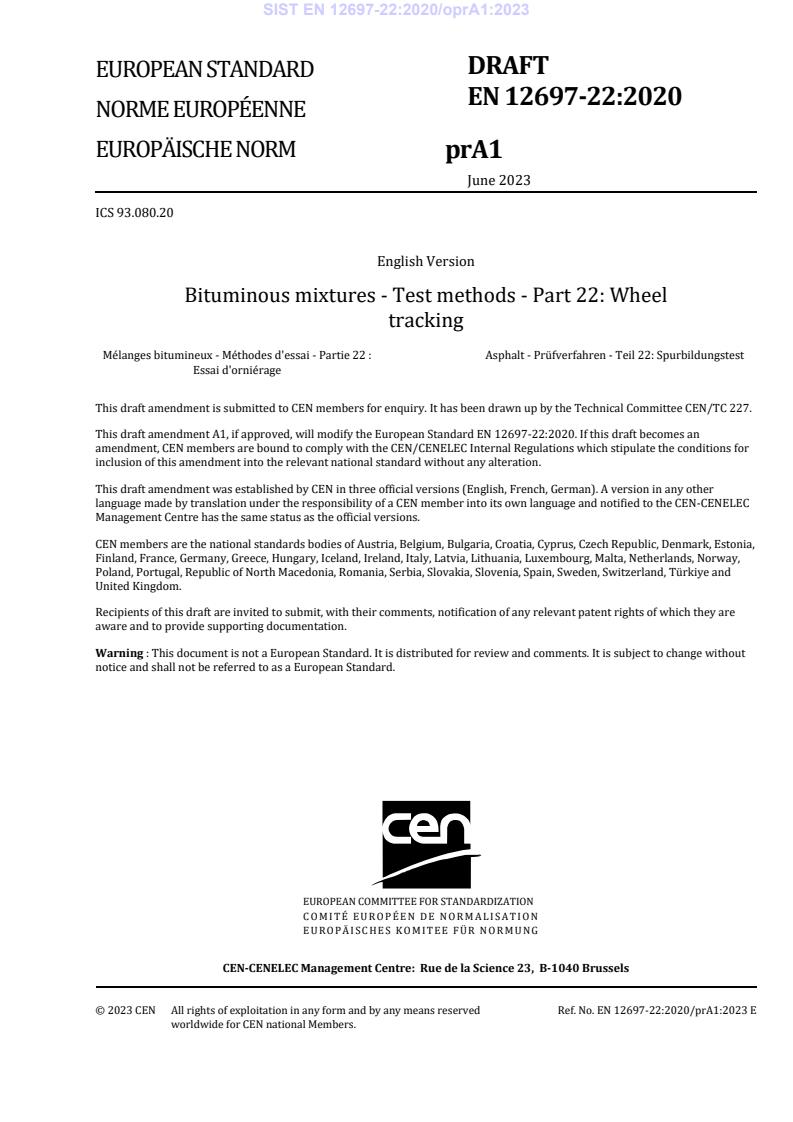
DRAFT
EUROPEAN STANDARD
EN 12697-22:2020
NORME EUROPÉENNE
EUROPÄISCHE NORM
prA1
June 2023
ICS 93.080.20
English Version
Bituminous mixtures - Test methods - Part 22: Wheel
tracking
Mélanges bitumineux - Méthodes d'essai - Partie 22 : Asphalt - Prüfverfahren - Teil 22: Spurbildungstest
Essai d'orniérage
This draft amendment is submitted to CEN members for enquiry. It has been drawn up by the Technical Committee CEN/TC 227.
This draft amendment A1, if approved, will modify the European Standard EN 12697-22:2020. If this draft becomes an
amendment, CEN members are bound to comply with the CEN/CENELEC Internal Regulations which stipulate the conditions for
inclusion of this amendment into the relevant national standard without any alteration.
This draft amendment was established by CEN in three official versions (English, French, German). A version in any other
language made by translation under the responsibility of a CEN member into its own language and notified to the CEN-CENELEC
Management Centre has the same status as the official versions.
CEN members are the national standards bodies of Austria, Belgium, Bulgaria, Croatia, Cyprus, Czech Republic, Denmark, Estonia,
Finland, France, Germany, Greece, Hungary, Iceland, Ireland, Italy, Latvia, Lithuania, Luxembourg, Malta, Netherlands, Norway,
Poland, Portugal, Republic of North Macedonia, Romania, Serbia, Slovakia, Slovenia, Spain, Sweden, Switzerland, Türkiye and
United Kingdom.
Recipients of this draft are invited to submit, with their comments, notification of any relevant patent rights of which they are
aware and to provide supporting documentation.
Warning : This document is not a European Standard. It is distributed for review and comments. It is subject to change without
notice and shall not be referred to as a European Standard.
EUROPEAN COMMITTEE FOR STANDARDIZATION
COMITÉ EUROPÉEN DE NORMALISATION
EUROPÄISCHES KOMITEE FÜR NORMUNG
CEN-CENELEC Management Centre: Rue de la Science 23, B-1040 Brussels
© 2023 CEN All rights of exploitation in any form and by any means reserved Ref. No. EN 12697-22:2020/prA1:2023 E
worldwide for CEN national Members.
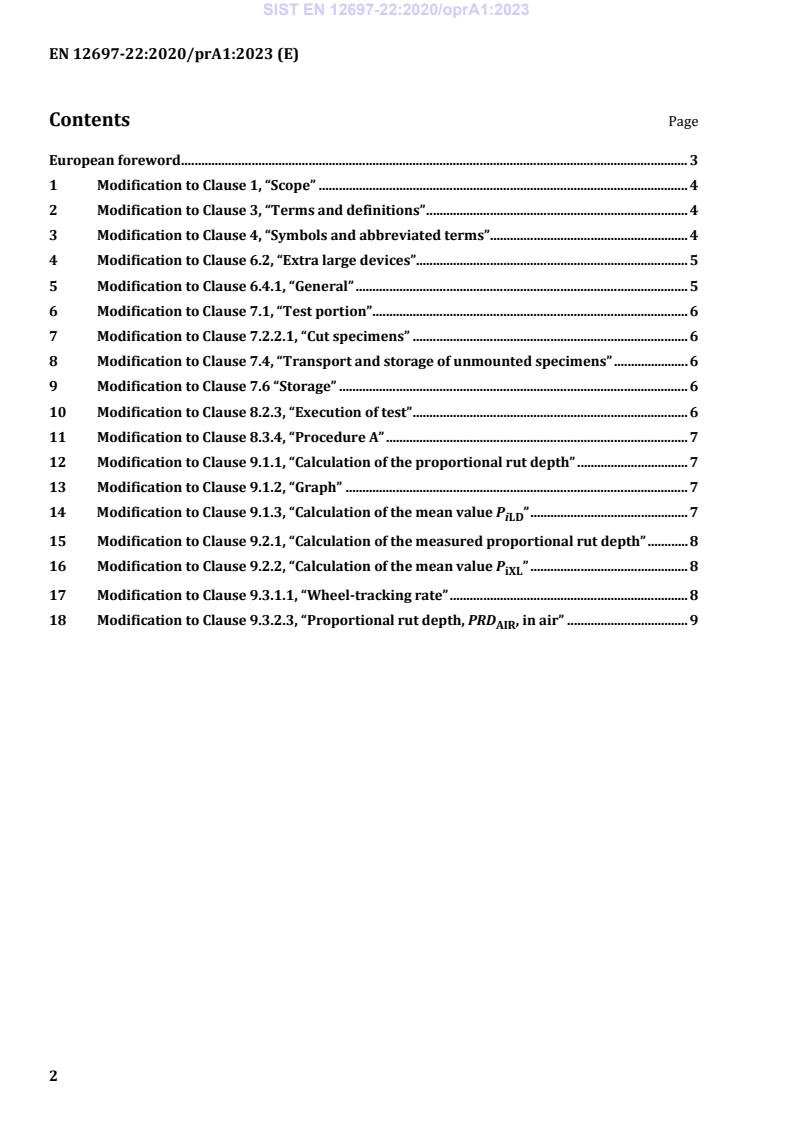
Contents Page
European foreword . 3
1 Modification to Clause 1, “Scope” . 4
2 Modification to Clause 3, “Terms and definitions” . 4
3 Modification to Clause 4, “Symbols and abbreviated terms” . 4
4 Modification to Clause 6.2, “Extra large devices”. 5
5 Modification to Clause 6.4.1, “General” . 5
6 Modification to Clause 7.1, “Test portion” . 6
7 Modification to Clause 7.2.2.1, “Cut specimens” . 6
8 Modification to Clause 7.4, “Transport and storage of unmounted specimens” . 6
9 Modification to Clause 7.6 “Storage” . 6
10 Modification to Clause 8.2.3, “Execution of test” . 6
11 Modification to Clause 8.3.4, “Procedure A” . 7
12 Modification to Clause 9.1.1, “Calculation of the proportional rut depth” . 7
13 Modification to Clause 9.1.2, “Graph” . 7
14 Modification to Clause 9.1.3, “Calculation of the mean value P ” . 7
iLD
15 Modification to Clause 9.2.1, “Calculation of the measured proportional rut depth” . 8
16 Modification to Clause 9.2.2, “Calculation of the mean value P ” . 8
iXL
17 Modification to Clause 9.3.1.1, “Wheel-tracking rate” . 8
18 Modification to Clause 9.3.2.3, “Proportional rut depth, PRD , in air” . 9
AIR
European foreword
This document (EN 12697-22:2020/prA1:2023) has been prepared by Technical Committee
CEN/TC 227 “Road materials”, the secretariat of which is held by BSI.
This document is currently submitted to the CEN Enquiry.
1 Modification to Clause 1, “Scope”
Replace the third paragraph and the NOTE with the following:
“The susceptibility of bituminous materials to deform is assessed by the rut formed by repeated passes
of a loaded wheel at constant temperature. Three alternative types of devices can be used according to
this document: large size devices, extra-large size devices and small size devices. With large size devices
and extra-large size devices, the specimens are conditioned in air during testing. With small size devices,
specimens are conditioned, in either air or water.
NOTE Large size and extra-large size devices are not suitable for use with cylindrical cores.”
2 Modification to Clause 3, “Terms and definitions”
Delete terminological entry 3.8:
“3.8
measurement sequence
test phase corresponding to the completion of n load cycles”
3 Modification to Clause 4, “Symbols and abbreviated terms”
Replace Table 1 with the following:
“
Symbol Definition Unit
d local distance between the reference plane and the j predetermined location on mm
ij
the test surface at the i-th measurement with multiple measurement points for
large size device.
NOTE j varies between 1 and 15
d local distance between a reference plane and the j predetermined location on the mm
0j
test surface before the start of the test (i=0) for large size device
d is the vertical displacement at the i-th measurement for small size device, mm
i
procedure A
d is the measured rut depth in the measured cross-section, at the i-th measurement mm
i, s
for extra-large device;
d is the vertical displacement after n load cycles for small size device, procedure B mm
n
d is the vertical displacement initially after 0 load cycles for small size device mm
h specimen thickness equal to the thickness of the course or courses of the test mm
piece in which a rut can form
L load applied N
n number of cycles —
n number of load cycles for rut depth to reach 15 mm using small size device, —
procedure A
N Total number of readings taken at 100 load cycle intervals for small size device, —
procedure A
P measured proportional rut depth calculated as the average depth o
...