

EN 421:2010
(Main)Protective gloves against ionizing radiation and radioactive contamination
- Abstract
This European Standard specifies requirements and test methods for gloves to protect against ionizing radiation and radioactive contamination. The standard is applicable to gloves offering protection to the hand and various parts of the arm and shoulder. It applies also to gloves to be mounted in permanent containment enclosures.
This European Standard also applies to intermediary sleeves used between a glove and a permanent containment enclosure (report to 4.7.2.3).
The requirements of this European Standard do not apply to protective gloves against X-ray radiation.
- Status
- Published
- Publication Date
- 25-May-2010
- Withdrawal Date
- 29-Nov-2010
- Technical Committee
- CEN/TC 162 - Protective clothing including hand and arm protection and lifejackets
- Drafting Committee
- CEN/TC 162/WG 8 - Protective gloves
- Current Stage
- 9093 - Decision to confirm - Review Enquiry
- Start Date
- 30-Jun-2023
- Completion Date
- 21-Oct-2026
- Directive
- 2016/425 - Regulation (EU) 2016/425 of the European Parliament and of the Council of 9 March 2016 on personal protective equipment and repealing Council Directive 89/686/EECOJ Ref: C, C 113 OJ Date: 27-Mar-2018
89/686/EEC - Personal protective equipment (PPE)OJ Ref: C, C 205 OJ Date: 09-Jul-2011

Overview
EN 421:2010 is the CEN (European) standard that specifies requirements and test methods for protective gloves against ionizing radiation and radioactive contamination. It applies to gloves that protect the hand and parts of the arm and shoulder, including gloves intended to be mounted in permanent containment enclosures (gloveboxes) and intermediary sleeves used between a glove and a containment enclosure. The standard explicitly does not cover protective gloves against X‑ray radiation.
Key topics and technical requirements
- Scope and applicability: Defines glove types covered (hand, arm, shoulder protection; containment enclosure gloves; intermediary sleeves).
- Design principles: Gloves may be single- or multi‑layered; materials are chosen by end‑use. For protection from external ionizing radiation, layers may include lead compounds or other heavy elements as attenuation media.
- Attenuation performance: Radiation attenuation is expressed as lead equivalent thickness. EN 421 specifies methods for determining lead equivalence and uniformity of protective material distribution (see test method 5.1).
- Glove integrity: Air‑leak integrity tests are required for containment and glovebox gloves to verify tightness and prevent radioactive contamination spread.
- Mechanical and chemical resistance: Mechanical performance (tear, abrasion, puncture) and chemical resistance requirements reference general glove standards (e.g., EN 388, EN 374).
- Ozone resistance: Static strain ozone cracking tests (ISO 1431‑1) are required where gloves are used in ozone‑containing atmospheres.
- Specific tests and methods: Includes procedures for lead equivalence detection (X‑ray film, numeric film, ionizing chamber), glove integrity (air leak test), ozone cracking, and pull tests for glove–sleeve assemblies.
- Marking and manufacturer information: Specifies required marking, supplied information and labelling; informative annexes cover water‑vapour permeability, warnings, special tests and measurement uncertainty.
- Normative references: Cross‑references key standards such as EN 420, EN 374, EN 388, EN 61331‑1, ISO 11933.
Applications and who uses it
EN 421:2010 is used to specify, design, test, certify and procure gloves for environments with ionizing radiation or radioactive contamination:
- Nuclear and radiological facilities (operations, maintenance)
- Research laboratories handling radioactive materials
- Pharmaceutical and isotope production facilities
- Manufacturers of radiation‑protective gloves, gloveboxes and containment systems
- PPE procurement officers, safety managers, and certification/testing laboratories
- Regulators and conformity assessment bodies assessing compliance with EU directives
Related standards
- EN 420 (general glove requirements)
- EN 374 (chemical/micro‑organism resistance)
- EN 388 (mechanical risks)
- EN 61331‑1 (attenuation properties for X‑radiation - referenced for methods)
- ISO 11933 (components for containment enclosures)
- ISO 1431‑1 (ozone resistance)
EN 421:2010 provides a practical framework for ensuring glove performance against radioactive contamination and ionizing radiation while aligning with broader PPE and containment component standards.
Relations
- Effective Date
- 08-Jun-2022
- Effective Date
- 25-Aug-2026
- Effective Date
- 25-Aug-2026
- Effective Date
- 25-Aug-2026
- Effective Date
- 25-Aug-2026
- Effective Date
- 09-Feb-2026
- Effective Date
- 28-Jan-2026
- Effective Date
- 28-Jan-2026
- Effective Date
- 28-Jan-2026
- Effective Date
- 28-Jan-2026
- Effective Date
- 28-Jan-2026
- Effective Date
- 28-Jan-2026
- Effective Date
- 28-Jan-2026
- Effective Date
- 28-Jan-2026
- Effective Date
- 28-Jan-2026
Get Certified
Connect with accredited certification bodies for this standard

CIS Institut d.o.o.
Personal Protective Equipment (PPE) certification body. Notified Body NB-2890 for EU Regulation 2016/425 PPE.

Kiwa BDA Testing
Building and construction product certification.
Kmetijski inštitut Slovenije
Agricultural Institute of Slovenia. Soil testing, plant health, agricultural product analysis.
Sponsored listings
Frequently Asked Questions
EN 421:2010 is a standard published by the European Committee for Standardization (CEN). Its full title is "Protective gloves against ionizing radiation and radioactive contamination". This standard covers: This European Standard specifies requirements and test methods for gloves to protect against ionizing radiation and radioactive contamination. The standard is applicable to gloves offering protection to the hand and various parts of the arm and shoulder. It applies also to gloves to be mounted in permanent containment enclosures. This European Standard also applies to intermediary sleeves used between a glove and a permanent containment enclosure (report to 4.7.2.3). The requirements of this European Standard do not apply to protective gloves against X-ray radiation.
This European Standard specifies requirements and test methods for gloves to protect against ionizing radiation and radioactive contamination. The standard is applicable to gloves offering protection to the hand and various parts of the arm and shoulder. It applies also to gloves to be mounted in permanent containment enclosures. This European Standard also applies to intermediary sleeves used between a glove and a permanent containment enclosure (report to 4.7.2.3). The requirements of this European Standard do not apply to protective gloves against X-ray radiation.
EN 421:2010 is classified under the following ICS (International Classification for Standards) categories: 13.280 - Radiation protection; 13.340.40 - Hand and arm protection. The ICS classification helps identify the subject area and facilitates finding related standards.
EN 421:2010 has the following relationships with other standards: It is inter standard links to EN 421:1994, ISO 1431-1:2004, ISO 11933-1:1997, ISO 7000:2004, ISO 11933-2:1997, EN 61331-1:2002, EN 374-1:2003, EN 12390-5:2000, EN 420:2003+A1:2009, CEN ISO/TR 11610:2004, EN 16523-1:2015+A1:2018, EN 12617-4:2002, EN 388:2003, EN ISO 12153:2012, EN 12323:2005. Understanding these relationships helps ensure you are using the most current and applicable version of the standard.
EN 421:2010 is associated with the following European legislation: EU Directives/Regulations: 2016/425, 89/686/EEC; Standardization Mandates: M/031. When a standard is cited in the Official Journal of the European Union, products manufactured in conformity with it benefit from a presumption of conformity with the essential requirements of the corresponding EU directive or regulation.
EN 421:2010 is available in PDF format for immediate download after purchase. The document can be added to your cart and obtained through the secure checkout process. Digital delivery ensures instant access to the complete standard document.
Standards Content (Sample)
2003-01.Slovenski inštitut za standardizacijo. Razmnoževanje celote ali delov tega standarda ni dovoljeno.WLYQRNRQWDPLQDFLMRSchutzhandschuhe gegen ionisierende Strahlung und radioaktive KontaminationGants de protection contre les rayonnements ionisants et la contamination radioactiveProtective gloves against ionizing radiation and radioactive contamination13.340.40Varovanje dlani in rokHand and arm protection13.280Varstvo pred sevanjemRadiation protectionICS:Ta slovenski standard je istoveten z:EN 421:2010SIST EN 421:2010en,fr,de01-oktober-2010SIST EN 421:2010SLOVENSKI
STANDARDSIST EN 421:19961DGRPHãþD
EUROPEAN STANDARD NORME EUROPÉENNE EUROPÄISCHE NORM
EN 421
May 2010 ICS 13.280; 13.340.40 Supersedes EN 421:1994English Version
Protective gloves against ionizing radiation and radioactive contamination
Gants de protection contre les rayonnements ionisants et la contamination radioactive
Schutzhandschuhe gegen ionisierende Strahlung und radioaktive Kontamination This European Standard was approved by CEN on 22 April 2010.
CEN members are bound to comply with the CEN/CENELEC Internal Regulations which stipulate the conditions for giving this European Standard the status of a national standard without any alteration. Up-to-date lists and bibliographical references concerning such national standards may be obtained on application to the CEN Management Centre or to any CEN member.
This European Standard exists in three official versions (English, French, German). A version in any other language made by translation under the responsibility of a CEN member into its own language and notified to the CEN Management Centre has the same status as the official versions.
CEN members are the national standards bodies of Austria, Belgium, Bulgaria, Croatia, Cyprus, Czech Republic, Denmark, Estonia, Finland, France, Germany, Greece, Hungary, Iceland, Ireland, Italy, Latvia, Lithuania, Luxembourg, Malta, Netherlands, Norway, Poland, Portugal, Romania, Slovakia, Slovenia, Spain, Sweden, Switzerland and United Kingdom.
EUROPEAN COMMITTEE FOR STANDARDIZATION
COMITÉ EUROPÉEN DE NORMALISATION EUROPÄISCHES KOMITEE FÜR NORMUNG
Management Centre:
Avenue Marnix 17,
B-1000 Brussels © 2010 CEN All rights of exploitation in any form and by any means reserved worldwide for CEN national Members. Ref. No. EN 421:2010: ESIST EN 421:2010
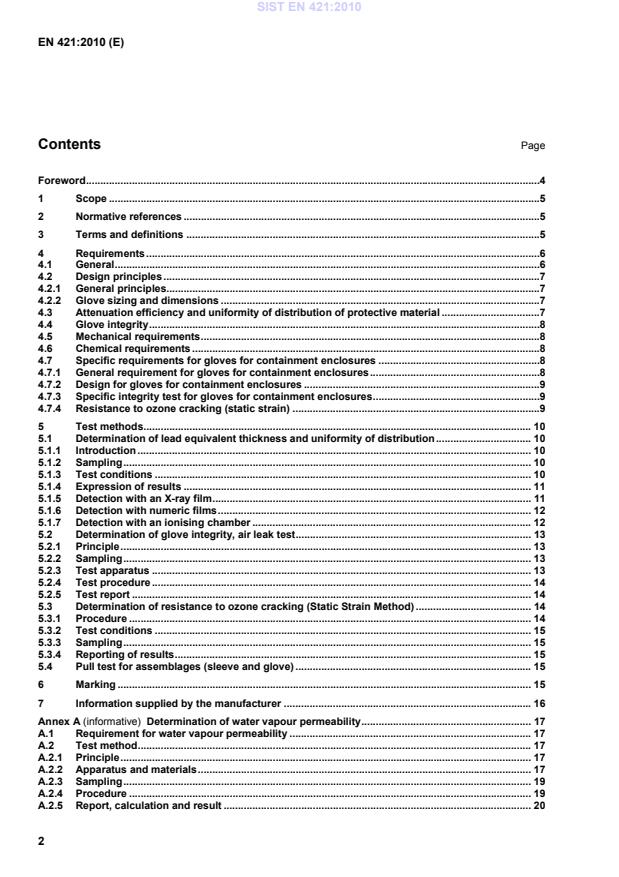
Determination of water vapour permeability . 17A.1 Requirement for water vapour permeability . 17A.2 Test method . 17A.2.1 Principle . 17A.2.2 Apparatus and materials . 17A.2.3 Sampling . 19A.2.4 Procedure . 19A.2.5 Report, calculation and result . 20SIST EN 421:2010
Warning . 21B.1 General . 21B.2 Special tests: Chemical resistance . 21B.3 Special tests: Radiation resistance . 21Annex C (informative)
Uncertainty of measurement and results interpretation . 23Annex D (informative)
Significant technical changes between this European Standard and the previous edition . 25Annex ZA (informative)
Relationship between this European Standard and the Essential Requirements of EU Directive 89/686/EEC . 26Bibliography . 27 Figures Figure 1 — Examples of glove integrity test apparatus for the air leak test . 14Figure 2 — Pictogram ISO 7000 – 2484
Protection against particulate radioactive contamination . 15Figure 3 — Pictogram ISO 7000 – 2809
Protection against ionizing radiation . 16Figure A.1 — Diagram of dishes and templates (water vapour permeability test) . 18Figure C.1 — Result pass . 23Figure C.2 — Result fail . 23Figure C.3 — Result fail . 24 SIST EN 421:2010
Gloves Gloves for containment enclosures Protection against radioactive contamination Protection against radioactive contamination and protection against ionizing radiation Protection against radioactive contamination Protection against radioactive contamination and protection against ionizing radiation Requirements 4.2.1 X X X X 4.2.2 X X
4.3
X
X 4.4 X X
4.5 X X X X 4.6 ‘ ‘ ‘ ‘ 4.7.2
X X 4.7.3
X X 4.7.4
‘‘‘‘ : optional requirement : mandatory if the gloves are used in an atmosphere containing ozone
4.2 Design principles 4.2.1 General principles The glove shall comply with the relevant requirements defined in EN 420, with the following specific additions. The glove may be constructed from a single or multiple material layers. The choice of material is defined by the end use requirements. In the case of protection against external ionizing radiation the glove may contain lead (PbO, Pb3O4) or other heavy metallic elements to act as attenuation medium in one or more of the layers. Metallic element distribution may be uniform or designed. 4.2.2 Glove sizing and dimensions Gloves shall be sized following prescriptions of EN 420:2003+A1:2009, 5.1. NOTE In case where specific use identified, special tests can be identified according to Annex B. 4.3 Attenuation efficiency and uniformity of distribution of protective material The lead equivalent thickness shall be measured by one of the methods described in 5.1. The test methods give equivalent results. The efficiency of the glove material to absorb radiation is quoted as lead equivalent thickness. The gloves shall have at least a lead equivalence thickness of 0,05 mm. SIST EN 421:2010
ISO 11933-2 shall be followed. Gloves used in containment enclosures are often used with under gloves. The user will have to take into account this parameter for the choice of an adapted size of equipment. NOTE ISO 11933-1 and ISO 11933-2 detail a list of characteristics of standardized gloves, glove ports, support rings, cell rings, etc. 4.7.2.3 Accessories used with gloves 4.7.2.3.1 Gloves equipped with a support ring In a few permanent containment enclosures, gloves can be equipped with a support ring. The support ring is considered as an integral part of the glove, and the whole equipment shall be tested according to the air leak test using a test bench equipped with a cell ring (see 4.7.3). 4.7.2.3.2 Sleeve Gloves mounted in permanent containment enclosures can be used with an intermediary sleeve, fixed between the glove and the containment enclosure. This sleeve is not considered as an integral part of the glove. It shall fulfill all requirements of this European Standard and shall be compatible with the glove used. The way of fixation between the glove and the sleeve and between the sleeve and the containment enclosure shall be detailed in the information supplied by the manufacturers. The sleeve shall be tested with one compatible glove as regards the integrity using the air leak test (see 4.7.3) Such an assemblage shall resist to a tensile strength test of 100 N according to 5.4. 4.7.3 Specific integrity test for gloves for containment enclosures The integrity of gloves used in containment enclosures shall be tested by the air leak test described in 5.2. The pressure shall not decrease by more than half the initial pressure. The initial pressure shall be mentioned in the instructions supplied by the manufacturer if it is different from 3 000 Pa. 4.7.4 Resistance to ozone cracking (static strain) When gloves can be exposed to ozone, the resistance to ozone cracking shall be determined. NOTE Powders emitting alpha particles can generate ozone containment enclosures. The performance level shall be determined by the method described in 5.3; at least level 1 of Table 2 shall be achieved. SIST EN 421:2010
...