

EN 13814-2:2019
(Main)Safety of amusement rides and amusement devices - Part 2: Operation, maintenance and use
General Information
- Abstract
This document specifies the minimum requirements necessary to ensure the safe maintenance, operation, inspection and testing of amusement ride and amusement devices which are intended to be installed both repeatedly without degradation or loss of integrity, and temporarily or permanently in fairgrounds and amusement parks or any other locations.
Grandstands, construction site installations, scaffolding, removable agricultural structures, simple coin operated children's amusement devices, carrying up to three children, and recreational devices like waterslides or summer toboggan runs, playground equipment, rope courses, climbing wall, inflatable, trampolines, swimming pool equipment (this list is not exhaustive) are not covered by this document.
In terms of workers’ health and safety, national regulations apply.
- Status
- Withdrawn
- Publication Date
- 28-May-2019
- Withdrawal Date
- 29-Sep-2026
- Technical Committee
- CEN/TC 152 - Fairground and amusement park machinery and structures - Safety
- Drafting Committee
- CEN/TC 152/WG 1 - Rides
- Current Stage
- 9960 - Withdrawal effective - Withdrawal
- Start Date
- 03-Dec-2024
- Completion Date
- 30-Sep-2026

Relations
- Effective Date
- 08-Jun-2022
- Effective Date
- 22-May-2024
- Effective Date
- 09-Feb-2026
- Effective Date
- 28-Jan-2026
- Effective Date
- 28-Jan-2026
- Effective Date
- 28-Jan-2026
- Effective Date
- 28-Jan-2026
- Effective Date
- 28-Jan-2026
- Effective Date
- 28-Jan-2026
- Effective Date
- 28-Jan-2026
- Refers
EN 13814-1:2019 - Safety of amusement rides and amusement devices - Part 1: Design and manufacture - Effective Date
- 28-Jan-2026
- Effective Date
- 28-Jan-2026
- Effective Date
- 28-Jan-2026
- Effective Date
- 28-Jan-2026
- Effective Date
- 28-Jan-2026
Get Certified
Connect with accredited certification bodies for this standard

DIBt (Deutsches Institut für Bautechnik)
German Institute for Building Technology.
DIN CERTCO
DIN Group product certification.

Aboma Certification B.V.
Specialized in construction, metal, and transport sectors.
Sponsored listings
Frequently Asked Questions
EN 13814-2:2019 is a standard published by the European Committee for Standardization (CEN). Its full title is "Safety of amusement rides and amusement devices - Part 2: Operation, maintenance and use". This standard covers: This document specifies the minimum requirements necessary to ensure the safe maintenance, operation, inspection and testing of amusement ride and amusement devices which are intended to be installed both repeatedly without degradation or loss of integrity, and temporarily or permanently in fairgrounds and amusement parks or any other locations. Grandstands, construction site installations, scaffolding, removable agricultural structures, simple coin operated children's amusement devices, carrying up to three children, and recreational devices like waterslides or summer toboggan runs, playground equipment, rope courses, climbing wall, inflatable, trampolines, swimming pool equipment (this list is not exhaustive) are not covered by this document. In terms of workers’ health and safety, national regulations apply.
This document specifies the minimum requirements necessary to ensure the safe maintenance, operation, inspection and testing of amusement ride and amusement devices which are intended to be installed both repeatedly without degradation or loss of integrity, and temporarily or permanently in fairgrounds and amusement parks or any other locations. Grandstands, construction site installations, scaffolding, removable agricultural structures, simple coin operated children's amusement devices, carrying up to three children, and recreational devices like waterslides or summer toboggan runs, playground equipment, rope courses, climbing wall, inflatable, trampolines, swimming pool equipment (this list is not exhaustive) are not covered by this document. In terms of workers’ health and safety, national regulations apply.
EN 13814-2:2019 is classified under the following ICS (International Classification for Standards) categories: 91.040.99 - Other buildings; 97.200.40 - Playgrounds; 97.200.99 - Other equipment for entertainment. The ICS classification helps identify the subject area and facilitates finding related standards.
EN 13814-2:2019 has the following relationships with other standards: It is inter standard links to EN 13814:2004, EN 13814-2:2019+A1:2024, EN IEC 60947-3:2021, EN 12385-3:2020, EN 12385-10:2003+A1:2008, EN 12385-1:2002+A1:2008, EN 12385-6:2004, EN 12385-9:2002, EN 12385-2:2002+A1:2008, EN ISO 9554:2019, EN 13814-1:2019, EN 13814-3:2019, EN 12385-4:2002+A1:2008, EN 12385-8:2002, EN ISO 13857:2019. Understanding these relationships helps ensure you are using the most current and applicable version of the standard.
EN 13814-2:2019 is available in PDF format for immediate download after purchase. The document can be added to your cart and obtained through the secure checkout process. Digital delivery ensures instant access to the complete standard document.
Standards Content (Sample)
SLOVENSKI STANDARD
01-september-2019
Nadomešča:
SIST EN 13814:2005
Varnost naprav in opreme v zabaviščnih parkih - 2. del: Delovanje, vzdrževanje in
uporaba
Safety of amusement rides and amusement devices - Part 2: Operation, maintenance
and use
Sicherheit von Fahrgeschäften und Vergnügungseinrichtungen - Teil 2: Betrieb,
Instandhaltung und Gebrauch
Sécurité des manèges et des dispositifs de divertissement - Partie 2: Installation,
maintenance et exploitation
Ta slovenski standard je istoveten z: EN 13814-2:2019
ICS:
97.200.40 Igrišča Playgrounds
2003-01.Slovenski inštitut za standardizacijo. Razmnoževanje celote ali delov tega standarda ni dovoljeno.
EN 13814-2
EUROPEAN STANDARD
NORME EUROPÉENNE
May 2019
EUROPÄISCHE NORM
ICS 97.200.40 Supersedes EN 13814:2004
English Version
Safety of amusement rides and amusement devices - Part
2: Operation, maintenance and use
Sécurité des manèges et des dispositifs de Sicherheit von Fahrgeschäften und
divertissement - Partie 2: Installation, maintenance et Vergnügungseinrichtungen - Teil 2: Betrieb,
exploitation Instandhaltung und Gebrauch
This European Standard was approved by CEN on 13 May 2018.
CEN members are bound to comply with the CEN/CENELEC Internal Regulations which stipulate the conditions for giving this
European Standard the status of a national standard without any alteration. Up-to-date lists and bibliographical references
concerning such national standards may be obtained on application to the CEN-CENELEC Management Centre or to any CEN
member.
This European Standard exists in three official versions (English, French, German). A version in any other language made by
translation under the responsibility of a CEN member into its own language and notified to the CEN-CENELEC Management
Centre has the same status as the official versions.
CEN members are the national standards bodies of Austria, Belgium, Bulgaria, Croatia, Cyprus, Czech Republic, Denmark, Estonia,
Finland, Former Yugoslav Republic of Macedonia, France, Germany, Greece, Hungary, Iceland, Ireland, Italy, Latvia, Lithuania,
Luxembourg, Malta, Netherlands, Norway, Poland, Portugal, Romania, Serbia, Slovakia, Slovenia, Spain, Sweden, Switzerland,
Turkey and United Kingdom.
EUROPEAN COMMITTEE FOR STANDARDIZATION
COMITÉ EUROPÉEN DE NORMALISATION
EUROPÄISCHES KOMITEE FÜR NORMUNG
CEN-CENELEC Management Centre: Rue de la Science 23, B-1040 Brussels
© 2019 CEN All rights of exploitation in any form and by any means reserved Ref. No. EN 13814-2:2019 E
worldwide for CEN national Members.
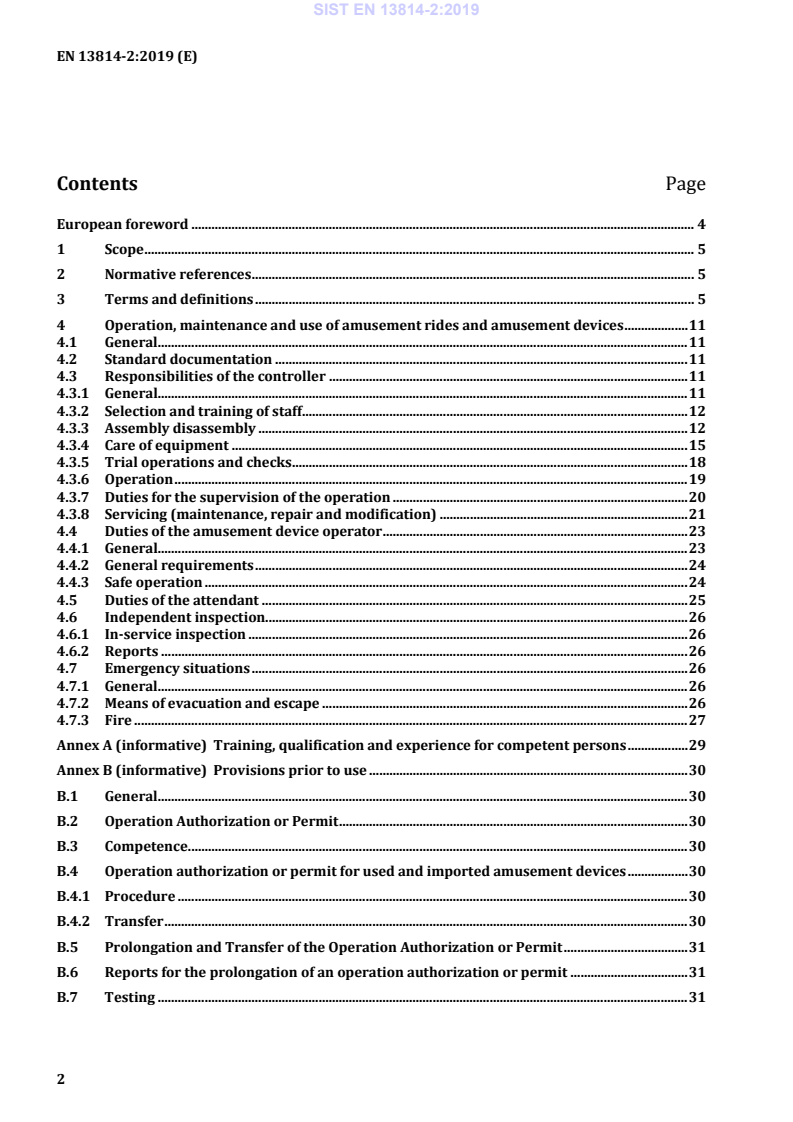
Contents Page
European foreword . 4
1 Scope . 5
2 Normative references . 5
3 Terms and definitions . 5
4 Operation, maintenance and use of amusement rides and amusement devices . 11
4.1 General. 11
4.2 Standard documentation . 11
4.3 Responsibilities of the controller . 11
4.3.1 General. 11
4.3.2 Selection and training of staff . 12
4.3.3 Assembly disassembly . 12
4.3.4 Care of equipment . 15
4.3.5 Trial operations and checks . 18
4.3.6 Operation . 19
4.3.7 Duties for the supervision of the operation . 20
4.3.8 Servicing (maintenance, repair and modification) . 21
4.4 Duties of the amusement device operator . 23
4.4.1 General. 23
4.4.2 General requirements . 24
4.4.3 Safe operation . 24
4.5 Duties of the attendant . 25
4.6 Independent inspection. 26
4.6.1 In-service inspection . 26
4.6.2 Reports . 26
4.7 Emergency situations . 26
4.7.1 General. 26
4.7.2 Means of evacuation and escape . 26
4.7.3 Fire . 27
Annex A (informative) Training, qualification and experience for competent persons . 29
Annex B (informative) Provisions prior to use . 30
B.1 General. 30
B.2 Operation Authorization or Permit . 30
B.3 Competence . 30
B.4 Operation authorization or permit for used and imported amusement devices . 30
B.4.1 Procedure . 30
B.4.2 Transfer . 30
B.5 Prolongation and Transfer of the Operation Authorization or Permit . 31
B.6 Reports for the prolongation of an operation authorization or permit . 31
B.7 Testing . 31
B.8 Inspection bodies. 32
B.9 Installation Examination . 32
B.10 Examples of examination intervals used by member states' regulations . 32
B.10.1 General . 32
B.10.2 Germany . 32
B.10.3 United Kingdom . 36
B.10.4 Netherlands . 36
B.10.5 Italy . 36
Bibliography . 37
European foreword
This document (EN 13814-2:2019) has been prepared by Technical Committee
CEN/TC 152 “Fairground and amusement park machinery and structures – Safety”, the secretariat of
which is held by UNI.
This European Standard shall be given the status of a national standard, either by publication of an
identical text or by endorsement, at the latest by November 2019, and conflicting national standards
shall be withdrawn at the latest by May 2022.
Attention is drawn to the possibility that some of the elements of this document may be the subject of
patent rights. CEN shall not be held responsible for identifying any or all such patent rights.
This document, together with its first and third parts, supersedes EN 13814:2004.
EN 13814 consists of the following parts, under the general title Safety of amusement rides and
amusement devices:
— Part 1: Design and manufacture
— Part 2: Operation, maintenance and use
— Part 3: Requirements for inspection during design, manufacture, operation and use
According to the CEN-CENELEC Internal Regulations, the national standards organisations of the
following countries are bound to implement this European Standard: Austria, Belgium, Bulgaria,
Croatia, Cyprus, Czech Republic, Denmark, Estonia, Finland, Former Yugoslav Republic of Macedonia,
France, Germany, Greece, Hungary, Iceland, Ireland, Italy, Latvia, Lithuania, Luxembourg, Malta,
Netherlands, Norway, Poland, Portugal, Romania, Serbia, Slovakia, Slovenia, Spain, Sweden, Switzerland,
Turkey and the United Kingdom.
1 Scope
This document specifies the minimum requirements necessary to ensure the safe maintenance,
operation, inspection and testing of amusement ride and amusement devices which are intended to be
installed both repeatedly without degradation or loss of integrity, and temporarily or permanently in
fairgrounds and amusement parks or any other locations.
Grandstands, construction site installations, scaffolding, removable agricultural structures, simple coin
operated children's amusement devices, carrying up to three children, and recreational devices like
waterslides or summer toboggan runs, playground equipment, rope courses, climbing wall, inflatable,
trampolines, swimming pool equipment (this list is not exhaustive) are not covered by this document.
In terms of workers’ health and safety, national regulations apply.
2 Normative references
The following documents are referred to in the text in such a way that some or all of their content
constitutes requirements of this document. For dated references, only the edition cited applies. For
undated references, the latest edition of the referenced document (including any amendments) applies.
EN 12385 (all parts), Steel wire ropes — Safety
EN 13814-1:2019, Safety of amusement rides and amusement devices — Part 1: Design and Manufacture
EN 13814-3:2019, Safety of amusement rides and amusement devices — Part 3: Requirements for
inspection during design, manufacture, operation and use
EN 60947-3, Low-voltage switchgear and controlgear - Part 3: Switches, disconnectors, switch-
disconnectors and fuse-combination units (IEC 60947-3)
EN ISO 2307, Fibre ropes - Determination of certain physical and mechanical properties (ISO 2307)
EN ISO 9554, Fibre ropes - General specifications (ISO 9554)
EN ISO 13857, Safety of machinery - Safety distances to prevent hazard zones being reached by upper and
lower limbs (ISO 13857)
3 Terms and definitions
For the purposes of this document, the following terms and definitions apply.
ISO and IEC maintain terminological databases for use in standardization at the following addresses:
• IEC Electropedia: available at http://www.electropedia.org/
• ISO Online browsing platform: available at http://www.iso.org/obp
3.1
amusement device
arrangement of equipment that produces the desired effect of amusement or entertainment when the
passenger (3.28) moves through it or on it primarily by his or her own action, or any other system that
is not covered by the term amusement ride (3.2)
3.2
amusement ride
equipment that is designed to entertain the passengers (3.28) during motion including the consequence
of biomechanical effect
Note 1 to entry: In this standard, the word amusement device is used to refer to an amusement device (3.1) or
amusement ride (3.2).
3.3
attendant
trained person appointed to work under the supervision of an operator (3.27), to assist in the operation
of an amusement device (3.1) available for use by the public
3.4
barrier
device intended to prevent the user from falling and from passing beneath
3.5
closed restraint
closed restraint position in which the restraint (3.37) is intended to remain during the operation of the
device in order to restrain the passenger (3.28)
3.6
competent person
person who can demonstrate that he has acquired through training, qualifications or experience, or a
combination of these, the knowledge and skills enabling that person to perform a specified task
3.7
controller
ride controller
person or organisation having overall control of an amusement device (3.1). This may be either an
individual or corporate body owning an amusement device (3.1) or the concessionaire or lessee who has
been granted control of the amusement device, by the owner, for a specified period
3.8
design review
document detailing the review of all the applicable design documents, to determine the suitability for
use of an amusement device
3.9
design risk assessment
DRA
document, produced by the designer (3.10) as a tool for safe design, within the agreed scope of supply
3.10
designer
engineer
person or body that is responsible for the design of an amusement device (or modifications thereof),
including, but not limited to establishing and describing the configuration of the amusement device,
conducting appropriate risk assessment(s), establishing strength (including fatigue strength), designing
and specifying electrical/electronic control systems, defining the acceptable quality level for
production, defining inspection criteria and including the publication of the necessary documentation
3.11
amusement device log
book and/or electronic data file containing all the necessary information about the use and history of
any amusement device
3.12
fail safe
characteristic of a system, component or device the failure of which maintains a safe state
3.13
fence
structure designed to restrict or prevent movement across a boundary without changing elevation
3.14
gate
section of fence (3.13) or barrier (3.4) that may be opened to provide access or egress
3.15
guardrail
rail intended to prevent a user from falling
3.16
guest
person that may interact with an amusement device
3.17
handrail
rail intended to assist the user to balance
3.18
initial approval
design and calculation review, verification, examinations and tests executed by the inspection
body (3.19) before a ride is first made available for public use
3.19
inspection body
organisation capable of carrying out examination, tests and approval of amusement devices
3.20
latching restraint
restraint (3.37) which is held secure against opening except by intentional action of the
passenger (3.28), operator (3.27), or other means. This can include restraints (3.37) (e.g. drop bars) held
in place by gravity, detents or other means
3.21
licensing body
national authority or body legally authorised to issue a permit for operation of an amusement device
and related documents
3.22
locking restraint
restraint (3.37) which is held secure against opening except by intentional action of the operator (3.27)
or other means not accessible by the passenger (3.28)
3.23
machinery component
component which form part of an assembly in which at least one component moves (excluding
vibration and deformation)
3.24
major modification
safety-related alteration to the hardware or software of an amusement device (3.1), including the
introduction of a new safety-related component (3.41) or the substitution of a safety-related
component (3.41), which results in a deviation from the current design specification
3.25
manufacturer
individual or commercial entity who is responsible for designing and manufacturing a product with the
view to placing it on the market under their own name
Note 1 to entry: Any commercial entity that either places a product on the market under their own name or
trademark or modifies a product in such a way that compliance with applicable requirements maybe affected
should be considered to be the manufacturer and should assume the obligations of the manufacturer.
3.26
operation and use risk assessment
OURA
document, produced by the controller (3.7), that details all of the considered risks inherent during all
modes of an amusement device operation and the means taken to mitigate against them
Note 1 to entry: This term is explained in details in EN 13814-1:2019, 5.1.2.2.
3.27
operator
trained person appointed by the controller (3.7) to be in charge of the operation of an amusement
device (3.1) when it is intended to be available for the public
3.28
passenger
patron
person using an amusement device
3.29
passenger containment
components (e.g. seating, footwells, handrails (3.17) and passenger restraints) designed to prevent
passengers (3.28) from moving outside a predetermined area on a ride either as a result of the ride
forces or the behaviour of the passenger (3.28)
3.30
passenger reach envelope
physical space where a passenger (3.28) can reach during a ride cycle while properly positioned, as
defined by the ride analysis, in the amusement ride (3.2) or amusement device (3.1) and limited only by
the vehicle, seat geometry, and restraint system
3.31
passenger unit
PU
part or parts of an amusement ride (3.2) in or on which the passenger (3.28) is intended to ride
3.32
permit
authorisation to operate an amusement device in a particular member state granted by the legally
authorised body after successful approval and/or examination
3.33
platform
horizontal or inclined surface raised above the level of an adjacent area
Note 1 to entry: See EN 13814-1:2019, 5.1.3.2 for maximum slope of platform.
3.34
reasonably foreseeable misuse
use of a machine in a way not intended by the designer (3.10), but which can result from readily
predictable human behaviour
Note 1 to entry: EN 13814-1:2019, Annex F (Guest Behaviour) gives a non-exhaustive list of human behaviours.
[SOURCE: EN ISO 12100:2010, 3.24, modified — Note 1 to entry has been added.]
3.35
redundancy
application of more than one device or system, or part of a device or system, with the objective of
ensuring that in the event of one failing to perform its function another will perform that function
3.36
repair
restoration of components or assemblies to an acceptable condition
3.37
restraint
system, device, or characteristic that is intended to inhibit or restrict the body movement and/or keep
the body position to tolerate accelerations of the passenger(s) (3.28) while on the amusement ride (3.2)
or amusement device (3.1)
3.38
safe stop
stop of an amusement ride (3.2) in a safe way and in a final safe stable position
3.39
safety envelope
theoretical or actual physical space that may be encroached by any part of a passenger (3.28) of an
amusement ride during the ride cycle
Note 1 to entry: This is the passenger reach envelope (3.30) plus a suitable margin as defined
in EN 13814-1:2019, Annex H.
3.40
safety-related control system
SRCS
assembly of components that may be electronic, electric, electro-mechanical, hydraulic, pneumatic or
mechanical combined to monitor and control an amusement device so as to reduce risks to guests (3.16)
3.41
safety-related part or component
part or component of an amusement device (3.1) on which the safety of the passengers (3.28) is
dependent as identified in the design risk assessment (3.9) and/or the operation and use risk
assessment (3.26)
3.42
service
replacement or replenishment and check on the condition of components, including fluids which are
designated to be replaced or replenished at specified intervals
3.43
sideshow
booth or similar enclosed structure containing, shows, activities or games for the entertainment of the
public, where the guest (3.16) is not carried in any way by the structure
3.44
spectator
person in the vicinity of an amusement device (3.1). Typically defined as a person watching the
operation of the amusement device or waiting to gain access to the use the amusement device
3.45
structural component
calculated load bearing part which has not been classified as machinery components (3.23) by the
designer (3.10)
3.46
sustained acceleration
accelerations with duration greater than or equal to 200 ms
3.47
temporarily installed amusement device
amusement device which is designed to be installed and uninstalled, the installation period of which
shall not exceed more than 3 months
3.48
thorough examination
procedures and investigations necessary for the inspection body (3.19) to decide whether the
amusement device (3.1) can continue to be operated safely, or whether it requires defects to be
remedied immediately or within a specified time
3.49
trial run
proving run of an amusement device (3.1) during which no passengers (3.28) are carried
4 Operation, maintenance and use of amusement rides and amusement devices
4.1 General
This standard is concerned with installing, assembling and disassembling, operating, handling,
maintaining, repairing, modifying and inspecting amusement devices and is addressed to controllers,
operators, attendants and inspection bodies.
4.2 Standard documentation
The documents, which shall be prepared for all amusement devices, are:
— operating manual (see EN 13814-1:2019, 5.5.1.3) to include at least the following:
— maintenance instructions;
— NDT schedule;
— operating instruction;
— inspection instruction;
— amusement device log (see EN 13814-1:2019, 5.7 and Annex E);
— official technical dossier (see EN 13814-1:2019, 5.8) including DRA and OURA results for safe
operation.
4.3 Responsibilities of the controller
4.3.1 General
The controller or nominated delegate(s) shall:
— ensure that the required documentation accompanies the amusement device when being bought,
sold or otherwise transferred or supplied;
— select and train operators and attendants;
— assemble, and disassemble safely;
— ensure safe operation in full compliance with all laws, prescriptions and regulations issued by local
and national authorities;
— service, maintain, repair and modify safely;
— where required, ensure that only amusement devices which have a valid operational permit and are
examined and tested by appropriately independent inspection bodies, are operated;
— maintain, keep available and update as required the Operating Manual and Amusement Device Log,
as well as creating necessary reports;
— ensure that where operators do not have a clear view of all loading or unloading points, devise a
clear system of signals for checking with attendants that it is safe to start. Make sure every person
using the system is instructed how to use it and display a copy of the signal code in appropriate
positions;
— ensure that emergency procedures are established, well documented and regularly practiced;
— provide full instructions on the control or communications system.
The ride controller can delegate any part of his duties, but remains responsible in law.
4.3.2 Selection and training of staff
Obtaining suitable and competent staff involves selection, training, testing of knowledge and
understanding, monitoring, auditing and keeping records. The controller shall select people able to put
the safety of the public first, to follow procedures conscientiously and having the maturity and authority
to give confidence to the public.
Adequate training shall be provided to all employees and training records kept. Training shall be
appropriate to the risks and given in a way that those being trained can understand.
The operator and attendants of amusement devices shall demonstrate competency in the operation of
amusement devices according to the manual(s).
No operators or attendants of the amusement device shall be younger than required by national
standards or law in the country of use.
Operators and attendants depending on their duties, shall be provided with suitable and sufficient
information and training in the working of their amusement devices, covering:
— systems of work for safe operation, including speed limits and any other specific safety measures;
— procedures for reporting breakdown, defects or unusual occurrences;
— loading and unloading procedures;
— passenger restrictions such as height and weight limits, medical conditions, limited accessibility
(guest behaviour);
— control of waiting and viewing areas;
— use and operation of passenger containment and passenger restraint systems including the
checking of restraint closure;
— controlled/emergency stop procedures;
— emergency procedures, including passenger evacuation.
4.3.3 Assembly disassembly
4.3.3.1 Siting of amusement devices
4.3.3.1.1 General
Amusement devices shall be sited and assembled in accordance with manufacturer’s instruction and
applicable national requirements.
4.3.3.1.2 Standard conditions for the siting of amusement rides and amusement devices
The ride controller or his representative shall ensure that an amusement device is only sited on ground
which is suitable for this purpose in accordance with the manual(s). For example ensure that the
ground:
— can safely bear the load of the amusement device. For existing structures e.g. buildings or piers, a
detailed inspection and calculation shall be carried out in order to establish permissible loads;
— is sufficiently flat, even and stable for the attraction to be assembled and used on safely, in
accordance with the amusement device log and manual.
The ground shall be checked at regular intervals after assembly, to confirm that there is no
deterioration in its load bearing capacity, especially during adverse weather conditions. Drainage shall
be considered.
The controller shall establish the position of underground services or overhead lines which may
present hazards during the assembly or operation of the amusement device, taking advice as necessary
from the appropriate authority. Where these could be a source of danger to persons employed or to
members of the public, all reasonably practicable precautions shall be taken to prevent such danger,
either by the provision of adequate and suitably placed barriers or otherwise.
Care shall be taken to ensure that underground services are not struck when poles or pegs are placed in
the ground or when excavation is undertaken. Service location techniques shall be employed before any
such work is commenced, unless it has been confirmed beforehand that there are no services present.
When positioning amusement devices, controllers shall apply the following principles.
a) The proximity to other fixed or mobile structures or services shall be in accordance with the
requirements of EN 13814-1:2019.
b) There shall be sufficient clearance between adjacent amusement devices, buildings or other
occupied areas to minimize the risk of fire spread.
c) Consideration shall be given to any possibility of uplift caused by wind.
d) They shall be arranged so that the public have safe access to each amusement device entrance, and
safe egress at exit points, so that there are no bottle necks which could cause overcrowding in an
emergency.
e) Sufficient clearance shall be provided between amusement devices on main access routes, so as to
provide access for emergency service vehicles, and provide access to fixed fire hydrants even when
the public may be being evacuated.
f) Where rides cross over or pass through each other, as a minimum the clearance envelopes for each
ride (see EN 13814-1:2019) shall apply. The controllers shall ensure that safety envelopes for both
passengers and spectators are not compromised. For coin-operated children's rides, spacing may
vary providing the safety envelopes are not thereby compromised.
g) The OURA will need to consider whether protection is required to prevent falling objects hitting
passengers or spectators.
NOTE There can be local regulations that define the minimum distance between amusement devices and
other structures, objects, services etc.
4.3.3.2 Transportation, assembly and disassembly
When amusement devices are transported, assembled or disassembled on site they shall be under the
direct supervision of the controller and/or competent delegate(s).
4.3.3.3 Ground packing, stability and anchors
4.3.3.3.1 General
All necessary measures shall be taken during assembly to ensure that the amusement device will be
stable when in use.
No amusement device shall be assembled on sloping or uneven ground, unless suitable packing has
been incorporated which allows the amusement device to be used safely.
The amusement device shall be level where necessary and have its load adequately distributed and
firmly supported. Its stability shall be checked frequently.
The number of packing pieces used shall be kept to a minimum. The height of the packing material shall
be kept to a minimum and the packing itself shall be stable.
All packing materials incorporated shall be sound and suitable for the purpose, chosen and located in
accordance with the manual(s), so as to prevent slipping and sinking, or dislodgement.
Packing shall be placed directly beneath the load points of the amusement device. If this cannot be
achieved a suitable supporting structure shall be formed which effectively transmits the load of the
amusement device safely through the packing to the ground. Dynamic loads can lead to the loosening of
packing and anchorage; consequently, repeated checks of the packing and anchors are essential.
If an attraction is equipped with props to support the structure, these props shall be used in accordance
with the manufacturer’s instructions.
Hydraulic jacks shall not be used to support an amusement device during operation, unless they are
designed and approved for the purpose.
4.3.3.3.2 Public safety
Members of the public shall not be admitted into areas where an amusement device is being assembled
or disassembled.
The controller and/or competent delegate(s) shall, where necessary, provide means to prevent
members of the public entering work areas e.g. with fences and/or warnings.
4.3.3.3.3 Working method
A safe system of work, which as a minimum takes into account the manufacturer’s manual(s) shall be
followed during these operations. Controllers shall make themselves familiar with, and follow the
official requirements of local and national authorities.
Amusement devices shall be moved so as to minimize the risk of damage to safety-related components
and all loads shall be properly secured during transit.
Where there is a risk of temporary instability or overstressing in the device during assembly or
dismantling, the precautions specified by the designer, manufacturer, and/or supplier, shall be
followed. This may require e.g. the use of temporary guys, stays, supports and fixings to prevent danger
through collapse of any part of the amusement device
Temporary provisions for access and working during assembly and disassembly operations shall be
safe, including sufficient and suitable lighting to allow work to be conducted in a safe and proper
manner.
Unauthorized access shall be prevented through openings in platforms and through any gaps within the
amusement device, which are only intended for access when the amusement device is not in motion or
use. Such openings or gaps shall be provided with covers, be securely fixed in position or equipped with
barriers and access doors, which are securely fastened.
Before reassembly, all components as specified in the manual(s) shall be cleaned, carefully examined
for signs of wear, deformation or other damage, confirming fitness for purpose or otherwise repaired or
replaced.
They shall be properly lubricated in accordance with the manual(s). Replacements and repairs of
safety-related components shall be noted in the Amusement Device Log.
Fastening and securing components shall be used in accordance with manufacturer's instructions and
correctly adjusted, or replaced if necessary.
Upon completion of assembly, all components that are important to the safety of the amusement device,
shall be checked to ensure that they have been properly installed in accordance with the manufacturer’s
manual(s).
All structural members needed to ensure the stability and safety of an amusement device shall be used
and correctly fitted. Where it is a design requirement, the whole assembly shall be securely anchored to
ensure that it is stable.
Where rail tracks form part of the amusement device, they shall be properly laid and aligned, according
to the manual(s).
4.3.4 Care of equipment
4.3.4.1 General
All equipment shall be maintained in accordance with manufacturer’s manual(s) and / or general
engineering practices.
4.3.4.2 Mechanical equipment
At the intervals as stated in the manual(s), safety-related components shall be checked to ensure that
they are within the limits stated in the manual. Parts requiring replacement shall be consistent with the
design specification.
Controllers shall have procedures to ensure that safety-related components are:
— individually identifiable by design and quality;
— traceable as per the location(s) on the amusement device;
— not interchangeable such that parts cannot be used in incorrect positions – for example, two pins
may look identical but have different material properties;
— stored so as to prevent deterioration and contamination;
— cleaned and lubricated as required by the manual before being incorporated into the amusement
device;
— carefully assembled so that they are not damaged, in particular:
1) assembled using fastenings and fixings correctly used and adjusted, in accordance with the
manual(s);
2) all pins shall be provided with their secondary retention system (such as safety locknuts and
washers, split pins or castellated nuts with split pins, etc.) as defined in the manual(s). Split-
pins shall be spread effectively;
3) “R” clips shall be of the right size, in good condition, of the right material and fitted correctly;
4) self-locking nuts shall not be used more than the maximum number of times specified in the
manual(s);
5) close attention shall also be paid to bolted joints by using tightening torques, dimensions and
classes of bolt in accordance with the requirements of the manual(s); torque wrenches shall be
used as required;
6) components having a specified operational life shall be checked to verify their operational life
is not expired, checked in accordance with manual(s) and replaced when necessary.
If there is repeated, unexpected or unusual damage to safety-related components, the manufacturer or
designer and the inspection body shall be informed and advice of these parties sought.
When lifting equipment is used for the assembly of components, the manufacturer's instructions shall
be followed so as not to adopt unsuitable lifting methods which might cause damage and subsequent
danger during operation.
Steel wire ropes for erection and dismantling shall be used in accordance with EN 12385 series.
Synthetic fibre ropes for erection and dismantling shall be used in accordance with EN ISO 2307
and/or EN ISO 9554.
NOTE Lifting equipment, whether integral to the amusement device or not, and depending on their function,
can be subject to specific local regulations, including inspection and testing.
4.3.4.3 Hydraulic and pneumatic equipment
The Controller shall ensure that pressure systems are operating within the limits set in the manual(s) as
supplied by the manufacturer.
The pressure system shall also be examined in accordance with the written scheme of inspection.
Leakage shall be kept to a minimum, contained where possible, and not create risks. For further
information refer to EN ISO 4413 and EN ISO 4414.
Equipment subject to compliance to the Pressure Equipment Directive or other nationally applicable
legislation should meet those requirements. Compliance with EN 13445 series can be used to
demonstrate compliance with the Pressure Equipment Directive.
4.3.4.4 Electrical equipment
4.3.4.4.1 Isolation and access
All electrical cabinets or enclosures shall be properly locked to prevent unauthorised access.
Amusement devices shall be provided with means to disconnect (isolate) the supply to all live
conductors and shall have a means permitting it to be locked in the off (isolated) position
(e.g. by padlocks). Suitable means of disconnection are listed in EN 60204-1.
When used for achieving isolation, the disconnecting device shall have a means permitting it to be
locked in the off (isolated) position (e.g. by padlocks).
Devices used for isolation shall have a visible gap or a position indicator that conforms
with EN 60947-3.
4.3.4.4.2 Inspection
See EN 13814-3:2019, 4.3.3.
4.3.4.4.3 Operating control equipment
All operating controls shall be:
— clearly visible to the operator;
— easily distinguishable from each other;
— readily accessible to the operator;
— easy to operate;
— clearly marked to show the function and mode of operation. All markings shall be permanent and
readable. Written markings shall be in a suitable language(s).
The operators working position shall:
— be safe (and have safe access);
— be designed with ergonomic considerations;
— have adequate lighting;
— give, where possible, an unobstructed view of all areas of operation. If it is not the case, other
means of surveillance shall be implemented (e.g. mirrors, surveillance cameras);
— take into account environmental aspects (e.g. temperature, vibration and noise).
The design shall take account of any need for the operator and operators to communicate, between
themselves and where necessary with the public e.g.:
— visibly;
— by phone/ intercom;
— public address;
— through the ride control system (such as 2-button operating systems).
4.3.4.4.4 Control equipment operated by passengers
Controls equipment intended to be operated by passengers shall:
— be clearly marked, in a language agreed with the controller, to show their functions;
— be accessible to all passengers within the designated size limits;
— not present a risk to passengers through their positioning or use;
— not be foreseeably capable of causing injury to passengers either directly (e.g. by trapping hands or
fingers, electric shock, etc) or by causing any controlled device to malfunction or operate
inappropriately;
— only be operable by passengers when it is safe for them to do so;
— never override an operator selected control input where it would be unsafe to do so;
— be able to be muted or over-ridden by the operator if necessary.
Controls equipment located in public areas and accessible to the general public should be tamper-proof
where necessary to prevent misuse.
The OURA shall take into account the risks related to anticipated failure of controls equipment or
misuse as well as the possibility of operator error shall not cause significant risk from such events.
Where an amusement device has remote areas or areas obscured from the view of the operator, means
of observing and communicating with passengers, as required by risk assessment, shall be provided at
the control station.
NOTE Assisted views can be provided by means such as the use of closed-circuit television, mirrors or
additional operators.
4.3.5 Trial operations and checks
4.3.5.1 Putting into use after assembly
After assembly the Controller, shall ensure that the amusement device is checked by a competent
person to ensure the assembly is in accordance with the manufacturer’s manual(s).
A similar check routine shall be carried out where an amusement device has been idle for a long period
or after it has been partially dismantled and re-erected.
The controller shall perform one or more trial runs without any member of the public according to the
manufacturer’s manual(s), simulating where possible emergency situations to verify particularly that
control systems, emergency stops, safety equipment and emergency equipment work properly.
The Controller shall retain a record of the checks carried out in the amusement device Log.
Devices
...