

EN 17740:2023
(Main)Requirements for professional profiles related to personal data processing and protection
- Abstract
The standard defines the requirements related to the professional activity of subjects active in the processing and protection of
personal data, namely the intellectual profession that is pursued at different levels of complexity and in different organizational
contexts, both public and private.
These requirements are specified, starting from the specific tasks and activities identified, in terms of knowledge, skills and
competence, in accordance with the European Qualifications Framework - EQF and are expressed in such a way as to facilitate and
contribute to harmonize, as far as possible, evaluation and validation processes of learning outcomes.
- Status
- Published
- Publication Date
- 24-Oct-2023
- Technical Committee
- CEN/CLC/TC 13 - Cybersecurity and Data Protection
- Drafting Committee
- CEN/CLC/JTC 13/WG 5 - Data Protection, Privacy and Identity Management
- Current Stage
- 6060 - Definitive text made available (DAV) - Publishing
- Start Date
- 25-Oct-2023
- Due Date
- 05-Aug-2022
- Completion Date
- 25-Oct-2023

Overview
EN 17740:2023 - "Requirements for professional profiles related to personal data processing and protection" (CEN) defines a harmonized framework of tasks, knowledge, skills and competences for professionals working in personal data processing and protection. The standard maps profile requirements to the European Qualifications Framework (EQF) and the e-Competence Framework (e-CF) to support consistent evaluation, validation and recognition of learning outcomes across public and private organizations.
Key topics and requirements
- Professional profiles covered: roles such as Data Protection Officer (DPO), Data Protection Manager, Data Protection Specialist, Data Protection Engineer and Data Protection Auditor (profiles described by mission, deliverables and main tasks).
- Knowledge, skills & competence: requirements specified per profile using EQF/e-CF levels; includes technical, legal and organisational aspects relevant to personal data processing and protection.
- Tasks and activities: clear task descriptions and specific activities that underpin competence definitions.
- Assessment & validation: guidance on assessment methods, KPI application areas and elements to support evaluation and validation of learning outcomes.
- Access & continuing professional development: Annex B defines profile access requirements; the standard also addresses requirements for permanent professional update.
- Supporting material: Annex A provides an index of skills and knowledge; normative references include EN 16234‑1 (e-CF), EN ISO/IEC 27000 and EN ISO/IEC 29100.
Practical applications
- Recruitment & job design: use EN 17740 to write role descriptions and hiring criteria for DPOs, data protection managers, engineers and auditors.
- Training & certification: training providers and certification bodies can map curricula and assessment schemes to the standard’s competence descriptors and EQF levels.
- Organisational data protection: HR and compliance teams can align internal data protection functions and KPIs with standardized deliverables and tasks.
- Accreditation & validation: bodies assessing professional qualifications can use the standard to harmonize validation of formal, non‑formal and informal learning.
- Cross‑border consistency: facilitates interoperability and mutual recognition of skills across EU and CEN/CENELEC member states.
Who should use it
- Data Protection Officers, privacy managers, data protection specialists and engineers
- HR, hiring managers and organizational designers
- Training providers, certification and accreditation bodies
- Compliance, legal and IT security teams implementing GDPR-related programs
Related standards
- EN 16234‑1 (e‑Competence Framework)
- EN ISO/IEC 27000 (Information security management vocabulary)
- EN ISO/IEC 29100 (Privacy framework)
Keywords: EN 17740, data protection professional profiles, Data Protection Officer, GDPR, EQF, e-CF, privacy training, data protection certification, personal data processing.
Relations
- Effective Date
- 28-Jan-2026
Get Certified
Connect with accredited certification bodies for this standard

BSI Group
BSI (British Standards Institution) is the business standards company that helps organizations make excellence a habit.

Bureau Veritas
Bureau Veritas is a world leader in laboratory testing, inspection and certification services.

DNV
DNV is an independent assurance and risk management provider.
Sponsored listings
Frequently Asked Questions
EN 17740:2023 is a standard published by the European Committee for Standardization (CEN). Its full title is "Requirements for professional profiles related to personal data processing and protection". This standard covers: The standard defines the requirements related to the professional activity of subjects active in the processing and protection of personal data, namely the intellectual profession that is pursued at different levels of complexity and in different organizational contexts, both public and private. These requirements are specified, starting from the specific tasks and activities identified, in terms of knowledge, skills and competence, in accordance with the European Qualifications Framework - EQF and are expressed in such a way as to facilitate and contribute to harmonize, as far as possible, evaluation and validation processes of learning outcomes.
The standard defines the requirements related to the professional activity of subjects active in the processing and protection of personal data, namely the intellectual profession that is pursued at different levels of complexity and in different organizational contexts, both public and private. These requirements are specified, starting from the specific tasks and activities identified, in terms of knowledge, skills and competence, in accordance with the European Qualifications Framework - EQF and are expressed in such a way as to facilitate and contribute to harmonize, as far as possible, evaluation and validation processes of learning outcomes.
EN 17740:2023 is classified under the following ICS (International Classification for Standards) categories: 03.100.30 - Management of human resources; 35.030 - IT Security. The ICS classification helps identify the subject area and facilitates finding related standards.
EN 17740:2023 has the following relationships with other standards: It is inter standard links to EN 16234-1:2019. Understanding these relationships helps ensure you are using the most current and applicable version of the standard.
EN 17740:2023 is available in PDF format for immediate download after purchase. The document can be added to your cart and obtained through the secure checkout process. Digital delivery ensures instant access to the complete standard document.
Standards Content (Sample)
SLOVENSKI STANDARD
01-april-2024
Zahteve za poklicne profile pri obdelavi in varovanju osebnih podatkov
Requirements for professional profiles related to personal data processing and protection
Anforderungen an Berufsprofile im Zusammenhang mit der Verarbeitung und dem
Schutz personenbezogener Daten
Exigences relatives aux profils de professionnels en lien avec le traitement et la
protection de données à caractère personnel
Ta slovenski standard je istoveten z: EN 17740:2023
ICS:
03.100.30 Vodenje ljudi Management of human
resources
35.030 Informacijska varnost IT Security
2003-01.Slovenski inštitut za standardizacijo. Razmnoževanje celote ali delov tega standarda ni dovoljeno.
EUROPEAN STANDARD EN 17740
NORME EUROPÉENNE
EUROPÄISCHE NORM
October 2023
ICS 03.100.30; 35.030
English version
Requirements for professional profiles related to personal
data processing and protection
Exigences relatives aux profils de professionnels en Anforderungen an Berufsprofile im Zusammenhang
lien avec le traitement et la protection de données à mit der Verarbeitung und dem Schutz
caractère personnel personenbezogener Daten
This European Standard was approved by CEN on 4 September 2023.
CEN and CENELEC members are bound to comply with the CEN/CENELEC Internal Regulations which stipulate the conditions for
giving this European Standard the status of a national standard without any alteration. Up-to-date lists and bibliographical
references concerning such national standards may be obtained on application to the CEN-CENELEC Management Centre or to
any CEN and CENELEC member.
This European Standard exists in three official versions (English, French, German). A version in any other language made by
translation under the responsibility of a CEN and CENELEC member into its own language and notified to the CEN-CENELEC
Management Centre has the same status as the official versions.
CEN and CENELEC members are the national standards bodies and national electrotechnical committees of Austria, Belgium,
Bulgaria, Croatia, Cyprus, Czech Republic, Denmark, Estonia, Finland, France, Germany, Greece, Hungary, Iceland, Ireland, Italy,
Latvia, Lithuania, Luxembourg, Malta, Netherlands, Norway, Poland, Portugal, Republic of North Macedonia, Romania, Serbia,
Slovakia, Slovenia, Spain, Sweden, Switzerland, Türkiye and United Kingdom.
CEN-CENELEC Management Centre:
Rue de la Science 23, B-1040 Brussels
© 2023 CEN/CENELEC All rights of exploitation in any form and by any means
Ref. No. EN 17740:2023 E
reserved worldwide for CEN national Members and for
CENELEC Members.
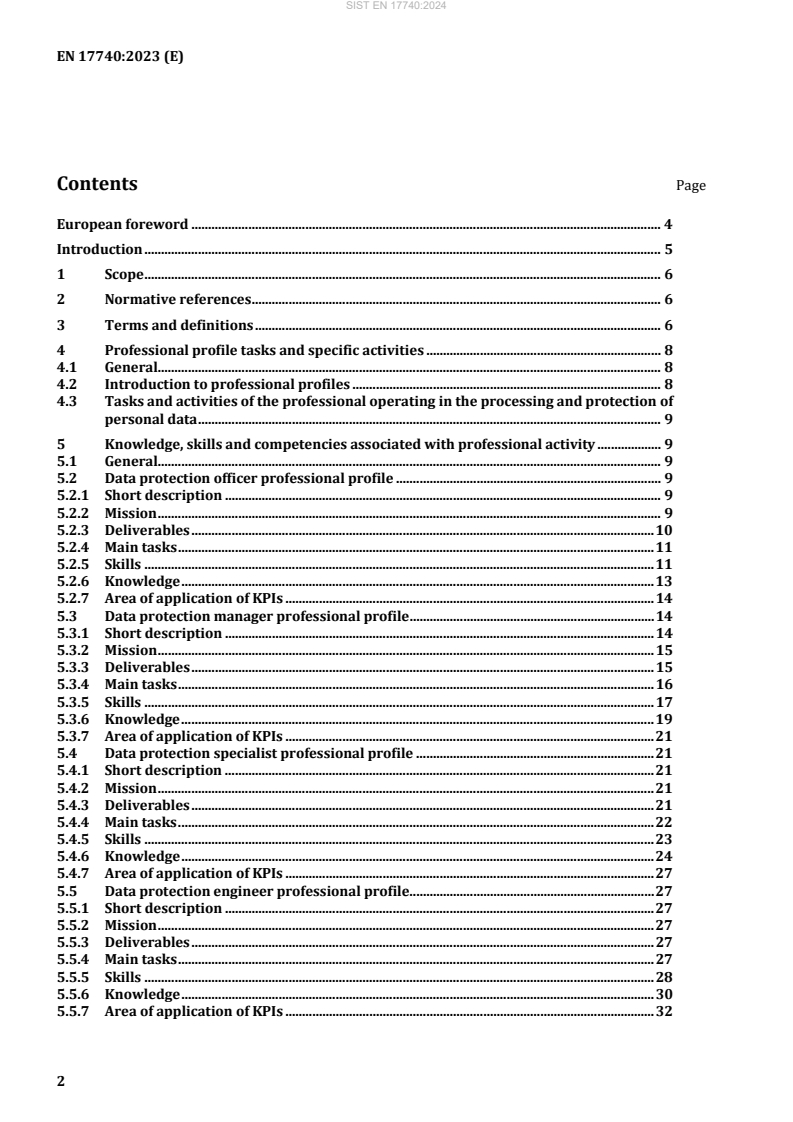
Contents Page
European foreword . 4
Introduction . 5
1 Scope . 6
2 Normative references . 6
3 Terms and definitions . 6
4 Professional profile tasks and specific activities . 8
4.1 General. 8
4.2 Introduction to professional profiles . 8
4.3 Tasks and activities of the professional operating in the processing and protection of
personal data . 9
5 Knowledge, skills and competencies associated with professional activity . 9
5.1 General. 9
5.2 Data protection officer professional profile . 9
5.2.1 Short description . 9
5.2.2 Mission . 9
5.2.3 Deliverables . 10
5.2.4 Main tasks . 11
5.2.5 Skills . 11
5.2.6 Knowledge . 13
5.2.7 Area of application of KPIs . 14
5.3 Data protection manager professional profile . 14
5.3.1 Short description . 14
5.3.2 Mission . 15
5.3.3 Deliverables . 15
5.3.4 Main tasks . 16
5.3.5 Skills . 17
5.3.6 Knowledge . 19
5.3.7 Area of application of KPIs . 21
5.4 Data protection specialist professional profile . 21
5.4.1 Short description . 21
5.4.2 Mission . 21
5.4.3 Deliverables . 21
5.4.4 Main tasks . 22
5.4.5 Skills . 23
5.4.6 Knowledge . 24
5.4.7 Area of application of KPIs . 27
5.5 Data protection engineer professional profile. 27
5.5.1 Short description . 27
5.5.2 Mission . 27
5.5.3 Deliverables . 27
5.5.4 Main tasks . 27
5.5.5 Skills . 28
5.5.6 Knowledge . 30
5.5.7 Area of application of KPIs . 32
5.6 Data protection auditor professional profile . 32
5.6.1 Short description . 32
5.6.2 Mission. 32
5.6.3 Deliverables . 32
5.6.4 Main tasks . 33
5.6.5 Skills . 33
5.6.6 Knowledge . 34
5.6.7 Area of application of KPIs . 36
6 Elements for the evaluation and validation of learning outcomes . 36
6.1 General . 36
6.2 Assessment methods of knowledge and specific experiences of the professional
operating in the field of processing and protection of personal data . 36
6.3 Evaluation and validation of results . 37
6.4 Qualification . 37
6.5 Requirements for permanent professional update . 37
Annex A (informative) Index of skills and knowledge . 38
Annex B (normative) Requirements for professional profiles access . 51
Bibliography . 53
FprEN 17740:2023 (E)
European foreword
This document (EN 17740:2023) has been prepared by Technical Committee CEN/CLC/JTC 13
“Cybersecurity and Data protection”, the secretariat of which is held by DIN.
This European Standard shall be given the status of a national standard, either by publication of an
identical text or by endorsement, at the latest by April 2024, and conflicting national standards shall be
withdrawn at the latest by April 2024.
Attention is drawn to the possibility that some of the elements of this document may be the subject of
patent rights. CEN shall not be held responsible for identifying any or all such patent rights.
Any feedback and questions on this document should be directed to the users’ national standards body.
A complete listing of these bodies can be found on the CEN website.
According to the CEN-CENELEC Internal Regulations, the national standards organisations of the
following countries are bound to implement this European Standard: Austria, Belgium, Bulgaria, Croatia,
Cyprus, Czech Republic, Denmark, Estonia, Finland, France, Germany, Greece, Hungary, Iceland, Ireland,
Italy, Latvia, Lithuania, Luxembourg, Malta, Netherlands, Norway, Poland, Portugal, Republic of North
Macedonia, Romania, Serbia, Slovakia, Slovenia, Spain, Sweden, Switzerland, Türkiye and the United
Kingdom.
Introduction
The definition of requirements for professional profiles in the field of processing and protection of
personal data are necessary to establish the fundamental set of knowledges, skills and competences that
distinguish such profiles.
The standard applies to the professional profiles in the identified area, regardless of the working methods
and type of employment relationship. Tasks and activities related to the profession are described on the
basis of all functions actually performed by professionals working in the field of processing and
protection of personal data in different work contexts. These functions are varied and concern technical,
administrative, cultural, scientific and legal aspects.
This document adopts the reference European framework for the definition of competences and related
skills: EN 16234-1. For related ICT-oriented profiles, such as for example the system administrator,
please refer to CEN CWA 16458-1.
The profiles specified in this document are not intended to be exhaustive and are applicable regardless
of the work placement of the subjects operating in the sector.
The main intended audience of this document comprises professionals seeking guidance regarding their
professional development, enterprises defining their internal data protection organization and related
hiring requirements, bodies providing personnel training, accreditation and certification services.
Methodological approach
Within the development of this document the principles and indications set out in Recommendation 2008
/ C111 / 01 (European Qualification Framework - EQF) and Recommendation 2009 / C 155/02
(European Credit System for Vocational Education and Training - ECVET) were first considered.
From a methodological point of view, it was established in particular that:
• the basic terms and definitions (Clause 3) adopted are, for the most part, derived from the EQF, ECVET
and the relevant terminology commonly used in the European Community;
• the specific terms and definitions of the subject “protection of personal data” are consistent with those
set out in EU 2016/679 Regulation;
• for the description of the requirements of knowledge, skills and competence of a specific professional
profile, it is necessary to start from a preliminary identification of the tasks and specific activities of
the professional profile (Clause 4);
• the requirements of the specific professional profile are specified in terms of knowledge, skills and
competence (Clause 5) and the personal ability expected have also been identified, as far as
applicable. An indication of the levels associated with the specific professional activity, using the e-
CF levels which are directly mapped to the ones within the European Qualifications Framework
(EQF), is also provided;
• the useful elements regarding the applicable assessment methods are specified (Clause 7). These
elements have been developed taking into due consideration what already consolidated within
voluntary technical standardization, also with reference to the normative corpus concerning the
conformity assessment (EN ISO/IEC 17000 series);
• in Annex A (informative) skills and knowledges applicable to the development of the profiles are listed;
• in Annex B (normative) requirements for access to professional profiles are specified.
Furthermore, as far as relevant, the guidelines specified in the CEN Guide 14 were also followed.
FprEN 17740:2023 (E)
1 Scope
This document specifies the requirements related to the professional activity of persons active in the
processing and protection of personal data, namely the intellectual profession that is pursued at different
levels of complexity and in different organizational contexts, both public and private.
These requirements are specified, starting from the specific tasks and activities identified, in terms of
knowledge, skills and competence, in accordance with the European Qualifications Framework - EQF and
are expressed in such a way as to facilitate and contribute to harmonize, as far as possible, evaluation and
validation processes of learning outcomes.
2 Normative references
The following documents are referred to in the text in such a way that some or all of their content
constitutes requirements of this document. For dated references, only the edition cited applies. For
undated references, the latest edition of the referenced document (including any amendments) applies.
EN 16234-1, e-Competence Framework (e-CF) - A common European Framework for ICT Professionals in
all sectors - Part 1: Framework
EN ISO/IEC 27000, Information technology - Security techniques - Information security management
systems - Overview and vocabulary
EN ISO/IEC 29100, Information technology – Security techniques – Privacy framework
CEN CWA 16458-3, European ICT Professional Role Profiles – Part 3: Methodology documentation
3 Terms and definitions
For the purposes of this document, the terms and definitions given in EN 16234-1, EN ISO/IEC 27000,
EN ISO/IEC 29100 and the following apply.
ISO and IEC maintain terminological databases for use in standardization at the following addresses:
• IEC Electropedia: available at https://www.electropedia.org/
• ISO Online browsing platform: available at https://www.iso.org/obp
3.1
formal learning
learning process deriving from training activities, intentional and structured, carried out by entities /
institutions of education and training recognized by a competent authority
Note 1 to entry: Formal learning can involve the issues of certificate with legal value .
3.2
informal learning
learning process deriving from work experiences, from family life and also from leisure time
Note 1 to entry: Informal learning is not a deliberately structured activity and sometimes learning is not intentional.
3.3
non-formal learning
learning process resulting from training activities, intentional and structured, implemented in any field
other than formal
Note 1 to entry: Such a training does not issue a certificate with legal value.
3.4
audit
systematic, independent and documented process for obtaining audit evidence (records, statements of
facts or other relevant and verifiable information) and evaluating them objectively, in order to establish
to what extent the audit criteria (policies, procedures or requirements used as a reference) have been
met
3.5
validation of learning outcomes
process confirming that certain assessed learning outcomes, obtained by a learner, correspond to the
results required for a specified qualification or part of it
Note 1 to entry: Certification in accordance with EN ISO/IEC 17024 is an evaluation and validation process.
Note 2 to entry: The recognition of learning outcomes, according to defined rules, by subjects or other organizations
in charge, is also a process of evaluation and validation.
3.6
Privacy Impact Assessment
PIA
overall process of identifying, analysing, evaluating, consulting, communicating and planning the
treatment of potential privacy impacts with regard to the processing of personally identifiable
information, framed within an organization’s broader risk management framework
[SOURCE: ISO/IEC 29134:2017, 3.7]
3.7
Privacy Level Agreement
PLA
level of protection of personal data ensured by a supplier in the provision of services to its customers,
conceptually similar to an SLA
3.8
qualification
formal result of an assessment and validation process, obtained when a competent and impartial
organization states that the learning outcomes of an individual are compliant with technical standards
Note 1 to entry: Definition adapted from the EQF, Annex I, definition a).
3.9
Service Level Agreement
SLA
Document that defines the technical support or business performance objectives, including measures for
performance and consequences for failure the provider of a service can provide its clients
[SOURCE: ISO/IEC 27039 :2015, 2.27]
FprEN 17740:2023 (E)
3.10
evaluation of learning outcomes
Methods and processes used to define the extent to which a person has effectively achieved one specific
knowledge, skill or competence
4 Professional profile tasks and specific activities
4.1 General
The professional operating in the processing and protection of personal data performs a wide range of
activities, frequently transversal to other business processes, both with respect to the life cycle of the
processing - from design to cessation - and with respect to the examined topics, technological,
organizational, legal or otherwise.
The professional working in the field of processing and protection of personal data thus contributes to
the management or the verification of a more or less extensive set of processes and information systems
involved in the processing of personal data, on behalf of natural or legal persons, such as entities,
institutions, associations, public or private. Legal entities of different sizes may decide either to collapse
related professional profiles into one (e.g. data protection manager and data protection specialist or a
data protection auditor with another auditor) or to have several instances of the same profile within
different responsibility areas, such as geographical or organizational ones. In all cases the separation
between control-related profiles like auditor and data protection officer and the other ones should be
preserved.
At the time of publication of this document, the maintenance, updating and development of the skills
necessary for the professional activity of the subjects, operating in the processing and protection of
personal data, are not subject to a detailed training path herewith specified. The professional is however
required to follow autonomous or guided paths of continuous professional updating, consistent with the
provisions of paragraph 6.4 and Annex B.
If professionals have already followed previous training courses, not aligned with the indications of this
document, it shall be necessary to carry out an analytical comparison between the path already followed
by the candidate for certification and the path illustrated in this document, assuming the related
responsibilities.
4.2 Introduction to professional profiles
A series of considerations of an introductory nature and preliminary to the description of the main
professional profiles, referred to in Clause 6 of this document, is listed below in order to facilitate their
understanding.
Data protection officer
It is a profile corresponding to the professional profile described in EU Regulation 2016/679, art. 39. It is
possible to assign to the profile different tasks and other tasks included in other managerial level profiles,
if no conflict of interest is present.
Data protection manager
It is a profile corresponding to professionals with a very high level of knowledge, skills and competences
in a specific organizational context (both a functional area of the organization and a specific sector), to
ensure the adoption of appropriate organizational measures in the processing of personal data.
Data protection specialist
It is a profile corresponding to professionals able to support the Data protection officer and / or the Data
protection manager in developing the appropriate technical and organizational measures for the
processing of personal data.
Data protection engineer
It is a profile corresponding to professionals who are designing and building systems that process
personal data, who have a specialist knowledge of, and responsibility for, related data protection issues.
They can work alongside other software and systems engineers and related technical disciplines, as well
as with other data protection-devoted profiles in an organization both developing and operating those
systems.
Data protection auditor
It is a profile corresponding to independent professionals with knowledge and skills in the IT /
technology sector and legal / organizational activities, able to carry out processing and protection of
personal data, which can still make use of data protection specialists in both areas to carry out audit
assignments.
4.3 Tasks and activities of the professional operating in the processing and protection of
personal data
The profile of the professional operating in the field of processing and protection of personal data
includes a series of fundamental tasks which, without pretending exhaustiveness, are described in the
following Clause 5 (see item “Main tasks”).
A professional operating in the processing and protection of personal data are intended as a person who
has a profile that complies with the aforementioned tasks, and performs, or has the necessary
preparation, to achieve the “Expected Results”.
5 Knowledge, skills and competencies associated with professional activity
5.1 General
Each professional profile in this chapter is structured with a short description synthesizing it, the pursued
mission, the deliverables of which they are accountable, responsible or contributor, the specific
performed main tasks, competences defined according to EN 16234-1 and CWA 16458-3 are identified
within the “Competences e-CF” table with related skills and knowledge and the KPIs measuring their
performance.
5.2 Data protection officer professional profile
5.2.1 Short description
Advises controllers or processors for the application of EU Regulation 2016/679 or other applicable data
protection legislation.
5.2.2 Mission
Advises controllers or processors with respect to the risks of data processing activities to ensure
compliance with EU Regulation 2016/679 and other local data protection provisions.
FprEN 17740:2023 (E)
5.2.3 Deliverables
This profile is accountable for the following deliverables:
• Regular risk-based reports on compliance with laws regarding personal data protection.
• Documentation in support of the request for consultation addressed to data protection authorities,
according to the development of data protection impact assessment .
• Requests for consultation with data protection authorities on specific application issues.
• Documentation supporting the interface with the data protection authorities (requests for
information, assessment procedures or testing etc.).
• Documentation (including forms) supporting the interface with the interested parties.
• Indicators on the protection of personal data.
• Advice with respect to inquiries regarding data protection law and its application.
This profile is responsible for the following deliverables:
• Opinions on data protection impact assessments pursuant to Regulation 2016/679.
This profile is a contributor for the following deliverables:
• Attribution of responsibilities in the processing and protection of personal data.
• Budget for the protection of personal data.
• Policy for the protection of personal data.
• Data protection notices.
• Requirements for the processing and protection of personal data.
• Operating procedures for processing and protection of personal data.
• Development of a Data protection impact assessment.
• Evaluation of the risk related to information security.
• Risk management plan related to information security.
• Codes of conduct.
• Answers to data subject exercising their rights.
• Audit program for the protection and processing of personal data.
• Training program, professional development and awareness.
Please note that all professional profiles herewith described are not related to legal responsibilities, but only to
operating responsibilities.
• Notification of incidents that result in a violation of personal data (to data protection authorities).
5.2.4 Main tasks
The main tasks associated to this profile are:
• inform and provide advice to controllers or processors, as well as to employees involved in
processing of personal data, about the obligations arising from this Regulation as well as from other
Union or Member State data protection provisions;
• monitor compliance with the Regulation, other Union or Member State or other provisions on data
protection and the policies of the controller or data controller, regarding the protection of personal
data, including the assignment of responsibilities, the awareness and training of personnel involved
in the processing and related control activities;
• provide, if requested, an opinion on the impact assessment on data protection and monitor its
performance;
• cooperate with the supervisory authority;
• act as a contact point for the supervisory authority for matters related to processing.
The following Table 1 shows the assigned competencies and required levels according to the e-CF
provided in EN 16234-1.
Table 1 — assigned competencies and required levels according to the e-CF provided in
EN 16234-1
e-CF competence Level
D.8. Contract Management 3
D.9. Personnel Development 3
E.3. Risk management 4
E.4. Relationship Management 4
E.8. Information Security Management 3
5.2.5 Skills
Skills associated to this profile are:
• Analyse personal data processing and evaluate their compliance to applicable legal requirements
• Verify the application of data protection by design and protection by default
• Verify the appropriate application of data protection principles
• Identify roles, responsibilities and legal basis for the processing of personal data
• Contribute to the strategy for the processing and protection of personal data
• Contribute to provision of correct information to data subjects
• Manage the application of codes of conduct and certification applicable to the processing and
protection of personal data
FprEN 17740:2023 (E)
• Ability to communicate
• Analytical skills
• Self management and stress control
• Self-development capacity
• Control capacity
• Persuasion capacity
• Conflict management capacity
• Initiative
• Eligibility for negotiation
• Organization skills
• Perspective thinking
• Planning and scheduling
• Constructive attitude in solving problems
• Tenacity
• S1 - address CPD needs of staff to meet organisational requirements
• S5 - analyse the company critical assets and identify weaknesses and vulnerability to intrusion or
attack
• S19 - anticipate required changes to the organization’s information security strategy and formulate
new plans
• S21 - apply mitigation and contingency actions
• S23 - apply relevant standards, best practices and legal requirements for information security
• S40 – coach
• S45 - compose, document and catalogue essential processes and procedures
• S52 - communicate and promote the organization’s risk analysis outcomes and risk management
processes
• S55 - communicate good and bad news to avoid surprises
• S66 - establish a risk management plan to feed and produce preventative action plans
• S91 - ensure that IPR and privacy issues are respected
• S111 - identify competence and skill gaps
• S140 - negotiate contract terms and conditions
• S153 - prepare templates for shared publications
• S156 - design and document the processes for risk analysis and management
• S167 - gather internal and external knowledge and information needs
• S171 - make information available
• S172 - address professional development needs of staff to meet organisational requirements
• S176 – observe and deploy effective use of corporate standards for publications
• S187 - develop risk management plan to identify required preventative actions
5.2.6 Knowledge
Knowledge associated to this task is related to:
• The principles of data protection including data protection by design and by default
• The rights of the interested parties provided for by current laws and regulations
• Responsibilities related to the processing of personal data
• Local and European laws on the processing and protection of personal data
• Legal developments related to local and European judicial decisions.
• Legislation on the transfer of personal data abroad and circulation of personal data outside the EU /
EEA
• Data protection impact assessment methodologies
• Possible threats to the protection of personal data
• ISO/IEC technical standards applicable to the management of personal data
• The codes of conduct and the certifications applicable in the matter of processing and protection of
personal data
• Communication techniques and tools (relationship with institutions, authorities, law enforcement
agencies, local authorities and press)
• Cryptographic techniques
• Anonymization techniques
• Pseudonymisation techniques
• Monitoring and reporting systems and techniques
• Tools for production, editing and distribution of professional documents
FprEN 17740:2023 (E)
• K49 - competence development methods
• K60 - organization processes including, decision making, budgets and management structure
• K67 - the critical risks for information security management
• K71 - the typical KPI (key performance indicators)
• K83 - the potential and opportunities of relevant standards and best practices
• K85 - the return on investment compared to risk avoidance
• K98 - the impact of legal requirements on information security
• K108 - the computer forensics
• K115 - the organization’s security management policy and its implications for engagement with
customers, suppliers and subcontractors
• K122 - the information strategy of the organization
• K130 - good practices (methodologies) and standards in risk analysis
• K132 - the best practices and standards in information security management
• K139 - competence and skill needs analysis methodologies
• K149 - legal regulations applicable to ICT contracts
• K152 - new emerging technologies (e.g. distributed systems, virtualisation models, data sets, mobile
systems)
• K158 - possible security threats
• K161 - challenges related to the size of data sets (e.g. big data)
• K162 - challenges related to unstructured data (e.g. data analytics)
• K180 - cyber attack techniques and counter measures for avoidance
5.2.7 Area of application of KPIs
Application of the EU Regulation 2016/679
5.3 Data protection manager professional profile
5.3.1 Short description
Is responsible for and coordinates the processing of personal data.
The definition is different from the “processor” definition, used in the GDPR (EU 2016/679)
5.3.2 Mission
Coordinates all subjects involved in the processing of personal data, in order to ensure compliance with
the applicable laws and the achievement and maintenance of the appropriate level of protection, on the
basis of the specific processing of personal data carried out.
5.3.3 Deliverables
This profile is accountable for the following deliverables:
• Operating procedures for processing and protection of personal data.
• Reports on the overall status of personal data protection (i.e. review).
• Indicators on the protection of personal data.
This profile is responsible for the following deliverables:
• Budget for the protection of personal data.
• Attribution of responsibilities for processing and protection of personal data.
• Data protection impact assessment.
• Policy for the protection of personal data.
• Requirements for the processing and protection of personal data.
• Technical and organizational measures to ensure data protection by default.
• Preventive consultations.
• Notification of incidents that result in a violation of personal data (to data subjects).
• Data protection notices.
• Answers to data subject exercising their rights.
• Records of processing activities.
• Training, updating and awareness program.
This profile is contributor for the following deliverables:
• Evaluation of the risk related to information security
• Risk processing plan relating to information security.
• Codes of conduct.
• Audit program for the protection and processing of personal data.
Please note that all professional profiles herewith described are not related to legal responsibilities, but only to
operating responsibilities.
Such evaluation are intended to be carried out by information security professionals
FprEN 17740:2023 (E)
5.3.4 Main tasks
The main tasks associated to this profile are:
• Assist the controller in following up the requests to exercise the rights of the interested parties.
• Assist the controller in arranging the cancellation or return of personal data at the end of the
processing.
• Keep the controller updated on the status of the processing and protection of personal data.
• Manage the budget for the protection of personal data.
• Continuously monitor the overall level of personal data protection.
• Organize and assign responsibilities related to the processing and protection of personal data.
• Approve the policies and procedures for the processing and protection of personal data.
• Assist the controller in the approval process of the measures to be taken to manage risks related to
the protection of personal data.
• Participate in risk assessment activities related to information security.
• Work to ensure compliance with the requirements regarding the processing and protection of
personal data also in project activities.
• Communicate, if appropriate, violations of personal data to data subjects.
• Manage records of processing activities.
• Define and evaluate SLAs and PLAs to be ensured by third parties, involved in the processing of
personal data.
• Integrate activities for compliance with the processing of personal data with activities related to
other types of compliance where possible.
• Manage contracts with relevance to data protection (especially joint controller agreements and
processing agreements).
The following Table 2 shows the assigned competencies and required levels according to the e-CF
provided in EN 16234-1
Table 2 — assigned competencies and required levels according to the e-CF provided in
EN 16234-1
e-CF competence Level
A.4. Product or Service Planning 3
A.5. Architecture Design 4
D.8. Contract Management 3
E.3. Risk management 4
E.8. Information Security Management 3
5.3.5 Skills
Skills associated to this profile are:
• Contribute to the strategy for the processing and protection of personal data
• Manage the application of the codes of conduct and the applicable certifications concerning the
processing and protection of personal data
• Identify roles, responsibilities and legal basis for the processing of personal data
• Contribute to provision of correct information to data subjects
• Ability to communicate
• Analytical skills
• Self management and stress control
• Self-development capacity
• Control capacity
• Persuasion capacity
• Capacity for coordination and management of collaborators
• Decision-making skills
• Flexibility
• Conflict management capacity
• Group management capacity
• Initiative
• Eligibility for negotiation
• Organization skills
• Results orientation
• Perspective thinking
• Planning and scheduling
• Constructive attitude in solving problems
• Tenacity
• S1 - address CPD needs of staff to meet organisational requirements
• S5 - analyse the company critical assets and identify weaknesses and vulnerability to intrusion or
attack
FprEN 17740:2023 (E)
• S6 - analyse future developments in business process and technology application
• S14 - analyse feasibility in terms of costs and benefits
• S21 - apply mitigation and contingency actions
• S23 - apply relevant standards, best practices and legal requirements for information security
• S40 - coach
• S42 - collect, formalize and validate functional and no-functional requirements
• S46 - understand the impact of new technologies on business (e.g. open / big data, dematerialisation
opportunities and strategies)
• S45 - compose, document and catalogue essential processes and procedures
• S47 - understand the business objectives / drivers that impact the architecture component (data,
application, security, development etc)
• S48 - understand the legal and regulatory landscape in order to factor into business requirements
• S49 - understand the enterprise architecture
• S51 - clearly communicate with end users and provide instructions on how to progress issues
• S52 - communicate and promote the organization’s risk analysis outcomes and risk management
processes
• S53 - communicate the value, risks and opportunities derived from the IS strategy
• S55 - communicate good and bad news to avoid surprises
• S60 - contribute to the development of the business strategy
• S61 - contribute to the development of ICT strategy and policy, including ICT security and quality
• S66 - establish a risk management plan to feed and produce preventative action plans
• S71 - define and implement appropriate KPI’s
• S91 - ensure that IPR and privacy issues are respected
• S140 - negotiate contract terms and conditions
• S153 - prepare templates for shared publications
• S156 - design and document the processes for risk analysis and management
• S165 - propose effective contingency measures
• S167 - gather internal and external knowledge and information needs
• S171 - make information available
• S176 - observe and deploy effective use of corporate standards for publications
• S178 - select appropriate ICT solutions based upon benefit, risks and overall impact
• S181 - establish the recovery plan
• S182 - establish systematic and frequent communication with customers, users and stakeholders
• S186
...